
Reports
The Global Isoparaffin Solvents Market was valued at USD 930.5 Million in 2025 and is anticipated to reach a value of USD 1,254.0 Million by 2033 expanding at a CAGR of 3.8% between 2026 and 2033. Growth is being driven by low-aromatic solvent substitution, tighter VOC management, demand for high-purity grades, and expanding use in coatings, printing inks, metalworking fluids, cosmetics, and industrial cleaners.
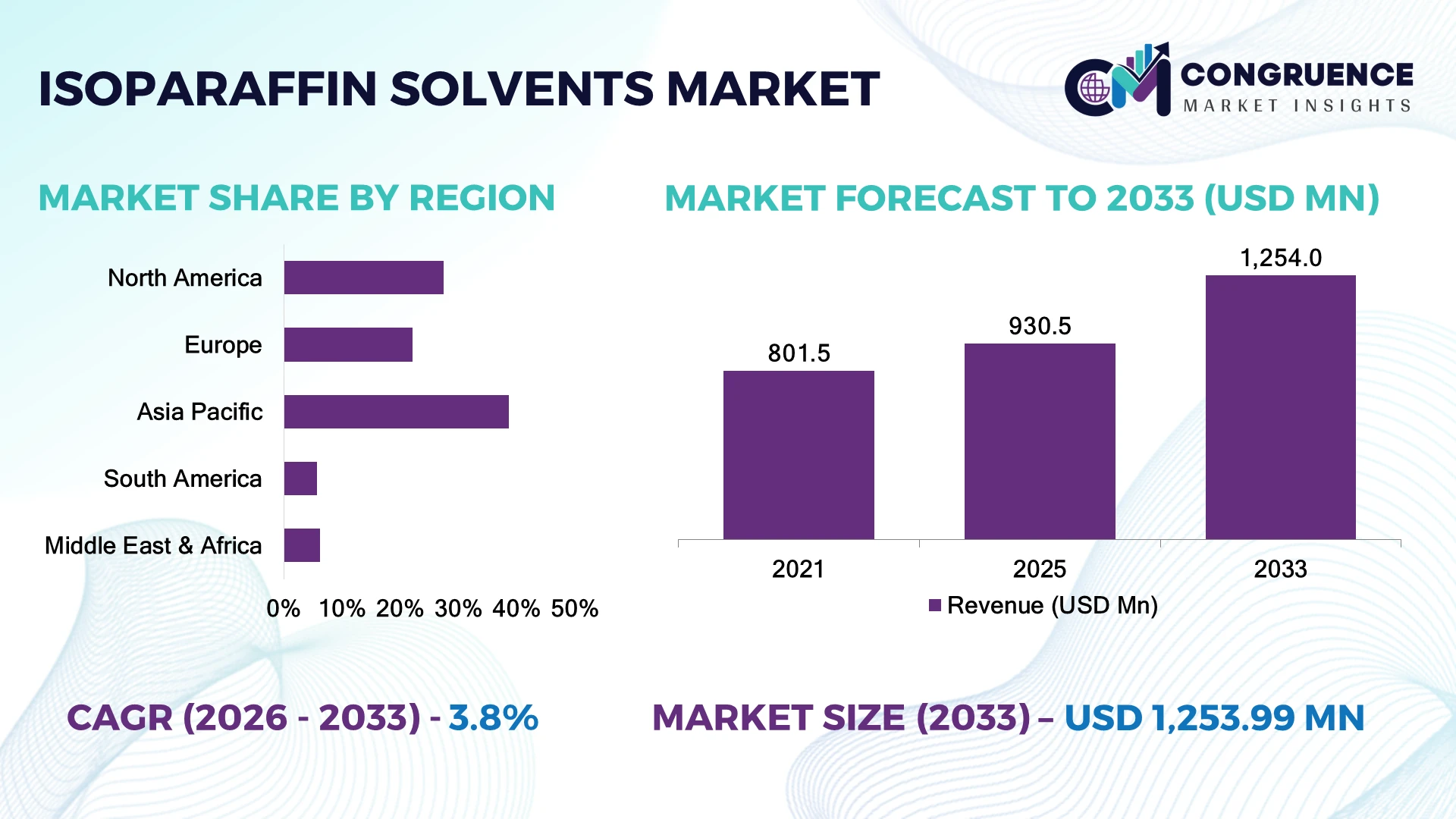
The United States remains a leading consumption and production market, representing approximately 27–30% of global isoparaffin solvent demand, supported by coatings, personal care, industrial cleaning, and specialty chemical manufacturing. Gulf refining investments strengthen feedstock availability, while China commands a larger manufacturing base and increasingly supplies Asia-Pacific formulators. U.S. high-purity grades show roughly 15–20% greater penetration in specialty formulations than conventional industrial grades. Red Sea shipping disruptions and broader Middle East supply-chain restructuring are reinforcing the value of geographically diversified solvent sourcing.
Strategically, suppliers with reliable hydrocarbon feedstock access, narrow boiling-range grades, and regional distribution networks are best positioned to protect margins and capture specialty-solvent substitution demand.
Market Size & Growth: USD 930.5 million in 2025 to USD 1,254.0 million by 2033 at 3.8% CAGR, driven by low-aromatic solvent substitution.
Top Growth Drivers: Coatings demand 29%, industrial cleaning 22%, and cosmetics/personal care 18% represent key demand drivers.
Short-Term Forecast: By 2028, optimized solvent formulations can reduce VOC-related processing losses by 8–12% while improving formulation consistency.
Emerging Technologies: Narrow-boiling isoparaffins, high-purity grades, low-aromatic formulations, and bio-attributed feedstock integration are gaining commercial attention.
Regional Leaders: Asia-Pacific is positioned near USD 390 million by 2033, North America around USD 310 million, and Europe approximately USD 290 million, with specialty-grade adoption strengthening.
Consumer/End-User Trends: Specialty coatings and personal-care formulations increasingly prioritize low-odor solvents, with premium low-aromatic grades capturing roughly 30–35% of specialty applications.
Pilot/Case Example: 2026 reformulation programs using narrow-boiling isoparaffins demonstrate approximately 10–15% improvement in evaporation-control consistency compared with broader hydrocarbon solvent blends.
Competitive Landscape: Major suppliers including ExxonMobil, Shell, Chevron Phillips Chemical, TotalEnergies, and Idemitsu compete across refined hydrocarbon quality, grade breadth, logistics, and formulation support.
Regulatory & ESG Impact: VOC-control requirements are accelerating substitution toward lower-aromatic solvent systems, with selected formulations achieving 10–20% lower VOC-related emissions.
Investment & Funding: Refining and specialty-solvent investments exceeding USD 1 billion across major hydrocarbon-producing regions are strengthening feedstock flexibility and regional supply security.
Innovation & Future Outlook: Next-generation solvent portfolios are shifting toward tighter boiling ranges, lower aromatic content, higher purity, renewable feedstock integration, and application-specific formulation engineering.
The Isoparaffin Solvents Market is concentrated in coatings, printing inks, adhesives, metalworking fluids, industrial cleaners, cosmetics, and agricultural formulations. Demand is shifting toward low-aromatic and high-purity grades, with specialty formulations representing roughly 30–35% of premium applications. Refinery integration and regional inventory diversification are becoming more important as shipping disruptions and feedstock volatility reshape hydrocarbon solvent procurement, supporting the market's strategic transition.
The Isoparaffin Solvents Market is becoming strategically important as formulators balance solvent performance, VOC exposure, odor characteristics, worker safety, and raw-material security. Isoparaffins offer controlled evaporation and low aromaticity, making them increasingly relevant where conventional hydrocarbon solvents face formulation or regulatory pressure. The shift is particularly significant for coatings, industrial cleaning, personal care, and specialty chemical producers seeking consistent performance without extensive reformulation.
Supply-chain restructuring is also changing procurement priorities. Refinery-linked suppliers in the United States and Middle East can provide stronger feedstock integration, while Asian manufacturers are expanding local conversion and distribution capacity. Narrow-boiling isoparaffins can improve evaporation consistency by approximately 10–15% versus broader hydrocarbon blends, reducing formulation variability and supporting tighter process control.
Regional priorities remain differentiated. North American producers emphasize specialty grades and integrated refining, European formulators prioritize low-VOC and lower-aromatic solutions, while China and India combine expanding industrial consumption with cost-sensitive procurement. Practical deployment is visible in coatings and metalworking formulations where solvent selection directly affects drying behavior and surface finish. Through 2028, companies are likely to prioritize high-purity production, regional warehousing, feedstock diversification, and formulation partnerships. Competitive advantage will increasingly depend on supplying consistent grades reliably while helping customers transition toward lower-emission solvent systems.
Low-aromatic solvent substitution is strengthening isoparaffin adoption across coatings, industrial cleaners, metalworking fluids, and personal-care formulations. Low-aromatic grades already represent approximately 35–40% of specialty isoparaffin consumption, while high-purity formulations command roughly 15–25% premiums over conventional hydrocarbon blends. In the United States, tighter VOC-management practices are encouraging formulators to redesign solvent systems around controlled evaporation and lower odor. This shift improves worker-facing formulation characteristics while maintaining solvency performance. Producers are responding by expanding narrow-boiling-range portfolios, upgrading refining capacity, and developing application-specific grades. The non-obvious advantage is tighter evaporation control, which can reduce formulation variability by approximately 10–15% and improve coating-process consistency.
Isoparaffin solvent economics remain closely linked to refinery feedstock, crude-oil pricing, hydrogenation capacity, and transportation costs. Hydrocarbon feedstock can represent approximately 55–70% of manufacturing cost, while logistics and storage contribute another 10–15% depending on destination and packaging. Producers serving India and Southeast Asia remain exposed to imported feedstock and freight volatility, particularly when Middle East shipping routes experience disruption. Cost fluctuations complicate long-term formulation contracts and can compress margins in price-sensitive industrial applications. Companies are responding through multi-source procurement, longer-term feedstock agreements, regional tank storage, and greater refinery integration. A key operational pressure is that maintaining narrow boiling ranges requires consistent feedstock quality, limiting how aggressively manufacturers can substitute lower-cost raw materials.
High-purity and tightly fractionated isoparaffins create opportunities in electronics cleaning, precision coatings, cosmetics, pharmaceuticals, and specialty formulations where odor, residue, and evaporation characteristics are critical. Premium grades can represent 20–30% higher selling value than conventional industrial formulations, while specialty applications are increasingly targeting solvent systems with 10–20% lower residue or VOC exposure. Japan and South Korea offer attractive electronics-related demand, while India is expanding specialty chemical formulation capacity. Producers are investing in advanced fractionation, hydrogenation, and application laboratories to tailor boiling ranges and solvency parameters. The strongest opportunity lies in co-development with formulators: customized solvent grades can lock in recurring industrial demand and create switching costs that commodity-grade suppliers cannot easily replicate.
Maintaining consistent boiling range, purity, odor profile, and solvency across production batches remains a significant execution challenge as customers increasingly specify tighter formulation tolerances. Premium applications can require purity levels above 99%, while boiling-range deviations of only 2–5% can alter drying behavior, viscosity, or coating appearance. Plants in China, India, and Southeast Asia must also manage variable feedstock quality and increasingly sophisticated analytical requirements. Companies are investing in online process monitoring, automated fractionation controls, and laboratory chromatography to reduce batch variability by approximately 10–20%. The longer-term challenge is balancing higher purification requirements against energy consumption and operating cost. Suppliers that integrate process analytics with application testing can protect qualification status and sustain higher-value customer relationships.
Narrow-Boiling Grades Gain Preference: Formulators are increasingly specifying tighter boiling-range isoparaffins, with premium grades capturing roughly 30–35% of specialty applications. Narrow fractions can improve evaporation consistency by 10–15%, particularly in coatings and metalworking fluids. Producers are expanding fractionation capabilities and application-specific portfolios, turning solvent specification into a stronger competitive differentiator.
Low-Odor Formulations Reshape Cleaning: Industrial and consumer cleaning formulators are shifting toward low-aromatic, low-odor solvent systems, with adoption increasing approximately 8–12% across selected specialty applications. Workplace exposure considerations and VOC-management programs are supporting the transition. Suppliers are reformulating grades and working directly with customers to preserve solvency while improving operator acceptance and indoor-use suitability.
Refinery Integration Strengthens Supply: Producers with integrated refining and hydrogenation assets are gaining greater control over feedstock consistency and product quality. Integrated operations can reduce selected intermediate handling requirements by approximately 10–15%, while regional storage additions shorten replenishment cycles. Middle Eastern and Asian suppliers are strengthening refinery-to-customer logistics as shipping disruptions encourage industrial buyers to diversify procurement.
Application Testing Becomes Differentiator: Solvent suppliers are increasing formulation laboratories and technical-service capabilities as customers demand validated performance rather than commodity specifications. Application testing can reduce reformulation cycles by approximately 15–20% for qualified systems. Companies are increasingly co-developing grades for coatings, inks, cosmetics, and precision cleaning, creating stronger customer retention and reducing direct price comparison.
C4–C8 isoparaffin solvents account for approximately 34–36% of global demand, supported by broad use in paints, coatings, adhesives, cleaning formulations, and carrier-solvent systems. Their faster evaporation profile and established production infrastructure provide strong cost and formulation advantages. C9–C11 represents the fastest-growing type, benefiting from higher flash points, lower volatility, and suitability for automotive, construction, and industrial formulations. Demand for C9–C11 is strengthening as formulators balance solvency with workplace handling requirements.
C12, C13–C14, and C15+ grades remain strategically important where slower evaporation, higher boiling ranges, or specialized solvency are required. C9–C11 and higher-boiling grades increasingly command approximately 10–20% premiums over standard light fractions. Producers are therefore expanding fractionation flexibility and application-specific grades rather than maximizing volume alone. The investment priority is shifting toward flexible distillation and high-purity processing that allows suppliers to optimize product cuts according to coatings, cleaning, personal-care, and industrial demand.
Industry analysis published in 2025 identifies C4–C8 as the leading isoparaffin category because of its broad application base, while C9–C11 is gaining adoption from automotive and construction formulations requiring lower volatility and higher flash points.
Paints and coatings represent approximately 40–43% of global isoparaffin solvent consumption, making the segment the principal demand center because controlled evaporation, low odor, and formulation compatibility directly influence coating quality. Industrial and architectural coatings maintain the largest volume base, while agrochemical formulations and metalworking increasingly require solvent systems with tighter safety and performance specifications. Personal care is the fastest-growing application, supported by demand for low-odor emollient and carrier systems in skincare, haircare, and color cosmetics.
Personal-care and specialty formulations can command approximately 10–25% higher value for high-purity grades than standard industrial products. Metalworking and precision cleaning remain important because residue control and degreasing performance are operationally critical. Producers are responding with application-specific grades, technical formulation support, and higher-purity fractionation. The strategic shift is toward customized solvent performance rather than commodity volume, particularly where customers require controlled evaporation, low aromatic content, and consistent batch specifications.
Market analysis published in 2025 places paints and coatings at approximately 43% of global isoparaffin solvent consumption, while personal care is identified as the fastest-growing application as C10–C13 grades gain use in creams, cosmetics, and haircare formulations.
Automotive and construction industries collectively represent approximately 35–40% of downstream isoparaffin solvent demand through coatings, cleaning, metalworking, adhesives, and surface-treatment applications. Automotive is particularly important because component manufacturing requires controlled degreasing and coating processes, while construction supports sustained consumption through architectural and protective coatings. Electronics is the fastest-growing end-user group as precision cleaning increasingly requires high-purity, low-residue solvent systems.
Electronics applications can support approximately 15–25% higher-value grades than conventional industrial uses, while healthcare and personal-care manufacturing similarly prioritize tighter impurity specifications. Aerospace remains smaller in volume but strategically valuable because qualification requirements create stronger customer retention. Suppliers are targeting these segments through application laboratories, technical partnerships, localized inventory, and dedicated high-purity product lines. China, Japan, South Korea, and India are attracting greater attention as manufacturing clusters expand. The competitive priority is shifting from bulk availability toward qualification, purity consistency, and application-specific technical support.
2026 market analysis highlights automotive, aerospace, and precision-engineering applications as important users of isoparaffins for cleaning and degreasing, while miniaturized components are increasing demand for residue-free, high-purity solvent systems.
Asia-Pacific accounted for the largest market share at 38.6% in 2025 however, Middle East & Africa is expected to register the fastest growth, expanding at a CAGR of 4.6% between 2026 and 2033.

Specialty formulations strengthen demand for high-purity grades
North America accounted for approximately 27.4% of global isoparaffin solvent demand in 2025, supported by established coatings, automotive, metalworking, industrial cleaning, and personal-care manufacturing. The United States represents the dominant consumption base, with specialty and low-aromatic formulations gaining preference over conventional hydrocarbon solvents. High-purity and narrow-boiling grades represent roughly 30–35% of regional specialty demand, reflecting tighter formulation specifications and workplace requirements. Gulf Coast refining infrastructure provides an important feedstock advantage, while domestic distribution networks support shorter replenishment cycles. Producers are increasingly integrating hydrogenation, fractionation, and application testing to serve customers requiring consistent evaporation characteristics. A notable shift is the increasing use of regional inventory hubs, which can reduce selected customer replenishment times by approximately 15–20% during periods of international freight disruption.
United States Market Outlook: The United States remains the region's most strategically important market because of its integrated refining base and large downstream coatings and chemical industry. Gulf Coast facilities provide access to hydrocarbon feedstocks, while specialty chemical clusters in Texas and Louisiana support formulation development. Low-aromatic and high-flash-point grades are increasingly used where odor and handling characteristics influence plant operations. More than 30% of specialty demand is increasingly concentrated in higher-specification formulations, encouraging suppliers to expand technical support and customized solvent portfolios.
VOC management accelerates solvent reformulation
Europe represented approximately 22.1% of global isoparaffin solvent demand in 2025, with Germany, France, Italy, and the United Kingdom accounting for a substantial share of industrial consumption. Coatings, automotive manufacturing, industrial cleaning, and personal-care production remain major applications. Regulatory pressure on VOC emissions is encouraging formulators to replace higher-aromatic systems with lower-aromatic hydrocarbon alternatives where technically feasible. Approximately 30–35% of specialty formulations increasingly prioritize low-odor or tightly controlled evaporation characteristics. Producers are responding with higher-purity grades, formulation support, and localized warehousing. The region's mature chemical infrastructure gives suppliers an advantage in qualification-intensive applications, although energy-intensive fractionation places greater emphasis on process efficiency.
Germany Market Outlook: Germany is the principal European demand center because of its concentration of automotive manufacturing, industrial coatings, specialty chemicals, and engineering operations. Automotive and machinery producers require consistent degreasing and coating performance, supporting demand for controlled-boiling solvent grades. High-purity formulations account for an estimated 20–25% of demand in selected precision applications. German manufacturers are increasingly evaluating solvent systems through lifecycle, worker-exposure, and process-efficiency criteria, strengthening opportunities for suppliers offering technically validated low-aromatic alternatives.
Manufacturing scale reinforces regional solvent demand
Asia-Pacific held approximately 38.6% of global isoparaffin solvent demand in 2025, making it the largest consumption and production center. China, Japan, South Korea, and India provide the strongest industrial demand through coatings, electronics, automotive components, printing, personal care, and metalworking. China combines large refining capacity with extensive downstream chemical manufacturing, while Japan and South Korea generate higher-value demand for controlled-purity solvents. India is expanding domestic specialty-chemical and formulation capacity, increasing demand for imported and locally processed hydrocarbon solvents. Approximately 35–40% of regional consumption is linked to coatings and industrial manufacturing. Producers are increasing local storage and distribution capacity to reduce exposure to ocean freight disruptions and improve delivery reliability for high-volume industrial customers.
China Market Outlook: China is the region's most significant market because its integrated petrochemical infrastructure connects hydrocarbon feedstocks with large downstream coatings, automotive, electronics, and chemical-processing clusters. Production concentration around eastern and southern industrial corridors supports rapid movement from refineries to formulators. Demand for higher-purity solvent grades is strengthening alongside electronics and specialty coatings production. Suppliers are investing in fractionation flexibility and localized technical support, enabling them to serve both cost-sensitive industrial buyers and customers requiring tighter boiling-range specifications.
Industrial coatings and automotive activity support selective expansion
South America accounted for approximately 5.7% of global isoparaffin solvent demand in 2025, with Brazil representing the largest consumption base. Automotive manufacturing, construction coatings, industrial maintenance, agricultural chemicals, and metalworking provide the principal demand channels. Brazil's large industrial footprint supports recurring solvent consumption, although imported specialty grades remain exposed to currency and freight fluctuations. Low-aromatic formulations account for approximately 25–30% of specialty demand, particularly where workplace odor and handling characteristics are important. Distributors are responding by increasing local inventories and broadening supplier relationships rather than relying on single-country procurement. The most important operational opportunity is localized blending and packaging, which can reduce lead times by approximately 15–20% for industrial customers compared with fully imported specialty products.
Brazil Market Outlook: Brazil dominates South American demand because of its automotive, paints and coatings, agricultural-input, and industrial-maintenance industries. São Paulo and surrounding manufacturing corridors provide concentrated downstream consumption, while domestic chemical distribution infrastructure supports nationwide supply. Automotive and protective-coating applications create recurring demand for medium- and high-flash-point isoparaffins. Suppliers are increasingly maintaining regional inventories and offering formulation support to offset import lead-time variability, while higher-purity grades are gaining relevance in specialized industrial cleaning and personal-care formulations.
Refining integration creates a strategic supply advantage
Middle East & Africa represented approximately 5.2% of global isoparaffin solvent demand in 2025, with Saudi Arabia, the United Arab Emirates, South Africa, and selected North African markets accounting for most regional activity. The Middle East benefits from strong hydrocarbon feedstock availability and expanding downstream chemical integration, while Africa remains more dependent on imported specialty solvents. Construction coatings, industrial cleaning, automotive maintenance, oilfield chemicals, and personal care are key demand channels. High-flash-point and low-aromatic grades are gaining traction in industrial environments, representing approximately 20–25% of specialty demand. Producers and distributors are developing tank-storage and regional logistics networks, while Gulf petrochemical integration can reduce feedstock-to-product handling stages and improve supply reliability.
Saudi Arabia Market Outlook: Saudi Arabia offers the strongest strategic supply position because of its integrated refining and petrochemical infrastructure, abundant hydrocarbon feedstocks, and expanding downstream specialty-chemical ecosystem. Industrial cities such as Jubail provide proximity between feedstock suppliers and chemical formulators, supporting efficient solvent production and distribution. Increasing downstream diversification is encouraging greater production of value-added hydrocarbon derivatives. Suppliers with integrated fractionation and hydrogenation capabilities can potentially reduce intermediate handling by approximately 10–15%, strengthening the country's role as both a regional supplier and an export-oriented production base.
ExxonMobil, Shell, Chevron Phillips Chemical, TotalEnergies, and Idemitsu Kosan compete as integrated global suppliers, while Braskem, Sasol, INEOS, and regional producers challenge them on cost and regional availability. The top five players command an estimated 32% combined share. Competition centers on purity, boiling-range control, feedstock security, logistics, and customization: premium grades can command 10–25% higher pricing, narrow-boiling specifications improve process consistency by 10–15%, and localized inventory can shorten replenishment 15–20%. ExxonMobil and Shell leverage integrated production and global distribution; TotalEnergies differentiates through low-aromatic and renewable BioLife fluids; Idemitsu targets high-purity Asian applications; regional suppliers compete through flexible grades and shorter delivery cycles. The competitive shift is moving from commodity solvent pricing toward application-specific performance, renewable feedstocks, and supply resilience. Entry barriers remain significant because hydrogenation, fractionation, quality certification, and global logistics require capital and technical expertise. Winners will combine feedstock integration, verified purity, responsive technical support, and dependable regional availability.
ExxonMobil
Shell
Chevron Phillips Chemical
TotalEnergies
Idemitsu Kosan
Braskem
INEOS
Sasol
DHC Solvent Chemie
Gandhar Oil Refinery
SK Geo Centric
LyondellBasell Industries
Calumet Specialty Products Partners
Isoparaffin production is shifting toward tighter hydrogenation, narrow-cut fractionation, and online quality control. Modern processes can reduce aromatic content to below 20 ppm while maintaining tightly controlled boiling windows, improving formulation consistency by roughly 10–15%. High-purity grades already represent about 30–35% of specialty demand, supporting electronics, cosmetics, coatings, and precision cleaning.
Renewable isoparaffins are the most disruptive technology pathway. Hydrotreated vegetable-oil feedstocks can produce bio-based fluids with more than 95% isoparaffin content and very low aromatics, enabling lower-impact substitution without redesigning established formulations. Compared with conventional petroleum-derived grades, optimized renewable routes can improve lifecycle carbon performance by approximately 50–70%, depending on feedstock and processing. TotalEnergies benefits from early BioLife positioning, while integrated producers can leverage existing hydrogenation and distribution infrastructure.
Between 2026 and 2028, digital formulation support, automated fractionation monitoring, and renewable feedstock integration will become stronger competitive differentiators. Automated quality control can reduce batch variability by 10–15%, while application-specific grade selection can cut reformulation cycles by 10–20%. Global leaders with integrated feedstocks gain scale advantages; regional producers can compete by offering rapid customization, smaller batch flexibility, and technical service. The priority is moving from basic solvent supply toward measurable purity, consistency, sustainability, and application performance across demanding industrial formulations.
March 2024 TotalEnergies published a biosourced isoparaffinic diluent patent for battery recycling, targeting liquid-liquid metal extraction. The process uses renewable feedstocks and isoparaffinic fluids, expanding solvent applications beyond conventional formulations into circular battery-material recovery. Source: patents.google.com
May 2025 ExxonMobil’s Isopar H technical specification confirmed aromatic content capped at 0.01 wt%, with controlled boiling performance. The specification supports tighter formulation requirements in aerosols, coatings, cosmetics, cleaning, and metalworking, strengthening premium positioning for consistent high-purity solvents. Source: exxonmobilchemical.com
January 2025 TotalEnergies issued technical data for ISANE BioLife grades, covering boiling ranges from 120°C to 320°C and aromatic content below 20 ppm. The portfolio demonstrates commercialization of renewable isoparaffins across multiple performance windows for lower-impact solvent substitution. Source: totalenergies.com
October 2025 Scientific Reports published research showing ozone enhanced isoparaffin insecticidal activity, opening a technical pathway for more effective pesticide formulations. The study provides evidence for formulation-level performance optimization and could broaden specialty agricultural applications for isoparaffinic carriers. Source: nature.com (Nature)
The Isoparaffin Solvents Market Report covers C4–C8, C9–C11, C12, C13–C14, and C15+ grades across paints and coatings, agrochemicals, metalworking, personal care, cleaning, polymers, and specialty applications. End-user analysis includes automotive, construction, electronics, aerospace, healthcare, and consumer-product manufacturing. The study evaluates purity, boiling-range control, flash point, low-aromatic formulations, and renewable isoparaffin technologies.
Regional coverage spans North America, Europe, Asia-Pacific, South America, and Middle East & Africa, with country-level analysis of major production and consumption centers. The report assesses supply concentration, specialty-grade adoption, formulation shifts, technical customization, and regional sourcing patterns. Approximately 30–35% of specialty demand is associated with higher-specification grades, reinforcing opportunities in premium applications. Insights support investment planning, capacity localization, supplier selection, expansion strategy, competitive positioning, technology prioritization, and strategic market direction through 2033.
| Report Attribute/Metric | Report Details |
|---|---|
|
Market Revenue in 2025 |
USD 930.5 Million |
|
Market Revenue in 2033 |
USD 1,254.0 Million |
|
CAGR (2026 - 2033) |
3.8% |
|
Base Year |
2025 |
|
Forecast Period |
2026 - 2033 |
|
Historic Period |
2021 - 2025 |
|
Segments Covered |
By Type
By Application
By End-User
|
|
Key Report Deliverable |
Revenue Forecast, Growth Trends, Market Dynamics, Segmental Overview, Regional and Country-wise Analysis, Competition Landscape |
|
Region Covered |
North America, Europe, Asia-Pacific, South America, Middle East, Africa |
|
Key Players Analyzed |
ExxonMobil, Shell, Chevron Phillips Chemical, TotalEnergies, Idemitsu Kosan, Braskem, INEOS, Sasol, DHC Solvent Chemie, Gandhar Oil Refinery, SK Geo Centric, LyondellBasell Industries, Calumet Specialty Products Partners |
|
Customization & Pricing |
Available on Request (10% Customization is Free) |




