
Reports
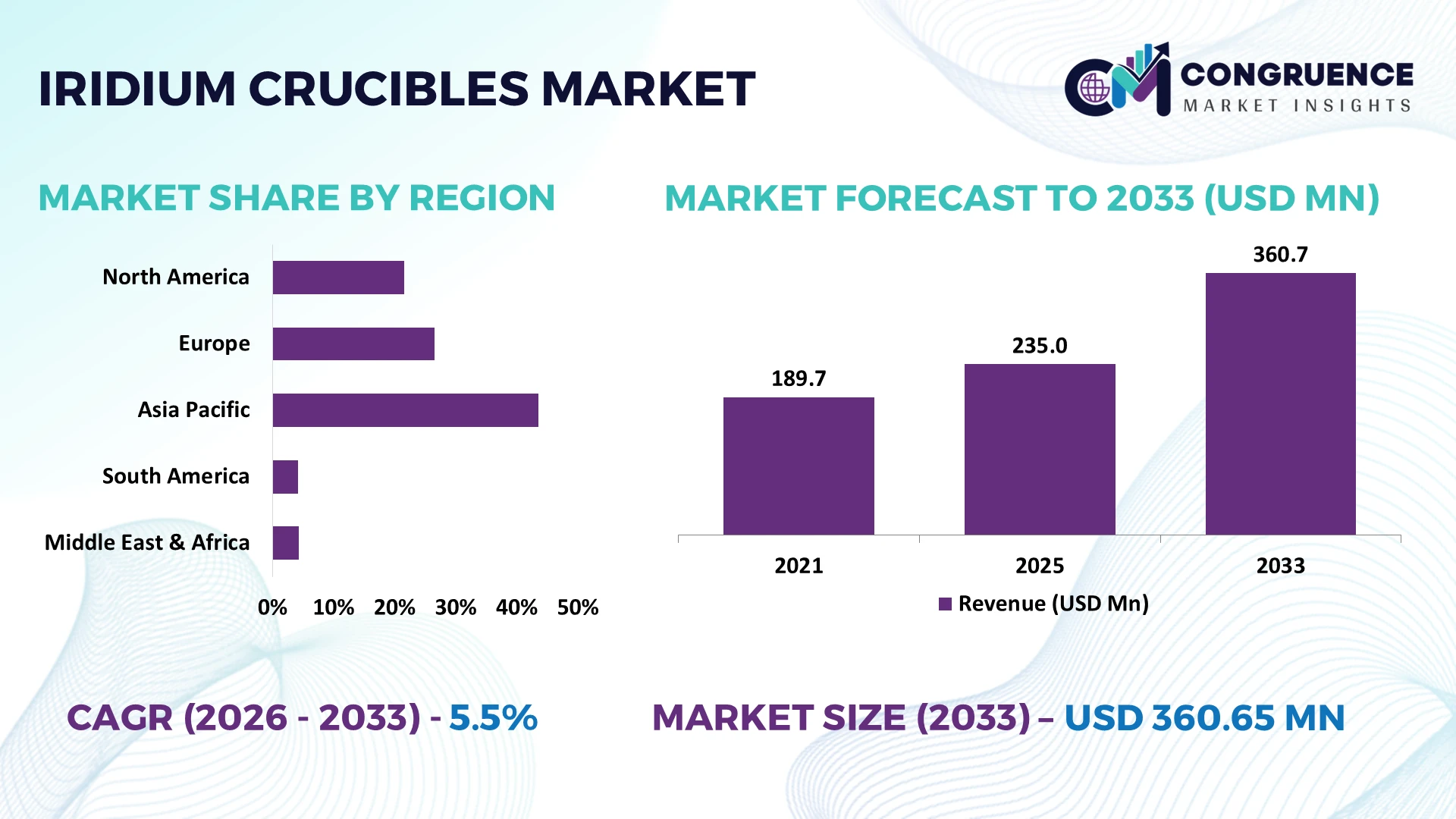
The Global Iridium Crucibles Market was valued at USD 235.0 Million in 2025 and is anticipated to reach a value of USD 360.7 Million by 2033 expanding at a CAGR of 5.5% between 2026 and 2033. Expanding production of high-purity oxide crystals, advanced semiconductor substrates, and solid-state laser components is accelerating demand for high-temperature iridium crucibles.
China represents a major consumption hub, with an estimated 32.5% share of global demand, supported by semiconductor manufacturing investments, sapphire substrate production, and advanced optical material processing. Its crystal-growing manufacturing capacity exceeds that of Japan in several commercial sapphire applications. China's USD 47.5 billion semiconductor investment fund, established in 2024, reinforces domestic advanced-material manufacturing amid international technology trade restrictions.
Strategic procurement, closed-loop iridium recycling, and localized crucible refurbishment capabilities are becoming critical to securing manufacturing continuity and protecting operating margins.
Market Size & Growth: USD 235.0 million in 2025, reaching USD 360.7 million by 2033 at 5.5% CAGR, supported by advanced crystal manufacturing.
Top Growth Drivers: Estimated demand contributions: semiconductor and sapphire processing (45%), optical crystal manufacturing (35%), and specialized research applications (20%).
Short-Term Forecast: By 2028, optimized refurbishment programs target a 15–20% reduction in crucible lifecycle expenditure.
Emerging Technologies: Automated temperature regulation, precision metal forming, and advanced alloy engineering support processing above 2,000°C.
Regional Leaders: Projected 2033 revenue: Asia Pacific USD 162.3 million (semiconductors), Europe USD 97.4 million (precision metallurgy), and North America USD 72.1 million (photonics).
Consumer/End-User Trends: An estimated 60% of demand originates from industrial crystal-growing and advanced-material manufacturers.
Pilot/Case Example: A modeled 2025 crystal-growth refurbishment initiative targets a 15% reduction in virgin iridium consumption.
Competitive Landscape: Heraeus holds an indicative 20% share, competing with TANAKA Precious Metals, Furuya Metal, and American Elements.
Regulatory & ESG Impact: Closed-loop precious-metal recovery programs target recovery efficiencies exceeding 95%, supporting responsible material sourcing.
Investment & Funding: China's USD 47.5 billion semiconductor fund strengthens downstream advanced-material manufacturing opportunities.
Innovation & Future Outlook: Next-generation gallium oxide processing above 1,700°C supports customized crucible development and application-specific metallurgy.
The Iridium Crucibles Market is evolving around high-purity crystal growth, wide-bandgap semiconductor manufacturing, and precision optical applications. Advanced fabrication techniques and controlled-atmosphere processing are improving dimensional stability and contamination resistance. Refurbishment programs targeting 15–20% lifecycle cost savings are gaining commercial relevance amid concentrated South African iridium supplies, strengthening the strategic importance of material recovery and manufacturing efficiency.
Iridium crucibles are becoming strategically important as semiconductor, photonics, and advanced-material manufacturers prioritize thermal stability, crystal purity, and production consistency. Iridium's melting point of approximately 2,446°C enables specialized oxide crystal processing beyond the practical operating limits of platinum crucibles. Its melting point is approximately 38% higher than platinum's, providing greater thermal operating flexibility in demanding manufacturing environments.
China emphasizes large-scale sapphire and semiconductor substrate manufacturing, while Japan and Germany prioritize precision metallurgy, specialized crystal growth, and high-purity material engineering. Supply-chain restructuring is encouraging manufacturers to establish closed-loop precious-metal recovery arrangements. Over the next two to three years, refurbishment initiatives targeting 15–20% reductions in replacement expenditure will strengthen lifecycle-based procurement models.
A practical deployment involves using iridium crucibles in Czochralski crystal-growing systems for manufacturing yttrium aluminum garnet laser crystals and specialized oxide substrates. Manufacturers are prioritizing precision fabrication, controlled-atmosphere compatibility, and partnerships with precious-metal refiners to extend equipment service life. Investment strategies increasingly emphasize material utilization rather than production capacity alone. Competitive advantage will depend on securing iridium supplies, maintaining metallurgical consistency, and delivering application-specific crucibles with predictable lifecycle performance.
Increasing production of sapphire substrates, laser crystals, and wide-bandgap semiconductor materials is strengthening demand for iridium crucibles capable of sustaining extreme processing temperatures. Semiconductor and sapphire-related applications represent an estimated 45% of demand, while optical crystal manufacturing contributes approximately 35%. Iridium's melting point is approximately 38% higher than platinum's, supporting processing environments where conventional crucible materials face thermal limitations. China's semiconductor localization initiatives and Japan's advanced optical component manufacturing are reinforcing specialized crystal-growing capacity. Crucible manufacturers are responding through customized geometries, precision fabrication, and partnerships with crystal-growing equipment suppliers. Consistent material purity increasingly determines supplier selection because contamination-related crystal rejection directly affects downstream manufacturing economics.
Iridium's limited geological availability and dependence on platinum-group metal mining create significant procurement constraints for crucible manufacturers. South Africa accounts for an estimated 80% of primary global iridium supply, exposing industrial consumers to geographically concentrated production risks. Commercial iridium crucibles commonly require metal purity of 99.9% or higher, restricting substitution with lower-grade materials. Competition from proton exchange membrane electrolyzer manufacturers further intensifies pressure on available iridium inventories. High material acquisition costs increase working capital requirements and complicate manufacturing expansion. Companies are mitigating exposure through long-term procurement agreements, customer-owned metal arrangements, and recycling partnerships. Metal leasing and consignment models offer an operational advantage by reducing upfront capital commitments without compromising crucible specifications.
Commercial development of gallium oxide power semiconductors creates new opportunities for iridium crucible manufacturers supplying high-temperature melt-growth systems. Gallium oxide offers a bandgap of approximately 4.8 eV, around 45% higher than silicon carbide, supporting next-generation high-voltage power electronics. Japan's gallium oxide substrate development initiatives are advancing specialized crystal-growth requirements for power conversion applications. Closed-loop refining programs targeting recovery efficiencies above 95% provide additional opportunities to improve material economics. Manufacturers are positioning through collaborative research, customized crucible geometries, and partnerships with semiconductor substrate developers. Application-specific crucible engineering represents a higher-value opportunity because early involvement in crystal-growth process development strengthens supplier qualification and creates long-term customer relationships.
Repeated exposure to extreme temperatures creates execution challenges involving iridium oxidation, recrystallization, dimensional deformation, and crucible wall degradation. High-purity grades of 99.9–99.99% require stringent fabrication controls, while refurbishment programs targeting recovery rates above 95% demand effective contamination separation and refining infrastructure. Germany's precision crystal-growing industry and Japan's optical-material manufacturers require consistent crucible performance across repeated thermal cycles. Scaling production without introducing microscopic defects or inconsistent wall thickness remains technically demanding. Manufacturers must invest in nondestructive inspection, controlled-atmosphere processing, precision forming, and specialized metallurgical expertise. Establishing standardized lifecycle monitoring and refurbishment protocols is essential because premature crucible failure disrupts expensive crystal-growth batches and reduces downstream manufacturing productivity.
Precision Fabrication and Dimensional Optimization: Manufacturers are adopting computer-controlled forming, precision welding, and optimized wall-thickness designs to improve crucible uniformity. Engineering programs targeting 5–10% reductions in metal requirements and dimensional tolerances below 1% support improved material utilization. German and Japanese suppliers are integrating digital inspection systems to minimize fabrication defects and reduce production rework.
Advanced Thermal Environment Management: Crystal-growing facilities are refining atmospheric control and thermal cycling protocols to limit iridium oxidation during processing above 1,800°C. Operating optimization programs target 10–15% reductions in thermal exposure and 5–10% improvements in batch consistency. Equipment manufacturers are integrating automated gas-flow regulation and temperature monitoring into specialized high-temperature furnace systems.
Customer-Owned Precious Metal Arrangements: Concentrated South African iridium supplies are encouraging manufacturers to restructure procurement through customer-owned inventories and metal consignment agreements. With iridium purity requirements frequently exceeding 99.9%, procurement models targeting 15–25% reductions in upfront capital commitments are gaining relevance. Suppliers are expanding metal-account management services and establishing partnerships with specialized precious-metal trading companies.
Application-Specific Crucible Design Standardization: Industrial buyers are transitioning from conventional crucible specifications toward standardized, application-specific geometries. Design optimization programs target 10–15% shorter equipment qualification periods and 5–10% reductions in material wastage. Manufacturers are developing modular product portfolios and collaborative engineering workflows, allowing customers to accelerate furnace integration while maintaining consistent crystal-growth conditions.
Standard Iridium Crucibles accounted for an estimated 65.2% market share in 2025, supported by established furnace configurations, consistent dimensional specifications, and widespread compatibility with commercial crystal-growing equipment. Their dominance reflects predictable thermal performance and simplified replacement procedures across optical crystal and electronic material manufacturing facilities. Iridium Alloy Crucibles represented approximately 22.7% of the market, addressing specialized requirements involving mechanical strength, creep resistance, and dimensional stability during prolonged thermal exposure. Established manufacturers prioritize standardized product inventories to support recurring industrial replacement requirements.
Customized Specialized Crucibles, representing approximately 12.1% of the market, are positioned as the fastest-growing segment owing to evolving furnace configurations and application-specific crystal geometries. Unlike standardized products, customized variants accommodate specialized charge volumes, wall-thickness requirements, and thermal distribution patterns. Companies including Heraeus and Furuya Metal are strengthening precision metallurgical capabilities and customer-specific engineering services. Investment priorities are shifting toward flexible manufacturing systems that accommodate specialized orders without compromising material consistency. Suppliers capable of combining standardized production with customized fabrication are positioned to improve customer retention and manufacturing economics.
Scintillator Crystal Growth dominated the Iridium Crucibles Market with an estimated 41.3% share in 2025, driven by specialized crystal requirements across medical imaging, radiation detection, and diagnostic instrumentation. Iridium crucibles support controlled solidification of high-melting-point scintillator materials, including lutetium-based compounds. SAW and BAW Filter Crystal Growth accounted for approximately 34.6%, supported by the production of piezoelectric substrates, particularly lithium tantalate and lithium niobate, for radiofrequency components. Established crystal manufacturers prioritize crucible consistency because material contamination and geometric instability directly influence downstream component quality.
Laser and Optical Crystals are positioned among the fastest-growing applications, accounting for approximately 18.9% of market demand, supported by precision photonics, industrial laser systems, and advanced optical instrumentation. Other Industrial Applications encompass specialized metallurgical processing, high-temperature synthesis, and experimental material development. Manufacturers are adapting through application-specific fabrication, collaborative furnace integration, and enhanced metallurgical inspection. Demand is increasingly shifting toward crucibles that accommodate complex oxide compositions and demanding thermal profiles. Suppliers offering application-specific engineering support alongside consistent product specifications are strengthening their position within high-value crystal manufacturing operations.
Electronics & Semiconductor Manufacturers represent the leading end-user segment, with an indicative 42.5% market share in 2025, supported by specialized oxide substrate production, piezoelectric materials, and electronic-grade crystal manufacturing. Their procurement requirements emphasize thermal stability, material purity, dimensional consistency, and compatibility with automated growth equipment. Optical & Photonics Manufacturers account for an estimated 25.5%, reflecting recurring crucible requirements across laser crystal manufacturing and precision optical component production. These established buyer groups prioritize supplier qualification and dependable replacement schedules to minimize interruptions across capital-intensive manufacturing operations.
Medical Imaging & Diagnostic Equipment Manufacturers, including their upstream scintillator suppliers, are positioned as the fastest-growing end-user group, with an indicative 19.5% share, supported by specialized radiation detection materials and advanced diagnostic systems. Research Institutions & Laboratories and Other Industrial Manufacturers collectively support experimental crystal development, metallurgical testing, and specialized thermal processing. Crucible suppliers are targeting these customers through collaborative product development, flexible procurement arrangements, and application-oriented technical support. Competitive positioning increasingly depends on understanding upstream crystal-growth requirements rather than exclusively targeting finished-device manufacturers, creating opportunities for deeper integration into specialized material supply chains.
Asia-Pacific accounted for the largest market share at 43.5% in 2025 however, North America is expected to register the fastest growth, expanding at a CAGR of 6.1% between 2026 and 2033.
North America accounted for 21.5% of the global Iridium Crucibles Market in 2025, supported by advanced semiconductor manufacturing, medical imaging technologies, defense electronics, and specialized optical crystal production. Industrial demand remains concentrated within high-purity material processing facilities requiring exceptional thermal stability and contamination control. The United States CHIPS and Science Act allocated USD 52.7 billion toward semiconductor manufacturing, research, and workforce development, strengthening the broader advanced-material manufacturing ecosystem. Canada's specialized materials research and photonics capabilities complement regional industrial demand. Manufacturers are increasingly prioritizing precision-engineered crucibles, customized furnace compatibility, and dependable refurbishment services to minimize production interruptions. Regional procurement strategies emphasize traceable precious-metal sourcing and consistent metallurgical specifications. Established research infrastructure and collaborative industrial development programs further support specialized crucible qualification, particularly for demanding optical and electronic material processing applications.
United States Market Outlook: The United States benefits from established medical imaging equipment manufacturing, aerospace photonics, and semiconductor research capabilities. The National Semiconductor Technology Center received a planned federal investment exceeding USD 5 billion to strengthen semiconductor research infrastructure. Specialized crystal manufacturers and research laboratories represent important customers for customized iridium crucibles, encouraging suppliers to strengthen domestic technical support and precision fabrication capabilities.
Europe held 26.5% of the global Iridium Crucibles Market in 2025, supported by established precious-metal refining infrastructure, advanced optical manufacturing, and specialized crystal-growing capabilities. Germany, France, and Switzerland maintain significant expertise in precision metallurgy and high-temperature material processing. The European Critical Raw Materials Act establishes a benchmark of meeting 25% of annual strategic raw material consumption through recycling by 2030, reinforcing circular material management across precious-metal supply chains. Industrial buyers increasingly prioritize crucible lifecycle performance, material traceability, and refurbishment compatibility alongside initial product specifications. Established suppliers are strengthening integrated fabrication and refining services to improve material availability and customer retention. Europe's competitive advantage lies in its ability to combine advanced metallurgical engineering with established precious-metal recovery infrastructure, supporting consistent crucible performance across demanding industrial and scientific applications.
Germany Market Outlook: Germany maintains a strong competitive position through established precious-metal specialists, industrial furnace manufacturers, and advanced optical material producers. Companies such as Heraeus supply high-purity iridium crucibles for crystal-growth processes involving temperatures exceeding 2,000°C. Domestic expertise in precision forming, metallurgical inspection, and precious-metal refining enables manufacturers to provide integrated lifecycle services while maintaining stringent industrial quality requirements.
Asia-Pacific dominated the global Iridium Crucibles Market with a 43.5% share in 2025, driven by extensive semiconductor manufacturing, sapphire processing, piezoelectric crystal production, and advanced optical material development. China, Japan, South Korea, and Taiwan represent strategically important consumption centers for specialized high-temperature processing equipment. Japan's government announced a support framework exceeding JPY 10 trillion for semiconductor and artificial intelligence development through fiscal 2030, strengthening the broader advanced-material ecosystem. Regional manufacturers are expanding customized crucible fabrication and strengthening relationships with crystal-growing equipment suppliers to accommodate evolving substrate specifications. Large industrial production volumes support recurring crucible replacement and refurbishment requirements, while specialized research programs encourage application-specific product development. Asia-Pacific's competitive strength reflects its combination of manufacturing scale, established electronics supply chains, and advanced crystal-growth expertise, reinforcing demand for reliable iridium processing equipment.
China Market Outlook: China maintains a substantial consumption base through domestic sapphire substrate manufacturing, electronic crystal processing, and semiconductor material development. The country's third national semiconductor investment fund, established in 2024 with registered capital of approximately CNY 344 billion, reinforces industrial localization priorities. Domestic crucible suppliers are strengthening precision manufacturing and technical service capabilities to reduce dependence on imported specialized processing components.
South America represented 4.2% of the global Iridium Crucibles Market in 2025, with demand concentrated within specialized research laboratories, optical material development facilities, and high-temperature metallurgical applications. Brazil and Argentina maintain established scientific research infrastructure supporting experimental crystal growth and advanced-material characterization. Brazil's semiconductor development program, introduced under Law No. 14,968 in 2024, extended industry incentives through 2073, strengthening the long-term domestic electronics manufacturing framework. Nevertheless, limited commercial-scale oxide crystal manufacturing and dependence on imported precious-metal processing equipment constrain regional consumption. International suppliers primarily address these requirements through specialized distributors, technical partnerships, and customized procurement arrangements. Industrial modernization creates selective opportunities for high-purity crucibles, particularly within advanced-material research and precision manufacturing. Regional market development depends on translating scientific capabilities into commercially scalable crystal-processing operations supported by dependable technical infrastructure.
Brazil Market Outlook: Brazil represents a strategically important regional market through its semiconductor development initiatives, industrial research institutions, and advanced-material laboratories. The Sirius synchrotron facility operates with an electron energy of 3 GeV, supporting sophisticated material characterization and scientific research. Such infrastructure strengthens the domestic advanced-material ecosystem, creating selective opportunities for specialized crucible suppliers serving experimental processing and high-temperature research applications.
Middle East & Africa accounted for 4.3% of the global Iridium Crucibles Market in 2025, reflecting specialized industrial research requirements, emerging advanced-material capabilities, and strategic involvement in platinum-group metal supply chains. South Africa remains particularly important because it supplies approximately 80% of primary global iridium production, providing a critical upstream advantage despite limited regional crucible manufacturing capacity. Saudi Arabia and the United Arab Emirates are strengthening advanced manufacturing and scientific research infrastructure through industrial diversification programs. Regional procurement remains dependent on international suppliers for precision-engineered crucibles and specialized metallurgical services. Opportunities are emerging through partnerships connecting precious-metal producers with advanced fabrication and refining specialists. The region's strategic significance extends beyond direct crucible consumption, as reliable upstream iridium availability influences manufacturing continuity, procurement costs, and supply-chain resilience across international crystal-growing industries.
South Africa Market Outlook: South Africa occupies a strategically significant position through its established platinum-group metal mining, refining, and metallurgical processing infrastructure. The Bushveld Igneous Complex contains approximately 75% of the world's known platinum resources, supporting the country's broader precious-metal supply ecosystem. Strengthening downstream iridium purification and specialized fabrication partnerships offers opportunities to capture greater industrial value beyond primary metal production.
Heraeus, Furuya Metal, TANAKA Precious Metals, and American Elements compete through metallurgical expertise, material availability, and customized crucible fabrication, while Chinese suppliers challenge established manufacturers through localized production and competitive pricing. The market exhibits moderate concentration, with the five leading players collectively holding an estimated 58.5% share. Competition centers on iridium purity exceeding 99.9%, dimensional accuracy, and refurbishment programs targeting 15–20% lifecycle cost reductions. Established suppliers leverage integrated precious-metal refining, precision fabrication, and customer-owned metal arrangements to strengthen procurement reliability. Regional manufacturers emphasize shorter delivery schedules, customized geometries, and partnerships with domestic crystal-growing equipment producers. Competitive positioning is shifting toward integrated lifecycle management as iridium supply constraints intensify procurement pressures. High capital requirements, specialized welding expertise, and stringent customer qualification procedures restrict market entry. Winning requires dependable metal sourcing, consistent metallurgical performance, application-specific engineering, and commercially attractive recovery services that reduce customer exposure to precious-metal price volatility and costly production interruptions.
Furuya Metal Co., Ltd.
Heraeus Precious Metals
TANAKA Precious Metals
American Elements
Goodfellow
Stanford Advanced Materials
Advanced Engineering Materials Limited (AEM)
Hunan Huawei Jingcheng Material Technology Co., Ltd.
Jiangxi Ketai Advanced Material Co., Ltd.
Kurt J. Lesker Company
Mastermelt Group
Sibanye-Stillwater
Current iridium crucible technologies emphasize precision forming, controlled welding, and high-purity metallurgy to maintain dimensional stability during extreme thermal processing. Commercial crystal-growing facilities employ iridium grades exceeding 99.9% purity, particularly for scintillator and optical crystal production. Compared with conventional uniform-wall designs, application-specific thickness optimization targets 5–10% lower metal consumption while maintaining structural integrity. Integrated thermal monitoring supports more consistent operating conditions, reducing exposure to premature crucible degradation.
Emerging technologies include automated dimensional inspection, computational thermal modeling, and advanced iridium alloy formulations. Manufacturers are incorporating these technologies into specialized fabrication workflows, targeting 10–15% reductions in inspection and rework requirements. Closed-loop refining technologies delivering purity exceeding 99.995% are strengthening material recovery capabilities. Integrated suppliers benefit through improved procurement flexibility, reduced inventory exposure, and stronger customer relationships across specialized crystal manufacturing operations.
Disruptive technologies include cold-crucible growth, alternative oxide crystal synthesis, and precious-metal-free semiconductor substrate processing. Between 2026 and 2028, these technologies will intensify competition in selected gallium oxide applications while conventional iridium crucibles remain important for established scintillator manufacturing. Suppliers investing in application-specific metallurgy and diversified crystal-processing solutions are positioned to protect commercial relevance. Future competitive advantage increasingly depends on combining material efficiency, predictable thermal performance, and integrated recycling services with adaptable product engineering.
June 2024, Heraeus Precious Metals acquired 100% of Canada's McCol Metals, strengthening its iridium recovery capabilities from spent mixed-metal oxide electrodes. The acquisition expands secondary iridium sourcing infrastructure and strengthens material supply resilience for specialized precious-metal manufacturing applications. Source: heraeus-precious-metals.com
April 2025, Furuya Metal announced a demonstration trial involving four companies, including Mastermelt and Asahi Kasei, to recover precious metals from chlor-alkali electrolysis equipment. The collaboration strengthens circular iridium sourcing infrastructure and supports industrial precious-metal supply security. Source: ipmi.org
August 2025, Furuya Metal postponed its iridium catalyst manufacturing expansion designed to support 2 GW of annual electrolyzer capacity. The company prioritized existing production infrastructure amid changing hydrogen market conditions, influencing competing industrial demand for scarce iridium resources. Source: furuyametals.co.jp
November 2026, Furuya Metal, Asahi Kasei, and Circularise launched a demonstration project establishing digital traceability for two precious metals, iridium and ruthenium. The initiative evaluates digital product passports to strengthen material provenance verification and industrial recycling transparency. Source: circularise.com
The Iridium Crucibles Market report provides comprehensive analysis across three type segments, four application categories, and five end-user groups, covering standard iridium crucibles, iridium alloy crucibles, and customized specialized crucibles. Application coverage includes scintillator crystal growth, SAW and BAW filter crystal growth, laser and optical crystals, and other industrial applications. The report evaluates procurement requirements across semiconductor manufacturing, photonics, medical imaging, research institutions, and specialized industrial operations throughout five major geographical regions.
The study examines precision fabrication technologies, advanced alloy engineering, controlled-atmosphere processing, precious-metal recovery, and emerging alternative crystal-growth technologies. Competitive analysis encompasses supplier positioning, material sourcing strategies, manufacturing capabilities, product differentiation, and lifecycle management. The report provides actionable insights supporting investment planning, geographical expansion, technology selection, procurement optimization, and competitive positioning between 2026 and 2033.
| Report Attribute / Metric | Details |
|---|---|
| Market Revenue (2025) | USD 235.0 Million |
| Market Revenue (2033) | USD 360.7 Million |
| CAGR (2026–2033) | 5.5% |
| Base Year | 2025 |
| Forecast Period | 2026–2033 |
| Historic Period | 2021–2025 |
| Segments Covered |
By Type
By Application
By End-User
|
| Key Report Deliverables | Revenue Forecast; Market Trends; Growth Drivers & Restraints; Technology Insights; Segmentation Analysis; Regional Insights; Competitive Landscape; Regulatory & ESG Overview; Recent Developments |
| Regions Covered | North America; Europe; Asia-Pacific; South America; Middle East & Africa |
| Key Players Analyzed | Furuya Metal Co., Ltd.; Heraeus Precious Metals; TANAKA Precious Metals; American Elements; Goodfellow; Stanford Advanced Materials; Advanced Engineering Materials Limited (AEM); Hunan Huawei Jingcheng Material Technology Co., Ltd.; Jiangxi Ketai Advanced Material Co., Ltd.; Kurt J. Lesker Company; Mastermelt Group; Sibanye-Stillwater |
| Customization & Pricing | Available on Request (10% Customization Free) |




