
Reports
The Global IP Deskphones Market was valued at USD 384.0 Million in 2025 and is anticipated to reach a value of USD 584.0 Million by 2033 expanding at a CAGR of 5.3% between 2026 and 2033. Enterprise migration toward cloud-based unified communications platforms and hybrid workplace infrastructure modernization continues to accelerate IP deskphone deployment across corporate, government, healthcare, and financial organizations.
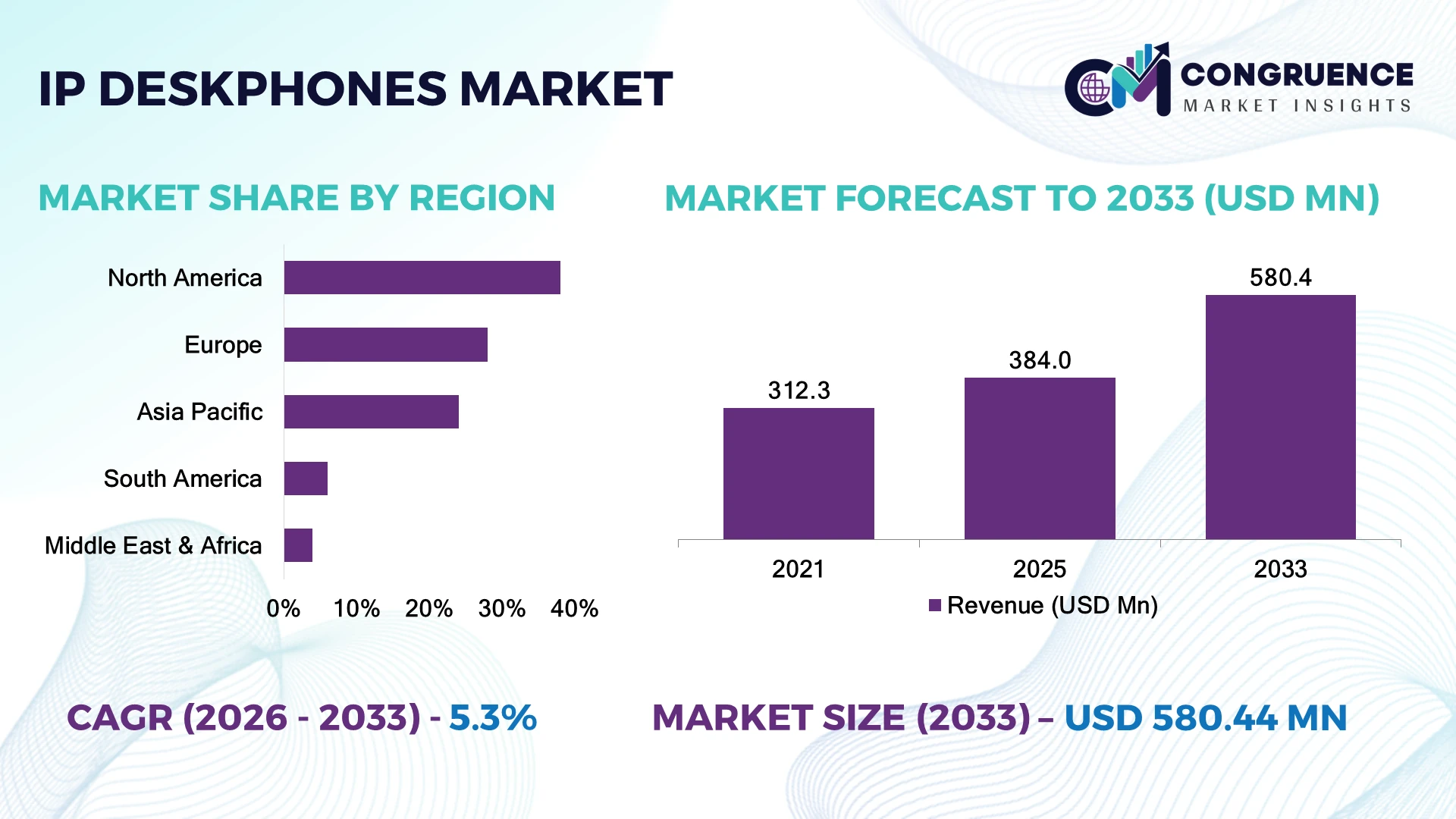
The United States dominates the market with approximately 34% share, supported by widespread enterprise VoIP adoption, over 85% broadband business connectivity, and strong investments in cloud communications infrastructure across BFSI, healthcare, and public sectors. Compared with Germany, where enterprise IP telephony penetration is nearing 61%, U.S. deployments remain larger due to higher UCaaS integration and ongoing digital workplace investments. Ongoing enterprise IT modernization following post-pandemic workplace transformation further strengthens long-term deployment strategies.
Strategic investments should prioritize cloud-integrated enterprise communication ecosystems, AI-enabled collaboration, and secure hybrid workplace infrastructure to strengthen long-term competitive positioning.
Market Size & Growth: USD 384.0 Million in 2025, projected to reach USD 584.0 Million by 2033 at 5.3% CAGR, driven by enterprise cloud communications migration.
Top Growth Drivers: Hybrid workplace adoption (+41%), UCaaS deployment (+36%), enterprise VoIP migration (+29%).
Short-Term Forecast: By 2028, enterprise communication efficiency improves by nearly 22% while maintenance costs decline around 18%.
Emerging Technologies: AI voice assistants, SIP-based automation, cloud provisioning, and advanced remote device management improve enterprise productivity.
Regional Leaders: North America (~USD 205 Million), Europe (~USD 142 Million), Asia-Pacific (~USD 128 Million), supported by enterprise digital infrastructure expansion.
Consumer/End-User Trends: Nearly 69% of large enterprises prioritize cloud-managed IP deskphones for hybrid collaboration.
Pilot/Case Example: In 2024, a multinational enterprise unified communications deployment reduced internal call management time by approximately 27%.
Competitive Landscape: Cisco holds nearly 21% market share alongside Yealink, Avaya, Poly, and Grandstream.
Regulatory & ESG Impact: Enterprise energy-efficient communication hardware lowers office power consumption by approximately 15% while supporting digital workplace compliance.
Investment & Funding: More than USD 1.2 Billion supports cloud communication partnerships, enterprise expansion, and network modernization amid global supply-chain diversification.
Innovation & Future Outlook: AI-enabled call analytics, zero-touch provisioning, and secure collaboration ecosystems are reshaping next-generation enterprise communications.
IP Deskphones Market demand remains strong across enterprise headquarters, government offices, healthcare networks, and financial institutions seeking secure voice collaboration with unified communications platforms. AI-assisted call management, zero-touch provisioning, and cloud-native device administration continue advancing product innovation. More than 60% of enterprise deployments now integrate UC platforms, while ongoing semiconductor supply-chain normalization supports faster hardware availability and enterprise upgrade cycles, strengthening the market's strategic evolution.
IP deskphones have become strategically important as enterprises modernize workplace communications, strengthen cybersecurity, and standardize collaboration across distributed operations. Cloud-first communication strategies, enterprise digital transformation, and unified communications adoption continue reshaping procurement priorities. Infrastructure modernization across corporate campuses, government institutions, and healthcare facilities is accelerating replacement of legacy PBX environments with intelligent IP communication ecosystems.
Modern SIP-based IP deskphones reduce deployment and maintenance effort by nearly 30% compared with traditional PBX systems while enabling centralized management and remote provisioning. North America leads large-scale enterprise deployment, whereas Asia-Pacific records faster implementation across expanding technology parks and business service centers. Over the next two to three years, AI-enabled device management and cloud integration are expected to increase enterprise communication automation by approximately 25%.
Large multinational organizations increasingly deploy cloud-managed communication platforms across multiple office locations using centralized provisioning and unified security policies. Vendors are expanding strategic alliances with UC platform providers, strengthening software interoperability and lifecycle services. Organizations prioritizing scalable, secure, and AI-enabled communication infrastructure will establish stronger operational resilience, higher workforce productivity, and sustainable competitive differentiation.
Rapid migration toward cloud communications is accelerating enterprise replacement of conventional PBX infrastructure with SIP-enabled IP deskphones. Nearly 72% of large organizations now operate hybrid work environments, while cloud collaboration deployments have increased by approximately 35% over recent years. Government digital workplace initiatives and enterprise network modernization across the United States continue reinforcing large-scale adoption. Vendors are responding through AI-enabled endpoint innovation, strategic UC platform partnerships, and expanded cloud device management capabilities. A key operational advantage comes from centralized administration, allowing IT teams to deploy, update, and secure thousands of enterprise endpoints with significantly lower administrative complexity while improving communication reliability.
Legacy enterprise communication infrastructure continues limiting rapid IP deskphone deployment, particularly among organizations operating aging PBX environments. Nearly 38% of medium-sized enterprises still rely on mixed telephony architectures, while migration costs can increase project expenditure by approximately 20% due to interoperability upgrades. Semiconductor component availability and specialized networking equipment remain operational constraints for certain enterprise projects. Manufacturers are reducing deployment risks through localized production, long-term supplier agreements, and standardized SIP interoperability certification. Strategic infrastructure assessment before migration has become essential for minimizing deployment delays and maintaining enterprise communication continuity.
Artificial intelligence integration is creating significant opportunities through intelligent call routing, automated provisioning, predictive diagnostics, and real-time communication analytics. More than 58% of enterprises are evaluating AI-supported unified communications platforms, while remote device management can reduce administrative workloads by nearly 30%. Japan and Singapore continue expanding smart office initiatives that encourage enterprise digital collaboration investments. Leading vendors are increasing R&D spending, strengthening software ecosystems, and partnering with UC platform providers to deliver intelligent communication solutions. Organizations capable of combining AI, cloud management, and cybersecurity within a unified communication platform gain measurable operational efficiency and long-term customer retention advantages.
Expanding enterprise communication ecosystems introduce execution challenges involving cybersecurity, software compatibility, and lifecycle management across distributed offices. Nearly 43% of enterprise IT teams identify endpoint security as a primary communications concern, while multi-vendor environments increase integration complexity by approximately 26%. Increasing regulatory attention on enterprise cybersecurity frameworks requires continuous firmware updates, authentication controls, and encrypted communications. Companies are investing in secure cloud management platforms, zero-trust security architectures, and certified interoperability partnerships to maintain deployment consistency. Long-term competitiveness increasingly depends on balancing communication flexibility, enterprise-grade security, and simplified operational management across complex digital workplace environments.
AI-Enabled Device Intelligence Enterprise deployments increasingly integrate AI-powered call analytics, voice enhancement, and predictive diagnostics into IP deskphones. More than 46% of newly deployed enterprise endpoints now support embedded AI functions, while automated provisioning reduces device setup time by nearly 35% and lowers IT support tickets by approximately 22%. Organizations are standardizing cloud-based management platforms following broader digital workplace transitions, with vendors expanding software partnerships and firmware automation to improve lifecycle management and reduce operational overhead.
Cloud-Native Communication Migration Businesses are accelerating migration from on-premises PBX systems to cloud-managed SIP environments, with cloud-connected deskphone deployments rising by roughly 38% across large enterprises. Centralized administration shortens configuration cycles by nearly 30% while improving network visibility across distributed offices. Following enterprise infrastructure modernization initiatives in the United States and Europe, manufacturers are strengthening interoperability with unified communications platforms and scaling subscription-based device management services to simplify enterprise operations.
Supply Chain Localization Strategies Hardware vendors are restructuring manufacturing networks as geopolitical uncertainty and semiconductor availability reshape procurement priorities. Around 32% of enterprise communication equipment suppliers have expanded regional sourcing, while average component lead times have declined by nearly 18% compared with previous disruption periods. Companies are diversifying supplier ecosystems, increasing inventory resilience, and establishing localized assembly partnerships to improve delivery reliability and reduce procurement risk for enterprise customers.
Security-First Endpoint Deployment Enterprise buyers increasingly prioritize secure communication endpoints supporting encrypted voice traffic, secure boot processes, and centralized firmware governance. Approximately 64% of IT decision-makers now include cybersecurity certification in procurement requirements, while zero-touch deployment adoption has increased by nearly 28% across multinational organizations. Regulatory compliance requirements and expanding hybrid workforces are encouraging vendors to integrate identity management, automated security updates, and enterprise-grade authentication into next-generation IP deskphone portfolios.
The Global IP Deskphones Market is commonly segmented into SIP IP Deskphones, Wi-Fi IP Deskphones, Video IP Deskphones, Cordless IP Deskphones, and Conference IP Deskphones. SIP IP Deskphones lead the market with an estimated 49% share because of broad interoperability, lower deployment costs, and seamless integration with unified communications platforms. Their standardized architecture supports scalable enterprise rollouts and centralized device management, making them the preferred choice for large organizations. Video IP Deskphones represent the fastest-growing segment as enterprises increasingly integrate voice and video collaboration into hybrid workplace environments. Wi-Fi IP Deskphones continue gaining traction in flexible office layouts, while Cordless and Conference IP Deskphones maintain strategic importance across healthcare, hospitality, manufacturing, and executive collaboration environments. Manufacturers are expanding AI-enabled SIP portfolios, enhancing touchscreen interfaces, and strengthening compatibility with major UC ecosystems. Around 58% of enterprise procurement projects now prioritize cloud-ready SIP devices, while nearly 34% of newly deployed premium endpoints include integrated video collaboration capabilities. Product differentiation increasingly focuses on security, automation, and simplified lifecycle management rather than hardware specifications alone.
The market is segmented by Corporate Offices, Government Organizations, Healthcare Facilities, Educational Institutions, Hospitality, Manufacturing, and Others. Corporate Offices account for approximately 52% of total deployments due to extensive unified communications adoption, hybrid workforce management, and centralized IT administration. Healthcare Facilities represent the fastest-growing application as hospitals modernize secure internal communications, nurse collaboration workflows, and emergency response systems. Government organizations continue upgrading digital communication infrastructure, while educational institutions increasingly deploy IP telephony to support campus-wide collaboration. Hospitality and manufacturing facilities are also expanding deployments to improve operational coordination and customer service efficiency. Nearly 67% of enterprise communication upgrades now include cloud-managed IP deskphones integrated with collaboration software, while approximately 29% of healthcare communication projects involve secure SIP-based endpoint modernization. Vendors continue expanding industry-specific device portfolios, strengthening software integration, and delivering customized deployment services that improve operational reliability across specialized environments.
The market is segmented into Large Enterprises, Small & Medium Enterprises (SMEs), Government & Public Sector, Healthcare Providers, Educational Institutions, and Others. Large Enterprises hold approximately 56% of overall demand due to extensive multi-site communication infrastructure, centralized procurement, and advanced cybersecurity requirements. SMEs represent the fastest-growing end-user segment as subscription-based unified communications solutions reduce deployment complexity and upfront infrastructure investment. Government agencies continue replacing legacy telephony with secure IP platforms, while healthcare providers expand endpoint deployments to strengthen mission-critical communications. Educational institutions increasingly modernize campus communication systems to improve administrative efficiency and digital collaboration. Around 63% of multinational organizations now standardize cloud-managed communication endpoints across branch offices, while SME adoption has increased by nearly 31% through simplified provisioning and managed service offerings. Vendors are introducing scalable licensing, flexible pricing models, channel partnerships, and managed deployment programs to capture emerging enterprise segments and strengthen long-term customer retention.
North America accounted for the largest market share at 38% in 2025 however, Asia-Pacific is expected to register the fastest growth, expanding at a CAGR of 6.4% between 2026 and 2033.
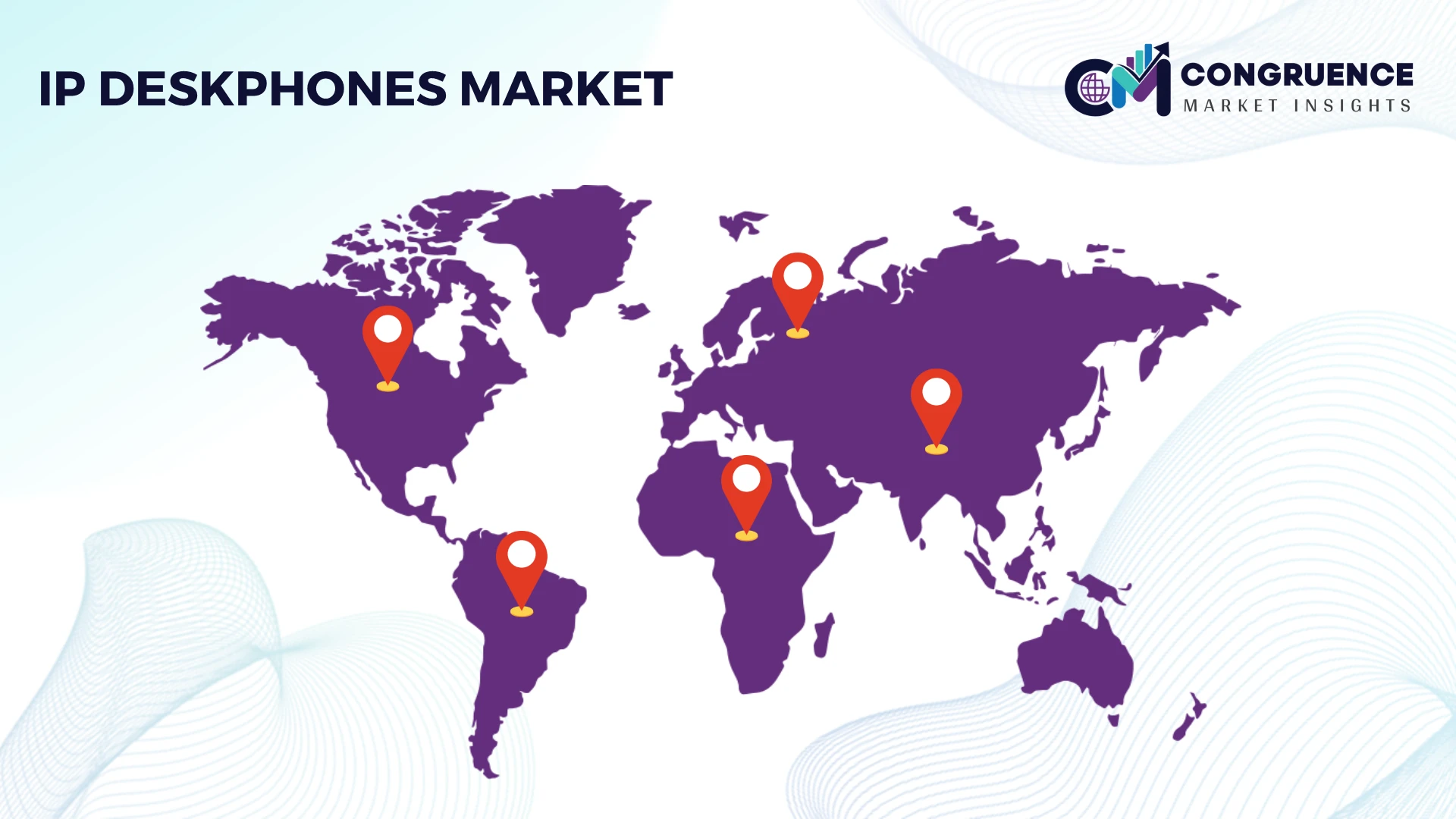
North America maintains the largest position in the IP deskphones market, supported by mature unified communications infrastructure, widespread enterprise cloud adoption, and continuous workplace modernization initiatives. The region contributes approximately 38% of global demand, with large enterprises, government agencies, financial institutions, and healthcare providers accounting for the majority of deployments. Migration from legacy PBX systems to SIP-enabled communication platforms continues to accelerate enterprise procurement. More than 72% of large organizations have adopted hybrid workplace communication strategies, encouraging large-scale endpoint refresh programs. Strategic alliances between communication platform providers and hardware manufacturers are improving interoperability, while enterprise investments in AI-enabled endpoint management and cybersecurity strengthen operational efficiency and long-term infrastructure resilience.
United States Market Outlook: The United States remains the regional leader due to its extensive enterprise IT infrastructure, advanced cloud communications ecosystem, and strong concentration of multinational corporations. Approximately 34% of global IP deskphone deployments originate from U.S.-based organizations, supported by large-scale digital workplace modernization across healthcare, BFSI, education, and government sectors. Enterprise demand continues shifting toward AI-enabled communication endpoints with centralized lifecycle management, while technology vendors expand channel partnerships and managed communication services nationwide.
Europe represents a mature enterprise communications market where digital workplace transformation, cybersecurity compliance, and standardized unified communications deployments continue driving procurement activity. The region accounts for approximately 28% of global market demand, supported by extensive enterprise modernization across manufacturing, financial services, healthcare, and government institutions. Organizations increasingly prioritize secure SIP-based communication systems that integrate with cloud collaboration platforms. More than 61% of medium and large enterprises have implemented advanced unified communications environments, encouraging replacement of conventional telephony infrastructure. Vendors continue strengthening software compatibility, regional support capabilities, and enterprise deployment services to improve operational continuity and long-term infrastructure performance.
Germany Market Outlook: Germany leads the European market through its strong industrial economy, advanced enterprise digitalization initiatives, and extensive adoption across manufacturing, engineering, and automotive sectors. Enterprise communication modernization continues supporting large deployment projects, with nearly 63% of major organizations operating integrated unified communications environments. Domestic enterprises increasingly prioritize secure communication infrastructure, while technology providers strengthen cloud partnerships and localized enterprise support capabilities.
Asia-Pacific is emerging as the fastest-developing regional market due to rapid enterprise digitalization, expanding technology parks, increasing cloud infrastructure investments, and large-scale electronics manufacturing capacity. The region contributes approximately 24% of global demand while serving as a major production hub for IP communication hardware. Enterprise communication modernization across business process outsourcing, financial services, education, and manufacturing sectors continues supporting deployment growth. More than 40% of global communication endpoint manufacturing capacity is concentrated across leading Asian economies. Manufacturers continue expanding automated production facilities, strengthening component sourcing networks, and increasing partnerships with unified communications software providers to improve product competitiveness and delivery efficiency.
China Market Outlook: China represents the region's largest market through its extensive electronics manufacturing ecosystem, strong enterprise digital transformation programs, and expanding cloud communications infrastructure. Domestic manufacturers continue increasing production capacity while supporting both domestic and export demand. More than 45% of regional communication hardware manufacturing is associated with Chinese production facilities, supported by integrated supply chains, automation investments, and continuous enterprise network modernization initiatives.
South America continues strengthening its enterprise communication infrastructure as organizations replace conventional telephony systems with IP-enabled collaboration platforms. The region accounts for approximately 6% of global market activity, supported primarily by banking, telecommunications, public administration, and corporate service industries. Increasing fiber broadband availability and cloud communication adoption are improving deployment opportunities across major metropolitan business centers. Enterprise communication projects have increased by nearly 21% among large organizations implementing hybrid workplace strategies. Technology providers continue expanding regional distribution networks, managed deployment services, and channel partnerships while addressing infrastructure disparities that remain outside major commercial hubs.
Brazil Market Outlook: Brazil leads the regional market because of its large enterprise sector, expanding telecommunications infrastructure, and ongoing digital transformation initiatives. Financial institutions, government agencies, and multinational corporations continue replacing legacy communication systems with cloud-compatible IP deskphones. Nearly 58% of enterprise communication modernization projects within the region are concentrated in Brazil, encouraging vendors to strengthen technical support, reseller ecosystems, and localized deployment capabilities.
The Middle East & Africa market is advancing through smart city programs, enterprise digitalization, expanding broadband infrastructure, and government-backed technology modernization initiatives. The region contributes approximately 4% of global demand while demonstrating increasing deployment across public administration, energy, financial services, and healthcare organizations. Large enterprise communication projects increasingly emphasize secure unified communications platforms integrated with cloud collaboration environments. More than 27% of recently completed enterprise office developments incorporate IP-based communication infrastructure as a standard technology requirement. Vendors continue expanding regional partnerships, certified integration services, and enterprise support operations to strengthen deployment consistency and long-term customer engagement.
United Arab Emirates Market Outlook: The United Arab Emirates serves as the regional technology leader through extensive smart infrastructure investment, advanced enterprise connectivity, and strong government support for digital transformation. Large corporate headquarters, financial institutions, and public-sector organizations continue deploying secure unified communications ecosystems. Enterprise cloud adoption exceeds 70% across major organizations, encouraging technology vendors to expand strategic alliances, regional demonstration centers, and managed communication service capabilities.
The competitive landscape is led by Cisco, Yealink, Poly, Grandstream, and Fanvil, competing directly against established regional manufacturers and value-focused OEM suppliers, while cloud communication specialists challenge traditional hardware-centric vendors through software integration. The top five players collectively account for approximately 61% of global market activity, reflecting moderate market concentration with strong brand-driven enterprise procurement. Competition centers on interoperability, cybersecurity, AI-enabled device management, pricing flexibility, and supply-chain responsiveness. Enterprises increasingly prioritize platforms delivering up to 30% faster deployment, 25% lower lifecycle management effort, and nearly 20% lower support costs through centralized cloud provisioning. Leading vendors are strengthening positions through strategic UC platform partnerships, regional distribution expansion, firmware innovation, and localized manufacturing to improve delivery resilience. The competitive shift favors intelligent cloud-managed endpoints over standalone deskphones, while certification requirements and enterprise integration complexity create meaningful entry barriers. Success increasingly depends on delivering secure, interoperable, AI-enabled communication ecosystems supported by scalable services, rapid deployment capabilities, and long-term enterprise lifecycle management.
Yealink Network Technology Co., Ltd.
Poly
Grandstream Networks, Inc.
Fanvil Technology Co., Ltd.
Avaya LLC
Mitel Networks Corporation
Snom Technology GmbH
Htek (Htek Technology Co., Ltd.)
NEC Corporation
Gigaset AG
Alcatel-Lucent Enterprise
Cloud-native SIP architecture, AI-assisted call management, and centralized endpoint orchestration are redefining enterprise IP deskphone deployments. More than 68% of new enterprise installations now connect directly with unified communications platforms, while zero-touch provisioning reduces deployment effort by nearly 32%. Embedded AI enables voice enhancement, intelligent routing, and predictive diagnostics, lowering support requests by approximately 21%. Enterprises increasingly integrate IP deskphones with Microsoft Teams, Zoom, and other collaboration ecosystems to streamline workplace communications and improve administrative control.
Modern cloud-managed IP deskphones outperform legacy PBX-based systems by reducing provisioning time by approximately 35% and lowering ongoing maintenance effort by nearly 28%. Secure boot technology, encrypted SIP signaling, and automated firmware management strengthen endpoint protection while minimizing manual intervention. Large enterprises and managed service providers gain the greatest competitive advantage through centralized lifecycle management, improved scalability, and standardized security governance across geographically distributed operations.
Between 2026 and 2028, AI-powered analytics, edge computing, and software-defined communication management will accelerate enterprise modernization. More than 45% of premium IP deskphone deployments are expected to include advanced automation capabilities, while digital twin-based device monitoring and predictive maintenance will further optimize operational continuity. Organizations investing early in interoperable, cloud-first communication ecosystems will strengthen resilience, reduce infrastructure complexity, and maintain superior enterprise communication performance.
March 2024 – Cisco Systems introduced the Cisco Desk Phone 9800 Series at Enterprise Connect, adding AI-enabled collaboration, desk reservation, QR-based sign-in, and cloud/on-premises flexibility for hybrid workplaces. The launch addressed organizations where over 50% of employers and employees believe office technology needs modernization, strengthening Cisco's enterprise collaboration portfolio. Source: www.newsroom.cisco.com
November 2024 – Cisco Systems announced a phased firmware upgrade for its DBS-110 and DBS-210 DECT devices used with Webex Calling, upgrading systems to firmware version 5.1.2SR through early 2025. The update improved platform stability, security, and enterprise communications continuity across supported deployments. Source: www.help.webex.com
October 2025 – Cisco Systems expanded its portfolio with the new Cisco Desk Phone 9811, extending the 9800 Series. The device incorporates 77% post-consumer recycled materials, reinforcing enterprise sustainability goals while delivering streamlined cloud calling capabilities for modern workplaces. Source: www.blog.webex.com
2025 – Yealink, Poly, and Cisco continued expanding interoperability with Webex Calling, with Cisco officially supporting a broader portfolio of Yealink and Poly IP desk phones for enterprise deployments. This strengthened migration pathways for organizations with existing third-party devices and accelerated cloud telephony adoption without requiring complete hardware replacement.
This report provides a comprehensive assessment of the global IP Deskphones market, covering major product categories including SIP IP Deskphones, Wi-Fi IP Deskphones, Video IP Deskphones, Cordless IP Deskphones, and Conference IP Deskphones. It evaluates demand across corporate offices, healthcare, government organizations, educational institutions, hospitality, manufacturing, and other application segments while analyzing procurement behavior among large enterprises, SMEs, public-sector organizations, and institutional users. Regional assessment spans North America, Europe, Asia-Pacific, South America, and the Middle East & Africa, capturing deployment trends, technology adoption, and competitive positioning.
The analysis examines cloud communications, AI-enabled endpoint management, SIP interoperability, cybersecurity technologies, and unified communications integration shaping enterprise purchasing decisions. More than 60% of enterprise deployments are assessed through cloud-managed communication environments, providing insight into operational modernization and infrastructure evolution. The report supports investment planning, market expansion, product positioning, partnership strategy, and competitive benchmarking while identifying emerging deployment opportunities and enterprise communication priorities expected to influence industry direction between 2026 and 2033.
| Report Attribute / Metric | Details |
|---|---|
| Market Revenue (2025) | USD 384.0 Million |
| Market Revenue (2033) | USD 584.0 Million |
| CAGR (2026–2033) | 5.3% |
| Base Year | 2025 |
| Forecast Period | 2026–2033 |
| Historic Period | 2021–2025 |
| Segments Covered |
By Type
By Application
By End-User
|
| Key Deliverables | Revenue Forecast; Market Trends; Growth Drivers & Restraints; Technology Insights; Segmentation Analysis; Regional Insights; Competitive Landscape; Regulatory & ESG Overview; Recent Developments |
| Regions Covered | North America; Europe; Asia-Pacific; South America; Middle East & Africa |
| Companies Profiled | Cisco Systems, Inc.; Yealink Network Technology Co., Ltd.; Poly; Grandstream Networks, Inc.; Fanvil Technology Co., Ltd.; Avaya LLC; Mitel Networks Corporation; Snom Technology GmbH; Htek Technology Co., Ltd.; NEC Corporation; Gigaset AG; Alcatel-Lucent Enterprise |
| Customization & Pricing | Available on Request (10% Customization Free) |




