
Reports
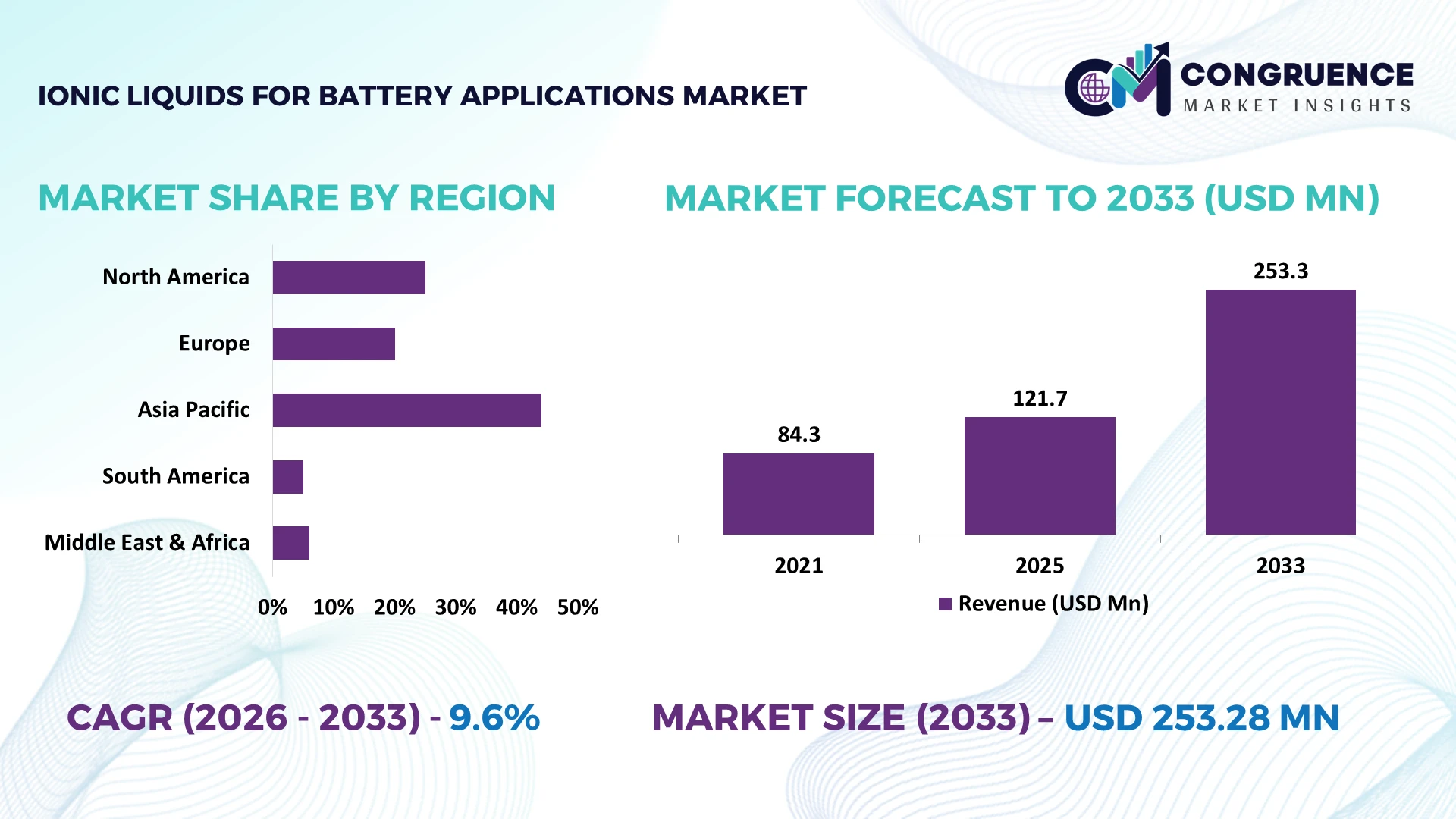
The Global Ionic Liquids for Battery Applications Market was valued at USD 121.65 Million in 2025 and is anticipated to reach a value of USD 253.28 Million by 2033 expanding at a CAGR of 9.6% between 2026 and 2033. Market expansion is driven by the development of nonflammable electrolytes, improvements in lithium metal battery stability, and increasing investment in advanced battery chemistries for electric vehicles and stationary energy storage.
China represents the principal manufacturing opportunity for advanced battery electrolyte suppliers, supported by its extensive lithium ion battery production infrastructure. The country accounted for over 80% of global battery manufacturing capacity in 2025, compared with approximately 6% to 7% each for the European Union and the United States. China's integrated cathode, anode, and battery manufacturing ecosystem provides opportunities for ionic liquid electrolyte commercialization. Meanwhile, American and European investments in domestic battery production are creating alternative markets for specialized electrolyte formulations and advanced energy storage technologies.
Strategically, electrolyte manufacturers should prioritize partnerships with Chinese battery producers while developing regional supply agreements in North America and Europe to diversify commercialization opportunities.
Market Size & Growth: The market reached USD 121.65 million in 2025 and is forecast to attain USD 253.28 million by 2033, registering 9.6% CAGR, supported by nonflammable electrolyte development.
Top Growth Drivers: Three principal drivers are battery safety requirements, advanced lithium metal battery development, and expanding stationary energy storage applications, supported by the market's projected 9.6% annual growth.
Short Term Forecast: By 2028, electrolyte suppliers will increasingly target 3 performance requirements: improved thermal stability, reliable ionic conductivity, and compatibility with high energy density electrodes.
Emerging Technologies: Three technologies are shaping product development: localized high concentration ionic liquid electrolytes, polymer ionic liquid composites, and advanced electrode interface engineering.
Regional Leaders: Asia Pacific benefits from China's greater than 80% battery manufacturing capacity share, while Europe and North America each represent approximately 6% to 7% of global capacity.
Consumer and End User Trends: Electric vehicle manufacturers, battery developers, and grid storage operators represent 3 important customer groups prioritizing battery safety and operating reliability.
Pilot and Research Example: Research published in 2025 demonstrated a concentrated ionic liquid electrolyte operating between minus 30°C and 70°C, highlighting opportunities for improved temperature adaptability.
Competitive Landscape: Competition centers on 3 capabilities: electrolyte purity, customized chemical formulations, and battery manufacturer qualification. Verified company specific market shares remain unavailable.
Regulatory and ESG Impact: Battery safety and environmental compliance influence electrolyte development across 2 major applications: electric mobility and stationary energy storage.
Investment and Funding: Global lithium ion battery manufacturing capacity exceeded 4 TWh in 2025, establishing an expanding industrial foundation for advanced electrolyte research and commercialization.
Innovation and Future Outlook: Next generation development focuses on 3 priorities: improved lithium metal compatibility, lower electrolyte viscosity, and greater thermal stability, supporting advanced battery commercialization.
The Ionic Liquids for Battery Applications Market is increasingly influenced by electrolyte safety engineering, lithium metal battery research, and the development of specialized energy storage materials. Recent innovations emphasize concentrated ionic liquid formulations, improved electrode interfaces, and wider operating temperature ranges. Experimental formulations demonstrating operation across a 100°C temperature span illustrate progress in temperature adaptability. China's concentration of more than 80% of global battery manufacturing capacity also highlights the importance of geographically diversified supply chains. These developments establish battery qualification, formulation economics, and regional manufacturing partnerships as central considerations for long term strategic planning.
Ionic liquids are becoming strategically important as battery manufacturers seek safer electrolytes for lithium metal batteries, electric vehicles, and stationary energy storage. Their negligible vapor pressure and low flammability offer advantages over conventional organic carbonate electrolytes. China's concentration of more than 80% of global battery manufacturing capacity reinforces its importance for electrolyte commercialization. Meanwhile, supply chain localization initiatives in the United States and Europe are encouraging manufacturers to develop alternative material sourcing and specialized electrolyte partnerships.
Technological progress is shifting investment toward ionic liquid formulations with improved conductivity, electrochemical stability, and electrode compatibility. Research into concentrated ionic liquid electrolytes has demonstrated operating temperature ranges extending from minus 30°C to 70°C. Compared with conventional volatile organic electrolytes, these formulations offer improved thermal safety, although conductivity and production costs remain commercialization barriers. Japanese researchers emphasize advanced electrolyte chemistry, while Chinese manufacturers benefit from established battery production infrastructure and industrial integration.
Between 2026 and 2028, commercial development will concentrate on pilot validation, manufacturing compatibility, and application specific electrolyte qualification. For example, lithium metal battery developers can evaluate ionic liquid formulations using controlled cycling and thermal stability testing before scaling production. Chemical suppliers are strengthening research partnerships and investing in purification processes to meet battery grade specifications. Competitive positioning will depend on translating laboratory performance into consistent industrial production.
Battery safety requirements and the development of lithium metal batteries are strengthening demand for ionic liquid electrolytes. Conventional lithium ion batteries commonly use flammable organic carbonate solvents, creating thermal management challenges. Ionic liquids offer low volatility and improved thermal stability, supporting research into safer battery architectures. China's share of global battery manufacturing capacity exceeds 80%, while the United States and European Union each account for approximately 6% to 7%. These manufacturing concentrations influence electrolyte qualification and commercialization priorities. China's battery supply chain integration encourages material suppliers to establish technical partnerships with cell manufacturers. Companies are investing in fluorinated ionic liquids, advanced electrolyte additives, and electrode interface engineering to improve performance.
Complex synthesis, purification requirements, and expensive precursor materials constrain the commercial adoption of battery grade ionic liquids. Electrolyte purity directly influences electrochemical stability, making contamination control essential for industrial production. China accounts for more than 80% of global battery manufacturing capacity, creating substantial geographical concentration in potential customer qualification programs. Meanwhile, the United States and European Union each represent approximately 6% to 7% of manufacturing capacity, limiting immediate opportunities for diversified industrial deployment. Specialized fluorinated compounds also introduce procurement and environmental compliance considerations. Manufacturers are addressing these limitations through precursor diversification, improved purification efficiency, and localized technical partnerships. Standardizing electrolyte formulations across multiple battery architectures offers an additional opportunity to reduce qualification expenses.
Lithium metal batteries create opportunities for ionic liquid formulations designed to stabilize reactive electrode interfaces and support high energy density applications. Lithium metal has a theoretical specific capacity of approximately 3,860 mAh/g, compared with 372 mAh/g for conventional graphite anodes. This substantial difference encourages investment in electrolytes capable of controlling lithium deposition and suppressing undesirable interfacial reactions. Japan's established battery research ecosystem provides opportunities for collaboration between chemical producers and advanced cell developers. Meanwhile, China's extensive manufacturing infrastructure supports subsequent industrial validation. Companies are developing concentrated ionic liquid formulations, polymer composite electrolytes, and customized electrolyte additives. Commercial differentiation will depend on achieving stable cycling performance without compromising manufacturability.
Translating laboratory electrolyte performance into commercially reproducible battery production remains a significant execution challenge. Ionic liquid viscosity, electrode wetting characteristics, and interfacial resistance complicate integration with established manufacturing processes. Lithium metal offers approximately 10 times the theoretical gravimetric capacity of graphite, but realizing this advantage requires reliable lithium deposition and long cycle life. Experimental ionic liquid formulations have demonstrated operation across a 100°C temperature span, although temperature adaptability alone does not establish commercial durability. Japanese and Chinese battery developers must reconcile advanced electrolyte chemistry with industrial coating, filling, and formation processes. Manufacturers are investing in automated electrolyte characterization, pilot production equipment, and collaborative cell testing. Long term competitiveness depends on reproducible electrochemical performance at manufacturing scale.
Increasing Focus on Electrolyte Formulation Optimization: Battery material developers are refining ionic liquid formulations to address viscosity, ionic conductivity, and electrode compatibility simultaneously. Lithium metal offers a theoretical capacity of 3,860 mAh/g, compared with 372 mAh/g for graphite. This performance difference increases the importance of electrolyte optimization. Japanese research institutions and specialty chemical manufacturers are expanding collaborative testing programs to improve formulation consistency and accelerate material qualification.
Expansion of Automated Electrolyte Testing: Battery research laboratories are integrating automated electrochemical testing, advanced spectroscopy, and computational screening into electrolyte development workflows. Experimental formulations demonstrating operation between minus 30°C and 70°C require extensive validation across a 100°C temperature span. Automated characterization enables more consistent comparisons between electrolyte compositions and operating conditions. Manufacturers are investing in standardized testing protocols to reduce experimental variability and improve development efficiency.
Greater Emphasis on Material Traceability: Electrolyte manufacturers are strengthening precursor traceability and impurity monitoring as battery supply chains become increasingly localized. China's concentration of more than 80% of global battery manufacturing capacity creates substantial exposure to geographically concentrated qualification networks. European battery regulations are reinforcing material documentation and sustainability requirements. Specialty chemical producers are responding through supplier audits, improved analytical testing, and closer coordination with battery manufacturers.
Growing Adoption of Hybrid Electrolyte Architectures: Research is increasingly combining ionic liquids with polymer matrices and conventional electrolyte components to balance conductivity, mechanical stability, and electrode compatibility. Conventional graphite offers a theoretical capacity of 372 mAh/g, while lithium metal provides approximately 10 times greater theoretical capacity. Hybrid formulations target the interface limitations associated with advanced electrode materials. Companies are expanding collaborative research programs to establish practical manufacturing specifications and improve electrolyte integration.
Imidazolium ionic liquids maintain a prominent position in battery electrolyte research because of their established synthesis methods, tunable molecular structures, and extensive electrochemical characterization. Their applications include electrolyte additives, ion transport research, and specialized battery formulations. An indicative market scenario places imidazolium materials at approximately 35% of application specific demand, although comprehensive commercial segment data remains unavailable. Their established research infrastructure supports formulation development, while compatibility limitations with certain electrode chemistries encourage continued molecular optimization.
Pyrrolidinium ionic liquids represent an important emerging category because of their electrochemical stability and compatibility with selected advanced battery architectures. An illustrative segment scenario assigns pyrrolidinium formulations approximately 28% of demand, with increasing research attention supporting their commercialization prospects. Piperidinium materials offer alternative electrochemical characteristics, while ammonium ionic liquids attract interest through structural versatility and formulation flexibility. Phosphonium compounds provide additional opportunities for thermal stability optimization. Manufacturers are concentrating investment on application specific molecular design, purification technology, and collaborative electrochemical validation rather than expanding production across all five chemical categories simultaneously.
Lithium Ion Batteries represent the most established application for ionic liquid electrolyte research, supported by extensive battery manufacturing infrastructure and established electrochemical testing procedures. An illustrative market allocation places this application at approximately 45% of demand, reflecting its comparatively mature development ecosystem rather than a verified industry share. Manufacturers are investigating ionic liquid additives and specialized formulations to improve thermal stability and electrolyte performance. China's extensive lithium ion battery manufacturing infrastructure provides substantial opportunities for technical qualification, particularly where manufacturers are evaluating alternatives to conventional electrolyte formulations.
Lithium Metal Batteries represent an important emerging application because lithium metal offers approximately 10 times the theoretical gravimetric capacity of graphite. Sodium Ion Batteries are attracting research attention as manufacturers investigate alternative battery chemistries and material supply chains. Supercapacitors benefit from ionic liquids offering suitable electrochemical operating windows, while Solid State Batteries present opportunities for ionic liquid integration into composite electrolyte architectures. Manufacturers are developing application specific formulations, establishing research partnerships, and expanding electrochemical characterization capabilities. Investment priorities increasingly reflect the different conductivity, stability, and manufacturing requirements of these five applications.
Battery Manufacturers represent the principal commercial customer group because electrolyte adoption requires extensive cell level testing, manufacturing qualification, and long term performance validation. An indicative segmentation scenario assigns battery manufacturers approximately 40% of application specific demand, although verified purchasing shares remain unavailable. Their established testing infrastructure and direct control over electrolyte integration provide advantages over downstream customer groups. Automotive companies influence formulation requirements through battery safety specifications, while Consumer Electronics manufacturers prioritize compact cell performance, reliability, and manufacturing consistency.
Energy Storage represents an emerging customer segment as grid operators and battery suppliers evaluate technologies suited to demanding operating environments. Aerospace applications require specialized electrolyte performance under stringent safety and temperature conditions, while Research Institutes remain important purchasers of experimental ionic liquid formulations. China's extensive battery manufacturing infrastructure supports large scale customer qualification opportunities, whereas Japanese research institutions contribute specialized electrochemical expertise. Suppliers are responding through customized electrolyte development, collaborative testing agreements, and application specific product portfolios. Commercial positioning increasingly depends on securing qualification relationships with battery manufacturers rather than relying exclusively on downstream customer demand.
Asia Pacific holds a leading position in the industrial ecosystem supporting ionic liquids for battery applications, while North America and Europe are developing specialized commercialization opportunities. Verified regional market shares and comparative growth rates for ionic liquid battery electrolytes remain unavailable.
Advanced Battery Research and Domestic Supply Chain Development
North America's ionic liquids for battery applications market is supported by advanced battery research, domestic manufacturing investment, and specialized electrolyte development. The United States provides an established research environment for lithium metal batteries, advanced electrolyte chemistry, and electrochemical interface engineering. Government initiatives supporting domestic battery manufacturing have encouraged closer cooperation between material suppliers, research institutions, and battery developers. The region's commercialization strategy emphasizes electrolyte safety, manufacturing compatibility, and intellectual property development. Canada's battery material research ecosystem provides complementary opportunities for chemical processing and specialized material development. Regional suppliers are prioritizing electrolyte purification, electrochemical characterization, and customer qualification programs. Although commercial ionic liquid adoption remains limited, expanding battery manufacturing infrastructure provides a foundation for transitioning selected formulations from laboratory research into industrial testing and specialized commercial applications.
United States Market Outlook: The United States benefits from established battery research institutions and government support for domestic energy storage manufacturing. Argonne National Laboratory and other research organizations contribute to advanced electrolyte and battery chemistry development. The Inflation Reduction Act has also influenced domestic battery supply chain investment. Specialized chemical manufacturers can capitalize on these developments through electrolyte qualification partnerships and application specific formulation development.
Regulatory Compliance and Specialized Electrolyte Innovation
Europe's ionic liquids for battery applications market is characterized by advanced chemical research, battery sustainability requirements, and investment in specialized energy storage technologies. Germany, France, and the United Kingdom provide established research capabilities supporting electrolyte chemistry and advanced battery development. European battery regulations are increasing the importance of material traceability, environmental documentation, and lifecycle performance. These requirements encourage chemical manufacturers to evaluate alternative electrolyte formulations alongside established battery materials. European research programs also support lithium metal battery development, creating opportunities for ionic liquid electrolyte characterization and integration. Manufacturers are emphasizing collaborative research, electrochemical performance validation, and specialized production capabilities. Commercial expansion depends on demonstrating compatibility with industrial battery manufacturing processes while satisfying increasingly detailed chemical safety and sustainability requirements across the European battery supply chain.
Germany Market Outlook: Germany offers significant opportunities through its automotive engineering capabilities, chemical manufacturing infrastructure, and battery research institutions. The country's established automotive industry provides a pathway for translating advanced electrolyte research into industrial qualification programs. German chemical producers and research organizations are investigating advanced battery materials, creating opportunities for specialized ionic liquid formulations that address electrode stability, thermal performance, and manufacturing compatibility.
Integrated Battery Manufacturing and Electrolyte Commercialization
Asia Pacific benefits from extensive battery manufacturing infrastructure, established chemical supply chains, and advanced electrochemical research capabilities. China accounts for more than 80% of global battery manufacturing capacity, providing substantial industrial infrastructure for advanced electrolyte qualification. Japan contributes specialized expertise in electrolyte chemistry, while South Korea maintains established battery research and manufacturing capabilities. These complementary strengths support collaboration between chemical suppliers, battery developers, and research institutions. Chinese manufacturers benefit from proximity to electrode material producers and established battery production facilities, reducing logistical complexity during formulation testing. Japanese and South Korean research organizations contribute advanced electrochemical characterization and materials engineering capabilities. Regional suppliers are concentrating on formulation optimization, material purity, and industrial qualification. Commercial opportunities increasingly depend on connecting specialized ionic liquid production with established battery manufacturing processes.
China Market Outlook: China possesses extensive battery production infrastructure and established supply chains for electrode materials, separators, and conventional electrolytes. Its manufacturing concentration provides opportunities for evaluating ionic liquid formulations through established industrial testing networks. Chinese battery developers are investigating advanced battery chemistries, creating opportunities for specialty chemical suppliers to establish technical partnerships and develop application specific electrolyte products.
Battery Material Integration and Emerging Research Opportunities
South America's ionic liquids for battery applications market remains at an early stage of commercial development. The region's strategic relevance is associated with lithium resources, emerging battery research, and opportunities for downstream chemical processing. Chile, Argentina, and Brazil provide different capabilities across lithium production, industrial chemistry, and energy storage research. However, lithium extraction does not automatically translate into demand for ionic liquid electrolytes, which require specialized synthesis and battery qualification infrastructure. Regional development therefore depends on establishing connections between existing material industries and advanced battery research programs. Brazil offers opportunities through its industrial chemical sector and academic research institutions. Suppliers pursuing regional expansion must prioritize technical collaboration, access to specialized materials, and partnerships with established battery manufacturers before committing to substantial local production capacity.
Brazil Market Outlook: Brazil provides an established industrial and academic environment for electrochemical research and specialized chemical development. Its manufacturing capabilities and energy storage research activities support opportunities for advanced electrolyte characterization. Commercial progress depends on connecting domestic chemical expertise with battery developers and establishing reliable access to specialized ionic liquid precursors, purification technologies, and electrochemical testing facilities.
Energy Storage Investment and Industrial Diversification
The Middle East and Africa represent emerging opportunities for ionic liquid electrolyte research and specialized energy storage applications. Saudi Arabia and the United Arab Emirates are investing in industrial diversification and energy technologies, while South Africa possesses established electrochemical research capabilities. Regional interest in stationary energy storage creates opportunities to investigate advanced battery safety and performance requirements. However, most energy storage deployment currently relies on established battery technologies rather than commercially mature ionic liquid formulations. Market development consequently depends on collaboration with international chemical suppliers, research institutions, and battery technology developers. Regional investment priorities include technical capability development, specialized materials research, and industrial partnerships. Companies evaluating expansion should distinguish between general battery storage investment and projects specifically requiring advanced ionic liquid electrolyte technologies.
Saudi Arabia Market Outlook: Saudi Arabia's industrial diversification initiatives and investment in energy technologies provide opportunities for specialized battery material research. Its developing industrial ecosystem offers potential for international partnerships involving electrolyte formulation and advanced energy storage technologies. Establishing electrochemical testing capabilities and technical collaboration with established battery research organizations would strengthen its position in specialized electrolyte development.
Competition in the ionic liquids for battery applications market involves specialty chemical suppliers, advanced materials developers, and battery electrolyte research organizations. Merck KGaA, Solvay, BASF, IoLiTec, and Proionic represent relevant participants across specialty chemicals and ionic liquid technologies, although their direct battery electrolyte portfolios and commercial exposure differ considerably. A verified combined market share for the five largest suppliers is unavailable because application specific sales are not consistently disclosed. Competition centers on electrolyte purity, electrochemical stability, formulation customization, and industrial qualification capabilities. Established chemical manufacturers benefit from manufacturing infrastructure and technical resources, while specialized ionic liquid suppliers emphasize molecular design and customized formulations. Commercial partnerships increasingly connect material developers with battery manufacturers and academic research institutions. The principal competitive barrier is translating promising laboratory formulations into reproducible industrial products. Suppliers must demonstrate reliable material specifications, electrode compatibility, and manufacturing economics to establish durable customer relationships and achieve commercial differentiation.
Merck KGaA
BASF
Solvay
IoLiTec Ionic Liquids Technologies
Proionic
Tokyo Chemical Industry
Thermo Fisher Scientific
Kanto Chemical
Nippon Chemical Industrial
Tatva Chintan Pharma Chem
Strem Chemicals
Advanced ionic liquid electrolytes are transforming battery research through improved thermal stability, molecular customization, and electrode compatibility. Imidazolium and pyrrolidinium formulations support specialized lithium battery development. Experimental ionic liquid composite electrolytes have demonstrated thermal stability approaching 400°C. Research involving metal organic framework composites achieved ionic conductivity of 0.000614 S/cm at room temperature, increasing to 0.00172 S/cm at 75°C. These results establish measurable performance benchmarks for advanced electrolyte qualification.
Emerging technologies combine ionic liquids with polymer matrices, ceramic fillers, and concentrated electrolyte formulations. Compared with the same composite's room temperature performance, elevated temperature testing demonstrated approximately 180% higher conductivity. However, this temperature dependent improvement does not establish superiority over conventional electrolytes. Automated electrochemical screening and computational molecular design accelerate formulation optimization. Commercial adoption remains concentrated in research and specialized development rather than established mass production. Battery manufacturers benefit from improved formulation screening and more targeted material selection.
Between 2026 and 2028, development priorities will emphasize scalable purification, controlled lithium deposition, and industrial electrolyte qualification. Arkema's acquisition of approximately 78% of Proionic demonstrates increasing investment in specialized ionic liquid manufacturing. Suppliers integrating proprietary synthesis capabilities with battery development partnerships gain advantages in customization, material consistency, and qualification efficiency. Industrial competitiveness ultimately depends on translating laboratory electrochemical performance into reliable manufacturing processes.
April 2024: Arkema announced an agreement to acquire nearly 78% of Proionic, strengthening its ionic liquid technology portfolio. The transaction expanded Arkema's capabilities in advanced electrolyte development, supporting safer lithium batteries and next generation solid state battery technologies.
February 2025: India's Centre for Materials for Electronics Technology published research developing an ionic liquid composite electrolyte with thermal stability reaching 400°C. The formulation demonstrated improved ionic conductivity, establishing measurable performance benchmarks for advanced lithium ion battery electrolyte development.
June 2026: The University of Illinois reported research demonstrating improved ionic conductivity through controlled water addition to salt based ionic liquid electrolytes. The molecular engineering approach targets sodium ion batteries, supporting electrolyte optimization and alternative battery chemistry development.
June 2026: Shanghai Jiao Tong University researchers reported an advanced ionic liquid electrolyte supporting 600 stable cycles in lithium metal battery testing. The formulation improved high voltage stability, demonstrating opportunities for safer electrolyte architectures and advanced battery development.
The Ionic Liquids for Battery Applications Market Report examines industry developments between 2026 and 2033, covering electrolyte technologies, commercial applications, manufacturing capabilities, and competitive positioning. Segmentation includes five chemical types: imidazolium, pyrrolidinium, piperidinium, ammonium, and phosphonium. Application analysis covers lithium ion batteries, lithium metal batteries, sodium ion batteries, supercapacitors, and solid state batteries. End user coverage includes battery manufacturers, automotive companies, consumer electronics, energy storage, aerospace, and research institutions.
Regional analysis evaluates North America, Europe, Asia Pacific, South America, and the Middle East and Africa. Technology coverage examines advanced electrolyte formulations, polymer composites, electrochemical stability, and industrial purification. The report assesses manufacturing concentration, emerging commercialization opportunities, regulatory considerations, and strategic partnerships to support investment planning, regional expansion, product development, and competitive decision making.
| Report Attribute/Metric | Report Details |
|---|---|
Market Revenue in 2025 | USD 121.65 Million |
Market Revenue in 2033 | USD 253.28 Million |
CAGR (2026 - 2033) | 9.6% |
Base Year | 2025 |
Forecast Period | 2026 - 2033 |
Historic Period | 2021 - 2025 |
Segments Covered | By Type
By Application
By End-User
|
Key Report Deliverable | Revenue Forecast, Growth Trends, Market Dynamics, Segmental Overview, Regional and Country-wise Analysis, Competition Landscape |
Region Covered | North America, Europe, Asia-Pacific, South America, Middle East, Africa |
Key Players Analyzed | Merck KGaA, BASF, Solvay, IoLiTec Ionic Liquids Technologies, Proionic, Tokyo Chemical Industry, Thermo Fisher Scientific, Kanto Chemical, Nippon Chemical Industrial, Tatva Chintan Pharma Chem, Strem Chemicals |
Customization & Pricing | Available on Request (10% Customization is Free) |




