
Reports
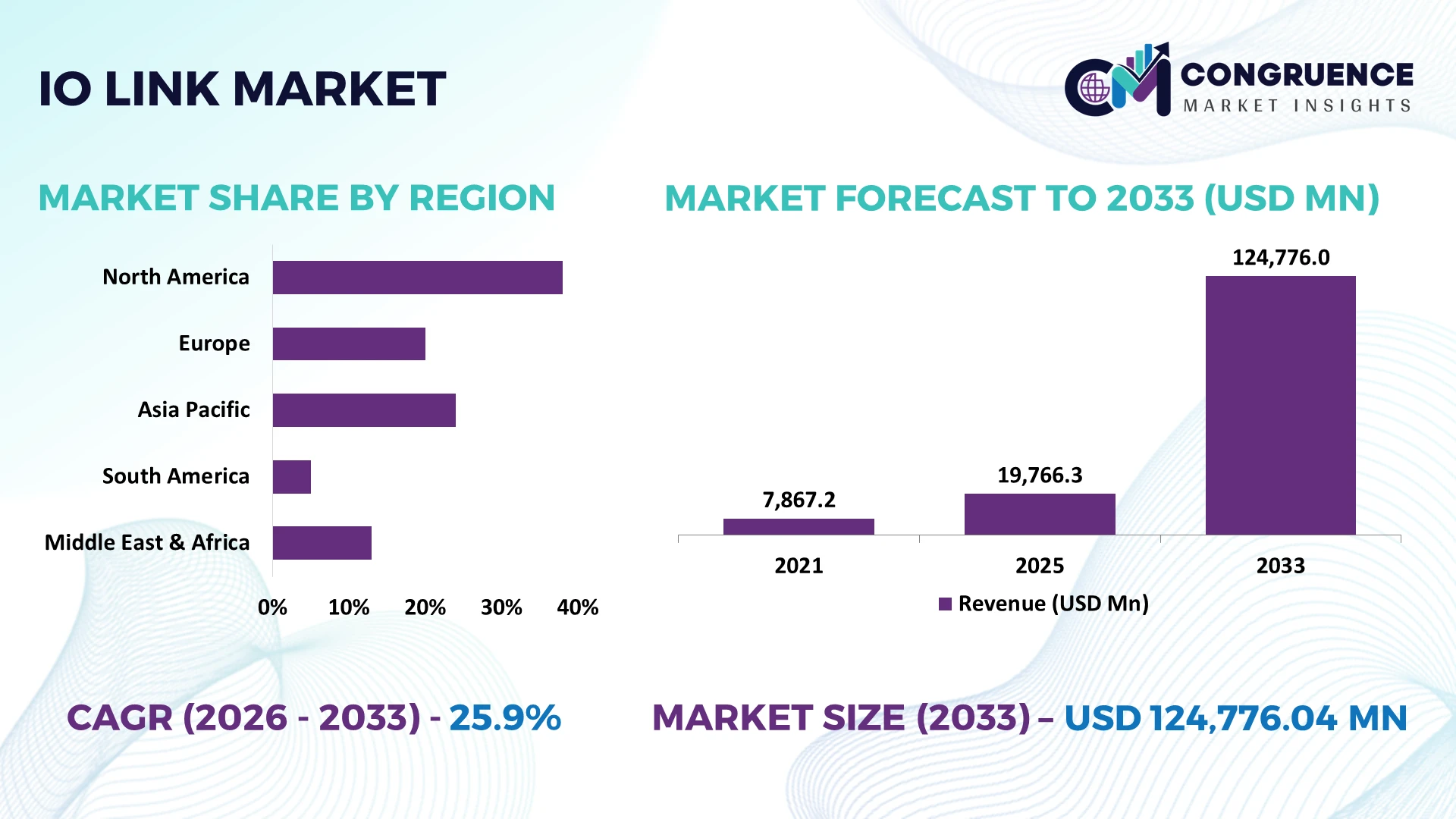
The Global IO-Link Market was valued at USD 19766.3 Million in 2025 and is anticipated to reach a value of USD 124776.04 Million by 2033 expanding at a CAGR of 25.9% between 2026 and 2033. Growth is driven by intelligent sensor deployment, predictive maintenance, decentralized I/O architectures, and the transition from conventional analog interfaces toward digitally parameterized factory devices, with more than 70 million cumulative IO-Link nodes deployed globally.
Germany remains a dominant IO-Link adoption center, supported by automotive, machinery, packaging, electronics, and process manufacturing. The country operates roughly 449 industrial robots per 10,000 manufacturing employees, compared with about 307 in the U.S., creating a denser automation environment for IO-Link masters and smart sensors. China’s rapid factory automation expansion is simultaneously challenging Germany’s established Industry 4.0 leadership.
Industrial automation suppliers should prioritize Germany-led European OEM ecosystems while accelerating Asia-Pacific expansion as China-centered manufacturing localization reshapes global IO-Link deployment opportunities.
Market Size & Growth: USD 19,766.3 million in 2025 is projected to reach USD 124,776.04 million by 2033 at 25.9%, supported by smart sensors, machine digitalization, and decentralized factory automation.
Top Growth Drivers: Predictive maintenance can reduce unplanned downtime by around 30%, digital device configuration lowers commissioning effort by nearly 25%, and smart-sensor penetration in advanced production lines continues exceeding 40%.
Short-Term Forecast: By 2027, wider IO-Link retrofits are positioned to reduce sensor commissioning and machine changeover time by approximately 40–50%, improving utilization across packaging, automotive, and discrete manufacturing facilities.
Emerging Technologies: IO-Link Wireless, IO-Link Safety, AI-enabled condition monitoring, and edge analytics are extending functionality beyond basic sensor communication, while the global ecosystem has expanded beyond 30,000 compatible products.
Regional Leaders: Europe could approach USD 42.6 billion, Asia-Pacific USD 38.7 billion, and North America USD 30.0 billion by 2033 as Industry 4.0 upgrades, localized automation, and brownfield modernization accelerate deployment.
Consumer/End-User Trends: Automotive, food processing, packaging, pharmaceuticals, machine tools, and intralogistics increasingly standardize intelligent field devices, with IO-Link-ready architectures representing roughly 30% of advanced European automation installations.
Pilot/Case Example: In 2025, guided machine-format changeover applications using IO-Link-enabled position indicators demonstrated setup-time reductions of approximately 50%, directly improving equipment availability and supporting high-mix production environments.
Competitive Landscape: Germany represents approximately 29% of European IO-Link activity, while Siemens, Balluff, ifm electronic, SICK, and Pepperl+Fuchs compete through extensive sensor portfolios, industrial Ethernet integration, and OEM relationships.
Regulatory & ESG Impact: IEC 61131-9 interoperability supports standardized device communication, while remote parameterization and condition-based maintenance can reduce wiring and associated installation requirements by approximately 20–30%.
Investment & Funding: Germany’s robotics and automation sector generates more than USD 17 billion in annual industry activity, supporting sustained investments in intelligent sensors, machine connectivity, edge systems, and software-defined production infrastructure.
Innovation & Future Outlook: More than 70 million installed IO-Link nodes provide the foundation for IO-Link Wireless, Safety, edge-to-cloud integration, and AI diagnostics as manufacturers regionalize supply chains and pursue autonomous operations.
IO-Link demand is expanding across automotive assembly, packaging, machine tools, food processing, pharmaceuticals, and intralogistics as manufacturers replace conventional analog interfaces with intelligent digital sensors. More than 70 million installed nodes demonstrate increasing industrial penetration, while IO-Link Wireless, Safety, and edge analytics broaden functionality. China’s automation expansion and European factory modernization are reshaping supplier strategies, establishing the priorities for the strategic discussion ahead.
IO-Link is becoming strategically important because machine builders increasingly compete on commissioning speed, diagnostic visibility, modularity, and lifecycle service rather than hardware performance alone. More than 30,000 compatible products and over 500 participating companies demonstrate a mature industrial ecosystem. Europe’s Cyber Resilience Act is simultaneously pushing connected-device manufacturers toward secure-by-design architectures, strengthening the importance of standardized digital interfaces in factory modernization.
Compared with conventional parallel wiring and analog instrumentation, IO-Link architectures have demonstrated up to 60% shorter installation and commissioning time and 30% lower instrumentation costs in industrial applications. Germany remains innovation-intensive through its established automation and machine-building base, while China is scaling deployment through automotive, electronics, battery, and localized equipment manufacturing. In U.S. battery-production equipment, compact IO-Link architectures have delivered 40% sensor-technology cost reductions and 30% lower wiring and commissioning costs.
Through 2028, IO-Link Wireless, Safety, edge connectivity, and automated device replacement will deepen deployment across brownfield and modular factories. Wireless configurations already support 120 devices within a 20×20-meter production cell with 5-millisecond cycles. Suppliers are expanding interoperable portfolios and ecosystem partnerships accordingly. Competitive advantage will increasingly belong to vendors that convert field-level data into lower engineering effort, faster service, and scalable digital production.
Factory modernization is shifting intelligence from centralized controllers toward sensors, actuators, and decentralized I/O, making IO-Link a practical foundation for machine-level digitalization. Industrial deployments have demonstrated 50% reductions in instrumentation commissioning time, while optimized architectures can lower instrumentation costs by 30% and installation time by 60%. Germany’s machinery, automotive, packaging, and food-processing industries are accelerating this transition as manufacturers modernize brownfield assets without replacing complete control architectures. The non-obvious advantage is workforce productivity: automatic parameter transfer reduces dependence on scarce specialist technicians during device replacement. Automation suppliers are responding by expanding IP67/IP69K masters, intelligent sensor portfolios, edge connectivity, and standardized device profiles, turning IO-Link from a component interface into a scalable operational-data layer.
Legacy machinery remains a structural constraint because IO-Link deployment requires compatible masters, digital sensors, engineering changes, and integration with existing PLC or fieldbus environments. Although optimized implementations deliver up to 30% instrumentation savings, initial conversion costs become harder to justify on low-value equipment with long replacement cycles. Retrofitting also competes against installed 4–20 mA and conventional discrete architectures that remain adequate for basic applications. In India and other cost-sensitive manufacturing locations, capital allocation still prioritizes production capacity before comprehensive sensor digitalization. Even successful implementations showing 40% lower pressure-transmitter inventory costs depend on application-specific economics. Suppliers are reducing adoption friction through retrofit masters, fieldbus-independent gateways, standardized M12 connectivity, reusable parameter sets, and phased modernization contracts rather than demanding complete automation-platform replacement.
IO-Link Wireless opens an underpenetrated opportunity in robotics, rotating equipment, automated guided systems, modular production, and difficult-to-wire machinery. The technology supports 40 devices per wireless master and up to 120 devices within a 20×20-meter production cell, while deterministic communication operates at 5-millisecond cycle times. Its packet-error probability of 10⁻⁹ provides industrial-grade reliability for applications where conventional wireless connectivity lacks deterministic behavior. China’s expanding battery and electronics factories create particularly attractive deployment conditions because production lines require frequent reconfiguration and dense sensor networks. Suppliers are directing R&D toward wireless masters, energy-efficient sensors, IO-Link Safety, edge analytics, and 5G-compatible architectures. The strategic opportunity extends beyond eliminating cables: wireless field intelligence enables equipment designs and mobile automation configurations that fixed point-to-point wiring economically restricts.
Scaling IO-Link from isolated machines to connected factory architectures increases cybersecurity, device-management, and engineering complexity. The ecosystem now exceeds 500 participating companies and 30,000 products, making consistent device descriptions, firmware management, interoperability testing, and secure integration increasingly important. Europe’s Cyber Resilience Act raises the execution threshold further by requiring connected-product manufacturers to manage vulnerabilities, secure configurations, and security updates, with support periods generally extending at least five years. Meanwhile, wireless deployments can concentrate up to 120 devices within one production cell, increasing configuration and lifecycle-management requirements. The long-term challenge is therefore governance rather than basic connectivity. Vendors must invest in certification, secure device identity, automated configuration, engineering training, firmware lifecycle tools, and OT/IT partnerships to ensure large IO-Link estates remain interoperable, maintainable, and cyber-resilient.
Device Ecosystems Are Scaling Rapidly: IO-Link has moved beyond specialist machine applications as its ecosystem exceeds 30,000 compatible products and cumulative installed nodes surpassed 70 million in 2025. Standardized device descriptions and broader multi-vendor portfolios are simplifying component substitution. Automation vendors are consequently expanding master, sensor, hub, and software portfolios to capture OEM standardization programs.
Decentralized Architectures Replace Control Cabinets: Machine builders are moving I/O closer to production assets using IP67/IP69K masters and distributed hubs, reducing cabinet space, point-to-point cabling, and installation labor. Optimized architectures can cut instrumentation costs by roughly 30% and installation time by up to 60%. German machinery suppliers increasingly package decentralized connectivity directly into modular machine platforms.
Configuration Becomes Software-Driven: Automatic parameter transfer, device identification, and remote diagnostics are changing maintenance workflows from manual sensor adjustment toward software-managed replacement. Applications have demonstrated commissioning-time reductions approaching 50%, while parameterized replacement substantially reduces technician intervention. Skilled-labor shortages reinforce this shift, prompting suppliers to integrate IO-Link engineering functions with PLC, HMI, edge, and asset-management environments.
Automation Demand Broadens Beyond Automotive: IO-Link demand is diversifying alongside factory automation. In 2025, U.S. industrial robot installations increased 11% to 38,000 units, while food-industry deployments surged 30% and approached 3,000 units. This broadening creates new sensor-connectivity requirements beyond automotive lines, pushing vendors toward hygienic devices, compact masters, condition-monitoring sensors, and application-specific automation partnerships.
IO-Link Masters lead the type segmentation with an estimated 35–40% share, reflecting their central role in linking field-level sensors and actuators with PLCs, industrial Ethernet networks, and higher-level control systems. Their value increases as factories adopt decentralized architectures, multi-protocol connectivity, and IP67/IP69K installation outside control cabinets. Masters can consolidate multiple device connections while helping machine builders reduce installation effort by approximately 30–50%. Suppliers are therefore adding OPC UA, MQTT, PROFINET, EtherNet/IP, and edge integration to master portfolios.
IO-Link Sensors represent the fastest-growing type as condition monitoring, smart measurement, and automated parameterization move intelligence closer to production equipment. Devices are benefiting from an ecosystem exceeding 30,000 compatible products, while IO-Link Hubs remain strategically important for converting conventional binary signals economically. IO-Link Devices—including actuators, valves, identification systems, and instrumentation—broaden addressable applications. Investment is consequently shifting from standalone connectivity hardware toward integrated master-plus-intelligent-device ecosystems that increase recurring engineering and lifecycle-service opportunities.
Factory Automation leads IO-Link applications with an estimated 35–40% share because assembly systems, packaging lines, material handling, and modular machinery require dense networks of sensors, actuators, and distributed I/O. Automatic parameterization and simplified wiring can reduce commissioning effort by around 30–50%, strengthening the technology’s role in high-mix manufacturing. German automotive and machinery plants remain important adopters as manufacturers redesign production assets around modular cells and digitally accessible field components.
Predictive Maintenance is the fastest-growing application as vibration, temperature, pressure, flow, and position data become available directly from intelligent sensors. Machine Monitoring remains established for status visibility and fault diagnostics, while Process Monitoring gains relevance in food, pharmaceutical, and chemical operations requiring continuous measurement. Robotics is also strengthening as automated cells demand compact connectivity and rapid tool changeovers. Vendors are responding with condition-monitoring sensors, edge analytics, configurable masters, and diagnostic software, shifting IO-Link investment from simple connectivity toward actionable equipment-health data and faster maintenance workflows.
Automotive represents the leading IO-Link end-user, with an estimated 30–35% share, supported by extensive sensor density across assembly, welding, painting, powertrain, battery, and final-inspection operations. Highly automated vehicle factories require rapid device replacement, parameter management, diagnostics, and modular production changes. European automotive facilities installed 23,000 industrial robots in 2024, illustrating the automation intensity supporting intelligent field connectivity. IO-Link suppliers are targeting OEMs and Tier-1 manufacturers with rugged masters, identification systems, position sensors, and predictive-maintenance packages.
Electronics is emerging as the fastest-growing end-user as semiconductor, battery, consumer-electronics, and precision-assembly plants deploy increasingly sensor-dense automation. Electrical and electronics manufacturing accounted for approximately 24% of global industrial robot installations in 2024, overtaking automotive. Machinery Manufacturing remains critical because OEMs embed IO-Link into equipment sold across industries, while Food & Beverage adoption centers on hygienic sensors and flexible lines. Pharmaceuticals increasingly require digital instrumentation and traceable process parameters. Vendors are responding through industry-specific portfolios, OEM partnerships, localized engineering, and interoperable automation ecosystems.
Europe accounted for the largest market share at 34.1% in 2025 however, Asia-Pacific is expected to register the fastest growth, expanding at a CAGR of 25.9% between 2026 and 2033.

Brownfield Automation and Reshoring Accelerate Retrofits
North America represents roughly 20–25% of global IO-Link demand, with adoption concentrated across automotive assembly, packaging, food processing, electronics, intralogistics, and advanced machinery. The market is increasingly retrofit-driven as manufacturers decentralize I/O, connect legacy equipment, and reduce control-cabinet complexity without replacing complete automation architectures. U.S. industrial robot installations reached about 34,200 units in 2024, confirming a large addressable base for intelligent sensors, masters, and machine diagnostics. Semiconductor and battery manufacturing localization is also raising demand for configurable production assets with faster commissioning and device replacement. Suppliers are responding with IP67 masters, EtherNet/IP connectivity, edge integration, and application engineering partnerships. The strategic shift favors vendors that integrate IO-Link into existing PLC environments while minimizing brownfield engineering costs.
U.S. Market Outlook: The United States anchors regional adoption through automotive, semiconductor, battery, logistics, and food-production automation. Manufacturing reshoring is strengthening demand for flexible machine architectures, while approximately 34,200 industrial robots installed in 2024 demonstrate substantial automation intensity. Suppliers increasingly combine IO-Link masters with EtherNet/IP, condition monitoring, edge analytics, and localized technical support to win modernization programs.
Standardized Automation Sustains Technology Leadership
Europe holds approximately 34.1% of the global IO-Link system market, supported by established automation ecosystems in Germany, Italy, France, Switzerland, and the United Kingdom. Automotive production, machine building, packaging, pharmaceuticals, and food processing provide a dense installed base for intelligent field devices. European procurement increasingly prioritizes interoperability, lifecycle diagnostics, energy efficiency, and standardized machine architectures rather than standalone sensor pricing. Germany installed roughly 27,000 industrial robots in 2024, while European manufacturers continue shifting toward decentralized I/O and software-configurable equipment. Industry 5.0 initiatives and tighter cybersecurity requirements are reinforcing secure, interoperable industrial communication. Balluff, ifm, Siemens, SICK, Pepperl+Fuchs, and other automation specialists are expanding IO-Link masters, sensors, safety functions, and edge connectivity, strengthening Europe’s influence over product architecture and industrial interoperability.
Germany Market Outlook: Germany remains Europe’s strategic IO-Link center, representing approximately 29% of European demand. Its advantage comes from tightly connected automotive OEMs, machine builders, sensor manufacturers, and automation engineering companies. Around 27,000 industrial robots were installed nationally in 2024, reinforcing demand for parameterized sensors, decentralized masters, predictive diagnostics, and standardized machine interfaces across highly automated production environments.
Manufacturing Scale Shifts Deployment Eastward
Asia-Pacific is rapidly approaching European deployment levels as China, Japan, South Korea, India, and Taiwan automate electronics, automotive, battery, semiconductor, and machinery production. China alone installed approximately 295,000 industrial robots in 2024, representing 54% of global installations, while its operational robot stock surpassed 2 million units. This extraordinary automation density creates a scalable installed base for smart sensors, decentralized I/O, condition monitoring, and machine-level diagnostics. Japan and South Korea add high-value robotics and electronics demand, while India’s 9,100 robot installations in 2024 reflected a 7% increase. Procurement is simultaneously becoming more localized as Chinese automation suppliers expand domestic production. Global IO-Link vendors are therefore strengthening distributor networks, local engineering, OEM partnerships, and cost-optimized portfolios to defend positions against increasingly capable domestic automation ecosystems.
China Market Outlook: China provides the strongest deployment-scale advantage, with 295,000 industrial robots installed in 2024 and domestic suppliers capturing 57% of its robot market. Electronics alone accounted for 83,000 installations. This localization shift is pushing IO-Link suppliers toward Chinese OEM partnerships, locally engineered masters and sensors, faster technical support, and tighter integration with domestic PLC and automation platforms.
Industrial Modernization Concentrates Around Brazil
South America accounts for approximately 5–6% of global IO-Link demand, with adoption concentrated in Brazil’s automotive, food and beverage, mining, pulp and paper, machinery, and packaging industries. Unlike Germany or China, deployment remains project-led rather than standardized across complete manufacturing networks, creating uneven penetration between multinational plants and smaller domestic factories. Automotive modernization and export-oriented food processing provide the strongest near-term use cases because downtime, changeovers, and hygiene requirements increase the value of intelligent sensing. Industrial connectivity investments increasingly favor retrofit-compatible masters that preserve existing PLC and fieldbus infrastructure. Currency volatility, imported-component dependence, and engineering-skill availability constrain broader deployment. Automation suppliers are addressing these limitations through Brazilian distribution partnerships, localized inventory, technical training, and modular retrofit packages that lower upfront engineering requirements and shorten commissioning cycles.
Brazil Market Outlook: Brazil dominates the regional opportunity through its diversified industrial base and position as Latin America’s largest automotive manufacturing hub. More than 2.5 million vehicles were produced in 2024, creating substantial demand for assembly automation, welding, material handling, sensing, and condition monitoring. Vendors targeting brownfield production lines with locally supported IO-Link retrofit packages gain the strongest operational advantage.
Industrial Diversification Creates Automation Demand
Middle East & Africa represents approximately 4–5% of global IO-Link demand, with deployment concentrated in Gulf manufacturing, energy, water, petrochemicals, logistics, and infrastructure modernization. Saudi Arabia and the UAE are shifting automation spending beyond conventional process industries toward advanced manufacturing, electronics, food production, and industrial logistics. Saudi Arabia’s Future Factories Program targets about 4,000 factories for technology-enabled transformation, creating a practical pathway for intelligent sensing, condition monitoring, and decentralized connectivity. Large greenfield facilities provide an advantage over brownfield markets because digital field architectures can be specified during initial engineering. Adoption across Africa remains more fragmented because automation infrastructure and technical support vary substantially. Vendors are responding through system-integrator alliances, regional service centers, training programs, and ruggedized sensing portfolios designed for distributed industrial assets.
Saudi Arabia Market Outlook: Saudi Arabia offers the strongest regional expansion platform as Vision 2030 connects industrial localization with automation investment. The Future Factories Program targets approximately 4,000 factories, while a 200,000-square-meter advanced manufacturing facility opened in Riyadh in 2025. IO-Link suppliers can capture demand by partnering with local integrators and embedding intelligent field connectivity into greenfield production systems.
Siemens, Balluff, ifm electronic, SICK, and Pepperl+Fuchs form the leading competitive group, while Rockwell Automation, Emerson, and Phoenix Contact challenge through broader control, connectivity, and industrial automation portfolios. The top five suppliers collectively represent an estimated 45–50% of IO-Link demand, reflecting strong OEM relationships and installed automation bases. Competition increasingly centers on interoperability, diagnostics, decentralized architecture, and engineering speed rather than component pricing alone. Integrated masters and automatic parameterization can reduce commissioning effort by 30–50%, while decentralized installations can cut wiring requirements by roughly 20–30%. Balluff and ifm emphasize sensor-to-cloud ecosystems; Siemens leverages PLC integration; SICK and Pepperl+Fuchs compete through intelligent sensing; Phoenix Contact strengthens distributed connectivity. Current competition is shifting toward IO-Link Wireless, Safety, edge analytics, and multi-protocol masters. Certification requirements, application engineering expertise, and established distribution channels remain significant entry barriers. Winning requires interoperable portfolios, rapid integration, localized support, and demonstrable lifecycle-cost reduction across increasingly software-defined factories.
Siemens AG
Balluff GmbH
ifm electronic GmbH
SICK AG
Pepperl+Fuchs SE
Rockwell Automation, Inc.
Emerson Electric Co.
Phoenix Contact GmbH & Co. KG
Turck Holding GmbH
Festo SE & Co. KG
OMRON Corporation
Keyence Corporation
Hans TURCK GmbH & Co. KG
Beckhoff Automation GmbH & Co. KG
IO-Link masters with multiprotocol Ethernet, integrated OPC UA, edge connectivity, and automatic device parameterization are reshaping machine architectures. Digital sensor-to-controller communication eliminates analog conversion losses, while direct field mounting can reduce commissioning effort by about 30% and input-card cost by roughly 50%. Adoption is established, with more than 71 million IO-Link nodes installed globally, strengthening lifecycle-service opportunities for automation suppliers across automotive, electronics, packaging, food, and pharmaceuticals plants.
Emerging technologies center on IO-Link Wireless, Safety, condition-monitoring sensors, and software-defined device management. Wireless masters support up to 40 devices with 5-millisecond cycles, extending connectivity to robotics, rotating tooling, and mobile transport systems. Compared with legacy wired sensor networks, wireless IO-Link can remove cable wear points while preserving deterministic communication, improving deployment flexibility by roughly 20–30% in motion-intensive applications. Machine builders gain faster changeovers and lower maintenance exposure.
Through 2026–2028, integration with MQTT, JSON, OpenAPI, edge analytics, and AI-based diagnostics will turn field devices into structured data sources for predictive operations. Vendors combining masters, sensors, software, and cybersecurity capabilities benefit most because customers increasingly standardize complete ecosystems rather than standalone components. Companies acting now secure OEM design-ins, reduce engineering complexity, and build recurring value around diagnostics, energy monitoring, and digital service models.
April 2024 Balluff expanded IO-Link Wireless availability in North America after UL certification, enabling one wireless master to connect up to 40 devices. The move broadened cable-free automation for robotics and mobile systems, materially reducing retrofit complexity. Source: PRWeb
June 2025 ifm introduced the AL159x multi-protocol IO-Link master supporting PROFINET and EtherNet/IP, with integrated OPC UA and eight device ports. The launch simplified OT/IT connectivity, reduced hardware variants, and strengthened predictive-maintenance architectures across global machine fleets. Source: P&C
December 2025 SICK advanced IO-Link Safety deployment with its safeIDS RFID safety switch, capable of reading over 1,000 uniquely coded tags up to Performance Level e. The product supports automated format changes and safer flexible manufacturing today. Source: SICK
May 2026 Balluff opened a 400-square-meter Chengdu Technical Innovation Center focused on sensors, connectivity, and industrial networking, backed by EUR 15 million over five years. Localization shortens engineering cycles and strengthens Asia-based IO-Link ecosystem support for manufacturers. Source: Balluff
The IO-Link Market report covers IO-Link Masters, Devices, Hubs, and Sensors across Factory Automation, Machine Monitoring, Process Monitoring, Predictive Maintenance, and Robotics. End-user analysis spans Automotive, Electronics, Food & Beverage, Pharmaceuticals, and Machinery Manufacturing, while regional coverage evaluates North America, Europe, Asia-Pacific, South America, and Middle East & Africa. Deployment patterns include more than 71 million installed IO-Link nodes and a product ecosystem exceeding 30,000 solutions.
The report also assesses IO-Link Wireless, IO-Link Safety, edge connectivity, OPC UA, MQTT, JSON integration, intelligent diagnostics, and automated parameter management. It examines brownfield retrofits, decentralized I/O, contactless connectivity, and sensor-to-cloud architectures alongside competitive positioning and supplier ecosystems. The analysis supports 2026–2033 investment planning, geographic expansion, product portfolio decisions, partnership strategy, and identification of high-value opportunities where machine digitalization, interoperability, and maintenance efficiency are reshaping purchasing priorities.
| Report Attribute/Metric | Report Details |
|---|---|
Market Revenue in 2025 | USD 19766.3 Million |
Market Revenue in 2033 | USD 124776.04 Million |
CAGR (2026 - 2033) | 25.9% |
Base Year | 2025 |
Forecast Period | 2026 - 2033 |
Historic Period | 2021 - 2025 |
Segments Covered | By Type
By Application
By End-User
|
Key Report Deliverable | Revenue Forecast, Growth Trends, Market Dynamics, Segmental Overview, Regional and Country-wise Analysis, Competition Landscape |
Region Covered | North America, Europe, Asia-Pacific, South America, Middle East, Africa |
Key Players Analyzed | Siemens AG, Balluff GmbH, ifm electronic GmbH, SICK AG, Pepperl+Fuchs SE, Rockwell Automation, Inc., Emerson Electric Co., Phoenix Contact GmbH & Co. KG, Turck Holding GmbH, Festo SE & Co. KG, OMRON Corporation, Keyence Corporation, Hans TURCK GmbH & Co. KG, Beckhoff Automation GmbH & Co. KG |
Customization & Pricing | Available on Request (10% Customization is Free) |




