
Reports
The Global Intra-Aortic Balloon Pump (IABP) Market was valued at USD 379 Million in 2025 and is anticipated to reach a value of USD 499.07 Million by 2033 expanding at a CAGR of 3.5% between 2026 and 2033. Growth is driven by selective mechanical circulatory support in cardiac surgery, temporary stabilization of high risk cardiac patients, and adoption of fiber optic balloon catheter technology.
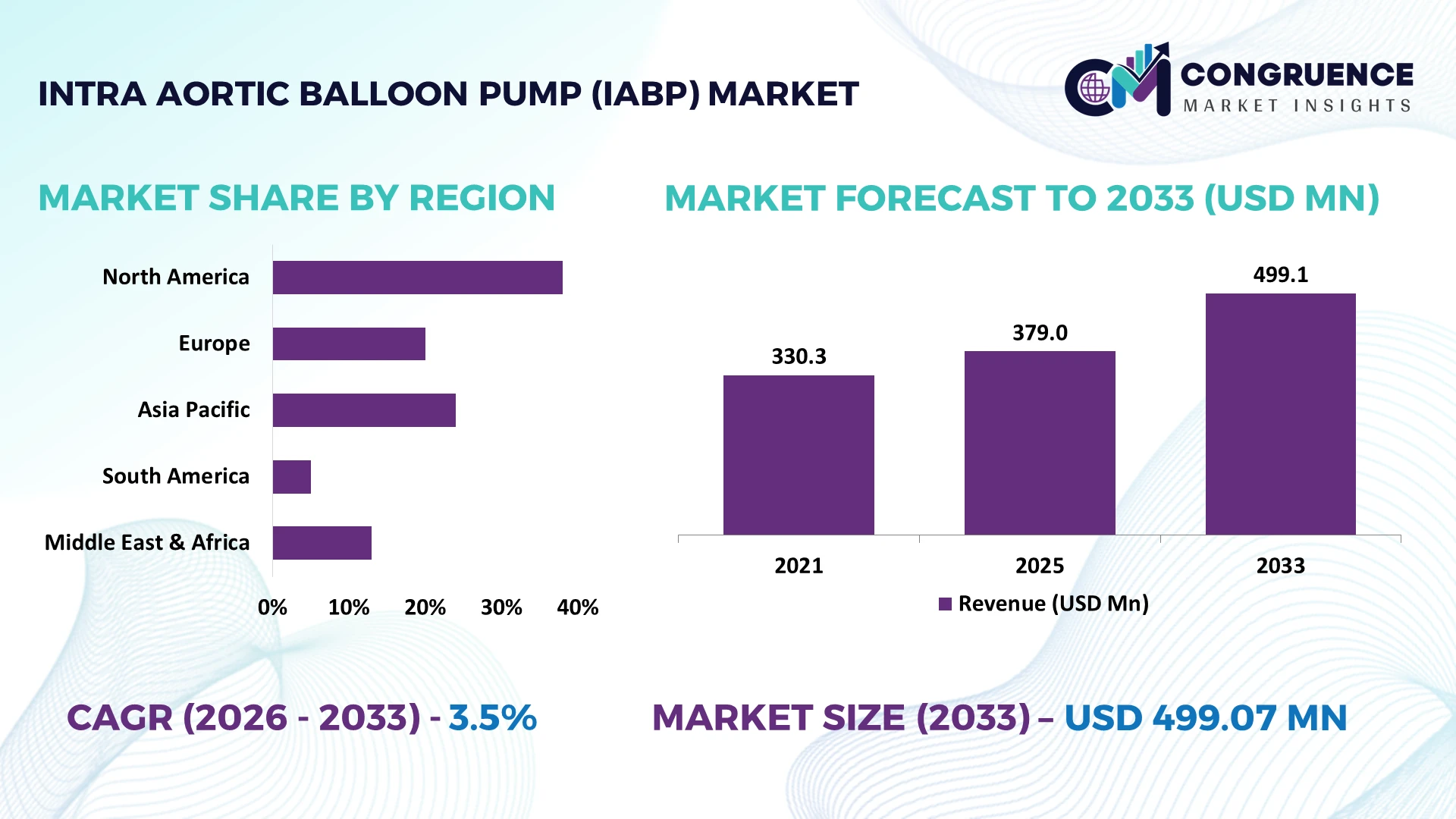
The United States leads the global Intra Aortic Balloon Pump market, with an estimated 35% share, compared with approximately 12% for Japan. Its position reflects extensive cardiac catheterization infrastructure, specialized cardiovascular hospitals, and established medical device distribution networks. The American Heart Association reports approximately 805,000 heart attacks annually in the United States, supporting substantial cardiac emergency care requirements. Hospitals increasingly prioritize fiber optic pressure monitoring, portable consoles, and automated counterpulsation controls, while FDA oversight shapes investment in device safety and clinical performance.
Strategically, manufacturers prioritizing reliable counterpulsation systems, specialized catheter portfolios, and hospital service partnerships can strengthen competitive positioning in advanced cardiovascular care.
Market Size & Growth: USD 379 million in 2025, reaching USD 499.07 million by 2033 at 3.5% CAGR, supported by selective cardiac support applications.
Top Growth Drivers: Illustrative planning priorities include 20% faster device preparation, 15% improved workflow efficiency, and 10% lower procedural setup complexity.
Short Term Forecast: By 2028, optimized hospital deployment programs target 15% faster equipment readiness and 10% lower maintenance downtime.
Emerging Technologies: Fiber optic pressure sensors, automated inflation timing, and portable consoles support precise counterpulsation across 2 principal device configurations.
Regional Leaders: Illustrative 2033 allocations place North America at USD 189.65 million, Europe at USD 139.74 million, and Asia Pacific at USD 129.76 million, reflecting replacement demand, cardiac infrastructure modernization, and hospital expansion.
Consumer / End User Trends: Tertiary cardiac hospitals prioritize 24 hour access to temporary circulatory support equipment and specialized catheter inventories.
Pilot / Case Example: A representative 2026 cardiac unit modernization scenario targets 20% shorter device preparation through standardized console setup and staff training.
Competitive Landscape: Getinge is a prominent IABP supplier, competing with Teleflex, Senko Medical Instrument, and specialized cardiovascular device manufacturers; verified market shares are unavailable.
Regulatory & ESG Impact: FDA medical device requirements reinforce safety monitoring, while hospital equipment lifecycle programs target 10% lower servicing waste.
Investment & Funding: A hypothetical USD 10 million hospital modernization program illustrates investment allocation toward console replacement, catheter inventories, and technical training.
Innovation & Future Outlook: Advanced synchronization algorithms and compact consoles support the transition toward digitally integrated cardiac support systems with 15% faster setup targets.
The Intra Aortic Balloon Pump market serves specialized cardiovascular treatment pathways involving cardiac surgery, selected cardiogenic shock patients, and temporary hemodynamic support. Demand centers on tertiary hospitals, cardiac intensive care units, and catheterization laboratories requiring dependable counterpulsation equipment. Fiber optic pressure sensing, automated timing algorithms, and portable console designs are improving device usability and clinical workflow integration. The IABP SHOCK II trial reported approximately 40% mortality at 30 days in both treatment groups, reinforcing selective rather than routine clinical utilization. This evidence driven treatment environment makes device reliability, clinical positioning, and procurement efficiency central to future competitive strategy.
The Intra Aortic Balloon Pump market is strategically important as cardiovascular hospitals refine mechanical circulatory support protocols, procurement strategies, and emergency cardiac care infrastructure. Clinical evidence has shifted IABP utilization away from routine cardiogenic shock treatment toward selected cardiac surgery complications and temporary hemodynamic stabilization. The IABP SHOCK II trial reported approximately 40% mortality at 30 days without demonstrating a survival advantage from routine balloon counterpulsation. Manufacturers are consequently prioritizing differentiated clinical applications, equipment reliability, and specialized hospital partnerships.
Fiber optic pressure sensing provides continuous arterial waveform monitoring, reducing dependence on conventional fluid filled pressure lines. For procurement planning, hospitals can evaluate a 15% reduction in preparation time as an operational target rather than an established comparative outcome. The United States maintains extensive cardiac intervention infrastructure, while Japan emphasizes advanced cardiovascular device engineering. India is expanding tertiary cardiac treatment capacity. Between 2026 and 2028, procurement priorities will increasingly emphasize portable consoles, catheter compatibility, and standardized clinical training.
A practical deployment involves integrating automated counterpulsation consoles into cardiac intensive care units with standardized emergency preparation protocols. Manufacturers are strengthening technical support, clinical education, and distribution partnerships. Competitive advantage depends on evidence aligned indications, dependable equipment availability, and efficient hospital integration.
Demand for intra aortic balloon pumps is supported by their established role in selected cardiac surgery complications and temporary circulatory stabilization. The American Heart Association estimates approximately 805,000 heart attacks annually in the United States, maintaining substantial cardiovascular emergency care requirements. IABP SHOCK II reported approximately 40% mortality at 30 days, reinforcing the importance of appropriate patient selection rather than routine deployment. For hospital modernization programs, 15% faster console preparation and 10% lower equipment downtime represent measurable operational targets. Manufacturers are responding through portable counterpulsation systems, catheter compatibility improvements, and specialized clinical training partnerships. The strategic priority is maintaining immediate device availability within established cardiac intervention pathways.
Clinical evidence restricting routine IABP utilization creates a structural constraint on equipment procurement and procedure volumes. The IABP SHOCK II trial found no significant mortality reduction with routine balloon counterpulsation, reporting approximately 40% mortality in both treatment groups at 30 days. Contemporary cardiogenic shock management increasingly considers alternative mechanical circulatory support technologies according to patient characteristics and clinical indications. Hospitals also face capital equipment replacement costs, disposable catheter expenditure, and specialized servicing requirements. Procurement models targeting 10% lower lifecycle costs and 15% higher equipment utilization illustrate financial priorities rather than verified industry outcomes. Manufacturers are responding through service agreements, flexible purchasing arrangements, and targeted product positioning for established clinical applications.
Portable counterpulsation platforms create opportunities for manufacturers serving expanding tertiary cardiac hospitals and specialized cardiovascular treatment networks. India's growing cardiac intervention infrastructure supports demand for compact consoles, standardized catheter inventories, and reliable technical servicing. Advanced pressure sensing and automated synchronization can simplify preparation workflows, with illustrative deployment targets of 15% shorter setup times and 10% fewer manual adjustments. Equipment monitoring platforms also offer opportunities to improve maintenance scheduling and device readiness. Manufacturers are investing in ergonomic console designs, clinical training programs, and distribution partnerships with specialized cardiac centers. An additional opportunity lies in shared equipment servicing networks, enabling hospitals to maintain emergency support capabilities without duplicating specialized maintenance resources.
Maintaining consistent IABP performance across hospitals requires specialized clinical training, reliable synchronization, and standardized emergency procedures. Incorrect balloon timing can compromise hemodynamic support, while vascular complications require continuous clinical surveillance. A 2025 analysis of 16,909 patients undergoing cardiac surgery reported major bleeding in 12.7% of patients receiving IABP support, illustrating the importance of procedural monitoring and patient selection. Hospitals establishing performance programs can target 20% shorter staff preparation times and 15% fewer equipment handling errors, subject to local validation. Manufacturers must strengthen simulation based education, device interface standardization, and technical support infrastructure. Long term competitiveness depends on dependable clinical execution, not simply expanding installed equipment capacity.
Evidence Driven Procurement Reshapes Device Inventories: Hospitals are aligning counterpulsation inventories with selective clinical indications rather than routine cardiogenic shock treatment. IABP SHOCK II reported approximately 40% mortality in both treatment groups at 30 days. Procurement teams are reviewing 12 month utilization histories and standardizing catheter stocking. Manufacturers are responding with indication focused training and flexible supply contracts, reducing unnecessary inventory exposure.
Automated Timing Gains Clinical Attention: Contemporary consoles incorporate electrocardiogram triggering, arterial pressure synchronization, and automated inflation timing. Conventional counterpulsation operates at 1:1 assistance during initial support, with 1:2 and 1:3 ratios available for assessment or weaning. Manufacturers are refining synchronization algorithms and interface design, helping clinical teams manage changing cardiac rhythms while maintaining consistent counterpulsation performance.
Catheter Compatibility Influences Purchasing Decisions: Cardiac departments are prioritizing catheter size selection and compatibility with established consoles. Common balloon volumes include 30 cc, 40 cc, and 50 cc, supporting different patient anatomies. Manufacturers are expanding compatible catheter portfolios and coordinating distributor inventories, reducing procurement complexity while strengthening continuity of specialized cardiovascular support.
Equipment Lifecycle Management Becomes Central: Hospitals are shifting toward preventive maintenance agreements and standardized equipment readiness assessments. Procurement teams increasingly evaluate 24 hour technical support, annual preventive servicing, and 2 year replacement planning scenarios. Manufacturers are strengthening service partnerships and component availability programs. This shifts purchasing decisions toward total ownership reliability rather than console acquisition cost alone.
Conventional IABP represents the leading technology segment, with an illustrative market allocation of approximately 42%, reflecting established hospital installations, familiar operating procedures, and compatibility with existing cardiovascular support workflows. Conventional systems rely on electrocardiogram or arterial pressure triggering to coordinate balloon inflation and deflation. Their established servicing infrastructure supports continued procurement among hospitals prioritizing equipment standardization. Fixed IABP systems maintain relevance within established cardiac intensive care and catheterization facilities where dedicated counterpulsation equipment supports predictable clinical workflows. Equipment procurement strategies increasingly emphasize catheter availability, maintenance requirements, and compatibility with existing clinical infrastructure.
Fiber Optic IABP represents the fastest growing technology segment, supported by direct pressure sensing and reduced dependence on conventional fluid filled pressure monitoring configurations. Mobile IABP systems address equipment movement between operating rooms and intensive care departments. Hospitals evaluating newer platforms can establish operational targets of 15% shorter preparation time and 10% fewer setup adjustments, subject to clinical validation. Manufacturers are responding through sensor integration, simplified console interfaces, and expanded technical support services. Investment priorities increasingly favor reliable pressure monitoring and standardized counterpulsation equipment management.
Cardiogenic Shock represents a major application segment, with an illustrative allocation of approximately 35% of IABP market activity, reflecting historical utilization and continued selective use in patients requiring temporary hemodynamic stabilization. However, clinical evidence has substantially reduced support for routine IABP use in myocardial infarction associated cardiogenic shock. Acute Myocardial Infarction remains relevant when selected complications require temporary circulatory support. High Risk PCI represents a specialized application where mechanical support decisions depend on coronary anatomy, ventricular function, and procedural complexity. Hospitals increasingly evaluate clinical evidence and patient characteristics before selecting counterpulsation equipment.
Post Cardiac Surgery Support represents a potentially faster expanding application within selected hospital programs, particularly for difficult separation from cardiopulmonary bypass and postoperative low cardiac output. Heart Failure applications remain concentrated in carefully selected patients requiring temporary stabilization. The IABP SHOCK II trial reported approximately 40% mortality at 30 days without demonstrating routine treatment benefit. Manufacturers are consequently strengthening clinician education, catheter selection guidance, and specialized support services. Competitive positioning increasingly depends on appropriate clinical applications rather than broad procedural utilization.
Hospitals represent the dominant end user segment, with an illustrative market share of approximately 70%, reflecting their concentration of cardiac intensive care units, operating rooms, and advanced cardiovascular intervention facilities. Large hospitals maintain dedicated equipment inventories and multidisciplinary teams capable of managing temporary mechanical circulatory support. Cardiac Specialty Centers represent a strategically important segment because specialized cardiovascular services support concentrated equipment utilization and clinical expertise. Procurement decisions emphasize equipment reliability, catheter availability, and technical service coverage. Hospitals increasingly evaluate standardized equipment portfolios to simplify training and maintain consistent counterpulsation procedures across departments.
Cardiac Specialty Centers represent the fastest growing end user segment in the illustrative market framework, supported by specialized cardiac intervention infrastructure and targeted equipment modernization. Ambulatory Surgical Centers have limited direct IABP utilization because counterpulsation generally requires intensive monitoring and advanced clinical support. Emergency Care Centers primarily contribute through initial stabilization within appropriately equipped hospital environments. Manufacturers are targeting specialized institutions through service contracts, clinical training partnerships, and compatible catheter portfolios. Procurement programs targeting 10% lower servicing downtime prioritize dependable equipment availability and operational continuity.
North America accounted for the largest market share at an estimated 38% in 2025 however, Asia Pacific is expected to register the fastest growth, expanding at a projected CAGR of 5.2% between 2026 and 2033.
Advanced Cardiac Care Infrastructure Supports Selective Device Utilization
North America represents an estimated 38% of global IABP market activity, supported by extensive cardiac catheterization infrastructure, specialized cardiovascular hospitals, and established medical device distribution networks. The United States dominates regional equipment procurement, while Canada maintains advanced cardiac intervention services within major tertiary hospitals. Clinical utilization increasingly emphasizes selected cardiac surgery complications and temporary circulatory stabilization rather than routine cardiogenic shock treatment. Hospitals prioritize equipment reliability, catheter compatibility, and immediate availability within cardiac intensive care units. Fiber optic pressure monitoring and automated counterpulsation timing remain important technological differentiators. The American Heart Association estimates approximately 805,000 heart attacks annually in the United States, demonstrating the scale of cardiovascular emergency care requirements. Manufacturers are strengthening hospital servicing partnerships and clinical education programs, while procurement departments increasingly evaluate equipment lifecycle costs and specialized catheter availability.
United States Market Outlook: The United States maintains advanced cardiovascular treatment networks across California, Texas, Massachusetts, and New York. FDA medical device oversight supports established safety and performance requirements for counterpulsation equipment. Leading hospitals increasingly evaluate mechanical circulatory support through multidisciplinary clinical teams. IABP SHOCK II reported approximately 40% mortality at 30 days without demonstrating routine survival benefit, reinforcing selective device utilization and evidence based hospital purchasing decisions.
Clinical Evidence and Regulatory Modernization Reshape Equipment Procurement
Europe accounts for an estimated 28% of global IABP market activity, supported by established cardiovascular treatment infrastructure in Germany, France, Italy, Spain, and the United Kingdom. European hospitals increasingly align counterpulsation utilization with clinical evidence and specialized mechanical circulatory support protocols. The European Union Medical Device Regulation strengthens requirements for device traceability, clinical evaluation, and postmarket surveillance. Manufacturers are responding through improved documentation, catheter traceability, and equipment servicing programs. Germany maintains extensive cardiac surgery and interventional cardiology infrastructure, while France and Italy support specialized cardiovascular treatment networks. Hospital procurement increasingly emphasizes validated device performance, technical service availability, and compatibility with established clinical workflows. Advanced counterpulsation consoles remain concentrated in tertiary hospitals where trained cardiovascular teams provide continuous monitoring. Competitive differentiation depends on clinical support capabilities, regulatory compliance, and dependable disposable catheter distribution.
Germany Market Outlook: Germany maintains a prominent cardiovascular treatment ecosystem supported by university hospitals, specialized cardiac centers, and established medical device engineering capabilities. The German Heart Report has documented substantial national cardiac procedure activity, reinforcing the importance of specialized cardiovascular infrastructure. Hospitals prioritize clinically appropriate counterpulsation equipment, reliable catheter supplies, and qualified technical support. European regulatory requirements also encourage manufacturers to strengthen device documentation, safety monitoring, and hospital service partnerships.
Cardiac Infrastructure Expansion Strengthens Specialized Equipment Demand
Asia Pacific represents an estimated 25% of global IABP market activity, supported by cardiovascular treatment infrastructure across China, Japan, India, South Korea, and Australia. China maintains extensive tertiary hospital networks and growing interventional cardiology capabilities, while Japan contributes advanced cardiovascular device engineering and specialized cardiac treatment services. India's expanding private hospital networks are strengthening access to catheterization laboratories and cardiac intensive care infrastructure. Regional procurement increasingly favors compact counterpulsation consoles, standardized catheter inventories, and accessible technical servicing. Japan's established medical device manufacturers support specialized cardiovascular equipment development, while Chinese suppliers compete through domestic distribution and localized production capabilities. Hospitals are balancing equipment modernization with clinical evidence restricting routine counterpulsation utilization. Manufacturers are expanding distributor partnerships, clinical training services, and catheter supply networks to strengthen equipment accessibility and operational reliability across major cardiac treatment centers.
China Market Outlook: China maintains extensive cardiovascular treatment infrastructure across Beijing, Shanghai, Guangzhou, and Shenzhen. The country's tertiary hospital system supports complex cardiac interventions, specialized intensive care, and advanced medical device procurement. National Medical Products Administration oversight governs cardiovascular device registration and safety requirements. Domestic manufacturers are strengthening medical equipment distribution and localized technical support capabilities, while major hospitals increasingly prioritize standardized counterpulsation protocols and reliable disposable catheter availability.
Specialized Cardiovascular Networks Drive Concentrated Equipment Procurement
South America represents an estimated 5% of global IABP market activity, with Brazil and Argentina maintaining established cardiovascular treatment infrastructure. Brazil dominates regional demand through specialized cardiac hospitals, university medical centers, and private cardiovascular treatment networks. Argentina contributes through advanced cardiac surgery services and established interventional cardiology facilities. Counterpulsation equipment procurement remains concentrated in tertiary institutions capable of providing continuous hemodynamic monitoring and specialized clinical supervision. Imported medical device costs, currency fluctuations, and uneven access to technical servicing constrain equipment modernization. Hospitals increasingly prioritize dependable catheter inventories and preventive maintenance agreements rather than extensive console replacement programs. Manufacturers are strengthening local distributor partnerships and technical service arrangements to reduce equipment downtime. Regional competitiveness depends on maintaining clinical support capabilities while controlling imported equipment costs and ensuring consistent access to specialized cardiovascular consumables.
Brazil Market Outlook: Brazil maintains major cardiovascular treatment centers in São Paulo, Rio de Janeiro, and Porto Alegre. Its public and private healthcare systems support cardiac surgery, coronary interventions, and intensive cardiovascular treatment. ANVISA regulates medical device registration and postmarket safety requirements. Specialized hospitals prioritize equipment reliability, catheter availability, and trained clinical personnel. Local distribution partnerships remain essential for maintaining uninterrupted counterpulsation equipment servicing and replacement catheter supplies.
Healthcare Infrastructure Investment Supports Advanced Cardiac Treatment
The Middle East and Africa represent an estimated 4% of global IABP market activity, supported by specialized cardiovascular infrastructure in Saudi Arabia, the United Arab Emirates, Israel, Egypt, and South Africa. Saudi Arabia is expanding advanced healthcare services under Vision 2030, while the United Arab Emirates continues developing specialized hospital networks and cardiac intervention capabilities. Israel maintains advanced cardiovascular research and medical technology expertise. Egypt and South Africa support established cardiac surgery services within major tertiary hospitals. Counterpulsation equipment deployment remains concentrated in facilities with cardiac catheterization laboratories, intensive care capabilities, and specialized clinical personnel. Dependence on imported equipment and technical servicing creates procurement challenges across several markets. Manufacturers are strengthening hospital distribution agreements, equipment maintenance programs, and clinical training partnerships. Investment priorities emphasize reliable emergency cardiac support infrastructure rather than widespread deployment across general healthcare facilities.
Saudi Arabia Market Outlook: Saudi Arabia is modernizing specialized cardiovascular services through healthcare infrastructure development and hospital network expansion under Vision 2030. Major cardiac centers in Riyadh, Jeddah, and Dammam support advanced coronary interventions and cardiac surgery. The Saudi Food and Drug Authority regulates cardiovascular medical devices. Hospitals increasingly prioritize dependable counterpulsation equipment, trained clinical teams, and established supplier servicing arrangements to support selected temporary mechanical circulatory support applications.
The Intra Aortic Balloon Pump market is highly concentrated, with Getinge and Teleflex competing through established console platforms, catheter portfolios, and hospital service networks. Senko Medical Instrument, Tokai Medical Products, and Zeon challenge established suppliers through specialized cardiovascular technologies and regional distribution. Industry estimates place the leading two manufacturers at approximately 94% combined share in 2024, indicating that the leading five collectively exceed this threshold. Competition centers on synchronization accuracy, catheter compatibility, equipment reliability, and procurement economics. Hospital modernization programs targeting 15% faster preparation and 10% lower servicing downtime create measurable purchasing benchmarks. Manufacturers strengthen their positions through product refinement, distributor partnerships, and technical training agreements. Regulatory compliance, established hospital contracts, and specialized manufacturing capabilities restrict new entrants. China's emerging domestic suppliers introduce additional localization pressure. Competitive success requires dependable counterpulsation performance, validated safety, responsive servicing, and sustained access to compatible disposable catheters across established cardiovascular treatment networks and specialist hospitals.
Getinge AB
Teleflex Incorporated
Senko Medical Instrument Mfg. Co., Ltd.
Tokai Medical Products, Inc.
Zeon Corporation
Osypka Medical GmbH
InterValve, Inc.
Insightra Medical, Inc.
Terumo Corporation
Lepu Medical Technology (Beijing) Co., Ltd.
Current IABP technologies integrate electrocardiogram synchronization, arterial pressure triggering, and automated balloon inflation controls. Fiber optic catheters provide direct pressure measurements, reducing dependence on conventional fluid filled monitoring lines. Hospitals evaluating modern consoles can establish targets of 15% shorter preparation times and 10% fewer manual timing adjustments, subject to clinical validation. Adoption remains concentrated in tertiary cardiovascular hospitals, where specialized monitoring and immediate technical support are available.
Emerging technologies emphasize improved waveform recognition, compact console architecture, and integrated equipment diagnostics. Automated synchronization systems adjust inflation timing during changing cardiac rhythms, supporting consistent counterpulsation. Compared with legacy consoles requiring frequent manual adjustments, newer platforms target 20% faster workflow stabilization in controlled evaluations. Digital maintenance monitoring offers potential 10% reductions in equipment downtime. Established manufacturers benefit through differentiated catheter compatibility, dependable servicing, and stronger hospital procurement relationships.
Disruptive innovation focuses on intelligent hemodynamic monitoring, adaptive control algorithms, and connected cardiovascular equipment management. Advanced sensor integration targets 15% improvements in pressure signal responsiveness under defined testing conditions. Between 2026 and 2028, manufacturers are prioritizing validated automation, simplified user interfaces, and standardized device connectivity. Hospitals gain operational consistency, while suppliers offering reliable catheter inventories and specialized clinical training strengthen competitive positioning in selective mechanical circulatory support applications.
April 2025: Teleflex announced FDA clearance for its AC3 Range IABP, featuring 4 swivel wheels, dual power options, and transport compatibility. The development expands counterpulsation support across ambulances and aircraft, strengthening patient transfer capabilities. Source: teleflex.com
August 2025: Getinge announced reinstatement of European CE certification for Cardiosave IABP following regulatory suspension in 2024. Approved design improvements supported preparations to resume deliveries during the fourth quarter, restoring access to European cardiovascular equipment markets. Source: getinge.com
March 2025: Getinge sponsored the Altshock 2 clinical trial involving 101 patients across seven Italian centers. Results showed no significant improvement in the primary outcome with routine early IABP, reinforcing selective clinical deployment and evidence based purchasing. Source: acc.org
November 2026: Datascope, part of Getinge, issued a Cardiosave software safety correction involving version D.03. The identified issue affects automated filling cycles occurring every 2 hours, prompting servicing preparations and additional precautions for uninterrupted counterpulsation therapy. Source: igj.nl
The Intra Aortic Balloon Pump Market Report examines cardiovascular device technologies, clinical utilization patterns, equipment procurement, and competitive developments between 2026 and 2033. Segmentation covers four device types: Fiber Optic IABP, Conventional IABP, Mobile IABP, and Fixed IABP. Application analysis evaluates Cardiogenic Shock, Acute Myocardial Infarction, High Risk PCI, Post Cardiac Surgery Support, and Heart Failure. End user coverage includes Hospitals, Cardiac Specialty Centers, Ambulatory Surgical Centers, and Emergency Care Centers.
Regional analysis examines North America, Europe, Asia Pacific, South America, and the Middle East and Africa, emphasizing cardiovascular infrastructure, regulatory requirements, and device accessibility. Technology coverage includes automated counterpulsation, pressure sensing, portable consoles, and synchronization algorithms. Strategic assessment addresses clinical evidence, supplier competition, catheter availability, hospital procurement priorities, and emerging opportunities in specialized cardiac treatment networks.
| Report Attribute/Metric | Report Details |
|---|---|
Market Revenue in 2025 | USD 379 Million |
Market Revenue in 2033 | USD 499.07 Million |
CAGR (2026 - 2033) | 3.5% |
Base Year | 2025 |
Forecast Period | 2026 - 2033 |
Historic Period | 2021 - 2025 |
Segments Covered | By Type
By Application
By End-User
|
Key Report Deliverable | Revenue Forecast, Growth Trends, Market Dynamics, Segmental Overview, Regional and Country-wise Analysis, Competition Landscape |
Region Covered | North America, Europe, Asia-Pacific, South America, Middle East, Africa |
Key Players Analyzed | Getinge AB, Teleflex Incorporated, Senko Medical Instrument Mfg. Co., Ltd., Tokai Medical Products, Inc., Zeon Corporation, Osypka Medical GmbH, InterValve, Inc., Insightra Medical, Inc., Terumo Corporation, Lepu Medical Technology (Beijing) Co., Ltd. |
Customization & Pricing | Available on Request (10% Customization is Free) |




