
Reports
The Global Internet of Things (IoT) in Energy Market was valued at USD 37300 Million in 2025 and is anticipated to reach a value of USD 99159.96 Million by 2033 expanding at a CAGR of 13% between 2026 and 2033. Growth is driven by utility-scale smart-meter deployment, grid-edge sensors, predictive asset monitoring, distributed-energy integration, and cloud-connected automation across electricity, oil and gas, and renewable-energy infrastructure.
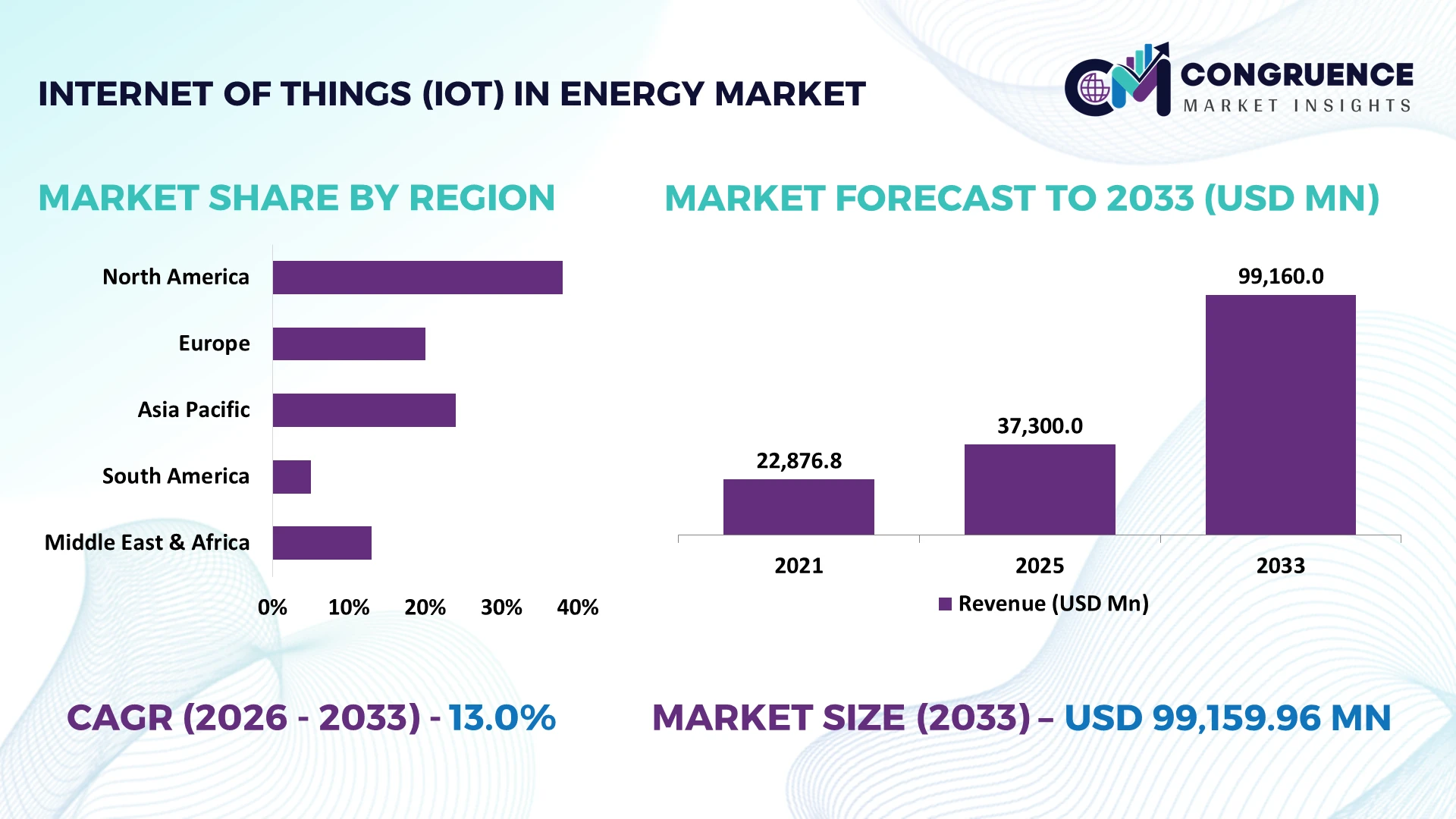
The United States remains a dominant country-level market, supported by extensive utility digitization, smart-grid investment, and large-scale deployment of connected grid infrastructure. North America represented approximately 37.6% of global IoT-in-energy activity in 2025, while U.S. federal grid-modernization programs include USD 10.5 billion under GRIP, with more than USD 6 billion announced through its first two rounds. China provides the strongest scale comparison, backed by more than USD 442 billion of planned 2021–2025 power-grid investment and extensive smart-meter adoption. U.S. deployment is increasingly shaped by grid resilience, data-center load growth, and extreme-weather exposure.
Strategically, suppliers should prioritize interoperable AMI, edge analytics, cybersecurity, and AI-enabled grid intelligence where utilities are converting modernization budgets into large connected-device estates.
Market Size & Growth: USD 37,300 million in 2025 advances to USD 99,159.96 million by 2033 at 13% CAGR, driven by smart-grid modernization, connected assets, and real-time energy optimization.
Top Growth Drivers: Smart-grid monitoring represented 38.1% of 2025 activity, utilities held 45.4% of end-user demand, and cellular connectivity accounted for 53.5%, demonstrating infrastructure-led adoption.
Short-Term Forecast: By 2028, AI-assisted IoT architectures will increasingly shift maintenance from scheduled intervention toward predictive workflows, with advanced digital-twin implementations delivering approximately 30% lower operational response time.
Emerging Technologies: Edge AI, digital twins, and 5G/NB-IoT are becoming core technologies; cloud-hosted platforms represented approximately 48.6% of deployments in 2025, accelerating remote analytics and automated control.
Regional Leaders: North America maintains approximately 37.6% market participation, Asia-Pacific is expanding through large-scale smart-grid programs, while Europe accelerates connected energy infrastructure through advanced metering and renewable integration.
Consumer/End-User Trends: Electric and gas utilities represented approximately 45.4% of 2025 demand, while connected consumption analytics can reduce energy use by around 12% through improved visibility and automated optimization.
Pilot/Case Example: In 2025, a smart-meter deployment covering 9,572 metering points increased billing efficiency by 35 percentage points and reduced AT&C losses from 38.5% to 9.6%.
Competitive Landscape: Hardware represented approximately 40.4% of the 2025 component mix, with IBM, Siemens, Schneider Electric, Cisco, and major cloud-platform providers competing across analytics, automation, connectivity, and grid intelligence.
Regulatory & ESG Impact: India had installed approximately 52.8 million smart meters by December 2025, while national AT&C losses declined from 21.91% in FY2021 to 15.04% in FY2025 amid distribution-sector modernization.
Investment & Funding: The U.S. GRIP program carries USD 10.5 billion in authorized funding, including USD 3 billion for Smart Grid Grants, strengthening connected-grid infrastructure amid rising manufacturing and data-center electricity loads.
Innovation & Future Outlook: Cellular connectivity accounts for approximately 53.5% of deployments, while edge AI, satellite IoT, digital twins, and distributed-energy orchestration are shifting competition toward secure end-to-end energy intelligence platforms.
The Internet of Things (IoT) in Energy Market is increasingly concentrated around smart grids, advanced metering infrastructure, renewable-asset monitoring, predictive maintenance, and digitally managed oil and gas operations. AI-enabled edge devices and digital twins are moving analytics closer to substations, turbines, and distributed energy resources, enabling approximately 30% faster operational response in advanced implementations. India’s deployment of 52.8 million smart meters by December 2025 illustrates how regulatory modernization is creating massive connected-device estates. This transition is strengthening demand for interoperability, cybersecurity, real-time analytics, and automated energy management, establishing the foundation for the market’s strategic evolution.
IoT is becoming strategically important as utilities shift from periodic asset inspection toward continuous, data-driven grid management. Smart meters, connected substations, distributed-energy resources, and sensorized generation assets give operators real-time visibility over increasingly complex electricity networks. India’s rollout of more than 52 million smart meters illustrates this infrastructure transition, while U.S. grid-modernization programs are accelerating investment in resilient digital networks. Competition is consequently shifting from standalone hardware toward interoperable platforms combining connectivity, analytics, cybersecurity, and automation.
Technology economics reinforce this transition. Advanced smart-meter deployments can cut meter-reading costs by over 60% versus manual collection, while predictive monitoring can reduce unplanned equipment downtime by approximately 20–30%. The United States emphasizes grid resilience, distributed resources, and data-center load management; China operates at substantially greater smart-meter and grid-investment scale. Through 2026–2028, edge AI, digital twins, and private cellular networks will increasingly move decision-making directly to energy assets.
A practical example is automated metering infrastructure linking household meters with utility billing and outage-management platforms, enabling faster fault localization and remote service operations. Suppliers are therefore increasing partnerships across cloud, telecom, automation, and utility ecosystems. Competitive advantage will increasingly depend on converting connected-device data into measurable reliability, maintenance, and energy-efficiency gains.
Utility modernization is the primary structural driver for energy IoT deployment, as operators replace isolated meters and equipment with continuously connected grid assets. India had installed approximately 52.8 million smart meters by December 2025, while distribution-sector AT&C losses declined from 21.9% in FY2021 to 15.0% in FY2025. Smart-grid monitoring accounts for roughly 38% of IoT-in-energy applications, reinforcing demand for AMI, substation sensors, outage intelligence, and distribution automation. India’s Revamped Distribution Sector Scheme is accelerating this transition from manual monitoring toward digitally measurable networks. Technology suppliers are responding through meter manufacturing expansion, communications partnerships, cloud integration, and analytics platforms. Strategically, ownership of meter-to-cloud data architecture creates recurring software and grid-management opportunities beyond initial hardware deployment.
Fragmented legacy infrastructure remains a significant commercial constraint because utilities must integrate modern sensors with equipment designed around proprietary protocols and limited digital interfaces. Industrial IoT projects can allocate approximately 30–40% of implementation expenditure to integration, connectivity, cybersecurity, and system modification rather than endpoint hardware. In many legacy environments, more than 20% of connected assets can require gateways or protocol conversion before centralized monitoring becomes practical. India’s distribution network illustrates the operational divide between advanced urban smart-grid deployments and utilities still upgrading communications and metering infrastructure. This fragmentation lengthens commissioning cycles, raises systems-integration costs, and limits standardized platform scaling. Vendors are reducing exposure through protocol-agnostic gateways, modular software, multivendor interoperability testing, and local implementation partnerships. The key commercial constraint is therefore integration economics rather than sensor availability.
Edge AI and distributed-energy orchestration are opening higher-value opportunities beyond conventional remote monitoring. Processing data near substations, solar farms, batteries, and industrial microgrids can reduce cloud traffic by 30–50% in data-intensive applications while cutting response latency by more than 40% compared with centralized architectures. India surpassed 100 GW of installed solar capacity in 2025, creating an expanding asset base requiring forecasting, inverter monitoring, storage coordination, and grid-balancing intelligence. Virtual power plants, AI-based load forecasting, and digital twins will extend IoT platforms into automated energy optimization through 2026–2028. Technology companies are investing in edge computing, DER management software, telecom partnerships, and API-based ecosystems. The less obvious opportunity lies in monetizing flexibility data, turning connected assets into dispatchable grid resources rather than passive monitoring endpoints.
Scaling millions of connected energy endpoints creates an execution challenge that extends well beyond conventional IT security. Energy organizations face interconnected risks across smart meters, substations, industrial controllers, cloud platforms, and third-party communications networks; compromised credentials remain involved in roughly one-third of analyzed security breaches across industries. Meanwhile, legacy operational-technology environments can remain active for 15–25 years, creating prolonged exposure where modern security controls must coexist with older equipment. U.S. critical-infrastructure cybersecurity requirements are pushing utilities toward stronger segmentation, device authentication, encryption, and continuous asset visibility. Suppliers must embed security-by-design, zero-trust controls, firmware lifecycle management, and automated threat detection into IoT architectures. Long-term competitiveness depends on securing device fleets at scale without adding latency or operational complexity that undermines automation benefits.
AI Moves Into Control Rooms: Utilities are moving AI from centralized analytics into operational workflows, with nearly 40% of utility control rooms expected to use AI by 2027. Edge processing is enabling millisecond-level decisions, while 60% of surveyed U.S. power companies plan to shift selected AI workloads toward alternative computing architectures. Companies are combining edge, cloud, and on-premises infrastructure to improve outage restoration, inspection prioritization, and field-crew productivity.
IoT Data Becomes Operational Asset: Energy companies are shifting from device accumulation toward higher utilization of existing telemetry. More than 1 billion smart meters and approximately 320 million distribution sensors create extensive data streams, yet historically only 2–4% of available smart-meter data has supported grid-efficiency improvements. Utilities are restructuring data architectures around interoperable platforms, APIs, and advanced analytics, turning previously underused datasets into outage, customer, and network-planning intelligence.
Hybrid Computing Replaces Cloud-Only Models: Rising AI-processing costs are changing energy IoT architecture. About 60% of surveyed U.S. power companies plan workload migration, while 52% require cloud costs to reach 1.25–1.75 times alternative costs before switching. Utilities are therefore distributing workloads across substations, private infrastructure, and cloud platforms, reducing transmission dependency while keeping latency-sensitive operational technology closer to physical assets.
Flexible Loads Enter Grid Operations: Connected distributed resources are moving from customer-side assets into active utility workflows. Severe weather caused about 80% of major U.S. outages between 2000 and 2023, while renewable generation continues expanding rapidly. Utilities are integrating IoT-enabled batteries, EV charging, thermostats, and microgrids through aggregators and virtual power plants, strengthening demand-response capability while partnerships increasingly connect customer devices directly with distribution-management systems.
Smart Meters represent the leading type, accounting for approximately 32% of Internet of Things (IoT) in Energy Market deployment value. Their dominance reflects large device volumes, standardized utility workflows, remote billing capability, outage detection, and integration with advanced metering infrastructure. Connected Devices provide the broader endpoint layer across substations and generation assets, while Smart Sensors strengthen condition monitoring by capturing temperature, vibration, pressure, and electrical parameters. IoT Gateways remain strategically important where utilities must connect heterogeneous operational-technology protocols with cloud and enterprise platforms.
Edge Computing Devices represent the fastest-growing type as energy operators move latency-sensitive analytics closer to equipment. Edge architectures can reduce upstream data traffic by approximately 30–50% in data-intensive deployments while supporting near-real-time processing for substations, renewable assets, and microgrids. Smart Sensors increasingly incorporate embedded analytics, further narrowing the distinction between sensing and computing. Vendors are consequently prioritizing edge-capable gateways, AI-enabled sensors, secure meter platforms, and multivendor interoperability. Investment is shifting from basic device connectivity toward equipment that converts field data into immediate operational decisions.
Smart Grid Monitoring leads applications with approximately 38% market share, reflecting the operational necessity of monitoring voltage, loading, outages, power quality, and distribution-network conditions in real time. Energy Consumption Monitoring remains established through smart-meter and building-energy platforms, while Asset Management increasingly combines IoT telemetry with equipment lifecycle records. Predictive Maintenance is gaining operational importance because continuous vibration, temperature, and electrical monitoring can reduce unplanned downtime by approximately 20–30% in well-integrated industrial environments.
Renewable Energy Management represents the fastest-growing application as utilities absorb rapidly expanding solar, wind, battery, and distributed-energy capacity. Demand Response is simultaneously evolving from scheduled load reduction toward automated orchestration of flexible devices, while IoT-enabled Asset Management is extending visibility across transformers, turbines, pipelines, and substations. Companies are integrating digital twins, AI forecasting, DER management systems, and automated control into existing monitoring platforms. The investment priority is consequently shifting from observing network conditions toward predicting and autonomously responding to operational events, increasing the strategic value of integrated application suites.
Electric Utilities are the dominant end-user group, representing approximately 45% of market demand because distribution networks require millions of connected meters, sensors, switches, transformers, and communications endpoints. Power Generation Companies form another established buyer group, applying connected monitoring to turbines, boilers, generators, and balance-of-plant equipment. Oil and Gas Companies prioritize remote equipment surveillance and predictive maintenance, while Industrial Facilities deploy IoT systems for energy optimization, equipment availability, and power-quality management. Commercial Buildings increasingly use connected controls to coordinate HVAC, lighting, and consumption.
Renewable Energy Operators represent the fastest-growing buyer group as solar, wind, storage, and hybrid portfolios become geographically distributed and operationally data-intensive. In the United States, solar generation increased approximately 30% year over year during the first nine months of 2024, intensifying requirements for remote asset analytics and forecasting. Suppliers are responding with renewable-specific monitoring software, utility partnerships, customized analytics, and integrated service models. Competitive positioning is shifting toward platforms capable of managing conventional infrastructure and distributed clean-energy assets through a common operational layer.
North America accounted for the largest market share at approximately 37.6% in 2025 however, Asia-Pacific is expected to register the fastest growth, expanding at a CAGR of approximately 17% between 2026 and 2033.
Grid Intelligence and Resilience Drive Deployment
North America maintains a leading position in energy IoT, supported by extensive smart-meter penetration, digitally managed transmission infrastructure, distributed-energy integration, and advanced utility analytics. The region accounted for approximately 37.6% of global market activity in 2025, with the United States representing the principal deployment base. Utilities are connecting AMI, substation sensors, distributed energy resources, and outage-management platforms to improve network visibility and accelerate restoration. Federal grid-modernization initiatives have authorized USD 10.5 billion through the Grid Resilience and Innovation Partnerships program, including USD 3 billion allocated to Smart Grid Grants. Rising data-center electricity consumption and weather-related grid disruption are strengthening investment in real-time monitoring, edge computing, and predictive asset management. Technology vendors are consequently integrating IoT connectivity with AI-based grid orchestration, cybersecurity, and cloud platforms rather than competing primarily through standalone sensing hardware.
United States Market Outlook: The United States combines large utility networks, mature cloud infrastructure, advanced grid software, and strong investment in distributed-energy management. Data centers consumed approximately 176 TWh of U.S. electricity in 2023, increasing pressure for granular load visibility. Utilities are prioritizing connected substations, automated distribution equipment, DER management, and AI-supported predictive maintenance to manage increasingly variable electricity flows.
Smart Metering Enables Flexible Energy Systems
Europe’s energy IoT market is being reshaped by smart-meter saturation, renewable integration, dynamic electricity pricing, and regulatory pressure for consumer-level energy visibility. Deployment maturity varies sharply by country: household smart-meter penetration has reached 100% in Denmark, Italy, and Sweden, approximately 99% in Spain and Finland, and 94% in France. This installed base is shifting technology spending from meter deployment toward data analytics, demand flexibility, grid-edge intelligence, and automated distribution management. Renewable-heavy power systems require connected sensors and forecasting tools to coordinate intermittent generation with storage and flexible loads. At the same time, uneven digitization creates integration opportunities, particularly where legacy distribution infrastructure remains prevalent. Vendors are increasingly linking IoT platforms with energy-management software, digital twins, cybersecurity, and demand-response capabilities, allowing utilities to extract greater operational value from already-connected metering estates.
Germany Market Outlook: Germany presents substantial untapped digitization potential because household smart-meter penetration remained around 2% in 2025 despite approximately 47.5 million metering points. Accelerated rollout requirements are creating opportunities for meter manufacturers, gateway providers, communications specialists, and energy-management platforms. The country’s large renewable fleet further increases demand for granular consumption data and distribution-grid visibility.
Infrastructure Scale Accelerates Connected Energy Deployment
Asia-Pacific combines massive electricity infrastructure expansion with manufacturing strength in meters, sensors, communications equipment, and power electronics. China, India, Japan, South Korea, and Australia are expanding connected-grid capabilities as renewable capacity and electricity consumption increase. China provides exceptional deployment scale through extensive smart-meter coverage and digitally monitored transmission infrastructure, while India is rapidly converting conventional meters into connected endpoints under national distribution reforms. The region represented approximately 26.5% of global IoT-in-energy activity in an established benchmark and is moving toward stronger global positioning as utility digitization accelerates. India alone had installed more than 52 million smart meters by late 2025, creating a substantial platform for remote billing, outage analytics, and loss management. Suppliers are expanding local manufacturing, communications partnerships, and meter-data-management capabilities to compete for high-volume utility programs.
China Market Outlook: China’s advantage comes from enormous grid scale, domestic equipment manufacturing, and coordinated investment in renewable generation, ultra-high-voltage transmission, and intelligent distribution. State-backed grid operators have deployed hundreds of millions of smart meters, giving technology suppliers an unusually large operational dataset. Investment is increasingly moving toward AI-enabled inspection, digital substations, renewable forecasting, and automated grid balancing.
Distribution Digitalization Moves Into Execution
South America is transitioning from selective energy IoT projects toward structured distribution-network digitalization, led by Brazil’s large electricity system and renewable generation base. Connected meters, remote asset monitoring, distribution automation, and loss-detection technologies are increasingly important where utilities manage geographically dispersed networks and persistent non-technical losses. Brazil’s 2026 smart-meter framework requires distributors to install additional intelligent metering systems equivalent to at least 2% of consumer units annually during an initial 24-month period, potentially enabling approximately 3.6 million installations. Chile and Colombia provide additional demand through renewable integration and grid modernization. However, legacy infrastructure, capital constraints, and uneven communications coverage continue to slow standardized deployment. Suppliers are responding with modular AMI architectures, cellular connectivity, localized implementation partnerships, and targeted deployments where loss reduction produces the strongest investment returns.
Brazil Market Outlook: Brazil offers the region’s strongest deployment opportunity because regulatory policy is now linking smart-meter investment directly with distribution efficiency. Utilities must justify installations through measurable benefits including reduced non-technical losses and operating costs. This favors vendors capable of combining meters, communications, analytics, and implementation services rather than supplying hardware independently.
National Modernization Programs Scale Energy IoT
Middle East & Africa adoption is concentrated around utility modernization, oil and gas digitization, smart-city infrastructure, and large renewable-energy developments. Gulf countries lead deployment intensity because vertically integrated utilities can implement connected metering and distribution automation at national scale. Saudi Arabia’s smart-meter program equipped more than 10 million customers, while approximately 40% of meters were manufactured locally, demonstrating how digital-grid investment is simultaneously supporting domestic technology supply chains. Connected infrastructure is also becoming increasingly important across UAE solar projects, industrial facilities, and oil and gas operations where remote monitoring reduces field intervention. African markets remain more fragmented, with connectivity gaps and utility financing limiting large-scale adoption. Vendors are therefore combining IoT hardware with managed connectivity, cloud analytics, and service contracts to reduce upfront implementation complexity.
Saudi Arabia Market Outlook: Saudi Arabia represents a highly advanced national-scale implementation environment. Saudi Electricity’s smart-meter estate exceeds 10 million connected customers and has generated estimated energy savings approaching 3 million MWh. The installed infrastructure creates a foundation for automated demand management, distribution analytics, remote operations, and increasingly sophisticated grid-edge applications supporting broader energy-sector digitalization.
IBM, Siemens, Schneider Electric, Cisco, ABB, and SAP anchor competition across energy IoT platforms, with industrial automation leaders challenging enterprise software and connectivity specialists for utility digitalization contracts. The top five players collectively account for an estimated 30–35% share, leaving substantial space for specialized meter, analytics, connectivity, and edge-computing suppliers. Technology integration increasingly determines differentiation: advanced platforms can reduce unplanned downtime by 20–30%, while edge architectures lower upstream data traffic by 30–50%. Siemens, Schneider Electric, and ABB compete through integrated electrical equipment and automation portfolios; IBM and SAP emphasize analytics and enterprise data; Cisco targets secure network infrastructure. Partnerships with utilities, telecom operators, cloud providers, and system integrators are accelerating end-to-end deployment. Competition is shifting from isolated devices toward interoperable AI-enabled ecosystems. Cybersecurity certification, legacy-system compatibility, and long utility procurement cycles remain major entry barriers. Winning requires secure interoperability, measurable operational savings, scalable analytics, and deep utility integration expertise.
Siemens
Schneider Electric
ABB
IBM
Cisco Systems
SAP
Honeywell
Rockwell Automation
Intel
Oracle
Itron
Landis+Gyr
Huawei Technologies
Eaton
Current energy IoT architectures combine smart meters, grid sensors, AMI, cloud analytics, and automated distribution controls. More than one billion smart electricity meters are installed globally, establishing a data layer for utility optimization. Predictive monitoring can reduce unplanned equipment downtime by 20–30%, while connected metering eliminates manual reading workflows. Utilities with extensive endpoint estates benefit because standardized telemetry improves outage detection, billing accuracy, and asset utilization.
Emerging architectures shift computation from centralized clouds toward edge AI, digital twins, 5G, NB-IoT, and distributed intelligence. Edge processing can reduce upstream data traffic by 30–50% and shorten response latency by over 40% versus cloud-dependent processing. AI-enabled meters analyze voltage, load, and power-quality conditions locally. This model provides approximately 20–30% faster operational response than legacy periodic monitoring, strengthening advantages for utilities managing renewables and distributed energy resources.
Disruptive development centers on autonomous grid orchestration, where AI agents coordinate batteries, EV chargers, solar systems, and flexible loads through DERMS platforms. Grid-edge solutions can unlock up to 20% additional distribution capacity without immediate infrastructure reinforcement. During 2026–2028, utilities will integrate IoT, cybersecurity, digital twins, and AI within unified operational platforms. Companies acting now gain lower intervention costs, faster decisions, and stronger control over decentralized electricity networks.
February 2024 Landis+Gyr secured Rhode Island Energy’s smart-grid program covering 530,000 electricity customers, deploying Revelo smart meters with grid-edge sensing and Wi-SUN connectivity. The rollout strengthens two-way grid visibility, load management, renewable integration, and distributed-resource coordination. Source: landisgyr.com
March 2025 Schneider Electric committed over USD 700 million to expand U.S. energy and AI infrastructure through 2027, creating more than 1,000 jobs. The expansion strengthens domestic production, automation capacity, grid equipment availability, and digital-energy infrastructure deployment. Source: reuters.com
March 2025 Itron partnered with NVIDIA to integrate accelerated AI computing into Grid Edge Intelligence, processing data from hundreds of millions of endpoints. The collaboration moves forecasting, grid optimization, and real-time analytics closer to connected utility assets. Source: itron.com
March 2025 U.S. Department of Energy advanced distribution-grid transformation programs supporting data analytics and coordinated grid operations, alongside USD 3 billion in Smart Grid Grants. Funding accelerates deployment of sensors, controls, software, metering, and flexible-grid technologies nationwide. Source: energy.gov
The Internet of Things (IoT) in Energy Market report evaluates Smart Sensors, Smart Meters, Connected Devices, IoT Gateways, and Edge Computing Devices across Smart Grid Monitoring, Predictive Maintenance, Energy Consumption Monitoring, Asset Management, Demand Response, and Renewable Energy Management. Smart Grid Monitoring accounts for approximately 38% of application activity, while Electric Utilities represent roughly 45% of end-user demand, establishing the principal deployment concentration.
Coverage extends across North America, Europe, Asia-Pacific, South America, and Middle East & Africa, with country-level analysis of infrastructure modernization and technology adoption. The report assesses utilities, oil and gas companies, power generators, industrial facilities, commercial buildings, and renewable operators. Strategic analysis addresses edge AI, digital twins, NB-IoT, DERMS, cybersecurity, and autonomous grid orchestration, supporting 2026–2033 investment planning, geographic expansion, partnership selection, competitive positioning, and technology portfolio decisions.
| Report Attribute/Metric | Report Details |
|---|---|
Market Revenue in 2025 | USD 37300 Million |
Market Revenue in 2033 | USD 99159.96 Million |
CAGR (2026 - 2033) | 13% |
Base Year | 2025 |
Forecast Period | 2026 - 2033 |
Historic Period | 2021 - 2025 |
Segments Covered | By Type
By Application
By End-User
|
Key Report Deliverable | Revenue Forecast, Growth Trends, Market Dynamics, Segmental Overview, Regional and Country-wise Analysis, Competition Landscape |
Region Covered | North America, Europe, Asia-Pacific, South America, Middle East, Africa |
Key Players Analyzed | Siemens, Schneider Electric, ABB, IBM, Cisco Systems, SAP, Honeywell, Rockwell Automation, Intel, Oracle, Itron, Landis+Gyr, Huawei Technologies, Eaton |
Customization & Pricing | Available on Request (10% Customization is Free) |




