
Reports
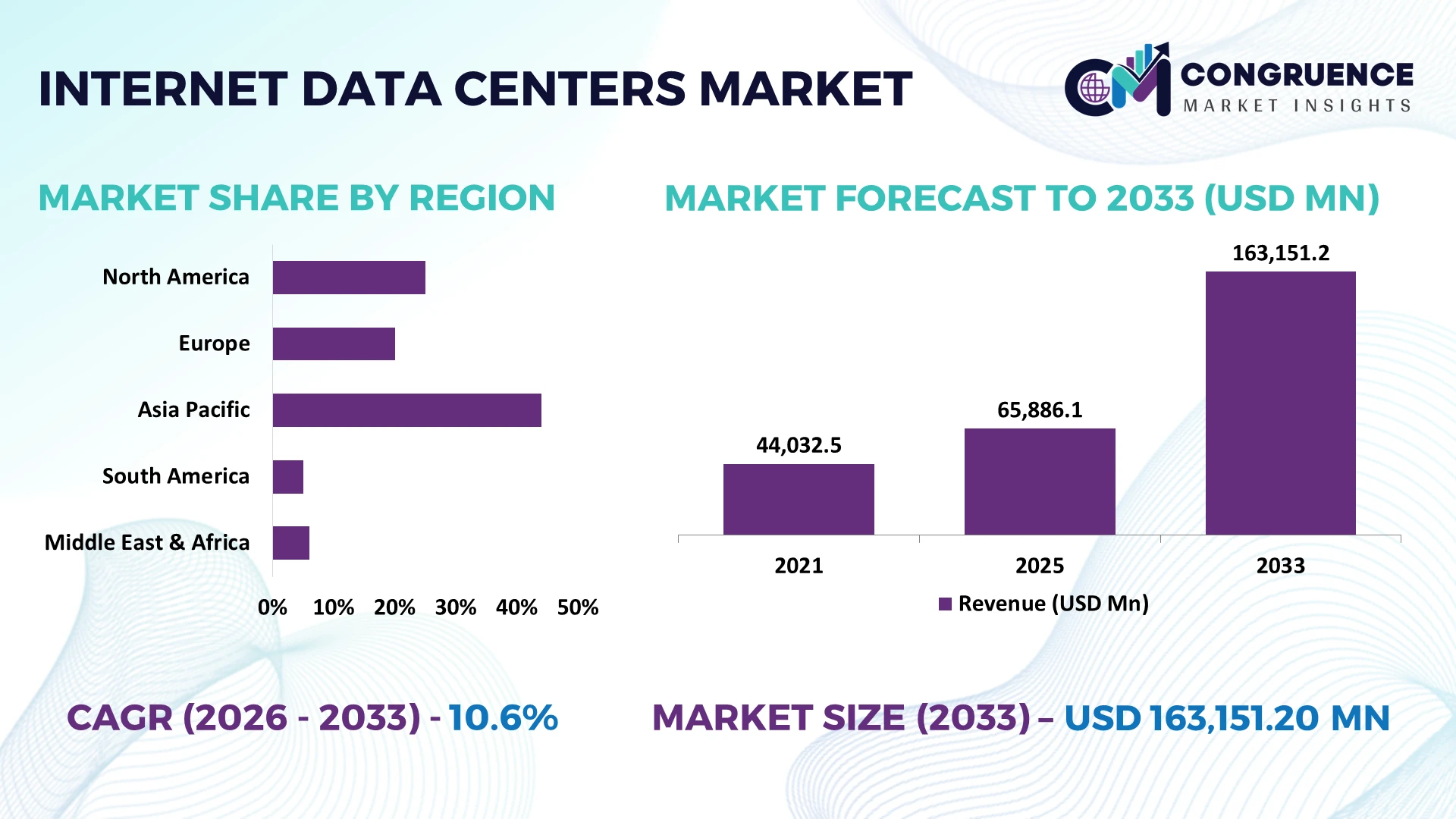
The Global Internet Data Centers Market was valued at USD 65886.1 Million in 2025 and is anticipated to reach a value of USD 163151.2 Million by 2033 expanding at a CAGR of 10.6% between 2026 and 2033. Growth is driven by hyperscale cloud infrastructure expansion, AI accelerator deployment, high density computing, enterprise colocation migration, and increasing demand for low latency digital services.
The United States dominates global internet data center infrastructure, accounting for approximately 40% of worldwide data center electricity consumption according to 2024 estimates. Major technology companies are expanding facilities across Virginia, Texas, and Ohio, supported by Microsoft's announced USD 80 billion AI infrastructure investment for fiscal 2025. Compared with China, which accounts for approximately 25% of global data center electricity consumption, the United States maintains a stronger concentration of hyperscale cloud platforms. AI workloads are accelerating liquid cooling adoption and high density rack deployment.
Strategic Implication: Infrastructure providers should prioritize power secured locations, advanced cooling systems, and hyperscale partnerships to strengthen capacity utilization and long term competitiveness.
Market Size & Growth: USD 65,886.1 million in 2025, reaching USD 163,151.2 million by 2033 at 10.6% CAGR, supported by AI computing infrastructure expansion.
Top Growth Drivers: Illustrative demand attribution assigns 40% to AI computing, 35% to cloud migration, and 25% to enterprise colocation requirements.
Short Term Forecast: By 2028, optimized facilities target 15% lower cooling electricity consumption and 12% higher rack utilization.
Emerging Technologies: Three priorities dominate: direct liquid cooling, AI infrastructure orchestration, and advanced power distribution supporting high density GPU clusters.
Regional Leaders: Illustrative 2033 allocations place North America at USD 65,260.48 million, Asia Pacific at USD 48,945.36 million, and Europe at USD 32,630.24 million.
Consumer Trends: An estimated 55% of infrastructure demand originates from hyperscale cloud and AI operators, reflecting concentrated computing capacity requirements.
Pilot/Case Example: Microsoft's 2025 AI infrastructure investment program committed approximately USD 80 billion toward data center development and computing capabilities.
Competitive Landscape: Equinix, Digital Realty, NTT Global Data Centers, CyrusOne, and Vantage compete; Equinix operates more than 260 data centers globally.
Regulatory & ESG Impact: The European Energy Efficiency Directive strengthens reporting obligations, while optimized cooling configurations target 15% lower facility electricity consumption.
Investment & Funding: Microsoft's USD 80 billion fiscal 2025 infrastructure program highlights accelerating hyperscale investment in AI computing capacity.
Innovation & Future Outlook: By 2033, next generation facilities increasingly integrate liquid cooling, 100 kW rack configurations, and automated energy management.
The Internet Data Centers Market supports hyperscale cloud platforms, enterprise computing, artificial intelligence training, content delivery networks, and digital financial services. High density GPU installations are reshaping facility design as operators deploy advanced power distribution, direct liquid cooling, and intelligent workload management. Modern AI racks can exceed 100 kW, substantially increasing cooling and electrical infrastructure requirements compared with conventional enterprise configurations. In the United States, electricity grid connection constraints are influencing site selection and capacity expansion schedules. These operational changes are shifting competitive advantage toward providers securing dependable power infrastructure, efficient cooling technology, and scalable computing environments.
Internet data centers are becoming strategic infrastructure assets as artificial intelligence, sovereign cloud requirements, and enterprise digitization reshape computing investment. Hyperscale operators are shifting expansion priorities toward locations offering secured electricity capacity, high bandwidth connectivity, and advanced cooling infrastructure. The International Energy Agency estimated that data centers consumed approximately 1.5% of global electricity in 2024, highlighting their growing importance within energy planning. In the United States, grid connection constraints are influencing facility development schedules and infrastructure partnerships.
Direct liquid cooling offers a measurable advantage over conventional air cooling for high density computing environments. Optimized liquid cooling configurations can target 20% lower cooling electricity consumption, depending on facility design and operating conditions. The United States leads hyperscale AI deployment, while Singapore emphasizes efficient capacity allocation under stricter energy requirements. India is expanding colocation infrastructure around Mumbai, Chennai, and Hyderabad, supported by cloud adoption and connectivity investment.
Between 2026 and 2028, operators are prioritizing 100 kW rack configurations, automated energy management, and modular electrical infrastructure. An illustrative 20 MW facility adopting intelligent cooling controls targets 15% lower cooling energy consumption. Developers are strengthening utility partnerships and securing equipment supply agreements. Competitive advantage increasingly depends on power availability, deployment speed, and computing density.
Artificial intelligence training, inference processing, and cloud platform expansion are transforming data center infrastructure requirements. An illustrative demand attribution model assigns 40% of incremental equipment requirements to AI computing, 35% to cloud migration, and 25% to enterprise colocation. The International Energy Agency reported that data centers accounted for approximately 1.5% of global electricity consumption in 2024, demonstrating their infrastructure significance. In the United States, Microsoft, Amazon, and Google are expanding computing facilities to accommodate accelerated GPU workloads. Operators are investing in high density electrical distribution, liquid cooling, and dedicated network infrastructure. Suppliers delivering scalable power systems and efficient cooling equipment gain stronger positioning in hyperscale procurement contracts.
Electricity infrastructure limitations are restricting data center development across established computing hubs. Northern Virginia faces grid connection pressures, while Dublin's electricity network constraints have influenced new facility approvals. In an illustrative project cost model, electrical infrastructure represents 35% of development expenditure, cooling equipment accounts for 20%, and network infrastructure contributes 10%. A modeled 15% increase in electrical equipment costs raises overall project expenditure by approximately 5.25% when other inputs remain unchanged. Transformer procurement delays and limited transmission capacity extend development schedules and reduce deployment flexibility. Operators are responding through advance equipment purchasing, utility agreements, and geographic diversification. Securing reliable electrical infrastructure increasingly determines project feasibility before computing equipment selection begins.
Advanced infrastructure automation creates opportunities to improve computing density, operational efficiency, and equipment utilization. Direct liquid cooling supports increasingly powerful GPU clusters, while AI driven infrastructure management optimizes temperature, airflow, and electricity distribution. An illustrative modernization program targets 20% lower cooling electricity consumption, 15% faster fault detection, and 10% higher rack utilization. India's expanding digital infrastructure provides opportunities for specialized AI colocation facilities in Mumbai and Hyderabad. Between 2026 and 2028, operators are expected to accelerate adoption of modular liquid cooling systems and predictive maintenance platforms. Equipment manufacturers are expanding engineering partnerships and developing integrated infrastructure packages. Providers combining high density computing support with intelligent facility management strengthen their ability to attract specialized enterprise workloads.
Scaling high density computing infrastructure introduces complex thermal management, electrical coordination, and cybersecurity requirements. AI accelerator racks increasingly exceed 100 kW, requiring specialized cooling distribution and advanced power protection. An illustrative operating scenario assumes 15% higher thermal management complexity, 10% additional commissioning effort, and 5% potential capacity loss when infrastructure integration remains incomplete. Singapore's stringent data center efficiency requirements demonstrate the importance of coordinating computing performance with environmental and operational standards. Operators must strengthen cybersecurity controls across building management systems, cooling automation, and connected electrical equipment. Investment in specialized engineering personnel, infrastructure testing, and resilient network architecture is essential. Long term competitiveness depends on reliable deployment execution, operational security, and sustained high density computing performance.
Power Procurement Shifts Toward Dedicated Generation: Data center developers are increasingly negotiating long term electricity supply agreements as grid availability becomes a primary site selection constraint. In an illustrative 100 MW development, securing 80% of electricity requirements through contracted supply and reserving 20% for operational flexibility reduces procurement uncertainty. United States operators are expanding utility partnerships and evaluating dedicated generation arrangements to improve project scheduling and electricity availability.
Prefabricated Infrastructure Accelerates Facility Commissioning: Developers are adopting factory assembled electrical rooms, modular substations, and standardized mechanical equipment to reduce construction dependencies. A modeled deployment targets 20% shorter installation schedules and 15% fewer onsite assembly hours. Equipment manufacturers are expanding prefabrication capabilities and coordinating factory acceptance testing before delivery. This approach strengthens construction predictability, particularly where skilled electrical contractors face capacity constraints.
Fiber Interconnection Density Reshapes Campus Design: Data center campuses are increasing network connectivity capacity to support distributed applications and traffic exchange. An illustrative modernization program targets 25% higher fiber connection density and 15% faster network provisioning through standardized cross connect infrastructure. Singapore and Frankfurt remain important connectivity hubs. Colocation providers are expanding carrier partnerships and redesigning meet me rooms to improve customer interconnection flexibility and service activation.
Water Efficiency Influences Cooling Procurement: Water availability is becoming an important factor in selecting cooling infrastructure, particularly in Arizona and other water stressed locations. An illustrative cooling assessment targets 30% lower onsite water consumption and 10% lower maintenance requirements through optimized dry cooling configurations. Operators are reviewing water usage effectiveness alongside electricity performance. Equipment suppliers are developing hybrid cooling designs and improving environmental monitoring to support permitting and operational resilience.
Hyperscale Data Centers represent the leading segment, accounting for an estimated 42% of global Internet Data Centers Market demand. Their dominance reflects extensive computing requirements, large scale infrastructure procurement, and centralized cloud platform operations. Amazon Web Services, Microsoft Azure, and Google Cloud continue expanding hyperscale infrastructure to accommodate enterprise workloads and accelerated computing. Colocation Data Centers represent an estimated 28% share, supported by enterprises seeking flexible capacity without constructing dedicated facilities. Enterprise Data Centers remain important for organizations maintaining direct control over sensitive applications and internal infrastructure. Operators are investing in high capacity electrical distribution, standardized building designs, and integrated network connectivity to improve deployment efficiency and customer scalability.
Edge Data Centers represent the fastest growing type in the analytical outlook, supported by low latency processing requirements and geographically distributed digital services. Managed Data Centers serve organizations requiring outsourced infrastructure operations, maintenance, and service management. An illustrative edge deployment model targets 20% lower application latency through localized processing. Providers are expanding metropolitan facilities, strengthening telecommunications partnerships, and developing standardized infrastructure packages. Investment priorities increasingly distinguish centralized computing scale from distributed service delivery requirements, creating opportunities for operators combining geographic coverage with reliable network connectivity.
Cloud Computing represents the leading application, accounting for an estimated 38% of global internet data center demand. Its dominance reflects enterprise migration toward scalable computing platforms, virtualized infrastructure, and managed application environments. Microsoft Azure, Amazon Web Services, and Google Cloud operate extensive data center networks supporting enterprise workloads. Data Storage and Backup remains an important application, particularly for organizations requiring resilient information management and regulatory compliance. An estimated 20% share for Data Storage and Backup reflects sustained infrastructure requirements. Big Data Analytics supports large scale information processing, while Content Delivery relies on geographically distributed computing resources to reduce network transmission delays. Operators are expanding storage capacity, improving network interconnection, and automating workload placement.
Artificial Intelligence represents the fastest growing application in the analytical outlook, driven by accelerated computing requirements for model training and inference. Disaster Recovery remains strategically important for business continuity and geographically separated infrastructure operations. An illustrative AI infrastructure modernization program targets 15% higher accelerator utilization through improved workload scheduling. Providers are deploying specialized computing environments, expanding high bandwidth networking, and developing dedicated infrastructure services. Competitive advantage increasingly depends on matching computing architecture with application intensity, latency requirements, and operational resilience.
IT and Telecommunications represents the dominant end user segment, accounting for an estimated 36% of global Internet Data Centers Market demand. Its leadership reflects extensive cloud infrastructure operations, telecommunications network requirements, and continuous digital service delivery. Major technology companies operate geographically distributed computing facilities supporting enterprise applications and internet connectivity. Banking and Financial Services represents an estimated 19% share, driven by transaction processing, regulatory data retention, and resilient infrastructure requirements. Government organizations maintain dedicated infrastructure needs for public services and sensitive information systems. Data center operators are strengthening network interconnection, developing specialized compliance capabilities, and expanding service agreements to support these established customer groups.
Healthcare represents the fastest growing end user category in the analytical outlook, supported by digital medical records, diagnostic imaging, and computational healthcare applications. Retail and E-commerce increasingly require scalable infrastructure during transaction peaks, while Media and Entertainment depends on content processing and streaming delivery. An illustrative healthcare infrastructure program targets 20% faster medical data retrieval through optimized storage architecture. Providers are developing secure computing environments, expanding industry specific partnerships, and introducing flexible capacity arrangements. Competitive positioning increasingly depends on regulatory compliance, application availability, and infrastructure customization.
Middle East & Africa accounted for the largest market share at an estimated 38% in 2025; however, Asia Pacific is expected to register the fastest growth, expanding at an estimated CAGR of 13.2% between 2026 and 2033.
Renewable Powered Water Infrastructure and Industrial Treatment Modernization
North America accounts for an estimated 16% of global solar desalination equipment demand, supported by water scarcity, advanced membrane technology, and established renewable energy infrastructure. The United States concentrates deployment opportunities in California, Arizona, Texas, and other water stressed areas, while Mexico provides additional opportunities through coastal desalination and industrial water treatment. California's Carlsbad desalination facility produces approximately 190,000 cubic meters of drinking water daily, demonstrating the scale of regional desalination infrastructure, although the facility is not itself a dedicated solar desalination installation. Equipment suppliers are developing photovoltaic compatible reverse osmosis systems, energy recovery devices, and automated monitoring platforms. Regional procurement increasingly emphasizes lifecycle electricity expenditure, water quality compliance, and operational reliability. Manufacturers combining membrane engineering with renewable energy integration gain stronger positioning in municipal and industrial infrastructure projects.
United States Market Outlook: The United States benefits from advanced membrane research, established water treatment engineering, and specialized equipment manufacturers. Energy Recovery, headquartered in California, develops pressure exchanger technologies that improve reverse osmosis efficiency. The Bureau of Reclamation's desalination research programs support treatment innovation, while southwestern states provide suitable solar generation conditions. Industrial operators increasingly evaluate photovoltaic integration to reduce electricity exposure and strengthen water supply resilience.
Membrane Engineering Leadership and Renewable Water Treatment Integration
Europe represents an estimated 12% of global solar desalination equipment demand, supported by advanced water treatment engineering, renewable energy policies, and established membrane manufacturing capabilities. Spain, Italy, and Greece face seasonal water shortages that strengthen interest in efficient desalination infrastructure. European equipment suppliers emphasize reverse osmosis optimization, energy recovery, advanced pretreatment, and environmental discharge management. Spain maintains substantial desalination infrastructure, with national installed capacity exceeding 5 million cubic meters daily across desalination facilities. European Union water management policies and renewable energy objectives encourage improved electricity efficiency and environmental performance. Manufacturers are strengthening partnerships between desalination engineering companies and solar technology providers. Competitive differentiation increasingly depends on combining reliable treatment performance with efficient power management, regulatory compliance, and dependable technical servicing across coastal and island installations.
Spain Market Outlook: Spain maintains one of Europe's most developed desalination industries, supported by established engineering expertise and extensive coastal water infrastructure. ACCIONA operates internationally in desalination design and construction, while Spanish research institutions advance membrane and renewable energy technologies. The country's 2023 drought conditions intensified attention to water infrastructure resilience. Equipment manufacturers are prioritizing solar compatible treatment configurations, efficient energy recovery, and agricultural water supply applications.
Solar Manufacturing Scale Accelerates Distributed Water Infrastructure
Asia Pacific represents an estimated 28% of global solar desalination equipment demand, supported by extensive photovoltaic manufacturing, industrial water treatment requirements, and freshwater scarcity across selected coastal and island locations. China provides substantial manufacturing capacity for photovoltaic modules, pumps, electrical controls, and membrane components. India supports decentralized treatment opportunities in Gujarat, Tamil Nadu, and island territories, while Australia contributes advanced desalination engineering and renewable energy integration expertise. China accounted for more than 60% of global solar photovoltaic capacity additions during 2024, strengthening equipment supply availability. Manufacturers are developing modular reverse osmosis packages, localized assembly operations, and integrated power management solutions. Procurement strategies increasingly favor standardized components, reduced installation complexity, and accessible maintenance services. Regional manufacturing capabilities support competitive equipment pricing and faster deployment across distributed water treatment applications.
China Market Outlook: China combines large scale photovoltaic manufacturing with established membrane production and industrial water treatment capabilities. The country added approximately 277 gigawatts of solar photovoltaic capacity during 2024, expanding the renewable electricity infrastructure available for water treatment integration. Domestic manufacturers are developing solar compatible pumping systems, membrane modules, and automated controls. Industrial clusters in Jiangsu, Zhejiang, and Guangdong strengthen component sourcing, manufacturing efficiency, and export competitiveness.
Mining Water Security and Solar Integration in Arid Regions
South America accounts for an estimated 6% of global solar desalination equipment demand, with Chile representing a strategically important market through mining operations and severe water scarcity in northern industrial regions. Copper mining facilities require dependable process water, encouraging investment in seawater desalination and renewable electricity integration. Chile's Atacama Desert provides exceptional solar generation conditions, supporting photovoltaic powered pumping and treatment infrastructure. The Quebrada Blanca Phase 2 project includes a desalination plant designed to supply approximately 850 liters per second, demonstrating substantial industrial water infrastructure requirements. Equipment suppliers are developing energy efficient reverse osmosis systems and strengthening partnerships with mining engineering contractors. However, long distance water transportation, high elevation pumping, and infrastructure expenditure complicate project economics. Suppliers combining efficient treatment equipment with reliable industrial servicing gain stronger procurement advantages.
Chile Market Outlook: Chile's copper mining industry provides concentrated demand for desalination infrastructure, particularly across Antofagasta and Tarapacá. The Atacama region receives exceptionally high solar irradiation, creating opportunities for renewable electricity integration. Mining operators increasingly incorporate seawater treatment into long term water security strategies. Equipment manufacturers prioritize corrosion resistant materials, high pressure pumping efficiency, and operational compatibility with remote mining infrastructure.
National Water Security Programs Accelerate Solar Desalination Investment
The Middle East & Africa region dominates the Solar Desalination Equipment Market with an estimated 38% share, supported by extensive desalination infrastructure and government investment in water security. Saudi Arabia and the United Arab Emirates maintain major desalination programs, while Morocco and Egypt are developing renewable energy and water treatment capabilities. Saudi Arabia's Al Khafji solar desalination project was designed for approximately 60,000 cubic meters of daily freshwater production, demonstrating integration of solar generation with membrane treatment. Regional infrastructure programs increasingly prioritize efficient reverse osmosis equipment, energy recovery, and reduced dependence on conventional electricity generation. Manufacturers are strengthening partnerships with utilities, engineering contractors, and renewable energy developers. Equipment qualification increasingly emphasizes sustained production capacity, membrane reliability, and compatibility with high salinity feedwater conditions.
Saudi Arabia Market Outlook: Saudi Arabia maintains extensive desalination infrastructure and established procurement channels for advanced water treatment equipment. Vision 2030 encourages renewable energy integration and improved infrastructure efficiency. The country operates desalination facilities with combined capacity exceeding 11 million cubic meters daily. National water authorities are advancing treatment modernization, creating opportunities for efficient membranes, solar power integration, automated controls, and specialized maintenance services.
Veolia, ACCIONA, IDE Technologies, Aquatech, and Energy Recovery compete through desalination engineering, membrane integration, and energy efficiency technologies. Their combined solar desalination equipment share is estimated at 38% in an illustrative concentration model, rather than verified company disclosures. Veolia and ACCIONA emphasize integrated infrastructure delivery, while IDE Technologies competes through process engineering and treatment optimization. Aquatech targets specialized industrial applications, whereas Energy Recovery differentiates through pressure exchanger technology. Modeled operating benchmarks indicate that 15% lower electricity consumption and 12% fewer maintenance interventions strengthen equipment competitiveness. Manufacturers are expanding utility partnerships, integrating photovoltaic generation, and developing automated treatment controls. Competition increasingly shifts toward complete lifecycle performance rather than equipment acquisition costs. Membrane qualification, project financing requirements, and dependable technical servicing create substantial entry barriers. Winning suppliers combine proven water quality performance, efficient energy integration, localized service capabilities, and scalable installation designs.
Veolia
ACCIONA
IDE Technologies
Aquatech International
Energy Recovery, Inc.
Solar Water Solutions
Elemental Water Makers
Desolenator
SolarSpring GmbH
F CUBED Limited
Boreal Light GmbH
SUEZ
Hitachi Zosen Corporation
Abengoa Water
Photovoltaic powered reverse osmosis, high efficiency membranes, and isobaric energy recovery devices underpin modern solar desalination systems. Pressure exchangers can achieve approximately 95% to 98% energy transfer efficiency, reducing pumping electricity requirements in seawater treatment. Compared with conventional reverse osmosis installations lacking energy recovery, optimized configurations can reduce specific electricity consumption by approximately 30% to 50%, depending on feedwater conditions. Deployment is concentrated in water stressed coastal regions, particularly Saudi Arabia, where renewable integration supports infrastructure modernization and energy diversification.
Emerging technologies include artificial intelligence membrane diagnostics, automated pretreatment, and solar thermal membrane distillation. Predictive monitoring targets 15% fewer unplanned maintenance interventions, while intelligent pressure control supports modeled electricity savings of 10%. Containerized photovoltaic desalination units integrate remote sensors, battery management, and automated water quality monitoring. Adoption is expanding across island communities, industrial facilities, and agricultural operations requiring decentralized treatment. Manufacturers offering integrated energy controls and membrane servicing gain advantages over suppliers selling standalone equipment.
Between 2026 and 2028, hybrid solar generation, advanced energy storage, and adaptive process controllers will reshape equipment procurement. A modeled 5,000 cubic meter daily installation targets 20% lower grid electricity dependence through coordinated photovoltaic generation and pumping schedules. Suppliers are strengthening utility partnerships, expanding digital maintenance capabilities, and prioritizing reliable freshwater production.
May 2025: Sineng Electric announced commissioning of a 65 MW photovoltaic plant supporting Saudi Arabia's Shuaibah 3 desalination facility. The solar installation supplies renewable electricity to reverse osmosis operations, strengthening energy diversification and reducing dependence on conventional power generation. Source: si-neng.com.
June 2025: GS Inima secured financing for a 6.3 MWp photovoltaic installation at Oman's Barka V desalination facility. The project is designed to supply approximately 11% of plant electricity requirements, improving renewable integration and operational energy resilience. Source: smartwatermagazine.com.
June 2025: Elemental Water Makers documented a solar desalination installation in Ambola, Madagascar, delivering 30,000 liters of freshwater daily. Developed with local partners, the system supplies a school and surrounding community, strengthening decentralized water access without conventional grid electricity. Source: elementalwatermakers.com.
December 2024: Jakson Green announced a strategic investment and partnership with Desolenator to commercialize solar thermal desalination technology. The collaboration targets seawater treatment and integrated zero liquid discharge, supporting cleaner water production and international deployment of 100% solar powered systems. Source: jakson-green.com.
The Solar Desalination Equipment Market Report examines industry developments from 2026 to 2033 across Solar Thermal Desalination Systems, Solar PV Powered RO Systems, Solar Humidification Dehumidification Systems, and Solar Membrane Distillation Systems. Application coverage includes Seawater Desalination, Brackish Water Desalination, Drinking Water Production, Agricultural Water Supply, and Industrial Water Treatment. End user analysis evaluates Municipal Water Utilities, Industrial Facilities, Agricultural Operators, Remote Communities, and Commercial Establishments.
Regional analysis covers North America, Europe, Asia Pacific, South America, and the Middle East & Africa. Analytical estimates identify Middle East & Africa with 38% regional share, Solar PV Powered RO Systems with 48% equipment share, and Municipal Water Utilities with 45% end user demand. The report assesses membrane efficiency, solar integration, energy recovery, automated monitoring, and decentralized treatment technologies. Competitive analysis supports investment planning, supplier selection, infrastructure expansion, and procurement decisions.
| Report Attribute/Metric | Report Details |
|---|---|
Market Revenue in 2025 | USD 65886.1 Million |
Market Revenue in 2033 | USD 163151.2 Million |
CAGR (2026 - 2033) | 10.6% |
Base Year | 2025 |
Forecast Period | 2026 - 2033 |
Historic Period | 2021 - 2025 |
Segments Covered | By Type
By Application
By End-User
|
Key Report Deliverable | Revenue Forecast, Growth Trends, Market Dynamics, Segmental Overview, Regional and Country-wise Analysis, Competition Landscape |
Region Covered | North America, Europe, Asia-Pacific, South America, Middle East, Africa |
Key Players Analyzed | Equinix, Inc., Digital Realty Trust, Inc., NTT Global Data Centers, Vantage Data Centers, CyrusOne, QTS Realty Trust, CoreSite, Iron Mountain Data Centers, GDS Holdings Limited, ST Telemedia Global Data Centres, Princeton Digital Group, Global Switch, AirTrunk, Telehouse |
Customization & Pricing | Available on Request (10% Customization is Free) |




