
Reports
The Global Interior Wood Doors Market was valued at USD 30,045.7 Million in 2025 and is anticipated to reach a value of USD 42,078.2 Million by 2033 expanding at a CAGR of 4.3% between 2026 and 2033. Growth is driven by residential renovation, multifamily construction, premium interior finishing, hospitality refurbishment, and demand for engineered wood doors offering dimensional stability and design flexibility.
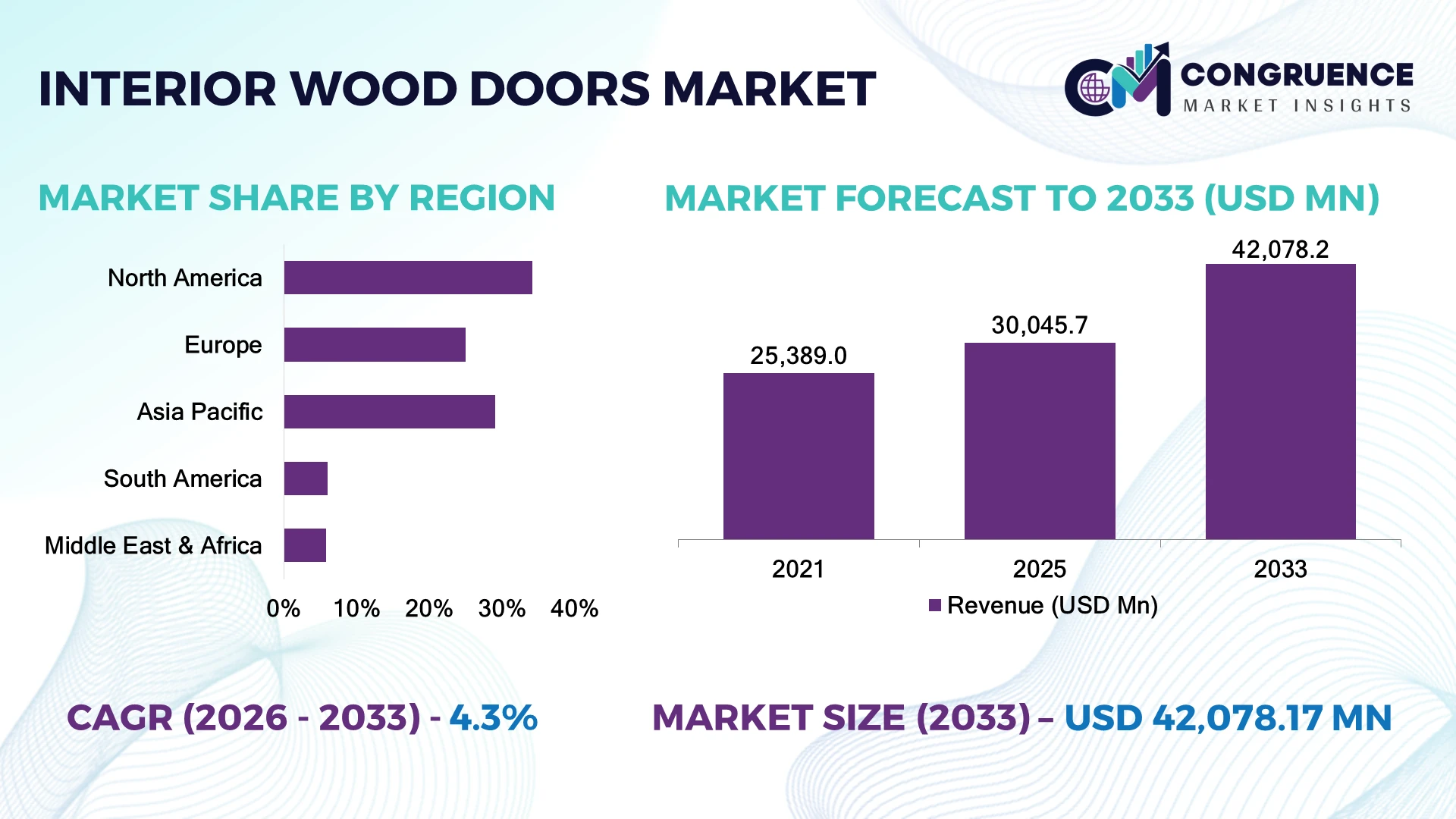
The U.S. represents approximately 27% of global interior wood door demand, supported by residential remodeling, multifamily construction, and institutional renovation, while China contributes roughly 20% through large housing, commercial interiors, and extensive door manufacturing capacity. Engineered and laminated wood products now represent approximately 55–60% of new premium interior-door specifications, reflecting greater resistance to warping and finish consistency. U.S. remodeling activity remains more replacement-oriented, while China's demand is more strongly tied to new construction and manufactured interiors.
The strategic priority is to balance certified timber sourcing, automated manufacturing, customization, and regional production capacity to capture premium interior-door demand while controlling material and logistics costs.
Market Size & Growth: USD 30,045.7 million in 2025 to USD 42,078.2 million by 2033 at 4.3% CAGR, supported by renovation, multifamily housing, and premium interior specifications.
Top Growth Drivers: Residential renovation 5–7%, multifamily construction 4–6%, and hospitality refurbishment 4–5%.
Short-Term Forecast: By 2028, automated cutting and finishing can improve production efficiency 10–15% and reduce material waste 5–8%.
Emerging Technologies: CNC machining, automated edge finishing, digital configuration, engineered-core construction, and water-based coatings are reshaping door manufacturing.
Regional Leaders: North America approaches USD 12.5 billion, Asia-Pacific USD 11.8 billion, and Europe USD 9.2 billion by 2033, with engineered-door adoption increasing.
Consumer/End-User Trends: Premium residential and hospitality projects increasingly specify customized wood doors, with engineered products representing approximately 55–60% of premium installations.
Pilot/Case Example: 2026 automated production upgrades targeting 10–15% faster machining cycles and 5–8% lower material waste strengthen customized-door manufacturing economics.
Competitive Landscape: Masonite holds approximately 8–10% of organized global demand, competing with JELD-WEN, ASSA ABLOY, Hörmann, and Simpson Door.
Regulatory & ESG Impact: Certified timber and low-emission coatings increasingly influence procurement, while optimized cutting can reduce manufacturing waste 5–10%.
Investment & Funding: More than USD 1.2 billion is being directed toward manufacturing modernization, capacity expansion, automation, and sustainable wood-processing infrastructure.
Innovation & Future Outlook: Digital customization, acoustic cores, fire-rated assemblies, recycled materials, and automated finishing are shifting competition toward specification-driven, higher-value door systems.
The Interior Wood Doors Market spans solid wood, engineered wood, veneer-faced, laminate-finished, and composite-core interior doors used across residential, commercial, hospitality, and institutional buildings. Engineered products account for approximately 55–60% of premium specifications as manufacturers prioritize dimensional stability and consistent finishes. Demand is also shifting toward factory-finished, customizable doors as renovation projects require shorter installation cycles and controlled quality.
Interior wood doors are becoming strategically important as developers and renovation contractors increasingly treat doors as functional architectural components rather than standardized building materials. Acoustic performance, fire ratings, finish consistency, durability, and sustainable material credentials are influencing specifications alongside aesthetics. This shift is particularly visible in multifamily housing, hotels, healthcare facilities, and premium residential renovation, where replacement cycles and design requirements support higher-value door systems.
Manufacturing technology is changing production economics. CNC machining and automated finishing can increase throughput by approximately 10–15% while reducing material waste 5–8% compared with less automated workflows. North America is characterized by renovation-led replacement demand, Europe emphasizes sustainability, energy-conscious construction, and certified materials, while China and India benefit from large-scale residential and commercial development. Over the next 2–3 years, digitally configured doors, factory-applied finishes, and engineered-core products are expected to gain further specification share.
Manufacturers are responding by expanding regional production, integrating digital configurators, improving certified timber procurement, and partnering with architects, developers, and distributors. A practical advantage is shorter project lead time when customized doors are manufactured and finished before delivery rather than completed onsite. Competitive positioning will increasingly depend on combining design flexibility with dependable dimensions, certified materials, fast fulfillment, and automated manufacturing economics.
Residential remodeling, multifamily development, hospitality refurbishment, and institutional renovation are increasing demand for factory-finished interior wood doors. Renovation activity supports approximately 5–7% annual replacement growth in mature markets, while multifamily projects can specify 10–20% more standardized door units per project than detached housing. In the U.S., aging housing stock is reinforcing replacement demand, while India is adding higher-specification doors to premium residential developments. Manufacturers are responding with engineered cores, pre-finished surfaces, and modular designs that reduce onsite finishing requirements by 15–25%. The strategic advantage is shifting toward manufacturers that combine design customization with repeatable factory quality, allowing developers to standardize procurement without sacrificing architectural differentiation.
Interior wood door manufacturers remain exposed to fluctuations in timber, veneer, adhesives, hardware, and energy costs. Raw materials can represent approximately 45–60% of manufacturing costs, while imported hardwood and specialty veneer prices can vary 5–15% across procurement cycles. European producers also face tighter certified-timber and chemical-emission requirements, increasing compliance and material-selection complexity. Supply disruptions in major timber-producing markets can extend procurement lead times by 10–20%, affecting project schedules and inventory commitments. Companies are reducing exposure through engineered wood cores, diversified timber sourcing, longer-term supplier contracts, and localized veneer production. A non-obvious margin lever is yield optimization: CNC nesting and digital cutting can reduce material waste by 5–10%, partially offsetting input-cost pressure.
Digital configuration platforms are creating opportunities for manufacturers to offer customized door dimensions, finishes, glazing, hardware preparation, and acoustic specifications without proportionally increasing production complexity. CNC-enabled manufacturing can improve machining throughput by 10–15%, while automated finishing can reduce coating labor requirements by approximately 15–20%. In China and India, expanding modular housing and commercial interiors provide scalable demand for digitally configured door packages. Acoustic and fire-rated interior doors also offer higher-value specification opportunities in hotels, healthcare, offices, and multifamily buildings. Manufacturers are investing in configurators, automated production cells, and architect partnerships. The strongest opportunity lies in connecting digital specification directly to production scheduling, reducing quotation-to-manufacturing delays while enabling mass customization at near-standardized production economics.
Interior wood doors face increasing performance expectations around dimensional stability, acoustic isolation, fire resistance, finish durability, and hardware compatibility. Poor moisture control can cause dimensional movement of approximately 2–5% depending on wood composition and environmental conditions, while installation deviations can increase rework requirements by 5–10% on complex projects. European and North American projects increasingly require documented performance specifications, placing greater pressure on manufacturers and installers to maintain tolerance control. Companies are responding with engineered cores, controlled kiln drying, automated machining, digital quality inspection, and installer training. The long-term challenge is maintaining factory-level precision through transportation and onsite installation. Manufacturers that integrate packaging engineering, installation guidance, and field-quality feedback will protect margins more effectively than suppliers focused solely on door-unit production.
Engineered Cores Gain Share: Manufacturers are increasingly replacing solid timber constructions with engineered cores and veneer faces for dimensional consistency. Engineered products now represent approximately 55–60% of premium specifications, while improved stability can reduce warping-related rework by 10–15%. Producers are expanding engineered portfolios to control timber usage and provide consistent finishes across large multifamily and hospitality projects.
Factory Finishing Moves Upstream: Pre-finished doors are gaining traction as contractors face tighter installation schedules and skilled-finishing labor constraints. Factory finishing can reduce onsite finishing time by approximately 30–40% and improve coating consistency by 10–15%. Manufacturers are expanding automated spray, curing, and inspection lines, particularly for standardized residential and hotel developments requiring hundreds of matching door units.
Acoustic Performance Becomes Specifier Priority: Multifamily housing, hotels, healthcare facilities, and offices are placing greater emphasis on sound attenuation alongside appearance. Higher-performance acoustic doors can command approximately 10–20% specification premiums, encouraging manufacturers to combine timber faces with engineered acoustic cores, perimeter seals, and upgraded hardware. Developers are increasingly specifying complete door assemblies rather than purchasing slabs independently.
Digital Configuration Reshapes Ordering: Online configurators and BIM-compatible product data are changing how architects and contractors specify interior doors. Digital workflows can reduce quotation and configuration time by 20–30% while lowering specification errors by approximately 10–15%. Manufacturers are connecting configurators with CNC production and inventory systems, allowing customized dimensions and finishes to flow directly into manufacturing schedules.
Panel interior wood doors account for approximately 38–42% of global demand, supported by standardized manufacturing, broad architectural compatibility, and cost-effective deployment across residential, multifamily, office, and hospitality projects. Flush doors follow at roughly 28–32%, benefiting from clean contemporary aesthetics and efficient factory production, while stile-and-rail doors represent approximately 16–20% and retain stronger positioning in premium and traditional interiors. Molded and specialty wood doors comprise the remaining demand and serve design-specific or performance-led applications.
The fastest-growing shift is toward engineered-core and factory-finished variants within these established categories, particularly where dimensional stability and installation speed are critical. Factory-finished products can reduce onsite finishing work by 30–40%, while CNC production can improve machining throughput 10–15%. Manufacturers are expanding modular product platforms, digital configuration tools, and architect partnerships to offer customization without sacrificing production efficiency. Investment is therefore moving toward flexible automated lines capable of producing multiple door styles rather than highly specialized single-format facilities.
U.S. residential remodeling expenditure is projected to remain above USD 500 billion annually through the late 2020s, supporting sustained replacement demand for interior doors across existing housing stock.
Residential applications account for approximately 55–60% of global interior wood door demand, reflecting high unit volumes across detached housing, apartments, and multifamily developments. Renovation and replacement represent roughly 30–35% of residential consumption, while new construction remains the larger volume channel. Commercial offices and hospitality together contribute approximately 20–25%, with stronger requirements for acoustic performance, fire resistance, durability, and coordinated architectural finishes. Institutional applications, including healthcare and education, form a smaller but specification-intensive segment.
Hospitality and multifamily projects represent the fastest-changing applications as developers increasingly specify factory-finished, acoustic, fire-rated, and standardized door packages. Large projects can require hundreds or thousands of matching units, making dimensional consistency and delivery sequencing commercially critical. Manufacturers are responding with project-specific production cells, digital configuration, bulk procurement programs, and pre-installed hardware options. In the U.S., renovation-led demand differs from China's stronger new-construction orientation, while European projects place greater emphasis on certified timber and performance documentation. This divergence is encouraging suppliers to localize product portfolios rather than use one global specification model.
U.S. multifamily construction remains a major interior-door demand channel, with approximately 600,000 multifamily housing units authorized in 2025, sustaining high-volume standardized door requirements.
Residential property owners and homeowners represent approximately 43–47% of interior wood door demand, supported by replacement, remodeling, and interior renovation activity. Real-estate developers and builders account for roughly 27–31%, purchasing substantially larger standardized volumes for multifamily and new residential projects. Commercial property owners and contractors contribute approximately 15–19%, while hospitality and institutional buyers represent the balance. Residential buyers prioritize appearance, price, dimensions, and finish selection, whereas developers place greater weight on procurement consistency, lead times, warranty, and installation efficiency.
Real-estate developers and large contractors represent the fastest-growing strategic buyer group because centralized procurement enables standardized specifications across multiple properties. Project-scale purchasing can reduce unit procurement and installation costs by approximately 8–15%, encouraging suppliers to establish framework agreements and dedicated production capacity. Hospitality and institutional buyers increasingly demand acoustic, fire-rated, and low-emission assemblies, creating higher-value niches despite lower volumes. Manufacturers are responding with tiered product ranges, project pricing, digital specification support, and regional distribution partnerships. The competitive implication is a widening divide between retail-oriented door suppliers and manufacturers capable of managing large, specification-driven project orders.
U.S. housing completions remained above 1.5 million units on an annualized basis during 2025, sustaining large-scale demand for standardized interior building components, including doors, trim, and hardware packages.
North America accounted for the largest market share at 34.2% in 2025 however, Asia-Pacific is expected to register the fastest growth, expanding at a CAGR of 5.2% between 2026 and 2033.

Renovation-led replacement strengthens engineered-door specifications
North America represents approximately 34.2% of global interior wood door demand, supported by residential remodeling, multifamily construction, hospitality refurbishment, and institutional renovation. The U.S. accounts for the majority of regional consumption, with replacement activity creating sustained demand for standardized yet customizable door systems. Engineered-core and factory-finished products represent roughly 55–60% of premium specifications, reflecting greater dimensional stability and shorter installation cycles. Manufacturers are expanding automated machining, digital configuration, and pre-finishing capacity to address contractor labor constraints. Large multifamily and hospitality projects increasingly use standardized door packages, while acoustic and fire-rated assemblies support higher-value specifications. Suppliers with domestic manufacturing and regional distribution capabilities benefit from shorter lead times and reduced exposure to imported timber and hardware volatility.
U.S. Market Outlook: The U.S. remains the largest national market, supported by a substantial remodeling sector, multifamily development, hospitality renovation, and institutional construction. Replacement projects favor factory-finished doors because they reduce onsite finishing requirements by approximately 30–40%. Manufacturers are strengthening relationships with builders, architects, distributors, and remodeling contractors while expanding engineered-wood portfolios to improve dimensional consistency and control material usage.
Sustainability and performance reshape premium specifications
Europe accounts for approximately 25% of global interior wood door demand, with Germany, the United Kingdom, France, Italy, and Spain representing important manufacturing and consumption centers. Renovation, hospitality modernization, multifamily housing, and commercial refurbishment support demand, while sustainability requirements increasingly influence material selection. Certified timber, low-emission coatings, acoustic performance, and fire-rated assemblies are gaining specification importance. European manufacturers are investing in automated finishing and precision CNC production, with optimized manufacturing capable of reducing material waste by approximately 5–10%. Cross-border supply chains remain important, but regional production and certified sourcing are becoming strategic differentiators as buyers seek documented material provenance and shorter logistics chains.
Germany Market Outlook: Germany combines strong architectural manufacturing capabilities with an established renovation and commercial construction base. Interior door producers benefit from sophisticated woodworking clusters and established relationships with architects, contractors, and building-material distributors. Premium engineered doors and factory-finished systems are increasingly specified for multifamily, hospitality, and office projects, while automated machining can improve production throughput by approximately 10–15%.
Manufacturing scale accelerates engineered-door adoption
Asia-Pacific accounts for approximately 29% of global interior wood door demand and combines the world's largest manufacturing base with substantial residential and commercial construction activity. China represents roughly 20% of global demand and maintains extensive door manufacturing capacity, while India is expanding rapidly through residential development, hospitality projects, and organized interior construction. Engineered wood, laminate finishes, CNC machining, and automated coating systems are gaining adoption as manufacturers target consistent quality across large project volumes. Production automation can improve machining throughput by approximately 10–15%, strengthening competitiveness in export and domestic markets. Companies are expanding regional factories, dealer networks, and project-based partnerships while localizing hardware and panel sourcing to manage logistics costs.
China Market Outlook: China remains the region's dominant production and consumption center, supported by extensive housing, commercial interiors, furniture manufacturing, and construction supply chains. Large manufacturing clusters provide access to engineered panels, veneers, hardware, coatings, and automated woodworking machinery. Factory-integrated production allows suppliers to offer customized dimensions and finishes at scale, while CNC and automated finishing systems increasingly support shorter production cycles and consistent output.
Residential construction and local wood supply support expansion
South America contributes approximately 6% of global interior wood door demand, with Brazil accounting for more than half of regional consumption. Residential construction, remodeling, hospitality projects, and commercial interiors form the principal demand base, while locally available wood resources support domestic manufacturing. Brazilian producers increasingly combine solid and engineered wood construction to balance appearance, durability, and cost. Factory finishing and CNC machining are expanding among larger manufacturers, potentially reducing production waste by approximately 5–10% and improving dimensional consistency. Currency volatility and imported hardware costs remain relevant procurement considerations, encouraging suppliers to localize components and maintain regional inventories. Competitive positioning increasingly favors manufacturers capable of combining local timber access with standardized project production.
Brazil Market Outlook: Brazil dominates regional demand through its large housing market, established woodworking industry, and substantial domestic timber-processing base. São Paulo and southern manufacturing clusters provide access to furniture, construction-material, and interior-design supply chains. Manufacturers are increasingly adopting engineered panels and automated cutting to improve material yield, while project-oriented suppliers are expanding relationships with developers, contractors, and hospitality operators.
Mega-project interiors create premium specification demand
The Middle East & Africa accounts for approximately 5.8% of global interior wood door demand, with Saudi Arabia, the UAE, South Africa, and Egypt representing major consumption centers. Large hospitality, residential, healthcare, commercial, and tourism developments are increasing demand for premium interior door packages, particularly acoustic, fire-rated, decorative, and customized systems. Saudi Arabia's large-scale development pipeline is strengthening project-based procurement, while the UAE remains a major regional distribution and hospitality hub. Imported timber and hardware continue to influence costs, encouraging suppliers to establish regional warehouses and assembly capabilities. Manufacturers are increasingly partnering with developers, architects, and fit-out contractors to secure specification-led projects rather than competing solely through retail channels.
Saudi Arabia Market Outlook: Saudi Arabia is becoming a strategically significant market through large residential, hospitality, tourism, healthcare, and commercial developments associated with economic diversification. Major projects require coordinated door packages with consistent finishes, acoustic performance, and fire ratings across large building footprints. Suppliers with local distribution and project-management capabilities can shorten material response times by approximately 15–20%, improving competitiveness in fast-moving fit-out programs.
Masonite, JELD-WEN, Simpson Door, ASSA ABLOY, and Hörmann compete across standardized, engineered, premium, and specification-driven interior wood doors. Global manufacturers compete with regional woodworking specialists through scale, customization, and distribution reach. The top five players collectively hold approximately 24% of organized global demand. Competition centers on price, finish quality, customization, lead time, and certification; automated production can improve throughput 10–15%, while factory finishing reduces onsite labor 30–40%. Players are expanding automated facilities, strengthening architect partnerships, and integrating digital configurators with production systems. Premium suppliers emphasize certified timber, acoustic performance, and fire-rated assemblies, while regional producers compete through localized sourcing and faster project delivery. The market is shifting toward engineered construction, digital specification, and factory-finished products. Entry barriers include manufacturing precision, timber procurement, certification, distribution networks, and project relationships. Winning requires scalable customization, dependable fulfillment, certified materials, and consistent factory quality across high-volume projects.
Masonite
JELD-WEN
Simpson Door Company
ASSA ABLOY
Hörmann
Steves & Sons
TruStile Doors
Bayer Built Woodworks
Woodgrain
Lynden Door
Puertas SanRafael
OPPENAUER
Barausse
Bertolotto
Interior wood-door manufacturing is moving toward CNC machining, automated edge processing, robotic finishing, digital quality inspection, and engineered-core construction. CNC workflows can improve machining throughput by 10–15%, while automated finishing reduces labor requirements approximately 15–20%. Adoption is strongest in high-volume residential and multifamily production, where dimensional consistency directly affects installation schedules and rework.
Digital configurators and BIM-linked specification platforms are connecting architects and contractors with manufacturing systems, reducing quotation and configuration time by approximately 20–30%. Factory-finished doors can cut onsite finishing work 30–40% versus traditionally unfinished units. Smart production lines also capture cutting and yield data, allowing manufacturers to optimize material usage and reduce waste by 5–10%. Companies combining customization with automated production gain a clear advantage over labor-intensive regional workshops.
From 2026–2028, machine vision, robotic handling, predictive maintenance, and digitally synchronized production scheduling will strengthen factory economics. Compared with manual inspection, automated vision systems can improve defect detection consistency by approximately 10–20%. Manufacturers with large production networks benefit most from scale-based automation, while premium specialists benefit from digital customization. The competitive priority is therefore shifting from basic woodworking capability toward flexible manufacturing systems that deliver customized doors at standardized production speed and quality.
September 2025 JELD-WEN announced relocation of Sheffield operations to a purpose-built UK facility, strengthening manufacturing capacity and efficiency while supporting customer resilience. The investment modernizes European production and sustainability capabilities for contractors and distributors across markets. Source: corporate.jeld-wen.com
August 2025 Simpson Door appointed Steve Schneider as president, maintaining leadership continuity for its custom wood-door business. The company offers more than 60 interior designs, supporting customization-led competition across residential renovation and architectural projects across North America. Source: simpsondoor.com
2025 Masonite expanded its Heritage Series interior portfolio with the Calden three-panel recessed design, strengthening its solid-core offering. The range broadens Shaker-inspired choices while targeting improved sound management and durability for residential applications and multifamily builders nationwide today. Source: masonite.com
2025 ASSA ABLOY expanded wooden-door solutions across residential and hospitality applications, including acoustic and fire-rated configurations. Its apartment doors provide acoustic ratings up to 28 dB, strengthening specification-led positioning for multifamily and hotel projects worldwide in 2025. Source: assaabloy.com
The Interior Wood Doors Market Report covers panel, flush, stile-and-rail, molded, engineered-core, and specialty wood doors across residential construction, renovation, multifamily housing, hospitality, offices, healthcare, education, and institutional projects. End-user analysis evaluates homeowners, builders and developers, contractors, commercial property owners, hospitality operators, and institutional buyers, including premium acoustic and fire-rated applications.
Regional coverage spans North America, Europe, Asia-Pacific, South America, and Middle East & Africa, with country-level assessment of major manufacturing and construction hubs. Technology analysis covers CNC machining, automated finishing, digital configurators, BIM integration, engineered cores, acoustic materials, and machine-vision inspection. With engineered products representing approximately 55–60% of premium specifications, the report evaluates sourcing, production efficiency, customization, competitive positioning, partnerships, and expansion opportunities to support strategic decisions through 2026–2033.
| Report Attribute/Metric | Report Details |
|---|---|
|
Market Revenue in 2025 |
USD 30,045.7 Million |
|
Market Revenue in 2033 |
USD 42,078.2 Million |
|
CAGR (2026 - 2033) |
4.3% |
|
Base Year |
2025 |
|
Forecast Period |
2026 - 2033 |
|
Historic Period |
2021 - 2025 |
|
Segments Covered |
By Type
By Application
By End-User
|
|
Key Report Deliverable |
Revenue Forecast, Growth Trends, Market Dynamics, Segmental Overview, Regional and Country-wise Analysis, Competition Landscape |
|
Region Covered |
North America, Europe, Asia-Pacific, South America, Middle East, Africa |
|
Key Players Analyzed |
Masonite, JELD-WEN, Simpson Door Company, ASSA ABLOY, Hörmann, Steves & Sons, TruStile Doors, Bayer Built Woodworks, Woodgrain, Lynden Door, Puertas SanRafael, OPPENAUER, Barausse, Bertolotto |
|
Customization & Pricing |
Available on Request (10% Customization is Free) |




