
Reports
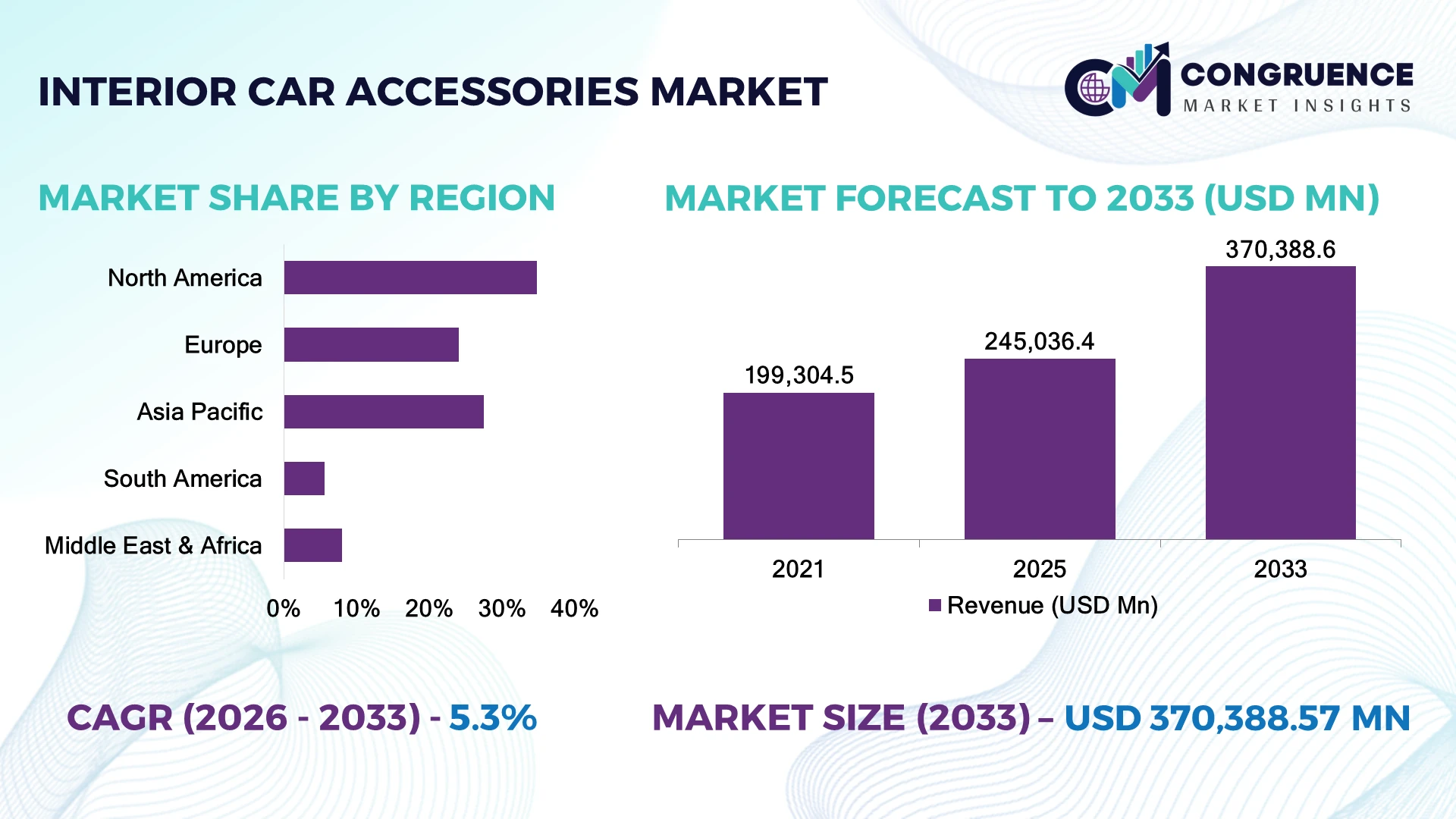
The Global Interior Car Accessories Market was valued at USD 245,036.4 Million in 2025 and is anticipated to reach a value of USD 370,388.6 Million by 2033 expanding at a CAGR of 5.3% between 2026 and 2033. Growth is being driven by software-defined cockpits, connected infotainment, premium comfort upgrades, EV-specific cabin design, and e-commerce-led aftermarket customization.
China is the dominant country market, supported by its 34.4 million vehicle sales in 2025 and 47.9% new-energy-vehicle share, creating substantial demand for digital displays, ambient lighting, smart storage, premium seating, and connected accessories. India is smaller but faster-moving, with 87% of surveyed consumers rating smartphone connectivity important for their next vehicle versus 63% in the United States. China's export expansion is also intensifying global accessory competition.
Strategic priority is shifting toward connected, lightweight, sustainable, and vehicle-specific interior products rather than conventional cosmetic accessories.
Market Size & Growth: USD 245,036.4 million in 2025 to USD 370,388.6 million by 2033 at 5.3% CAGR, supported by connected-cabin upgrades and EV interior content.
Top Growth Drivers: Connectivity 87%, personalization 64%, and premium-comfort adoption 58% are strengthening accessory demand.
Short-Term Forecast: By 2028, digital accessory integration is positioned to improve installation efficiency by 10–15% as modular interfaces replace vehicle-specific rewiring.
Emerging Technologies: AI voice interfaces, ambient lighting, digital keys, and smart surfaces are moving advanced interiors toward software-enabled personalization.
Regional Leaders: Asia-Pacific represents 37.4% of automotive interior demand, North America remains aftermarket-intensive, while Europe leads circular-material adoption.
Consumer/End-User Trends: 87% of surveyed Indian consumers consider smartphone connectivity important for their next vehicle, reinforcing connected-accessory demand.
Pilot/Case Example: 2025 vehicle-interior recycling initiatives targeted 25% recycled plastic content by 2030, accelerating material substitution and circular-design investment.
Competitive Landscape: Leading suppliers compete with OEM accessory divisions and aftermarket specialists across connectivity, comfort, styling, and vehicle-specific fitment.
Regulatory & ESG Impact: EU vehicle rules target 25% recycled material in new vehicles by 2030, increasing recycled-polymer qualification requirements.
Investment & Funding: Automotive suppliers are increasing spending on digital cockpit components, sustainable materials, and localized electronics supply chains as vehicle E/E content expands.
Innovation & Future Outlook: 2026–2028 competition will shift toward AI-enabled interfaces, OTA-compatible accessories, sustainable materials, and modular products that support rapid vehicle-platform updates.
The Interior Car Accessories Market is increasingly concentrated around infotainment upgrades, premium seat systems, ambient lighting, digital charging, storage solutions, and protective products. Interior accessories represented approximately 57.7% of the broader passenger-car accessories market in 2025, while connected features are gaining particular traction in China, India, and Southeast Asia. Sustainable polymers and synthetic materials are also becoming commercially important as automakers prepare for stricter recycled-content requirements. The market is moving from cosmetic customization toward technology-integrated cabin enhancement, creating stronger opportunities for suppliers capable of combining design, electronics, and vehicle-specific compatibility.
The Interior Car Accessories Market is becoming strategically important because the vehicle cabin is evolving from a physical compartment into a connected digital interface. Software-defined vehicles, EV platforms, and consumer expectations for smartphone integration are changing accessory value pools. In 2025, passenger-car interior accessories represented roughly 58% of the broader car-accessories market, confirming the cabin as the industry's primary customization zone.
Technology is accelerating this shift. Digital interfaces, modular ambient lighting, wireless charging, and connected displays can reduce installation complexity by approximately 10–15% compared with conventional hard-wired accessory systems. Asia-Pacific is moving fastest on connected experiences, while Europe is placing greater emphasis on recycled materials and circular design. India's strong consumer interest in smartphone connectivity further supports digitally integrated accessories.
Over the next 2–3 years, suppliers will increasingly develop plug-and-play modules compatible with multiple vehicle platforms, reducing SKU complexity and installation time. Automotive OEMs and aftermarket companies are also expanding partnerships around displays, connectivity, sustainable materials, and personalized cabin experiences. Competitive advantage will increasingly depend on delivering accessories that combine seamless vehicle integration, software compatibility, low material intensity, and rapid personalization rather than relying on styling alone.
Connected-car adoption is shifting interior accessories from passive styling toward integrated comfort, convenience, and digital functionality. In 2026, more than 60% of new passenger vehicles globally feature smartphone connectivity, while demand for ambient lighting, wireless charging, smart displays, and ergonomic accessories is strengthening premium aftermarket sales. In China, rapid EV penetration is accelerating cabin-tech experimentation, with automakers integrating modular interior interfaces into newer platforms. This transition increases accessory attachment opportunities while shortening product refresh cycles. Suppliers are responding with vehicle-specific designs, software-compatible modules, and OEM partnerships. The non-obvious advantage is data compatibility: accessories that integrate with existing vehicle electronics command stronger differentiation than standalone products. Companies prioritizing interoperability and low-voltage electronics are gaining faster access to digitally oriented vehicle platforms.
Interior accessory suppliers face persistent compatibility constraints as vehicle architectures, trim geometries, electronic interfaces, and safety requirements diverge across models. Material prices for polymers, synthetic leather, adhesives, and electronic components can shift operating costs by 5–10%, while model-specific tooling can raise development expenditure by 15–20% compared with standardized designs. China-based manufacturers also face tighter export compliance and logistics variability across major destination markets. These pressures reduce margin flexibility and complicate inventory planning because slow-moving model-specific components become obsolete quickly. Leading suppliers are countering the constraint through modular tooling, regional sourcing, multi-year component contracts, and common mounting architectures. The strategic pressure point is not raw material cost alone; it is minimizing SKU proliferation without sacrificing vehicle-specific fit.
The strongest opportunity is the convergence of smart functionality with lightweight, sustainable cabin materials. Recycled polymers, bio-based textiles, LED ambient systems, wireless charging surfaces, and modular organizers can reduce component weight by 8–15% while improving perceived interior quality. In India, expanding connected-vehicle penetration and rising premiumization are creating space for digitally enabled aftermarket accessories beyond traditional mats, covers, and storage products. Advanced suppliers are developing 12V/USB-C integrated modules, recycled-fiber trim components, and app-linked lighting systems, while vehicle manufacturers increasingly seek localized accessory ecosystems. A non-obvious opportunity lies in fleet and shared-mobility vehicles, where durable, replaceable interior modules can reduce refurbishment costs by 10–15%. Companies investing in modular design and circular-material partnerships can capture both premium and high-volume applications.
Increasing electronic content introduces integration and cybersecurity complexity that traditional accessory suppliers were not designed to manage. Connected interior products can require compatibility across multiple communication interfaces, while electronic failures or poor installation can increase warranty exposure by 5–8%. In the United States and European markets, evolving vehicle cybersecurity and functional-safety expectations are also raising validation requirements for connected accessories. Labor shortages among automotive electronics technicians further complicate installation consistency, particularly for complex aftermarket systems. Companies must therefore invest in firmware validation, secure communication protocols, standardized connectors, and certified installation networks. The critical long-term issue is moving from accessory manufacturing to systems engineering: suppliers unable to validate software-hardware interaction risk exclusion from integrated vehicle platforms even when their physical products remain competitive.
Connected Accessories Gain Ground Interior accessories are increasingly integrating wireless charging, USB-C, ambient lighting, and smartphone interfaces, with connected features appearing across more than 60% of new passenger vehicles. Suppliers are shifting from standalone products toward vehicle-specific electronic modules, improving attachment rates and creating higher-value aftermarket bundles.
Sustainable Materials Enter Mainstream Recycled polymers, bio-based fabrics, and low-emission synthetic materials are moving beyond premium programs, with lightweight material substitutions reducing component mass by roughly 8–15%. European manufacturers are accelerating material traceability and recycled-content integration, pushing suppliers to redesign trim components without compromising durability or tactile quality.
Modular Designs Reduce SKU Exposure Vehicle model proliferation is encouraging modular mounting systems and adaptable organizers that can serve multiple cabin architectures. Standardized platforms can reduce tooling and inventory complexity by approximately 10–15%, allowing suppliers to localize final assembly while retaining common component families across different vehicle programs.
Premium Comfort Expands Beyond Luxury Heated cushions, ergonomic supports, advanced seat organizers, and customizable illumination are spreading into mid-range vehicles as consumers prioritize cabin personalization. Adoption of comfort-oriented accessories is rising particularly in China and India, prompting manufacturers to bundle multiple functions and strengthen retail, dealership, and direct-to-consumer distribution.
Functional interior accessories represent the leading type, accounting for an estimated 46% of global demand, supported by broad vehicle compatibility, high replacement frequency, and lower purchase barriers. Mats, seat covers, organizers, sunshades, and storage products remain highly scalable because they require limited electronic integration. Decorative accessories account for approximately 27%, while comfort-oriented products represent about 17%, retaining strong relevance in premium and family vehicles. Companies are responding with modular designs, vehicle-specific fitment, and localized production to reduce SKU complexity by roughly 10–15%.
Smart and electronic accessories are the fastest-growing type, approaching a 10% share as wireless charging, ambient lighting, digital displays, and connected controls become increasingly embedded in modern cabins. Their adoption is strongest among EV-focused and technology-oriented buyers. McKinsey found that 57% of BEV customers were willing to change automotive brands for better connectivity, while well-packaged connectivity features achieved purchase likelihood of 40–60%, reinforcing investment in integrated, software-compatible accessory portfolios.
McKinsey’s automotive connectivity research indicates that well-packaged connectivity features achieve approximately 40–60% purchase likelihood, strengthening the business case for smart interior accessories integrated with connected vehicle ecosystems.
Passenger vehicles lead application demand with an estimated 72% share, reflecting their larger installed base, higher personalization spending, and broader accessory attachment opportunities. Demand spans protective mats, seat covers, organizers, illumination, wireless charging, infotainment integration, and comfort products. Commercial vehicles account for roughly 28%, with purchasing concentrated on durable floor protection, seat protection, storage systems, and driver-comfort accessories. Suppliers are increasingly developing vehicle-specific kits and modular mounting architectures, helping reduce fitment-related returns by approximately 8–12% while improving installation consistency.
Connected comfort and personalization applications represent the fastest-growing use cases within passenger vehicles, driven by EV adoption and increasingly software-defined cabins. Approximately 69% of EV buyers surveyed by McKinsey planned to increase their use of connectivity solutions, compared with 47% of traditional-car buyers. This shift is encouraging suppliers to combine ambient lighting, wireless charging, digital interfaces, and ergonomic functionality into integrated accessory packages. Companies are therefore prioritizing electronics compatibility and OEM partnerships over purely decorative product expansion.
McKinsey’s consumer research found that 69% of EV buyers planned to increase their use of connectivity solutions versus 47% of traditional-car buyers, highlighting a measurable shift toward technology-enabled cabin applications.
The aftermarket represents the leading end-user group, accounting for an estimated 61% of global interior accessory demand. Its dominance reflects recurring replacement, personalization, vehicle-age diversity, and broad consumer access across physical and digital retail channels. OEM and dealership programs account for approximately 39%, but their requirements favor higher-specification products engineered around factory platforms. Aftermarket suppliers are responding with digital vehicle-fitment catalogues, localized inventories, and rapid fulfillment, while OEM-focused manufacturers are investing in certified accessories and platform-specific integration.
OEM and dealership buyers are the fastest-growing strategic end-user segment as automakers increasingly monetize cabin personalization and differentiate connected vehicle experiences. Around 80% of consumers in McKinsey’s research wanted to select their initial connectivity services before or at vehicle handover, strengthening the case for factory-compatible accessory bundles. Suppliers are therefore shifting toward customization, co-development, and ecosystem partnerships, while aftermarket players retain an advantage in breadth and price flexibility.
McKinsey found that about 80% of consumers wanted to select initial connectivity services before or at vehicle handover, reinforcing the strategic importance of factory-compatible interior technology and accessory integration.
North America accounted for the largest market share at 34.8% in 2025 however, Asia-Pacific is expected to register the fastest growth, expanding at a CAGR of 6.4% between 2026 and 2033.
Connected-cabin integration is reshaping premium aftermarket demand
North America maintains the largest contribution to the global interior car accessories market, supported by a mature passenger-vehicle fleet, high aftermarket penetration, strong discretionary spending, and rapid adoption of connected cabin technologies. The United States represents the regional deployment center, particularly for wireless charging modules, digital displays, premium seat systems, ambient lighting, organizers, and protective accessories. Approximately 65% of new vehicles sold in the region now incorporate advanced smartphone-connectivity functionality, strengthening demand for compatible interior products. Suppliers are increasingly developing vehicle-specific electronic accessories rather than generic universal products. E-commerce fulfillment and dealership accessory programs are also expanding, with modular product architectures reducing installation time by approximately 10–15%. Competitive advantage is shifting toward suppliers capable of combining aesthetic customization with electronic compatibility, regulatory compliance, and rapid aftermarket fulfillment.
United States Market Outlook: The United States remains the region's strongest commercial market because of its large installed vehicle base, extensive aftermarket distribution network, and high penetration of SUVs, pickups, and premium vehicles. More than 15 million light vehicles are sold annually in a typical high-volume year, creating substantial accessory attachment opportunities. Suppliers are prioritizing direct-to-consumer platforms, dealership partnerships, and connected cabin products, while localized fulfillment reduces inventory lead times and supports faster model-specific launches.
Sustainability compliance is accelerating interior-material modernization
Europe is shifting toward lightweight, recyclable, and digitally integrated interior accessories as automakers respond to stricter environmental requirements and increasingly software-defined vehicle architectures. Germany, France, Italy, and the United Kingdom form the principal commercial centers, with premium vehicles generating disproportionate demand for ergonomic, illuminated, connected, and customized cabin products. Recycled polymers and low-emission textiles are gaining traction, with sustainable-material integration across selected interior programs increasingly exceeding 20%. Suppliers are investing in traceable materials, modular components, and lower-waste manufacturing to satisfy automaker procurement requirements. The region's competitive structure favors companies that can combine material compliance with precision fitment and electronics integration, rather than relying solely on low-cost conventional accessories.
Germany Market Outlook: Germany provides the strongest industrial platform through its concentration of premium automotive manufacturers, component suppliers, engineering capabilities, and advanced vehicle platforms. The country's automotive sector accounts for more than 20% of domestic industrial turnover, supporting a deep supplier ecosystem for cabin components and accessories. German manufacturers are increasingly emphasizing recycled-content materials, digital interfaces, ergonomic systems, and vehicle-specific accessories, creating strong opportunities for technically certified suppliers with OEM-grade production capabilities.
EV production scale is accelerating smart-cabin accessory adoption
Asia-Pacific is becoming the fastest-moving market for interior car accessories because of its enormous vehicle-production base, expanding EV ecosystem, competitive electronics manufacturing, and rapidly changing consumer preferences. China remains the principal deployment and manufacturing hub, while India, Japan, and South Korea contribute through growing vehicle production and technology-oriented supply chains. China produces more than 30 million vehicles annually, creating an extensive addressable base for interior accessories. EV manufacturers are also integrating larger displays, ambient lighting, wireless charging, and multifunctional cabin interfaces, encouraging accessory suppliers to develop electronics-compatible products. Companies are increasingly combining local manufacturing with rapid product iteration, reducing development cycles by approximately 15–20%. The strategic advantage increasingly rests with suppliers capable of synchronizing accessory design with fast-changing vehicle platforms.
China Market Outlook: China represents the most strategically significant country because of its scale in vehicle manufacturing, EV production, consumer electronics, and automotive component supply. New-energy vehicles account for more than 40% of domestic new-vehicle sales, accelerating adoption of digitally integrated cabin products. Shenzhen, Shanghai, Guangzhou, and the Yangtze River Delta provide dense electronics and automotive supplier ecosystems, enabling faster prototyping, localized sourcing, and cost-efficient production of smart interior accessories.
Aftermarket personalization is strengthening around aging vehicle fleets
South America remains predominantly aftermarket-driven, with Brazil serving as the principal commercial and manufacturing center. A relatively older vehicle fleet supports recurring replacement of seat covers, floor mats, organizers, sunshades, and protective products, while premium connected accessories remain concentrated in higher-income urban markets. Brazil accounts for more than half of regional vehicle production, giving local suppliers an important manufacturing and distribution advantage. Currency volatility and imported electronic-component costs remain operational constraints, encouraging manufacturers to increase domestic sourcing and simplify product architectures. E-commerce distribution is expanding the reach of model-specific accessories, while regional suppliers are strengthening dealership and installer partnerships. Companies with localized inventories can reduce delivery cycles by roughly 10–15%, making supply responsiveness a stronger differentiator than broad product breadth.
Brazil Market Outlook: Brazil dominates South America's automotive industrial base through its vehicle-production capacity, component ecosystem, and extensive aftermarket distribution network. Annual vehicle production remains above 2 million units, creating a substantial installed base for interior accessories. São Paulo and surrounding automotive corridors provide access to manufacturers, distributors, retailers, and installation networks. Local production and flexible sourcing are particularly important because currency movements can materially alter imported accessory costs, favoring suppliers with domestic manufacturing capabilities.
Premium vehicle growth is driving technology-led cabin upgrades
The Middle East & Africa market is increasingly shaped by premium vehicle ownership, hot-climate operating conditions, SUV concentration, and modernization of automotive retail infrastructure. The United Arab Emirates and Saudi Arabia are the principal commercial centers, with demand concentrated around premium seat protection, cooling-oriented accessories, ambient lighting, infotainment integration, and high-end personalization. Saudi Arabia's vehicle and mobility investment programs are strengthening automotive infrastructure, while the UAE remains an important re-export and aftermarket distribution hub. Premium and technology-enabled accessories can command substantially higher attachment values than basic protective products, encouraging suppliers to expand customized portfolios. Companies are also adapting materials for high-temperature environments, where cabin temperatures can exceed 60°C in direct sunlight, making thermal durability an important product-selection criterion.
Saudi Arabia Market Outlook: Saudi Arabia offers the strongest strategic opportunity through vehicle-market expansion, automotive localization initiatives, and large-scale mobility investment under Vision 2030. The country is targeting substantial domestic automotive manufacturing capacity, creating opportunities for local accessory assembly and supplier partnerships. Riyadh and Jeddah are emerging as major distribution and service centers, while increasing adoption of connected vehicles is supporting demand for wireless charging, digital cabin accessories, premium seating products, and climate-resilient interior components.
The market pits Tier-1 interior suppliers such as Yanfeng, Adient, Lear, Forvia, and Grupo Antolin against technology-led accessory specialists and regional aftermarket brands. The top five players collectively command approximately 28% share, leaving meaningful room for localized manufacturers. Competition centers on customization, integration, price, and delivery speed, with premium connected solutions carrying 15–20% higher selling values and digitally enabled products reducing installation time by 10–15%. Yanfeng and Forvia are strengthening integrated cockpit portfolios, while Adient and Lear emphasize modular seating and personalization. Regional suppliers compete through shorter lead times and cost structures. The competitive shift is moving from standalone accessories toward software-enabled, sensor-integrated cabin systems. High tooling costs, OEM qualification requirements, safety validation, and established distribution networks create significant entry barriers. Winners will combine scalable manufacturing, rapid customization, connected technology, and dependable supply chains while maintaining competitive pricing across OEM and aftermarket channels.
Yanfeng
Adient
Lear Corporation
Forvia
Grupo Antolin
Magna International
Hyundai Mobis
Visteon
Ficosa International
Car Mate MFG Co., Ltd.
Covercraft Industries
Katzkin Leather
WeatherTech
Pioneer Corporation
Connected infotainment, ambient lighting, wireless charging, digital displays, and sensor-enabled accessories are shifting interiors from passive components toward software-integrated cabin systems. Smart lighting adoption is estimated at approximately 20–25% of new premium vehicle programs, while connected infotainment penetration exceeds 70% across newly launched passenger vehicles. These technologies improve personalization, interface responsiveness, and perceived vehicle value while creating recurring software-upgrade opportunities.
In-mold electronics, e-textiles, haptic controls, and integrated smart surfaces represent the next technology layer. Compared with conventional separately assembled switches and trim modules, integrated electronic surfaces can reduce component and assembly complexity by approximately 15–20%. Yanfeng’s collaboration with Loomia demonstrates how e-textile circuits can integrate heating, lighting, and sensing directly into soft interior materials, benefiting suppliers with advanced materials expertise and OEMs seeking lighter, cleaner cabin architectures.
Between 2026 and 2028, generative-AI interfaces, zonal audio, adaptive lighting, and unified human-machine interfaces will become stronger differentiators. Panasonic Automotive Systems and Qualcomm’s expanded collaboration targets next-generation cockpit solutions beginning in 2026, while HARMAN’s seat-based audio architecture reduces dependence on conventional door-mounted speakers. Companies investing now in modular electronics, software-defined interfaces, and flexible manufacturing will secure stronger integration positions as cabin personalization becomes a competitive specification rather than an optional accessory.
October 2024 Yanfeng partnered with Loomia to develop e-textile circuits for automotive interiors, integrating heating, lighting, and sensing into trim components. The collaboration targets production-ready smart cabins and reduces reliance on bulky wiring. Source: Yanfeng
January 2025 Panasonic Automotive Systems expanded its Qualcomm collaboration around Snapdragon Cockpit platforms, adding generative AI and high-performance computing. Cabin solutions are scheduled from early 2026, strengthening software-defined cockpit capabilities. Source: Panasonic Automotive Systems
March 2025 Webasto launched its Infinity Roof with integrated ambient lighting for Mahindra BE 6 and XEV 9e electric SUVs. Optical coupling and LED technology enable customizable cabin illumination, strengthening premium interior differentiation. Source: Webasto Group
August 2025 Adient unveiled its ModuGo modular seat, designed to improve manufacturing efficiency while expanding customization across structure, materials, heating, ventilation, and massage. The architecture supports faster product development and flexible vehicle personalization. Source: Adient (Yanfeng)
The Interior Car Accessories Market Report covers product types including seat covers, floor mats, steering accessories, organizers, interior lighting, infotainment accessories, charging solutions, safety devices, and other cabin enhancements. Applications are assessed across passenger vehicles and commercial vehicles, with analysis of OEM and aftermarket channels and consumer, fleet, and enterprise purchasing patterns. Regional coverage spans North America, Europe, Asia-Pacific, South America, and the Middle East & Africa, with country-level assessment of major automotive manufacturing and consumption centers.
The report evaluates smart interiors, connected accessories, ambient lighting, digital interfaces, e-textiles, advanced materials, and modular cabin technologies, including emerging niche applications. Quantitative analysis tracks segment shares, adoption patterns, deployment intensity, technology penetration, and competitive positioning. The findings support investment planning, product portfolio decisions, market-entry strategies, supplier partnerships, capacity expansion, and competitive positioning through 2026–2033.
| Report Attribute/Metric | Report Details |
|---|---|
|
Market Revenue in 2025 |
USD 245,036.4 Million |
|
Market Revenue in 2033 |
USD 370,388.6 Million |
|
CAGR (2026 - 2033) |
5.3% |
|
Base Year |
2025 |
|
Forecast Period |
2026 - 2033 |
|
Historic Period |
2021 - 2025 |
|
Segments Covered |
By Type
By Application
By End-User
|
|
Key Report Deliverable |
Revenue Forecast, Growth Trends, Market Dynamics, Segmental Overview, Regional and Country-wise Analysis, Competition Landscape |
|
Region Covered |
North America, Europe, Asia-Pacific, South America, Middle East, Africa |
|
Key Players Analyzed |
Yanfeng, Adient, Lear Corporation, Forvia, Grupo Antolin, Magna International, Hyundai Mobis, Visteon, Ficosa International, Car Mate MFG Co., Ltd., Covercraft Industries, Katzkin Leather, WeatherTech, Pioneer Corporation |
|
Customization & Pricing |
Available on Request (10% Customization is Free) |




