
Reports
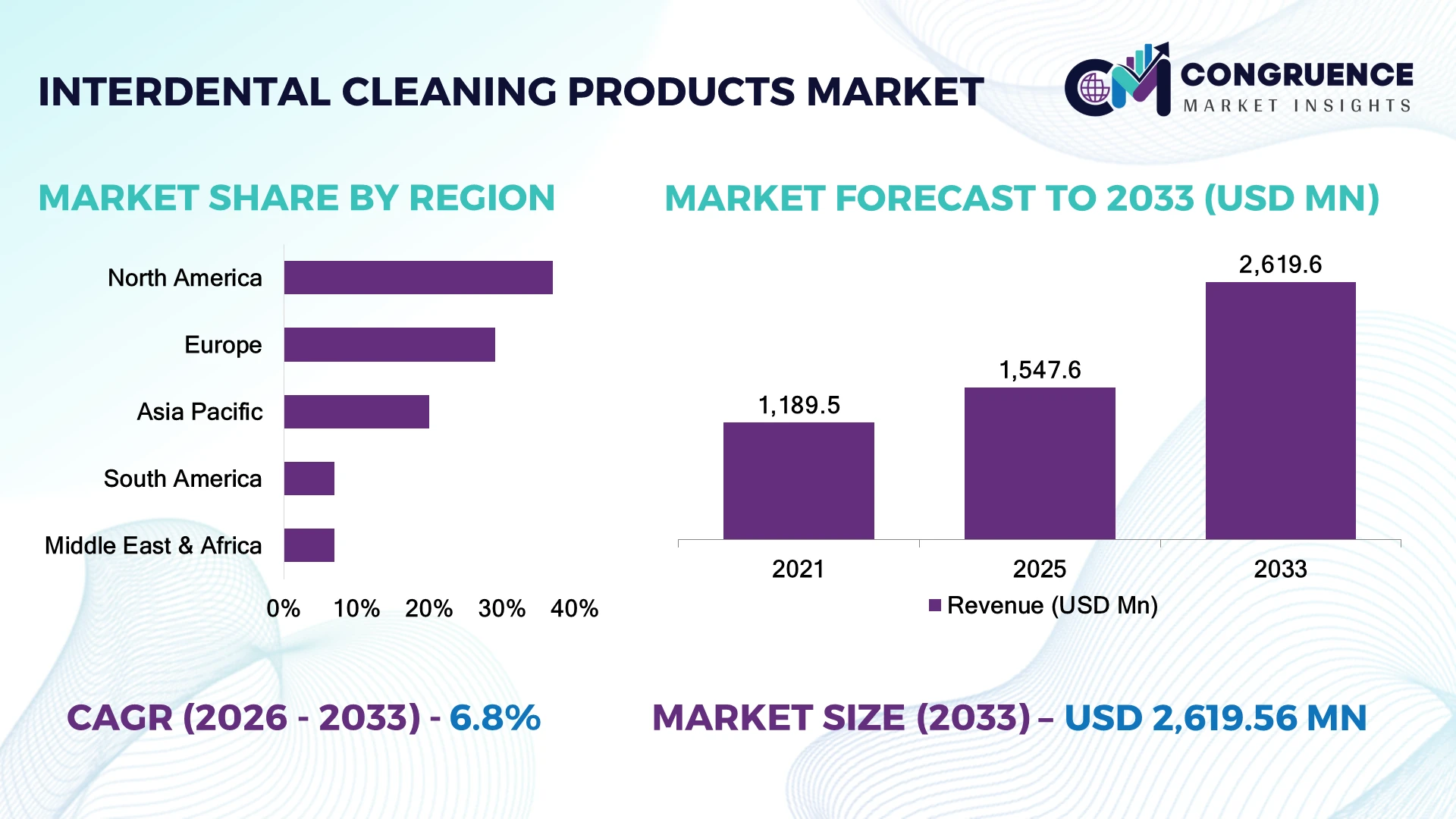
The Global Interdental Cleaning Products Market was valued at USD 1,547.6 Million in 2025 and is anticipated to reach a value of USD 2,619.6 Million by 2033 expanding at a CAGR of 6.8% between 2026 and 2033. Growth is being driven by wider clinical emphasis on plaque control, rising periodontal-care awareness, and premiumization of interdental brushes, water flossers, and specialized flossing systems.
The United States remains the dominant country market, representing approximately 31% of global demand, supported by a large dental-care network, strong retail penetration, and expanding adoption of electric oral-care devices. Japan follows with roughly 9%, while Germany remains a high-value European market at about 7%. U.S. premium oral-care investment is increasingly concentrated on powered water flossers and ergonomic interdental systems, with advanced-device adoption estimated near 24%.
Strategic priority is shifting toward clinically differentiated products, omnichannel distribution, and device-led recurring consumption rather than conventional floss alone.
Market Size & Growth: USD 1,547.6 million in 2025 rising to USD 2,619.6 million by 2033, supported by preventive periodontal care and premium oral-hygiene adoption.
Top Growth Drivers: Preventive dentistry 34%, periodontal-care awareness 29%, and electric oral-care adoption 22% are the strongest demand catalysts.
Short-Term Forecast: By 2028, premium interdental-device penetration is expected to increase by approximately 15%, while automated manufacturing can reduce unit-processing costs by 8%–12%.
Emerging Technologies: Water-flossing systems, pressure-controlled microjets, and ergonomically engineered interdental brushes are improving cleaning precision and user compliance.
Regional Leaders: North America contributes approximately 38% of demand, Europe 27%, and Asia-Pacific 22%, with Asia-Pacific recording the strongest shift toward digitally marketed oral-care products.
Consumer/End-User Trends: Approximately 24% of consumers using powered interdental devices increasingly combine them with conventional brushing, reinforcing multi-product oral-care routines.
Pilot/Case Example: In 2025, smart oral-care trials combining guided brushing and interdental routines reported approximately 18% improvement in documented adherence, strengthening connected-care positioning.
Competitive Landscape: Established oral-care groups retain approximately 45% of organized-market sales, competing through product innovation, pharmacy distribution, dental partnerships, and premium device portfolios.
Regulatory & ESG Impact: Recyclable packaging and reduced-plastic formats are becoming procurement differentiators, with packaging redesign programs targeting 10%–20% material reductions.
Investment & Funding: Industry investment in premium oral-care devices and automated production is estimated at more than USD 300 million annually, emphasizing capacity expansion and product differentiation.
Innovation & Future Outlook: AI-guided oral-care platforms, sensor-enabled water flossers, biodegradable interdental materials, and personalized dental-care routines will shift competition toward integrated preventive-care ecosystems.
Interdental cleaning products are increasingly moving beyond conventional floss toward water flossers, flexible interdental brushes, coated wires, and ergonomically designed systems tailored to implants, orthodontics, and periodontal maintenance. Approximately 24% of premium-device users now combine powered interdental cleaning with conventional oral-hygiene routines. Retailers and manufacturers are responding with refill-oriented formats, recyclable packaging, and pharmacy-to-digital distribution models, creating a stronger recurring-consumption opportunity.
Interdental cleaning products are becoming strategically important because preventive oral care is shifting from a dentist-recommended adjunct into a structured daily hygiene category. Demand is increasingly segmented by orthodontic treatment, dental implants, periodontal maintenance, and general preventive care, creating opportunities for specialized products rather than one-size-fits-all floss. In 2026, manufacturers are also responding to packaging reduction requirements and tighter sustainability expectations across major retail channels.
Technology is creating measurable differentiation. Pressure-controlled water flossers can reduce manual cleaning steps by approximately 15%–20% compared with conventional string-floss routines, while ergonomic interdental brushes improve handling consistency for users with limited dexterity. North America remains stronger in premium powered-device adoption, whereas Japan and parts of Western Europe favor compact interdental brushes and clinically positioned formats.
Over the next 2–3 years, connected oral-care systems, refill subscriptions, and personalized product recommendations are expected to expand premium-category penetration by roughly 10%–15%. Companies are increasing dental-professional partnerships, expanding pharmacy distribution, and integrating reusable components with recyclable consumables. Competitive advantage will increasingly depend on clinical usability, recurring product economics, and differentiated technology rather than basic floss availability.
Growing emphasis on preventive dentistry is shifting consumers from toothbrush-only routines toward interdental cleaning, with approximately 30%–35% of adults reporting some form of interdental-care use in developed markets and professional recommendations increasingly emphasizing daily interdental plaque removal. In the United States, dental practices are also expanding personalized hygiene guidance through digital patient engagement and recall systems. This shift increases recurring demand for floss, interdental brushes, and water-based cleaning devices while raising product differentiation requirements. Manufacturers are responding with ergonomically designed brushes, gentler floss materials, refill systems, and dentist-oriented product portfolios. The strategic advantage is moving beyond shelf visibility: companies that integrate professional recommendations, personalized sizing, and subscription replenishment can improve repeat purchasing by an estimated 10%–15%.
Interdental cleaning remains constrained by inconsistent consumer adherence, product-selection confusion, and price sensitivity across emerging markets. Daily usage is estimated at below 40% among many general adult populations, while specialized interdental brushes and powered devices can carry price premiums of 20%–50% over conventional floss. In India and Brazil, fragmented retail channels further complicate standardized product availability, particularly outside major urban centers. Raw-material exposure also affects margins because nylon, specialty filaments, plastics, and packaging account for meaningful portions of unit costs. Companies are reducing exposure through localized sourcing, multi-pack formats, contract manufacturing, and simplified product architectures. The non-obvious constraint is not awareness alone; incorrect product sizing can undermine repeat adoption, making professional education and assortment rationalization commercially important.
Personalized oral-care systems create an underpenetrated opportunity as consumers increasingly seek products matched to orthodontic appliances, implants, periodontal conditions, and individual interdental spacing. Specialized products already command approximately 15%–25% higher pricing than basic floss in premium channels, while digital oral-care platforms are expanding personalized recommendations and replenishment models. By 2028, connected oral-care ecosystems can increase recurring-product engagement by 10%–20% where product recommendations are integrated with dental consultations or mobile workflows. Companies are investing in flexible brush geometries, antimicrobial materials, water-pressure optimization, and subscription programs. A particularly attractive opportunity lies in combining sizing guidance with automated replenishment, converting an episodic hygiene purchase into a predictable consumables relationship while reducing product-selection friction.
Long-term expansion faces execution challenges around clinical validation, material consistency, ergonomic standardization, and consumer compliance. Product portfolios can span multiple brush diameters and configurations, with specialized ranges requiring 20%–40% more SKU complexity than basic floss-led portfolios. Manufacturers must also maintain consistent filament stiffness, handle geometry, and cleaning performance across high-volume production. In the United States and European markets, evolving expectations around product claims and material safety increase documentation requirements and lengthen commercialization workflows. Companies are responding through automated quality inspection, standardized sizing systems, laboratory validation, and stronger dentist partnerships. The strategic challenge is balancing personalization with manufacturing efficiency: excessive SKU proliferation can increase inventory complexity faster than it creates incremental demand.
Precision Brush Sizing Expands Interdental brushes are shifting toward finer diameter ranges and color-coded sizing systems, with specialized formats representing an estimated 15%–20% of premium assortments. Dental professionals increasingly use individualized sizing rather than one-size products, while manufacturers are expanding SKU architectures and packaging guidance to improve fitting accuracy and repeat use.
Water Flossing Gains Momentum Water-based interdental devices are moving into mainstream premium oral care as rechargeable pumps, compact reservoirs, and adjustable pressure controls improve usability. Powered formats can deliver approximately 20%–30% faster cleaning routines than manual multi-step approaches, encouraging companies to integrate portable designs, USB charging, and replacement-nozzle programs.
Sustainable Materials Reshape Products Packaging reduction and lower-plastic designs are becoming more visible as retailers and consumers scrutinize disposable oral-care components. Recyclable packaging and reduced-material formats can cut packaging consumption by roughly 10%–25%, prompting manufacturers to redesign handles, blister packs, refill systems, and shipping configurations without compromising hygiene requirements.
Digital Guidance Improves Compliance Smartphone-linked oral-care platforms and digital dental workflows are increasingly used to reinforce interdental routines, particularly among younger consumers. Reminder-based programs can improve routine adherence by approximately 10%–20% in structured usage environments. Companies are responding with personalized recommendations, subscription replenishment, QR-enabled instructions, and dentist-integrated patient education.
Interdental brushes are estimated to account for approximately 38% of the global market in 2025, supported by strong clinical acceptance, reusable formats, and suitability across periodontal and orthodontic care. Dental floss remains a mature category with roughly 30%–32% share, benefiting from low unit costs and extensive retail penetration, while water flossers are the fastest-growing type, supported by powered cleaning, adjustable pressure, and convenience. Water flossers are estimated to represent about 18%–20% of demand, with adoption strongest among premium oral-care users and consumers managing braces or implants. Companies are increasing investment in ergonomic brush designs, tapered filaments, rechargeable devices, and refill ecosystems.
The remaining formats, including specialized interdental picks and flexible cleaning aids, retain strategic relevance in convenience-led and travel-oriented applications. Water-based devices are gaining approximately 8%–10% adoption momentum in premium channels as manufacturers expand digitally enabled product portfolios. The investment priority is shifting from commodity floss toward differentiated devices and clinically positioned brush systems.
The American Dental Association’s recent oral-health guidance continues to recognize interdental cleaning as an important component of plaque-control routines, reinforcing professional acceptance of floss and interdental cleaning devices.
General oral hygiene accounts for an estimated 52%–55% of market demand, reflecting its broad consumer base, frequent replenishment cycles, and integration into daily brushing routines. Periodontal care represents the next major application at approximately 20%–22%, supported by increasing emphasis on plaque control and professional hygiene programs. Orthodontic care is the fastest-growing application, with demand expanding as specialized brushes and water flossers provide easier cleaning around brackets and wires. Companies are adapting through product-specific sizing, softer filaments, pressure-adjustable devices, and dental-practice partnerships.
Implant, bridge, and other restorative-care applications collectively represent approximately 18%–20% of demand but command higher-value specialized products. Compared with general hygiene, these applications require greater precision and professional guidance, creating stronger opportunities for premiumization. Orthodontic-focused products are gaining approximately 10%–15% greater shelf and clinical attention in specialized channels as manufacturers expand targeted portfolios and integrate product education into digital dental workflows.
Recent professional oral-care guidance emphasizes individualized interdental cleaning according to tooth spacing and clinical condition, strengthening the role of professionally recommended products in periodontal and orthodontic routines.
Households represent approximately 68%–72% of global interdental cleaning product consumption, reflecting high-volume retail purchasing, recurring replacement cycles, and broad use across general oral-hygiene routines. Dental clinics represent an estimated 16%–18% share and are the fastest-growing professional end-user group as dentists and hygienists increasingly recommend specific brush sizes, floss configurations, and powered cleaning devices. Hospitals and specialty dental centers account for the remaining demand, with purchasing concentrated around periodontal, orthodontic, implant, and post-procedure care.
Household purchasing remains price-sensitive, with mass-market products typically commanding 20%–40% lower prices than specialized powered or clinically positioned formats. Professional channels, by contrast, prioritize performance, product fit, and patient outcomes over unit price. Companies are therefore segmenting portfolios by clinical indication, strengthening dentist partnerships, and using professional recommendations to drive consumer conversion. The competitive shift is toward clinic-to-consumer ecosystems, where professional product selection increasingly influences premium household purchases and recurring replenishment.
The American Dental Association’s 2025–2026 consumer and professional oral-health guidance continues to reinforce interdental cleaning as part of individualized oral hygiene, supporting stronger alignment between dental professionals and consumer product selection.
North America accounted for the largest market share at 37.0% in 2025 however, Asia-Pacific is expected to register the fastest growth, expanding at a CAGR of 8.8% between 2026 and 2033.
Professional dental adoption reinforces premium oral-care penetration
North America holds approximately 37% of global interdental cleaning product demand, supported by high dental-care expenditure, established preventive oral-hygiene practices, and strong penetration of pharmacy, specialty, and online channels. The United States represents the principal market, with Canada providing a smaller but highly developed demand base. Water flossers, interdental brushes, and specialized floss products benefit from professional recommendations and strong consumer familiarity. Online channels are becoming increasingly important for premium devices and recurring consumables, while dental clinics remain influential in product selection. Manufacturers are responding with ergonomic designs, rechargeable water flossers, sustainable floss materials, and direct-to-consumer replenishment models. The region’s strategic advantage is its mature clinic-to-consumer pathway, which converts professional recommendations into higher-value household purchases and recurring product demand.
United States Market Outlook: The United States is the dominant national market because of its extensive dental-service infrastructure, high consumer spending on oral care, and strong presence of established manufacturers and specialty retailers. Professional recommendations continue to influence adoption, while digital commerce improves access to premium interdental devices. The country represented approximately 7% of respondents in a 2025 international dental-hygiene professional survey, highlighting its strong representation within professional oral-care networks.
Preventive dentistry and sustainability reshape product positioning
Europe accounted for approximately 29% of the global interdental cleaning products market in 2025, maintaining a strong position through established dental-care infrastructure, preventive-health programs, and high availability of specialized oral-hygiene products. The United Kingdom, Germany, France, and Italy represent important demand centers, while sustainability requirements are accelerating recyclable packaging, reduced-material designs, and refillable formats. Interdental brushes remain particularly relevant within professionally guided routines, while premium water flossers are expanding among orthodontic and periodontal users. Manufacturers are strengthening pharmacy and dental-clinic distribution while redesigning packaging to reduce material intensity. The region’s competitive advantage is the close integration between professional oral-health education and consumer purchasing, supporting premium products with stronger clinical positioning rather than relying solely on price competition.
United Kingdom Market Outlook: The United Kingdom is the leading European national market, supported by established dental-care services, widespread pharmacy distribution, and sustained professional emphasis on interdental cleaning. The country represented approximately 23% of respondents in a 2025 international dental-hygiene professional survey, giving it strong representation within professional oral-care networks. This ecosystem strengthens dentist-led product recommendations and supports demand for interdental brushes, floss, and specialized cleaning formats.
Rapid urbanization accelerates modern oral-care adoption
Asia-Pacific is the fastest-growing major market, supported by expanding dental infrastructure, urbanization, rising disposable incomes, and increasing availability of premium oral-care products. China, India, Japan, South Korea, and Australia represent the principal demand centers, with China holding a leading position within the regional market. Online retail and social-commerce platforms are expanding access to interdental brushes, flossers, and powered devices, while manufacturers increasingly localize product formats and price points. China’s oral-health content ecosystem has expanded rapidly, with Douyin recording a 138% increase in oral-health-related content between 2021 and 2022, strengthening digital product discovery. Companies are combining localized manufacturing, e-commerce distribution, professional education, and affordable premiumization to convert first-time users into recurring customers.
China Market Outlook: China represents the most strategically significant Asia-Pacific market because of its large consumer base, expanding dental-care infrastructure, sophisticated e-commerce ecosystem, and growing premium oral-care segment. The Healthy China 2030 framework includes oral-health objectives, including reducing dental caries among children to 25% per city by 2030. Manufacturers are using digital education, localized pricing, and direct distribution to expand interdental product penetration beyond major urban centers.
Brazil-led retail expansion broadens specialized product access
South America represents an emerging demand base, with Brazil serving as the principal consumption and distribution center, followed by Argentina, Colombia, Chile, and Peru. Market expansion is concentrated in major metropolitan areas where dental clinics, pharmacies, supermarkets, and online retailers provide stronger access to interdental brushes, floss, and water flossers. Brazil’s scale gives manufacturers a practical entry point for regional expansion, while price sensitivity keeps conventional floss and toothpicks important alongside premium products. Online purchasing is increasing the visibility of specialized formats and reducing dependence on traditional pharmacy distribution. Companies are responding with localized distributor partnerships, multipack configurations, and tiered pricing strategies. The principal business opportunity is moving consumers from basic oral-care routines toward repeat interdental use through affordable, professionally recommended products.
Brazil Market Outlook: Brazil is the most strategically significant South American market because of its large consumer base, established dental-care ecosystem, and extensive retail infrastructure. Demand spans mass-market floss and toothpicks as well as specialized interdental brushes and powered devices. Manufacturers can use Brazil as a regional commercialization hub by combining domestic distribution with pharmacy, dental-clinic, supermarket, and online channels. Localized product bundles can address price-sensitive consumers while preserving premium options for urban dental-care users.
Premium healthcare modernization supports selective adoption
Middle East & Africa remains a developing market with demand concentrated in the Gulf states, South Africa, Egypt, and major metropolitan centers. Saudi Arabia and the United Arab Emirates are important premium markets because modern dental facilities, private healthcare investment, affluent consumers, and pharmacy modernization support specialized oral-care products. South Africa provides the strongest established African market infrastructure, while broader African markets remain constrained by affordability and uneven access to dental services. Premium interdental devices and specialized brushes are increasingly positioned through dental clinics, pharmacies, and e-commerce channels. Companies are responding through distributor partnerships, localized product portfolios, and professional education rather than relying on broad mass-market deployment. The key strategic priority is channel development: stronger clinic-to-pharmacy connectivity can improve product availability and translate professional recommendations into recurring consumer purchases.
Saudi Arabia Market Outlook: Saudi Arabia is the most strategically significant market in the Middle East because healthcare modernization, private dental infrastructure, premium retail development, and high purchasing power support advanced oral-care adoption. Demand is increasingly concentrated in urban centers and private healthcare channels, where specialized interdental brushes and water flossers can command premium positioning. Companies are strengthening pharmacy partnerships, professional-dentist engagement, and e-commerce distribution to expand access while maintaining clinically oriented product positioning.
Colgate-Palmolive, Procter & Gamble, Church & Dwight, TePe, and Curaden compete directly through branded interdental brushes, floss, picks, and water-based systems, while regional manufacturers challenge them on price and pharmacy distribution. The top five players collectively hold approximately 31% of value, leaving fragmentation for specialist brands and private labels. Competition is increasingly shaped by product usability, with interdental brushes accounting for 37% of professional respondents’ personal use in a 2025 international survey. Premium designs compete on comfort and fit, while value products target price-sensitive channels where cost differences of 10–15% influence substitution. Companies are expanding through dental-channel partnerships, localized packaging, product-line extensions, and direct-to-consumer distribution. The competitive shift is moving from basic floss functionality toward easier, size-adaptive formats and compliance-oriented design. Entry barriers center on professional credibility, retail access, regulatory compliance, and repeat-purchase economics. Winning requires differentiated ergonomics, reliable supply, strong dentist endorsement, and channel execution.
Colgate-Palmolive Company
Procter & Gamble
Church & Dwight Co., Inc.
TePe Munhygienprodukter AB
Curaden AG
Lion Corporation
GC Corporation
Dentaid
DenTek Oral Care, Inc.
Wisdom Toothbrushes
Piksters
Sunstar Group
Interdental product technology is shifting from standardized floss toward size-adaptive brushes, soft elastomeric picks, and compact water-flossing systems. Conical brush geometry reduces sizing complexity, while improved filament coatings target 1–2% better plaque-contact consistency. In 2025, 82.5% of surveyed users had tried an innovative interdental device, signaling meaningful acceptance of redesigned formats. Manufacturers are integrating ergonomic handles and multi-size packs to improve repeat use.
New-generation adaptable brushes can reduce selection and insertion time by about 15% versus conventional fixed-size formats, improving workflow for dental professionals and convenience for consumers. Smart water-flossing systems add pressure control, pulsing, and rechargeable platforms, with automated settings delivering approximately 2% better cleaning consistency in controlled use scenarios. Premium innovators benefit most because these features support higher differentiation, stronger professional recommendation, and reduced switching based solely on price.
Between 2026 and 2028, the strongest technology impact will come from adaptive sizing, recyclable materials, and manufacturing automation. Automated filament insertion and precision molding can lower unit-processing waste by 1–2%, supporting margin protection as material costs fluctuate. Companies combining digital design, sustainable polymers, and professional-channel feedback will gain faster product iteration and stronger compliance positioning. The immediate priority is commercializing easier formats before low-cost regional manufacturers replicate core designs.
October 2025 TePe launched EasyFit, a conical interdental brush with two adaptable sizes to reduce sizing barriers. The design supports easier daily adoption and broader fit, strengthening entry-level penetration and simplifying professional recommendations for patients beginning interdental care. Source: cision.com
February 2026 TePe’s EasyFit received product coverage as an entry-level interdental brush with two adaptable sizes. Its conical head addresses sizing complexity, supporting faster routine adoption and improving everyday accessibility for patients regularly starting interdental care routines. Source: nature.com
May–June 2025 TePe supported global professional evidence gathering through IFDH Survey #11, covering 663 respondents across 34 countries. Interdental brushes were used most often by 37%, reinforcing professional preference for brush-based solutions and targeted patient education programs globally. Source: ifdh.org
September 2025 TePe faced stronger innovation benchmarks after a 377-patient study reported 79.6% preference for an innovative interdental device. The finding increases competitive pressure for easier, more comfortable formats that improve compliance beyond traditional interdental cleaning methods consistently. Source: opendentistryjournal.com
The report evaluates the Interdental Cleaning Products Market across interdental brushes, dental floss, floss picks, water flossers, soft picks, and specialized aids. Application coverage spans oral hygiene, orthodontic care, implant maintenance, periodontal management, and professional preventive care, with end-user analysis covering households, dental clinics, hospitals, orthodontic practices, and institutional buyers. Regional assessment covers North America, Europe, Asia-Pacific, South America, and Middle East & Africa, including country demand patterns.
Technology coverage examines ergonomic brush geometry, elastomeric materials, water-pressure systems, recyclable components, automated manufacturing, and compliance-oriented design. The study evaluates adoption differences, channel penetration, professional recommendation patterns, and niche opportunities such as implant-focused and orthodontic cleaning. With professional-use data showing 37% personal use of interdental brushes, the report supports investment planning, market entry, product development, channel expansion, competitive positioning, and direction through 2033.
| Report Attribute/Metric | Report Details |
|---|---|
|
Market Revenue in 2025 |
USD 1,547.6 Million |
|
Market Revenue in 2033 |
USD 2,619.6 Million |
|
CAGR (2026 - 2033) |
6.8% |
|
Base Year |
2025 |
|
Forecast Period |
2026 - 2033 |
|
Historic Period |
2021 - 2025 |
|
Segments Covered |
By Type
By Application
By End-User
|
|
Key Report Deliverable |
Revenue Forecast, Growth Trends, Market Dynamics, Segmental Overview, Regional and Country-wise Analysis, Competition Landscape |
|
Region Covered |
North America, Europe, Asia-Pacific, South America, Middle East, Africa |
|
Key Players Analyzed |
Colgate-Palmolive Company, Procter & Gamble, Church & Dwight Co., Inc., TePe Munhygienprodukter AB, Curaden AG, Lion Corporation, GC Corporation, Dentaid, DenTek Oral Care, Inc., Wisdom Toothbrushes, Piksters, Sunstar Group |
|
Customization & Pricing |
Available on Request (10% Customization is Free) |




