
Reports
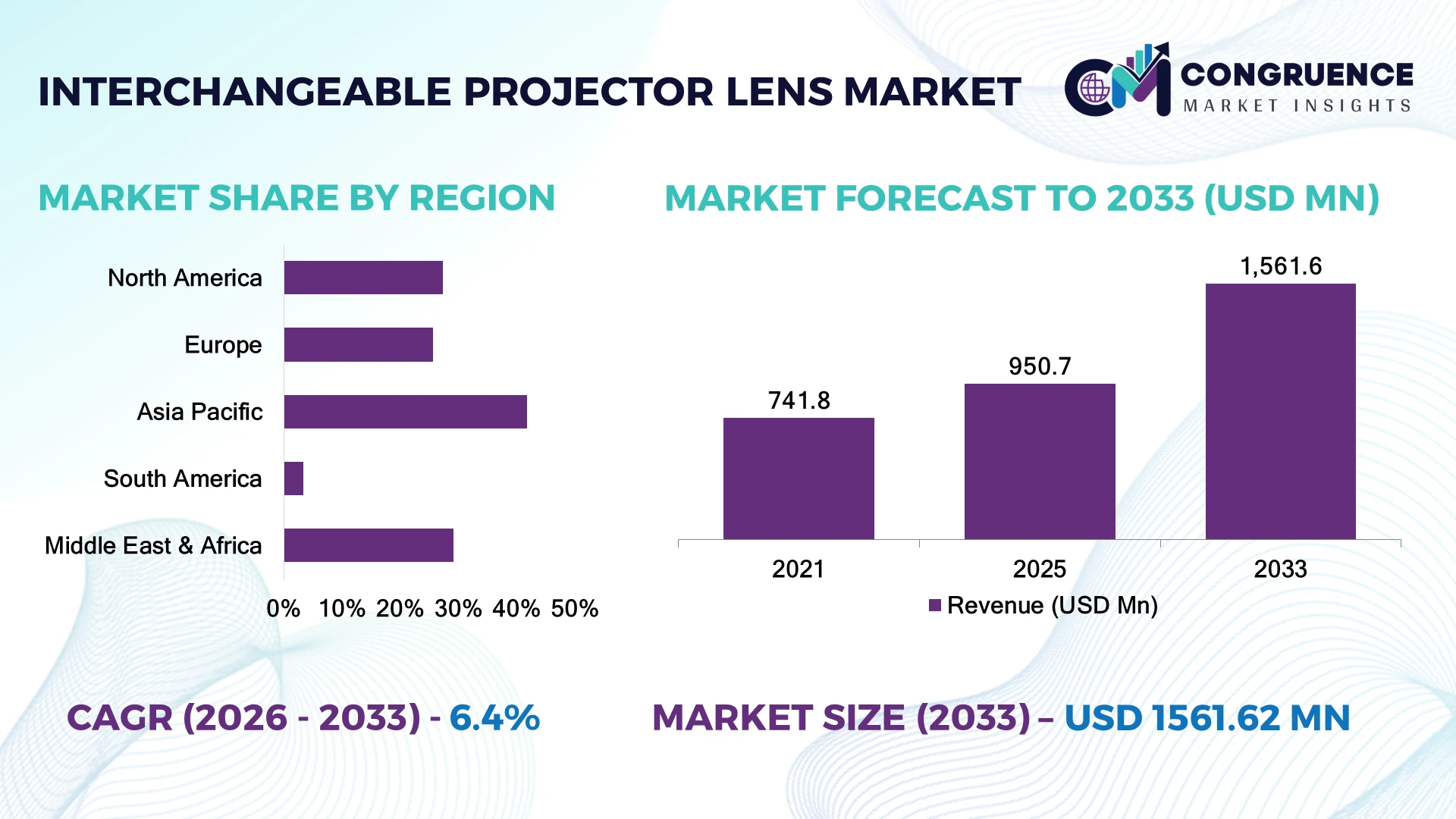
The Global Interchangeable Projector Lens Market was valued at USD 950.7 Million in 2025 and is anticipated to reach a value of USD 1,561.6 Million by 2033 expanding at a CAGR of 6.4% between 2026 and 2033. Growth is driven by rising deployment of high-brightness laser projectors across education, entertainment venues, museums, simulation centers, and large-format corporate installations requiring flexible projection distances and precision optics.
Japan remains the dominant country, accounting for approximately 34% of global interchangeable projector lens production, supported by advanced optical manufacturing, precision engineering, and strong professional AV industries. More than 72% of premium projector platforms launched by Japanese manufacturers support interchangeable lenses, while China continues expanding assembly capacity through large-scale AV manufacturing investments. Supply-chain diversification following semiconductor and optical component realignment is strengthening regional production resilience.
Manufacturers prioritizing precision optics, lightweight lens engineering, and faster product customization will strengthen competitive positioning across professional projection and immersive visualization markets.
Market Size & Growth: USD 950.7 Million in 2025, projected to reach USD 1,561.6 Million by 2033 at a CAGR of 6.4%, supported by laser projection adoption.
Top Growth Drivers: Laser projector deployment (+31%), immersive venues (+24%), education modernization (+19%).
Short-Term Forecast: By 2028, installation time declines 18% through modular lens compatibility and improved optical calibration.
Emerging Technologies: AI image correction, motorized optics, and lightweight aspherical glass improve projection accuracy.
Regional Leaders: Asia-Pacific exceeds USD 620 Million, North America surpasses USD 350 Million, Europe approaches USD 300 Million with expanding professional AV adoption.
Consumer/End-User Trends: Nearly 63% of enterprise buyers prioritize motorized zoom and lens-shift capabilities.
Pilot/Case Example: A 2026 museum modernization project improved projection coverage by 29% using interchangeable ultra-short-throw lenses.
Competitive Landscape: Leading suppliers hold approximately 49% market share, led by Epson, Panasonic, Canon, Christie Digital, and Barco.
Regulatory & ESG Impact: Energy-efficient laser projection systems reduce power consumption by approximately 17% during continuous operation.
Investment & Funding: More than USD 780 Million supports optical manufacturing expansion, precision lens development, and production automation.
Innovation & Future Outlook: Smart optical calibration and hybrid projection platforms continue strengthening premium product differentiation.
The interchangeable projector lens market is expanding across higher education, live entertainment, digital museums, corporate visualization, and simulation facilities where installation flexibility and image precision remain critical purchasing factors. Nearly 46% of premium projector installations now specify interchangeable optics for application-specific performance. Continued investment in precision optical manufacturing and localized component sourcing is reinforcing market resilience, setting the foundation for the strategic discussion.
The interchangeable projector lens market has become strategically significant as organizations increasingly require adaptable projection systems capable of serving multiple environments without replacing core hardware. Infrastructure modernization across education, entertainment, healthcare visualization, and enterprise collaboration is accelerating investment in modular projection ecosystems. Supply-chain diversification for optical components is also encouraging manufacturers to regionalize production while improving delivery reliability and product customization.
Modern motorized interchangeable lenses improve installation efficiency by approximately 25% compared with conventional fixed-lens configurations while reducing projector repositioning requirements by nearly 30%. Asia-Pacific leads optical manufacturing scale and production efficiency, whereas North America emphasizes advanced visualization, simulation, and enterprise deployment. Over the next two to three years, integrated optical calibration, automated lens recognition, and AI-assisted image optimization are expected to become standard features across premium professional projection platforms.
A practical example is the deployment of interchangeable ultra-short-throw and long-throw lenses within museums and convention centers where multiple projection distances must be supported using the same projector platform. Manufacturers are expanding precision optics production, strengthening partnerships with professional AV integrators, and investing in lightweight lens technologies that simplify installation while improving image quality. Companies combining advanced optical engineering, modular compatibility, and rapid deployment capabilities will establish stronger long-term competitive differentiation.
The rapid deployment of laser projector platforms across education, entertainment, museums, simulation centers, and corporate venues is strengthening demand for interchangeable projector lenses with flexible throw ratios and precision optics. Approximately 64% of newly installed professional laser projectors now support interchangeable lens systems, while motorized lens solutions reduce installation time by nearly 23%. Japan continues expanding high-precision optical manufacturing, supporting faster commercialization of premium projection components. The transition toward modular projection infrastructure enables end users to adapt installations without replacing entire projector systems. Manufacturers are responding through investment in lightweight optical materials, expanded lens portfolios, strategic AV integrator partnerships, and advanced motorized lens technologies that improve installation flexibility and long-term equipment utilization.
Manufacturing interchangeable projector lenses depends on high-precision optical glass, specialized coatings, and precision assembly processes that increase production complexity. Optical components contribute nearly 42% of total lens manufacturing costs, while procurement lead times for premium optical glass remain approximately 18% above pre-disruption levels. Supply-chain adjustments affecting specialty optics and semiconductor-controlled motorized assemblies continue influencing production schedules in Japan and other manufacturing hubs. These factors increase inventory costs and delay product availability for professional AV projects. Companies are mitigating risks by diversifying optical suppliers, expanding localized production, securing long-term procurement agreements, and redesigning lens assemblies for improved manufacturing efficiency without compromising optical performance.
Growing adoption of AI-enabled image optimization, automated calibration, and digital venue management is creating new opportunities for interchangeable projector lenses. Nearly 48% of premium installation projects now specify motorized lens memory and automated alignment capabilities, reducing setup time by approximately 28%. South Korea continues investing in immersive digital experiences across museums, entertainment venues, and corporate visualization facilities, accelerating demand for intelligent optical solutions. Manufacturers are expanding R&D in electronically controlled optics, lightweight lens materials, and cloud-enabled calibration platforms while forming partnerships with projector manufacturers to develop integrated projection ecosystems. Subscription-based remote lens management and predictive maintenance services represent an emerging competitive advantage.
Ensuring seamless compatibility between interchangeable projector lenses and multiple projector platforms remains a major execution challenge. Approximately 37% of enterprise AV installations involve mixed projector environments where proprietary lens mounts and firmware variations complicate deployment, while customization increases installation timelines by nearly 16%. The transition toward software-driven image optimization further requires secure firmware management and consistent hardware interoperability. These challenges directly affect installation efficiency, service scalability, and lifecycle maintenance costs. Manufacturers must strengthen standardized mounting systems, improve firmware interoperability, expand certified integration partnerships, and invest in universal calibration technologies to simplify deployment across increasingly diverse professional projection environments.
Advanced Motorized Lens Systems Nearly 61% of premium professional projectors now incorporate motorized zoom, focus, and lens-shift functions, reducing installation adjustments by approximately 24%. Convention centers and universities increasingly prioritize programmable lens memory. Manufacturers are expanding automated optical calibration, improving installation workflows, and strengthening partnerships with professional AV integrators.
Lightweight Optical Engineering Advanced aspherical glass elements and hybrid composite materials reduce lens weight by approximately 19% while maintaining image uniformity across large projection surfaces. Japanese optical manufacturers continue optimizing precision manufacturing processes to improve transportability and installation flexibility. Companies are investing in automated polishing technologies and next-generation optical coatings to strengthen premium product differentiation.
Immersive Venue Deployments Demand from museums, simulation centers, and immersive entertainment venues has increased by nearly 27%, while ultra-short-throw lens installations have expanded approximately 21%. Digital experience investments are accelerating deployment of specialized projection optics. Manufacturers are broadening application-specific lens portfolios and collaborating with visualization system integrators to address increasingly customized installation requirements.
Remote Calibration Integration Cloud-enabled projector management platforms now support approximately 44% of enterprise projection deployments, reducing maintenance visits by nearly 18% through remote diagnostics and calibration updates. Growing digital workplace adoption is encouraging software-driven projection management. Suppliers are integrating intelligent firmware, expanding remote support capabilities, and developing connected optical ecosystems that improve long-term operational efficiency.
Standard throw lenses remain the leading segment, accounting for approximately 43% of global interchangeable projector lens demand because they provide the broadest compatibility across education, corporate, auditoriums, and commercial presentation environments. Their balanced projection distance, cost efficiency, and installation flexibility make them the preferred choice for professional AV integrators. Ultra short throw (UST) lenses represent the fastest-growing segment as museums, simulation centers, immersive entertainment venues, and collaborative workplaces increasingly require large-format projection within limited installation space. Nearly 31% of newly installed premium laser projectors now utilize UST-compatible interchangeable lenses. Manufacturers are expanding UST product portfolios, investing in advanced optical correction technologies, and collaborating with projector OEMs to improve installation versatility and image uniformity.
Long throw lenses continue serving stadiums, theaters, and large auditoriums where extended projection distances are essential, while short throw lenses maintain steady demand across classrooms and meeting environments. Specialty fisheye and projection mapping lenses are strengthening their strategic relevance in immersive visualization and digital art applications. Companies continue prioritizing lightweight optics, motorized lens control, and precision optical coatings while shifting investment toward modular lens ecosystems supporting multiple professional projection environments.
Industry findings released during 2025 indicate that standard throw lenses continue representing the largest installed base in professional projection systems, while ultra short throw optics are recording the fastest deployment growth across immersive visualization, higher education, and digital exhibition projects.
Education remains the largest application segment, contributing approximately 39% of global interchangeable projector lens demand as universities, lecture halls, and training institutions increasingly deploy laser projection systems supporting flexible classroom configurations. Interchangeable lenses enable institutions to adapt projection distances without replacing core hardware, improving long-term infrastructure utilization. Entertainment and immersive visualization represent the fastest-growing application, driven by projection mapping, museums, theme parks, esports venues, and digital experience centers. Approximately 34% of newly commissioned immersive installations now specify interchangeable lens platforms supporting multiple projection geometries. Manufacturers are strengthening partnerships with professional AV integrators while expanding specialized lens portfolios for projection mapping and large-format visualization.
Corporate facilities, government institutions, houses of worship, and commercial venues continue adopting interchangeable projector lenses to improve installation flexibility and presentation quality. Simulation and command centers are also increasing demand for precision optics capable of supporting high-resolution visualization. Companies are expanding automation features, motorized calibration technologies, and integrated optical software to simplify deployment while improving image consistency across diverse operating environments.
Enterprise deployment assessments published during 2025 indicate that education continues generating the largest volume of professional projector installations, while immersive entertainment and projection mapping applications are experiencing the strongest acceleration in premium interchangeable lens adoption.
Commercial enterprises remain the dominant end-user group, accounting for nearly 41% of global procurement as corporations, convention centers, hotels, and business facilities increasingly invest in flexible large-format projection systems supporting conferences, training, and digital collaboration. Entertainment and media organizations represent the fastest-growing end-user segment due to expanding investment in immersive experiences, projection mapping, esports venues, and digital exhibitions. Approximately 33% of newly deployed premium entertainment projection systems now utilize interchangeable lens configurations to support multiple venue layouts. Manufacturers are responding through customized optical solutions, long-term AV integration partnerships, and advanced motorized lens technologies tailored for commercial installations.
Educational institutions continue representing a major purchasing group through classroom modernization and hybrid learning infrastructure, while government organizations, museums, healthcare facilities, and simulation centers increasingly prioritize interchangeable projection platforms supporting operational flexibility. Suppliers are strengthening regional service capabilities, expanding OEM collaborations, and developing modular optical ecosystems that improve lifecycle value while reducing installation complexity across professional environments.
Industry assessments released during 2025 indicate that commercial enterprises remain the largest purchasers of interchangeable projector lens systems, while entertainment and immersive visualization operators continue recording the strongest deployment growth as experience-driven venues expand globally.
Asia-Pacific accounted for the largest market share at 41.8% in 2025 moreover Asia-Pacific is also expected to register the fastest growth, expanding at a CAGR of 7.1% between 2026 and 2033.
Professional AV Modernization Strengthens Premium Lens Adoption
North America contributes approximately 27.3% of global demand, supported by strong investment in higher education, entertainment venues, simulation facilities, and enterprise collaboration infrastructure. Organizations increasingly deploy interchangeable projector lenses to improve installation flexibility while extending projector lifecycle across multiple environments. Nearly 61% of premium laser projector installations within large venues now incorporate motorized interchangeable lenses supporting automated lens memory and remote calibration. Growth in esports arenas, museums, and digital exhibition centers continues strengthening demand for precision optics. Manufacturers are expanding regional inventory, strengthening AV integrator partnerships, and investing in software-enabled optical management systems to improve deployment efficiency and customer support.
United States Market Outlook: The United States remains the largest regional market because of its extensive professional AV ecosystem, convention centers, higher education institutions, and entertainment industry. Large corporate campuses and live event venues increasingly standardize interchangeable lens platforms to maximize equipment utilization across multiple installations. More than 68% of enterprise-grade projector deployments now specify motorized lens functionality, encouraging manufacturers to strengthen localized technical support, application engineering, and custom optical solutions.
Cultural Infrastructure Drives Advanced Projection Systems
Europe accounts for approximately 25.6% of global market demand, supported by museums, performing arts venues, universities, and corporate digital transformation projects. Heritage preservation initiatives increasingly integrate advanced projection technologies requiring flexible interchangeable optics for immersive exhibitions. Modern conference facilities and auditoriums continue upgrading to laser projection systems supporting multiple lens configurations. Manufacturers are expanding precision optical development, strengthening collaboration with professional AV integrators, and increasing localized service capabilities to improve installation quality and long-term operational performance.
Germany Market Outlook: Germany leads the regional market through its advanced engineering sector, industrial exhibition industry, and strong investment in professional visualization technologies. Convention centers, automotive design facilities, and educational institutions increasingly deploy interchangeable projector lenses for flexible presentation environments. Suppliers continue investing in precision optics, customized lens solutions, and technical integration services supporting premium enterprise and institutional installations.
Optical Manufacturing Leadership Expands Global Supply
Asia-Pacific represents approximately 41.8% of global demand and serves as the primary manufacturing hub for interchangeable projector lenses. Rapid expansion of digital education, entertainment infrastructure, corporate visualization, and smart city projects is accelerating deployment of modular projection systems. Nearly 56% of global professional projector production is concentrated within the region, supporting strong ecosystem integration between projector manufacturers and optical suppliers. Companies continue expanding automated optical production, improving precision coating technologies, and strengthening regional component supply chains to enhance manufacturing efficiency and export competitiveness.
Japan Market Outlook: Japan remains the technology leader through its globally recognized expertise in precision optics, advanced glass manufacturing, and projector innovation. Approximately 34% of premium interchangeable projector lens production originates from Japanese manufacturers serving global professional AV markets. Companies continue investing in lightweight optical materials, automated polishing technologies, and next-generation motorized lens platforms that strengthen premium product differentiation.
Digital Education Supports Market Expansion
South America accounts for approximately 3.4% of global demand, driven by modernization of educational institutions, corporate conference infrastructure, and entertainment venues. Digital classroom initiatives and expanding commercial audiovisual installations continue increasing deployment of interchangeable projector lens systems despite budget constraints and imported equipment dependency. Professional AV providers are strengthening installation capabilities while suppliers improve regional product availability and after-sales technical support. Strategic partnerships with local system integrators continue enhancing project execution and operational reliability across commercial applications.
Brazil Market Outlook: Brazil leads regional demand through expanding education modernization, corporate infrastructure development, and entertainment investments. Universities, convention centers, and commercial enterprises increasingly adopt laser projection systems requiring flexible optical configurations. Manufacturers are expanding distributor networks, strengthening technical certification programs, and improving localized service capabilities to support long-term growth across professional audiovisual installations.
Large-Scale Entertainment Investments Drive Adoption
The Middle East & Africa market is strengthening through investment in tourism infrastructure, smart cities, museums, convention centers, and large entertainment developments. The region contributes approximately 1.9% of global demand, with premium projection systems increasingly specified for immersive visitor experiences and high-capacity event venues. Large public infrastructure projects continue accelerating demand for flexible projection technologies capable of supporting diverse installation environments. Manufacturers are strengthening regional partnerships, expanding technical support capabilities, and introducing premium optical solutions designed for large-scale commercial deployments.
Saudi Arabia Market Outlook: Saudi Arabia remains the leading regional market through significant investment in entertainment destinations, cultural attractions, convention centers, and tourism infrastructure. Major development projects increasingly specify interchangeable projector lens systems to support immersive digital experiences and large-format visualization. Suppliers are expanding local partner networks, strengthening engineering support, and delivering customized optical solutions that align with rapidly evolving entertainment and smart infrastructure projects.
Global projection leaders including Epson, Canon, Barco, Christie Digital, and Sharp NEC compete directly with regional optical manufacturers and specialized AV solution providers serving education, entertainment, and enterprise installations. The top five suppliers collectively account for approximately 49% of global interchangeable projector lens sales. Competition is driven by optical precision, installation flexibility, motorized control, and platform compatibility rather than pricing alone. Premium manufacturers deliver up to 24% faster installation through automated lens memory and calibration, while regional suppliers typically offer 15–18% lower acquisition costs for standard optical configurations. Companies are expanding precision optics production, strengthening AV integrator partnerships, introducing lightweight lens designs, and vertically integrating optical component manufacturing. Competitive momentum is shifting toward AI-assisted image correction, software-controlled lens management, and standardized modular lens ecosystems. Proprietary lens mounts, precision optical manufacturing, and certification requirements remain major market entry barriers. Winning depends on superior optical engineering, broad projector compatibility, scalable manufacturing, and strong professional AV integration capabilities.
Epson
Canon Inc.
Barco
Christie Digital Systems
Sharp NEC Display Solutions
Fujifilm
Sony Group Corporation
Optoma
Digital Projection
Panasonic Connect
Vivitek
BenQ Corporation
Acer Inc.
Modern interchangeable projector lenses increasingly combine precision aspherical optics, motorized zoom, focus, and lens-shift technologies with software-driven calibration. Approximately 59% of newly deployed professional laser projectors now support intelligent lens memory, reducing installation time by nearly 23%. Advanced multilayer optical coatings improve light transmission by approximately 16%, delivering brighter images while minimizing chromatic distortion. These technologies enhance operational flexibility across auditoriums, museums, simulation centers, and enterprise collaboration environments where installation accuracy directly influences visual performance.
Emerging innovations include AI-assisted geometric correction, automated lens recognition, lightweight composite optics, and cloud-enabled projector management. Compared with conventional manually adjusted optics, intelligent motorized lens systems improve setup precision by approximately 27% while reducing maintenance interventions by nearly 20%. Professional AV integrators, rental companies, and entertainment venues benefit most through faster deployment, simplified configuration, and greater projector utilization. Integrated optical software is becoming a key competitive differentiator for premium manufacturers seeking to strengthen long-term customer retention.
Between 2026 and 2028, software-defined optical management, predictive maintenance, and electronically optimized lens calibration will reshape professional projection systems. Automated image optimization platforms are expected to reduce commissioning time by approximately 18% while improving multi-projector alignment consistency. Companies investing in lightweight precision optics, intelligent calibration software, and modular lens ecosystems will strengthen competitive positioning as professional audiovisual installations become increasingly automated and operationally efficient.
January 2024 – Barco introduced its I600 projector family with a new ILD interchangeable lens range spanning 0.37 UST to 7.4:1 throw ratios. The launch expands installation flexibility for museums, simulation, and professional AV environments. Source: Barco
February 2025 – Epson expanded its PowerLite L-Series with 12 new laser projectors, introducing additional short-throw options and installation features previously reserved for interchangeable-lens models. The release broadens deployment flexibility across education and corporate environments. Source: Epson US
January 2026 – Fujifilm unveiled the FP-ZUH12000 projector featuring an interchangeable lens design for flexible professional installations and immersive projection applications. The product strengthens premium projection capabilities through advanced optical adaptability. Source: ProjectorCentral
June 2026 – Barco launched the I65 projection platform supporting the complete ILD interchangeable lens portfolio, including a new 0.35 ultra-short-throw lens. The development improves deployment versatility while simplifying fleet standardization across professional AV projects. Source: barco.com
The report provides a comprehensive assessment of the Interchangeable Projector Lens Market across major lens types, applications, end-user industries, and regional markets. It evaluates standard throw, short throw, ultra-short throw, long throw, and specialty projection lenses supporting education, corporate environments, entertainment venues, museums, simulation centers, and digital visualization facilities. Nearly 60% of premium professional projector installations now prioritize interchangeable optics to maximize installation flexibility and long-term equipment utilization.
The analysis covers North America, Europe, Asia-Pacific, South America, and the Middle East & Africa while examining optical innovation, projector compatibility, automation technologies, and competitive positioning between 2026 and 2033. It highlights deployment patterns, enterprise purchasing behavior, OEM partnerships, and evolving professional AV requirements across commercial, institutional, and entertainment markets. The report supports investment planning, product development, regional expansion, competitive benchmarking, and long-term strategic decision-making within the global interchangeable projector lens industry.
| Report Attribute/Metric | Report Details |
|---|---|
|
Market Revenue in 2025 |
USD 950.7 Million |
|
Market Revenue in 2033 |
USD 1,561.6 Million |
|
CAGR (2026 - 2033) |
6.4% |
|
Base Year |
2025 |
|
Forecast Period |
2026 - 2033 |
|
Historic Period |
2021 - 2025 |
|
Segments Covered |
By Type
By Application
By End-User
|
|
Key Report Deliverable |
Revenue Forecast, Growth Trends, Market Dynamics, Segmental Overview, Regional and Country-wise Analysis, Competition Landscape |
|
Region Covered |
North America, Europe, Asia-Pacific, South America, Middle East, Africa |
|
Key Players Analyzed |
Epson, Canon Inc., Barco, Christie Digital Systems, Sharp NEC Display Solutions, Fujifilm, Sony Group Corporation, Optoma, Digital Projection, Panasonic Connect, Vivitek, BenQ Corporation, Acer Inc. |
|
Customization & Pricing |
Available on Request (10% Customization is Free) |




