
Reports
The Global Interactive Kiosks Market was valued at USD 29560 Million in 2025 and is anticipated to reach a value of USD 59333.83 Million by 2033 expanding at a CAGR of 9.1% between 2026 and 2033. Retail, transportation, healthcare, and quick-service restaurant operators are accelerating self-service deployment as AI-enabled kiosks reduce customer processing time by over 35% while lowering front-end labor dependency across high-traffic environments.
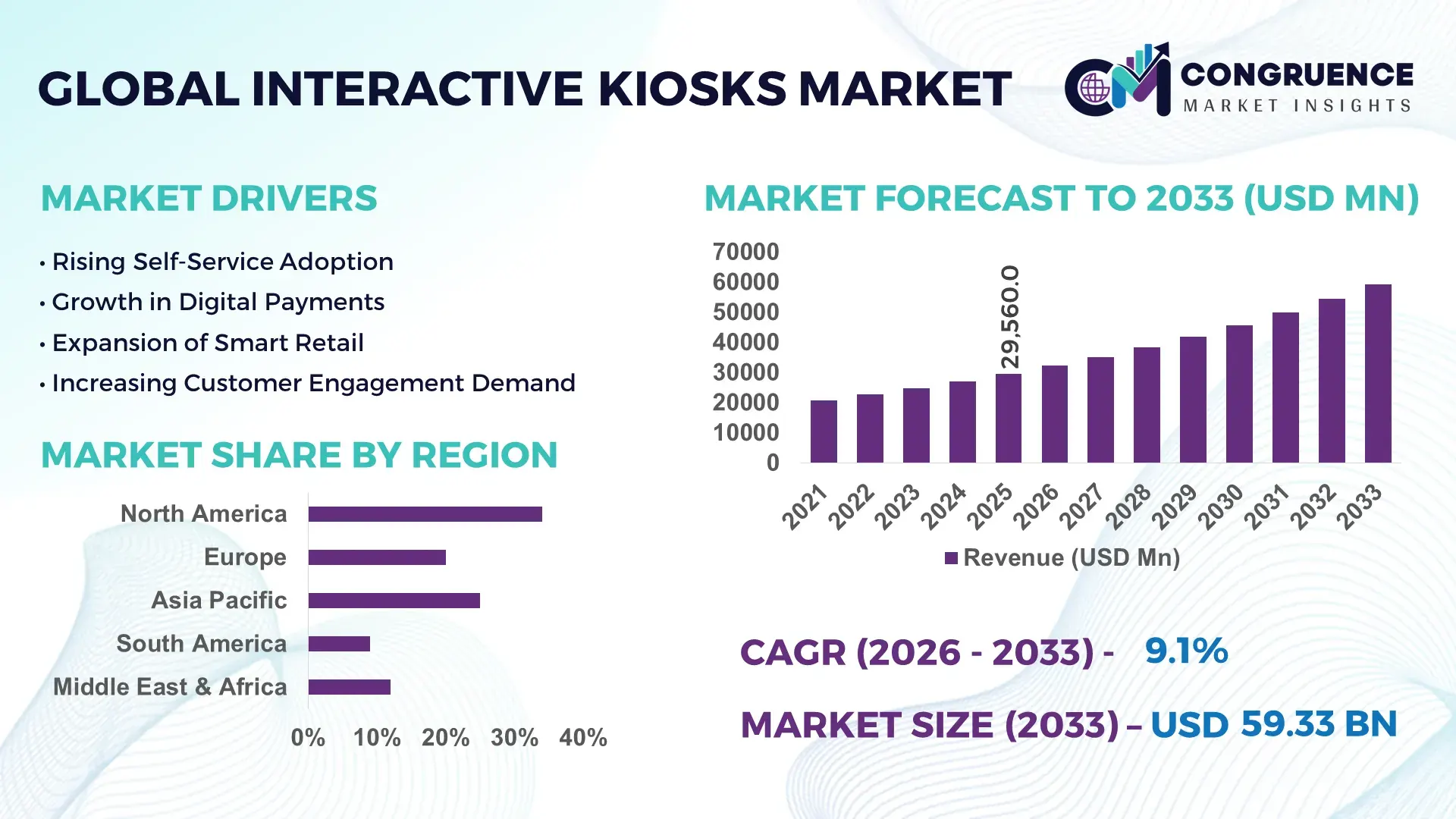
The United States leads the global interactive kiosks market with an estimated 31% deployment share, supported by large-scale investments in smart retail infrastructure, airport automation, and digital healthcare check-in systems. More than 68% of major retail chains in North America integrated touchscreen self-service terminals by 2026, compared to below 45% adoption across several European commercial networks. Federal digital modernization programs and reshoring initiatives linked to semiconductor and display manufacturing expansion strengthened hardware availability during ongoing Asia-Pacific supply chain realignments. Airports across the U.S. processed nearly 40% more passenger self-check-ins through biometric-enabled kiosks compared to pre-automation models, while restaurant operators reported order accuracy improvements exceeding 22% through AI-assisted menu systems.
Companies expanding advanced kiosk ecosystems with cloud analytics, biometric authentication, and multilingual interfaces are securing stronger operational scalability and long-term customer engagement advantages across competitive service industries.
Market Size & Growth: USD 29.56 billion in 2025 to USD 59.33 billion by 2033, driven by AI-powered self-service adoption across retail and transport sectors.
Top Growth Drivers: Contactless transactions rose 47%, smart retail automation expanded 39%, and digital ticketing deployments increased 34% globally.
Short-Term Forecast: By 2027, kiosk-assisted transactions are projected to reduce customer wait times by 28% and improve operational efficiency by 24%.
Emerging Technologies: AI vision systems, biometric authentication, and cloud-managed kiosks improved transaction accuracy by nearly 30% in advanced deployments.
Regional Leaders: North America exceeds USD 18 billion demand, Asia-Pacific approaches USD 16 billion, while Europe surpasses USD 11 billion through smart mobility adoption.
Consumer/End-User Trends: Nearly 63% of urban consumers prefer self-service ordering and digital check-in systems for faster transaction completion.
Pilot/Case Example: In 2026, a major airport modernization program reduced passenger processing congestion by 32% using biometric interactive kiosks.
Competitive Landscape: Top manufacturers control roughly 42% market share, with competition centered on AI integration, durability, and remote management platforms.
Regulatory & ESG Impact: Energy-efficient touchscreen systems lowered power consumption by 18% under stricter commercial sustainability compliance frameworks.
Investment & Funding: Global investments surpassed USD 7 billion, led by retail automation partnerships and transportation infrastructure modernization projects.
Innovation & Future Outlook: Edge computing integration and multilingual AI interfaces are reshaping high-growth interactive kiosk ecosystems across digitally transforming economies.
Retail and quick-service restaurants collectively contribute over 46% of global interactive kiosk installations, while transportation and healthcare continue expanding high-volume deployment networks. AI-powered voice navigation, biometric verification, and predictive maintenance software are improving uptime performance by nearly 25% in advanced commercial environments. Asia-Pacific remains the fastest deployment hub due to urban infrastructure expansion, whereas North America leads premium smart kiosk integration. Regulatory pressure supporting energy-efficient digital infrastructure and ongoing display component supply chain restructuring are influencing procurement strategies. The market is steadily shifting toward fully connected, analytics-driven kiosk ecosystems that support long-term operational intelligence and scalable customer engagement strategies.
Interactive kiosks are becoming strategically important as enterprises prioritize labor optimization, omnichannel customer engagement, and infrastructure digitization across retail, transportation, banking, and healthcare ecosystems. More than 61% of large-format retailers integrated self-service interfaces into customer operations by 2026 to reduce queue congestion and improve transaction consistency. The market is also benefiting from semiconductor supply-chain restructuring and accelerated smart-city modernization programs in the United States, Japan, and the UAE, where public-facing digital infrastructure investment expanded significantly.
AI-enabled kiosks with cloud-based analytics process customer interactions nearly 33% faster than legacy standalone systems while reducing maintenance interventions by approximately 21% through remote diagnostics. Japan continues leading compact high-density deployment efficiency in transportation hubs, whereas the United States dominates large-scale commercial rollouts integrated with biometric authentication and loyalty platforms. Over the next 2–3 years, touchless interfaces and multilingual AI systems are expected to account for more than 45% of newly deployed advanced kiosks in high-traffic service environments.
Airports, quick-service restaurant chains, and hospital networks are increasingly forming software-hardware partnerships to improve deployment scalability and customer analytics integration. Companies strengthening AI integration, cybersecurity architecture, and predictive maintenance capabilities are securing stronger competitive positioning as digital self-service infrastructure becomes a core operational differentiator.
Retailers, transportation operators, and healthcare providers are accelerating interactive kiosk deployment to improve transaction efficiency and reduce workforce pressure in high-volume environments. More than 58% of global quick-service restaurant chains upgraded to AI-assisted ordering systems by 2026, while self-check-in usage across major airport hubs increased nearly 37%. In the United States, infrastructure modernization funding and digital payment standardization accelerated touchscreen deployment across public and commercial facilities. The shift toward cloud-managed kiosks reduced average service downtime by approximately 24%, creating measurable operational savings for enterprise operators. Companies are responding through strategic software partnerships, edge-computing integration, and expansion of multilingual interfaces to improve customer retention. A key strategic insight is that enterprises adopting centralized kiosk analytics platforms are achieving faster operational scaling than competitors relying on fragmented legacy terminal networks.
Interactive kiosk manufacturers continue facing structural pressure from semiconductor dependency, industrial display pricing volatility, and complex system integration requirements. Advanced touchscreen controller costs fluctuated by nearly 19% during recent supply-chain disruptions, while installation and backend integration expenses account for over 30% of total deployment budgets in large enterprise projects. Germany and South Korea experienced extended procurement cycles for specialized display components linked to electronics manufacturing concentration. These constraints directly affect deployment timelines, scalability, and profitability for operators managing nationwide kiosk networks. Companies are reducing exposure through localized assembly operations, diversified component sourcing, and long-term procurement agreements with display and chipset suppliers. An important operational insight is that vertically integrated providers are maintaining stronger deployment consistency compared to vendors dependent on fragmented third-party hardware ecosystems.
Interactive kiosks are increasingly evolving into intelligent service nodes connected with AI analytics, IoT monitoring, and digital identity platforms. Smart transportation systems in Singapore and the UAE expanded automated passenger interaction infrastructure by over 32%, while healthcare facilities adopting predictive queue-management kiosks improved patient processing efficiency by nearly 27%. Emerging opportunities are developing around biometric authentication, edge-based personalization, and energy-efficient kiosk hardware aligned with smart-building initiatives. Companies are investing in modular kiosk platforms capable of supporting software upgrades without complete hardware replacement, reducing long-term infrastructure costs. A non-obvious strategic opportunity lies in industrial and logistics environments, where self-service workforce management kiosks are improving operational coordination and reducing manual administrative tasks. Firms strengthening ecosystem partnerships with fintech, cloud, and cybersecurity providers are positioning for higher-value recurring service models.
As interactive kiosks become deeply integrated with payment systems, biometric databases, and cloud-managed customer platforms, cybersecurity and interoperability challenges are intensifying. Nearly 41% of enterprise operators reported increased concern regarding endpoint vulnerability exposure in connected kiosk networks, while software integration delays extended deployment schedules by approximately 18% in complex multi-location projects. The United Kingdom and Canada introduced stricter digital privacy compliance requirements affecting biometric and customer-data processing systems. These pressures complicate long-term scalability and increase operational governance costs for large deployment networks. Companies must strengthen encryption frameworks, remote monitoring architecture, and software standardization to maintain deployment consistency. A critical strategic insight is that operators prioritizing secure API-driven ecosystems and centralized lifecycle management are improving long-term service resilience compared to businesses relying on isolated kiosk infrastructures.
AI-Driven Queue Optimization Retail and transportation operators are deploying AI-enabled kiosks with predictive traffic analytics to reduce service congestion and staffing inefficiencies. More than 44% of enterprise kiosk deployments in 2026 integrated real-time workflow management software, while average customer processing times declined by nearly 29%. Labor shortages in the United States and Japan accelerated adoption of autonomous check-in and ordering systems. Companies are expanding partnerships with cloud analytics providers and deploying edge-computing architectures to improve transaction continuity and remote diagnostics across distributed kiosk networks.
Touchless Biometric Interface Expansion Biometric authentication and touchless interaction systems are rapidly replacing conventional touchscreen workflows in healthcare, airports, and banking environments. Facial recognition-enabled kiosks improved passenger verification speed by approximately 31%, while contactless transaction usage exceeded 57% across major urban mobility hubs. Stricter digital identity regulations and cybersecurity compliance standards are reshaping procurement priorities. Companies are redesigning kiosk hardware with integrated sensors, encrypted authentication modules, and multilingual AI interfaces to support higher throughput and lower manual verification dependency.
Localized Manufacturing Restructuring Interactive kiosk vendors are restructuring supply chains to reduce dependence on concentrated electronics manufacturing ecosystems. Nearly 36% of enterprise hardware suppliers increased localized assembly operations in Mexico, Poland, and India following semiconductor and display procurement disruptions. Modular component design reduced replacement costs by almost 18% while improving maintenance flexibility. Companies are prioritizing regional manufacturing partnerships, inventory decentralization, and standardized hardware platforms to stabilize deployment timelines and improve long-term operational resilience.
Energy-Efficient Smart Deployments Sustainability-driven procurement is influencing next-generation kiosk architecture across transportation, hospitality, and government projects. Low-power display systems and adaptive brightness controls reduced energy consumption by nearly 22% in newly deployed commercial kiosks. Smart-building integration and stricter infrastructure efficiency requirements in Germany and Singapore accelerated demand for environmentally optimized systems. Companies are integrating recyclable hardware materials, remote power-management software, and predictive maintenance tools to lower operational costs while extending deployment lifecycle performance in high-density service environments.
Self-Service Kiosks remain the dominant segment due to their scalability, lower workforce dependency, and strong integration across retail, healthcare, and transportation environments. More than 48% of newly installed interactive kiosks in 2026 supported self-service ordering, check-in, or payment workflows, driven by enterprise demand for faster transaction throughput and operational consistency. Payment Kiosks are experiencing the fastest adoption growth as digital wallet integration and contactless authentication usage expanded by nearly 34% across urban commercial infrastructure. Ticketing Kiosks continue maintaining relevance in airports and metro systems where automated passenger handling reduced manual processing loads by approximately 27%. Information Kiosks remain strategically important in government facilities and healthcare navigation systems, while Digital Signage Kiosks are gaining traction through AI-enabled advertising personalization and audience analytics integration. Companies are prioritizing modular touchscreen systems, multilingual software ecosystems, and remote management capabilities to strengthen lifecycle efficiency and recurring service value across enterprise deployments.
Retail Transactions represent the leading application segment as supermarkets, quick-service restaurants, and large retail chains continue automating customer-facing operations to improve throughput and reduce staffing pressure. Nearly 52% of interactive kiosk deployments in 2026 were linked to retail ordering, self-checkout, or loyalty-driven engagement systems. Healthcare Registration is emerging as the fastest-growing application due to rising patient digitization requirements and hospital workflow modernization, with automated registration systems reducing administrative wait times by approximately 26%. Transportation Ticketing remains a mature but operationally critical segment, particularly across Japan and the United Kingdom where transit automation infrastructure continues expanding. Banking Services are evolving toward biometric-enabled financial transactions, while Hospitality Check-In systems are increasingly integrated with mobile verification and digital room access technologies. Advertising and Promotion kiosks are also gaining strategic value through AI-powered audience targeting and real-time campaign management. Companies are accelerating software integration and cloud-based deployment models to support scalable customer interaction ecosystems.
Retail remains the largest end-user segment due to extensive deployment density across supermarkets, quick-service restaurants, and shopping centers where operational speed and customer throughput directly influence profitability. More than 46% of enterprise interactive kiosk installations in 2026 were concentrated within retail environments, supported by rising adoption of AI-assisted self-checkout and digital ordering systems. Healthcare is the fastest-growing end-user segment as hospitals and diagnostic centers increasingly deploy automated patient registration and queue-management infrastructure, improving administrative efficiency by nearly 28%. BFSI institutions continue modernizing branch operations through secure self-service banking terminals integrated with biometric authentication. Transportation operators are expanding automated passenger service infrastructure, while hospitality companies are prioritizing digital check-in ecosystems to streamline staffing requirements. Government Sector deployments are also increasing through smart-city and citizen-service modernization initiatives. Companies are targeting these end-users through vertical-specific software customization, subscription-based maintenance models, and strategic ecosystem partnerships designed to improve deployment scalability and long-term operational retention.
North America accounted for the largest market share at 34% in 2025 however, Asia-Pacific is expected to register the fastest growth, expanding at a CAGR of 10.4% between 2026 and 2033.
Enterprise Automation Driving Large-Scale Deployments
North America maintains the strongest deployment concentration in the interactive kiosks market due to advanced retail automation, airport modernization, and digital healthcare infrastructure integration. The region accounted for nearly 34% of global deployment activity in 2025, supported by high penetration of AI-enabled self-service systems across the United States and Canada. More than 62% of major quick-service restaurant chains in the region upgraded customer interaction terminals with cloud-connected ordering and payment functionality. Transportation hubs are also accelerating biometric verification deployments to improve passenger throughput efficiency. Companies are investing heavily in predictive maintenance software, remote device management, and modular kiosk architecture to improve lifecycle scalability and reduce operational downtime across multi-site enterprise networks.
United States Market Outlook: The United States dominates regional deployment scale through advanced retail infrastructure, airport automation projects, and strong enterprise technology adoption. More than 68% of large-format retailers integrated self-service checkout and digital ordering systems by 2026. Federal investment supporting smart transportation modernization and digital identity infrastructure accelerated biometric kiosk installations across airports and healthcare facilities. Companies are expanding AI-assisted analytics integration and cybersecurity frameworks to strengthen operational resilience and customer engagement performance.
Sustainability and Smart Infrastructure Reshaping Procurement
Europe is strengthening its position through energy-efficient kiosk deployments, digital mobility modernization, and strict data-compliance integration across commercial and public infrastructure. The region represented approximately 26% of global deployment activity in 2025, supported by strong transportation and banking automation demand. Germany, France, and the United Kingdom are prioritizing low-power digital infrastructure aligned with sustainability mandates and smart-city transformation programs. More than 41% of newly deployed public-service kiosks in Western Europe incorporated adaptive power-management systems and recyclable hardware components. Companies are focusing on modular manufacturing strategies, localized component sourcing, and GDPR-compliant authentication systems to improve deployment flexibility and operational reliability across regulated enterprise environments.
Germany Market Outlook: Germany remains the region’s most strategically significant market due to its advanced industrial automation ecosystem and transportation infrastructure modernization programs. Railway networks and airport terminals increased digital passenger service deployments by nearly 29% during 2025–2026. The country’s emphasis on energy-efficient commercial systems and secure data-processing architecture accelerated adoption of AI-enabled information and ticketing kiosks. Enterprise operators are increasingly partnering with local software integrators to improve interoperability, multilingual functionality, and long-term maintenance efficiency.
High-Volume Manufacturing and Urban Digitization Expansion
Asia-Pacific is emerging as the fastest-scaling interactive kiosks market due to strong electronics manufacturing capabilities, rapid urban infrastructure expansion, and accelerated digital payment adoption. The region accounted for nearly 29% of global installations in 2025, supported by large-scale deployment across China, Japan, South Korea, and India. More than 54% of newly deployed transportation ticketing systems in major Asian metro networks integrated contactless and biometric-enabled interfaces. Regional hardware production concentration also strengthened supply-chain responsiveness during global semiconductor restructuring. Companies are expanding localized assembly operations, AI-enabled customer interaction software, and multilingual service platforms to support high-density deployment requirements across retail, healthcare, and public transportation environments.
China Market Outlook: China leads the regional market through large-scale smart-city deployment programs, strong electronics manufacturing infrastructure, and advanced digital payment ecosystems. More than 70% of urban convenience retail chains integrated self-service ordering or payment kiosks by 2026. The country’s rapid rollout of AI-powered transportation and healthcare automation systems continues driving enterprise demand for intelligent touchscreen infrastructure. Domestic manufacturers are prioritizing vertically integrated production and cloud-based management platforms to improve deployment speed and reduce hardware dependency risks.
Digital Banking and Retail Automation Accelerating Demand
South America is experiencing steady expansion in interactive kiosk deployment through retail digitization, financial inclusion initiatives, and transportation infrastructure modernization. The region contributed approximately 6% of global deployment activity in 2025, with Brazil and Chile leading adoption across banking and commercial retail environments. Self-service banking terminals and automated payment kiosks increased by nearly 24% across urban financial networks as institutions focused on reducing branch congestion and improving transaction accessibility. However, inconsistent infrastructure quality and import dependency continue affecting deployment consistency and maintenance efficiency. Companies are responding through localized partnerships, regional assembly strategies, and cloud-managed support systems to improve operational scalability and reduce long-term servicing costs.
Brazil Market Outlook: Brazil remains the most influential market in South America due to strong banking automation demand and expanding retail self-service infrastructure. Financial institutions accelerated deployment of biometric-enabled banking kiosks across metropolitan areas, improving customer processing speed by approximately 21%. Retail chains are increasingly integrating digital payment and loyalty-driven kiosk ecosystems to support omnichannel commerce operations. Technology providers are prioritizing local integration partnerships and flexible financing models to strengthen market penetration amid infrastructure and import-cost challenges.
Smart-City Investments Fueling Deployment Activity
Middle East & Africa is strengthening its market position through large-scale smart-city development, airport modernization, and government-led digital transformation programs. The region accounted for roughly 5% of global interactive kiosk deployment activity in 2025, led by the UAE and Saudi Arabia. More than 38% of newly deployed public-service kiosks in Gulf infrastructure projects integrated biometric verification and multilingual support systems. Hospitality and transportation sectors are accelerating adoption to improve visitor management and service efficiency during large-scale tourism and infrastructure expansion initiatives. Companies are investing in cloud-managed kiosk ecosystems, regional technical support centers, and AI-assisted customer interaction platforms to support growing demand for connected digital infrastructure.
United Arab Emirates Market Outlook: The UAE leads regional adoption through aggressive smart-city investment, advanced airport infrastructure, and rapid hospitality digitization. Major transportation and tourism hubs increased deployment of self-service check-in and information kiosks by nearly 33% during 2025–2026. Government-backed digital transformation initiatives and high contactless payment penetration continue strengthening enterprise demand for AI-enabled customer interaction systems. Technology providers are expanding regional partnerships and multilingual software integration capabilities to support high-volume international user environments.
Global kiosk leaders including NCR Voyix, Diebold Nixdorf, KIOSK Information Systems, Olea Kiosks, and Advantech compete directly against regional hardware assemblers and low-cost touchscreen integrators across retail, banking, transportation, and healthcare contracts. The top five players collectively control nearly 43% of enterprise-grade deployments through scale manufacturing, software integration capability, and long-term service contracts. Competition increasingly centers on AI-enabled analytics, remote device management, cybersecurity architecture, and modular hardware efficiency, with cloud-managed platforms reducing maintenance costs by almost 22% and improving deployment uptime by approximately 26%. North American firms are competing through vertical integration and enterprise software ecosystems, while Asian manufacturers are leveraging localized production and pricing advantages. Strategic partnerships with payment providers, airport operators, and healthcare networks are reshaping procurement dynamics. The market is shifting toward consolidated full-service deployment models, creating high entry barriers around cybersecurity compliance, infrastructure support capability, and multi-location lifecycle management execution excellence.
NCR Voyix
Diebold Nixdorf
KIOSK Information Systems
Olea Kiosks
Advantech Co., Ltd.
Meridian Kiosks
RedyRef Interactive Kiosks
Pyramid Computer GmbH
SlabbKiosks
Glory Ltd.
Zebra Technologies
Posiflex Technology Inc.
Embross
Frank Mayer and Associates, Inc.
AI-enabled self-service platforms, cloud-managed kiosk ecosystems, and biometric authentication technologies are reshaping operational efficiency across retail, transportation, and healthcare networks. More than 58% of newly deployed enterprise kiosks in 2026 integrated AI-assisted analytics and predictive maintenance software, reducing average service downtime by nearly 24%. Cloud-connected kiosks process software updates approximately 35% faster than legacy standalone terminals, improving deployment scalability and operational consistency. Retail chains and airport operators are prioritizing centralized device orchestration systems to strengthen transaction reliability, cybersecurity visibility, and customer throughput management across distributed infrastructure environments.
Emerging technologies including edge computing, computer vision, and multilingual conversational interfaces are accelerating deployment expansion between 2026 and 2028. AI-powered vision checkout systems improved transaction speed by approximately 31% compared to barcode-dependent legacy systems, while touchless authentication adoption surpassed 46% in high-density transportation hubs. Companies deploying integrated biometric and payment ecosystems are securing operational advantages through faster identity verification, lower staffing dependency, and stronger customer retention performance across digitally intensive service environments.
Disruptive innovation is increasingly centered around modular hardware architecture, energy-efficient display systems, and predictive workflow automation. Advanced low-power kiosk systems reduced energy consumption by nearly 22% while extending operational lifecycle performance across commercial deployments. Large enterprise operators and vertically integrated manufacturers benefit most from these transitions because standardized software-hardware ecosystems improve deployment speed, maintenance efficiency, and long-term infrastructure adaptability. Organizations delaying modernization risk higher servicing costs, fragmented customer experiences, and reduced competitiveness as AI-driven self-service ecosystems become operationally essential by 2028.
July 2024 – Diebold Nixdorf deployed AI-powered self-service checkout kiosks for EDEKA Paul’s 24/7 Germany retail format, enabling continuous unmanned operations with automated transaction resets, improving store accessibility and operational continuity. Source: Diebold Nixdorf
January 2025 – NCR Voyix launched AI-driven Halo Checkout with Everseen technology at Phillips 66 and Mach 1 locations, accelerating automated product recognition while improving checkout speed and transaction accuracy across fuel retail operations. Source: NCR Voyix
April 2025 – Morrisons expanded its NCR Voyix partnership across nearly 500 UK stores and over 13,000 checkout lanes, strengthening cloud-based retail infrastructure scalability, predictive analytics integration, and enterprise-wide operational modernization initiatives. Source: NCR Voyix Retail Solutions
March 2026 – KIOSK Information Systems partnered with AOPEN at HIMSS 2026 to deploy resilient healthcare self-service platforms engineered for 24/7 uptime, reducing workflow disruption risks and improving patient engagement reliability. Source: KIOSK Information Systems
The Interactive Kiosks Market report provides detailed analysis across self-service kiosks, ticketing kiosks, information kiosks, payment kiosks, and digital signage kiosks, covering operational adoption trends, enterprise deployment patterns, and technology integration strategies between 2026 and 2033. The study evaluates application demand across retail transactions, banking services, transportation ticketing, healthcare registration, hospitality check-in, and advertising workflows. More than 45% of current enterprise deployments are concentrated in retail and transportation infrastructure, while healthcare and government modernization programs are strengthening next-generation demand expansion.
The report delivers region-wise assessment across North America, Europe, Asia-Pacific, South America, and Middle East & Africa, highlighting manufacturing concentration, infrastructure investment, and smart-service deployment activity. It further analyzes AI-enabled analytics, biometric authentication, cloud-based management systems, and predictive maintenance technologies influencing operational efficiency and customer interaction models. Strategic insights support investment prioritization, competitive benchmarking, partnership evaluation, localization planning, and long-term digital infrastructure positioning for manufacturers, enterprise operators, software providers, and system integrators.
| Report Attribute/Metric | Report Details |
|---|---|
|
Market Revenue in 2025 |
USD 29560 Million |
|
Market Revenue in 2033 |
USD 59333.83 Million |
|
CAGR (2026 - 2033) |
9.1% |
|
Base Year |
2025 |
|
Forecast Period |
2026 - 2033 |
|
Historic Period |
2021 - 2025 |
|
Segments Covered |
By Type
By Application
By End-User
|
|
Key Report Deliverable |
Revenue Forecast, Growth Trends, Market Dynamics, Segmental Overview, Regional and Country-wise Analysis, Competition Landscape |
|
Region Covered |
North America, Europe, Asia-Pacific, South America, Middle East, Africa |
|
Key Players Analyzed |
NCR Voyix, Diebold Nixdorf, KIOSK Information Systems, Olea Kiosks, Advantech Co., Ltd., Meridian Kiosks, RedyRef Interactive Kiosks, Pyramid Computer GmbH, SlabbKiosks, Glory Ltd., Zebra Technologies, Posiflex Technology Inc., Embross, Frank Mayer and Associates, Inc. |
|
Customization & Pricing |
Available on Request (10% Customization is Free) |




