
Reports
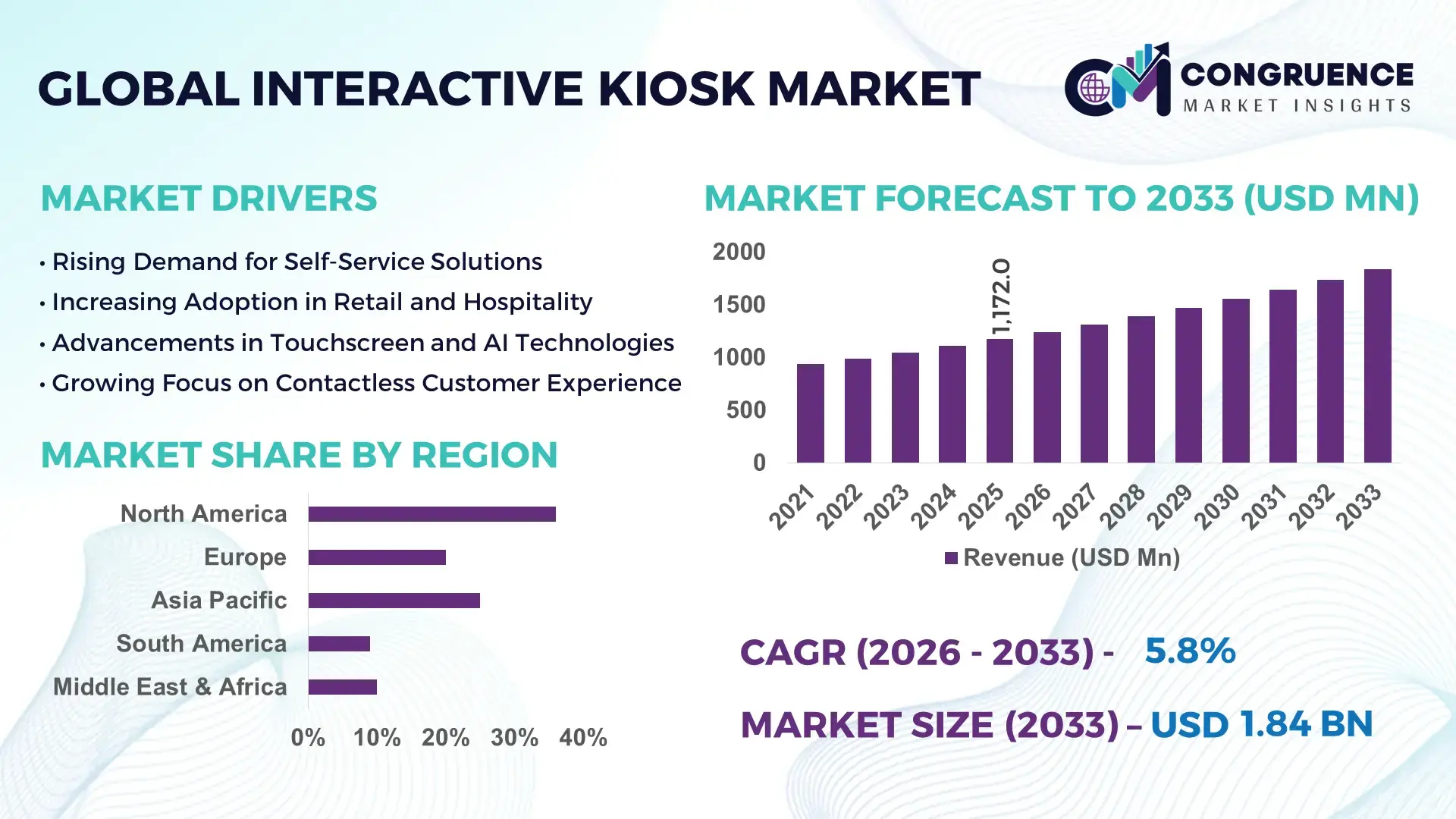
The Global Interactive Kiosk Market was valued at USD 1172 Million in 2025 and is anticipated to reach a value of USD 1839.97 Million by 2033 expanding at a CAGR of 5.8% between 2026 and 2033. The market is primarily driven by the rapid adoption of self-service technologies across retail, healthcare, transportation, and banking sectors to enhance customer experience and operational efficiency.
The United States demonstrates a highly advanced interactive kiosk ecosystem supported by strong production capacity and continuous capital investment in digital infrastructure. The country hosts over 35% of global kiosk manufacturing facilities, with annual installations exceeding 250,000 units across retail and transportation hubs. In retail alone, nearly 65% of large-format stores deploy self-service kiosks for checkout and product discovery. Healthcare institutions have also adopted over 120,000 patient check-in kiosks, improving administrative efficiency by approximately 30%. Technological advancements such as AI-powered touch interfaces and biometric authentication systems are widely integrated, while public sector initiatives continue to expand kiosk deployments in smart city projects and transit systems.
Market Size & Growth: Valued at USD 1172 Million in 2025, projected to reach USD 1839.97 Million by 2033, growing at 5.8% CAGR due to rising demand for self-service digital solutions.
Top Growth Drivers: 60% increase in self-checkout adoption, 45% improvement in operational efficiency, 35% reduction in customer wait times.
Short-Term Forecast: By 2028, kiosk deployments are expected to improve service efficiency by 40% and reduce staffing costs by 25%.
Emerging Technologies: AI-enabled touch interfaces, facial recognition authentication, IoT-integrated kiosk analytics platforms.
Regional Leaders: North America projected at USD 620 Million by 2033 with retail dominance; Asia-Pacific at USD 540 Million with rapid urban deployment; Europe at USD 420 Million with transport automation trends.
Consumer/End-User Trends: Retail and healthcare sectors account for over 55% of total installations, driven by demand for contactless services.
Pilot or Case Example: In 2024, a retail chain implemented AI kiosks, achieving 35% faster transactions and 20% reduction in operational delays.
Competitive Landscape: Market leader holds approximately 18% share, followed by several established global kiosk solution providers.
Regulatory & ESG Impact: Governments mandate accessibility compliance and promote energy-efficient kiosks, reducing power consumption by up to 30%.
Investment & Funding Patterns: Over USD 800 Million invested in kiosk innovation and deployment projects globally in recent years.
Innovation & Future Outlook: Integration of cloud analytics and contactless payment systems is shaping next-generation kiosk deployments.
The Interactive Kiosk Market is significantly influenced by key sectors such as retail, healthcare, transportation, and hospitality, collectively contributing over 70% of total installations. Retail leads with approximately 35% of deployments, followed by transportation at 20% and healthcare at 18%. Recent innovations include touchless interfaces, voice-enabled navigation, and AI-driven personalization engines that enhance user engagement. Regulatory frameworks focusing on accessibility standards and energy efficiency are encouraging manufacturers to develop eco-friendly kiosks with reduced energy consumption by up to 25%. Regionally, Asia-Pacific is witnessing accelerated adoption due to urbanization and smart infrastructure projects, while Europe focuses on transit automation. The future outlook highlights increased integration of cloud-based analytics, cybersecurity frameworks, and omnichannel retail systems, positioning kiosks as critical digital engagement tools.
The Interactive Kiosk Market holds strong strategic relevance as organizations increasingly prioritize automation, customer experience optimization, and cost efficiency. Businesses are deploying kiosks to streamline operations, reduce human intervention, and enhance service delivery accuracy. AI-powered kiosks deliver nearly 45% faster transaction processing compared to traditional manual service counters, significantly improving throughput and customer satisfaction. In addition, IoT-enabled kiosks provide real-time analytics, enabling enterprises to monitor usage patterns and optimize performance metrics effectively.
From a regional perspective, North America dominates in volume due to extensive retail and transportation deployments, while Asia-Pacific leads in adoption with over 55% of enterprises integrating self-service technologies into customer engagement strategies. The rapid digitalization of urban infrastructure in emerging economies is further strengthening market penetration. By 2028, AI-driven personalization and predictive analytics in kiosks are expected to improve customer engagement metrics by 40% while reducing operational inefficiencies by approximately 30%. Firms are committing to ESG goals by incorporating energy-efficient hardware and recyclable materials, targeting a 35% reduction in carbon footprint by 2030.
In 2024, a large-scale deployment initiative in Japan achieved a 32% reduction in service wait times through AI-enabled kiosks integrated with facial recognition and contactless payment systems. Such measurable improvements demonstrate the tangible benefits of technological integration. Looking ahead, the Interactive Kiosk Market is set to evolve as a core component of digital transformation strategies, enabling resilient operations, regulatory compliance, and sustainable growth across multiple industries.
The growing preference for contactless and self-service solutions is a major driver of the Interactive Kiosk Market. More than 70% of consumers now prefer self-service options in retail and hospitality environments due to convenience and reduced waiting times. Interactive kiosks enable businesses to handle high customer volumes efficiently, with transaction speeds improving by up to 50% compared to traditional service methods. In healthcare, patient check-in kiosks have reduced administrative workload by approximately 30%, allowing staff to focus on critical tasks. Additionally, the integration of digital payment systems and mobile connectivity has enhanced usability, further boosting adoption rates. These factors collectively contribute to sustained market expansion.
Despite strong growth prospects, the Interactive Kiosk Market faces challenges related to high upfront costs and ongoing maintenance requirements. The installation of advanced kiosks with AI capabilities and secure payment systems can cost significantly more than traditional service setups. Maintenance expenses, including software updates, hardware repairs, and cybersecurity measures, add to operational costs. Approximately 25% of small and medium enterprises hesitate to adopt kiosk systems due to budget constraints. Furthermore, technical complexities and the need for regular system upgrades can disrupt operations if not managed effectively. These financial and operational barriers limit widespread adoption, particularly in cost-sensitive markets.
Digital transformation initiatives across industries present significant opportunities for the Interactive Kiosk Market. Governments and private organizations are investing heavily in smart infrastructure projects, creating demand for advanced self-service technologies. In the transportation sector, over 40% of new transit systems are integrating kiosks for ticketing and passenger information services. Retailers are adopting omnichannel strategies, using kiosks to bridge online and offline experiences, resulting in improved customer engagement by nearly 35%. Emerging markets also offer growth potential, as urbanization and rising consumer spending drive demand for automated solutions. These factors create a favorable environment for market expansion and innovation.
Cybersecurity risks and data privacy concerns pose significant challenges to the Interactive Kiosk Market. As kiosks handle sensitive customer information, including payment details and personal data, they are vulnerable to cyber threats such as data breaches and unauthorized access. Reports indicate that nearly 30% of public-facing digital systems face security vulnerabilities due to inadequate protection measures. Ensuring compliance with data protection regulations requires continuous investment in advanced security solutions, increasing operational complexity. Additionally, consumer concerns regarding data privacy can impact adoption rates, particularly in regions with strict regulatory frameworks. Addressing these challenges is critical for sustaining long-term market growth.
• Accelerated Adoption of Contactless and Touchless Interfaces: The shift toward hygienic and seamless user experiences has led to a 65% increase in the deployment of contactless interactive kiosks across retail and healthcare environments. Touchless technologies, including gesture recognition and QR-based interactions, have reduced physical touchpoints by nearly 70%, improving user safety and operational efficiency. In high-traffic environments such as airports, over 50% of newly installed kiosks now incorporate contactless payment and navigation features, enhancing transaction speed by approximately 40%.
• Integration of Artificial Intelligence and Data Analytics: AI-enabled interactive kiosks are transforming customer engagement by delivering personalized recommendations and predictive services. Nearly 58% of modern kiosks are equipped with AI-driven analytics systems that improve customer interaction accuracy by 45%. These systems enable real-time data processing, allowing businesses to optimize service delivery and inventory management. In retail environments, AI-powered kiosks have increased upselling opportunities by 30%, while reducing customer decision time by 25%, creating measurable efficiency gains.
• Expansion of Self-Service Kiosks in Transportation and Smart Cities: The transportation sector is witnessing a 48% rise in kiosk installations, particularly in metro stations, airports, and bus terminals. Smart city initiatives have driven over 60% of urban infrastructure projects to integrate digital kiosks for ticketing, navigation, and public information services. These deployments have reduced ticketing queues by 35% and improved passenger flow efficiency by 28%. Government-backed digital transformation programs continue to support widespread kiosk integration in urban mobility systems.
• Growth in Customizable and Industry-Specific Kiosk Solutions: Demand for tailored kiosk solutions has increased by 52%, with businesses seeking industry-specific functionalities to enhance user experience. Retail, healthcare, and hospitality sectors are investing in customized kiosks designed for targeted applications such as self-checkout, patient registration, and digital concierge services. Custom-built kiosks have demonstrated a 33% improvement in operational efficiency and a 27% increase in user satisfaction rates. This trend is driving manufacturers to focus on modular designs and scalable software platforms to meet diverse business needs.
The Interactive Kiosk Market segmentation is primarily defined by product types, application areas, and end-user industries, each contributing distinctively to overall market expansion. Product types range from bank kiosks and self-service kiosks to vending and ticketing kiosks, with self-service models dominating due to their versatility across industries. Application-wise, retail leads adoption with over 35% of total deployments, followed by transportation and healthcare sectors benefiting from automation and digital engagement. End-user insights reveal that large enterprises account for nearly 60% of installations, driven by their capacity to invest in advanced digital infrastructure. Small and medium enterprises are gradually increasing adoption, supported by cost-effective kiosk solutions and cloud-based management systems. Regional consumption patterns highlight strong adoption in urban centers, where demand for automated customer interaction is highest.
The Interactive Kiosk Market includes several key product types such as self-service kiosks, vending kiosks, banking kiosks, ticketing kiosks, and information kiosks. Self-service kiosks lead the segment, accounting for approximately 46% of total deployments, driven by their widespread use in retail and hospitality for checkout and customer assistance. In comparison, banking kiosks represent around 22%, while ticketing kiosks contribute nearly 18%. However, vending kiosks are emerging as the fastest-growing segment, expanding at an estimated CAGR of 7.2%, fueled by demand for automated retail and unattended sales solutions in urban locations.
Information kiosks and other niche categories collectively contribute about 14% of the market, serving specialized functions in museums, corporate offices, and public spaces. These systems are increasingly integrated with multilingual support and digital signage capabilities, enhancing accessibility and engagement.
The Interactive Kiosk Market applications span retail, transportation, healthcare, hospitality, and financial services. Retail dominates the segment, accounting for approximately 38% of total kiosk usage due to the increasing demand for self-checkout systems and digital product browsing. Transportation follows with nearly 25%, driven by ticketing and passenger information systems in airports and metro stations. Healthcare contributes around 18%, focusing on patient check-in and information management systems.
Hospitality is the fastest-growing application segment, expanding at an estimated CAGR of 6.9%, supported by rising adoption of self-service check-in kiosks in hotels and restaurants. These systems improve customer service speed by up to 40% and reduce staff workload significantly. Financial services and other applications collectively hold around 19% share, with growing adoption in ATMs and service terminals.
The Interactive Kiosk Market is segmented by end-users into retail enterprises, healthcare providers, transportation authorities, hospitality businesses, and financial institutions. Retail enterprises lead the segment, accounting for approximately 40% of total installations, driven by the need for efficient customer service and automated checkout systems. Transportation authorities represent around 22%, while healthcare providers contribute nearly 16% of deployments.
Hospitality businesses are the fastest-growing end-user segment, with an estimated CAGR of 7.0%, as hotels and restaurants increasingly adopt kiosks for self-check-in and order management. Financial institutions and other sectors collectively account for about 22%, leveraging kiosks for banking services and customer engagement. Adoption rates among large enterprises exceed 65%, while small and medium enterprises are showing steady growth due to affordable, scalable solutions.
Region North America accounted for the largest market share at 34% in 2025 however, Asia-Pacific is expected to register the fastest growth, expanding at a CAGR of 6.7% between 2026 and 2033.
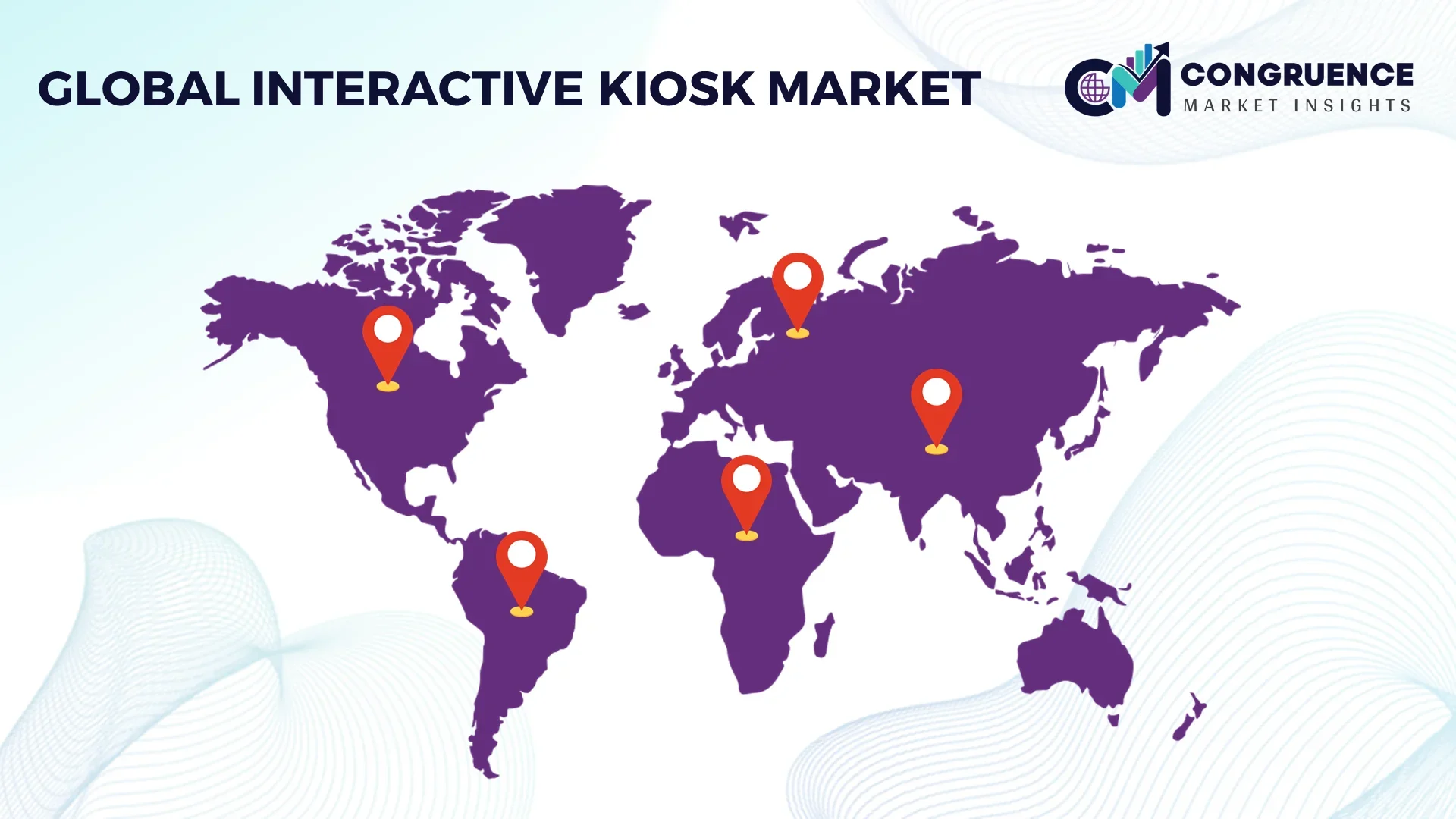
North America recorded over 420,000 active kiosk installations across retail, healthcare, and transportation sectors, with retail alone contributing nearly 45% of deployments. Europe followed with approximately 28% share, driven by over 300,000 installed units, particularly in transit systems and public infrastructure. Asia-Pacific accounted for around 26% share, supported by rapid urbanization and deployment of more than 350,000 kiosks across smart city initiatives. South America and the Middle East & Africa collectively represented 12%, with increasing adoption in banking and government service kiosks. Regionally, over 60% of new installations in 2025 were concentrated in urban areas, while rural adoption grew by 18%, highlighting expanding digital infrastructure. The global average kiosk usage rate increased by 32%, reflecting rising demand for automated and contactless customer interaction systems.
North America holds approximately 34% of the Interactive Kiosk Market share, supported by strong adoption across retail, healthcare, and financial services. Retail accounts for nearly 46% of kiosk deployments in the region, while healthcare contributes around 22%, driven by patient check-in and information systems. Government initiatives promoting digital accessibility standards have increased compliance-driven deployments by 30%. Technological advancements such as AI-enabled kiosks, biometric authentication, and cloud-based analytics are widely implemented, improving service efficiency by over 40%. A leading regional player has expanded its portfolio by deploying more than 50,000 AI-powered kiosks across retail chains, enhancing transaction speed and reducing operational delays. Consumer behavior indicates that over 68% of users prefer self-service kiosks for faster service, particularly in urban centers, where demand for contactless solutions is highest.
Europe accounts for approximately 28% of the Interactive Kiosk Market, with key markets including Germany, the United Kingdom, and France contributing over 65% of regional demand. Regulatory frameworks focused on sustainability and energy efficiency have driven the adoption of eco-friendly kiosks, reducing energy consumption by up to 25%. Transportation and public service sectors dominate, representing nearly 40% of deployments, followed by retail at 30%. The integration of emerging technologies such as multilingual interfaces and AI-based user analytics has improved service accessibility and engagement by 35%. A prominent regional manufacturer has introduced modular kiosks designed for urban transit systems, enabling faster deployment and reducing installation time by 20%. Consumer behavior reflects a strong preference for accessible and regulation-compliant systems, with over 60% of enterprises prioritizing sustainable digital infrastructure solutions.
Asia-Pacific ranks among the fastest-growing regions in the Interactive Kiosk Market, accounting for approximately 26% of global installations with over 350,000 units deployed. China, India, and Japan are the leading contributors, collectively representing more than 70% of regional demand. Infrastructure development projects and smart city initiatives have driven over 55% of new kiosk installations in transportation and public services. Manufacturing hubs in China produce nearly 40% of global kiosk hardware, supporting large-scale deployment. Technological innovation centers are focusing on AI integration, facial recognition, and mobile payment compatibility, improving transaction efficiency by 38%. A regional technology firm recently deployed over 25,000 kiosks in urban transit systems, reducing passenger wait times by 30%. Consumer behavior indicates strong adoption driven by mobile-first ecosystems, with over 72% of users engaging with digital kiosks for payments and services.
South America represents approximately 7% of the Interactive Kiosk Market, with Brazil and Argentina accounting for over 65% of regional deployments. The region has installed more than 80,000 kiosks across banking, retail, and public service sectors. Infrastructure development and digital transformation initiatives have increased kiosk adoption by 22% in urban areas. Government incentives promoting financial inclusion have supported the deployment of banking kiosks, particularly in underserved regions. A local provider has introduced multilingual kiosks tailored for diverse populations, improving user engagement by 28%. Consumer behavior highlights the importance of language localization, with over 58% of users preferring kiosks offering region-specific interfaces. Demand is also influenced by media and entertainment sectors, where kiosks are used for ticketing and information services.
The Middle East & Africa account for approximately 5% of the Interactive Kiosk Market, with the UAE and South Africa leading regional adoption. Over 60,000 kiosks are deployed across sectors such as transportation, retail, and government services. Smart city projects and infrastructure modernization initiatives have driven a 25% increase in kiosk installations in urban areas. Technological trends include the integration of contactless payment systems and AI-driven customer interfaces, improving service efficiency by 32%. Trade partnerships and regulatory frameworks promoting digital transformation have further supported market growth. A regional technology firm has implemented kiosks across major airports, enhancing passenger processing efficiency by 27%. Consumer behavior indicates a growing preference for digital services, with over 55% of users opting for self-service kiosks in public spaces.
United States – 31% share in the Interactive Kiosk Market, driven by high deployment across retail, healthcare, and transportation sectors.
China – 24% share in the Interactive Kiosk Market, supported by large-scale manufacturing capacity and extensive smart city initiatives.
The Interactive Kiosk Market exhibits a moderately fragmented competitive landscape, with over 120 active global and regional players competing across hardware, software, and integrated service offerings. The top five companies collectively account for approximately 38% of the market, indicating a balanced mix of established leaders and emerging innovators. Market participants are increasingly focusing on product differentiation through advanced technologies such as AI-driven interfaces, biometric authentication, and cloud-based kiosk management systems.
Strategic initiatives including mergers, acquisitions, and partnerships are shaping the competitive environment. Over 25 major partnerships were recorded in recent years, aimed at enhancing technological capabilities and expanding geographic reach. Product innovation remains a key competitive factor, with more than 40 new kiosk models launched globally, featuring improved user interfaces and enhanced security features.
Companies are also investing in modular designs and scalable solutions to cater to diverse industry requirements, particularly in retail and transportation sectors. Additionally, the growing emphasis on sustainability has led to the development of energy-efficient kiosks, reducing power consumption by up to 30%. Competitive intensity is further heightened by the entry of technology startups offering specialized solutions, increasing innovation and driving market evolution.
NCR Corporation
Diebold Nixdorf Incorporated
KIOSK Information Systems
Zebra Technologies Corporation
Toshiba Tec Corporation
Olea Kiosks Inc.
Meridian Kiosks
Advantech Co., Ltd.
SlabbKiosks
RedyRef Interactive Kiosks
Embross
Wincor Nixdorf International GmbH
The Interactive Kiosk Market is undergoing rapid technological transformation driven by advancements in artificial intelligence, Internet of Things integration, and next-generation user interface systems. Over 58% of newly deployed kiosks now incorporate AI-based software capable of real-time analytics, enabling personalized recommendations and adaptive user interfaces. These systems enhance transaction efficiency by up to 45% and significantly improve customer engagement through predictive behavior analysis. Touchless and contactless technologies have gained substantial traction, with nearly 65% of modern kiosks integrating QR-based interaction, gesture control, or voice recognition systems. These innovations reduce physical contact points by approximately 70%, aligning with hygiene and safety requirements across healthcare and retail sectors. Additionally, biometric authentication technologies, including facial recognition and fingerprint scanning, are now present in over 35% of advanced kiosk installations, enhancing security and identity verification processes.
Cloud-based kiosk management platforms are also reshaping operational efficiency, with over 60% of enterprises utilizing centralized systems for remote monitoring, software updates, and performance optimization. These platforms reduce maintenance costs by nearly 25% and improve uptime by over 30%. Integration with IoT devices further enables real-time data collection, supporting predictive maintenance and reducing system downtime by approximately 28%. Emerging technologies such as edge computing and 5G connectivity are enhancing processing speeds and enabling low-latency interactions, improving transaction times by up to 40%. Additionally, modular hardware designs and energy-efficient components are reducing power consumption by nearly 30%, aligning with sustainability goals. These technological advancements collectively position interactive kiosks as intelligent, scalable, and secure digital service platforms across multiple industries.
• In January 2025, NCR Corporation announced the expansion of its self-service kiosk portfolio with enhanced AI-driven checkout solutions, enabling retailers to improve transaction speed by 30% and reduce shrinkage through advanced computer vision technology. Source: www.ncr.com
• In September 2024, Diebold Nixdorf introduced next-generation DN Series® kiosks featuring contactless payment integration and advanced security modules, improving transaction security by 40% while supporting seamless omnichannel banking experiences. Source: www.dieboldnixdorf.com
• In March 2025, Zebra Technologies Corporation launched an upgraded interactive kiosk platform integrated with real-time analytics and mobile device compatibility, enabling enterprises to increase operational efficiency by 25% and enhance customer engagement through personalized interfaces. Source: www.zebra.com
• In November 2024, KIOSK Information Systems deployed a large-scale self-service kiosk solution across major transportation hubs, incorporating biometric authentication and cloud-based monitoring, resulting in a 35% reduction in passenger processing time and improved system uptime. Source: www.kiosk.com
The Interactive Kiosk Market Report provides a comprehensive evaluation of the global market landscape, covering multiple dimensions including product types, application areas, end-user industries, and regional performance. The report analyzes key product categories such as self-service kiosks, banking kiosks, ticketing systems, and vending units, which collectively account for over 85% of total market installations. It also examines application segments including retail, transportation, healthcare, hospitality, and financial services, with retail and transportation contributing more than 60% of overall deployments.
Geographically, the report spans major regions including North America, Europe, Asia-Pacific, South America, and the Middle East & Africa, capturing variations in adoption rates, infrastructure development, and technological integration. Over 70% of kiosk deployments are concentrated in urban areas, while emerging economies are witnessing adoption growth exceeding 20% in semi-urban regions.
The report further explores technological advancements such as AI integration, IoT connectivity, biometric authentication, and cloud-based management systems, which are present in more than 60% of modern kiosk solutions. It also highlights niche segments such as outdoor digital kiosks, smart city kiosks, and industry-specific customized solutions, which are gaining traction across sectors.
Additionally, the scope includes analysis of regulatory frameworks, sustainability initiatives, and energy-efficient technologies, with over 30% of new kiosks designed to meet environmental compliance standards. The report offers detailed insights into competitive strategies, innovation trends, and deployment models, providing decision-makers with actionable intelligence to navigate the evolving interactive kiosk ecosystem.
| Report Attribute/Metric | Report Details |
|---|---|
|
Market Revenue in 2025 |
USD V2025 Million |
|
Market Revenue in 2033 |
USD V2033 Million |
|
CAGR (2026 - 2033) |
5.8% |
|
Base Year |
2025 |
|
Forecast Period |
2026 - 2033 |
|
Historic Period |
2021 - 2025 |
|
Segments Covered |
By Types
By Application
By End-User
|
|
Key Report Deliverable |
Revenue Forecast, Growth Trends, Market Dynamics, Segmental Overview, Regional and Country-wise Analysis, Competition Landscape |
|
Region Covered |
North America, Europe, Asia-Pacific, South America, Middle East, Africa |
|
Key Players Analyzed |
NCR Corporation, Diebold Nixdorf Incorporated, KIOSK Information Systems, Zebra Technologies Corporation, Toshiba Tec Corporation, Olea Kiosks Inc., Meridian Kiosks, Advantech Co., Ltd., SlabbKiosks, RedyRef Interactive Kiosks, Embross, Wincor Nixdorf International GmbH |
|
Customization & Pricing |
Available on Request (10% Customization is Free) |




