
Reports
The Global Interactive Flat Panel Display Market was valued at USD 6213 Million in 2025 and is anticipated to reach a value of USD 12109.82 Million by 2033 expanding at a CAGR of 8.7% between 2026 and 2033. Growth is being driven by smart-classroom replacement cycles, AI-enabled collaboration, Google EDLA integration, hybrid workplace modernization, and government-funded digital education infrastructure.
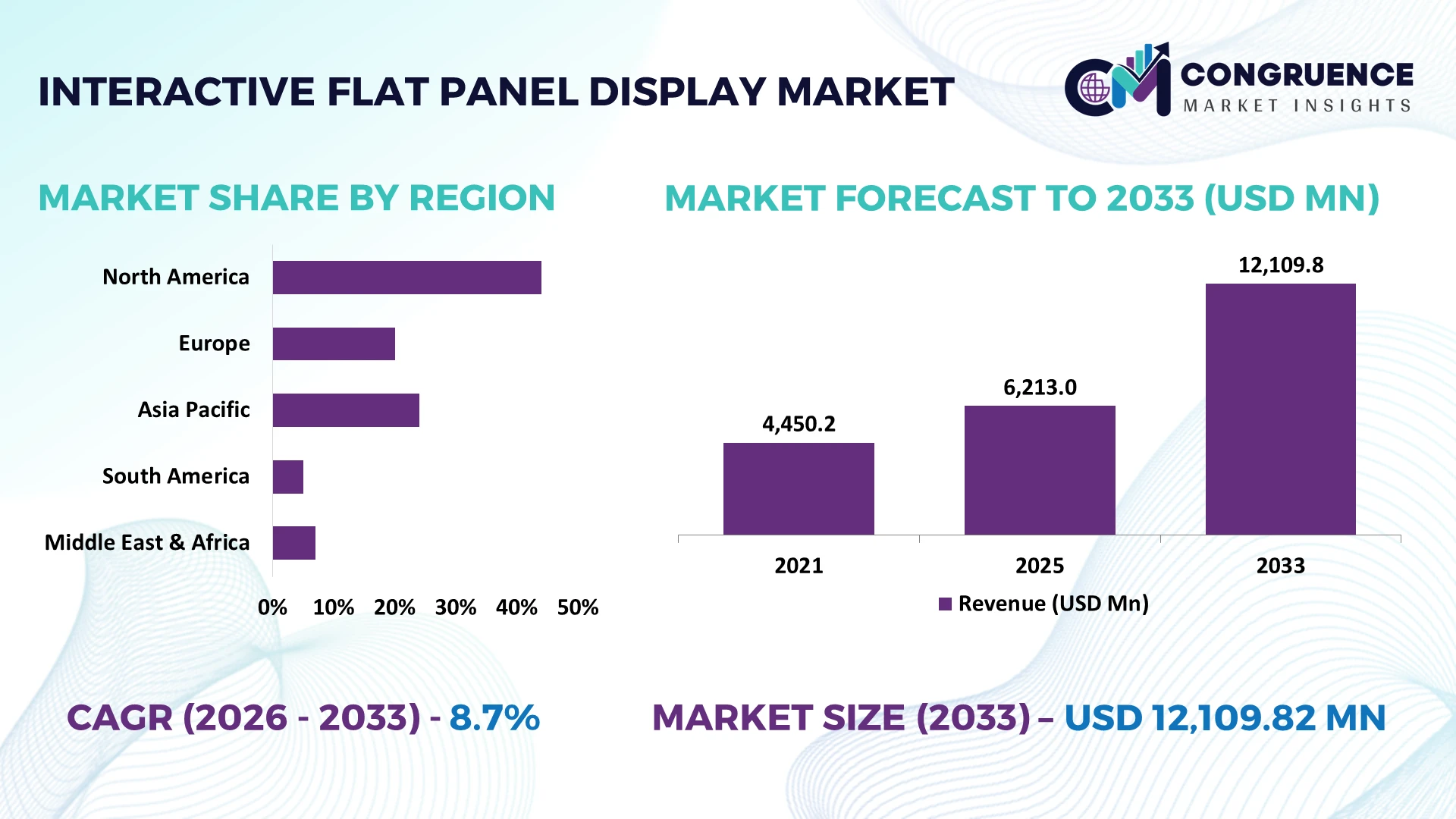
The United States anchors the advanced interactive display ecosystem, with North America accounting for approximately 35.5% of 2025 industry activity as schools and enterprises accelerate cloud-ready collaboration deployments. India provides a strong growth comparison: 90% of Kendriya Vidyalaya schools were equipped with smart classrooms under the updated ICT framework, while the PM SHRI program targets more than 14,500 technology-enabled schools. China adds geopolitical scale through its national education-digitalization strategy, with Smart Education of China 2.0 integrating AI into teaching and administration, intensifying Asia-Pacific competition in connected classroom infrastructure.
Strategically, suppliers combining secure operating systems, centralized device management, AI functions, local assembly, and education-specific software will capture replacement and greenfield procurement faster than hardware-only competitors.
Market Size & Growth: USD 6.21 billion in 2025 advances toward USD 12.11 billion by 2033 at 8.7%, supported by smart-classroom modernization and enterprise collaboration upgrades.
Top Growth Drivers: 90% smart-classroom coverage across KVS schools, approximately 40% of India’s ICT technology allocation directed toward smart classrooms, and India’s finished-panel customs duty rising from 10% to 20%.
Short-Term Forecast: By 2028, fleet-standardized interactive panels will target roughly 50% lower support workloads; one school-district pilot recorded a 54% reduction in display-related support tickets.
Emerging Technologies: Advanced panels now combine 40–50 touch points, AI processors delivering up to 10 TOPS, Android 14–16 platforms, OCR, multilingual translation, and automated device management.
Regional Leaders: Applying the 2025 regional mix to the 2033 industry benchmark indicates approximately USD 4.93 billion for Asia-Pacific, USD 3.20 billion for North America, and USD 2.77 billion for Europe, with education digitization, hybrid workplaces, and collaborative learning respectively supporting deployment.
Consumer/End-User Trends: A smart-classroom impact assessment found 72% of teachers observed improved student performance and 73% reported stronger attendance after digital classroom implementation.
Pilot/Case Example: A 2026 Tamil Nadu deployment placed 500 interactive panels across 12 districts in four months, reporting 95% first-year uptime and an 18% improvement in student attendance.
Competitive Landscape: ViewSonic retained the No.1 global interactive-display position outside China through 2025 and held approximately 64% share in the 100-inch-plus category, competing with BenQ, SMART Technologies, Samsung, and LG.
Regulatory & ESG Impact: India doubled basic customs duty on complete interactive flat panels from 10% to 20% while reducing open-cell duty to 5%, materially strengthening incentives for domestic module assembly.
Investment & Funding: U.S. Education Innovation and Research funding provided USD 259 million for new FY2025 awards, while India continues large-scale public investment in ICT laboratories and smart-classroom infrastructure.
Innovation & Future Outlook: 4K/5K displays reaching 98–110 inches, EDLA-certified ecosystems, embedded AI, centralized security, and cloud collaboration are shifting competition from panel specifications toward integrated classroom and workplace platforms.
Interactive Flat Panel Display Market demand is increasingly concentrated in K–12 education, universities, corporate meeting environments, training centers, and public institutions. Google EDLA-certified platforms, embedded AI assistants, 40-point multi-touch and centralized device management are accelerating product replacement. India’s 20% duty on finished panels is simultaneously encouraging localized assembly, making software integration, security and lifecycle management increasingly decisive purchasing criteria.
Interactive flat panel displays are becoming strategic infrastructure as education systems and enterprises shift from passive presentation hardware toward connected, software-managed collaboration environments. India illustrates the industrial transformation: the 2025 customs framework raised duty on finished interactive panels from 10% to 20% while lowering open-cell duty to 5%, directly encouraging domestic assembly, component sourcing, and local value addition.
Technology differentiation is increasingly measurable. Advanced interactive panels support 50 simultaneous touch points versus 20–32 points on many conventional Android-based alternatives, while touch response has fallen below 2.5 milliseconds on newer systems versus below 5 milliseconds on preceding configurations. Integrated 10-TOPS neural processors also deliver 67% more AI processing capacity than 6-TOPS architectures, supporting real-time transcription, handwriting recognition, content search, and image processing without separate computing hardware.
Deployment pathways now diverge geographically. India is emphasizing localized manufacturing and public digital-classroom infrastructure, while mature U.S. and European buyers increasingly prioritize device management, cybersecurity, interoperability, and lifecycle performance. Through 2028, procurement will increasingly favor integrated display-software ecosystems. A practical classroom can consolidate whiteboarding, wireless casting, video conferencing, and multi-user annotation onto one 4K panel. Manufacturers are consequently investing in EDLA-certified platforms, AI processors, local production, and software partnerships. Competitive advantage will shift decisively toward vendors controlling hardware, operating systems, security, and fleet management.
Digital classroom modernization is the strongest structural driver, converting interactive panels from supplementary equipment into core teaching infrastructure. India provides a clear deployment signal: approximately 90% of Kendriya Vidyalaya schools have smart-classroom infrastructure, while the PM SHRI initiative covers more than 14,500 schools. Hardware capability is simultaneously advancing, with current panels supporting 40–50 simultaneous touch points compared with roughly 20–32 on less advanced Android configurations. Government-led digital education programs and enterprise hybrid-work upgrades are therefore increasing requirements for 4K displays, wireless casting, integrated cameras, microphones, and centralized management. Manufacturers are responding with EDLA-certified platforms, embedded collaboration software, AI-assisted teaching functions, and locally assembled products. The strategic advantage increasingly comes from ecosystem integration rather than display specifications alone.
Component dependency remains a structural constraint because panel economics depend heavily on imported open cells, semiconductor components, touch controllers, and display electronics. India’s policy response exposes this vulnerability: Basic Customs Duty on finished interactive flat panels increased from 10% to 20%, while open-cell duty fell to 5% and specified open-cell parts became exempt. The 15-percentage-point differential strongly favors local assembly but increases landed-cost pressure for vendors dependent on completely built imports. Meanwhile, advanced configurations require 8 GB memory, 128 GB storage, multiple connectivity interfaces, and embedded computing, increasing bill-of-material complexity compared with conventional displays. Vendors are reducing exposure by localizing final assembly, diversifying component sourcing, negotiating longer procurement contracts, and developing modular product architectures. Scale increasingly depends on supply-chain control as much as sales reach.
On-device artificial intelligence creates an opportunity to reposition interactive displays as intelligent collaboration endpoints rather than touchscreen replacements. New-generation systems incorporate 10-TOPS neural processing, delivering 67% greater AI processing capacity than 6-TOPS configurations, while premium boards now accommodate 50 simultaneous touch inputs versus 20–32 on many conventional Android panels. These capabilities enable live transcription, intelligent search, handwriting recognition, automated summaries, and real-time image enhancement without continuous dependence on external PCs. India adds a manufacturing opportunity because finished-panel duty stands at 20% against 5% for open cells, strengthening incentives for domestic integration. Vendors are expanding R&D around AI-enabled firmware, EDLA-certified operating environments, device-management platforms, and education-specific applications. The non-obvious opportunity is recurring software and fleet-management value layered onto increasingly standardized display hardware.
Scaling interactive-display fleets creates an execution challenge extending beyond hardware reliability. Modern panels operate as networked endpoints with Android, Windows OPS modules, Wi-Fi, Bluetooth, cloud accounts, cameras, microphones, and enterprise applications, substantially expanding the security and integration surface. Current configurations can include 8 GB RAM, 128 GB storage and up to 50 touch points, while typical backlights are rated around 50,000 operating hours—meaning software support can become obsolete well before physical display hardware. Schools and enterprises therefore face long-term requirements for authentication, application governance, firmware updates, data protection, and cross-platform compatibility. Vendors must invest in over-the-air patching, centralized device administration, certified Android environments, identity controls, and longer software-support cycles. Sustainable competitiveness will depend on securing and managing thousands of connected panels consistently, not simply installing them.
AI Moves Directly On-Device: Interactive panels are shifting from display endpoints to AI-enabled workspaces, with current architectures offering up to 10 TOPS of neural processing, 8 GB RAM, and 128 GB storage. Vendors are embedding transcription, summarization, handwriting recognition, and intelligent search locally, reducing dependence on external PCs and accelerating classroom and meeting workflows.
Larger 4K Panels Become Standard: 4K UHD configurations represent roughly 41% of current market activity, while 65–86-inch panels account for about 71% of shipments in reported industry estimates. Procurement is consolidating around larger, standardized displays that improve classroom visibility and meeting-room usability. Manufacturers are consequently prioritizing 75-inch and 86-inch portfolios, anti-glare surfaces, and higher-precision touch systems.
Meeting Rooms Undergo Workflow Redesign: U.S. hybrid workers average five virtual meetings weekly, yet 27% lose at least 10 minutes during meeting setup and 67% have abandoned room video technology for laptops after setup difficulties. Enterprises are replacing fragmented peripherals with integrated interactive displays, while suppliers emphasize one-touch conferencing, platform interoperability, automated cameras, and centralized fleet administration.
Localization Reshapes Panel Supply Chains: India’s finished interactive-panel customs duty increased from 10% to 20%, while open-cell duty fell to 5%, creating a 15-percentage-point incentive favoring domestic value addition. Manufacturers are restructuring sourcing, expanding local assembly, and importing components rather than finished units. The less-visible shift is that procurement competitiveness increasingly depends on manufacturing architecture, not simply display performance.
4K UHD represents the leading strategic type, accounting for approximately 41% of current market activity as schools, universities, corporate campuses, and institutional buyers standardize high-resolution collaborative displays. Its advantage combines image clarity, large-format scalability, digital annotation, wireless casting, and compatibility with modern conferencing platforms. LCD-Based products remain fundamental because mature manufacturing infrastructure and competitive component economics support high-volume procurement. LED-Based configurations retain relevance where brightness, longevity, and commercial presentation performance outweigh acquisition cost.
Touchscreen functionality increasingly cuts across the entire product architecture rather than operating as an isolated specification, with touch-based configurations representing approximately 43% of reported industry demand. 8K UHD remains an emerging premium category, suited to specialized visualization, executive collaboration, healthcare imaging, and high-detail content environments where 4K remains insufficient. Manufacturers are concentrating investment on 4K touchscreen platforms while gradually introducing 8K capabilities, improved optical bonding, low-latency writing, AI processors, and multi-touch interfaces. This shifts competitive investment from basic resolution upgrades toward integrated visual-computing performance.
Interactive Learning remains the leading application, supported by education’s roughly 55–62% share of broader interactive-panel deployment across available 2025 market assessments. Schools and universities procure panels at classroom scale, creating stronger unit concentration than individual corporate meeting-room projects. Multi-touch annotation, multimedia lesson delivery, screen sharing, and learning-platform integration reinforce recurring classroom usage. Corporate Presentations remain established, while Training & Workshops benefit from collaborative annotation and instructor-led digital content.
Digital Collaboration is emerging as the fastest-growing operational application as hybrid organizations replace disconnected projectors, cameras, whiteboards, and conferencing peripherals with integrated endpoints. Video Conferencing strengthens this transition: 27% of U.S. hybrid workers report losing at least 10 minutes setting up meetings, while 67% have abandoned meeting-room video equipment for laptops because of complexity. Vendors are responding through platform-agnostic conferencing, automated framing, AI transcription, wireless casting, and centralized device management. The business implication is significant: purchasing decisions increasingly prioritize workflow simplification and interoperability rather than screen specifications alone.
Schools & Universities remain the dominant end-user group, representing approximately 55–62% of deployment across available 2025 industry assessments. Large classroom fleets, centralized procurement, daily instructional utilization, and government-backed digital-learning programs create considerably greater installation density than most commercial environments. Corporate Offices form the second major buyer group as meeting rooms become standardized collaboration environments. Training Centers increasingly favor touchscreen displays for instructor-led simulation, annotation, certification, and group exercises.
Healthcare Facilities represent the fastest-developing specialized end-user opportunity as telemedicine, clinical collaboration, medical education, and multidisciplinary case review increase requirements for high-resolution interactive visualization. Government Institutions are simultaneously deploying panels for command rooms, administrative training, public-service modernization, and collaborative planning. India demonstrates the education opportunity particularly clearly, with digital technology adoption reported across approximately 90% of surveyed schools in Mumbai, Thane, and Navi Mumbai during 2025. Manufacturers are differentiating through education bundles, enterprise device management, healthcare-oriented visualization, institutional pricing, and software ecosystems. Future competitive positioning increasingly depends on vertical-specific solutions rather than standardized hardware selling.
North America accounted for the largest market share at 35.5% in 2025 however, Asia-Pacific is expected to register the fastest growth, expanding at a CAGR of 8.8% between 2026 and 2033.

Software-Led Classroom and Enterprise Modernization
North America holds a leading position through mature education procurement, enterprise IT spending, hybrid-work infrastructure, and strong demand for managed collaboration endpoints. U.S. school districts increasingly replace projectors and first-generation boards with 4K, EDLA-certified interactive panels incorporating wireless casting, centralized management, cybersecurity controls, and cloud collaboration. A notable 2025 deployment equipped approximately 650 classrooms at Royse City ISD with Google Workspace-integrated interactive boards, demonstrating district-scale standardization rather than isolated classroom purchases. Enterprise demand follows a similar architecture, emphasizing Microsoft Teams, Google Workspace, USB-C connectivity, and remote fleet administration. Manufacturers are consequently integrating hardware with proprietary education software, automated device management, and professional services. The operational advantage lies in reducing fragmented AV infrastructure while giving IT teams centralized control over large display fleets.
United States Market Outlook: The United States combines large K–12 procurement networks, extensive corporate collaboration infrastructure, and a concentrated EdTech vendor ecosystem. ViewSonic’s education platform alone serves more than 11 million teachers and students globally, while its U.S. portfolio now includes 75-inch EDLA-certified displays with 50-point PCAP touch. U.S. buyers increasingly evaluate security, interoperability, software support, and device lifecycle alongside panel specifications, strengthening suppliers with established institutional channels.
Digital Standards Accelerate Fleet Renewal
Europe represents a mature interactive display market where procurement increasingly emphasizes interoperability, cybersecurity, energy efficiency, accessibility, and lifecycle support. Education modernization remains central, while corporate buyers are replacing fragmented presentation systems with integrated conferencing and digital-whiteboarding platforms. The United Kingdom provides a strong policy signal: its 2025 digital standards initiative expects schools and colleges to meet six core technology standards by 2030, increasing pressure to modernize outdated classroom infrastructure. Germany, France, the UK, and Nordic markets also favor centrally managed devices capable of supporting secure cloud collaboration and hybrid learning. Suppliers are responding with lower-power displays, remote administration, EDLA-certified Android environments, and platform-neutral conferencing. Europe’s strategic distinction is therefore not deployment volume alone; purchasing increasingly rewards compliant, manageable systems that remain operationally supportable throughout extended institutional replacement cycles.
United Kingdom Market Outlook: The UK combines centralized education policy, established EdTech procurement channels, and extensive hybrid workplace infrastructure. The six digital standards targeted for nationwide school and college implementation by 2030 create a defined modernization framework. This favors interactive-display suppliers offering secure networking, classroom management, accessibility features, reliable software updates, and integration with existing cloud productivity environments rather than standalone touchscreen hardware.
Manufacturing Scale Meets Digital Deployment
Asia-Pacific combines the strongest manufacturing economics with accelerating classroom and enterprise deployment. China anchors display-panel production, component ecosystems, electronics assembly, and large-scale education digitization, while India is developing stronger domestic assembly incentives and public digital-learning infrastructure. China’s Smart Education platform serves hundreds of millions of teachers and students and was upgraded in 2025 with AI-oriented resources supporting more personalized learning workflows. India, Japan, South Korea, and Australia add substantial institutional and corporate demand, creating a market where international brands compete directly with Chinese display specialists. Procurement increasingly centers on 4K resolution, AI-assisted teaching, multi-touch capability, wireless collaboration, and integrated operating environments. Manufacturers are expanding local channels and software ecosystems while restructuring assembly footprints. Asia-Pacific’s advantage is the ability to combine component proximity, manufacturing scale, rapid product iteration, and expanding digital infrastructure.
China Market Outlook: China remains strategically critical because manufacturing depth and domestic education digitization reinforce each other. Smart Education of China 2.0, launched in March 2025, expanded AI-enabled educational resources across an infrastructure already reaching hundreds of millions of users. Local suppliers can therefore iterate interactive hardware, AI software, touch systems, and collaboration platforms against unusually large deployment environments, creating significant scale and cost advantages.
Connectivity Expansion Unlocks Classroom Demand
South America’s interactive display opportunity is increasingly linked to school connectivity, digital curriculum deployment, corporate modernization, and public-sector technology programs. Brazil is the pivotal market because its large education system creates scalable demand once connectivity barriers are removed. By September 2025, adequate pedagogical connectivity across Brazilian public schools had increased from 45.4% to 65.4%, covering 90,195 schools and more than 23 million students. This infrastructure expansion strengthens the practical case for interactive classroom hardware, cloud content, and centrally managed display fleets. Corporate adoption is concentrated in major business centers, where conferencing and digital collaboration support hybrid operations. Suppliers are using distributors, education integrators, localized training, and value-oriented product configurations to address budget constraints. The principal operational limitation remains uneven broadband quality outside major urban areas, making infrastructure readiness an important determinant of panel utilization.
Brazil Market Outlook: Brazil has the strongest deployment foundation through its nationwide connected-schools strategy, which targets pedagogical connectivity across all public basic-education schools. The program aims to reach roughly 137,000 public schools, while more than 82,000 already had broadband by August 2025. This creates a widening installed base for interactive learning hardware, particularly when procurement combines connectivity, digital content, teacher training, and classroom displays.
Smart Infrastructure Drives Premium Deployment
Middle East & Africa demand is shaped by sharply different infrastructure conditions. Gulf economies emphasize premium smart classrooms, digitally enabled universities, government modernization, and technology-intensive corporate facilities, while African deployments remain more dependent on connectivity, public funding, and institutional procurement. The UAE and Saudi Arabia lead adoption through digitally integrated education and smart-government programs, creating demand for 4K panels, cloud collaboration, bilingual content, centralized administration, and AI-enabled classroom tools. South Africa provides a broader education and enterprise channel but faces greater infrastructure and budget variability. Suppliers are therefore segmenting portfolios: premium integrated platforms target Gulf institutions, while cost-optimized configurations and distributor-led support address developing markets. The strategic opportunity lies in combining display hardware with installation, connectivity, training, and lifecycle services rather than relying on transactional equipment sales.
United Arab Emirates Market Outlook: The UAE offers one of the region’s strongest environments for premium interactive displays because digitally enabled schools, universities, government facilities, and corporate campuses operate on advanced connectivity infrastructure. Procurement increasingly favors integrated touchscreen collaboration, secure cloud access, multilingual workflows, and centralized management. Vendors able to combine enterprise-grade hardware with local technical support and education-specific software gain a stronger position in institutional tenders.
Samsung Electronics, LG Electronics, Sharp, BenQ, Promethean, and ViewSonic compete across education, enterprise collaboration, and institutional modernization, while specialists challenge diversified electronics groups through software-led classroom ecosystems. The top five players hold approximately 18.9% combined share, confirming a fragmented structure where channel execution matters alongside scale. Competition increasingly centers on Google EDLA certification, AI-assisted collaboration, 4K performance, cybersecurity, and lifecycle management. Touch-based systems represent about 43% of demand, while 4K UHD configurations account for roughly 41%, pushing suppliers toward higher-specification portfolios. Vendors are expanding education partnerships, integrating cloud device management, strengthening local distribution, and vertically linking displays with proprietary software. ViewSonic’s leadership outside China demonstrates how education specialization can outperform broader hardware scale. Supply-chain localization and component access are becoming sharper differentiators as tariff exposure changes landed costs. Certification, software compatibility, service coverage, and procurement relationships create entry barriers. Winning requires integrated ecosystems, dependable supply, rapid deployment and institutional support.
Samsung Electronics
LG Electronics
ViewSonic Corporation
BenQ Corporation
Promethean
SMART Technologies
Sharp Corporation
Newline Interactive
Boxlight Corporation
Hitevision
Huawei Technologies
Panasonic
Ricoh Company
Hikvision
Current interactive flat panels are standardizing around 4K resolution, EDLA-certified Android platforms, USB-C connectivity, 40–50-point touch and centralized device management. Compared with 40-point systems, newer 50-point touch architectures increase simultaneous interaction capacity by 25%, supporting denser classroom collaboration. Samsung’s current WAF-P generation also doubles onboard storage from 64 GB in WAF to 128 GB, a 100% capacity improvement that reduces dependence on external computing and strengthens application availability.
Emerging architectures are moving AI processing onto the panel. BenQ’s 2026 RP05 integrates a 10-TOPS NPU for local knowledge retrieval, visual learning, gesture control and content safety, eliminating cloud dependence for those AI functions. Integrated cameras, microphone arrays and speakers further consolidate meeting-room hardware; Samsung’s WAF-P combines a 48MP camera, 10-meter microphone pickup and dual 20W speakers. OS-agnostic designs are also extending hardware life by allowing computing environments to be upgraded without replacing displays.
Through 2026–2028, competition will shift from screen specifications toward AI, security, software ecosystems and fleet orchestration. ViewSonic already holds the leading interactive-display position outside China across 2023–2025, signaling deployment preference for integrated platforms. Vendors controlling hardware, operating environments and remote management gain the strongest lifecycle advantage as schools and enterprises standardize connected display fleets across large institutional estates.
May 2024 — Samsung launched its first Google EDLA-certified WAD interactive displays in 65-, 75-, and 86-inch formats, supporting 40 simultaneous touchpoints and 65W USB-C charging. The launch strengthened Samsung’s classroom interoperability with Google Classroom, Drive, and Play. Source: avnetwork.com
July 2025 — Promethean expanded its AV portfolio with ActivPanel 10 Premium, ActivPanel LE, and D Series signage at ISTELive. The flagship added QLED full-array local dimming and flexible operating-system compatibility, strengthening greater security, sustainability, and platform choice. Source: eschoolnews.com
June 2026 — BenQ launched RP05 in India across 65-, 75-, and 86-inch models, integrating a 10-TOPS NPU for on-device AI. Local processing keeps classroom data on-panel while enabling knowledge retrieval, gesture control, visual learning, and content safety. Source: benq.com
February 2026 — ViewSonic retained the No.1 interactive-display position outside China for a third consecutive year, according to Futuresource Consulting’s tracker covering 2023–2025. Adoption of 80–100-inch ViewBoards reinforced education-sector preference for scalable hardware, integrated software, and platform stability. Source: viewsonic.com
The Interactive Flat Panel Display Market report evaluates LED-based, LCD-based, 4K UHD, 8K UHD and touchscreen systems across interactive learning, video conferencing, corporate presentations, digital collaboration, and training and workshops. End-user coverage spans schools and universities, corporate offices, training centers, government institutions, and healthcare facilities, with assessment across North America, Europe, Asia-Pacific, South America, and Middle East & Africa.
Technology analysis covers EDLA-certified operating environments, 4K/8K resolution, multi-touch interfaces, edge AI, USB-C, wireless casting, embedded conferencing, and centralized device management. Current platforms reach 50–64 simultaneous touchpoints, while 10-TOPS NPUs signal the transition toward locally processed AI. The report also examines localized display assembly, large-format 98–110-inch deployments, software ecosystems, cybersecurity, and lifecycle management, supporting investment planning, geographic expansion, supplier benchmarking, competitive positioning, and technology-roadmap decisions through 2033.
| Report Attribute/Metric | Report Details |
|---|---|
Market Revenue in 2025 | USD 6213 Million |
Market Revenue in 2033 | USD 12109.82 Million |
CAGR (2026 - 2033) | 8.7% |
Base Year | 2025 |
Forecast Period | 2026 - 2033 |
Historic Period | 2021 - 2025 |
Segments Covered | By Type
By Application
By End-User
|
Key Report Deliverable | Revenue Forecast, Growth Trends, Market Dynamics, Segmental Overview, Regional and Country-wise Analysis, Competition Landscape |
Region Covered | North America, Europe, Asia-Pacific, South America, Middle East, Africa |
Key Players Analyzed | Samsung Electronics, LG Electronics, ViewSonic Corporation, BenQ Corporation, Promethean, SMART Technologies, Sharp Corporation, Newline Interactive, Boxlight Corporation, Hitevision, Huawei Technologies, Panasonic, Ricoh Company, Hikvision |
Customization & Pricing | Available on Request (10% Customization is Free) |




