
Reports
The Global Interactive Display Market was valued at USD 52644.7 Million in 2025 and is anticipated to reach a value of USD 98165.79 Million by 2033 expanding at a CAGR of 8.1% between 2026 and 2033. Growth is driven by interactive flat-panel replacement in classrooms, AI-enabled enterprise collaboration, self-service retail deployment, and migration from projector-based systems toward large-format 4K touch displays.
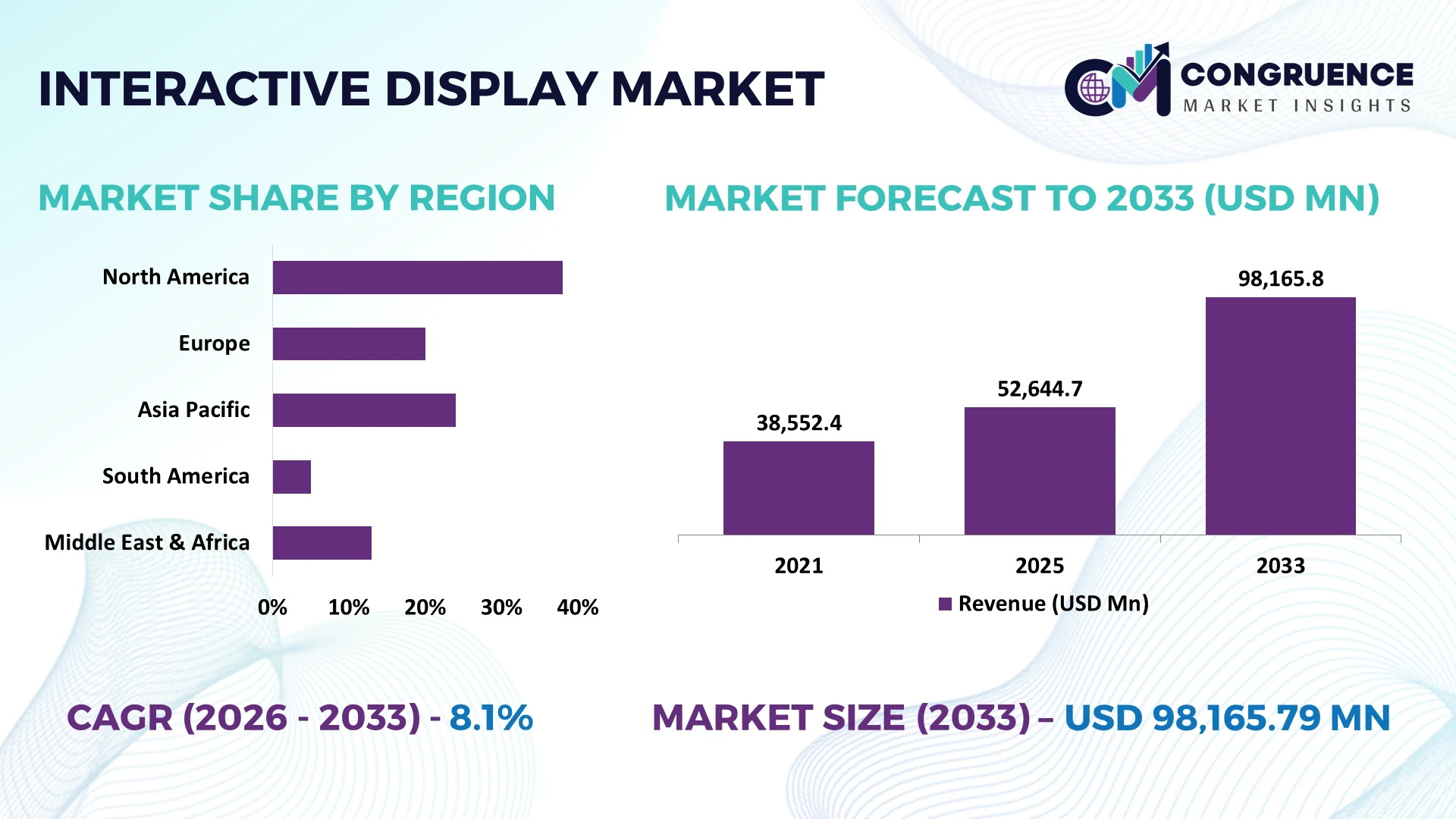
The United States remains the dominant country market, supported by North America’s roughly 37% global share and extensive deployment across K–12 education, universities, corporate meeting rooms, healthcare facilities, and retail. Large-format 65–86-inch interactive panels are increasingly replacing legacy projection systems, while education represents approximately 40% of global interactive-display demand. China is scaling faster through its national education-digitalization strategy and AI-enabled smart-classroom programs. Compared with the United States, China benefits from deeper domestic LCD manufacturing and stronger public-sector digital-classroom programs, while U.S. buyers maintain higher enterprise and institutional penetration; Asia-Pacific represents approximately one-third of global demand. China’s 2024–2035 education modernization agenda further strengthens procurement visibility across schools and public learning infrastructure.
Strategically, suppliers should prioritize education-platform integration, AI collaboration software, large-screen touch systems, and regionalized panel sourcing as procurement shifts from standalone hardware toward integrated interactive-display ecosystems.
Market Size & Growth: USD 52.64 billion in 2025 advances toward USD 98.17 billion by 2033 at 8.1%, driven by classroom digitization, enterprise collaboration upgrades, and interactive self-service infrastructure.
Top Growth Drivers: Education digitization accounts for approximately 40% of demand, interactive flat panels exceed 85% of display-type deployment, and LCD technology retains above 60% penetration.
Short-Term Forecast: By 2027, integrated AI transcription, wireless casting, and device-management platforms are positioned to reduce meeting and classroom setup time by approximately 20–30%.
Emerging Technologies: AI-generated summaries, multi-user capacitive touch, integrated 4K cameras, Android-based computing, NFC authentication, and cloud device management are redefining advanced interactive display platforms.
Regional Leaders: North America represents roughly USD 19–20 billion, Asia-Pacific approximately USD 17–18 billion, and Europe around USD 13–14 billion of 2025 demand, supported respectively by enterprise, education, and hybrid-work adoption.
Consumer/End-User Trends: Education contributes approximately 40% of global demand, while 32–65-inch displays capture more than 50% of installations; above-65-inch panels are gaining rapidly in collaborative environments.
Pilot/Case Example: In 2025, Uruguay’s Instituto Adventista replaced projectors across 30 classrooms with interactive ViewBoard systems, enabling cloud-based lesson delivery and fully digital classroom presentation workflows.
Competitive Landscape: Leading suppliers include ViewSonic, Samsung Electronics, LG Electronics, BenQ, Promethean, SMART Technologies, and Sharp; major individual vendors generally command single-digit global shares, confirming fragmented competition.
Regulatory & ESG Impact: Energy-efficiency requirements, cybersecurity controls, e-waste obligations, and device-management standards increasingly influence institutional tenders, while LED backlighting and automated power management can reduce operating energy by approximately 15–30%.
Investment & Funding: Samsung Display’s USD 1.8 billion Vietnam OLED investment illustrates continued Asian display-capacity expansion, strengthening regional supply diversification as manufacturers reduce concentration risk across global electronics supply chains.
Innovation & Future Outlook: Next-generation platforms combine AI assistants, 4K collaboration cameras, cloud management, handwriting recognition, and cross-OS compatibility; the strategic battleground is shifting from panel specifications toward software ecosystems and lifecycle services.
Interactive Display Market demand is increasingly concentrated in digital classrooms, hybrid meeting spaces, retail self-service, healthcare navigation, and transportation information systems. Interactive flat panels represent more than 85% of display-type deployment, while AI transcription, wireless collaboration, integrated cameras, and cloud management are accelerating product replacement. Regional panel-supply diversification and tighter institutional cybersecurity requirements now directly influence procurement, creating the foundation for deeper strategic market analysis.
Interactive displays are becoming strategic digital infrastructure as education, enterprise collaboration, retail automation, and healthcare move from passive screens toward connected touch, computing, conferencing, and content-management platforms. Interactive flat panels account for approximately 87% of display-type deployment, while education contributes around 40% of demand. Procurement is shifting from standalone AV hardware toward centrally managed ecosystems as institutions prioritize cloud collaboration, device security, and simplified multi-site administration.
Compared with projector-and-whiteboard configurations, integrated 4K interactive panels eliminate separate projection equipment, enable direct cloud access, and can reduce classroom or meeting setup time by approximately 20–30% through wireless casting and embedded computing. Uruguay's Instituto Adventista modernized 30 classrooms with 65-inch interactive displays, illustrating practical projector replacement. The United States leads institutional and enterprise deployments, while China combines large-scale education digitization with extensive domestic display manufacturing capacity.
Through 2026–2028, above-65-inch panels, AI-assisted transcription, handwriting recognition, remote device management, and integrated video collaboration will reshape procurement specifications. The 32–65-inch category currently represents approximately 54% of installations, leaving larger collaborative formats substantial expansion potential. Vendors are strengthening software integration, channel partnerships, and localized supply strategies. Competitive advantage will increasingly depend on controlling the complete hardware-software-service ecosystem rather than competing primarily on panel specifications.
Education and workplace modernization are accelerating replacement of projectors, conventional whiteboards, and disconnected conferencing equipment with interactive flat panels. Education represents approximately 40% of market demand, interactive flat panels account for about 87% of display-type deployment, and 32–65-inch screens represent roughly 54% of installations. Uruguay's Instituto Adventista replaced legacy classroom presentation equipment across 30 classrooms with 65-inch interactive displays, demonstrating the operational shift toward cloud-enabled instruction. Vendors including ViewSonic, Samsung, BenQ, Promethean, and SMART Technologies are responding with wireless casting, embedded operating systems, AI tools, conferencing, and centralized device management. The strategic advantage lies in workflow consolidation: suppliers combining hardware, software, security, and remote administration can reduce institutional IT complexity while creating stronger recurring service relationships.
Scaling interactive-display deployments remains constrained by dependence on large-format LCD panels, touch sensors, processors, display-driver ICs, and specialized glass concentrated within Asian electronics supply chains. LCD technology represents approximately 61% of technology deployment, infrared touch holds about 45% of touch-technology usage, and large-format displays above 65 inches impose materially higher transportation and installation requirements than smaller panels. China remains central to global display manufacturing, creating procurement efficiencies but also exposing international vendors to trade restrictions, logistics disruption, and component concentration. Suppliers are reducing exposure through multi-vendor panel qualification, regional assembly, longer procurement contracts, and common hardware architectures spanning multiple screen sizes. Standardizing components across product families is strategically important because it lowers spare-parts complexity, protects margins, and improves maintenance economics across large institutional fleets.
The strongest opportunity is converting interactive panels from hardware products into continuously managed collaboration endpoints. Education contributes approximately 40% of current demand, 32–65-inch displays represent around 54% of installations, and interactive flat panels hold approximately 87% of display-type deployment, creating a substantial installed base for software-led services. Between 2026 and 2028, AI transcription, automated meeting summaries, handwriting recognition, NFC authentication, occupancy-aware interfaces, and cloud fleet management will expand platform value. Healthcare provides an underpenetrated opportunity through clinical training, telemedicine collaboration, and patient communication, while India’s classroom digitization programs create additional institutional deployment potential. Suppliers are increasing R&D in cross-platform interoperability, remote administration, and collaboration software. The non-obvious opportunity is lifecycle monetization through analytics, security updates, training, fleet management, and technical support after hardware installation.
Interactive displays increasingly operate as networked IT endpoints rather than isolated presentation devices, creating long-term cybersecurity and interoperability challenges. Landscape installations represent approximately 84% of deployments, infrared touch accounts for around 45% of touch configurations, and interactive flat panels exceed 85% of display-type installations, expanding the number of connected devices requiring consistent administration. Cameras, microphones, wireless casting, cloud storage, Android or Windows environments, and remote management increase attack surfaces in schools, hospitals, enterprises, and government facilities. Large organizations also face inconsistent firmware, identity-management, and conferencing-platform compatibility across multi-vendor fleets. Vendors must invest in centralized patching, authentication, longer security-support cycles, interoperability certification, and channel-level technical expertise. Competitive differentiation increasingly depends on maintaining secure, standardized performance across thousands of devices throughout multi-year operating lifecycles.
AI Features Move On-Device: Interactive panels are shifting from touch-only hardware toward AI-assisted collaboration endpoints. Interactive flat panels represent about 87% of display-type deployment, 32–65-inch models hold roughly 54%, and larger screens continue gaining share. Vendors are embedding handwriting recognition, automated summaries, camera tracking, and device-level AI, reducing dependence on separate PCs and accelerating classroom and meeting workflows.
Large Screens Replace Projectors: Above-65-inch interactive panels are displacing projector-based installations as buyers prioritize 4K resolution, consistent brightness, and lower setup complexity. Education-specific interactive flat-panel shipments reached roughly 672,000 units in 2025, while flat panels captured nearly 83% of classroom interactive-display deployments. Manufacturers are expanding 75-inch and 86-inch portfolios and restructuring channel inventories around fewer, higher-value screen formats.
Self-Service Deployment Broadens: Interactive kiosks are moving beyond retail checkout into hospitals, airports, public services, hospitality, and transportation. North America accounted for about 31–42% of kiosk deployment depending on scope, while India is emerging as a high-expansion market. Companies are integrating contactless payment, identity verification, remote monitoring, and multilingual interfaces, shifting kiosk economics from transaction hardware toward automated service infrastructure.
Software Ecosystems Reshape Competition: Hardware specifications are becoming less differentiating as centralized device management, wireless casting, collaboration software, and security controls shape purchasing decisions. Newline captured 29.9% of the U.S. interactive-flat-panel market in Q4 2025, demonstrating how channel execution and ecosystem integration can rapidly alter vendor positions. Suppliers are therefore expanding software partnerships, certification programs, and lifecycle support rather than competing primarily through panel pricing.
Interactive Flat Panels dominate the type landscape with approximately 80–87% share in education-centered and broader interactive-display deployments, supported by integrated computing, 4K resolution, multi-touch capability, wireless casting, and lower maintenance requirements than projector-based systems. Their scalability from 65-inch to 86-inch formats makes them suitable for classrooms, boardrooms, and institutional collaboration spaces. Interactive Whiteboards remain relevant in established education installations but continue losing replacement demand as buyers migrate toward self-contained panels. Interactive Projectors retain niche relevance where wall size, retrofit requirements, or lower initial hardware costs matter.
Interactive Kiosks represent the fastest-expanding type as retailers, healthcare providers, airports, and public agencies automate customer-facing workflows. Interactive Tables remain smaller but strategically relevant in museums, training environments, design collaboration, and premium retail. Companies are concentrating R&D on flat-panel software ecosystems while expanding kiosk portfolios around payment, identity, analytics, and remote management. Investment is therefore dividing between high-volume collaborative panels and higher-service-intensity self-service systems.
Classroom Teaching remains the largest application, supported by education’s approximately 40% share of broader interactive-display demand and the large installed base of digital teaching infrastructure across K–12 and higher education. Interactive displays increasingly replace projectors and static boards through embedded computing, annotation, cloud content access, and multi-user participation. Interactive Learning overlaps operationally with classroom environments but is becoming more software-driven as gamification, digital assessment, and AI-assisted content tools expand. In education-specific deployments, K–12 accounted for nearly 74% of 2025 interactive-display activity, highlighting concentrated institutional purchasing.
Video Conferencing is the fastest-strengthening application as enterprises retrofit meeting rooms for hybrid collaboration. Corporate Presentations remain mature but are increasingly integrated with conferencing rather than deployed separately. Digital Signage is shifting toward interactive navigation, product discovery, and service automation. Vendors are responding with integrated cameras, microphones, wireless casting, unified communications certification, and remote fleet management. Demand is therefore strengthening where interactive displays become workflow infrastructure rather than standalone presentation equipment.
Educational Institutions remain the dominant end-user group with approximately 40% of global interactive-display demand, reflecting large classroom fleets, recurring technology-refresh cycles, and dependence on standardized teaching infrastructure. K–12 institutions represent the largest concentration within education, while universities increasingly deploy large-format panels in lecture halls, laboratories, and hybrid-learning spaces. Corporate Offices form the second major buyer group, with demand driven by meeting-room modernization, collaborative workspaces, and integrated video conferencing. Government Organizations maintain steady procurement for training, command centers, public information, and administrative collaboration.
Retail Stores are the fastest-growing end-user group as interactive kiosks, assisted selling, product configurators, and self-service workflows reduce service bottlenecks. Healthcare Facilities are also increasing adoption in patient registration, clinical training, telemedicine, and wayfinding. Suppliers are responding with education-specific pricing, enterprise software bundles, healthcare-grade integration, and retail kiosk partnerships. Competitive positioning increasingly depends on vertical customization rather than offering identical hardware across every customer category.
North America accounted for the largest market share at 37.28% in 2025 however, Asia-Pacific is expected to register the fastest growth, expanding at a CAGR of approximately 8.6% between 2026 and 2033.

Enterprise Collaboration and Education Refresh Accelerate
North America maintains the strongest interactive display position, accounting for approximately 37.3% of global demand in 2025, supported by mature education technology infrastructure, enterprise collaboration upgrades, healthcare digitization, and retail self-service deployment. U.S. school districts continue replacing projectors and legacy whiteboards with 65–86-inch interactive flat panels combining 4K resolution, embedded computing, and centralized device management. Competitive intensity is particularly high in education, where Newline reached 29.9% U.S. interactive-display share in Q4 2025. Corporate buyers are simultaneously consolidating displays, conferencing cameras, microphones, and collaboration software into unified meeting-room systems. Vendors are strengthening local warehousing, channel partnerships, cybersecurity certification, and software integration to shorten deployment cycles. The operational advantage increasingly comes from fleet-level management and dependable post-installation support rather than display hardware alone.
United States Market Outlook: The United States represents the region's largest concentration of institutional deployments, with Newline, ViewSonic, Promethean, SMART Technologies, Samsung, and BenQ competing aggressively for education and corporate installations. Newline held 29.9% U.S. share in Q4 2025, while ViewSonic reached 23.5%, demonstrating unusually concentrated channel competition. Buyers increasingly prioritize Google EDLA certification, remote administration, interoperability, rapid fulfillment, and multi-year technical support when standardizing district-wide or enterprise-wide display fleets.
Digital Education Meets Compliance-Led Modernization
Europe represents roughly one-quarter of interactive display demand, with the United Kingdom and Germany forming the region's primary deployment centers. Adoption is concentrated across schools, universities, corporate meeting environments, transportation hubs, and digital retail infrastructure. The UK and Germany together account for substantially more than half of major European interactive-display activity, reflecting established classroom technology budgets and enterprise AV modernization. Procurement is increasingly influenced by cybersecurity, device lifecycle management, energy efficiency, accessibility, and data-governance requirements, pushing suppliers toward longer firmware support and centrally managed platforms. Western European enterprises are also replacing fragmented projector, conferencing, and whiteboard setups with integrated collaboration displays. Vendors are responding through education partnerships, Google-certified platforms, Microsoft Teams compatibility, and stronger reseller networks. The structural shift favors suppliers capable of meeting both technical performance and increasingly formal institutional compliance requirements.
United Kingdom Market Outlook: The United Kingdom remains Europe's largest individual interactive-display market, supported by established digital-classroom infrastructure and widespread enterprise collaboration adoption. Its market scale exceeds Germany's, while school trusts, universities, and corporate buyers increasingly standardize 65-inch, 75-inch, and 86-inch interactive panels. Procurement increasingly rewards suppliers offering centralized management, classroom software compatibility, cybersecurity support, and nationwide installation capability rather than lowest-cost hardware alone.
Manufacturing Scale Supports Rapid Deployment
Asia-Pacific combines the industry's strongest manufacturing ecosystem with the fastest expansion in education, retail, corporate, and public-sector deployments. The region accounts for approximately one-third of broader interactive-display demand and over 40% of interactive-flat-panel production-oriented market activity, supported by concentrated LCD, semiconductor, touch-module, and electronics assembly capacity in China, South Korea, Taiwan, and Vietnam. China provides both substantial domestic demand and global component supply, while India is accelerating smart-classroom and enterprise digitization. Samsung Display's USD 1.8 billion Vietnam investment illustrates continued diversification of advanced display manufacturing outside China. Vendors benefit from shorter component supply chains and greater pricing flexibility, but competition is intensifying around Android platforms, AI functions, Google EDLA certification, and integrated collaboration software. Manufacturers are increasingly aligning localized production with country-specific education and enterprise channel partnerships.
China Market Outlook: China combines large domestic deployment potential with unmatched depth across panel manufacturing, display electronics, touch components, and finished-system assembly. The country operates roughly 4,500 shopping malls, creating substantial interactive kiosk and retail-display potential alongside education digitization. Domestic supply-chain integration enables manufacturers to shorten product-development cycles, control component sourcing, and compete aggressively on large-format panel pricing while increasingly adding AI-enabled classroom and enterprise software capabilities.
Education Modernization Drives Selective Deployment
South America represents approximately 5–6% of global interactive display demand, with Brazil accounting for the region's largest concentration of education, retail, corporate, and public-sector installations. Procurement remains more selective than in mature markets because currency volatility, imported hardware costs, and uneven digital infrastructure increase total deployment expense. Nevertheless, school modernization and retail digitization are creating concentrated demand for multifunctional flat panels and interactive kiosks. Samsung's 2025 introduction of AI-enabled WAFX-P interactive displays in Brazil reflects the shift toward Android-based classroom platforms incorporating translation, search, annotation, and collaboration tools. Large institutional buyers increasingly favor standardized screen sizes and cloud-managed systems that reduce maintenance complexity across distributed locations. Vendors are responding through local distributors, Portuguese-language software support, financing models, and channel partnerships designed to lower deployment friction and strengthen after-sales coverage.
Brazil Market Outlook: Brazil is South America's most strategically important market because of its scale across education, corporate offices, retail chains, and public services. Samsung's introduction of AI-enabled WAFX-P classroom displays in 2025 demonstrates increasing demand for integrated software rather than basic touch hardware. Local service coverage, financing flexibility, Portuguese-language interfaces, and compatibility with Google-based education platforms remain decisive for vendors seeking larger institutional deployment contracts.
Smart Infrastructure Spending Concentrates Demand
Middle East & Africa accounts for approximately 4% of global interactive display demand, but deployment is highly concentrated around Gulf education modernization, government digitization, hospitality infrastructure, transportation projects, and premium corporate environments. Saudi Arabia and the UAE are prioritizing technology-enabled classrooms and digital public infrastructure, creating demand for large-format interactive panels, smart podiums, kiosks, and centralized content systems. Saudi education technology providers increasingly package interactive displays alongside learning platforms and classroom-control systems, shifting procurement toward integrated solutions. Samsung's WAF-series availability in Saudi Arabia, including Google EDLA functionality, reflects growing preference for standardized Android-based education environments. Infrastructure quality remains uneven outside Gulf markets, making distributor capability and technical support critical. Suppliers are consequently concentrating investment around localized partnerships, government-aligned projects, certified platforms, and service networks rather than pursuing uniform geographic expansion.
Saudi Arabia Market Outlook: Saudi Arabia offers the strongest regional positioning through large-scale education modernization, smart-city investment, government digitization, and enterprise infrastructure development. Interactive displays are increasingly integrated with smart podiums, learning platforms, and classroom-management systems rather than purchased independently. Vendors offering Arabic-enabled interfaces, Google-compatible education software, centralized administration, and dependable local implementation support are best positioned for institutional procurement and multi-site deployments.
Samsung Electronics, LG Electronics, Sharp, BenQ, and Promethean compete globally against ViewSonic, SMART Technologies, and Newline across education, enterprise collaboration, and commercial-display deployments. The top five global interactive-flat-panel suppliers collectively hold about 18.9% share, confirming a fragmented structure where channel strength can outweigh manufacturing scale. Samsung and LG leverage panel integration and supply-chain control, while Newline captured 29.9% of the U.S. interactive-display market in Q4 2025 through education-focused distribution. ViewSonic and SMART differentiate through software ecosystems, device management, and classroom integration. Price gaps of roughly 10–20% remain influential in institutional tenders, while integrated software and service packages can reduce deployment complexity by around 15–25%. Competition is shifting from panel specifications toward AI features, operating-system flexibility, security, and lifecycle support. Entry barriers include certified software ecosystems, local inventory, installation networks, and procurement credentials. Winning requires dependable supply, vertical-specific software, rapid support, and stronger total-cost-of-ownership economics across large multi-site institutional deployments worldwide.
Samsung Electronics
LG Electronics
ViewSonic Corporation
BenQ Corporation
SMART Technologies
Promethean
Newline Interactive
Sharp Corporation
MAXHUB
Boxlight Corporation
Ricoh Company
Panasonic Holdings Corporation
Delta Electronics
HORIZON Display / Horion
Current interactive display technology is centered on 4K interactive flat panels, embedded Android computing, infrared or capacitive multi-touch, wireless casting, and cloud device management. Interactive flat panels represent roughly 85% of display-type deployments, while centralized management can cut classroom or meeting setup workloads by 20–30%. Compared with projector-based systems, integrated panels eliminate lamp replacement and separate computing hardware, improving operational availability by about 15% and simplifying fleet maintenance across large school and enterprise estates.
Emerging platforms combine AI transcription, handwriting recognition, automated summaries, NFC authentication, 48MP cameras, microphone arrays, and Google EDLA-certified application access. AI-assisted workflows can reduce note-preparation and meeting-recap effort by approximately 25%, while energy-optimized panels have demonstrated about 20% lower power consumption than preceding generations. Adoption is moving toward 65–86-inch systems, with 32–65-inch displays representing about 54% of installations and larger formats gaining institutional traction.
Disruptive development through 2026–2028 will center on on-device AI, Android 16, secure OTA upgrades, multi-window collaboration, and software-defined display fleets. Vendors controlling hardware, operating systems, cloud management, cybersecurity, and collaboration software gain the strongest competitive advantage. Buyers should act now because platform compatibility, update longevity, and remote management increasingly determine lifecycle cost, deployment consistency, and replacement timing for multi-site institutional networks globally.
January 2025 Samsung Electronics unveiled the AI-powered WAFX-P Interactive Display at Bett 2025, integrating generative AI, real-time transcription, a 4K camera, 16GB RAM, and 128GB storage, strengthening classroom collaboration while extending AI capabilities to earlier WAF-generation devices globally. Source: samsung.com
February 2024 Samsung’s WAD Series debuted as its first Google EDLA-certified interactive display, using Android 13 across 65-, 75-, and 86-inch models. The launch strengthened Google-integrated classroom deployment and reduced software friction for schools standardizing national collaborative learning environments. Source: avnetwork.com
July 2025 Wrocław University of Economics deployed more than 100 ProDVX interactive displays across campus for classroom information, AV control, lighting management, and centralized device administration, improving coordination while demonstrating scaled institutional adoption beyond conventional teaching-screen use cases. Source: avixa.org
September 2026 ViewSonic launched the ViewBoard IN04V-N Series in India with a 48MP AI camera, eight-microphone array, 4K interactive display, facial tracking, and sound localization, consolidating conferencing peripherals into one platform and simplifying hybrid classroom and boardroom deployments. Source: viewsonic.com
The Interactive Display Market Report evaluates Interactive Flat Panels, Interactive Whiteboards, Interactive Tables, Interactive Kiosks, and Interactive Projectors across Classroom Teaching, Corporate Presentations, Digital Signage, Video Conferencing, and Interactive Learning. It also assesses Educational Institutions, Corporate Offices, Retail Stores, Healthcare Facilities, and Government Organizations, with interactive flat panels representing more than 80% of display-type deployment in major collaborative environments.
Regional coverage spans North America, Europe, Asia-Pacific, South America, and Middle East & Africa, with emphasis on country-level adoption, procurement patterns, manufacturing concentration, and infrastructure readiness. Technology analysis covers 4K touch systems, AI-enabled collaboration, Android and EDLA integration, cloud device management, embedded conferencing, and large-format displays. The report supports 2026–2033 investment planning, market-entry decisions, partnership strategy, product positioning, and competitive benchmarking by identifying deployment shifts, underserved applications, technology priorities, and operational requirements shaping future demand.
| Report Attribute/Metric | Report Details |
|---|---|
Market Revenue in 2025 | USD 52644.7 Million |
Market Revenue in 2033 | USD 98165.79 Million |
CAGR (2026 - 2033) | 8.1% |
Base Year | 2025 |
Forecast Period | 2026 - 2033 |
Historic Period | 2021 - 2025 |
Segments Covered | By Type
By Application
By End-User
|
Key Report Deliverable | Revenue Forecast, Growth Trends, Market Dynamics, Segmental Overview, Regional and Country-wise Analysis, Competition Landscape |
Region Covered | North America, Europe, Asia-Pacific, South America, Middle East, Africa |
Key Players Analyzed | Samsung Electronics, LG Electronics, ViewSonic Corporation, BenQ Corporation, SMART Technologies, Promethean, Newline Interactive, Sharp Corporation, MAXHUB, Boxlight Corporation, Ricoh Company, Panasonic Holdings Corporation, Delta Electronics, HORIZON Display / Horion |
Customization & Pricing | Available on Request (10% Customization is Free) |




