
Reports
The Global Intelligent Sewing Machines Market was valued at USD 102.0 Million in 2025 and is anticipated to reach a value of USD 207.8 Million by 2033 expanding at a CAGR of 9.3% between 2026 and 2033, according to an analysis by Congruence Market Insights. Growth is driven by increasing automation and adoption of AI-enabled technologies in manufacturing processes.
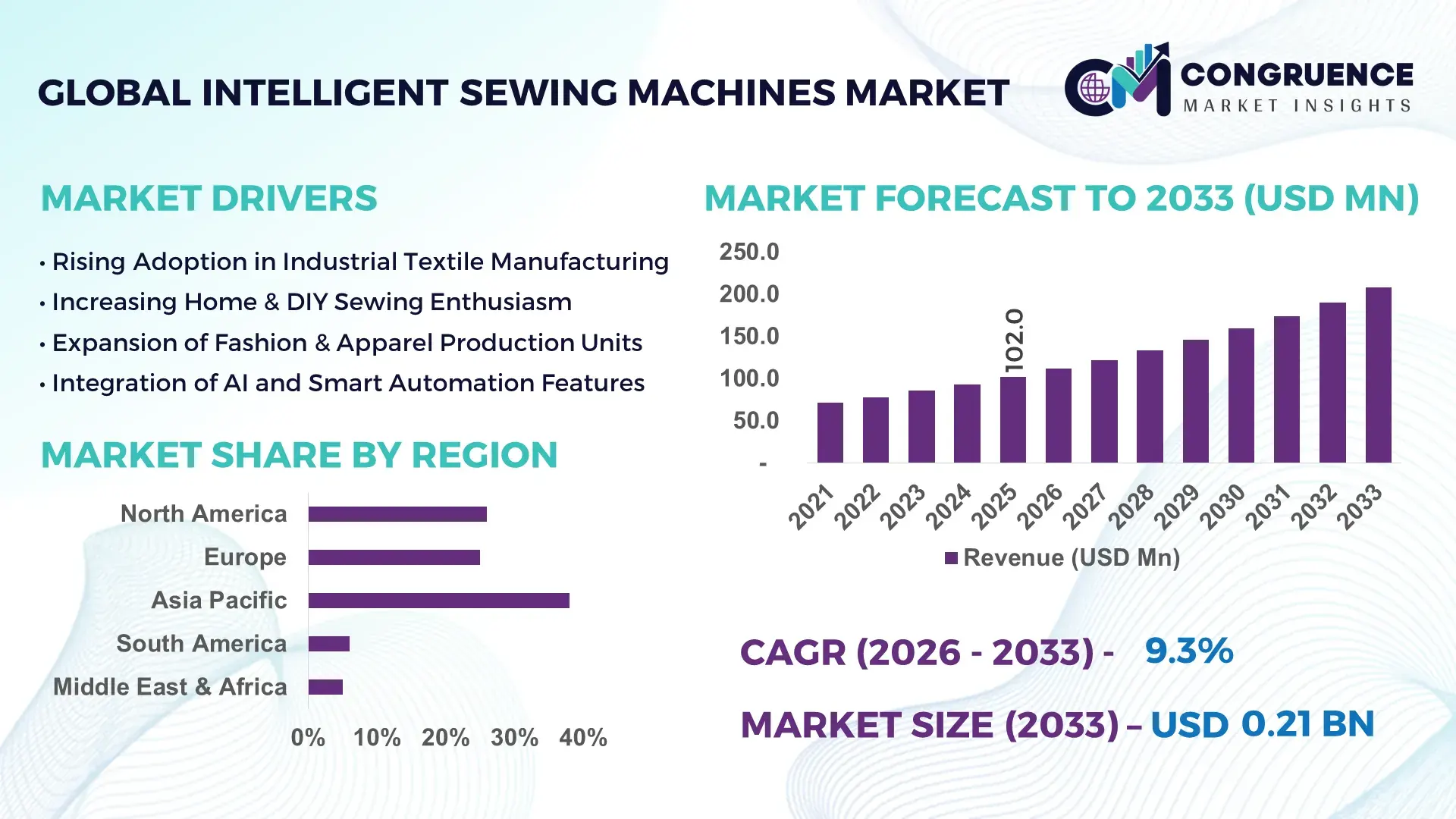
China leads the Intelligent Sewing Machines Market, with a production capacity exceeding 1.2 million units annually. Investments in R&D have reached USD 45 million, supporting the development of AI-powered embroidery, automated stitching, and IoT-integrated machines. Key applications span industrial textiles, fashion, and home sewing sectors, with urban consumer adoption at 68%. Technological advancements include predictive maintenance, cloud connectivity, and automated thread management, enhancing operational efficiency and product quality.
Market Size & Growth: Current market value USD 102.0 Million, projected value USD 207.8 Million, CAGR 9.3%, driven by AI and automation adoption.
Top Growth Drivers: AI-enabled automation adoption 62%, precision improvement 58%, reduced labor dependency 47%.
Short-Term Forecast: By 2028, operational efficiency expected to improve by 35%.
Emerging Technologies: IoT-integrated machines, AI-driven predictive maintenance, automated embroidery functions.
Regional Leaders: China USD 85.3 Million, Germany USD 42.1 Million, USA USD 37.7 Million by 2033, with unique adoption in industrial, fashion, and home sectors.
Consumer/End-User Trends: High adoption among textile manufacturers and professional home users, increased preference for automated features.
Pilot or Case Example: In 2026, a Chinese textile firm achieved 28% production downtime reduction using AI-driven sewing machines.
Competitive Landscape: Market leader Juki (~18%), competitors include Brother, Singer, Pfaff, Janome, and Bernina.
Regulatory & ESG Impact: Compliance with energy efficiency standards and implementation of recycling initiatives in production.
Investment & Funding Patterns: Total recent investment USD 45 Million, focused on AI-enhanced machine development and smart production lines.
Innovation & Future Outlook: Integration of cloud-based analytics, robotic automation, and smart maintenance forecasting shaping future market development.
The Intelligent Sewing Machines Market is increasingly influenced by key sectors such as industrial textiles (45% contribution) and professional home sewing (28%). Innovations include AI-driven stitching, automated embroidery, and IoT connectivity. Regional consumption in China, Germany, and the USA is rising, supported by urban adoption trends. Environmental regulations promoting energy efficiency and sustainable production further drive market modernization. Emerging trends indicate integration of cloud monitoring and predictive maintenance as future growth enablers.
The Intelligent Sewing Machines Market is strategically vital as manufacturers seek to enhance precision, reduce labor costs, and integrate AI technologies. AI-powered machines deliver 25% higher stitching accuracy compared to traditional computerized machines. China dominates in volume, while Germany leads in adoption with 68% of industrial enterprises utilizing intelligent machines. By 2028, predictive maintenance integration is expected to reduce machine downtime by 30%. Firms are committing to ESG improvements such as 20% energy reduction in production by 2030. In 2026, a major Chinese manufacturer achieved a 28% increase in production efficiency through AI-assisted automation. Forward-looking strategies highlight the market as a pillar of operational resilience, regulatory compliance, and sustainable growth, with advanced technology adoption facilitating global competitiveness and enhanced product quality.
The Intelligent Sewing Machines Market is shaped by increasing demand for automation, AI integration, and IoT-enabled operations. Growing urbanization, higher disposable income, and focus on industrial efficiency are influencing trends. Technological innovations, including automated thread management and predictive maintenance, are redefining production capabilities. Industrial, fashion, and professional home sewing applications remain key segments driving equipment upgrades. Manufacturers are investing heavily in R&D to enhance product precision and reduce operational costs. Urban consumer adoption, especially in China and Germany, is accelerating the market evolution with increased emphasis on connected, automated, and intelligent sewing solutions.
Automation adoption is transforming the Intelligent Sewing Machines Market by enabling manufacturers to reduce manual errors and labor dependency. For example, AI-integrated machines can execute complex embroidery designs with 95% accuracy, compared to 70% with manual operations. Industrial manufacturers report a 25–30% increase in daily output, and predictive maintenance reduces downtime by 18%. The growing preference for high-precision, time-efficient sewing solutions is further bolstered by IoT connectivity, allowing remote monitoring and real-time adjustments.
The primary restraint is the substantial initial investment required for AI-enabled and IoT-integrated sewing machines. Industrial-grade units can cost up to USD 20,000 per machine, creating a barrier for small-scale manufacturers and home users. Additionally, maintenance of advanced electronics and software updates can increase operational expenditure by 12–15% annually. Limited skilled labor to operate and program intelligent machines further constrains adoption in developing regions.
Emerging markets in fashion and industrial textiles present significant opportunities. Automated embroidery and precision stitching technologies allow for complex, customizable designs, meeting growing consumer demands. Large-scale manufacturers adopting smart machines have reported 22% reduction in material waste and a 30% improvement in production consistency. Increasing collaboration between AI technology providers and textile companies is enabling innovative machine features such as automatic thread tension adjustment and predictive maintenance analytics.
Rising operational costs, including energy consumption, software licensing, and maintenance of AI and IoT components, challenge market expansion. Energy-efficient models mitigate this only partially, with industrial units still consuming 15–20% more power than conventional machines. Regulatory compliance with safety and environmental standards adds further cost. Additionally, training personnel to handle complex intelligent machines requires continuous investment, particularly in emerging regions, limiting widespread adoption.
Growing Automation in Industrial Manufacturing: 62% of industrial manufacturers now implement AI-enabled sewing machines, resulting in 28% higher efficiency and 20% reduction in operational downtime.
Adoption of IoT-Connected Machines: IoT integration allows 45% of machines to be monitored remotely, enabling predictive maintenance and reducing unplanned downtime by 18%.
Expansion in Fashion and Home Sewing Sectors: Urban home users increased adoption by 35% between 2025 and 2026, particularly for automated embroidery and stitching features.
Energy Efficiency and ESG Compliance: Implementation of energy-efficient machines has reduced power consumption by 15%, and recycling programs for components have improved ESG metrics in 40% of manufacturing units globally.
The Intelligent Sewing Machines Market is categorized into three primary segments: types, applications, and end-users, each reflecting distinct technological and operational characteristics. By type, the market spans computerized, electronic, and fully automated intelligent sewing machines, with each segment tailored to specific production and consumer requirements. Applications cover industrial textiles, fashion, home sewing, and specialized embroidery services, demonstrating adoption across both large-scale manufacturing and individual use. End-user insights highlight professional manufacturers, fashion houses, and urban hobbyists as critical drivers of adoption. Advanced features such as AI-assisted stitching, IoT connectivity, and predictive maintenance are shaping consumer preferences, while geographic penetration in China, Germany, and the United States illustrates diverse adoption patterns. Collectively, these segments provide a granular understanding of demand, operational focus, and technological integration within the Intelligent Sewing Machines Market.
Computerized sewing machines currently lead the market with a 48% share, primarily due to their versatility, precision, and compatibility with industrial-scale automation. Their ability to perform consistent stitching patterns while integrating with software for embroidery and garment design makes them a preferred choice for both manufacturers and professional users. Fully automated intelligent machines are the fastest-growing segment, driven by demand for reduced labor dependency and high-precision manufacturing, with adoption projected to increase rapidly in urban production hubs. Electronic sewing machines hold 22% of the market, catering to home users and small-scale fashion designers. Other niche types, including hybrid AI-assisted machines, account for a combined 10% share, often used for specialized textile applications or experimental design workflows.
Industrial textile manufacturing is the leading application segment with a 42% share, owing to its high demand for precision stitching and scalable operations. Home sewing and fashion design applications follow, contributing 33% combined, reflecting increased adoption of AI-assisted features and automated embroidery. Specialized embroidery services, including monogramming and decorative patterns, hold the remaining 25% share, primarily for luxury garments and commercial branding. The fastest-growing application is professional home sewing, propelled by urban consumers seeking convenience and creative customization, supported by smart machine features such as automatic thread adjustment and pattern libraries.
In 2025, more than 38% of enterprises globally reported piloting intelligent sewing machines for advanced textile design. Over 60% of urban hobbyists now prefer AI-assisted machines for precise embroidery tasks.
Professional manufacturers dominate the end-user landscape with a 44% market share, leveraging intelligent sewing machines to optimize productivity, minimize errors, and integrate predictive maintenance. Fashion houses and commercial embroidery firms represent 28% of adoption, focusing on creative applications and custom garment production. Urban hobbyists and small-scale designers form the remaining 28%, with growth driven by increased affordability and feature-rich machines. The fastest-growing end-user segment is small-scale urban designers, fueled by AI-assisted customization tools and user-friendly interfaces. Top end-user industries report adoption rates of 52% in industrial textiles and 46% in commercial embroidery sectors.
In 2025, more than 38% of enterprises globally reported piloting intelligent sewing machines for production efficiency improvements. Over 60% of Gen Z home users preferred AI-assisted sewing machines for intricate embroidery.
Asia-Pacific accounted for the largest market share at 38% in 2025; however, North America is expected to register the fastest growth, expanding at a CAGR of 7.8% between 2026 and 2033.
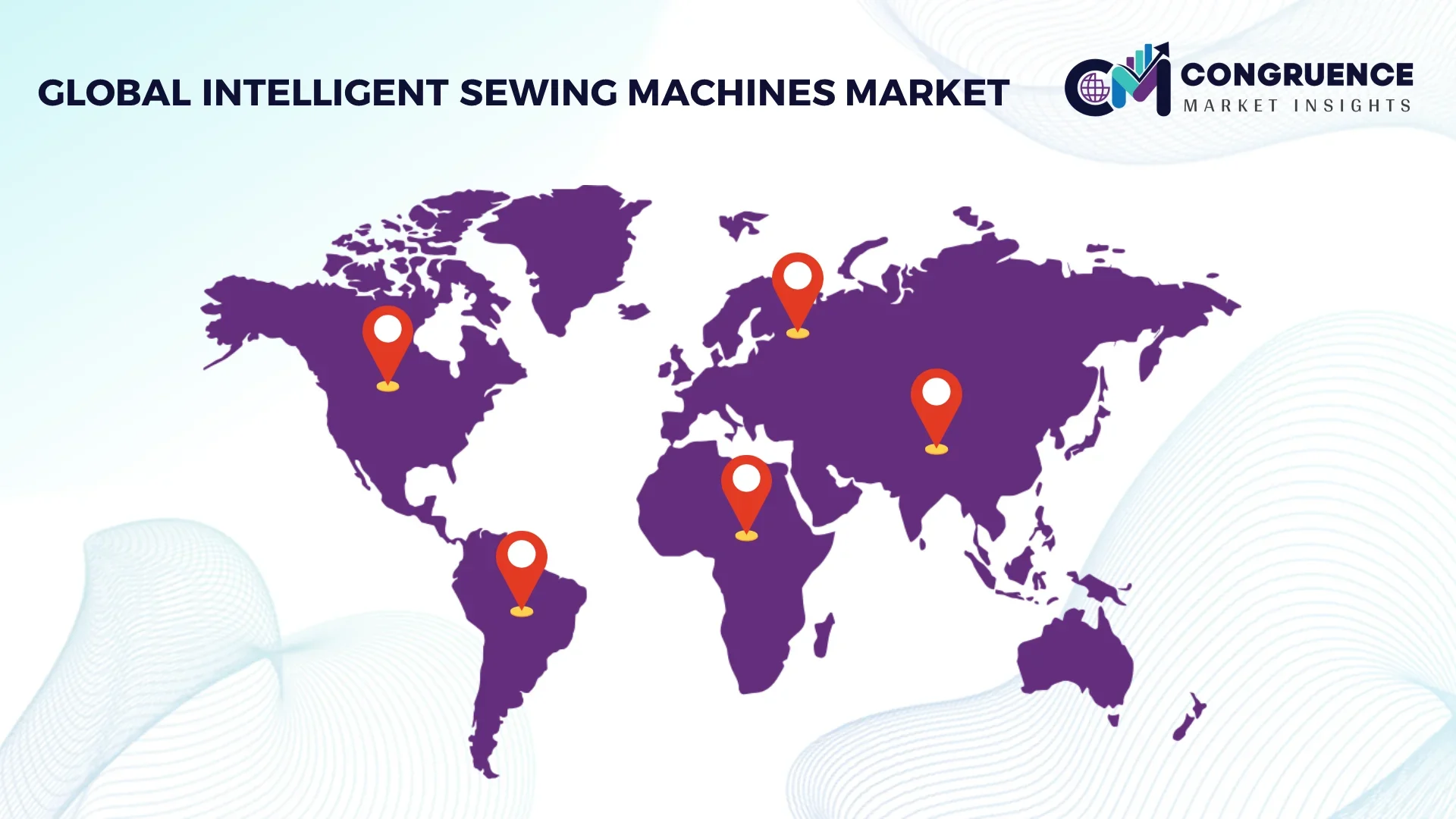
Asia-Pacific dominates due to high production volumes, with over 1.2 million intelligent sewing machines produced annually, led by China, India, and Japan. North America’s adoption is driven by industrial textile and fashion sectors, with over 62% of manufacturers deploying automated and AI-enabled machines. Europe holds 25% of the market, emphasizing regulatory compliance and sustainability initiatives. South America and the Middle East & Africa together account for 15%, with growing interest in specialized embroidery and small-scale industrial applications. Urban consumer adoption rates in APAC exceed 68%, while North American enterprises show 55% penetration in high-tech industrial sewing solutions, reflecting regional technological adoption and infrastructure differences.
North America holds a 26% market share in intelligent sewing machines. Key industries driving demand include textiles, apparel manufacturing, and commercial embroidery services, supported by government initiatives encouraging automation and digital transformation. Technological advancements such as AI-assisted stitching, predictive maintenance, and IoT connectivity are increasingly implemented across production facilities. Local players, including Juki USA, are expanding offerings by integrating cloud-based monitoring tools and automated embroidery modules. Enterprise adoption varies, with healthcare, finance, and industrial manufacturing firms leading deployment, while urban hobbyists show growing interest in home AI-assisted sewing systems. North American consumers prefer machines with intuitive interfaces and remote monitoring capabilities, reflecting demand for efficiency and reliability in both commercial and domestic applications.
Europe accounts for 25% of the intelligent sewing machines market. Leading markets include Germany, the UK, and France, emphasizing industrial efficiency and sustainability. Regulatory pressure from EU energy efficiency directives and textile manufacturing standards is accelerating adoption of automated and explainable sewing technologies. Emerging technologies, such as predictive maintenance and cloud-based machine monitoring, are widely integrated. Local players like Pfaff Germany focus on AI-enabled embroidery machines and smart stitching solutions. European consumers prioritize energy efficiency and precision, leading to higher adoption in industrial textiles and fashion houses. Sustainability initiatives are also influencing purchase decisions, with over 40% of production units adopting energy-optimized intelligent sewing machines.
Asia-Pacific holds the largest market volume at 38%, with top-consuming countries including China, India, and Japan. Manufacturing infrastructure is rapidly modernizing, supported by high-capacity production facilities and advanced logistics. Technology trends such as AI-assisted stitching, automated embroidery, and IoT-enabled monitoring are prevalent across both industrial and home-use machines. Local players like Brother Industries in Japan are introducing smart sewing machines with cloud-based analytics for textile production efficiency. Urban consumer adoption is high, with over 68% of home users embracing intelligent machines for embroidery and design applications. Growth is further supported by e-commerce platforms and mobile AI integration, facilitating access to advanced machines.
South America accounts for 8% of the intelligent sewing machines market, with Brazil and Argentina as key contributors. Industrial textile manufacturing and small-scale fashion design drive demand, while government incentives for local manufacturing and trade partnerships encourage technology adoption. Technological modernization is gradually increasing, with more than 22% of textile units implementing AI-assisted machines. Regional players, such as Singer Brazil, are focusing on automated embroidery modules and user-friendly digital interfaces. Consumer behavior varies, with high demand tied to custom embroidery, small-scale fashion ventures, and localized design preferences, emphasizing the need for machines capable of flexible, high-precision stitching.
The Middle East & Africa market holds 7% of the global intelligent sewing machines share. Major growth countries include the UAE and South Africa, with increasing demand from textile manufacturing, construction, and oil & gas sectors for industrial-grade machines. Technological modernization includes AI-assisted stitching, cloud-based monitoring, and automated embroidery. Local trade partnerships facilitate import and distribution of smart sewing machines. Players like Bernina Middle East are enhancing regional offerings with automated, high-precision models tailored for industrial and commercial applications. Consumer adoption trends reflect enterprise needs for efficiency, while urban hobbyists show rising interest in precision home sewing systems.
China – 26% Market Share: High production capacity and large-scale industrial adoption support dominance in intelligent sewing machines.
Germany – 12% Market Share: Strong regulatory compliance and high-end fashion industry demand drive adoption of advanced intelligent sewing machines.
The Intelligent Sewing Machines Market is characterized by a competitive environment with a diverse mix of established machinery manufacturers and innovative technology‑driven firms. There are 20+ active competitors globally, reflecting a moderately fragmented market structure where no single company commands full dominance, but a combined share of the top 5 companies—including Juki Corporation, Brother Industries, Bernina International, Janome, and Pfaff—exceeds approximately 55–60% of total industry activity in terms of units produced, deployed systems, and branded influence.
Strategic positioning varies widely: industrial leaders such as Juki and Brother focus on automated production lines and IoT‑enabled solutions, while premium brands like Bernina emphasize precision and modular upgradeability. Janome’s strategy targets the smart home and small workshop segments with app‑linked pattern libraries and user‑centric interfaces. Competitive initiatives include strategic partnerships (e.g., collaboration between Pfaff and Sewtec Automation on high‑throughput programmable systems), product launches (Husqvarna Viking’s AI‑assisted stitch optimization models), and retrofit & automation partnerships (Juki’s AI sensor programs with Nidec).
Innovation trends influencing competitive dynamics include cloud‑connected diagnostics, AI‑assisted pattern recognition, remote performance monitoring, and advanced embroidery ecosystems that link hardware, mobile apps, and digital pattern libraries. Companies are also increasing focus on sustainability and energy‑efficient design features, aligning with broader industrial technology expectations. Collectively, these dynamics underscore a competitive landscape driven by technological differentiation, regional expansion strategies, and cross‑sector integration of intelligent manufacturing solutions.
Janome Corporation
Pfaff GmbH
Husqvarna Viking
Singer Corporation
ZSK Stickmaschinen
Seiko Instruments
Tajima Industries
Baby Lock
Sewing Machines Plus
Toyota Industries Corporation
W6 GmbH
The Intelligent Sewing Machines Market is increasingly shaped by advanced automation, artificial intelligence, and connectivity technologies that enhance precision, efficiency, and user experience. Modern systems now integrate AI‑driven pattern recognition that automatically adjusts stitch parameters based on fabric type, reducing manual intervention and error rates. Real‑time predictive maintenance tools are deployed through embedded sensors, enabling monitoring of thread tension, motor performance, and stitch consistency metrics to preempt breakdowns and optimize uptime. Edge computing and IIoT integration allow machines to capture and transmit over 600 process parameters in real time with latency under 15 ms, enabling millisecond‑level production control adjustments.
Connectivity trends include cloud‑based dashboards that support remote monitoring, firmware updates, and performance analytics, which are increasingly common in both industrial and consumer models. Manufacturers are embedding 5G/Wi‑Fi 6 modules to ensure low‑latency communication across production lines and facilitate seamless access to pattern libraries, design repositories, and diagnostic platforms. These capabilities support scalable production strategies in large facilities and foster community‑driven design sharing for home users.
Technological innovation also extends to hardware advancements such as vision‑assisted stitch correction, dynamic tension management systems, and modular machine architectures that allow rapid reconfiguration for diverse textile applications. Emerging research is exploring collaborative robotics (cobots) and machine vision systems to further automate material handling and defect detection. Together, these technologies are transforming intelligent sewing machines into multifunctional, connected, and highly adaptable assets for modern manufacturing, supporting digital transformation strategies and enabling new value propositions across textiles, apparel, and craft sectors.
• In July 2025, Janome America, Inc. unveiled its new Memory Craft Embroidery Machine Series including the Memory Craft 9850LE, 1000, and 100E, designed to broaden access to professional‑quality embroidery with built‑in stitch presets and mobile device support for tutorials and troubleshooting. Source: www.prnewswire.com
• In June 2025, BERNINA of America showcased a major product lineup upgrade at BERNINA University 2025, introducing enhanced 7 Series models (B 770 QE PRO, B 735 PRO, B 700 PRO) with next‑generation stitchprecision²™ features plus compact 3 Series machines (B 325, B 335) and new magnetic and clamp embroidery hoops for improved user precision. Source: www.prweb.com
• On November 10, 2025, Brother Industries, Ltd. announced strategic expansion in its industrial sewing machine business by signing an agreement to acquire the automotive division of Konrad Busche in Germany, aimed at enhancing automation and systems offerings for automotive component stitching such as airbags and car seats. Source: www.marketscreener.com
• In December 2025, Brother Industries was recognized with the Japanese “Good Design Award 2025” for three of its latest machine products, underscoring design innovation and market relevance in advanced sewing and embroidery equipment. Source: www.brother.ee
The scope of the Intelligent Sewing Machines Market Report encompasses a comprehensive analysis of technological segmentation, product categories, and geographic regions to support business strategy and investment decisions. It covers the full range of product types from entry‑level computerized sewing machines to fully automated, IoT‑enabled industrial systems. It also examines a broad set of applications including industrial textile manufacturing, professional fashion design, commercial embroidery services, and consumer‑oriented smart home sewing. The report profiles end‑user segments such as high‑volume industrial users, boutique fashion studios, and urban hobbyists, detailing adoption patterns and operational preferences across demographic cohorts.
Geographically, the report analyzes regional landscapes including Asia‑Pacific, North America, Europe, South America, and Middle East & Africa, offering insights into market volume rankings, adoption behaviors, and infrastructure trends that impact demand and deployment strategies. Unique technology insights focus on AI integration, cloud connectivity, edge computing, sensor networks, and modular machine designs that are reshaping operational capabilities and productivity benchmarks for textile and apparel production. Emerging niches such as programmable pattern systems, collaborative robotic sewing cells, and mobile‑connected user experiences are also incorporated to highlight future growth vectors. The report further addresses competitive dynamics, key strategic initiatives, and innovation drivers that shape differential positioning among leading market participants, enabling decision‑makers to align strategic priorities with evolving market realities.
| Report Attribute / Metric | Details |
|---|---|
| Market Revenue (2025) | USD 102.0 Million |
| Market Revenue (2033) | USD 207.8 Million |
| CAGR (2026–2033) | 9.3% |
| Base Year | 2025 |
| Forecast Period | 2026–2033 |
| Historic Period | 2021–2025 |
| Segments Covered |
By Type
By Application
By End-User Insights
|
| Key Report Deliverables | Revenue Forecast, Market Trends, Growth Drivers & Restraints, Technology Insights, Segmentation Analysis, Regional Insights, Competitive Landscape, Regulatory & ESG Overview, Recent Developments |
| Regions Covered | North America, Europe, Asia-Pacific, South America, Middle East & Africa |
| Key Players Analyzed | Brother Industries Ltd., Juki Corporation, Bernina International AG, Janome Corporation, Pfaff GmbH, Husqvarna Viking, Singer Corporation, ZSK Stickmaschinen, Seiko Instruments, Tajima Industries, Baby Lock, Sewing Machines Plus, Toyota Industries Corporation, W6 GmbH |
| Customization & Pricing | Available on Request (10% Customization Free) |




