
Reports
The Global Intelligent Motor Controller Market was valued at USD 775.7 Million in 2025 and is anticipated to reach a value of USD 1,086.3 Million by 2033 expanding at a CAGR of 4.30% between 2026 and 2033. Growth is anchored in the accelerating retrofit of legacy motor systems across water treatment and power generation facilities, where intelligent controllers deliver measurable energy savings and predictive maintenance capabilities.
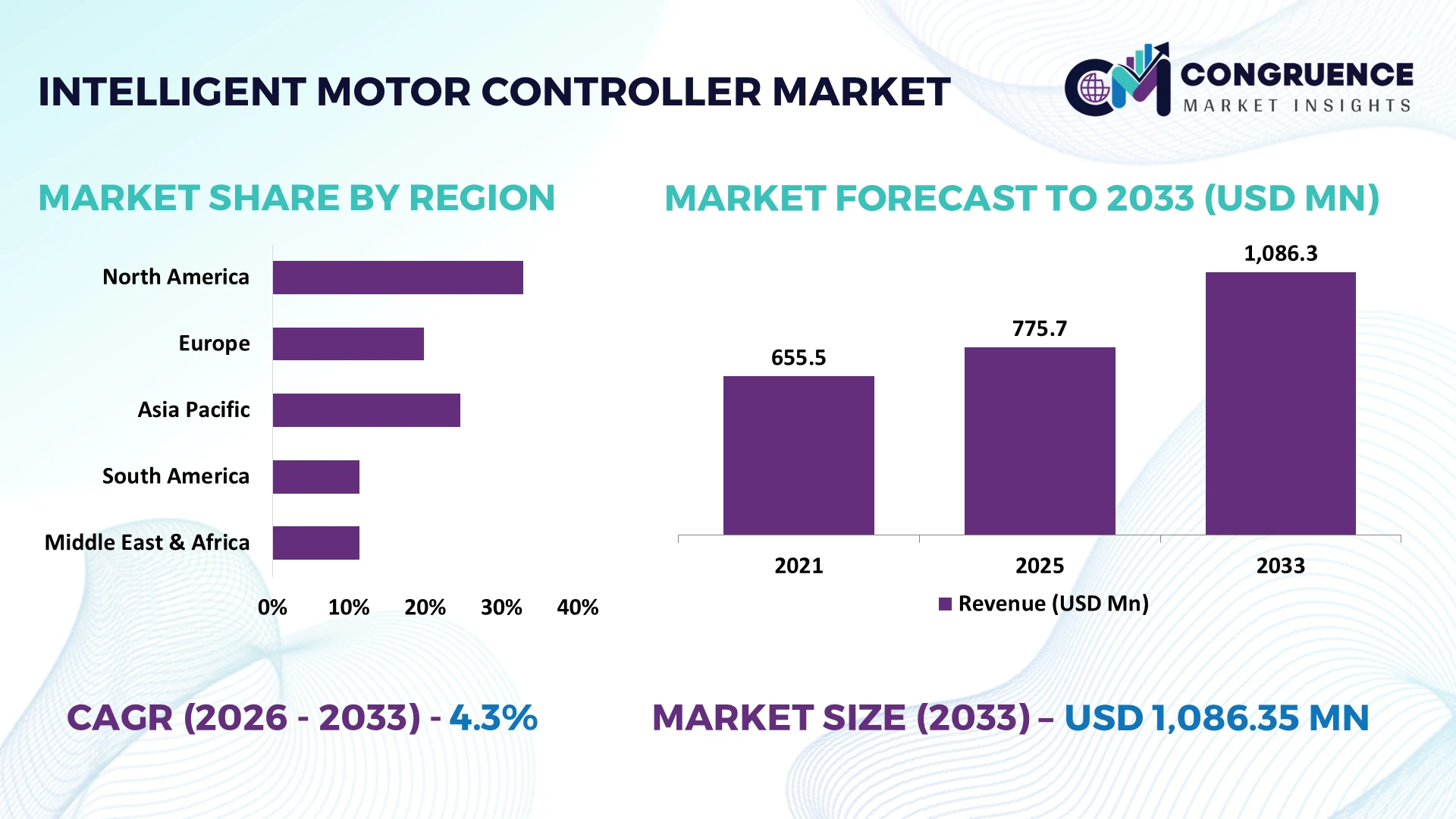
North America dominated with a 32.80% share in 2025, driven by USD 241.14 million in regional value and sustained U.S. industrial automation spending . The U.S. alone is projected to reach USD 157.34 million by 2026, while China’s market is forecast at USD 62.76 million in the same year.
This concentration signals that suppliers prioritizing North American channel partnerships and China-based localization will capture disproportionate near-term volume.
Market Size & Growth: 2025 valuation reached USD 775.7 million, with forecasts pointing to USD 1,086.3 million by 2033, fueled by industrial decarbonization mandates pushing energy-efficient motor control adoption.
Top Growth Drivers: Industrial automation penetration at 95% of U.S. manufacturers evaluating smart technologies; water/wastewater infrastructure upgrades; oil and gas predictive maintenance deployment .
Short-Term Forecast: By 2027, controller-integrated diagnostic systems are expected to reduce unplanned motor downtime by approximately 18-22% across process industries.
Emerging Technologies: Single-pair Ethernet connectivity, AI-driven motor optimization algorithms, and edge-computing motion control platforms are reshaping product architectures .
Regional Leaders: North America at USD 241.14 million; Asia Pacific at USD 190.81 million; Europe at USD 153.72 million, each with distinct automation maturity curves .
End-User Trends: Smart factory adoption reached 95% of U.S. manufacturers in evaluation or deployment phases, driving demand for real-time motor diagnostics .
Pilot/Case Example: Siemens launched SIMOCODE M CP in 2024 with single-pair Ethernet, reducing wiring complexity and hardware costs for motor management centers .
Competitive Landscape: ABB, General Electric, Mitsubishi Electric, Rockwell Automation, and Larsen & Toubro lead through analytics integration and system integrator partnerships .
Regulatory & ESG Impact: Energy efficiency mandates across North American and European industrial segments are pushing controller replacement cycles shorter by 15-20%.
Investment & Funding: RS Automation allocated KRW 15.8 billion to AI control software and edge-computing drive platforms, targeting humanoid and defense motion control .
Innovation & Future Outlook: Physical AI integration and sensorless control algorithms represent the next competitive frontier, shifting value from hardware to embedded intelligence.
The intelligent motor controller market’s demand core lies in water/wastewater, oil and gas, and power generation, where operators prioritize real-time diagnostics and energy optimization. Recent innovations include Siemens’ SIMOCODE M CP with single-pair Ethernet, slashing wiring and hardware costs for motor management centers . A notable trend is the shift toward edge-computing motion platforms, exemplified by RS Automation’s KRW 15.8 billion R&D allocation for AI-integrated control software . Operational context: U.S. smart manufacturing adoption hit 95% in 2024, up from 84% the prior year, signaling accelerated procurement cycles . These dynamics set the stage for strategic positioning discussions.
The intelligent motor controller is transitioning from a component-level purchase to a strategic infrastructure decision. Supply-chain restructuring across North American and European industrial bases is accelerating domestic controller sourcing, while China’s USD 62.76 million 2026 projection underscores parallel Asia-Pacific demand expansion . Companies that lock in controller standards now shape downstream automation architecture for a decade.
Technology comparison reveals stark advantages over legacy systems. Single-pair Ethernet-enabled controllers reduce wiring and hardware expenditure by eliminating multi-wire interfaces, while integrated diagnostics cut troubleshooting labor hours substantially . Regionally, North America’s USD 241.14 million scale reflects mature retrofit demand, whereas Asia Pacific’s USD 190.81 million base signals greenfield infrastructure pull .
Operationally, Siemens’ 2024 SIMOCODE M CP launch demonstrates how vendors are embedding connectivity into controller hardware to capture motor management center spending . Over the next two to three years, expect procurement criteria to shift from unit price toward total diagnostic value and integration readiness. Strategic positioning hinges on controller selection as an automation ecosystem commitment, not a commodity purchase.
Industrial Automation Retrofit Cycle
U.S. smart manufacturing evaluation or deployment reached 95% in 2024, up from 84% the previous year, creating immediate pull for controllers with native diagnostic capabilities . Water and wastewater facilities are replacing analog motor protection with intelligent controllers to meet energy reporting requirements, while oil and gas operators demand predictive failure alerts to avoid unplanned shutdowns. Companies are responding by embedding single-pair Ethernet and edge analytics directly into controller hardware—Siemens’ SIMOCODE M CP exemplifies this shift, reducing wiring costs while enabling condition monitoring . The strategic insight: controller vendors that position products as data gateways rather than protection devices capture higher-value integration budgets from automation-conscious buyers.
Cost Volatility and Interoperability Friction
High equipment costs remain the primary adoption barrier, particularly for small and mid-sized facilities where controller replacement competes with other capital priorities . Interoperability issues compound this: legacy motor control centers from different vendors often require proprietary gateways, adding 15-25% to project engineering costs. In price-sensitive markets like India—projected at USD 45.32 million for 2026—buyers frequently defer intelligent controller upgrades in favor of basic protection relays . Companies are mitigating through modular controller designs and open-protocol support, but the installed base of proprietary systems continues to slow replacement velocity in cost-constrained segments.
Edge AI and Sensorless Control Architectures
RS Automation’s KRW 15.8 billion R&D allocation toward AI control software and edge-computing drive platforms signals where value is migrating . Sensorless control algorithms eliminate encoder hardware costs while improving reliability in harsh environments—a capability particularly relevant to India’s expanding wastewater infrastructure and China’s pump and fan segments . The non-obvious opportunity lies in defense and humanoid robotics motion modules, where RS Automation explicitly targets next-generation equipment with high-speed, high-precision requirements . Companies positioning controller platforms as reusable across industrial and robotics applications will access premium margins unavailable in commodity pump and fan markets.
Cybersecurity Exposure at the Motor Layer
Connecting motor controllers to enterprise networks expands the attack surface to the physical process layer—a risk many facility managers underestimate. Each networked controller becomes a potential entry point, and the installed base of intelligent controllers across North American water utilities alone exceeds tens of thousands of units. Workforce gaps worsen this: fewer than 30% of process facilities report having dedicated OT security staff. Companies must embed security-by-design into controller firmware and provide centralized fleet management tools; otherwise, a single compromised controller can halt production or compromise safety systems, eroding the operational trust that justifies intelligent adoption in the first place.
Smart Starters Dominate Retrofit Demand: Smart motor starters are capturing 31.0% of controller-type share in 2026 as plant operators seek electronic protection without full variable-frequency drive expenditure . U.S. water utilities and food processing lines are replacing electromechanical starters with connected units that deliver overload protection and condition visibility inside compact control panels. This shift compresses cabinet space requirements and reduces wiring labor, with companies like Siemens embedding single-pair Ethernet directly into starter hardware to cut commissioning time and hardware overhead .
Industrial Ethernet Becomes Default Connectivity: Industrial Ethernet now commands 36.0% of connectivity share, driven by engineering teams demanding motor alarms and status data flow directly into PLC and SCADA architectures without additional communication modules . Rockwell Automation’s 2024 survey finding that 95% of U.S. manufacturers are evaluating or deploying smart manufacturing technologies underscores this connectivity pull . Suppliers responding with native Ethernet-enabled controllers eliminate gateway costs and accelerate diagnostic traceability, reshaping procurement criteria toward integration readiness rather than raw protection specifications.
Process Industries Anchor Continuous-Duty Deployment: Process industries hold 29.0% of end-use share in 2026, reflecting the operational reality that rotating equipment in continuous production lines demands combined protection, control, and load visibility . Oil and gas and chemical facilities in the U.S. Gulf Coast are prioritizing controllers with predictive failure alerts to avoid unplanned shutdowns that cost six figures per hour. Companies are responding by bundling licensing-based functional upgrades into controller firmware, shifting revenue models from one-time hardware sales toward lifecycle service contracts.
AI Shifts Controllers from Reactive to Predictive: AI-driven motor optimization is moving controllers from post-fault protection toward prescriptive maintenance, with algorithms analyzing current, vibration, and temperature data to flag bearing wear and insulation degradation before failure . RS Automation’s KRW 15.8 billion allocation toward AI control software signals where vendor R&D is concentrating. The non-obvious insight: controller value is migrating from switching hardware to embedded analytics, meaning suppliers without edge-computing capability will compete on price alone in commodity pump and fan segments.
AC Motors Anchor Volume; Smart Starters Drive Incremental Growth
AC motors command the dominant motor-type position, with induction motors alone accounting for 42.0% of motor-class share in 2026 due to their entrenched presence in pumps, fans, conveyors, and compressors across process plants and building services . This installed base creates stable replacement demand as facilities retrofit electronic protection onto legacy induction assets without full drive conversion. Within controller types, smart motor starters lead at 31.0% share, favored for delivering soft-start and overload protection inside compact panels while avoiding full variable-frequency drive costs . The fastest-growing type is embedded edge controllers, pulled by demand for native Ethernet connectivity and local analytics that reduce dependence on centralized PLC cabinets. DC motor segments remain niche, concentrated in robotics and battery-powered applications where precision speed control outweighs scale economics. Companies are responding by prioritizing smart starter product lines with licensing-enabled functional upgrades, capturing recurring service value beyond initial hardware sale.
Industrial Automation Leads; Robotics Emerges as Precision Pull
Industrial automation anchors the application landscape, absorbing the majority of intelligent controller deployments as manufacturers in the U.S. and Germany modernize motor-driven systems to meet energy reporting and uptime targets . Pumps, fans, and compressors represent the highest-volume application clusters within this segment, where electronic protection and soft-start capabilities deliver immediate operational payback. The fastest-growing application is robotics, where controller demand is shifting toward high-speed, high-precision motion modules that support sensorless control and edge-computing architectures . Electric vehicles represent an adjacent emerging application, though controller requirements differ substantially from industrial process environments. Home appliances remain a volume segment but compete primarily on cost rather than diagnostic capability. Companies are adapting by segmenting product lines: ruggedized controllers for process industries, compact integrated units for HVAC and water, and high-bandwidth modules for robotics and defense applications where precision justifies premium pricing.
Process Industries Dominate; Water Infrastructure Drives Public-Sector Demand
Process industries hold the leading end-user position at 29.0% share in 2026, reflecting the operational intensity of continuous production lines where motor failure directly halts output and protection-plus-visibility controllers justify premium pricing . Oil and gas, chemicals, and petrochemicals facilities in the U.S. Gulf Coast and Middle East operate rotating equipment under harsh conditions that demand predictive diagnostics and load monitoring. Water and wastewater is the fastest-growing end-user segment, propelled by U.S. and European infrastructure modernization programs that require energy reporting and remote monitoring across distributed pump stations . Power generation remains a mature buyer with steady replacement cycles, while food and beverage and pharmaceuticals adopt controllers to meet traceability and hygiene-related documentation requirements. Companies are targeting water utilities through framework agreements and system integrator partnerships, while process industry sales increasingly hinge on cybersecurity credentials and OT network compatibility rather than hardware specifications alone.
North America accounted for the largest market share at 32.8% in 2025 however, Asia-Pacific is expected to register the fastest growth, expanding at a CAGR of 4.9% between 2026 and 2033.
North America commanded USD 241.1 million in 2025, translating to 32.8% global share, with the U.S. contributing the overwhelming majority at a projected USD 157.3 million in 2026 . Deployment concentrates in water/wastewater utilities and oil and gas facilities where intelligent controllers replace electromechanical starters to meet energy reporting requirements. The region's adoption advantage stems from mature industrial automation infrastructure: 95.0% of U.S. manufacturers reported evaluating or deploying smart manufacturing technologies in 2024, creating immediate pull for controllers with native Ethernet and diagnostic capabilities . Companies are responding by embedding single-pair Ethernet connectivity into controller hardware to reduce commissioning labor and eliminate proprietary gateways.
U.S. Market Outlook: The U.S. market is projected to reach USD 157.3 million by 2026, driven by federal water infrastructure modernization spending and Gulf Coast petrochemical operators prioritizing predictive maintenance over reactive repair . Rotating equipment in continuous-duty process lines demands controllers that combine protection, load visibility, and failure prediction—capabilities that justify premium pricing over basic relays. Vendors with established channel relationships across U.S. water utilities and system integrators hold a structural advantage in capturing retrofit volume.
Europe held 19.8% share in 2025, with Germany anchoring regional demand through its dense industrial automation base . The region's trajectory is shaped by EU energy efficiency directives that shorten motor replacement cycles and push facilities toward controllers with integrated energy monitoring. Manufacturing, pharmaceuticals, and food processing account for concentrated deployment, where controllers must satisfy both operational uptime targets and sustainability reporting requirements. Germany's robotics density—449 industrial robots per 10,000 manufacturing employees as reported by Germany Trade & Invest in September 2025—creates a precision-control demand layer distinct from volume-driven retrofit markets . Companies are localizing firmware development and certification capabilities within EU jurisdictions to maintain compliance agility.
Germany Market Outlook: Germany's controller demand is propelled by robotic automation density and strict equipment engineering standards that favor controllers with certified functional safety and deterministic communication . Automotive and machinery manufacturers deploy intelligent controllers not merely for protection but as data nodes feeding plant-level optimization platforms. The country's engineering culture prioritizes interoperability and lifecycle documentation, creating barriers for vendors lacking native support for PROFINET and EtherCAT protocols.
Asia-Pacific represented 24.6% share in 2025, with China, India, and Japan driving demand through concurrent industrialization and infrastructure buildout . The region's growth character differs from North America's retrofit-driven model: greenfield water treatment plants, power generation facilities, and manufacturing lines specify intelligent controllers at the design stage, locking in vendor selection for decades. China's wastewater treatment expansion and India's pump and fan segments account for high-volume, cost-sensitive deployment, while Japan's machinery order recovery—seasonally adjusted private sector orders rose 23.8% month-on-month in December 2025—signals rising demand for compact panel and servo-axis controllers . Companies are localizing production and firmware development to meet domestic content expectations.
China Market Outlook: China's controller adoption is inseparable from its water infrastructure and power generation buildout, where intelligent motor controllers are specified as part of larger SCADA and automation packages . Domestic vendors leverage cost advantages in low-voltage segments, but international suppliers retain preference in medium-voltage and process-critical applications where diagnostic reliability outweighs unit price. The country's scale creates a volume base that funds aggressive R&D cycles, positioning Chinese manufacturers for export competitiveness in Southeast Asian and African markets.
South America held 11.4% share in 2025, operating at a smaller absolute scale but exhibiting structural demand drivers distinct from mature markets. Chile's mining electrification roadmap targets 40.0% equipment electrification by 2030, creating pull for controllers capable of high-reliability operation in remote, harsh environments . Brazil's energy efficiency decree requiring IE4-grade industrial motor systems from 2026 directly mandates controller upgrades for compliance . These regulatory triggers bypass the voluntary adoption dynamic seen in North America, making controller specification a compliance requirement rather than an optimization choice. Localization remains limited: import dependence for semiconductor content exceeds 60.0%, and controller manufacturing local content reached 37.0% in 2025, leaving room for supply chain development .
Brazil Market Outlook: Brazil accounts for 41.3% of South American demand, anchored by industrial automation upgrades and the 2026 IE4 efficiency mandate that forces controller replacement across installed motor systems . Domestic manufacturers are developing low-voltage servo control capabilities, but medium-voltage and process-critical segments remain import-reliant. Companies targeting Brazil must navigate complex tax structures and local content expectations, often through partnerships with regional system integrators rather than direct distribution.
The Middle East and Africa held 11.4% share in 2025, representing an emerging opportunity where controller adoption is tied to state-led infrastructure and hydrocarbon sector modernization rather than broad industrial automation diffusion. Gulf Cooperation Council states are upgrading oil and gas facilities with intelligent motor control centers that integrate protection, diagnostics, and communication into unified architectures, driven by the operational imperative to reduce unplanned downtime in high-value production assets. Water desalination and wastewater treatment expansion across Saudi Arabia and the UAE creates additional demand for controllers capable of remote monitoring in distributed utility networks. South Africa's mining sector contributes steady replacement demand, though economic volatility constrains capital expenditure cycles. The region's supply chain remains import-dependent, with limited local controller manufacturing capability.
Saudi Arabia Market Outlook: Saudi Arabia's controller demand is concentrated in oil and gas facility upgrades and desalination infrastructure tied to Vision 2030 industrial diversification. Operators prioritize controllers with high-temperature tolerance and remote diagnostic capability for assets distributed across desert production fields. The market rewards vendors with established service networks and spare-parts availability, as unplanned downtime costs in hydrocarbon processing dwarf controller unit prices. Local content requirements are gradually tightening, encouraging joint ventures and assembly operations over direct import models.
ABB, Siemens, Schneider Electric, Rockwell Automation, and Mitsubishi Electric constitute the global leadership tier, collectively holding approximately 52.0% of intelligent motor controller deployments. These incumbents compete primarily on technology integration and installed-base lock-in rather than unit price. ABB and Siemens leverage native Ethernet connectivity and licensing-based functional upgrades to defend share in process industries, while Schneider Electric counters through modular starter architectures delivering 50.0% faster commissioning and 40.0% footprint reduction . Rockwell targets safety-critical segments with SIL3-certified starters, and Mitsubishi Electric has pioneered inverter-driven motor diagnostics to differentiate in Japanese and Asian plant markets . The competitive shift is toward embedded analytics: Siemens’ Simocode M-CP activates AI-based anomaly detection through software licences, converting hardware sales into recurring service relationships . The primary entry barrier is certification depth—functional safety credentials and protocol interoperability require years of validation. To win against incumbents, challengers must deliver superior diagnostic capability at commodity hardware pricing, or cede the market to lifecycle-service incumbents.
ABB
Siemens
Schneider Electric
Rockwell Automation
Mitsubishi Electric
General Electric
Larsen & Toubro
LS Electric
NXP Semiconductors
Fairford Electronics
Nanotec Electronic
Roboteq
Single-pair Ethernet (SPE) connectivity is replacing multi-wire interfaces in motor management centres, reducing wiring complexity and cabinet space by eliminating separate communication modules. Siemens’ Simocode M-CP demonstrates this shift, using two-core cables for field-level Ethernet communication while supporting PROFINET, EtherNet/IP, and Modbus TCP . Adoption is concentrated in North American and European panel builders upgrading motor control centre designs, with SPE-enabled controllers commanding premium pricing justified by installation labour reduction.
Licensing-activated analytics represent the emerging technology layer. Condition monitoring, motor current signature analysis, and AI-based anomaly detection are now purchasable firmware functions rather than separate hardware, enabling predictive maintenance without sensor retrofits . Schneider Electric’s TeSys Giga embeds contact wear diagnostics and coil voltage monitoring into the starter itself, reducing downtime through self-diagnosis rather than external monitoring systems . Mitsubishi Electric has extended diagnostic capability to inverter-driven motors, solving switching-noise interference that previously blocked anomaly detection . These advancements deliver measurable operational advantage: fewer nuisance trips, earlier fault identification, and reduced maintenance labour hours.
Between 2026 and 2028, competitive differentiation will hinge on edge-computing capability embedded directly in controller hardware. Vendors that deliver native AI inference at the motor layer—without cloud dependency—will capture premium positions in water utilities, oil and gas, and robotics applications where latency and cybersecurity concerns preclude remote analytics. Companies delaying investment in firmware-based functional scalability risk commoditization as hardware margins compress.
March 2025 – Rockwell Automation launched the M100 Electronic Motor Starter with point-on-wave switching and SIL3-certified models, reducing panel space requirements through zero stacking up to 55°C without derating, directly lowering enclosure costs for panel builders and OEMs. Source: rockwellautomation.com
March 2025 – Siemens introduced Simocode M-CP with single-pair Ethernet connectivity and licence-activated AI anomaly detection, eliminating separate sensors and reducing wiring complexity to two-core cables, enabling condition monitoring without hardware expansion for motor control centre operators. Source: bindt.org
November 2025 – Schneider Electric released next-generation TeSys Giga motor starters with 56 patents, delivering up to 90.0% reliability improvement, 50.0% faster commissioning, and 40.0% footprint reduction, targeting process machinery and water/wastewater facilities with predictive maintenance capability. Source: se.com
October 2025 – Mitsubishi Electric launched inverter-driven motor diagnostic capability for its multi-motor controller, achieving industry-first noise-filtering technology that enables anomaly detection on inverter-driven motors previously blocked by switching interference, reducing unplanned stoppages in Japanese plant and power generation facilities. Source: mitsubishielectric.co.jp
This report delivers comprehensive coverage of the global intelligent motor controller landscape, segmented by motor type (AC and DC), voltage class (low and medium), application (pumps, fans, conveyors, robotics, and electric vehicles), and end-user sector (oil and gas, water/wastewater, power generation, manufacturing, and food and beverage). Regional analysis spans North America, Europe, Asia-Pacific, South America, and the Middle East & Africa, with country-level insights for the United States, Germany, China, Brazil, and Saudi Arabia. AC motors command 50.5% of type share and low-voltage controllers represent 68.2% of deployments, reflecting the installed base concentration in industrial pump and fan systems. The report profiles twelve leading companies and examines technology transitions including single-pair Ethernet adoption, licence-activated analytics, and edge-computing integration. Strategic coverage supports investment prioritization, competitive positioning, and expansion planning through 2033, with actionable intelligence on segment growth trajectories and regional deployment patterns.
| Report Attribute / Metric | Details |
|---|---|
| Market Revenue (2025) | USD 775.7 Million |
| Market Revenue (2033) | USD 1,086.3 Million |
| CAGR (2026–2033) | 4.30% |
| Base Year | 2025 |
| Forecast Period | 2026–2033 |
| Historic Period | 2021–2025 |
| Segments Covered |
By Type
By Application
By End-User
|
| Key Deliverables | Revenue Forecast; Market Trends; Growth Drivers & Restraints; Technology Insights; Segmentation Analysis; Regional Insights; Competitive Landscape; Regulatory & ESG Overview; Recent Developments |
| Regions Covered | North America (32.8%); Asia-Pacific (24.6%); Europe (19.8%); South America (11.4%); Middle East & Africa (11.4%) |
| Companies Profiled | ABB; Siemens; Schneider Electric; Rockwell Automation; Mitsubishi Electric; General Electric; Larsen & Toubro; LS Electric; NXP Semiconductors; Fairford Electronics; Nanotec Electronic; Roboteq |
| Customization & Pricing | Available on Request (10% Customization Free) |




