
Reports
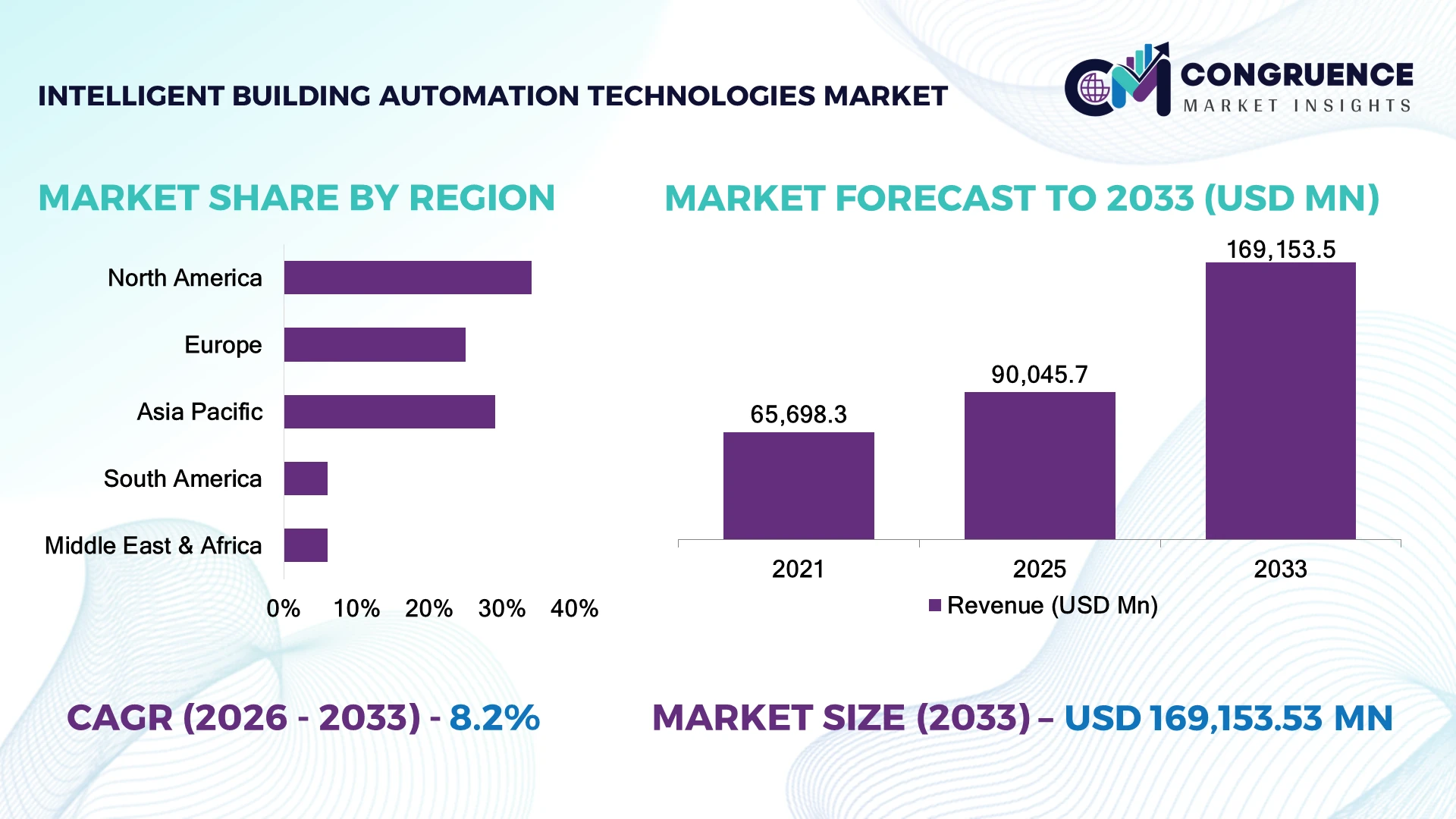
The Global Intelligent Building Automation Technologies Market was valued at USD 90,045.7 Million in 2025 and is anticipated to reach a value of USD 169,153.5 Million by 2033 expanding at a CAGR of 8.2% between 2026 and 2033. Growth is driven by energy-efficient HVAC controls, occupancy-responsive lighting, AI-enabled fault detection, and integrated building-management platforms that reduce energy waste and improve equipment performance.
The United States remains a strategically important market because of its extensive commercial building stock, healthcare facilities, data centers, and advanced manufacturing infrastructure. U.S. Department of Energy analysis indicates that high-performance building control sequences can reduce HVAC energy consumption by approximately 30% in suitable commercial buildings. Europe is accelerating automation through building-performance requirements, including provisions for qualifying non-residential buildings with heating, ventilation, or air-conditioning systems above 290 kW and a lower 70 kW threshold by 2029. Meanwhile, U.S.–China technology competition is increasing the importance of diversified electronics sourcing and interoperable automation platforms.
Businesses should prioritize retrofit-compatible automation systems that demonstrate measurable energy savings, protect connected infrastructure, and support compliance across changing building-performance requirements.
Market Size & Growth: The market is valued at USD 90,045.7 million in 2025 and projected to reach USD 169,153.5 million by 2033, supported by HVAC optimization, connected controls, and digital building management.
Top Growth Drivers: High-performance building controls can reduce HVAC energy consumption by approximately 30% in suitable commercial buildings, strengthening the business case for automation retrofits.
Short-Term Outlook: By 2028, buyers will increasingly assess automation investments through energy intensity, fault-detection performance, maintenance response, and verified operating savings rather than equipment counts alone.
Emerging Technologies: AI-assisted HVAC optimization, digital twins, occupancy sensors, predictive maintenance, and interoperable building-management software are shifting facilities from fixed schedules toward data-driven control.
Regional Positioning: North America benefits from established building technology and retrofit demand, Europe from regulatory requirements, and Asia-Pacific from urban development and smart-infrastructure investment. Comparable regional market values require independent validation.
End-User Trends: Offices, hospitals, data centers, industrial facilities, and educational campuses increasingly require integrated visibility into energy consumption, indoor environmental conditions, equipment faults, and access systems.
Efficiency Evidence: U.S. Department of Energy analysis indicates that high-performance control sequences can deliver approximately 30% HVAC energy savings in suitable commercial buildings, making commissioning and performance verification essential.
Competitive Landscape: Schneider Electric, Siemens, Johnson Controls, Honeywell, and ABB compete through integrated controls, building-management software, analytics, equipment connectivity, and lifecycle services. Comparable audited market-share figures are not established here.
Regulatory and ESG Impact: The revised EU Energy Performance of Buildings Directive introduces automation and control requirements for qualifying non-residential buildings above 290 kW, with a lower threshold above 70 kW by 2029 where applicable.
Investment Priorities: Building owners are prioritizing retrofit-ready controllers, software integration, cybersecurity, and automated fault detection to modernize existing assets without replacing entire building systems.
Innovation and Future Outlook: Competition is shifting toward interoperable platforms, predictive analytics, demand-response integration, and measurable performance improvements across multi-building portfolios.
The intelligent building automation technologies market is moving from isolated equipment control toward integrated optimization of HVAC, lighting, access, and energy systems. High-performance controls can reduce HVAC energy use by approximately 30% in suitable commercial buildings, reinforcing the importance of commissioning and measurable results. In 2026, building-performance requirements, electricity-system constraints, and the expansion of data-intensive facilities are strengthening demand for connected automation that improves operational visibility without requiring complete infrastructure replacement.
Intelligent building automation is becoming a strategic operating layer for commercial property owners, healthcare networks, industrial operators, and data-center developers. Integrating HVAC, lighting, access control, and environmental monitoring enables operators to coordinate equipment performance instead of managing disconnected systems. With buildings accounting for approximately 30% of global final energy consumption, improving operational efficiency has direct implications for electricity expenditure, asset performance, and decarbonization planning.
The technology shift is from fixed schedules and isolated control loops toward connected sensors, automated fault detection, and adaptive control. U.S. Department of Energy analysis indicates that high-performance control sequences can deliver around 30% HVAC energy savings in suitable commercial buildings. European projects face increasing regulatory pressure, while US retrofit programs emphasize integration with installed equipment and enterprise systems. These differences influence purchasing priorities: compliance-ready functionality is important in regulation-led markets, whereas compatibility, installation disruption, and payback periods dominate many existing-building upgrades.
During 2026–2028, operators will increasingly prioritize predictive maintenance, occupancy-responsive controls, energy benchmarking, and secure remote monitoring. A hospital, for example, can coordinate ventilation schedules, environmental sensors, and equipment alarms while maintaining required indoor conditions. Vendors are responding through open-protocol integration, software partnerships, and lifecycle service offerings. Competitive advantage will favor suppliers that verify operational savings, secure connected infrastructure, and deploy reliably across mixed-generation building equipment.
Energy optimization is a direct growth driver because HVAC, ventilation, and lighting schedules influence recurring operating costs across offices, hospitals, campuses, and industrial facilities. U.S. Department of Energy analysis indicates that high-performance control sequences can reduce HVAC energy consumption by approximately 30% in suitable commercial buildings. Separately, the updated ASHRAE Standard 90.1-2022 was assessed by the department as delivering approximately 9.8% site-energy savings against the previous baseline for covered buildings. These figures represent different measures and should not be combined. Building owners are responding by investing in controls retrofits, submetering, and automated fault detection. A significant commercial advantage is that better scheduling and commissioning can unlock savings from existing equipment before costly replacement, improving the economics of building modernization.
Legacy buildings frequently combine proprietary controllers, incompatible sensors, older communication protocols, and equipment supplied by different manufacturers. Connecting these systems can require gateways, panel modifications, engineering services, and commissioning, increasing deployment costs beyond the price of hardware and software. The approximately 9.8% site-energy savings associated with the ASHRAE 90.1-2022 baseline illustrates the potential of efficiency improvements but does not guarantee equivalent returns from every automation project. Vendors are reducing implementation friction through protocol support, phased installation, standardized interfaces, and service agreements. For building owners, the central restraint is often the cost of integrating existing infrastructure without disrupting operations. Suppliers that simplify interoperability and demonstrate project-specific payback are better positioned to overcome purchasing resistance.
Building-performance regulations create opportunities for suppliers offering monitoring, analytics, and interoperable control systems for existing facilities. Under the revised EU Energy Performance of Buildings Directive, qualifying non-residential buildings with relevant systems above 290 kW face building automation and control requirements, with the threshold extending to above 70 kW by 2029 where applicable. The framework emphasizes monitoring, energy analysis, interoperability, and indoor environmental quality. This supports staged upgrades rather than complete building-system replacement. Vendors can differentiate through retrofit kits, remote diagnostics, software commissioning, and integration with smart meters, storage, and demand-response platforms. An important opportunity lies in mid-sized properties without dedicated energy-management teams. Packaged automation services can provide remote performance monitoring and fault alerts without requiring owners to develop substantial in-house engineering capabilities.
Connected building infrastructure increases the number of devices, control interfaces, and remote-access points that require protection. HVAC controllers, access systems, sensors, and cloud dashboards may have different vendors and maintenance schedules, creating fragmented responsibility for software updates, identity management, and incident response. Automated decisions must also preserve ventilation, comfort, and safety requirements instead of optimizing energy consumption in isolation. Through 2026–2028, suppliers will need secure remote access, network segmentation, software lifecycle management, and auditable control logic across installations. Collaboration among automation vendors, cybersecurity specialists, and facility-management teams will become increasingly important. The challenge is to maintain reliable performance across diverse building portfolios while proving that connected controls remain secure, interoperable, and compliant as technologies and operating requirements evolve.
AI-Driven HVAC Optimization
Building operators are moving from fixed HVAC schedules toward control sequences that respond to occupancy, weather, and equipment conditions. U.S. Department of Energy analysis indicates that high-performance control sequences can deliver around 30% HVAC energy savings in suitable commercial buildings. Vendors are expanding predictive-control and analytics capabilities, while buyers increasingly require commissioning and measurement plans to verify results. This shifts purchasing decisions toward demonstrable operational performance rather than software functionality alone.
Regulation-Led Retrofit Programs
European building-performance rules are increasing the importance of automation for qualifying non-residential facilities above 290 kW, with the threshold extending to above 70 kW by 2029 where applicable. Requirements for monitoring, energy analysis, interoperability, and indoor environmental quality are influencing retrofit specifications. Suppliers are responding with phased upgrades and integration services that support compliance while preserving usable legacy equipment and limiting disruption.
Interoperable Connected Platforms
Building owners increasingly expect HVAC, lighting, meters, access control, and environmental sensors to exchange information across mixed-vendor estates. Open protocols and integration layers reduce dependence on isolated systems, although commissioning and data consistency remain critical. Suppliers are expanding APIs, centralized dashboards, and multi-site management capabilities. The competitive advantage comes from comparing building performance and coordinating corrective action across portfolios, rather than simply connecting more devices.
Indoor Environmental Quality Monitoring
Automation platforms are extending beyond energy management to track ventilation, temperature, humidity, and indoor air quality. European building-performance requirements are strengthening attention to indoor environmental conditions alongside efficiency. Hospitals, offices, and educational facilities increasingly need evidence that energy optimization does not compromise occupant requirements. Vendors are integrating environmental sensors with HVAC controls and maintenance alerts, allowing operators to coordinate comfort, compliance, and equipment performance through connected management systems.
Building Management Systems (BMS) represent the leading technology category, with an estimated 32% share of the global intelligent building automation technologies market in 2025. Their position reflects centralized coordination of HVAC equipment, lighting, ventilation, alarms, and energy consumption across large commercial facilities. HVAC control systems account for an estimated 26%, supported by their direct influence on building operating expenditure and equipment performance. Lighting control systems remain important in offices, retail facilities, and educational campuses, particularly where occupancy sensing and daylight harvesting improve utilization. Security and access control systems address surveillance, identity management, and facility protection, while energy management systems provide consumption analytics, load monitoring, and performance benchmarking.
Energy management systems are positioned as the fastest-growing technology category as building owners connect submetering, automated fault detection, demand response, and distributed energy resources. Their estimated 16% market share highlights an expanding software-intensive segment. Established BMS providers are strengthening open-protocol integration and cloud connectivity, while specialist developers are targeting predictive analytics and automated energy optimization. Companies are also investing in retrofit-compatible controllers and recurring software services to reduce installation barriers. The investment shift favors platforms that convert operational data into verified efficiency improvements rather than standalone monitoring functionality.
HVAC automation and optimization constitute the largest application segment, representing an estimated 35% of the intelligent building automation technologies market in 2025. Heating, cooling, and ventilation account for substantial controllable energy consumption in offices, hospitals, hotels, and institutional buildings, making automated scheduling, temperature regulation, and equipment coordination commercially important. Lighting automation holds an estimated 20% share, supported by occupancy sensors, daylight-responsive dimming, and centralized control across multi-floor facilities. Security and access management remain established applications where connected surveillance, electronic access, and integrated alarms improve operational oversight. Fire and life-safety integration addresses critical monitoring and emergency response requirements, while indoor environmental quality monitoring supports ventilation performance and occupant conditions.
Energy monitoring and optimization are emerging as the fastest-growing application, driven by building-performance regulations, electricity cost exposure, and the integration of smart meters with automation platforms. Their estimated 18% share reflects increasing investment in real-time consumption analysis, peak-load management, and automated fault identification. Germany and other European markets are emphasizing compliance-oriented building upgrades, while U.S. operators prioritize measurable retrofit savings. Technology suppliers are combining energy dashboards, predictive analytics, and interoperable controllers to support multi-building portfolios. Demand is strengthening where automation can connect equipment-level decisions with facility-wide energy and performance objectives.
Commercial buildings represent the largest end-user category, accounting for an estimated 38% of the global intelligent building automation technologies market in 2025. Offices, shopping centers, hotels, and mixed-use properties require integrated HVAC, lighting, access control, and energy monitoring across extensive floor areas. Industrial facilities hold an estimated 19% share, reflecting automation requirements in manufacturing plants, warehouses, and process-support infrastructure. Healthcare facilities prioritize environmental stability, ventilation control, and uninterrupted operation, while educational institutions and government buildings emphasize centralized management and retrofit efficiency. Residential developments represent a separate demand base, particularly for connected lighting, climate control, and security in premium and multi-unit properties.
Data centers are emerging as the fastest-growing end-user category because high-density computing infrastructure requires coordinated cooling, power monitoring, environmental sensing, and equipment alarms. Their estimated 12% share indicates a specialized but increasingly influential buying group. Operators in the United States are prioritizing thermal management and continuous operational visibility as AI-related infrastructure expands. Suppliers are responding with integrated cooling controls, predictive maintenance, and partnerships linking building automation with electrical infrastructure management. Future competitive positioning will depend on application-specific reliability, secure connectivity, and the ability to demonstrate performance across complex facility portfolios.
North America accounted for the largest market share at 34% in 2025 however, Asia-Pacific is expected to register the fastest growth, expanding at a CAGR of 9.1% between 2026 and 2033.

Modernization of Existing Buildings Strengthens Integrated Controls Demand
North America is estimated to account for approximately 34% of the global intelligent building automation technologies market in 2025, supported by established building-management infrastructure, commercial property modernization, and demand from healthcare facilities, industrial campuses, and data centers. The United States provides the region's principal demand base, with Canada contributing through commercial construction, institutional facilities, and energy-efficiency programs. Buyers increasingly prioritize integrated HVAC optimization, remote fault detection, cybersecurity, and interoperability with installed equipment. The U.S. Department of Energy indicates that high-performance controls can deliver approximately 30% annual HVAC energy savings in suitable commercial buildings, strengthening retrofit economics. Suppliers are responding with software-enabled upgrades, service contracts, and analytics platforms that improve operating performance without requiring complete replacement of building systems.
United States Market Outlook: The United States remains the region's primary center for building automation deployment, supported by commercial real estate, hospitals, data centers, universities, and advanced manufacturing. Federal building-efficiency initiatives and utility programs encourage investment in controls that reduce energy consumption and improve equipment reliability. The Department of Energy also supports interoperable control platforms designed to simplify integration across different vendors and building technologies. This creates opportunities for suppliers offering retrofit-compatible systems, predictive maintenance, and measurable performance verification. Competition increasingly depends on reducing commissioning complexity and demonstrating savings across multi-site property portfolios.
Regulatory Requirements Accelerate Energy Monitoring and Automation Retrofits
Europe's market is shaped by building decarbonization targets, energy-performance regulations, and modernization of aging commercial infrastructure. Germany, France, the United Kingdom, Italy, and the Nordic countries provide important demand centers across offices, public buildings, healthcare, and industrial facilities. The revised EU Energy Performance of Buildings Directive requires member states to establish building automation and control requirements for qualifying non-residential buildings with relevant systems above 290 kW, with a lower threshold above 70 kW by 2029 where applicable. These requirements encourage continuous energy monitoring, efficiency analysis, and system interoperability. Suppliers are expanding retrofit services and integrating controls with building-management software to help property owners address compliance while managing installation costs.
Germany Market Outlook: Germany benefits from its large industrial base, commercial building stock, and focus on energy-efficient infrastructure. Manufacturing plants, office complexes, logistics facilities, and public buildings require reliable HVAC regulation, lighting management, and energy monitoring. The country's energy-transition priorities strengthen the business case for automation that coordinates building demand with increasingly variable electricity supply. Suppliers that combine interoperable controllers, industrial-grade reliability, and lifecycle support are well positioned to serve both new developments and existing properties. Integration with energy-management systems is especially relevant for facilities seeking to manage operating costs while meeting evolving efficiency expectations.
Urban Infrastructure Expansion and Digital Facilities Accelerate Deployment
Asia-Pacific is positioned as the fastest-growing regional market as urban development, commercial construction, smart-city programs, and digital infrastructure expand across China, India, Japan, South Korea, and Southeast Asia. Demand spans office towers, hospitals, transport infrastructure, industrial campuses, hotels, and data centers. China contributes significant construction and technology-manufacturing capacity, while India offers opportunities through commercial development, infrastructure modernization, and energy-management initiatives. However, China's property market remains uneven: official statistics recorded a 17.2% year-on-year decline in real estate development investment in 2025, emphasizing the importance of distinguishing new-build demand from retrofit opportunities. Suppliers are increasingly focusing on modular controls, scalable software, local integration partners, and systems suited to different building budgets.
China Market Outlook: China combines domestic automation manufacturing, large-scale urban infrastructure, and strong demand for digitally managed commercial and public facilities. The country is also investing in data-intensive infrastructure and modernizing industrial operations, supporting demand for centralized monitoring, HVAC optimization, access control, and energy analytics. At the same time, the 2025 contraction in real estate development investment highlights the need for vendors to balance new construction projects with renovation and efficiency upgrades. Companies offering cost-competitive products, local technical support, and integration with domestic building systems are better positioned to navigate varied investment conditions.
Commercial Modernization and Energy-Cost Management Shape Adoption
South America's intelligent building automation market is supported by commercial property modernization, industrial facilities, healthcare infrastructure, hotels, and energy-management requirements. Brazil represents the principal demand center, with additional opportunities in Chile, Argentina, and Colombia. Adoption is concentrated in larger buildings and organizations able to justify integrated controls through electricity savings, operational visibility, and equipment reliability. Smaller facilities often face tighter capital budgets, uneven technical support, and legacy-system compatibility challenges. These conditions favor modular deployments, phased retrofits, and service-based offerings rather than large-scale replacement programs. Vendors are competing through local engineering partnerships, adaptable system configurations, and solutions that connect HVAC, lighting, and security without excessive installation disruption.
Brazil Market Outlook: Brazil has the region's largest building and industrial base, supporting demand from commercial offices, hospitals, shopping centers, hotels, and manufacturing facilities. Energy management is particularly relevant for buildings with substantial cooling loads and variable occupancy. The country's distributed electricity system and expanding digital infrastructure create opportunities for smart controls that improve monitoring and operational coordination. However, project economics remain sensitive to financing costs, imported equipment prices, and the availability of qualified integrators. Suppliers that provide localized service, phased implementation, and clear evidence of operating savings can strengthen adoption beyond premium commercial developments.
Large-Scale Developments and Infrastructure Modernization Support Integrated Systems
The Middle East & Africa market is shaped by major commercial developments, hospitality projects, healthcare infrastructure, transport hubs, and modernization of public facilities. Saudi Arabia and the United Arab Emirates are prominent Middle Eastern demand centers, while South Africa contributes through commercial property, industrial operations, and institutional infrastructure. High cooling requirements make HVAC optimization particularly important, while large projects often specify centralized controls for energy monitoring, access, safety, and facility management. Saudi Arabia's Vision 2030 initiatives are supporting smart-infrastructure development, and a July 2025 memorandum between New Murabba and Honeywell established a framework to explore automation and digital solutions for the Riyadh development. Suppliers are pursuing project partnerships and integrated building platforms.
Saudi Arabia Market Outlook: Saudi Arabia is a strategically important market because of large-scale urban development, hospitality projects, commercial infrastructure, and investments linked to Vision 2030. New districts and mixed-use developments require coordinated HVAC, lighting, security, and energy management across extensive building portfolios. High cooling demand strengthens the business case for automated controls, while smart-infrastructure programs encourage integration of digital systems from the planning stage. The New Murabba–Honeywell memorandum announced in July 2025 illustrates how developers are engaging automation providers early in project design. Suppliers that combine local delivery capability, scalable control platforms, and lifecycle services are well positioned to compete for complex developments.
Schneider Electric, Siemens, Johnson Controls, Honeywell, and ABB compete as global integrated-platform leaders, while Distech Controls, Delta Controls, and specialist integrators target retrofit projects and regional accounts. The top-five combined market share is not reliably disclosed in a independently verifiable dataset; reporting a precise percentage would imply unsupported concentration. Competition centers on interoperability, cybersecurity, installation time, lifecycle support, and verified energy performance. High-performance controls can reduce HVAC energy use by about 30% in suitable commercial buildings, making measured savings a stronger sales argument than device pricing alone. A 2025 industry survey found 91% of North American respondents already used smart-building systems, while nearly 45% were planning or open to cloud-based building management. Leaders are adding AI, open APIs, and remote diagnostics; smaller integrators compete through customization and local service. Legacy integration, cybersecurity assurance, and commissioning expertise raise entry barriers. Winners prove savings, connect mixed-vendor assets, and scale securely across portfolios.
Intelligent building automation is shifting from rule-based systems to AI-assisted control and digital twins. High-performance HVAC sequences can reduce energy consumption by approximately 30% in buildings, while occupancy-responsive lighting and ventilation limit operation in unused spaces. Results depend on baseline conditions, commissioning, and building use; they are not universal guarantees. Legacy systems remain relevant where replacement costs outweigh modernization benefits.
Cloud-based building management is gaining traction as owners seek portfolio visibility, diagnostics, and deployment. A 2025 North American survey of 308 building stakeholders found 91% already used smart-building systems and nearly 45% were planning or open to cloud management. Open APIs and standardized protocols connect HVAC, lighting, access, fire safety, and energy meters, reducing data silos. Cybersecurity and integration quality determine whether connected systems deliver intelligence.
From 2026 to 2028, AI agents and fault detection will flag anomalies, recommend maintenance, and optimize equipment schedules. Johnson Controls reported its 2026 OpenBlue updates reduced airside energy use by nearly 10% at one customer and cut onboarding time by up to 95%. These results are not market-wide averages. Integrated-platform leaders benefit from installed equipment bases, while software specialists compete through flexibility. Buyers should prioritize verified savings, interoperability, cyber resilience, and phased retrofit economics.
August 2026 Johnson Controls expanded OpenBlue with agentic AI, airside optimization, and automated onboarding. The company reported nearly 10% lower airside energy use at DATEV and onboarding time reductions up to 95%, improving rollout speed and operational efficiency. Source: johnsoncontrols.com
June 2025 Honeywell launched Connected Solutions, an AI-powered interface unifying building software and devices; installation can be completed in hours. Vanderbilt University had adopted it in nearly 10% of its buildings, enabling campus-wide operational visibility and phased deployment. Source: honeywell.com
August 2025 Siemens presented Building X as an open, cloud-based smart-building platform integrating systems through APIs and AI applications. The modular architecture supports portfolio-wide data visibility, partner-developed applications, and scalable modernization without locking customers into isolated building systems. Source: news.siemens.com
December 2025 The Association for Smarter Homes & Buildings reported that 91% of 308 surveyed North American stakeholders already used smart-building systems, while nearly 45% considered cloud-based management. The findings signal demand for connected analytics and retrofit-ready integration. Source: ashb.com
The report assesses intelligent building automation across hardware, software, and services, including building management systems, HVAC controls, lighting automation, access control, sensors, and energy-management platforms. Application coverage includes commercial buildings, residential properties, industrial facilities, healthcare institutions, data centers, and educational campuses. End-user analysis distinguishes building owners, facility managers, industrial operators, and institutional organizations across North America, Europe, Asia-Pacific, South America, and the Middle East & Africa.
Technology coverage examines AI-driven optimization, predictive maintenance, digital twins, cloud-based management, open-protocol integration, cybersecurity, and retrofit solutions. Adoption indicators provide context for investment decisions: a 2025 North American survey found 91% of respondents already used smart-building systems, while nearly 45% were planning or open to cloud-based management. Competitive analysis evaluates leading equipment manufacturers, software platforms, and integration specialists. The report supports investment planning, geographic expansion, product positioning, partnership selection, and technology priorities through 2033.
| Report Attribute/Metric | Report Details |
|---|---|
|
Market Revenue in 2025 |
USD 90,045.7 Million |
|
Market Revenue in 2033 |
USD 169,153.5 Million |
|
CAGR (2026 - 2033) |
8.2% |
|
Base Year |
2025 |
|
Forecast Period |
2026 - 2033 |
|
Historic Period |
2021 - 2025 |
|
Segments Covered |
By Type
By Application
By End-User
|
|
Key Report Deliverable |
Revenue Forecast, Growth Trends, Market Dynamics, Segmental Overview, Regional and Country-wise Analysis, Competition Landscape |
|
Region Covered |
North America, Europe, Asia-Pacific, South America, Middle East, Africa |
|
Key Players Analyzed |
Schneider Electric, Siemens, Johnson Controls, Honeywell, ABB, Legrand, Trane Technologies, Carrier Global, Belimo, Lutron Electronics, Crestron Electronics, Bosch Building Technologies, Delta Electronics |
|
Customization & Pricing |
Available on Request (10% Customization is Free) |