
Reports
The Global Integrated Food Ingredients Market was valued at USD 68,498.7 Million in 2025 and is anticipated to reach a value of USD 114,219.4 Million by 2033 expanding at a CAGR of 6.6% between 2026 and 2033. Growth is driven by clean-label reformulation, multifunctional ingredient systems, protein fortification, and manufacturers consolidating multiple formulation functions into fewer ingredient platforms.
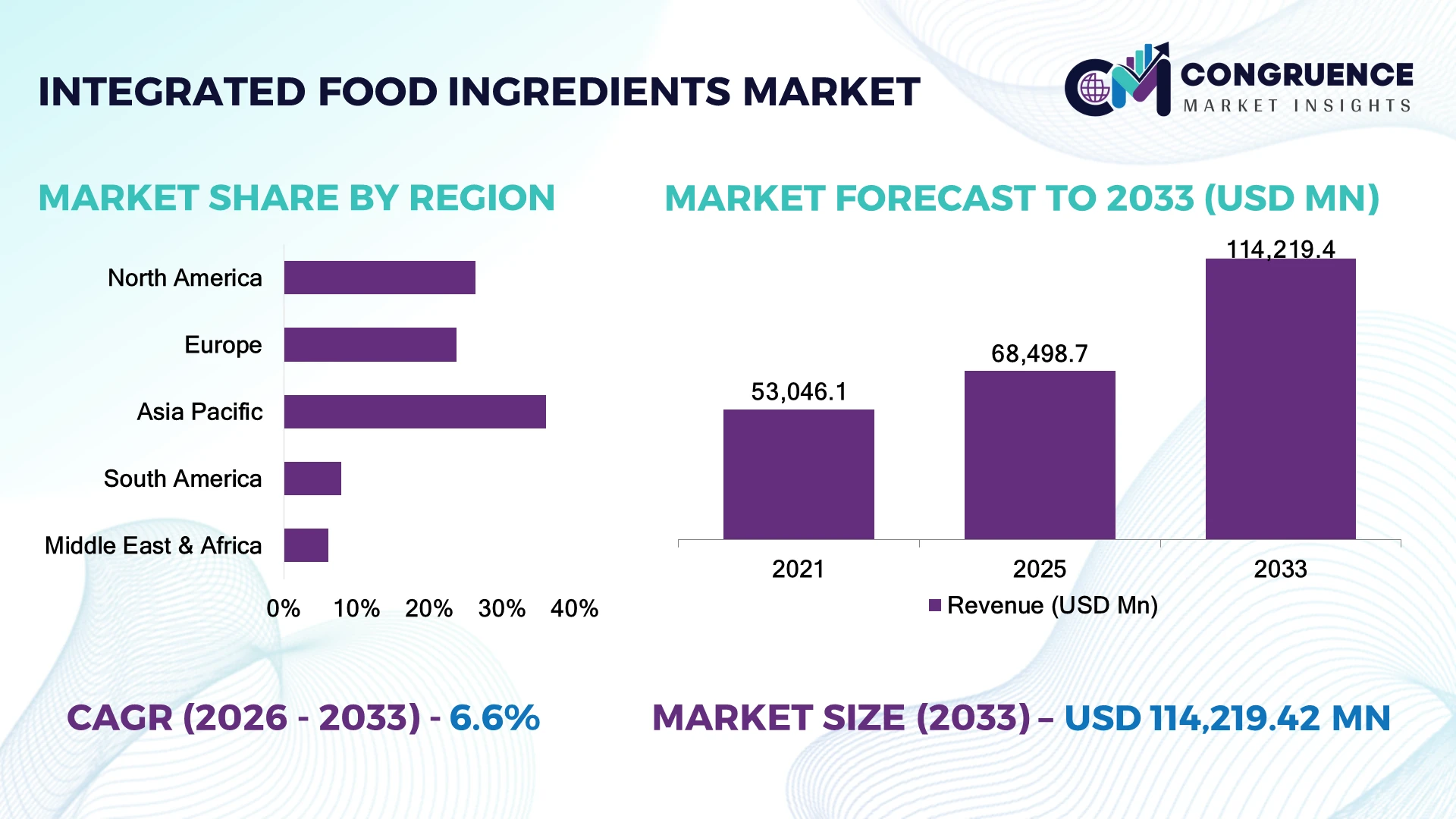
The United States remains the dominant country, accounting for approximately 28% of high-value integrated ingredient demand, supported by advanced food processing, functional nutrition, bakery, dairy, and beverage manufacturing. China follows with nearly 18%, benefiting from large-scale food production and rapid ingredient localization. U.S. manufacturers increasingly deploy AI-assisted formulation and automated dosing, with digital quality-control adoption approaching 40%. Geopolitical supply-chain realignment is accelerating regional sourcing and dual-supplier strategies.
Strategically, suppliers combining functionality, formulation support, and resilient sourcing are best positioned to capture premium food-manufacturing contracts.
Market Size & Growth: USD 68.5 billion in 2025 to USD 114.2 billion by 2033 at 6.6% CAGR, driven by multifunctional formulations.
Top Growth Drivers: Clean-label 34%, functional nutrition 29%, convenience foods 24%.
Short-Term Forecast: By 2028, automated formulation can reduce development time 15%–20%.
Emerging Technologies: AI formulation, precision fermentation, encapsulation adoption reaches 25%–40% in advanced producers.
Regional Leaders: North America 31%, Europe 26%, Asia-Pacific 29%; Asia-Pacific shows fastest formulation localization.
Consumer Trends: Approximately 42% of new product concepts emphasize protein, fiber, or functional positioning.
Pilot Example: 2025 automated batching programs delivered approximately 12% lower ingredient waste.
Competitive Landscape: Leading integrated suppliers hold about 6%–8% each, competing through formulation breadth and technical service.
Regulatory & ESG Impact: Clean-label and waste-reduction programs target 10%–15% lower formulation complexity.
Investment & Funding: Major producers are directing roughly USD 2.5 billion toward capacity, fermentation, specialty blends, and regional sourcing.
Innovation & Outlook: Encapsulation, precision fermentation, and AI-led formulation shift competition toward performance-per-ingredient and faster commercialization.
Integrated food ingredients are gaining traction across bakery, dairy, beverages, processed foods, sports nutrition, and convenience formulations where manufacturers seek multiple functions from fewer inputs. Approximately 35% of new formulation programs prioritize multifunctional blends that combine texture, nutrition, stability, or flavor performance. In 2026, supply-chain localization and tighter ingredient qualification are pushing producers toward regional manufacturing, standardized premixes, and shorter formulation cycles, creating a stronger transition toward integrated ingredient platforms.
Integrated food ingredients are becoming strategically important because food manufacturers are moving from single-function additives toward formulation systems that simultaneously improve nutrition, texture, stability, shelf life, and processing efficiency. This shift reduces formulation complexity and strengthens supplier influence over product development. In 2026, regional sourcing and supply-chain restructuring are also encouraging manufacturers to qualify alternative ingredient combinations closer to production sites.
Technology is accelerating this transition. AI-assisted formulation can shorten recipe-development cycles by approximately 15%–20% compared with manual trial-and-error workflows, while encapsulation and controlled-release systems improve active-ingredient stability by roughly 10%–18% in targeted applications. North American producers lead in digital formulation infrastructure, whereas Asian manufacturers are scaling faster through localized ingredient platforms and high-volume processing.
Over the next 2–3 years, adoption of automated dosing, precision fermentation, functional premixes, and data-driven formulation is positioned to expand across large food plants. A beverage producer, for example, can consolidate stabilizers, micronutrients, flavor systems, and texture modifiers into standardized premixes, reducing batching complexity and procurement touchpoints. Companies investing in formulation laboratories, regional production, and technical partnerships will gain faster commercialization and stronger customer retention.
Food manufacturers are shifting toward multifunctional ingredient systems that combine stabilization, texture, nutrition, flavor, and shelf-life functions, reducing formulation complexity. Approximately 35% of new product development programs now prioritize multifunctional blends, while protein- and fiber-fortified formulations represent roughly 30% of active reformulation projects. In the United States, automated dosing and digital formulation workflows are expanding as manufacturers seek tighter batch consistency and lower labor dependence. Supply-chain disruptions affecting specialty inputs have accelerated dual-sourcing and regional production strategies. Ingredient suppliers are responding through application laboratories, customized premixes, and strategic partnerships with processors. The non-obvious advantage is procurement consolidation: suppliers able to replace three or more individual ingredients with one validated system can secure longer contracts and deeper customer integration.
Integrated formulations face cost pressure from volatile proteins, specialty fibers, emulsifiers, natural flavors, and functional additives. Specialty ingredients can represent 20%–35% of formulation input costs in premium products, while price swings of 10%–15% can materially alter product margins. European processors also face tighter qualification requirements for novel and reformulated ingredients, extending commercialization timelines. Supply concentration for fermentation-derived compounds and certain plant-based inputs creates additional exposure when international logistics tighten. Companies are reducing risk through regional sourcing, multi-year supplier agreements, alternative ingredient specifications, and localized blending. The strategic pressure point is not ingredient availability alone; it is maintaining equivalent sensory and functional performance after substitution without triggering costly reformulation, relabeling, or consumer acceptance issues.
Precision nutrition creates a high-value opportunity for integrated ingredient suppliers combining protein, fiber, micronutrients, probiotics, and controlled-release technologies. Functional formulations already account for roughly 30%–40% of innovation activity among advanced food manufacturers, while personalized nutrition concepts are expanding across approximately 15% of new premium product pipelines. Precision fermentation and microencapsulation can improve active stability by 10%–20%, enabling lower inclusion rates and cleaner labels. Companies are investing in application centers, fermentation partnerships, and modular premix platforms rather than selling isolated ingredients. A particularly attractive opportunity lies in reformulating mainstream products with multifunctional systems that deliver measurable nutrition and processing benefits without substantial changes to manufacturing equipment. This expands addressable demand beyond premium health foods into beverages, bakery, dairy alternatives, and convenience foods.
Scaling integrated ingredient systems from laboratory trials to high-volume production remains difficult because viscosity, hydration, shear sensitivity, thermal stability, and ingredient interactions can change materially across equipment configurations. Pilot-to-commercial transfer can generate 5%–10% formulation adjustment requirements, while automated plants increasingly demand tighter batch-variation thresholds below 2%. Digital formulation platforms also introduce data-governance and cybersecurity requirements when recipes, supplier specifications, and production parameters become interconnected. In India and Southeast Asia, uneven cold-chain and processing infrastructure adds complexity for sensitive functional ingredients. Companies must strengthen pilot-scale validation, process analytics, supplier interoperability, and technical training before expanding integrated platforms. The competitive differentiator is therefore reproducibility: suppliers that demonstrate identical functional performance across multiple production environments will reduce customer qualification friction and protect long-term contracts.
AI-Led Formulation Optimization AI-assisted recipe development is moving from experimental use toward commercial workflows, with adoption approaching 20%–25% among larger food manufacturers and development-time reductions of 15%–20%. Companies are integrating formulation databases with ingredient-performance models to reduce trial batches, accelerate reformulation, and improve first-pass success.
Multifunctional Premix Consolidation Manufacturers increasingly replace separate additives with integrated premixes covering two or more functions, with approximately 35% of new formulation programs prioritizing multifunctionality. This can reduce ingredient handling steps by 10%–15% and simplify procurement. Suppliers are expanding customized blending and application-support capabilities to secure deeper customer integration.
Precision Fermentation Scaling Precision-fermented proteins, enzymes, and functional compounds are moving toward larger commercial deployments, with fermentation-based ingredients appearing in roughly 10%–15% of advanced product-development pipelines. Improved process yields of 8%–12% are strengthening economics, while manufacturers are forming technology partnerships to diversify specialty-ingredient sourcing and reduce dependence on constrained agricultural inputs.
Localized Ingredient Manufacturing Geopolitical logistics disruptions and freight volatility are accelerating regional blending and sourcing. Approximately 25% of multinational food manufacturers are increasing dual-source qualification for critical ingredients, while localized production can shorten replenishment cycles by 10%–20%. Suppliers are responding with regional plants, contract manufacturing, and inventory hubs closer to major food-processing clusters.
Multifunctional Ingredient Systems Lead the Market
Multifunctional ingredient systems represent the leading type, accounting for approximately 34% of market demand, because they combine stabilization, texture, nutrition, flavor, and processing functions within fewer formulation inputs. Their scalability and procurement efficiency make them particularly attractive to large food manufacturers. Protein-based integrated systems hold about 24%, supported by reformulation toward higher-protein foods, while specialty functional blends account for nearly 18% and serve targeted performance requirements. The mature multifunctional segment therefore retains scale advantages, while specialized systems gain share through application-specific performance.
Precision-function blends are the fastest-growing type, driven by encapsulation, precision fermentation, and targeted nutrient delivery. Adoption is strengthening as manufacturers seek 10%–15% better ingredient stability and lower inclusion rates. Companies are responding with application laboratories, customized premixes, fermentation partnerships, and expanded R&D portfolios. This shifts investment toward integrated formulation platforms rather than commodity ingredient capacity, giving suppliers with technical support and formulation expertise stronger negotiating power with enterprise food manufacturers.
The Institute of Food Technologists reported that 22% of surveyed food, beverage, and ingredient companies expected to invest in precision fermentation in 2025, while 21% planned investment in biochemical technologies.
Bakery and Beverages Anchor Demand
Bakery and confectionery is the leading application, representing approximately 28% of integrated food ingredient demand because manufacturers require coordinated emulsification, stabilization, texture, flavor, nutrition, and shelf-life performance. Beverages follow at about 24%, while dairy and dairy alternatives account for nearly 19%. Bakery remains comparatively mature, supported by established formulation practices, whereas beverages are adopting integrated systems faster as manufacturers combine protein, fiber, botanicals, electrolytes, and flavor functionality within single products.
Beverages represent the fastest-growing application, with approximately 35% of new concepts incorporating two or more functional attributes. Integrated systems can reduce batching complexity by 10%–15% and accelerate reformulation when sugar, protein, or additive specifications change. Companies are expanding modular premixes, automated dosing compatibility, and co-development programs. The strategic shift is toward ingredient platforms that shorten formulation cycles while preserving sensory performance, giving suppliers with beverage-specific application expertise an advantage over single-function ingredient vendors.
IFT's 2025 industry coverage highlighted multifunctional beverages and targeted functional benefits as major formulation priorities, with protein, fiber, and other functional ingredients increasingly incorporated into convenient food and beverage formats.
Large Food Manufacturers Maintain Buying Power
Large food manufacturers represent the dominant end-user group, accounting for approximately 42% of integrated food ingredient consumption because their production scale supports customized premixes, centralized procurement, automated dosing, and dedicated formulation laboratories. Contract manufacturers account for about 21%, benefiting from shorter product-development cycles and the need to reproduce customer specifications consistently. Specialized nutrition producers contribute roughly 17%, but their purchasing behavior is shifting faster toward performance-based ingredient systems.
Specialized nutrition producers are the fastest-growing end-user segment, driven by demand for high-protein, fiber-rich, probiotic, and fortified formulations. Their adoption of integrated systems is approximately 12%–15% higher than traditional packaged-food producers because formulation flexibility and functional validation are prioritized over minimum ingredient cost. Companies are targeting these buyers through smaller development batches, technical partnerships, customized pricing, and co-formulation services. Meanwhile, multinational manufacturers are strengthening dual sourcing and regional production, making supply continuity and standardized specifications increasingly decisive in supplier selection.
The Institute of Food Technologists reported in 2025 that 55% of consumers aged 18–29 choose foods and beverages with added protein, while 50% of consumers across age groups consider high-protein claims very important in purchasing decisions.
Asia-Pacific accounted for the largest market share at 36% in 2025 however, North America is expected to register the fastest growth, expanding at a CAGR of 7.8% between 2026 and 2033.
Formulation Consolidation Reshapes Large-Scale Food Production
North America represents approximately 30% of global integrated food ingredients demand, supported by sophisticated packaged-food manufacturing, sports nutrition, functional beverages, and clean-label reformulation. U.S. manufacturers increasingly favor multifunctional ingredient systems that reduce formulation complexity while improving texture, stability, protein delivery, and shelf life. Approximately 42% of large food manufacturers in the region prioritize multifunctional formulations in new product development, strengthening demand for customized ingredient platforms. Automated dosing, digital formulation management, and co-development laboratories are also expanding deployment across major processing hubs. Ingredient suppliers are responding through application centers, strategic formulation partnerships, and regional production expansion. The competitive advantage is shifting from ingredient volume toward formulation integration, technical support, and rapid commercialization, particularly as manufacturers optimize supply chains following persistent freight and raw-material volatility.
United States Market Outlook: The United States remains the region's strategic center, supported by its extensive processed-food manufacturing base, advanced ingredient R&D infrastructure, and high concentration of multinational food companies. Functional nutrition, beverages, bakery, and dairy-alternative production collectively account for a substantial portion of integrated formulation activity. Approximately 45% of major U.S. food manufacturers are actively incorporating multifunctional ingredient systems into reformulation programs, reinforcing demand for suppliers capable of delivering standardized performance across high-volume production lines.
Clean-Label Reformulation Accelerates Ingredient Integration
Europe accounts for approximately 27% of global integrated food ingredients consumption, with Germany, France, Italy, the United Kingdom, and the Netherlands forming important manufacturing and formulation centers. Regulatory pressure on additives, sugar reduction, allergen management, and sustainability is encouraging manufacturers to replace multiple conventional inputs with integrated systems delivering several functional attributes. Around 35% of European new-product formulations increasingly emphasize clean-label or simplified ingredient declarations. Suppliers are investing in plant-based proteins, natural stabilizers, fermentation-derived ingredients, and precision blending capabilities. The region's mature food-processing infrastructure favors technically validated systems over low-cost commodity inputs, while sustainability requirements are increasing attention to traceable sourcing and lower processing intensity.
Germany Market Outlook: Germany provides Europe's strongest industrial platform through its large bakery, dairy, processed-food, and ingredient-processing ecosystem. Manufacturers increasingly deploy automated blending and formulation-control systems to improve batch consistency and reduce material losses. Approximately 38% of major German food manufacturers prioritize ingredient simplification or clean-label reformulation, supporting demand for integrated systems that combine texture, stabilization, nutrition, and processing functionality without expanding production complexity.
Scale Manufacturing Drives Multifunctional Formulation Adoption
Asia-Pacific holds the largest market position at approximately 36%, led by China, Japan, India, South Korea, and Southeast Asian manufacturing hubs. High-volume processed-food production, expanding functional beverages, dairy alternatives, convenience foods, and nutritional products are accelerating adoption of integrated ingredient systems. China and India together represent more than half of regional manufacturing activity, creating substantial opportunities for scalable premixes and application-specific formulations. Approximately 40% of major food processors are increasing investment in automation, standardized formulation control, or multifunctional ingredients. Suppliers are expanding local production, technical centers, and partnerships with regional manufacturers to reduce import dependence and shorten formulation cycles. The strategic opportunity lies in adapting global ingredient platforms to local taste profiles, regulatory requirements, and cost structures.
China Market Outlook: China is the region's most significant industrial market, supported by extensive food-processing capacity, sophisticated ingredient manufacturing, and rapid commercialization of functional and convenience products. Large processors increasingly integrate premixes and multifunctional systems into automated production environments. Approximately 43% of major Chinese food manufacturers are prioritizing formulation efficiency and ingredient standardization, encouraging suppliers to establish local technical capabilities, regional sourcing networks, and application-specific product portfolios.
Processing Modernization Shifts Demand Toward Higher-Function Systems
South America contributes approximately 9% of global integrated food ingredients demand, with Brazil serving as the principal manufacturing and consumption center. The region's large dairy, bakery, meat-processing, beverage, and packaged-food industries create demand for integrated systems that improve texture, stability, nutritional value, and processing consistency. Brazil accounts for more than 60% of regional processed-food manufacturing activity, concentrating supplier opportunities around major industrial corridors. Approximately 28% of large processors are increasing use of premixed or multifunctional ingredient systems to simplify production and reduce formulation variability. Currency fluctuations and imported specialty ingredients remain operational constraints, encouraging suppliers to localize blending, strengthen domestic sourcing, and establish longer-term procurement agreements.
Brazil Market Outlook: Brazil offers the strongest commercial base through its large-scale food-processing industry, extensive agricultural supply chain, and established ingredient manufacturing infrastructure. Demand is particularly concentrated in beverages, bakery, dairy, meat products, and nutritional formulations. Approximately 30% of major Brazilian processors are increasing investment in automated formulation and ingredient standardization, creating opportunities for suppliers offering locally produced multifunctional systems with stable performance and flexible batch specifications.
Food Manufacturing Localization Drives Strategic Ingredient Investment
Middle East & Africa represents approximately 7% of global integrated food ingredients demand, with the Gulf states, South Africa, Egypt, and Turkey-linked supply networks supporting regional processing activity. Food-security programs, domestic manufacturing investments, and expanding bakery, beverage, dairy, and nutritional-product capacity are increasing demand for integrated formulations. Gulf food-processing investments increasingly emphasize localized production and supply-chain resilience, while approximately 25% of major processors are adopting more standardized premixes or multifunctional systems. Suppliers are establishing regional distribution, technical support, and blending capabilities to reduce exposure to international logistics disruptions. The strongest opportunity is concentrated in high-throughput food plants where integrated ingredients reduce formulation complexity and improve consistency across imported and locally sourced raw materials.
Saudi Arabia Market Outlook: Saudi Arabia has become a strategically important food-processing hub through large-scale food-security programs, industrial diversification, and investment in domestic manufacturing capacity. Bakery, dairy, beverage, and convenience-food production are expanding alongside modern processing infrastructure. Approximately 27% of major food manufacturers are increasing adoption of standardized ingredient systems, strengthening opportunities for suppliers that combine technical formulation support with localized production and reliable regional inventory.
ADM, Cargill, Kerry, Ingredion, and IFF compete as global integrated solution leaders, while Ajinomoto, Sensient, Döhler, and regional formulators challenge them through specialization and customization speed. The top five players together command an estimated 24% share, creating a fragmented field. Competition centers on formulation technology, supply reliability, pricing, and speed: integrated platforms cut formulation complexity by 10–15%, while localized sourcing can reduce logistics exposure by 5–8%. Kerry and IFF emphasize taste, nutrition, and biotechnology; ADM and Cargill leverage agricultural integration; Ingredion competes through texturants, sweetening, and formulation systems. Players are expanding application centers, adding regional manufacturing, forming co-development partnerships, and integrating upstream raw-material capabilities. The competitive shift is toward multifunctional ingredient platforms, digital formulation, and supply-chain control rather than commodity volume alone. Entry barriers remain high because customers require regulatory validation, consistent performance, technical support, and qualification. Winning requires differentiated formulation science, dependable regional supply, rapid commercialization, and performance gains.
Archer Daniels Midland Company (ADM)
Cargill, Incorporated
Kerry Group plc
Ingredion Incorporated
International Flavors & Fragrances Inc. (IFF)
Ajinomoto Co., Inc.
Sensient Technologies Corporation
Döhler GmbH
Givaudan SA
dsm-firmenich AG
Corbion N.V.
AAK AB
Integrated formulation platforms are becoming the core technology layer, combining texturizers, stabilizers, flavors, sweeteners, and nutritional components into systems. Automated dosing and inline quality control can improve batch consistency by 8–12%, while digital formulation tools reduce trial iterations by 10–15%. Adoption is strongest among processors with standardized product portfolios, giving integrated suppliers an advantage in speed and technical service.
Emerging biotechnology is reshaping ingredient development through precision fermentation, enzyme engineering, postbiotics, and natural taste modulation. Fermentation-derived ingredients can reduce process inputs by 5–10% in formulations, while enzyme-assisted processing can improve yield or functional performance by 3–7%. AI-assisted formulation is moving from experimentation toward deployment, with users applying predictive models to sensory, texture, nutrition, and raw-material optimization. The main beneficiaries are suppliers with data, pilot laboratories, and manufacturing capabilities.
From 2026–2028, digital twins, automated experimentation, advanced encapsulation, and low-energy processing will connect formulation development with plant operations. Compared with conventional manual formulation, integrated digital workflows can shorten development cycles by 15–20% and improve first-pass success by 5–8%. Large suppliers benefit because they integrate R&D, application centers, manufacturing, and customer data. Companies should act now by upgrading formulation platforms, securing fermentation capacity, and partnering with food manufacturers before technology-led differentiation becomes embedded in customer qualification processes.
January 2026 ADM invested $26 million at Erlanger, adding 3,600 square feet and raising capabilities 40% through automation and digital upgrades. The expansion strengthens natural color and flavor supply and supports faster U.S. reformulation programs for U.S. customers. Source: ADM.com
March 2026 Kerry expanded manufacturing in Egypt and Rwanda and opened customer innovation capabilities, alongside fermentation-derived taste, enzyme, and postbiotic launches. The investments strengthen localized formulation support and accelerate sugar, salt, nutrition, and sustainability reformulation for food manufacturers. Source: Kerry.com
November 2024 Ingredion partnered with Lantmännen as the Swedish group invested more than €100 million in a pea-protein factory. The collaboration strengthens sustainably sourced protein supply, product innovation, process enhancement, and European alternative-protein commercialization across multiple European applications. Source: FoodandDrinkTechnology.com
June 2026 IFF agreed to sell its Food Ingredients division to CVC for $4.3 billion, retaining 10%. The transaction sharpens portfolio focus and gives the ingredient business dedicated ownership for specialty-product expansion, operational discipline, and targeted innovation priorities.
The Integrated Food Ingredients Market Report evaluates integrated ingredient systems across taste enhancers, form enhancers, texturizers, coloring agents, and preservatives, with application analysis covering bakery and confectionery, beverages, dairy, meat products, and snacks. End-user coverage distinguishes large food manufacturers, specialty processors, contract manufacturers, and foodservice-oriented producers. The study assesses formulation integration, multifunctionality, clean-label positioning, functional nutrition, plant-based systems, and emerging fermentation-derived ingredients.
Geographic analysis spans North America, Europe, Asia-Pacific, South America, and the Middle East & Africa, with country-level assessment of manufacturing concentration, ingredient sourcing, technology adoption, and localization. The report evaluates competitive positioning across major suppliers and emerging specialists, including digital formulation, precision fermentation, AI-assisted ingredient discovery, and automated blending. Adoption indicators, supplier participation, regional production patterns, and application-level demand support investment planning, capacity expansion, partnership selection, portfolio optimization, and strategic positioning through 2026–2033.
| Report Attribute/Metric | Report Details |
|---|---|
|
Market Revenue in 2025 |
USD 68,498.7 Million |
|
Market Revenue in 2033 |
USD 114,219.4 Million |
|
CAGR (2026 - 2033) |
6.6% |
|
Base Year |
2025 |
|
Forecast Period |
2026 - 2033 |
|
Historic Period |
2021 - 2025 |
|
Segments Covered |
By Type
By Application
By End-User
|
|
Key Report Deliverable |
Revenue Forecast, Growth Trends, Market Dynamics, Segmental Overview, Regional and Country-wise Analysis, Competition Landscape |
|
Region Covered |
North America, Europe, Asia-Pacific, South America, Middle East, Africa |
|
Key Players Analyzed |
Archer Daniels Midland Company (ADM), Cargill, Incorporated, Kerry Group plc, Ingredion Incorporated, International Flavors & Fragrances Inc. (IFF), Ajinomoto Co., Inc., Sensient Technologies Corporation, Döhler GmbH, Givaudan SA, dsm-firmenich AG, Corbion N.V., AAK AB |
|
Customization & Pricing |
Available on Request (10% Customization is Free) |




