
Reports
The Global Insurance Telematics Market was valued at USD 1970.9 Million in 2025 and is anticipated to reach a value of USD 4845.13 Million by 2033 expanding at a CAGR of 11.9% between 2026 and 2033. Growth is driven by expanding usage-based insurance programs, AI-powered driver risk analytics, connected vehicle ecosystems, and regulatory support for road safety and digital insurance infrastructure.
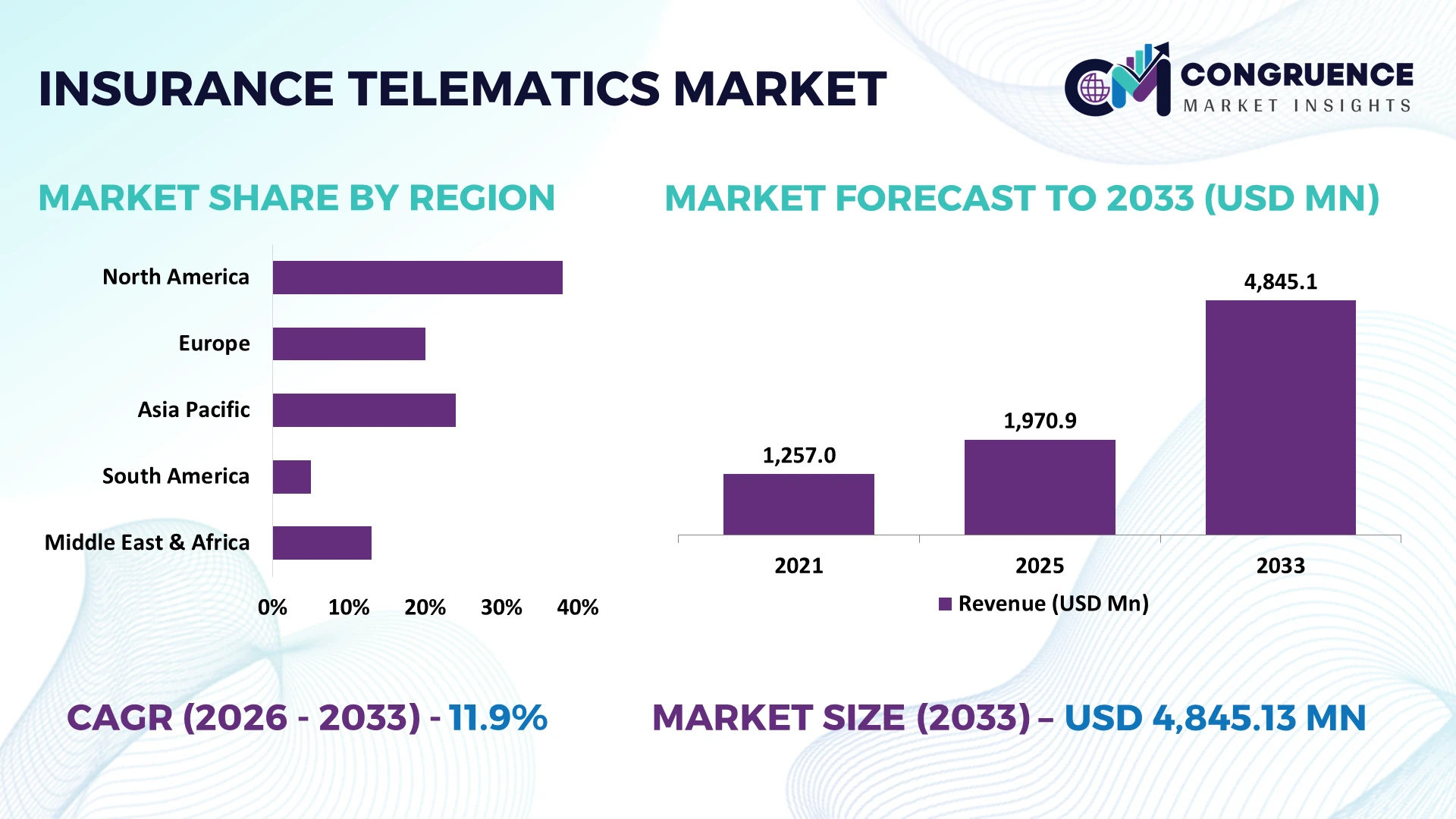
The United States dominates the global Insurance Telematics Market with approximately 36% market share, supported by over 290 million registered vehicles, mature connected-car infrastructure, and sustained insurer investments in AI-driven underwriting. Compared with Germany, where telematics adoption continues accelerating through EV integration and data privacy-compliant platforms, the U.S. benefits from broader insurer participation and large-scale fleet digitization. Ongoing vehicle software innovation amid evolving global automotive supply-chain restructuring further strengthens deployment across advanced insurance ecosystems.
Strategic implication: Companies prioritizing scalable telematics platforms, secure data ecosystems, and AI-enabled claims intelligence will strengthen competitive positioning in high-growth insurance markets.
Market Size & Growth: USD 1970.9 Million (2025) to USD 4845.13 Million (2033) at 11.9% CAGR, fueled by connected vehicles and AI-enabled insurance underwriting.
Top Growth Drivers: Usage-based insurance adoption exceeds 25%, connected vehicle penetration surpasses 60% in advanced markets, and claims processing automation improves operational efficiency by 30%.
Short-Term Forecast: By 2028, insurers reduce claim settlement time by 35% through advanced telematics analytics and digital claims workflows.
Emerging Technologies: AI, edge computing, and real-time IoT vehicle diagnostics improve driver scoring accuracy by over 20% across high-growth insurance platforms.
Regional Leaders: North America (~USD 1.8 Billion), Europe (~USD 1.4 Billion), and Asia-Pacific (~USD 1.2 Billion) lead through connected mobility expansion and digital insurance adoption.
Consumer/End-User Trends: More than 40% of new usage-based policyholders actively use mobile telematics applications for personalized premiums.
Pilot/Case Example: In 2025, AI-based telematics deployment reduced fraudulent claims by approximately 18% while improving customer response speed.
Competitive Landscape: Top providers hold roughly 45% combined share, led by Cambridge Mobile Telematics, OCTO, Verisk, Vodafone Automotive, and LexisNexis Risk Solutions.
Regulatory & ESG Impact: Road safety initiatives support telematics adoption, while eco-driving programs lower fleet fuel consumption by nearly 12% in several markets.
Investment & Funding: Industry investments exceeded USD 1 Billion, emphasizing cloud partnerships, AI platforms, and regional expansion despite evolving automotive supply-chain dynamics.
Innovation & Future Outlook: Next-generation AI, predictive risk modeling, and embedded vehicle connectivity accelerate digital insurance transformation and strengthen data-driven underwriting strategies.
Insurance Telematics Market demand is expanding across passenger vehicles, commercial fleets, and mobility-as-a-service platforms as insurers prioritize behavior-based pricing and automated claims management. AI-powered driving analytics, smartphone telematics, and embedded vehicle connectivity continue advancing product capabilities, while telematics-enabled policy adoption has surpassed 30% in several developed markets. Strengthening vehicle cybersecurity requirements and digital compliance frameworks are reshaping operational strategies, setting the foundation for the strategic discussion ahead.
Insurance telematics has become a strategic differentiator as insurers shift from traditional actuarial models to real-time risk intelligence, enabling more accurate underwriting, personalized pricing, and faster claims resolution. Accelerated digital insurance adoption and connected vehicle deployment, combined with evolving vehicle cybersecurity regulations, are reshaping competitive dynamics. Insurers integrating behavioral data into underwriting report claim frequency reductions of nearly 20%, strengthening profitability while improving customer retention.
Modern AI-enabled telematics platforms process driving events in real time, reducing claims assessment time by approximately 35% compared with legacy rule-based systems while lowering manual fraud investigation workloads by nearly 25%. The United States leads large-scale deployment through mature connected vehicle ecosystems, whereas Japan emphasizes precision telematics integrated with advanced automotive manufacturing and intelligent mobility infrastructure. Over the next two to three years, embedded telematics adoption in newly connected vehicles is expected to exceed 65% across several developed automotive markets.
Fleet insurers increasingly deploy telematics with predictive maintenance and automated first-notice-of-loss capabilities to reduce operational disruption and improve policyholder engagement. Companies are expanding cloud partnerships, investing in AI analytics, and integrating vehicle OEM data into insurance platforms to strengthen ecosystem capabilities. Organizations that combine secure data governance with scalable analytics infrastructure will secure stronger competitive positioning as insurance increasingly evolves into a continuous, data-driven service.
Usage-based insurance is transforming underwriting as insurers increasingly rely on real-time driving behavior instead of historical risk profiles. More than 60% of newly manufactured passenger vehicles in the United States now incorporate connected vehicle capabilities, while insurers report premium personalization improvements exceeding 20% through telematics-driven analytics. Digital insurance regulations supporting electronic policy administration further accelerate implementation. The combination of connected mobility, AI-powered driver scoring, and cloud-native insurance platforms is prompting insurers to expand technology partnerships and invest in embedded telematics ecosystems. Companies aligning with automotive manufacturers and mobility service providers are shortening policy issuance cycles while improving fraud detection accuracy, creating sustainable operational advantages beyond conventional pricing models.
Fragmented data standards and strict privacy regulations continue limiting seamless telematics integration across insurance ecosystems. In Germany, compliance with evolving vehicle data governance frameworks increases deployment complexity, while nearly 30% of insurers continue managing multiple legacy policy administration systems that restrict interoperability. Integration expenses can account for over 15% of digital transformation budgets during large-scale platform modernization. To reduce operational disruption, insurers are adopting standardized APIs, localized cloud infrastructure, and long-term technology partnerships. Organizations prioritizing interoperable architectures gain greater deployment flexibility while reducing implementation delays and lowering long-term system maintenance requirements.
Embedded insurance linked directly with connected vehicles is creating new value beyond conventional policy distribution. Smartphone telematics now supports more than 40% of usage-based insurance enrollments in several developed markets, while AI-driven behavioral analytics improves driver risk segmentation by approximately 25%. South Korea's connected mobility ecosystem and software-defined vehicle initiatives are accelerating insurer collaboration with automotive technology providers. Companies are increasing investment in predictive analytics, digital claims automation, and OEM partnerships to create integrated mobility ecosystems. The greatest opportunity lies in combining telematics with predictive maintenance, enabling insurers to reduce claim severity while delivering differentiated mobility services and long-term customer engagement.
Maintaining secure, scalable telematics infrastructure across millions of connected vehicles remains a significant execution challenge. Cybersecurity incidents targeting automotive software ecosystems continue increasing, while insurers managing cross-platform telematics environments often experience implementation timelines extending by nearly 20% because of integration complexity. The United States faces growing pressure to strengthen connected vehicle cybersecurity alongside expanding software-defined mobility. Companies must invest in zero-trust architectures, encrypted data exchange, and continuous AI-powered threat monitoring while strengthening collaboration with automotive manufacturers and cloud technology providers. Long-term competitiveness will depend on delivering secure, interoperable telematics services without compromising customer trust or operational consistency.
AI-Driven Claims Automation AI-powered telematics platforms are reducing first-notice-of-loss processing time by approximately 35% while improving fraud detection accuracy by nearly 22%. Expanding digital claims regulations and cloud-native insurance workflows are accelerating deployment across enterprise insurers. Companies are integrating predictive analytics, automated damage assessment, and intelligent claims orchestration to lower administrative costs, improve settlement speed, and enhance customer experience without increasing operational complexity.
Embedded Connectivity Becomes Standard More than 65% of newly connected passenger vehicles in developed automotive markets now include embedded telematics, while remote software updates have increased by over 40%. The shift toward software-defined vehicles is reducing dependence on aftermarket hardware and improving data reliability. Insurers are expanding OEM partnerships and integrating factory-installed telematics into underwriting platforms to deliver seamless policy activation and higher-quality driving insights.
Fleet Intelligence Expands Operational Scope Commercial fleet operators report fuel efficiency improvements of approximately 12% and accident reductions approaching 18% through AI-enabled telematics and predictive maintenance. Ongoing logistics workforce shortages are increasing demand for automated fleet monitoring and driver coaching solutions. Insurance providers are scaling integrated fleet platforms that combine vehicle diagnostics, risk analytics, and maintenance intelligence to strengthen operational resilience and reduce claims frequency.
Privacy-First Data Management Models More than 70% of enterprise insurers are strengthening encrypted telematics architectures and consent management frameworks as connected vehicle regulations continue evolving. Increasing cybersecurity requirements are reshaping digital insurance operations through secure cloud infrastructure and standardized APIs. Companies are restructuring data governance strategies to improve interoperability, simplify compliance, and build long-term customer trust while supporting scalable telematics deployment.
Embedded telematics represents the leading segment with an estimated 42% market share because factory-installed connectivity provides continuous vehicle data, superior reliability, and seamless integration with insurer underwriting platforms. Automotive OEMs increasingly deploy embedded systems during production, reducing installation complexity while improving real-time risk assessment. Black Box solutions remain valuable for high-risk driver portfolios requiring verified behavioral data, whereas OBD-Based devices continue serving existing vehicle fleets through cost-effective retrofit deployment.
Smartphone-Based telematics is the fastest-growing segment as insurers accelerate mobile-first insurance programs requiring no dedicated hardware. Smartphone-based policy enrollments have increased by more than 30%, while embedded systems support over 65% of newly connected vehicles across developed automotive markets. Companies are expanding AI-powered driving analytics, strengthening OEM collaborations, and investing in cloud-native telematics ecosystems that improve scalability, customer engagement, and operational efficiency while shifting long-term investment toward software-centric insurance platforms.
Usage-Based Insurance remains the leading application with approximately 44% market share as insurers increasingly adopt behavior-based pricing models that improve underwriting precision and customer retention. Continuous driving analytics enable personalized premium calculation and more accurate risk profiling. Driver Behavior Monitoring remains a mature segment supporting accident prevention initiatives, while Theft Recovery continues delivering operational value through GPS-enabled vehicle tracking and recovery capabilities.
Claims Management is the fastest-growing application as insurers automate accident assessment and digital claims workflows using AI-enabled telematics. Claims processing time has declined by nearly 35%, while driver risk scoring accuracy has improved by approximately 20%. Fleet Insurance continues expanding through predictive maintenance integration and operational monitoring that minimizes downtime. Companies are strengthening cloud-based claims ecosystems, deploying intelligent automation, and integrating connected vehicle data to improve policy servicing and operational performance.
Insurance Companies account for approximately 52% of total demand because they oversee underwriting, pricing, claims operations, and customer engagement across extensive policy portfolios. Their investment in telematics continues increasing as real-time vehicle data strengthens underwriting accuracy and operational efficiency. Fleet Operators remain significant adopters by integrating telematics with fleet safety, predictive maintenance, and operational analytics, while Leasing Companies increasingly deploy connected vehicle technologies to improve asset utilization and lifecycle management.
Automotive OEMs are the fastest-growing end-user segment as embedded connectivity becomes standard across new vehicle platforms. More than 65% of connected vehicle launches now include integrated telematics capabilities, while insurer-OEM partnerships have expanded by approximately 25% in recent years. Companies are developing connected mobility ecosystems, customized insurance offerings, and shared analytics platforms that enhance customer experience while creating long-term competitive differentiation through integrated digital services.
North America accounted for the largest market share at 38.0% in 2025 however, Asia-Pacific is expected to register the fastest growth, expanding at a 13.8% CAGR between 2026 and 2033.

Advanced Connected Vehicle Insurance Ecosystem
North America remains the largest Insurance Telematics Market due to widespread connected vehicle deployment, mature digital insurance infrastructure, and strong insurer investment in AI-based underwriting platforms. The region contributes approximately 38% of global market activity, supported by high penetration of usage-based insurance and extensive integration between insurers, automotive manufacturers, and cloud technology providers. More than 65% of newly connected passenger vehicles support embedded telematics, enabling continuous driver analytics and automated claims workflows. Enterprise insurers continue expanding partnerships with mobility technology providers to improve policy personalization, fraud detection, and operational efficiency. Ongoing vehicle software modernization and cybersecurity requirements are accelerating investment in secure telematics ecosystems capable of supporting large-scale digital insurance operations.
United States Market Outlook: The United States leads regional deployment through its extensive connected vehicle fleet, advanced insurance technology ecosystem, and large concentration of usage-based insurance providers. More than 290 million registered vehicles provide significant deployment opportunities, while AI-enabled underwriting and cloud-native claims platforms continue expanding across major insurers. Strategic collaboration between insurers, automotive OEMs, and technology companies is strengthening embedded telematics adoption and improving operational efficiency throughout the insurance value chain.
Regulatory Compliance Drives Digital Insurance Modernization
Europe maintains a strong position through advanced automotive manufacturing, strict vehicle data governance, and widespread digital insurance transformation. The region accounts for nearly 29% of global market activity, with insurers prioritizing secure telematics deployment that complies with evolving privacy regulations. Connected mobility initiatives and software-defined vehicle adoption continue strengthening embedded telematics integration across passenger and commercial vehicles. More than 55% of newly registered connected vehicles incorporate factory-installed telematics capabilities, supporting accurate driver behavior analysis and streamlined claims management. Companies are increasing investment in interoperable platforms and encrypted data infrastructure to improve regulatory compliance while expanding partnerships with automotive manufacturers and mobility service providers.
Germany Market Outlook: Germany remains the regional technology leader because of its globally competitive automotive manufacturing sector and advanced engineering capabilities. Connected vehicle deployment continues expanding through premium vehicle manufacturers integrating embedded telematics into new models. Strong industrial digitization, intelligent mobility programs, and collaboration between insurers and automotive technology providers are accelerating secure telematics deployment while strengthening digital underwriting and connected insurance capabilities.
Large-Scale Connected Mobility Expansion
Asia-Pacific is emerging as the fastest-expanding Insurance Telematics Market due to accelerating vehicle connectivity, digital insurance adoption, and large-scale smart mobility investments. Rapid growth in passenger vehicle production and increasing smartphone penetration are enabling insurers to deploy telematics solutions across diverse customer segments. Embedded connectivity deployment continues rising as automotive manufacturers integrate intelligent vehicle platforms into new production lines. Connected vehicle installations have expanded by more than 30% across several leading automotive markets, while insurers increasingly adopt AI-powered driver analytics to strengthen pricing accuracy. Companies are expanding regional partnerships, investing in cloud infrastructure, and localizing telematics platforms to address diverse regulatory and operational requirements.
China Market Outlook: China leads regional expansion through its extensive automotive manufacturing capacity, large connected vehicle ecosystem, and strong digital infrastructure. Government support for intelligent transportation and software-defined vehicles continues encouraging embedded telematics deployment across domestic vehicle production. Rapid growth in electric vehicles and digital insurance platforms is enabling insurers to integrate real-time vehicle data into underwriting, claims management, and customer engagement strategies.
Fleet Digitalization Accelerates Adoption
South America is witnessing increasing telematics deployment as insurers modernize commercial fleet insurance and expand digital policy management capabilities. Brazil and neighboring markets are adopting connected vehicle technologies to improve fleet safety, driver monitoring, and operational efficiency. Commercial fleet telematics deployments have improved fuel efficiency by approximately 10% while reducing accident-related operational losses through continuous driver analytics. Infrastructure modernization and expanding mobile connectivity are supporting broader implementation, although varying digital maturity across countries continues influencing deployment consistency. Companies are strengthening technology partnerships and investing in scalable cloud platforms to improve operational performance while expanding telematics-based insurance offerings.
Brazil Market Outlook: Brazil represents the region's largest insurance telematics market due to its substantial commercial vehicle fleet and expanding digital insurance ecosystem. Large logistics operators increasingly integrate telematics with fleet management platforms to improve operational visibility and reduce claims frequency. Continued investment in connected mobility infrastructure and digital insurance technologies is supporting broader adoption across commercial and passenger vehicle segments.
Smart Mobility Investment Reshapes Insurance Operations
The Middle East & Africa Insurance Telematics Market is advancing through smart city initiatives, digital insurance modernization, and expanding connected mobility infrastructure. Countries across the Gulf are investing in intelligent transportation systems that strengthen demand for telematics-enabled insurance solutions. Connected fleet deployment has increased by approximately 20% across major logistics operations, supporting improved driver monitoring and vehicle utilization. Insurance providers are expanding partnerships with mobility technology firms while adopting cloud-native underwriting platforms to improve operational efficiency. Although infrastructure maturity varies across the region, targeted investments in digital mobility and enterprise connectivity continue strengthening long-term deployment potential.
United Arab Emirates Market Outlook: The United Arab Emirates leads regional adoption through advanced digital infrastructure, smart mobility initiatives, and strong investment in connected transportation technologies. National digital transformation programs continue supporting insurer adoption of AI-enabled telematics platforms for fleet insurance and personalized policy management. Collaboration between insurers, automotive companies, and technology providers is accelerating deployment of secure, data-driven insurance ecosystems across commercial and personal mobility segments.
The Insurance Telematics Market is led by Cambridge Mobile Telematics, OCTO, Verisk, LexisNexis Risk Solutions, and Vodafone Automotive, competing against regional telematics providers, automotive OEM platforms, and insurtech specialists. The top five companies collectively account for approximately 45% of the market, while regional vendors compete through localized deployment and insurer-specific customization. Technology capability, AI-driven analytics, deployment speed, and secure data integration have overtaken price as primary differentiators. AI-enabled risk scoring improves underwriting accuracy by nearly 20%, while automated claims workflows reduce processing time by approximately 35%, creating measurable operational advantages. Leading companies are expanding through OEM collaborations, cloud partnerships, embedded telematics integration, and predictive analytics innovation to strengthen customer retention and platform scalability. Competition is shifting toward software-defined vehicle ecosystems where access to connected vehicle data determines long-term advantage. High cybersecurity compliance requirements and deep insurer integration create significant entry barriers. Winning requires scalable AI platforms, trusted data governance, strong automotive partnerships, and continuous product innovation.
Cambridge Mobile Telematics
OCTO Group
Verisk
LexisNexis Risk Solutions
Vodafone Automotive
IMS (Intelligent Mechatronic Systems)
Zubie
The Floow
Arity
MiX Telematics
Trakm8 Holdings
Geotab
Artificial intelligence, edge computing, and embedded vehicle connectivity are redefining insurance telematics by transforming real-time driving data into predictive underwriting and automated claims intelligence. More than 65% of newly connected vehicles now support embedded telematics, while AI-based driver risk models improve underwriting accuracy by approximately 20%. Insurers increasingly integrate cloud-native analytics with connected vehicle platforms to accelerate policy personalization and strengthen operational decision-making across large customer portfolios.
Legacy Black Box systems primarily collected periodic driving records, whereas modern embedded and AI-enabled telematics platforms process continuous vehicle data, reducing claims assessment time by nearly 35% and lowering fraud investigation workloads by approximately 22%. Smartphone-based telematics adoption has exceeded 40% across several digital insurance programs because deployment requires minimal hardware investment. Technology leaders and automotive OEMs gain the greatest competitive advantage by integrating secure vehicle data directly into underwriting, claims management, and customer engagement platforms.
Between 2026 and 2028, software-defined vehicles, predictive risk engines, and privacy-preserving data architectures will become strategic technology priorities. Digital twin analytics and generative AI-assisted claims processing will improve operational efficiency by approximately 15% while enhancing decision consistency. Insurers investing early in interoperable telematics ecosystems, cybersecurity, and OEM partnerships will strengthen competitive positioning, accelerate product innovation, and create scalable digital insurance platforms capable of supporting future connected mobility services.
July 2024 Cambridge Mobile Telematics and Hastings Direct renewed their long-term partnership to expand the YouDrive smartphone-based insurance program using DriveWell Fusion AI. The platform continues supporting real-time driver scoring for 100% app-based participation, strengthening personalized underwriting and customer retention. Source: cmtelematics.com
March 2025 OCTO was selected by ABAX Group's Fair insurance business as its AI-powered risk scoring partner following a 6-month competitive evaluation process. The deployment improves pricing precision and claims correlation, reinforcing OCTO's expansion across Nordic usage-based insurance operations. Source: globenewswire.com
October 2025 Mobilisights partnered with OCTO to combine connected vehicle data from 14 Stellantis automotive brands with advanced telematics analytics. The collaboration enables enhanced crash detection, fleet optimization, and insurance data services, accelerating embedded telematics deployment across connected mobility ecosystems. Source: stellantis.com
May 2026 OCTO and Sedgwick announced a strategic partnership integrating telematics analytics with global claims management services through a telematics-agnostic platform supporting multiple connected vehicle data sources. The collaboration improves claims accuracy, fraud validation, and operational efficiency across insurance and fleet markets. Source: octotelematics.com
The report provides comprehensive analysis of the Insurance Telematics Market across OBD-Based, Smartphone-Based, Embedded, and Black Box solutions, together with detailed assessment of Usage-Based Insurance, Driver Behavior Monitoring, Claims Management, Fleet Insurance, and Theft Recovery applications. It further evaluates demand across Insurance Companies, Fleet Operators, Automotive OEMs, and Leasing Companies while covering North America, Europe, Asia-Pacific, South America, and the Middle East & Africa. Embedded telematics now supports more than 65% of connected vehicle deployments in advanced automotive markets, reflecting accelerating digital insurance transformation.
The study evaluates competitive positioning, deployment strategies, technology adoption, regulatory developments, AI integration, connected vehicle ecosystems, and enterprise partnerships shaping industry evolution between 2026 and 2033. It benchmarks leading participants, compares operational capabilities, and identifies emerging opportunities across software-defined vehicles, cloud-native insurance platforms, predictive analytics, and embedded mobility services. The report supports expansion planning, investment prioritization, product development, and long-term strategic decision-making through actionable segmentation, regional intelligence, and technology-focused market assessment.
| Report Attribute/Metric | Report Details |
|---|---|
Market Revenue in 2025 | USD 1970.9 Million |
Market Revenue in 2033 | USD 4845.13 Million |
CAGR (2026 - 2033) | 11.9% |
Base Year | 2025 |
Forecast Period | 2026 - 2033 |
Historic Period | 2021 - 2025 |
Segments Covered | By Type
By Application
By End-User
|
Key Report Deliverable | Revenue Forecast, Growth Trends, Market Dynamics, Segmental Overview, Regional and Country-wise Analysis, Competition Landscape |
Region Covered | North America, Europe, Asia-Pacific, South America, Middle East, Africa |
Key Players Analyzed | Cambridge Mobile Telematics, OCTO Group, Verisk, LexisNexis Risk Solutions, Vodafone Automotive, IMS (Intelligent Mechatronic Systems), Zubie, The Floow, Arity, MiX Telematics, Trakm8 Holdings, Geotab |
Customization & Pricing | Available on Request (10% Customization is Free) |




