
Reports
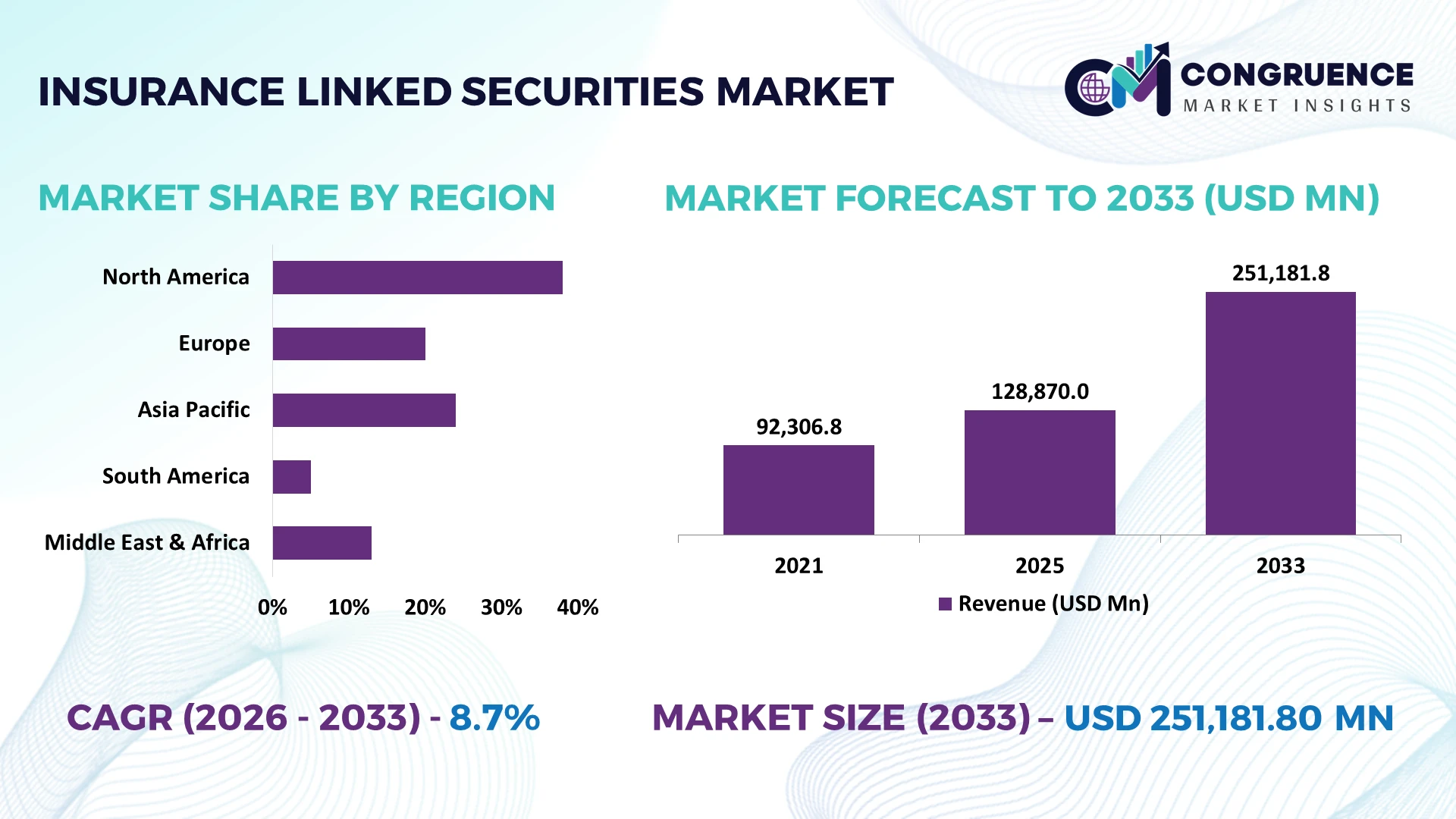
The Global Insurance-Linked Securities Market was valued at USD 128870 Million in 2025 and is anticipated to reach a value of USD 251181.8 Million by 2033 expanding at a CAGR of 8.7% between 2026 and 2033. Growth is driven by catastrophe reinsurance capacity diversification, institutional investment in collateralized risk transfer, rising insured catastrophe exposures, and expanding catastrophe bond issuance supported by advanced risk modeling.
The United States dominates global insurance linked securities activity through catastrophe bond sponsorship, institutional capital allocation, and extensive property catastrophe insurance exposures. US named storm and earthquake risks represent major components of catastrophe bond portfolios, while outstanding catastrophe bond and related ILS capital exceeded USD 50 billion during 2025. Compared with Bermuda, which provides specialized reinsurance structuring infrastructure, the United States contributes substantial underlying insured risk. Advanced catastrophe modeling and parametric triggers are strengthening transaction execution, while hurricane exposure continues influencing investment allocation.
Strategic implication: Insurers and institutional investors prioritizing diversified catastrophe exposures, transparent risk modeling, and efficient collateral structures strengthen capital efficiency and competitive positioning.
Market Size & Growth: USD 128,870 million in 2025, reaching USD 251,181.8 million by 2033 at 8.7% CAGR, supported by catastrophe reinsurance capacity diversification.
Top Growth Drivers: Modeled contributions include catastrophe risk transfer at 45%, institutional diversification at 35%, and collateralized reinsurance at 20%.
Short Term Forecast: By 2028, automated catastrophe modeling targets 15% faster transaction analysis and 10% lower underwriting processing costs.
Emerging Technologies: AI catastrophe modeling, satellite analytics, and blockchain collateral administration target 20% faster risk assessment and settlement workflows.
Regional Leaders: Illustrative 2033 allocations place North America at USD 110,520 million, Europe at USD 65,307 million, and Asia Pacific at USD 45,213 million, reflecting catastrophe issuance, institutional allocation, and parametric adoption.
Consumer / End User Trends: A modeled 40% institutional allocation concentration highlights demand for diversified catastrophe bond portfolios and collateralized reinsurance strategies.
Pilot / Case Example: A proposed 2027 parametric catastrophe bond program targets 30% faster loss verification through predefined event triggers.
Competitive Landscape: Swiss Re represents a major market participant; an illustrative 12% leadership share frames competition with Munich Re, RenaissanceRe, Aon, and Nephila Capital.
Regulatory & ESG Impact: Bermuda's ILS regulatory framework supports collateralized structures, while digital administration programs target 15% lower documentation processing requirements.
Investment & Funding: An illustrative USD 10 billion capital deployment scenario prioritizes catastrophe bond portfolios, collateralized reinsurance, and diversified institutional risk strategies.
Innovation & Future Outlook: By 2033, advanced parametric triggers and integrated catastrophe analytics target 20% faster transaction execution and improved capital allocation efficiency.
The Insurance-Linked Securities Market connects institutional investors with catastrophe and insurance risk through catastrophe bonds, collateralized reinsurance, and specialized risk transfer structures. Demand concentrates among reinsurers, insurers, pension funds, hedge funds, and dedicated ILS investment managers seeking diversified exposures. Advanced catastrophe modeling integrates satellite observations, geospatial analytics, and probabilistic event simulations to improve underwriting transparency. A targeted 15% reduction in transaction analysis time represents a practical operational improvement benchmark. Bermuda's established special purpose insurer framework and Singapore's ILS development initiatives are influencing international structuring activity, establishing important priorities for capital deployment and competitive differentiation.
The Insurance Linked Securities Market is becoming strategically important as insurers transfer catastrophe exposures to institutional capital markets, reducing dependence on conventional reinsurance capacity. Outstanding catastrophe bond and related securities capital exceeded USD 50 billion during 2025, demonstrating institutional participation in alternative risk transfer. United States hurricane exposure remains a major transaction driver, while Bermuda provides established special purpose insurer infrastructure. Increasing catastrophe losses and regulatory capital requirements are encouraging insurers to diversify risk financing arrangements and strengthen collateralized protection strategies.
Technology modernization is improving catastrophe risk assessment and transaction execution. Compared with traditional spreadsheet based underwriting, integrated catastrophe modeling platforms target 15% faster risk analysis and approximately 10% lower administrative processing costs under optimized workflows. Satellite observations, geospatial analytics, and automated exposure aggregation improve portfolio transparency. Bermuda emphasizes transaction structuring and collateral administration, whereas Singapore supports emerging Asian insurance risk securitization. Between 2026 and 2028, advanced ILS managers are prioritizing automated portfolio monitoring and improved event loss estimation.
A practical deployment involves structuring a hurricane catastrophe bond using modeled loss triggers, collateralized special purpose vehicles, and automated exposure monitoring. Reinsurers are strengthening partnerships with institutional investors and catastrophe analytics providers. Competitive advantage increasingly depends on transparent risk pricing, efficient capital deployment, and reliable claims settlement mechanisms.
Increasing insured catastrophe exposures and pressure on traditional reinsurance capacity are accelerating institutional participation in insurance linked securities. United States hurricane and earthquake risks remain central to catastrophe bond issuance, while Bermuda provides established collateralized reinsurance infrastructure. In a modeled insurer portfolio, transferring 15% of peak catastrophe exposure into capital markets can reduce retained concentration and diversify protection capacity. A 10% increase in modeled catastrophe loss estimates can materially influence attachment points, investor pricing, and collateral requirements. Insurers are expanding catastrophe bond programs, strengthening relationships with institutional investors, and adopting advanced exposure analytics. The strategic advantage lies in securing multiyear protection with predefined contractual terms, reducing dependence on annual reinsurance renewal negotiations and improving catastrophe capital planning.
Insurance linked securities face structural limitations from catastrophe risk pricing volatility, collateral requirements, and concentrated exposure to United States natural disasters. Fully collateralized catastrophe bonds typically require 100% collateralization of the covered principal, restricting capital flexibility for investors and transaction sponsors. A modeled 15% increase in required risk spreads raises protection costs, while a 10% reduction in available investor capacity can constrain issuance execution. Hurricane loss uncertainty and elevated catastrophe activity influence pricing negotiations, particularly for Florida property exposures. Bermuda based structures also require specialized legal, actuarial, and collateral administration capabilities. Sponsors are reducing financing uncertainty through staggered issuance schedules, diversified peril coverage, and multiyear investor relationships. Efficient collateral management and disciplined transaction timing remain essential for maintaining economically viable risk transfer arrangements.
Parametric insurance linked securities present opportunities to expand catastrophe protection beyond established hurricane and earthquake portfolios. Satellite observations, seismic monitoring, and predefined event parameters enable automated trigger verification and more transparent settlement processes. Optimized parametric structures target 20% to 30% faster event verification compared with complex indemnity assessment workflows, depending on contractual design. Japan offers opportunities for earthquake protection, while Singapore provides infrastructure for Asian catastrophe risk securitization. A modeled 15% diversification allocation toward additional geographic perils can reduce dependence on concentrated United States exposures. Insurers and specialized investment managers are developing alternative trigger structures, expanding catastrophe modeling partnerships, and evaluating emerging agricultural and infrastructure risks. The strongest opportunity involves converting previously difficult to transfer exposures into standardized, investable catastrophe risk instruments.
Scaling insurance linked securities requires consistent catastrophe modeling, transparent exposure data, and reliable integration between insurers, investment managers, and collateral administrators. Climate related hazard changes challenge historical loss assumptions, particularly for United States hurricanes, wildfires, and severe convective storms. A 10% divergence between competing catastrophe models can materially influence transaction pricing and portfolio risk limits. Investment managers targeting 95% exposure data completeness must reconcile property characteristics, geographic coordinates, and insurance policy information across multiple systems. Cybersecurity requirements also intensify as transaction workflows adopt interconnected analytics platforms. Companies are investing in independent model validation, standardized exposure databases, and specialized catastrophe analytics partnerships. Long term competitiveness depends on controlling model uncertainty, maintaining investor confidence, and ensuring reliable transaction performance during extreme catastrophe events.
Catastrophe Bond Maturities Encourage Refinancing: Insurance sponsors are increasingly coordinating replacement issuance before existing catastrophe bonds mature, reducing protection gaps during renewal periods. Typical transactions provide 3 years of coverage, while selected structures extend protection to 4 years. United States insurers are aligning issuance calendars with hurricane exposure assessments. Investment banks and reinsurance intermediaries are expanding placement coordination, helping sponsors maintain protection continuity and reduce dependence on annual renewal negotiations.
Secondary Market Liquidity Gains Importance: Institutional investors increasingly evaluate catastrophe bond liquidity alongside modeled loss expectations and contractual attachment points. Portfolio managers monitor 2 critical indicators: secondary trading spreads and expected loss estimates. Bermuda based investment managers are strengthening relationships with specialized trading counterparties, while European investors are refining liquidity allocation limits. More active portfolio rebalancing improves exposure management, although transaction pricing remains sensitive to catastrophe events and investor concentration.
Collateral Investment Strategies Become More Disciplined: Insurance linked securities managers are refining collateral administration as interest rate movements influence investment returns and counterparty exposure. Fully collateralized structures generally maintain collateral equivalent to 100% of covered principal, while treasury backed arrangements prioritize liquidity preservation. Bermuda administrators increasingly coordinate collateral accounts with specialized custodians and investment managers. These arrangements improve transparency, strengthen transaction security, and reduce operational uncertainty during catastrophe loss settlement and collateral release.
Investor Reporting Becomes More Granular: Catastrophe bond investors increasingly request detailed geographic exposure, peril concentration, and model sensitivity information before allocating capital. Portfolio reporting now emphasizes 3 analytical dimensions: geographic aggregation, modeled loss distributions, and trigger characteristics. Swiss and United Kingdom investment managers are strengthening standardized reporting frameworks and portfolio monitoring dashboards. Improved disclosure supports investment committee decisions, strengthens risk comparison, and reduces information asymmetry between transaction sponsors and institutional capital providers.
Catastrophe Bonds represent the leading Insurance Linked Securities Market segment, with an estimated 40% share, supported by standardized issuance structures, institutional investor accessibility, and established secondary trading mechanisms. Their multiyear protection characteristics enable insurers to transfer defined catastrophe exposures while reducing dependence on conventional reinsurance renewals. Collateralized Reinsurance accounts for an estimated 30%, offering customized protection structures and direct participation in insurance risk portfolios. Bermuda remains an important transaction jurisdiction because of its specialized insurance regulatory infrastructure and established collateral administration capabilities. Investment managers are expanding catastrophe bond portfolios and strengthening institutional placement relationships.
Sidecars represent the fastest growing type under an illustrative market scenario, supported by insurers seeking dedicated capital participation in selected underwriting portfolios. Industry Loss Warranties provide event based protection linked to independently reported industry losses, while Mortality Linked Securities address exceptional mortality exposures. Longevity Linked Securities support the transfer of unexpected longevity risk associated with retirement liabilities. Market participants are prioritizing transaction customization, portfolio diversification, and improved risk transparency. Investment strategies increasingly balance tradability against customized protection requirements.
Natural Disaster Risk Transfer represents the largest application segment, accounting for an estimated 45% of the global Insurance Linked Securities Market. Hurricane, earthquake, wildfire, and severe storm exposures drive transaction activity because insurers require additional protection against concentrated catastrophe losses. United States hurricane risks remain particularly important, while Japan contributes earthquake related securitization opportunities. Property and Casualty Risk Transfer represents approximately 25%, supporting broader underwriting portfolio protection and structured catastrophe exposure management. Reinsurance Capacity Management enables insurers and reinsurers to diversify capital providers and establish multiyear protection arrangements. Sponsors are strengthening catastrophe analytics capabilities and coordinating issuance with institutional investment demand.
Mortality and Longevity Risk Management represents the fastest growing application under an illustrative adoption scenario, supported by increasing attention to retirement liabilities and demographic uncertainty. Life Insurance Risk Transfer remains specialized, focusing on mortality exposures and structured insurance obligations. Asset managers are developing customized risk portfolios, while reinsurers are evaluating alternative capital structures for liability management. Competitive differentiation increasingly depends on reliable risk measurement, transparent contractual triggers, and access to investors with appropriate liability duration preferences.
Reinsurance Companies represent the leading end user category, accounting for an estimated 35% of Insurance Linked Securities Market activity, reflecting their central role in catastrophe risk aggregation, underwriting capacity management, and alternative capital transactions. Bermuda based reinsurers utilize collateralized structures and catastrophe bonds to diversify protection arrangements and support capital deployment. Insurance Companies account for approximately 30%, particularly through property catastrophe programs and multiyear protection transactions. United States insurers prioritize hurricane exposure management, while Japanese insurers emphasize earthquake protection. Reinsurance intermediaries are strengthening relationships with institutional capital providers and expanding specialized transaction advisory capabilities.
Institutional Investors represent the fastest growing end user category under an illustrative allocation scenario, supported by interest in catastrophe risk diversification and investment strategies with limited direct exposure to conventional financial market movements. Asset Management Firms provide specialized portfolio construction, catastrophe modeling, and investment administration capabilities. Pension Funds participate selectively through dedicated investment mandates and diversified alternative asset allocations. Market participants are developing customized risk portfolios, improving investor reporting, and strengthening collateral governance. Competitive positioning increasingly depends on transparent risk selection, investment liquidity, and reliable portfolio administration.
North America accounted for the largest market share at an estimated 44% in 2025 however, Asia Pacific is expected to register the fastest growth, expanding at a CAGR of approximately 11.2% between 2026 and 2033.
Catastrophe Bond Issuance Strengthens Alternative Capital Deployment
North America accounts for an estimated 44% of global Insurance Linked Securities Market activity, supported by extensive property catastrophe exposures, established institutional investment infrastructure, and sophisticated reinsurance purchasing strategies. The United States dominates transaction sponsorship, particularly through hurricane, earthquake, wildfire, and severe convective storm protection programs. Outstanding catastrophe bonds and related insurance linked securities exceeded USD 50 billion globally during 2025, with United States catastrophe exposures representing a substantial component. Insurers increasingly integrate catastrophe bonds with conventional reinsurance treaties to diversify capital providers and secure multiyear protection. Advanced catastrophe modeling, geospatial exposure analytics, and collateralized special purpose vehicles support transaction execution. Investment managers are strengthening portfolio monitoring and investor reporting capabilities. Competitive positioning depends on accurate catastrophe pricing, transparent contractual triggers, and access to institutional capital capable of absorbing concentrated natural disaster exposures.
United States Market Outlook: The United States maintains a leading position through extensive property insurance exposures, sophisticated capital markets, and established catastrophe risk modeling infrastructure. Florida represents an important hurricane risk transfer market, while California contributes earthquake and wildfire exposures. The California Earthquake Authority and Citizens Property Insurance Corporation illustrate the role of public insurance entities in catastrophe risk financing. Securities regulation, specialized transaction advisers, and institutional investor participation support structured issuance. Insurers increasingly prioritize diversified protection layers and transparent exposure modeling.
Institutional Capital Allocation Strengthens Risk Securitization
Europe represents an estimated 26% of global Insurance Linked Securities Market activity, supported by established reinsurance institutions, specialized investment managers, and sophisticated insurance risk analytics. Switzerland, Germany, the United Kingdom, and France contribute through catastrophe underwriting, investment management, and institutional capital allocation. Swiss Re and Munich Re maintain established catastrophe risk expertise, while London provides extensive insurance brokerage and structured risk transfer capabilities. European Solvency II requirements influence capital management and encourage evaluation of alternative risk financing arrangements. Investment managers increasingly emphasize diversified catastrophe bond portfolios, transparent modeled loss estimates, and collateral security. Automated portfolio monitoring targets approximately 15% faster exposure analysis under optimized operating conditions. European investors also assess climate related catastrophe concentrations and secondary market liquidity. Competitive advantage depends on specialized underwriting expertise, disciplined portfolio construction, and dependable institutional investor relationships.
Switzerland Market Outlook: Switzerland benefits from established global reinsurance institutions, sophisticated asset management capabilities, and specialized catastrophe risk modeling expertise. Zurich serves as an important center for insurance risk assessment, institutional investment management, and international reinsurance operations. Swiss Re participates in catastrophe risk transfer through underwriting expertise and capital markets activities. Swiss investment managers evaluate modeled catastrophe losses, portfolio diversification, and collateral arrangements when allocating capital. Advanced analytical infrastructure supports international transaction structuring and investment risk assessment.
Catastrophe Exposure Diversification Accelerates Market Development
Asia Pacific represents an estimated 18% of global Insurance Linked Securities Market activity, supported by earthquake, typhoon, and flood exposures across Japan, China, Australia, and Southeast Asia. Japan maintains established earthquake risk financing requirements, while Singapore provides specialized infrastructure for insurance linked securities issuance and international transaction structuring. Singapore's Monetary Authority has supported catastrophe bond development through regulatory initiatives and transaction grant arrangements. Japanese insurers increasingly evaluate capital market protection alongside conventional catastrophe reinsurance programs. Advanced seismic modeling, typhoon simulation, and geospatial exposure analytics support transaction underwriting. Institutional investors are expanding familiarity with catastrophe bond structures and diversified risk portfolios. Optimized digital transaction workflows target approximately 10% lower administrative processing requirements. Competitive positioning depends on transparent catastrophe data, supportive regulatory frameworks, and specialized partnerships connecting insurance sponsors with international institutional capital providers.
Japan Market Outlook: Japan represents a strategically important market because of substantial earthquake and typhoon exposures, sophisticated insurance institutions, and established catastrophe modeling capabilities. Tokyo provides extensive insurance underwriting and institutional investment infrastructure. Japanese insurers utilize catastrophe risk transfer arrangements to manage concentrated natural disaster exposures. The country's seismic monitoring network supports detailed earthquake risk assessment and structured protection design. Advanced catastrophe analytics and international reinsurance relationships strengthen the feasibility of catastrophe bond sponsorship and institutional capital participation.
Agricultural Catastrophe Exposure Encourages Alternative Risk Financing
South America represents an estimated 7% of global Insurance Linked Securities Market activity, supported by agricultural insurance requirements, flood exposures, and expanding catastrophe risk management capabilities. Brazil, Chile, Colombia, and Peru present distinct opportunities for structured insurance risk transfer. Brazil's extensive agricultural sector creates exposure to drought, flooding, and severe weather, while Chile faces significant earthquake risks. Regional insurance markets remain more dependent on conventional reinsurance than established catastrophe bond markets. Limited catastrophe modeling coverage, transaction structuring expertise, and institutional investor participation constrain wider adoption. Insurance companies are evaluating international partnerships and improved exposure databases to strengthen catastrophe financing capabilities. Parametric risk structures offer opportunities for agricultural and infrastructure protection, particularly where conventional loss assessment is operationally complex. Competitive development depends on reliable catastrophe data, regulatory coordination, and access to specialized international investment managers.
Brazil Market Outlook: Brazil benefits from substantial agricultural insurance activity, established financial institutions, and growing attention to climate related catastrophe exposures. São Paulo provides important insurance underwriting, reinsurance brokerage, and institutional investment infrastructure. The Brazilian insurance regulator SUSEP oversees insurance and reinsurance activities, influencing structured risk transfer development. Agricultural producers face material drought and flood exposures, creating opportunities for alternative catastrophe protection. Insurance companies are strengthening risk modeling partnerships and evaluating capital market solutions for concentrated agricultural portfolios.
Climate Risk Financing Encourages Capital Market Innovation
The Middle East and Africa region represents an estimated 5% of global Insurance Linked Securities Market activity, supported by infrastructure insurance requirements, climate risk financing initiatives, and developing institutional investment capabilities. The United Arab Emirates and Saudi Arabia provide established financial infrastructure, while South Africa contributes through sophisticated insurance and asset management institutions. African economies face significant drought, flood, and agricultural catastrophe exposures, creating opportunities for alternative risk financing arrangements. The African Risk Capacity framework demonstrates the importance of structured disaster protection for participating governments. However, limited catastrophe data, specialized transaction expertise, and institutional investment infrastructure constrain broader securitization. Insurance providers are strengthening international reinsurance partnerships and evaluating parametric protection arrangements. Advanced geospatial monitoring and climate analytics improve risk assessment capabilities. Long term competitiveness depends on transparent regulation, reliable exposure information, and institutional capital participation.
United Arab Emirates Market Outlook: The United Arab Emirates benefits from established international financial centers, sophisticated insurance distribution, and expanding institutional investment infrastructure. Dubai International Financial Centre and Abu Dhabi Global Market provide regulated environments supporting financial services and structured investment activities. The country's insurance sector operates under Central Bank supervision, while specialized financial center regulations support international investment operations. Insurance institutions are evaluating advanced risk analytics and international reinsurance partnerships to strengthen catastrophe protection and capital management capabilities.
The global Insurance Linked Securities Market features competition between Swiss Re, Munich Re, RenaissanceRe, Aon, and specialized investment managers including Fermat Capital Management. These participants collectively represent an illustrative 35% share of relevant transaction activity, reflecting diversified underwriting, structuring, and investment functions. Swiss Re and Munich Re compete through catastrophe underwriting expertise, while RenaissanceRe emphasizes alternative capital management and collateralized risk participation. Aon differentiates through transaction advisory and institutional placement capabilities. Specialized managers compete through portfolio construction, catastrophe modeling, and investor access. Advanced analytics programs target 15% faster risk assessment, while automated administration seeks approximately 10% lower processing costs. Companies are expanding investor partnerships, strengthening catastrophe data infrastructure, and developing customized protection structures. Regulatory expertise, collateral requirements, and sophisticated risk modeling create substantial entry barriers. Competitive success requires transparent pricing, dependable capital access, specialized underwriting capabilities, and efficient transaction execution across diversified catastrophe portfolios.
Swiss Re Ltd.
Munich Re Group
RenaissanceRe Holdings Ltd.
Aon plc
Marsh McLennan
Hannover Re SE
SCOR SE
Fermat Capital Management, LLC
Twelve Capital AG
Leadenhall Capital Partners LLP
Securis Investment Partners LLP
Nephila Capital Ltd.
Elementum Advisors, LLC
Aeolus Capital Management Ltd.
Catastrophe modeling platforms, geospatial analytics, and automated exposure aggregation underpin insurance linked securities underwriting. Probabilistic models integrate historical losses, property characteristics, and hazard simulations to estimate attachment probabilities. Compared with spreadsheet based assessment, integrated modeling workflows target 15% faster exposure analysis and 10% lower administrative processing costs. Adoption is established among major catastrophe bond sponsors, reinsurers, and specialized investment managers. Swiss and Bermudian institutions increasingly combine portfolio analytics with standardized transaction documentation, improving risk transparency and institutional capital allocation decisions.
Emerging technologies include artificial intelligence loss forecasting, satellite observation systems, and automated collateral administration. Machine learning workflows target 12% faster scenario evaluation, while digital collateral reconciliation offers potential processing efficiency improvements of 15%. Deployment concentrates in sophisticated reinsurance operations and institutional investment platforms. Automated data validation reduces inconsistencies between underwriting records and investment reporting. Specialized managers benefit through faster portfolio adjustments, whereas smaller sponsors face higher integration requirements and technology investment barriers.
Between 2026 and 2028, advanced catastrophe analytics will increasingly incorporate climate adjusted hazard models, application programming interfaces, and continuous portfolio monitoring. Digital trigger verification offers opportunities for faster settlement administration. Investment managers prioritizing interoperable analytics and independent model validation will strengthen pricing discipline, operational resilience, and investor confidence across catastrophe risk portfolios.
December 2025: Swiss Re Capital Markets structured and placed a USD 400 million Topanga Re catastrophe bond for Farmers Insurance Group, incorporating innovative reinstatement protection. The transaction broadened coverage against United States storms, earthquakes, severe weather, and fire. Source: swissre.com
August 2026: Aon reported alternative reinsurance capital reaching USD 144.5 billion, alongside record catastrophe bond issuance and expanding casualty sidecars. Its annual market assessment documented stronger institutional investor participation, supporting broader risk transfer options for insurers and reinsurers. Source: aon.mediaroom.com
February 2026: Allstate secured USD 1.2 billion of multiyear catastrophe reinsurance through two Sanders Re bond issuances, its largest single market placement. Four and five year protection strengthened funding certainty and diversified the insurer's catastrophe reinsurance protection tower. Source: artemis.bm
November 2025: The World Bank confirmed a 100% payout on Jamaica's catastrophe bond after Hurricane Melissa satisfied predefined parametric triggers. Independent storm verification unlocked USD 150 million of disaster protection, demonstrating the operational effectiveness of sovereign risk securitization. Source: worldbank.org
The Insurance Linked Securities Market Report evaluates industry developments between 2026 and 2033 across Catastrophe Bonds, Industry Loss Warranties, Collateralized Reinsurance, Sidecars, Mortality Linked Securities, and Longevity Linked Securities. Application coverage includes Natural Disaster Risk Transfer, Property and Casualty Risk Transfer, Life Insurance Risk Transfer, Reinsurance Capacity Management, and Mortality and Longevity Risk Management. End user analysis examines Insurance Companies, Reinsurance Companies, Pension Funds, Asset Management Firms, and Institutional Investors.
Regional coverage spans North America, Europe, Asia Pacific, South America, and the Middle East and Africa, with North America representing an estimated 44% market share. Technology analysis examines catastrophe modeling, artificial intelligence, parametric triggers, and automated collateral administration. Competitive assessments support investment allocation, transaction structuring, geographic expansion, institutional partnerships, and strategic positioning across emerging insurance risk securitization opportunities.
| Report Attribute/Metric | Report Details |
|---|---|
Market Revenue in 2025 | USD 128870 Million |
Market Revenue in 2033 | USD 251181.8 Million |
CAGR (2026 - 2033) | 8.7% |
Base Year | 2025 |
Forecast Period | 2026 - 2033 |
Historic Period | 2021 - 2025 |
Segments Covered | By Type
By Application
By End-User
|
Key Report Deliverable | Revenue Forecast, Growth Trends, Market Dynamics, Segmental Overview, Regional and Country-wise Analysis, Competition Landscape |
Region Covered | North America, Europe, Asia-Pacific, South America, Middle East, Africa |
Key Players Analyzed | Swiss Re Ltd., Munich Re Group, RenaissanceRe Holdings Ltd., Aon plc, Marsh McLennan, Hannover Re SE, SCOR SE, Fermat Capital Management, LLC, Twelve Capital AG, Leadenhall Capital Partners LLP, Securis Investment Partners LLP, Nephila Capital Ltd., Elementum Advisors, LLC, Aeolus Capital Management Ltd. |
Customization & Pricing | Available on Request (10% Customization is Free) |




