
Reports
The Global Insulated Concrete Form Market was valued at USD 1493.19 Million in 2025 and is anticipated to reach a value of USD 2362.01 Million by 2033 expanding at a CAGR of 5.9% between 2026 and 2033. Growth is driven by stringent building energy regulations, demand for disaster resistant construction, expanding residential development and adoption of thermally efficient concrete wall systems.
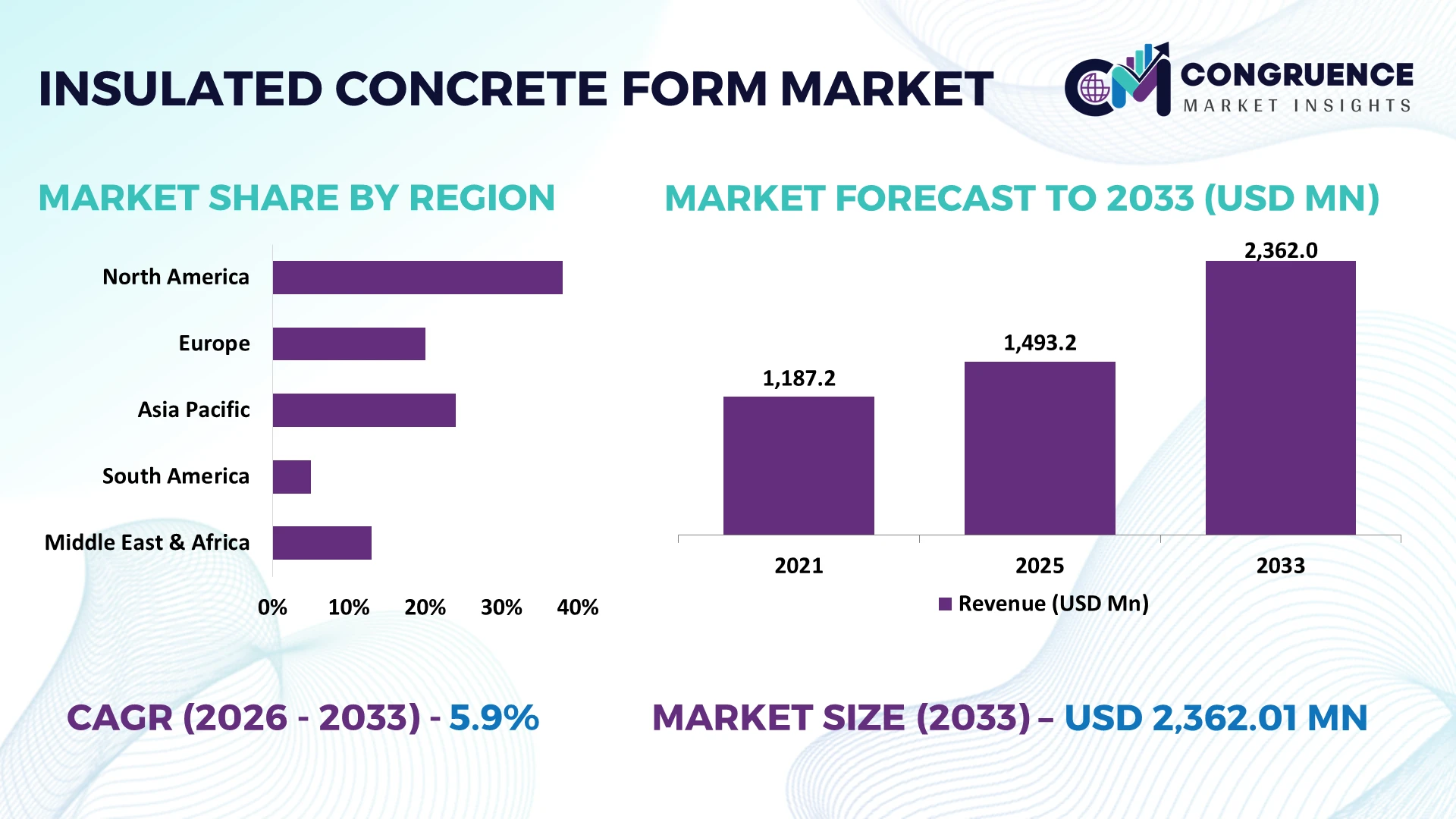
The United States represents the largest national market, accounting for an estimated 25.8% of global demand in 2025. North America holds a 36.6% regional share, supported by established manufacturing infrastructure and energy efficient residential construction. Canada complements American manufacturing through specialized ICF production and distribution networks. Expanded polystyrene represents 61.2% of global product demand, demonstrating the commercial importance of established insulation technology. American construction activity increasingly emphasizes hurricane resistance, thermal performance and compliance with evolving building energy standards.
Manufacturers should prioritize American residential construction, advanced insulation technologies and contractor partnerships while developing localized production capabilities for international expansion.
Market Size & Growth: USD 1493.19 million in 2025, reaching USD 2362.01 million by 2033 at 5.9% CAGR, driven by energy efficient construction.
Top Growth Drivers: Residential construction represents 65.3% of demand, polystyrene insulation holds 61.2%, and North America contributes 36.6% of market activity.
Short Term Forecast: By 2028, manufacturers should prioritize measurable installation efficiency improvements, reduced material waste and faster construction through modular wall assembly.
Emerging Technologies: Three technologies are transforming production: automated foam molding, digital construction modeling and advanced graphite enhanced insulation materials.
Regional Leaders: North America leads established deployment, Europe benefits from stringent energy regulations, and Asia Pacific presents expanding construction opportunities. Comparable regional forecasts require consistent market segmentation.
Consumer Trends: Residential applications account for 65.3% of industry demand, reflecting construction preferences for durable building envelopes and improved thermal insulation.
Pilot and Case Example: A 2025 Oklahoma residential study examined five houses over 12 months. Insulated concrete form homes consumed up to 41% less electricity.
Competitive Landscape: Nudura, BuildBlock, Fox Blocks, Amvic and Quad Lock compete through insulation performance, manufacturing capacity, contractor networks and installation efficiency.
Regulatory & ESG Impact: European building efficiency regulations encourage improved insulation performance. Advanced concrete wall systems support lower operational energy consumption throughout building lifecycles.
Investment & Funding: Investment priorities include automated manufacturing, regional production facilities and contractor training. BuildBlock's 2026 Ireland licensing collaboration illustrates international manufacturing expansion.
Innovation & Future Outlook: Advanced insulation materials, modular construction and digital installation technologies support manufacturing modernization and differentiated construction solutions through 2033.
The global insulated concrete form market serves residential construction, commercial development and institutional infrastructure requiring durable, thermally efficient building envelopes. Manufacturers are advancing automated foam molding, modular interlocking systems and graphite enhanced insulation to improve installation efficiency and building performance. A residential energy study demonstrated electricity consumption reductions reaching 41% compared with conventional wood framed construction. Increasing attention to disaster resilience in the United States and building energy regulations in Europe is influencing material selection. These developments establish the strategic importance of manufacturing localization, contractor training and integrated construction technologies in future market competition.
Insulated concrete forms are becoming strategically important as construction companies prioritize energy efficiency, structural resilience and predictable installation schedules. The technology combines permanent insulation with reinforced concrete, reducing separate insulation operations and simplifying building envelope construction. The European Union's revised Energy Performance of Buildings Directive requires new public buildings to meet zero emission standards from 2028. This regulatory transition strengthens demand for high performance building envelopes and encourages manufacturers to expand contractor training, technical certification and localized distribution.
Compared with conventional wood framing, insulated concrete form construction integrates insulation and structural concrete within a single wall assembly. Depending on building design and installation conditions, ICF systems can reduce wall construction labor requirements by 20% to 30%. American manufacturers benefit from established residential construction networks, while Canadian suppliers emphasize cold climate performance. European manufacturers increasingly align product development with stringent building efficiency requirements and construction decarbonization objectives.
Between 2026 and 2028, manufacturers will prioritize automated block production, digital construction modeling and regional distribution expansion. Practical deployment involves integrating prefabricated ICF components with building information modeling to coordinate reinforcement placement, concrete quantities and installation sequencing. Companies investing in contractor certification and standardized installation procedures will strengthen project delivery reliability, reduce construction waste and improve competitive positioning.
Building energy regulations and demand for resilient construction are accelerating insulated concrete form adoption. Buildings account for approximately 30% of global final energy consumption, making improved thermal performance an important construction priority. The European Union requires new public buildings to achieve zero emission standards from 2028, followed by all new buildings from 2030. Insulated concrete form systems integrate continuous insulation with reinforced concrete, reducing thermal bridging and supporting improved building envelope performance. Manufacturers are responding through advanced insulation materials, standardized wall systems and partnerships with construction contractors. In the United States, hurricane resistant construction requirements create additional demand for reinforced building envelopes, strengthening opportunities for specialized ICF manufacturers.
Insulated concrete form manufacturing faces structural limitations associated with expanded polystyrene production, cement procurement and specialized distribution requirements. Cement manufacturing accounts for approximately 7% to 8% of global carbon dioxide emissions, increasing pressure on construction material suppliers to improve environmental performance. Expanded polystyrene production also depends on petrochemical feedstocks, exposing manufacturers to energy and raw material price fluctuations. Additionally, ICF construction requires concrete placement, reinforcement installation and specialized installation knowledge, creating additional procurement considerations compared with conventional framing. Manufacturers are reducing exposure through diversified material suppliers, regional manufacturing facilities and standardized construction components. Establishing reliable local concrete partnerships improves project scheduling and limits transportation related cost pressures.
Advanced modular construction creates opportunities for insulated concrete form manufacturers to improve installation efficiency and expand into specialized building applications. Digital construction modeling enables more accurate material estimation, reinforcement planning and coordination between contractors. The United States Department of Energy identifies buildings as responsible for approximately 40% of national energy consumption, highlighting the importance of efficient building envelope technologies. Manufacturers are developing graphite enhanced insulation, modular interlocking systems and digitally coordinated construction components. Canadian cold climate construction provides additional opportunities for integrated insulation solutions. Companies investing in prefabrication partnerships and automated manufacturing can reduce installation complexity while improving dimensional consistency. Combining modular production with digital project coordination strengthens differentiation in residential and institutional construction.
Scaling insulated concrete form construction requires consistent installation quality, specialized contractor training and reliable coordination between structural engineering and construction teams. Concrete placement errors, reinforcement misalignment and inadequate bracing can compromise structural performance and increase corrective construction costs. The United States construction industry continues to experience skilled workforce shortages, creating pressure on specialized installation capacity. ICF wall assemblies commonly incorporate insulation layers measuring approximately 2.5 inches on each side of the concrete core, requiring accurate alignment and fastening procedures. Manufacturers must invest in contractor certification, installation documentation and technical support networks. Standardized training programs and digital installation guidance will improve construction consistency and support expansion into larger commercial and institutional projects.
Increasing Integration of Digital Construction Workflows: American contractors are integrating building information modeling with insulated concrete form installation to improve reinforcement planning and material estimation. Three dimensional modeling coordinates wall dimensions, concrete quantities and construction sequencing. Manufacturers are developing digital product libraries and installation resources, enabling contractors to identify design conflicts earlier and reduce corrective work.
Growing Adoption of Disaster Resilient Construction: Insulated concrete form manufacturers are emphasizing structural performance in hurricane prone American construction markets. Reinforced concrete wall assemblies provide continuous load paths and resistance to extreme weather. Manufacturers are expanding technical documentation, engineering partnerships and contractor certification programs. Improved structural resilience supports insurance related construction considerations and differentiates ICF systems from conventional lightweight framing.
Manufacturing Localization Reshapes Distribution Networks: Expanded polystyrene manufacturers are strengthening regional production and distribution capabilities to address transportation costs and construction delivery schedules. Lightweight ICF blocks occupy substantial shipping volume, making distribution distance commercially important. Manufacturers are developing localized molding partnerships, standardized product dimensions and regional inventory networks to improve delivery reliability and reduce logistical complexity.
Advanced Insulation Materials Improve Performance: Manufacturers are developing graphite enhanced polystyrene and improved interlocking block geometries to strengthen thermal performance and installation consistency. Advanced insulation materials support improved resistance to heat transfer, while redesigned connections simplify assembly and concrete placement. Companies are investing in material research and manufacturing improvements to differentiate their products through measurable building envelope performance.
Flat Wall systems represent an estimated 55% of insulated concrete form demand, supported by their compatibility with conventional reinforced concrete engineering and straightforward installation procedures. Their continuous concrete core simplifies structural calculations, reinforcement placement and concrete consolidation. Manufacturers prioritize standardized block dimensions and interlocking connections to improve construction efficiency. Screen Grid systems offer reduced concrete consumption through interconnected structural elements, while Waffle Grid configurations distribute concrete through variable thickness wall sections. These alternatives provide opportunities for material optimization where engineering requirements permit specialized structural configurations.
Panel Systems represent an emerging product category because their modular configurations support flexible wall dimensions and specialized construction requirements. Post-and-Beam systems provide additional alternatives through discrete structural elements and integrated insulation. Panel Systems are positioned for expanding adoption as manufacturers improve modular assembly and compatibility with digital construction planning. Manufacturers are strengthening technical support, installation training and product development to address different structural requirements. Investment priorities increasingly emphasize standardized engineering documentation, manufacturing flexibility and contractor productivity across residential and commercial construction applications.
Exterior Walls represent the leading application for insulated concrete forms, accounting for an estimated 48% of demand. Their dominance reflects the integration of structural concrete and continuous insulation within a single building envelope system. Manufacturers prioritize thermal performance, reinforcement compatibility and installation efficiency to address residential and commercial construction requirements. Foundation Walls represent another established application because ICF construction provides structural support and integrated insulation. Basement Walls benefit from similar characteristics, particularly in colder climates where below ground thermal performance influences building efficiency.
Interior Walls support specialized applications requiring structural strength, sound insulation or fire resistance. Retaining Walls represent an emerging application where structural engineering requirements permit appropriate insulated concrete form configurations. Manufacturers are developing application specific installation guidance and engineering documentation to support broader deployment. Exterior Wall demand continues to influence manufacturing capacity and distribution planning, while specialized foundation and retaining applications create opportunities for differentiated product development. Companies are expanding technical partnerships and contractor training to address application specific structural requirements.
Residential Construction accounts for an estimated 65.3% of insulated concrete form demand, supported by established applications in detached housing, residential foundations and energy efficient building envelopes. Homebuilders prioritize structural durability, thermal insulation and predictable construction performance. Manufacturers are strengthening relationships with residential contractors through installation training, standardized product systems and regional distribution partnerships. Commercial Construction represents another important application, particularly where developers prioritize building envelope performance, structural resilience and reduced operational energy consumption.
Institutional Buildings present opportunities through educational facilities, healthcare infrastructure and public construction projects requiring durable building envelopes. Industrial Construction supports specialized facilities where structural performance and temperature control influence material selection. Infrastructure Projects represent an additional application requiring detailed structural engineering and project specific product configurations. Manufacturers are developing technical documentation, engineering partnerships and specialized installation resources to address these requirements. Future investment priorities increasingly emphasize contractor education, standardized design specifications and manufacturing capabilities supporting larger construction projects.
North America accounted for the largest market share at 36.6% in 2025 however, Asia Pacific is expected to register the fastest growth, expanding at a CAGR of an estimated 7.5% between 2026 and 2033.
Advanced Construction Technology and Resilient Building Infrastructure
North America accounted for an estimated 36.6% of the global insulated concrete form market in 2025, supported by established manufacturing infrastructure and growing adoption of energy efficient construction systems. The United States dominates regional demand through residential development, commercial construction and hurricane resistant building applications. Canada contributes specialized manufacturing capabilities and cold climate construction expertise. Manufacturers, including Nudura, BuildBlock and Fox Blocks, maintain established distribution networks and contractor training programs. Increasing adoption of automated block molding and digital construction planning is improving manufacturing consistency and installation coordination. Building regulations emphasizing structural resilience and thermal performance are strengthening demand for integrated concrete wall systems. Manufacturers are expanding regional production partnerships and technical support networks to reduce transportation costs and improve construction project delivery.
United States Market Outlook: The United States represents the region's principal insulated concrete form market, supported by extensive residential construction activity and established concrete manufacturing infrastructure. The country accounted for an estimated 25.8% of global demand in 2025. Florida and Texas offer significant opportunities for reinforced concrete construction because hurricane exposure increases demand for resilient building envelopes. Manufacturers are expanding contractor certification and technical engineering support to strengthen adoption.
Building Decarbonization and Advanced Insulation Integration
Europe accounted for an estimated 28% of the global insulated concrete form market in 2025, supported by stringent building energy regulations and established advanced construction material industries. Germany, the United Kingdom and France represent important markets for energy efficient residential and commercial construction. The European Union's revised Energy Performance of Buildings Directive is accelerating investment in thermally efficient building envelopes and advanced insulation systems. Manufacturers are developing modular construction solutions, improved interlocking systems and specialized insulation materials to support regulatory compliance. Regional construction companies are integrating digital building design with prefabricated components to improve installation accuracy and project coordination. Manufacturers are strengthening partnerships with engineering consultants and construction contractors to expand technical capabilities. Building renovation requirements and institutional construction projects provide additional opportunities for specialized insulated concrete form applications.
Germany Market Outlook: Germany benefits from established construction engineering expertise and a developed building materials manufacturing industry. The country's Building Energy Act establishes minimum energy performance requirements for buildings and influences construction material selection. Manufacturers are developing integrated insulation solutions and working with construction contractors to improve building envelope performance. Advanced manufacturing capabilities support specialized component production and technical product development.
Urban Construction Expansion and Manufacturing Modernization
Asia Pacific accounted for an estimated 22% of the global insulated concrete form market in 2025, supported by expanding construction infrastructure and increasing attention to energy efficient building technologies. China represents an important manufacturing and construction market, while India offers opportunities through residential development and infrastructure modernization. Australia contributes established demand for durable construction systems in areas exposed to extreme weather. Manufacturers are developing localized production capabilities and distribution partnerships to improve access to construction projects. Automated molding equipment and modular construction systems support manufacturing efficiency and standardized component production. Government initiatives encouraging sustainable construction influence material selection and technical product development. Regional manufacturers are prioritizing contractor training and engineering partnerships to address differences in construction practices. Local manufacturing and technical support capabilities are becoming important factors in international market entry.
China Market Outlook: China benefits from extensive construction material manufacturing infrastructure and established production capabilities for expanded polystyrene and concrete products. Its construction industry provides opportunities for modular building systems and advanced insulation technologies. Manufacturers are integrating automated production equipment and standardized component designs to improve manufacturing consistency. Local engineering partnerships support compliance with national construction standards and project specific requirements.
Residential Modernization and Alternative Construction Adoption
South America accounted for an estimated 7% of the global insulated concrete form market in 2025, supported by emerging demand for energy efficient residential construction and alternative building technologies. Brazil represents an important construction market because of its established cement industry and extensive urban development. Chile offers additional opportunities for thermally efficient construction, particularly in regions experiencing colder climatic conditions. Manufacturers face challenges involving specialized installation expertise, distribution infrastructure and established preferences for conventional masonry construction. International suppliers are developing partnerships with local building material distributors and construction contractors to improve product accessibility. Regional expansion strategies increasingly emphasize contractor training, standardized installation systems and localized manufacturing partnerships. These initiatives support construction productivity and reduce dependence on imported finished building components.
Brazil Market Outlook: Brazil benefits from an established cement manufacturing industry and extensive residential construction activity. Its population exceeds 200 million, creating substantial underlying demand for housing and supporting infrastructure. Insulated concrete form manufacturers can develop partnerships with domestic construction material suppliers to introduce integrated wall systems. Contractor education and localized distribution remain important requirements for commercial adoption.
Infrastructure Investment and Thermal Construction Modernization
The Middle East and Africa accounted for an estimated 6.4% of the global insulated concrete form market in 2025, supported by infrastructure investment and demand for improved building thermal performance. Saudi Arabia and the United Arab Emirates represent important opportunities through commercial development, residential construction and large infrastructure programs. South Africa provides additional opportunities through established concrete manufacturing and construction material distribution networks. Extreme temperatures in several Middle Eastern markets strengthen the relevance of high performance building insulation. Manufacturers are developing partnerships with regional construction contractors and material distributors to improve project accessibility. Building regulations emphasizing energy efficiency are influencing construction specifications and material selection. Regional market development depends on contractor training, reliable concrete supply and technical engineering support for specialized construction applications.
Saudi Arabia Market Outlook: Saudi Arabia offers significant opportunities through Vision 2030 construction initiatives and extensive investment in residential and commercial infrastructure. The country's National Housing Program targets 70% homeownership among Saudi families by 2030. Large construction programs create opportunities for insulated concrete form manufacturers supplying durable building envelope systems. Regional distribution partnerships and specialized contractor training support participation in major development projects.
The global insulated concrete form market features competition between established manufacturers, specialized construction technology providers and regional suppliers. Nudura, BuildBlock, Fox Blocks, Amvic and Quad Lock compete through insulation performance, installation efficiency, distribution coverage and contractor relationships. Their combined global market share requires consistent company level sales verification. Flat Wall systems represent an estimated 55% of demand, making standardized manufacturing and installation compatibility important competitive priorities. Manufacturers are investing in automated molding, modular block configurations and technical training to strengthen market penetration. Established suppliers leverage regional production networks, while specialized manufacturers emphasize customization and engineering support. Competition increasingly involves integrated construction solutions, digital design compatibility and localized supply chains. Transportation costs, contractor certification and building code compliance create significant entry barriers. Manufacturers are strengthening distribution partnerships and expanding technical support capabilities. Competitive success requires reliable manufacturing, differentiated insulation performance, efficient installation and established contractor relationships across major construction markets.
Nudura
BuildBlock Building Systems
Fox Blocks
Amvic Building System
Quad Lock Building Systems
Logix Insulated Concrete Forms
LiteForm Technologies
SuperForm Products
Beco Products
Polycrete International
Rastra
Isolofoam
Thermohouse
Automated expanded polystyrene molding, precision interlocking systems and digitally integrated construction planning are advancing insulated concrete form manufacturing. Automated molding improves dimensional consistency and supports standardized block production. Manufacturers implementing modern equipment can target 15% higher production efficiency and 10% lower material waste compared with conventional processing. Digital construction modeling improves reinforcement planning, material estimation and installation sequencing. Established manufacturers benefit from integrating these technologies into existing production facilities, strengthening manufacturing flexibility and improving project delivery coordination.
Emerging technologies include graphite enhanced insulation, automated quality inspection and modular construction integration. Graphite enhanced expanded polystyrene can improve thermal insulation performance by 15% to 20% compared with conventional white expanded polystyrene, depending on material specifications. Computer vision supports dimensional inspection and automated identification of manufacturing defects. Manufacturers integrating digital inspection can target 12% faster quality control operations through reduced manual intervention. These technologies benefit manufacturers supplying standardized components for large residential and commercial construction projects, where production consistency and predictable installation performance influence procurement decisions.
Between 2026 and 2028, technological investment will increasingly emphasize automated production, digital engineering integration and advanced insulation materials. Manufacturers are developing modular product configurations compatible with building information modeling and prefabricated construction workflows. Integrated manufacturing systems support consistent product dimensions, while digital installation resources improve contractor coordination. Companies combining advanced insulation performance, standardized engineering documentation and localized production capabilities will strengthen competitiveness as construction projects demand improved efficiency, reliable material supply and consistent building envelope performance.
March 2026: BuildBlock Building Systems announced an international licensing agreement with BuildBlock Ireland, enabling localized manufacturing and distribution across Ireland and the United Kingdom. The partnership leverages over 20 years of technical expertise, reducing freight dependence and strengthening international expansion.
January 2025: Logix Brands introduced Element ICF, a new hybrid insulated concrete form system designed to replace its established product line. The transition supports manufacturing modernization and product differentiation, strengthening the company's competitive positioning in advanced construction materials.
July 2025: The Insulating Concrete Forms Manufacturers Association and National Ready Mixed Concrete Association published collaborative research investigating compliance with NFPA 285. The initiative addresses exterior wall fire performance, supporting regulatory acceptance and expanding opportunities in commercial construction.
January 2026: Fox Blocks received recognition for its Yosemite Lake House project during the ICF Builder Awards. The 2,500 square foot residence demonstrated insulated concrete form applications in wildfire exposed terrain, strengthening the commercial case for resilient residential construction.
The global Insulated Concrete Form Market Report examines industry structure, construction technology adoption and competitive developments between 2026 and 2033. Product segmentation covers five categories: Flat Wall, Screen Grid, Waffle Grid, Post and Beam, and Panel Systems. Application analysis examines Exterior Walls, Foundation Walls, Basement Walls, Interior Walls and Retaining Walls. End user coverage includes Residential Construction, Commercial Construction, Industrial Construction, Institutional Buildings and Infrastructure Projects.
Regional analysis encompasses North America, Europe, Asia Pacific, South America, and the Middle East and Africa. Technology coverage includes automated foam molding, graphite enhanced insulation, digital construction modeling and modular installation systems. The report evaluates manufacturing localization, regulatory compliance, contractor training and competitive strategies, supporting investment planning, geographic expansion and long term market positioning.
| Report Attribute/Metric | Report Details |
|---|---|
Market Revenue in 2025 | USD 1493.19 Million |
Market Revenue in 2033 | USD 2362.01 Million |
CAGR (2026 - 2033) | 5.9% |
Base Year | 2025 |
Forecast Period | 2026 - 2033 |
Historic Period | 2021 - 2025 |
Segments Covered | By Type
By Application
By End-User
|
Key Report Deliverable | Revenue Forecast, Growth Trends, Market Dynamics, Segmental Overview, Regional and Country-wise Analysis, Competition Landscape |
Region Covered | North America, Europe, Asia-Pacific, South America, Middle East, Africa |
Key Players Analyzed | Nudura, BuildBlock Building Systems, Fox Blocks, Amvic Building System, Quad Lock Building Systems, Logix Insulated Concrete Forms, LiteForm Technologies, SuperForm Products, Beco Products, Polycrete International, Rastra, Isolofoam, Thermohouse |
Customization & Pricing | Available on Request (10% Customization is Free) |




