
Reports
The Global Instrument Panel Market was valued at USD 1,204.0 Million in 2025 and is anticipated to reach a value of USD 2,038.0 Million by 2033 expanding at a CAGR of 6.8% between 2026 and 2033. Growth is driven by the rapid integration of digital cockpit platforms, larger display clusters, and software-defined vehicle architectures across passenger and electric vehicle production programs.
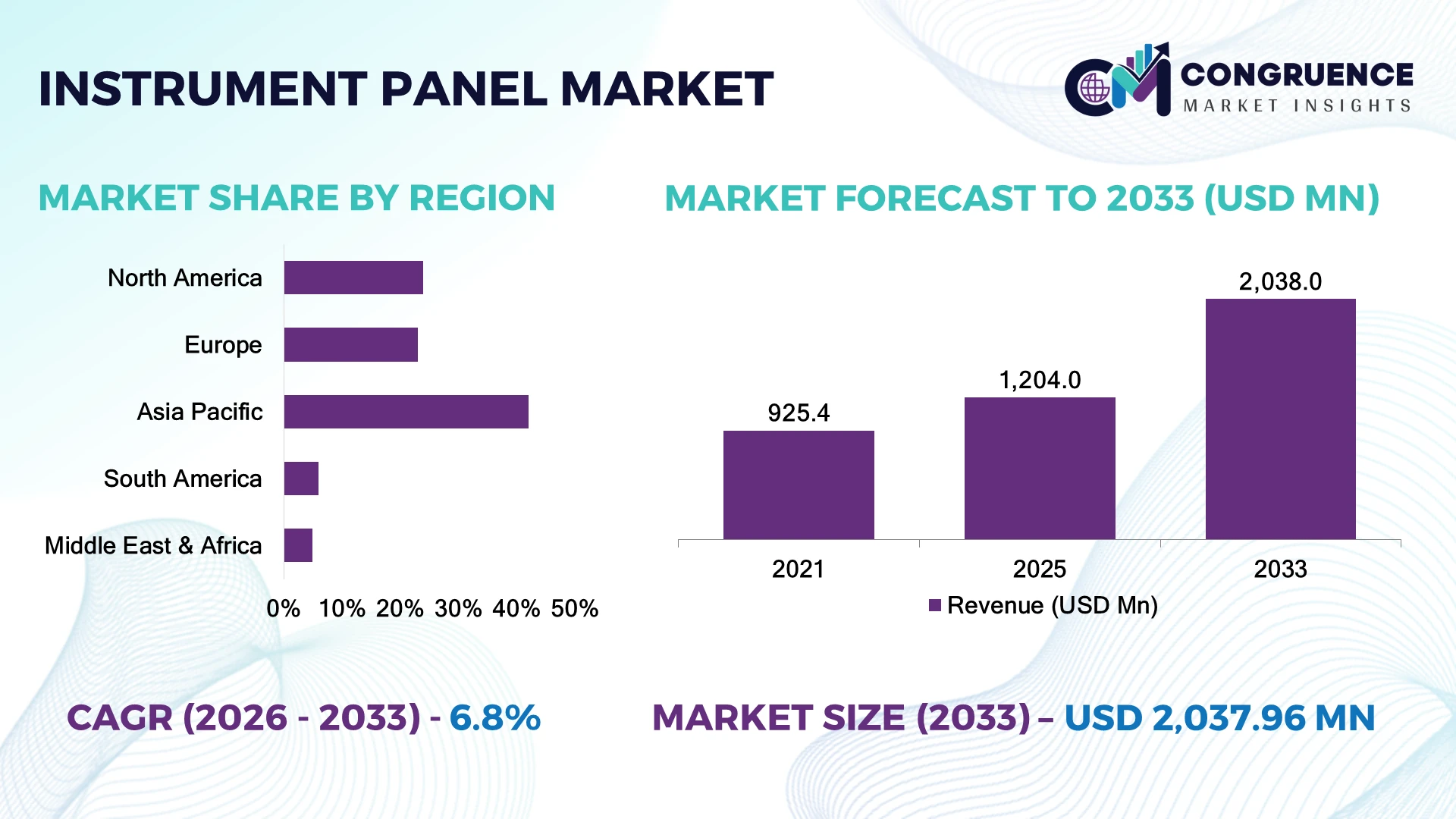
China dominates the global instrument panel market with an estimated 34% share, supported by annual vehicle production exceeding 30 million units and large-scale investments in smart cockpit technologies. More than 60% of newly launched electric vehicles in China feature digital instrument clusters, compared with roughly 45% in Germany. Government-backed EV manufacturing initiatives and advanced electronics supply chains continue strengthening domestic adoption, while automotive OEMs accelerate display-centric cockpit development.
Manufacturers prioritizing software-enabled cockpit ecosystems and localized electronics sourcing are positioned to secure long-term competitive advantages across next-generation vehicle platforms.
Market Size & Growth: USD 1,204.0 Million in 2025, reaching USD 2,038.0 Million by 2033, driven by digital cockpit adoption and connected vehicle integration.
Top Growth Drivers: Digital cluster adoption (+28%), EV production expansion (+22%), smart cockpit software deployment (+19%).
Short-Term Forecast: By 2028, cockpit processing efficiency improves by 25% while hardware integration costs decline by 15%.
Emerging Technologies: AI-enabled HMIs, OLED displays, augmented reality interfaces, and centralized vehicle computing platforms.
Regional Leaders: Asia Pacific (~USD 850 Million), Europe (~USD 430 Million), North America (~USD 380 Million); each benefits from EV and premium vehicle adoption.
Consumer/End-User Trends: Over 55% of new vehicle buyers prefer fully digital instrument clusters over analog systems.
Pilot/Case Example: In 2024, advanced cockpit deployments reduced driver information access time by nearly 20%.
Competitive Landscape: Top players control approximately 48% share; key companies include Continental, Forvia, Visteon, Denso, and Panasonic Automotive.
Regulatory & ESG Impact: Vehicle safety regulations improved digital display implementation rates by more than 18%.
Investment & Funding: Over USD 2.5 Billion invested globally in cockpit electronics, software platforms, and display technologies.
Innovation & Future Outlook: Integrated panoramic displays, AI assistants, and software-defined cockpits are reshaping vehicle user experiences.
Instrument panel systems are evolving from information displays into intelligent vehicle control hubs supporting navigation, safety monitoring, and connected services. Demand is strongest in electric vehicles, premium passenger cars, and autonomous driving programs. AI-powered interfaces and curved OLED displays now account for over 30% of advanced cockpit launches. Ongoing semiconductor localization efforts and automotive electronics supply-chain restructuring are further accelerating platform modernization, setting the stage for broader strategic transformation.
The instrument panel market has become a strategic focal point within the automotive industry as cockpit systems increasingly define vehicle differentiation, customer experience, and software monetization opportunities. The transition toward software-defined vehicles is shifting investment priorities from traditional hardware components to integrated digital ecosystems. Automotive manufacturers are restructuring supply chains and strengthening partnerships with semiconductor, display, and software providers to improve resilience and accelerate innovation cycles.
Modern digital instrument panels deliver measurable advantages over legacy analog systems. Advanced display architectures reduce information retrieval time by nearly 20% while enabling centralized control of multiple vehicle functions through a single interface. China leads in large-scale deployment due to its strong EV manufacturing base, whereas Germany focuses on premium cockpit innovation and advanced human-machine interface technologies. Over 55% of newly launched premium vehicles now incorporate fully digital clusters and connected display systems.
A practical example is the deployment of integrated cockpit platforms combining navigation, safety alerts, and vehicle diagnostics through unified displays. Manufacturers are expanding software capabilities, increasing R&D spending, and forming technology alliances to enhance user experiences. Over the next few years, AI-enabled interfaces and centralized computing architectures will strengthen competitive positioning, creating durable operational advantages for companies that establish scalable cockpit ecosystems early.
The automotive industry's shift toward digital cockpit ecosystems is accelerating instrument panel adoption across passenger and electric vehicles. More than 60% of newly launched EV models now feature digital instrument clusters, while integrated cockpit display installations have increased by approximately 25% over the past three years. China's smart vehicle initiatives and Europe’s vehicle safety modernization programs are encouraging OEMs to replace analog interfaces with connected display systems. This transition improves driver interaction, enables software updates, and supports advanced driver-assistance features. In response, manufacturers are investing heavily in display technologies, AI-enabled interfaces, and centralized computing platforms. A notable strategic insight is that instrument panels are increasingly becoming software platforms, allowing automakers to generate recurring value through connected services rather than relying solely on hardware differentiation.
Instrument panel manufacturing remains highly dependent on semiconductors, display modules, and specialized electronic components. Advanced cockpit systems contain up to 40% more electronic content than conventional dashboard assemblies, increasing exposure to component shortages and pricing fluctuations. During recent supply-chain disruptions, lead times for certain automotive-grade chips extended by more than 50%, creating production bottlenecks for vehicle manufacturers. Rising display and processor costs continue to pressure margins, particularly among mid-tier vehicle segments. To mitigate these risks, companies are localizing component sourcing, securing long-term procurement contracts, and diversifying supplier networks. A key operational insight is that supply-chain resilience has become as important as technological innovation in maintaining consistent cockpit production and vehicle launch schedules.
Artificial intelligence is creating significant opportunities for next-generation instrument panel solutions. AI-driven cockpit systems can improve information personalization by over 30% while reducing driver distraction through contextual display management. Advanced voice assistants, augmented reality overlays, and predictive vehicle diagnostics are expanding the functional value of instrument panels beyond traditional monitoring applications. China and South Korea are emerging as key innovation hubs due to strong investments in intelligent mobility technologies. Automotive suppliers are increasing R&D spending, forming software partnerships, and developing cloud-connected cockpit ecosystems. A less obvious opportunity lies in subscription-based software features delivered through digital instrument panels, enabling manufacturers to unlock new revenue streams while improving customer engagement throughout the vehicle lifecycle.
As vehicle architectures become increasingly software-centric, integrating instrument panels with infotainment, ADAS, connectivity, and vehicle control systems presents substantial execution challenges. Modern cockpit platforms can involve more than 100 interconnected software modules, significantly increasing validation and cybersecurity requirements. Industry assessments indicate that software-related vehicle development workloads have risen by nearly 35% over the past five years. Regulatory scrutiny regarding data privacy and cybersecurity is adding further complexity, particularly in markets such as Germany and the United States. Companies must invest in software engineering capabilities, cybersecurity frameworks, and cross-industry partnerships to maintain deployment consistency. The most critical strategic challenge is ensuring seamless interoperability across multiple vehicle platforms while sustaining rapid innovation and long-term system reliability.
• Software-Defined Cockpit Expansion Digital cockpit deployment has surpassed 58% of newly launched passenger vehicles, while centralized computing architectures have reduced electronic control unit requirements by nearly 30%. Automotive manufacturers are consolidating display, infotainment, and vehicle-control functions into unified platforms, improving software update efficiency and reducing integration complexity. OEMs in China and Germany are expanding partnerships with software and semiconductor providers to accelerate platform standardization and shorten development cycles.
• Larger Display Integration Shift Average instrument cluster display sizes have increased by approximately 22% over the past three years, while curved and panoramic displays now account for nearly 18% of premium vehicle cockpit installations. Consumer preference for immersive digital interfaces is reshaping dashboard design strategies. Automotive suppliers are scaling advanced display manufacturing and investing in OLED and mini-LED technologies to improve visibility, reduce component counts, and enhance cockpit functionality.
• Localized Electronics Supply Chains Supply-chain diversification efforts have increased localized sourcing activity by more than 25%, while automotive electronics inventory planning cycles have shortened by nearly 15%. Ongoing geopolitical trade pressures and semiconductor availability concerns are prompting manufacturers to establish regional component ecosystems. Companies are restructuring procurement networks, expanding local assembly operations, and strengthening supplier collaboration to improve production continuity and operational resilience.
• AI-Driven Driver Interaction Systems AI-enabled cockpit features have expanded into more than 35% of advanced vehicle launches, while voice-command utilization rates have improved by roughly 20%. Intelligent human-machine interfaces are reducing driver distraction and streamlining vehicle information access. Manufacturers are integrating predictive assistance functions, contextual display management, and cloud-connected services, creating differentiated user experiences while strengthening long-term software ecosystem strategies.
Digital instrument clusters hold the largest share of approximately 52% of the global instrument panel market due to superior visualization capabilities, software integration flexibility, and compatibility with connected vehicle architectures. Automakers increasingly favor fully digital systems because they support over-the-air updates, customizable interfaces, and integration with advanced driver-assistance functions. Hybrid instrument clusters continue to maintain relevance in mid-range vehicle categories where cost optimization remains a priority. Conventional analog systems retain deployment in select entry-level vehicle segments but continue losing share as cockpit digitalization accelerates. The fastest-growing segment is augmented-display instrument clusters, supported by increasing adoption of intelligent driving technologies and premium vehicle platforms. Deployment of advanced display interfaces has increased by nearly 24% across new electric vehicle launches, while integrated digital cockpit adoption has surpassed 60% among premium models. Suppliers are expanding display technology portfolios, strengthening software partnerships, and investing in next-generation visualization solutions. These developments are shifting investment priorities toward scalable software-enabled cockpit ecosystems capable of supporting future autonomous driving requirements.
Passenger vehicles account for approximately 68% of instrument panel demand, supported by high production volumes, rising consumer expectations for connected experiences, and increasing deployment of digital cockpit technologies. Vehicle manufacturers continue integrating larger displays, advanced graphics processors, and intelligent user interfaces to enhance driving experiences. Premium passenger vehicles demonstrate the highest concentration of digital instrument clusters, while mainstream vehicle segments are rapidly adopting cost-optimized digital solutions. Commercial vehicle applications maintain steady demand through fleet modernization and operator efficiency initiatives. Electric vehicle applications represent the fastest-growing segment, with digital cockpit penetration exceeding 65% across newly launched models. Demand is accelerating due to software-defined vehicle architectures, integrated navigation systems, and advanced energy-management displays. Commercial transportation fleets are also increasing adoption of digital instrument systems to improve operational monitoring and vehicle diagnostics. Companies are expanding production capacity, integrating AI-driven interfaces, and developing scalable display platforms to address evolving application requirements across multiple vehicle categories.
Automotive original equipment manufacturers (OEMs) represent the largest end-user group with approximately 74% market share, supported by large-scale vehicle production programs and direct integration of instrument panel systems into new vehicle architectures. OEM demand is concentrated around digital clusters, connected displays, and software-enabled cockpit platforms that improve user experience and support vehicle differentiation strategies. Their purchasing decisions strongly influence technology roadmaps, supplier relationships, and product development priorities throughout the automotive electronics ecosystem. Electric vehicle manufacturers are emerging as the fastest-growing end-user segment, driven by increasing adoption of intelligent cockpit technologies and advanced display integration. Digital cluster utilization exceeds 70% among many EV-focused vehicle platforms, compared with lower adoption levels in conventional vehicle categories. Aftermarket customers continue adopting upgraded display systems, while fleet operators increasingly deploy digital interfaces for monitoring and diagnostics. Suppliers are responding through customized platform development, strategic technology alliances, and software integration capabilities designed to meet evolving OEM and EV manufacturer requirements.
Asia-Pacific accounted for the largest market share at 42% in 2025 however, Asia-Pacific is expected to register the fastest growth, expanding at a CAGR of 7.6% between 2026 and 2033.

North America represented approximately 24% of the global instrument panel market in 2025, supported by strong demand for connected vehicles, premium vehicle platforms, and advanced driver-assistance technologies. Automotive manufacturers continue integrating larger digital displays and centralized cockpit systems to improve user experience and software functionality. The United States and Mexico remain important production hubs for passenger vehicles and automotive electronics, creating stable demand for advanced instrument panel solutions. More than 60% of newly launched premium vehicle models in the region incorporate fully digital instrument clusters. Strategic partnerships between automakers, software developers, and semiconductor suppliers are accelerating cockpit innovation while improving system interoperability. Increasing deployment of software-defined vehicle architectures is also reshaping supplier priorities toward scalable and update-enabled display platforms.
United States Market Outlook: The United States remains the region’s most influential market due to its concentration of automotive technology developers, vehicle manufacturers, and software engineering capabilities. Advanced cockpit systems have become a key competitive differentiator across electric and premium vehicle segments. More than half of new EV launches feature integrated digital cockpit environments combining instrument clusters, infotainment, and driver-assistance displays. Strong investment in vehicle software ecosystems and automotive semiconductor partnerships continues strengthening the country's leadership in next-generation cockpit technologies.
Europe accounted for approximately 23% of global market demand, supported by a strong premium automotive sector and widespread adoption of advanced vehicle electronics. Vehicle manufacturers are prioritizing digital cockpit integration to enhance safety, connectivity, and user interaction capabilities. Regulatory focus on vehicle safety and driver information accessibility continues encouraging deployment of advanced display technologies. Germany, France, and the United Kingdom remain key centers for automotive engineering and cockpit system innovation. Digital instrument cluster penetration exceeds 65% across many premium vehicle programs. Automotive suppliers are expanding software development capabilities and investing in human-machine interface technologies to support increasingly intelligent vehicle architectures. The region also benefits from close collaboration between OEMs and automotive electronics specialists.
Germany Market Outlook: Germany serves as the technological center of the European instrument panel market, supported by premium vehicle manufacturing and advanced engineering expertise. Luxury vehicle brands continue leading adoption of digital clusters, augmented displays, and integrated cockpit platforms. More than 70% of newly introduced premium vehicle models utilize advanced digital instrument systems. Strong collaboration between automakers, display technology firms, and software developers is enabling rapid deployment of intelligent cockpit solutions while supporting long-term vehicle digitalization objectives.
Asia-Pacific maintained the leading market position with approximately 42% share, supported by large-scale vehicle production, extensive electronics manufacturing infrastructure, and rapid electric vehicle deployment. China, Japan, South Korea, and India form the region's primary automotive production centers, generating significant demand for advanced cockpit technologies. Digital instrument cluster adoption has expanded rapidly as vehicle manufacturers increasingly standardize connected display systems across multiple vehicle categories. More than 60% of newly launched EV models in major regional markets include fully digital instrument panels. Strong semiconductor manufacturing capabilities and localized supply chains improve production efficiency and support faster technology commercialization. Automotive suppliers continue expanding display production capacity and strengthening software integration capabilities to address evolving customer requirements.
China Market Outlook: China remains the largest individual market globally due to its automotive production scale, electric vehicle leadership, and extensive electronics ecosystem. Annual vehicle production exceeds 30 million units, creating substantial demand for digital cockpit solutions. More than 60% of newly launched electric vehicles incorporate advanced digital instrument clusters and integrated display environments. Government-backed intelligent vehicle initiatives and strong domestic component manufacturing capabilities continue supporting rapid deployment of next-generation cockpit technologies across both domestic and international vehicle brands.
South America accounted for approximately 6% of global demand, driven by gradual vehicle modernization and increasing adoption of connected automotive technologies. Passenger vehicle production remains concentrated in Brazil and Argentina, where manufacturers are introducing higher levels of digital functionality across vehicle portfolios. Demand for digital instrument clusters is increasing as consumers prioritize enhanced vehicle connectivity and user experience features. Instrument panel upgrades are becoming more common within mid-range vehicle categories, reflecting changing customer expectations. Regional deployment remains influenced by economic conditions and component import dependencies; however, automotive manufacturers continue investing in localized production and supplier partnerships to improve operational efficiency. Digital cockpit technologies are progressively moving from premium models into broader market segments.
Brazil Market Outlook: Brazil represents the largest market within South America due to its established automotive manufacturing base and strong vehicle assembly capacity. The country serves as a regional production hub for multiple global automakers, supporting consistent demand for instrument panel systems. Digital display integration has expanded across passenger vehicle platforms, while local manufacturing initiatives are improving supply-chain efficiency. Continued investment in automotive production facilities and technology upgrades is strengthening Brazil’s position as the region’s primary cockpit technology market.
The Middle East & Africa region accounted for approximately 5% of global market demand, supported by automotive modernization initiatives, premium vehicle imports, and expanding mobility infrastructure investments. Demand is increasingly concentrated in Gulf countries where consumers show strong preference for technologically advanced vehicles equipped with digital cockpit systems. Vehicle distributors and manufacturers are introducing more connected vehicle models to align with changing customer expectations. Several automotive investment programs are encouraging development of local assembly capabilities and supporting broader adoption of advanced vehicle technologies. While deployment remains smaller than other major markets, rising infrastructure investment and increasing vehicle technology awareness continue improving long-term market prospects. Suppliers are expanding regional partnerships and strengthening aftermarket support networks to capture emerging opportunities.
Saudi Arabia Market Outlook: Saudi Arabia is the most strategically significant market in the region due to ongoing automotive sector development, infrastructure modernization, and growing adoption of advanced vehicle technologies. Demand for premium and connected vehicles continues increasing as mobility transformation initiatives accelerate. Digital instrument panels are becoming standard across a growing share of newly imported and locally assembled vehicles. Investments in automotive manufacturing, smart mobility projects, and technology partnerships are positioning the country as an important future center for advanced cockpit technology deployment within the Middle East.
The instrument panel market is led by Continental, Forvia, Visteon, Denso, and Marelli, which collectively control approximately 58% of global market activity. Competition is primarily between global cockpit electronics leaders and regional automotive component suppliers, while OEM-aligned technology specialists increasingly challenge traditional dashboard manufacturers. Market leadership depends on display integration, software capability, supply-chain control, and platform scalability rather than price alone. Digital cockpit programs now account for more than 60% of new vehicle development projects, while integrated display adoption has increased by roughly 25% across premium vehicle platforms. Leading suppliers are expanding software capabilities, forming semiconductor partnerships, and investing in centralized computing architectures to secure long-term contracts. Regional competitors focus on cost-efficient manufacturing and localized sourcing strategies to improve responsiveness. The competitive landscape is shifting toward software-defined cockpit ecosystems and AI-enabled interfaces, increasing pressure on companies with limited digital capabilities. High development costs, validation requirements, and OEM qualification processes remain significant barriers. Success depends on combining advanced software, reliable supply networks, scalable manufacturing, and continuous cockpit innovation.
Forvia SE
Visteon Corporation
Denso Corporation
Marelli Holdings Co., Ltd.
Panasonic Automotive Systems
Yazaki Corporation
Aptiv PLC
Bosch Mobility
Hyundai Mobis
Nippon Seiki Co., Ltd.
JVCKENWOOD Corporation
Alps Alpine Co., Ltd.
Pioneer Corporation
Digital instrument clusters and centralized cockpit computing platforms currently define the technology landscape. More than 60% of newly launched electric vehicles integrate fully digital clusters, while centralized architectures reduce electronic control unit requirements by nearly 30%. Advanced graphics processors, high-resolution displays, and software-defined interfaces enable faster system updates and improved functionality. Automotive manufacturers benefit through reduced integration complexity, enhanced user experiences, and greater platform standardization across vehicle portfolios.
Emerging technologies include AI-powered human-machine interfaces, augmented reality head-up displays, and panoramic display systems. AI-enabled cockpit platforms improve information personalization by approximately 25%, while augmented reality displays enhance driver awareness and reduce information access time by nearly 20%. Adoption of integrated AI cockpit solutions has surpassed 35% among advanced vehicle programs. Premium vehicle manufacturers and technology-focused suppliers gain a competitive advantage through differentiated digital experiences and higher software integration capabilities.
Disruptive technologies between 2026 and 2028 will center on edge AI computing, immersive panoramic displays, and cloud-connected cockpit ecosystems. Compared with traditional analog systems, next-generation digital cockpit platforms deliver over 40% greater information flexibility and significantly higher software upgrade capability. Companies investing early in intelligent cockpit ecosystems, semiconductor partnerships, and scalable software architectures will secure stronger positioning as vehicle interiors evolve into interactive digital environments.
April 2025 – Visteon and Qualcomm announced collaboration on an AI-based intelligent cockpit platform integrating Snapdragon Cockpit Elite technology and multimodal AI capabilities to improve in-vehicle responsiveness and advanced graphics performance. The initiative strengthens next-generation digital cockpit competitiveness. Source: www.visteon.com
June 2025 – Visteon launched high-resolution automotive camera and display backlight unit manufacturing in India through a USD 10 million investment. The facility supports camera resolutions from 1.3 MP to 8 MP, enhancing cockpit display quality and local supply-chain resilience. Source: www.visteon.com
September 2025 – Visteon partnered with FUTURUS to co-develop augmented reality and panoramic head-up display technologies for global automakers. The collaboration expands advanced cockpit visualization capabilities and strengthens integration of ADAS-related driver information within instrument panel environments. Source: www.investors.visteon.com
April 2024 – FORVIA and Chery established a joint venture focused on smart and sustainable cockpit systems, including cockpit electronics and integrated cabin modules. The venture targets advanced cockpit development and supports large-scale manufacturing expansion across China.
This report provides comprehensive analysis of the global instrument panel market across major technology categories, vehicle applications, and end-user groups. Coverage includes digital instrument clusters, hybrid systems, analog platforms, advanced display technologies, and emerging intelligent cockpit solutions. The assessment evaluates deployment patterns across passenger vehicles, commercial vehicles, electric vehicles, and other automotive segments while examining purchasing behavior among OEMs, EV manufacturers, fleet operators, and aftermarket participants.
The study delivers detailed regional analysis covering North America, Europe, Asia-Pacific, South America, and the Middle East & Africa, representing the majority of global vehicle production and cockpit technology deployment. More than half of new vehicle programs now incorporate advanced digital display architectures, making technology adoption a critical competitive factor. The report further evaluates AI-enabled interfaces, augmented reality displays, software-defined cockpit platforms, supply-chain developments, and strategic industry initiatives. It supports investment planning, expansion strategies, competitive benchmarking, partnership evaluation, and long-term market positioning through 2033.
| Report Attribute / Metric | Details |
|---|---|
| Market Revenue (2025) | USD 1,204.0 Million |
| Market Revenue (2033) | USD 2,038.0 Million |
| CAGR (2026–2033) | 6.8% |
| Base Year | 2025 |
| Forecast Period | 2026–2033 |
| Historic Period | 2021–2025 |
| Segments Covered |
By Type
By Application
By End-User
|
| Key Deliverables | Revenue Forecast; Market Trends; Growth Drivers & Restraints; Technology Insights; Segmentation Analysis; Regional Insights; Competitive Landscape; Regulatory & ESG Overview; Recent Developments |
| Regions Covered | North America; Europe; Asia-Pacific; South America; Middle East & Africa |
| Companies Profiled | Continental AG; Forvia SE; Visteon Corporation; Denso Corporation; Marelli Holdings Co., Ltd.; Panasonic Automotive Systems; Yazaki Corporation; Aptiv PLC; Bosch Mobility; Hyundai Mobis; Nippon Seiki Co., Ltd.; JVCKENWOOD Corporation; Alps Alpine Co., Ltd.; Pioneer Corporation |
| Customization & Pricing | Available on Request (10% Customization Free) |




