
Reports
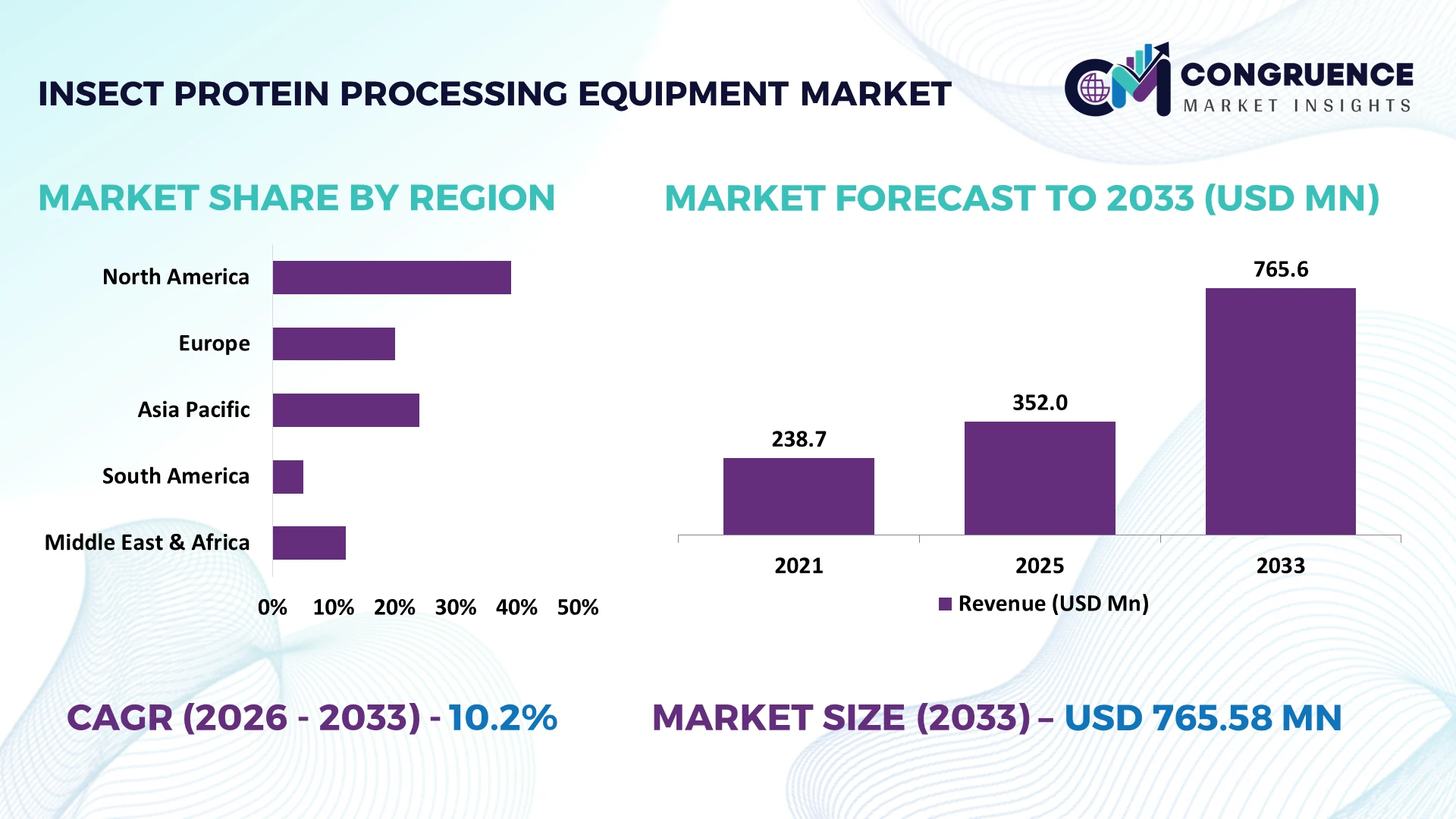
The Global Insect Protein Processing Equipment Market was valued at USD 352 Million in 2025 and is anticipated to reach a value of USD 765.58 Million by 2033 expanding at a CAGR of 10.2% between 2026 and 2033. Growth is driven by industrial black soldier fly processing, automated larvae handling, protein extraction technologies, and increasing requirements for commercially scalable insect ingredients in aquaculture and pet food manufacturing.
France represents a major industrial development center for insect protein processing equipment, supported by advanced manufacturing infrastructure and established industrial partnerships. Innovafeed's Nesle facility completed its third expansion phase in 2024, increasing its production area to 55,000 square meters and multiplying larval production capacity fivefold. By June 2026, the facility had produced more than 15,000 tonnes of protein and oil over three years. Vietnam provides an important manufacturing comparison, with Entobel establishing a facility designed to produce 10,000 tonnes of insect protein annually.
Strategically, equipment manufacturers should prioritize automated processing systems, energy integration, and modular production technologies that improve facility utilization and industrial processing economics.
Market Size & Growth: USD 352 million in 2025, reaching USD 765.58 million by 2033 at 10.2% CAGR, supported by industrial processing automation.
Top Growth Drivers: Larval production capacity increased fivefold at Innovafeed's Nesle facility, while production costs subsequently declined approximately 85.7%, demonstrating the importance of industrial scaling.
Short Term Forecast: By 2028, processing efficiency and equipment utilization will determine expansion priorities. Innovafeed's reported sevenfold production cost reduction establishes an operational benchmark.
Emerging Technologies: Three technologies are reshaping equipment requirements: automated larvae handling, intelligent environmental monitoring, and integrated protein extraction systems.
Regional Leaders: Europe demonstrates advanced industrial deployment, Asia Pacific offers expanding manufacturing infrastructure, and North America provides equipment development opportunities. Verified regional equipment market projections remain unavailable.
Consumer and End User Trends: Innovafeed's Nesle facility produced more than 15,000 tonnes of protein and oil over three years, supporting industrial ingredient commercialization.
Pilot and Case Example: In 2024, Innovafeed completed its Nesle expansion, increasing larval production capacity fivefold through automated production management.
Competitive Landscape: Equipment manufacturers compete through processing automation, production reliability, and integration capabilities. Verified equipment supplier market shares remain unavailable.
Regulatory & ESG Impact: European authorization permits processed insect proteins from 8 specified insect species in aquaculture feed, supporting regulated industrial processing applications.
Investment & Funding: Innovafeed secured €51 million in June 2026 to support commercial development, industrial equipment optimization, and additional product applications.
Innovation & Future Outlook: Integrated processing and industrial automation are becoming investment priorities, with Innovafeed reporting a tenfold production increase and sevenfold cost reduction during its industrial scaling phase.
The Insect Protein Processing Equipment Market encompasses automated breeding systems, larvae harvesting equipment, drying technologies, mechanical separation systems, and industrial protein extraction machinery. Aquaculture and pet food manufacturers represent important downstream customers requiring consistent ingredient quality and reliable production volumes. Advanced processing facilities increasingly integrate automated environmental controls, continuous material handling, and energy optimization. Innovafeed's industrial scaling experience demonstrates the operational importance of automation, with production volumes increasing tenfold and manufacturing costs declining sevenfold. Industrial expansion in France and Vietnam highlights the growing importance of equipment reliability, integrated production infrastructure, and commercially sustainable processing economics.
The Insect Protein Processing Equipment Market is becoming strategically important as feed manufacturers seek alternative protein sources and insect producers prioritize industrial efficiency. European authorization of processed insect proteins for aquaculture, poultry, and pig feed has expanded commercial applications. This regulatory shift is encouraging investment in automated breeding, harvesting, drying, and protein separation equipment capable of meeting industrial feed manufacturing standards.
Industrial automation is transforming production economics. Innovafeed reported a tenfold production increase and sevenfold reduction in production costs during its industrial scaling phase, demonstrating the advantages of integrated manufacturing over earlier production configurations. France has established advanced industrial processing infrastructure, while Vietnam is developing large production facilities supported by favorable operating conditions. Entobel's Vietnamese facility was designed for approximately 10,000 tonnes of annual insect protein production.
Between 2026 and 2028, equipment suppliers will increasingly focus on modular processing systems, automated environmental controls, and industrial energy integration. Innovafeed's Nesle facility demonstrates practical deployment through its integration with neighboring industrial infrastructure. Manufacturers are strengthening engineering partnerships and prioritizing equipment utilization over capacity expansion alone. Competitive positioning increasingly depends on delivering consistent protein quality, predictable processing costs, and reliable industrial production.
Industrial feed diversification is accelerating investment in automated insect protein processing equipment. European regulations authorize processed insect proteins from 8 specified insect species for regulated feed applications, expanding commercial processing opportunities. Innovafeed's industrial scaling program demonstrated a tenfold production increase alongside an approximately 85.7% reduction in production costs. Its Nesle facility also achieved a fivefold increase in larval production capacity following expansion. These developments demonstrate how automation and integrated processing infrastructure improve industrial production economics. Equipment manufacturers are responding through automated harvesting systems, continuous drying technologies, and integrated protein separation equipment. French industrial operators increasingly prioritize production efficiency and consistent ingredient specifications, strengthening demand for scalable processing solutions.
Energy consumption and substrate availability remain structural limitations for industrial insect protein processing. Drying operations must remove substantial moisture because fresh insect larvae typically contain approximately 60% to 70% water. Consequently, thermal processing represents an important operating cost, particularly where industrial waste heat infrastructure is unavailable. Innovafeed's reported sevenfold production cost reduction demonstrates the significance of integrated manufacturing efficiency, although equivalent improvements are not established across the industry. In France, substrate procurement and energy integration influence facility location and processing economics. Equipment suppliers are responding through heat recovery technologies, improved mechanical dewatering, and localized substrate partnerships. Combining moisture reduction with reliable substrate procurement improves equipment utilization and reduces operating cost exposure.
Intelligent processing systems create opportunities for equipment manufacturers to improve production consistency and support modular industrial expansion. Innovafeed demonstrated a tenfold production increase through industrial scaling, while its Nesle expansion multiplied larval production capacity fivefold. These achievements establish relevant industrial benchmarks without representing industrywide performance. Vietnam offers additional deployment opportunities through Entobel's facility designed for approximately 10,000 tonnes of annual insect protein production. Automated environmental monitoring, intelligent harvesting controls, and integrated processing analytics are emerging areas of equipment development. Manufacturers are investing in modular production architecture and partnerships with insect producers. Equipment suppliers capable of integrating breeding, harvesting, and downstream processing can reduce installation complexity and strengthen long term customer relationships.
Achieving reliable industrial scalability remains a significant challenge for insect protein processing equipment manufacturers. Fresh insect larvae contain approximately 60% to 70% moisture, requiring carefully controlled dewatering and drying to maintain consistent protein quality. Entobel's Vietnamese facility targets approximately 10,000 tonnes of annual insect protein production, demonstrating the operational scale that integrated processing systems must support. Innovafeed's fivefold larval capacity expansion illustrates the importance of coordinating biological production with downstream processing throughput. Unlike conventional feed manufacturing, insect processing must accommodate variable biological growth cycles and substrate characteristics. Equipment manufacturers must invest in process monitoring, automated quality control, predictive maintenance, and integrated engineering to maintain production consistency during industrial expansion.
Industrial Processing Efficiency Becomes Critical: Innovafeed reported a tenfold production increase and a sevenfold reduction in production costs following industrial scaling. Its Nesle facility produced more than 15,000 tonnes of protein and oil within three years. Industrial operators are optimizing equipment utilization, processing schedules, and production workflows to improve commercial performance.
Advanced Thermal Processing Gains Attention: Research published in 2025 demonstrated that microwave drying processed black soldier fly larvae in 42 minutes. Separate research found that thermal pretreatment at 120°C for 3 minutes reduced cricket drying time by 56%. Equipment developers are evaluating alternative thermal processing configurations to reduce processing time while preserving nutritional characteristics.
Industrial Energy Integration Reshapes Facilities: Innovafeed's Decatur facility incorporates access to 27 MW of recovered industrial energy through its partnership with ADM. Its French industrial integration model targets annual savings of 50,000 tonnes of carbon dioxide. These developments demonstrate the importance of facility location, energy recovery infrastructure, and coordinated industrial partnerships in equipment procurement.
Regulatory Requirements Reshape Processing Specifications: European regulations permit processed proteins from eight specified insect species in designated animal feed applications. By 2025, seven insect novel food ingredients had received European authorization. Manufacturers are adapting equipment configurations to accommodate different processing requirements, product specifications, hygienic manufacturing procedures, and regulatory documentation across commercial applications.
Drying is a critical equipment category within industrial insect protein production because harvested larvae require substantial moisture removal before grinding, separation, and ingredient stabilization. However, independently verified equipment market shares do not establish the leading category among the seven specified types. A 2025 experimental investigation demonstrated that microwave drying processed black soldier fly larvae in 42 minutes. Another investigation recorded approximately 56% shorter drying times following specialized thermal pretreatment of edible crickets. These results demonstrate technology specific processing improvements rather than industrywide performance.
Grinding supports standardized particle size, while Separation and Extraction equipment enable protein fractionation and lipid recovery. Blending ensures ingredient formulation consistency, whereas Extrusion supports specialized product manufacturing. Packaging protects processed ingredients during storage and transportation. Advanced drying and extraction technologies represent important development areas, although their relative growth rankings remain unverified. Manufacturers are prioritizing equipment integration, moisture control, thermal efficiency, and processing flexibility. Investment decisions increasingly depend on energy consumption, ingredient specifications, processing throughput, and compatibility between successive manufacturing stages.
Animal Feed represents an established commercial application for insect protein processing equipment, supported by regulatory authorization and industrial ingredient production. European regulations permit processed proteins from eight specified insect species in designated aquaculture, poultry, and pig feed applications. However, independently verified market shares do not establish the leading application within the seven specified categories. Protein Powder provides an intermediate ingredient for multiple formulations, while Protein Concentrates and Protein Isolates require additional separation and extraction capabilities.
Pet Food represents another established commercial application, supported by specialized insect protein formulations. Innovafeed's industrial facility produced more than 15,000 tonnes of protein and oil over three years, demonstrating commercial processing scale across its broader ingredient portfolio. Protein Bars and Sports Nutrition require additional ingredient standardization, hygienic processing, and formulation capabilities. Verified application growth rankings remain unavailable. Equipment manufacturers are developing processing configurations tailored to different nutritional specifications, production volumes, and regulatory requirements. Industrial investment priorities increasingly distinguish large volume ingredient processing from specialized applications requiring greater control over protein composition and finished product consistency.
Insect Farms represent a central equipment purchasing group because industrial insect production requires coordinated harvesting, drying, grinding, and material handling operations. However, independently verified market shares do not establish the largest end user within the seven specified categories. Feed Manufacturers require standardized ingredients compatible with established feed formulations, while Ingredient Producers prioritize extraction, separation, and consistent protein specifications. Innovafeed's Nesle facility produced more than 15,000 tonnes of protein and oil within three years, demonstrating the industrial scale associated with integrated insect processing.
Pet Food Companies represent an established commercial customer group, while Food Manufacturers require equipment configurations compatible with food safety and ingredient quality requirements. Nutraceutical Companies and Sports Nutrition Companies emphasize specialized protein processing and formulation consistency. Verified end user growth rankings remain unavailable. Equipment suppliers are developing customized processing systems and strengthening partnerships with industrial producers. Commercial investment priorities increasingly reflect processing throughput, equipment integration, ingredient quality requirements, and production reliability rather than manufacturing capacity alone.
Europe accounted for an estimated 38% market share in 2024; however, Asia Pacific was projected to register the fastest growth at 19.4% during the forecast period covered by that estimat
Industrial Energy Integration Strengthens Processing Infrastructure
North America's insect protein processing equipment industry is developing through agricultural processing partnerships, industrial automation, and integrated manufacturing infrastructure. The United States provides an established industrial base, particularly in agricultural processing centers across Illinois. Innovafeed inaugurated its Decatur facility in April 2024, establishing an industrial production platform alongside ADM's corn processing operations. The partnership provides access to 27 MW of recovered industrial energy, reducing dependence on dedicated thermal infrastructure. Integrated agricultural byproduct handling also supports continuous substrate availability for insect cultivation. These operational arrangements influence equipment procurement across automated feeding, harvesting, thermal processing, and protein separation. Industrial engineering partnerships are increasingly important because equipment manufacturers must coordinate biological production with conventional agricultural processing infrastructure. Facilities integrating energy recovery with automated processing establish measurable infrastructure advantages over independently operated production systems.
United States Market Outlook: The United States provides established agricultural processing infrastructure and industrial engineering capabilities. Illinois represents an important manufacturing location through its corn processing ecosystem and established logistics networks. Innovafeed's Decatur project demonstrates industrial integration between agricultural processing and insect protein production. Equipment suppliers can target automated cultivation, industrial drying, mechanical separation, and integrated material handling technologies. The availability of 27 MW of recovered energy at Decatur provides a measurable example of infrastructure integration supporting industrial insect production.
Industrial Automation and Integrated Manufacturing Expansion
Europe has an established industrial insect protein processing ecosystem supported by specialized equipment manufacturers, commercial production facilities, and regulatory authorization for insect ingredients. France, the Netherlands, Germany, and Switzerland contribute through industrial engineering, insect cultivation, and processing technology development. Innovafeed's Nesle facility in France demonstrates industrial integration through its connection with neighboring agricultural and energy infrastructure. The company's industrial configuration targets annual savings of approximately 50,000 tonnes of carbon dioxide through industrial integration. European equipment manufacturers are developing automated substrate preparation, continuous harvesting, thermal processing, and protein separation technologies. Regulatory authorization for processed insect proteins in aquaculture, poultry, and pig feed provides established commercial applications. Manufacturers are strengthening engineering partnerships to improve equipment utilization, processing consistency, and industrial production reliability.
France Market Outlook: France represents an important industrial center for insect protein manufacturing and processing technology deployment. Innovafeed's Nesle facility demonstrates the integration of biological production with established industrial infrastructure. Its expansion multiplied larval production capacity fivefold, establishing an operational benchmark for industrial scaling. French equipment manufacturers and engineering partners benefit from opportunities involving automated production, energy recovery, industrial monitoring, and specialized protein processing.
Commercial Production Expansion Strengthens Equipment Deployment
Asia Pacific is developing industrial insect protein processing capacity through commercial manufacturing investments, aquaculture supply chains, and agricultural processing infrastructure. Vietnam represents an important production location because of its established aquaculture industry and expanding insect protein manufacturing capabilities. Entobel established an industrial facility in Vung Tau designed to produce approximately 10,000 tonnes of insect protein annually. The project followed a USD 33 million funding round and was expected to create approximately 150 manufacturing and operational jobs. This investment demonstrates substantial equipment requirements across automated insect cultivation, biomass harvesting, industrial drying, and protein extraction. Equipment manufacturers serving Asian production facilities must accommodate tropical operating conditions, variable substrate characteristics, and industrial maintenance requirements. Partnerships with agricultural processors and local engineering providers strengthen equipment servicing capabilities and production reliability.
Vietnam Market Outlook: Vietnam combines established aquaculture production with expanding insect protein manufacturing infrastructure. Entobel's Vung Tau facility provides a commercial deployment example, with designed annual production capacity of approximately 10,000 tonnes of insect protein. The project demonstrates opportunities for suppliers specializing in automated harvesting, industrial moisture management, drying equipment, and protein separation. Local technical servicing and reliable processing performance remain important procurement considerations.
Agricultural Byproduct Utilization Supports Industrial Development
South America's insect protein processing equipment industry is developing around agricultural byproduct utilization, animal nutrition manufacturing, and specialized insect cultivation. Brazil provides an established agricultural and industrial foundation through its poultry, aquaculture, and livestock supply chains. Domestic biotechnology companies are developing black soldier fly production systems that convert organic materials into protein ingredients and agricultural products. Buzz Fly, established in 2021, represents domestic commercialization activity involving insect derived products for animal and plant nutrition. These developments establish equipment requirements for substrate preparation, controlled cultivation, harvesting, and downstream processing. Industrial deployment remains less extensively documented than established European manufacturing projects. Equipment suppliers entering Brazil must balance production automation with accessible maintenance services, local engineering capabilities, and substrate processing requirements. Partnerships with agricultural processors provide an industrial pathway for commercial equipment deployment.
Brazil Market Outlook: Brazil provides an established industrial foundation through agricultural processing infrastructure and animal feed manufacturing. Domestic insect biotechnology companies are developing black soldier fly production for animal and plant nutrition. Equipment suppliers can target automated cultivation, substrate processing, harvesting, and protein recovery applications. Integration with existing agricultural facilities provides access to established logistics networks and industrial maintenance capabilities, reducing the infrastructure required for independent processing operations.
Agricultural Diversification Encourages Processing Infrastructure
Middle East and Africa are developing insect protein processing capabilities through agricultural diversification, alternative feed production, and organic material recovery initiatives. Saudi Arabia provides an emerging industrial development location, while South Africa offers established agricultural processing capabilities. Industrial insect production requires integrated equipment capable of maintaining controlled biological conditions and consistent downstream processing performance. Saudi company PHYLA has outlined industrial pilot development, precommercial operations, and subsequent industrial deployment. These activities demonstrate the development of regional production infrastructure and associated equipment requirements. Environmental control, energy consumption, and equipment reliability represent important operational considerations, particularly in locations experiencing elevated ambient temperatures. Equipment manufacturers can support regional deployment through modular processing systems, technical partnerships, and localized maintenance arrangements. Integrating biological production with downstream processing remains important for commercial manufacturing efficiency.
Saudi Arabia Market Outlook: Saudi Arabia is developing alternative protein production capabilities alongside its broader industrial diversification initiatives. PHYLA's development program includes industrial pilot systems and planned commercial deployment. Its product portfolio covers insect protein, insect oil, fertilizer, and chitin. These applications require coordinated equipment for biological production, separation, extraction, and finished ingredient processing. Modular processing configurations and reliable environmental control provide practical advantages for industrial deployment.
The Insect Protein Processing Equipment Market features competition between integrated engineering providers and specialized processing equipment manufacturers. Bühler supplies industrial insect production systems, while Alfa Laval provides wet rendering, centrifugal separation, and protein recovery technologies. GEA, ANDRITZ, and Dupps compete through thermal processing, separation, and industrial equipment engineering. A verified combined market share for these suppliers has not been established. Alfa Laval's wet rendering systems provide processing capacities starting at 400 kilograms hourly, lipid purity exceeding 99%, and insect meal containing less than 10% lipids. These measurable specifications illustrate competition based on processing efficiency and ingredient quality. Manufacturers are strengthening engineering partnerships, developing modular equipment, and integrating multiple processing stages. The competitive shift favors suppliers capable of coordinating biological production with downstream ingredient manufacturing. Industrial integration complexity and equipment qualification create substantial entry barriers. Competitive positioning requires demonstrated processing performance, reliable technical support, scalable equipment configurations, and effective integration with established production infrastructure.
Bühler Group
Alfa Laval
GEA Group
ANDRITZ AG
Dupps Company
Hosokawa Micron Group
CPM
JBT Marel
Flottweg SE
Kason Corporation
Industrial insect protein processing increasingly combines automated harvesting, continuous drying, centrifugal separation, and integrated thermal management. Alfa Laval's wet rendering technology supports processing capacities starting at 400 kilograms hourly, producing lipids exceeding 99% purity and insect meal containing less than 10% lipids. These specifications demonstrate how integrated separation technologies improve ingredient consistency while supporting industrial processing efficiency and commercial product differentiation.
Emerging technologies include microwave drying, automated environmental monitoring, and advanced protein fractionation. Research conducted in 2025 demonstrated that microwave drying processed black soldier fly larvae within 42 minutes. Compared with conventional hot air drying, microwave technology offers faster moisture removal, although percentage improvements depend on operating conditions. Automated monitoring and robotic handling support consistent biological production, benefiting industrial operators managing increasingly complex processing facilities.
Disruptive innovation centers on integrated manufacturing infrastructure, industrial energy recovery, and intelligent process optimization. Innovafeed's American facility incorporates access to 27 MW of recovered industrial energy, demonstrating practical integration with established agricultural processing infrastructure. Between 2026 and 2028, manufacturers will prioritize continuous processing, modular equipment configurations, and improved thermal efficiency. Equipment suppliers combining separation expertise, industrial automation, and energy integration gain competitive advantages through processing reliability, consistent ingredient specifications, and reduced infrastructure requirements across commercial insect production facilities.
April 2024: Innovafeed inaugurated its North American Insect Innovation Center in Decatur, Illinois, establishing its first American industrial development platform. Integration with ADM provides access to 27 MW of recovered industrial energy, strengthening processing infrastructure and supporting commercial expansion.
July 2025: GEA inaugurated its New Food Application and Technology Center in Wisconsin, establishing its second global alternative protein technology center. The facility operates using 100% renewable energy and supports insect protein processing development, pilot testing, and industrial equipment validation.
June 2026: Innovafeed secured additional financing and announced operational consolidation at its Nesle facility. Industrial production reached approximately 1,000 tonnes of insects weekly, demonstrating commercial manufacturing stability while redirecting investment toward operational efficiency, processing optimization, and established production infrastructure.
2025: Researchers published an experimental comparison of four drying technologies for black soldier fly larvae, including microwave, infrared, hot air, and freeze drying. Microwave processing achieved a drying time of 42 minutes, establishing a measurable equipment performance benchmark.
The Insect Protein Processing Equipment Market Report examines industrial equipment development, manufacturing technologies, competitive positioning, and commercial deployment between 2026 and 2033. Equipment segmentation covers Drying, Grinding, Separation, Extraction, Blending, Extrusion, and Packaging. Application analysis includes Protein Powder, Protein Concentrates, Protein Isolates, Protein Bars, Animal Feed, Pet Food, and Sports Nutrition. End user analysis evaluates Food Manufacturers, Feed Manufacturers, Nutraceutical Companies, Sports Nutrition Companies, Pet Food Companies, Insect Farms, and Ingredient Producers.
Regional coverage includes North America, Europe, Asia Pacific, South America, and the Middle East and Africa. Technology analysis examines automated harvesting, thermal processing, centrifugal separation, industrial energy recovery, and integrated production systems. Operational benchmarks include processing capacities starting at 400 kilograms hourly and lipid purity exceeding 99%. The report supports equipment investment planning, manufacturing expansion, supplier evaluation, and competitive positioning.
| Report Attribute/Metric | Report Details |
|---|---|
Market Revenue in 2025 | USD 352 Million |
Market Revenue in 2033 | USD 765.58 Million |
CAGR (2026 - 2033) | 10.2% |
Base Year | 2025 |
Forecast Period | 2026 - 2033 |
Historic Period | 2021 - 2025 |
Segments Covered | By Type
By Application
By End-User
|
Key Report Deliverable | Revenue Forecast, Growth Trends, Market Dynamics, Segmental Overview, Regional and Country-wise Analysis, Competition Landscape |
Region Covered | North America, Europe, Asia-Pacific, South America, Middle East, Africa |
Key Players Analyzed | Bühler Group, Alfa Laval, GEA Group, ANDRITZ AG, Dupps Company, Hosokawa Micron Group, CPM, JBT Marel, Flottweg SE, Kason Corporation |
Customization & Pricing | Available on Request (10% Customization is Free) |




