
Reports
The Global Infrastructure As Code Market was valued at USD 1243 Million in 2025 and is anticipated to reach a value of USD 7083.3 Million by 2033 expanding at a CAGR of 24.3% between 2026 and 2033. Growth is driven by enterprise-wide cloud-native modernization, DevSecOps integration, multi-cloud automation, and policy-based infrastructure management that reduce deployment errors while accelerating application delivery across regulated and digital-first industries.
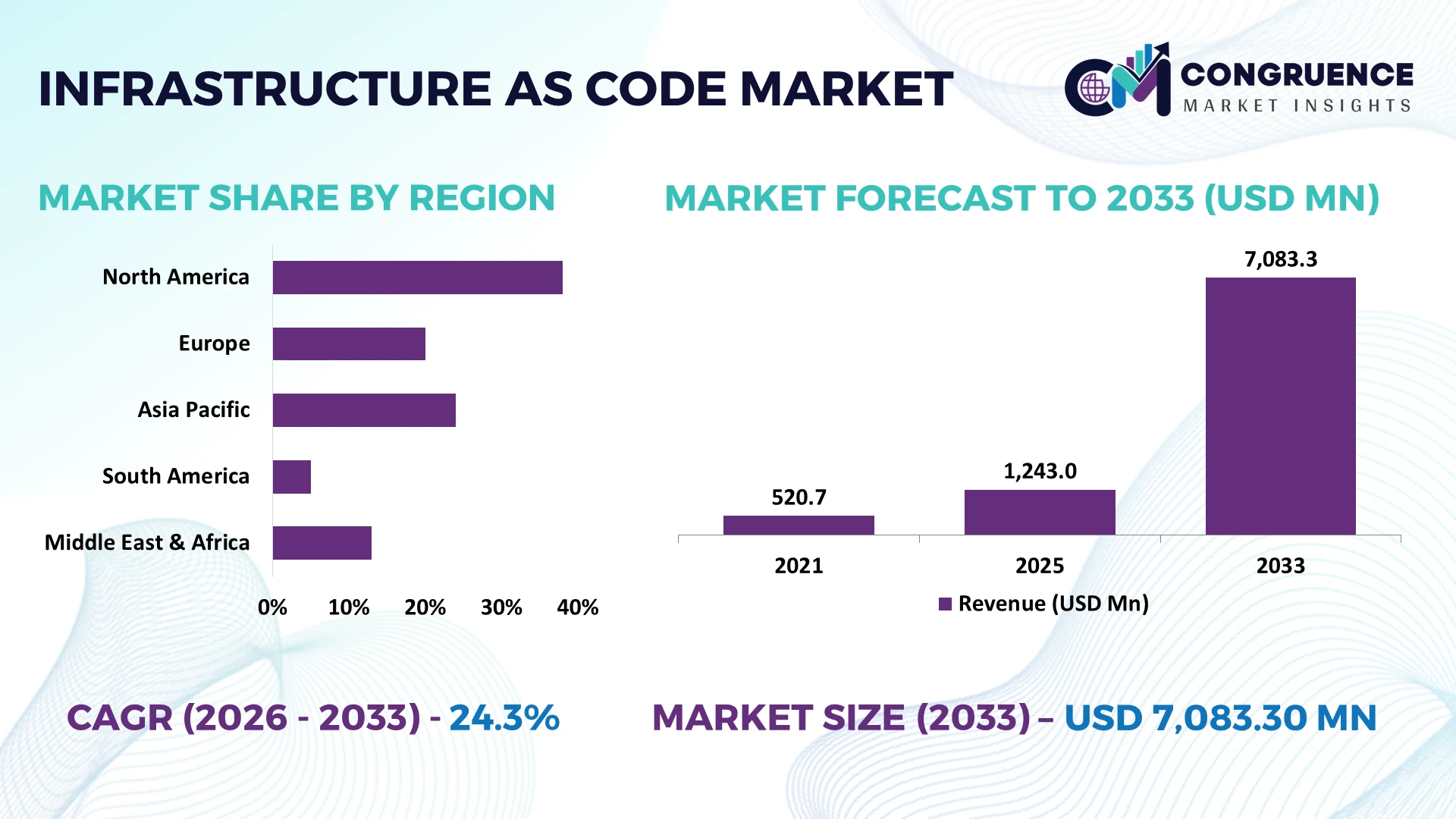
The United States leads the global Infrastructure As Code market with approximately 38% share, supported by hyperscale cloud investments, federal cybersecurity modernization programs, and widespread adoption across finance, defense, healthcare, and technology sectors. In comparison, India records infrastructure automation adoption exceeding 30% among large enterprises, driven by expanding digital public infrastructure and software development centers. Continued AI infrastructure expansion and evolving cyber resilience priorities following global supply-chain security initiatives further strengthen enterprise investment decisions.
Organizations prioritizing automated infrastructure governance and standardized deployment frameworks are positioned to improve operational resilience while accelerating digital transformation initiatives.
Market Size & Growth: USD 1243 Million (2025) to USD 7083.3 Million (2033) at 24.3% CAGR, fueled by enterprise cloud automation and DevSecOps adoption.
Top Growth Drivers: AI-enabled automation improves deployment efficiency by 35%, multi-cloud adoption exceeds 65%, and policy-as-code reduces configuration errors by 40%.
Short-Term Forecast: By 2028, automated infrastructure provisioning cuts deployment time by 50% and lowers operational costs by 30%.
Emerging Technologies: AI-driven orchestration, GitOps, and policy-as-code strengthen security compliance while increasing infrastructure consistency by over 45%.
Regional Leaders: North America approaches USD 2.9 billion, Europe USD 1.8 billion, and Asia-Pacific USD 1.6 billion, supported by expanding enterprise cloud deployments.
Consumer/End-User Trends: More than 70% of large enterprises integrate Infrastructure as Code into continuous delivery pipelines for faster software releases.
Pilot/Case Example: In 2026, enterprise cloud automation programs reduced provisioning cycles by 60% while improving infrastructure consistency by 45%.
Competitive Landscape: HashiCorp holds approximately 22% market presence alongside Red Hat, Microsoft, Google Cloud, and Amazon Web Services in advanced infrastructure automation.
Regulatory & ESG Impact: Automated compliance monitoring reduces audit preparation time by 35% while supporting stronger governance across global cloud environments.
Investment & Funding: Over USD 4 billion supports cloud automation platforms through strategic partnerships, regional expansion, and enterprise platform integration.
Innovation & Future Outlook: AI-assisted infrastructure optimization, autonomous operations, and secure software supply-chain automation redefine next-generation enterprise infrastructure management.
Infrastructure As Code solutions continue expanding across financial services, telecommunications, manufacturing, and public sector environments where automated provisioning and compliance are operational priorities. AI-assisted configuration validation, security scanning, and GitOps workflows improve deployment consistency by nearly 40%. Increasing software supply-chain security requirements and stricter governance frameworks are accelerating standardized infrastructure automation, setting the foundation for the following strategic market assessment.
Infrastructure as Code has become a strategic enterprise capability as organizations prioritize standardized infrastructure management, cyber resilience, and faster application delivery across hybrid and multi-cloud environments. The market is increasingly shaped by infrastructure modernization programs, software supply-chain security requirements, and stricter governance policies that require automated configuration management instead of manual provisioning. This transition is strengthening competitive positioning for enterprises operating highly distributed digital environments.
Modern Infrastructure as Code platforms complete infrastructure provisioning around 60% faster than legacy manual administration while reducing configuration drift by nearly 45%, improving operational consistency across complex cloud estates. The United States remains the largest deployment market because of mature cloud ecosystems and enterprise DevSecOps adoption, whereas India is expanding rapidly through large-scale software engineering centers and government-backed digital infrastructure initiatives. During the next two to three years, enterprise policy-as-code adoption is expected to exceed 65% among large organizations, supported by broader AI-assisted infrastructure automation.
A multinational financial institution deploying automated Infrastructure as Code across hybrid environments can reduce release cycles while improving audit readiness through standardized configuration controls. Vendors are expanding strategic partnerships with cloud providers, cybersecurity firms, and platform integrators to strengthen automation portfolios. Organizations investing in scalable infrastructure orchestration and governance frameworks will secure stronger operational resilience, faster innovation cycles, and sustainable competitive differentiation.
Cloud-native application development and enterprise automation remain the primary structural drivers for Infrastructure as Code adoption. More than 70% of large enterprises now standardize infrastructure provisioning through automated workflows, while policy-driven automation lowers configuration errors by approximately 40% and improves deployment consistency by nearly 50%. The United States continues expanding zero-trust modernization initiatives, encouraging automated infrastructure governance across regulated sectors. As software supply-chain security receives greater executive attention, technology vendors are investing in AI-assisted infrastructure validation, strategic cloud partnerships, and integrated DevSecOps platforms. This shift enables organizations to shorten release cycles while strengthening compliance, creating measurable operational advantages beyond traditional infrastructure management.
Interoperability remains a structural limitation as enterprises manage diverse cloud environments, legacy infrastructure, and multiple automation frameworks simultaneously. Nearly 45% of large organizations continue operating mixed infrastructure estates, while integration activities can consume over 30% of implementation resources during transformation projects. Germany and Japan face additional compliance alignment challenges where sector-specific governance increases deployment complexity across regulated industries. Organizations respond by adopting standardized templates, localized cloud architectures, and long-term technology partnerships that simplify migration. Companies also expand platform certification programs and unified management capabilities to reduce operational fragmentation, improve deployment predictability, and maintain governance across increasingly distributed infrastructure environments.
Artificial intelligence, predictive infrastructure optimization, and edge computing create significant opportunities beyond conventional automation. AI-assisted infrastructure operations improve resource utilization by approximately 35%, while intelligent policy engines reduce manual intervention by nearly 40%. India is strengthening digital infrastructure ecosystems through expanding hyperscale data center investments, creating new demand for standardized infrastructure provisioning across distributed environments. Vendors are increasing R&D investment in autonomous remediation, infrastructure observability, and secure GitOps ecosystems while forming alliances with cloud platform providers. The combination of intelligent automation and distributed computing enables organizations to achieve faster deployment, stronger governance, and lower operational overhead in high-volume enterprise environments.
Scaling Infrastructure as Code across global enterprises requires specialized expertise in automation, cloud architecture, security, and governance, creating execution challenges beyond technology deployment. Around 48% of organizations report shortages of advanced cloud automation skills, while multi-team infrastructure environments increase configuration management complexity by over 35%. The United Kingdom and Canada continue investing in cloud engineering capability to address expanding enterprise modernization requirements. Companies must strengthen workforce development, platform engineering practices, and automated governance frameworks while integrating continuous security validation into deployment pipelines. Organizations solving these operational challenges establish more resilient infrastructure operations, consistent deployment quality, and stronger long-term competitive positioning.
AI-Driven Infrastructure Governance Enterprise adoption of AI-assisted Infrastructure as Code validation has surpassed 55%, while automated policy enforcement reduces configuration drift by nearly 40% and accelerates compliance checks by over 35%. Tightening cybersecurity regulations and software supply-chain scrutiny are prompting vendors to integrate AI-based code analysis, expand cloud security partnerships, and automate governance across multi-cloud environments, improving operational resilience without increasing infrastructure complexity.
GitOps Becomes Deployment Standard GitOps workflows now support more than 60% of cloud-native development environments, reducing deployment rollback incidents by approximately 30% and shortening release cycles by nearly 45%. Enterprises in the United States are standardizing repository-driven infrastructure management to improve traceability. Platform vendors are expanding Kubernetes integration and lifecycle automation to simplify large-scale infrastructure operations while maintaining consistent deployment quality.
Platform Engineering Expansion Internal platform engineering adoption has increased beyond 50% among large digital enterprises, enabling infrastructure provisioning efficiency improvements approaching 40%. Growing engineering talent shortages are driving organizations to centralize reusable Infrastructure as Code modules instead of maintaining fragmented deployment teams. Technology providers are restructuring product portfolios around self-service automation, standardized templates, and integrated developer platforms that improve productivity while lowering operational overhead.
Hybrid Cloud Standardization More than 65% of enterprise workloads now operate across hybrid or multi-cloud environments, increasing demand for unified Infrastructure as Code frameworks that reduce provisioning time by approximately 50%. Japanese manufacturers and financial institutions are accelerating standardized automation following infrastructure modernization initiatives. Vendors continue expanding strategic alliances with cloud providers, enabling consistent orchestration, stronger governance, and streamlined infrastructure lifecycle management across geographically distributed operations.
Declarative Infrastructure as Code remains the leading segment with an estimated 46% market share because it enables predictable infrastructure provisioning, simplified lifecycle management, and stronger scalability across hybrid cloud environments. Organizations increasingly prefer declarative models for policy enforcement, automated reconciliation, and reduced configuration drift. Agent-Based solutions represent the fastest-growing segment as enterprises require continuous monitoring, intelligent orchestration, and real-time infrastructure visibility across distributed environments. Adoption of Agent-Based deployments has increased by nearly 32% within complex enterprise cloud architectures.
Imperative Infrastructure as Code continues serving organizations requiring detailed execution control and customized workflows, particularly in legacy enterprise environments. Agentless platforms remain strategically important for organizations seeking lower deployment complexity and simplified infrastructure integration without installing endpoint software. Technology vendors are expanding declarative automation capabilities, strengthening agent intelligence through AI integration, and investing in platform interoperability to address increasingly complex enterprise cloud ecosystems. These investment priorities continue shifting enterprise preference toward automated, policy-driven infrastructure management with greater operational consistency.
Infrastructure Provisioning accounts for approximately 37% of total deployment activity, supported by enterprise cloud migration, standardized environment creation, and automated resource allocation. Organizations prioritize provisioning automation because it reduces manual deployment effort by nearly 50% while improving infrastructure consistency across hybrid cloud operations. Cloud Automation represents the fastest-growing application as enterprises expand AI-enabled orchestration, distributed infrastructure, and policy-driven operations. Adoption has increased by approximately 35% among large organizations modernizing enterprise platforms.
Configuration Management remains essential for maintaining infrastructure consistency and compliance, while Continuous Deployment gains traction through DevSecOps integration and accelerated software delivery. Disaster Recovery adoption continues expanding as organizations automate resilient recovery environments and improve business continuity across distributed infrastructure. Vendors are strengthening orchestration capabilities, integrating automation into cloud-native platforms, and expanding strategic partnerships with hyperscale cloud providers. Demand is increasingly concentrated on applications that combine operational efficiency, governance, and deployment speed within unified automation frameworks.
IT & Telecom represents the largest end-user segment with approximately 41% market share due to continuous cloud infrastructure expansion, large-scale software deployment, and high infrastructure automation requirements. The Healthcare sector is emerging as the fastest-growing end-user as hospitals and digital health providers automate compliant infrastructure supporting connected healthcare platforms and secure clinical applications. Infrastructure automation adoption within healthcare environments has increased by approximately 30%, while deployment standardization improves operational efficiency by nearly 35%.
BFSI organizations continue investing heavily in Infrastructure as Code to strengthen regulatory compliance, cybersecurity, and resilient digital banking platforms. Retail enterprises increasingly automate cloud infrastructure to support omnichannel operations, while Government agencies modernize digital public services through standardized deployment frameworks. Vendors are tailoring industry-specific automation capabilities, strengthening cybersecurity partnerships, and expanding managed Infrastructure as Code offerings to address sector-specific operational requirements. Competitive positioning increasingly depends on delivering secure, compliant, and scalable automation aligned with enterprise transformation priorities.
North America accounted for the largest market share at 39% in 2025 however, Asia-Pacific is expected to register the fastest growth, expanding at a 27.1% between 2026 and 2033.
Enterprise Cloud Automation and DevSecOps Leadership
North America remains the leading Infrastructure as Code market due to extensive enterprise cloud adoption, mature DevSecOps ecosystems, and hyperscale infrastructure investments. Large enterprises increasingly standardize infrastructure provisioning to improve deployment consistency, with nearly 72% of cloud-native organizations integrating Infrastructure as Code into continuous delivery pipelines. Financial services, healthcare, telecommunications, and public sector modernization programs continue driving enterprise-scale implementation. A measurable trend is the expansion of AI-assisted infrastructure governance, reducing configuration drift by approximately 40% while accelerating deployment validation. Technology vendors continue strengthening cloud partnerships, expanding managed automation services, and integrating security-first orchestration platforms. Growing enterprise demand for standardized governance and multi-cloud lifecycle management reinforces North America's leadership in operational maturity and advanced infrastructure automation.
United States Market Outlook: The United States dominates regional adoption through hyperscale cloud infrastructure, advanced software engineering capabilities, and strong enterprise technology spending. More than 75% of Fortune 500 organizations operate hybrid cloud environments supported by Infrastructure as Code frameworks. Federal cybersecurity modernization initiatives and zero-trust implementation continue accelerating enterprise automation investments, while leading cloud providers expand AI-enabled infrastructure management capabilities to improve deployment quality and operational resilience.
Compliance-Driven Infrastructure Modernization
Europe is strengthening Infrastructure as Code deployment through digital sovereignty initiatives, cybersecurity compliance, and enterprise modernization strategies. Organizations increasingly automate infrastructure governance to satisfy evolving regulatory requirements while improving operational efficiency across distributed cloud environments. Approximately 58% of large enterprises have integrated infrastructure automation into digital transformation programs, particularly across banking, manufacturing, and public administration. Growing investment in sovereign cloud infrastructure is encouraging standardized deployment frameworks and policy-driven automation. Technology providers are expanding regional cloud partnerships and localized platform capabilities to address compliance requirements. Enterprise demand increasingly focuses on resilient infrastructure management that combines operational flexibility with regulatory consistency.
Germany Market Outlook: Germany leads the European market through advanced industrial digitization, manufacturing modernization, and enterprise cloud transformation. More than 60% of large industrial organizations have accelerated infrastructure automation as part of Industry 4.0 initiatives. Strong cybersecurity standards, engineering expertise, and investments in sovereign cloud ecosystems continue positioning Germany as a strategic center for secure Infrastructure as Code deployment across regulated enterprise environments.
Digital Infrastructure Expansion Accelerates Adoption
Asia-Pacific is emerging as the fastest-expanding Infrastructure as Code market as enterprises modernize digital infrastructure, expand cloud-native applications, and establish regional software engineering hubs. More than 65% of newly deployed enterprise workloads are designed for cloud-native environments, increasing demand for automated provisioning and infrastructure orchestration. Large-scale hyperscale data center investments and government-backed digital transformation initiatives continue strengthening deployment activity. Cloud providers are expanding regional capacity while software vendors establish strategic partnerships with enterprise service providers to support scalable automation. Standardized infrastructure management is becoming an operational priority across banking, manufacturing, telecommunications, and digital commerce.
India Market Outlook: India is the region's strongest growth engine, supported by expanding hyperscale data centers, global capability centers, and enterprise cloud transformation. Infrastructure automation adoption among large enterprises exceeds 30%, while software engineering exports continue driving demand for standardized DevOps workflows. Government digital infrastructure programs and sustained investment in AI-ready cloud platforms are reinforcing India's position as a strategic Infrastructure as Code deployment hub.
Enterprise Digital Transformation Gains Momentum
South America is experiencing steady Infrastructure as Code adoption as enterprises modernize cloud operations and improve deployment efficiency across financial services, retail, and telecommunications. Organizations increasingly replace manual infrastructure management with automated provisioning to reduce operational delays and improve governance. Enterprise cloud adoption has exceeded 45% among large organizations in several major economies, supporting broader automation initiatives. Technology vendors continue expanding regional partnerships and managed cloud services despite infrastructure disparities across countries. Investment priorities increasingly focus on operational efficiency, cybersecurity, and standardized infrastructure governance that supports scalable digital business operations.
Brazil Market Outlook: Brazil represents the region's largest Infrastructure as Code market due to its expanding cloud ecosystem, financial technology sector, and enterprise digitalization programs. Cloud infrastructure investments continue supporting automation across banking, telecommunications, and retail organizations. More than half of large enterprises are expanding hybrid cloud strategies, encouraging vendors to strengthen local partnerships, managed automation services, and enterprise infrastructure platforms.
Cloud Modernization Drives Infrastructure Investment
The Middle East & Africa market is expanding through national digital transformation programs, cloud infrastructure investments, and enterprise modernization across government, finance, and energy sectors. Organizations increasingly adopt Infrastructure as Code to improve operational governance and accelerate cloud deployment consistency. Enterprise cloud adoption has surpassed 40% among leading organizations in key Gulf economies, supported by large-scale smart city and digital government initiatives. Global technology providers continue investing in regional cloud facilities, strategic alliances, and cybersecurity capabilities to strengthen automation services. Infrastructure standardization is becoming essential for supporting resilient digital operations across critical industries.
Saudi Arabia Market Outlook: Saudi Arabia leads regional momentum through Vision 2030 digital transformation initiatives, expanding hyperscale cloud investments, and rapid public-sector modernization. Enterprise demand for automated infrastructure management continues rising across government, financial services, and energy organizations. Growing cloud infrastructure deployments and strategic partnerships with global technology providers are strengthening the country's position as a regional center for Infrastructure as Code implementation.
The Infrastructure as Code market is led by HashiCorp, Red Hat, Microsoft, Amazon Web Services, and Google Cloud, competing directly with cloud-native automation specialists and enterprise platform vendors. The top five players collectively control approximately 58% of market activity through integrated cloud ecosystems and automation platforms. Competition centers on deployment speed, policy automation, platform interoperability, and security, with AI-assisted provisioning improving operational efficiency by nearly 35% and automated compliance reducing configuration errors by approximately 40%. Vendors strengthen market position through cloud partnerships, GitOps integration, platform expansion, and embedded DevSecOps capabilities rather than price competition alone. The competitive landscape is shifting toward intelligent infrastructure orchestration, where AI-enabled governance and hybrid cloud management increasingly differentiate leading platforms. High technical expertise requirements, ecosystem integration, and enterprise migration complexity create significant entry barriers. Sustainable competitive advantage depends on delivering secure, scalable, interoperable automation platforms with strong ecosystem partnerships and continuous innovation.
HashiCorp
Red Hat
Microsoft
Amazon Web Services
Google Cloud
IBM
Oracle
VMware
Pulumi
SUSE
CloudBees
GitLab
Puppet
Progress Software
Infrastructure as Code is evolving beyond template-based automation toward intelligent infrastructure orchestration powered by AI, GitOps, and policy-as-code. Declarative provisioning remains the dominant approach, with adoption exceeding 70% among cloud-native enterprises because it improves deployment consistency by nearly 45%. Policy-as-code integration reduces compliance validation time by approximately 35%, while GitOps workflows shorten release cycles by almost 40%. Organizations increasingly combine Infrastructure as Code with Kubernetes, DevSecOps pipelines, and hybrid cloud platforms to standardize operations across distributed environments.
Emerging technologies include AI-assisted code generation, autonomous drift detection, infrastructure observability, and platform engineering. AI-driven validation improves configuration accuracy by roughly 30%, while automated remediation reduces incident response time by nearly 25%. More than 60% of large enterprises now integrate Infrastructure as Code into continuous delivery workflows, strengthening governance and accelerating software delivery. Compared with legacy manual provisioning, modern automated platforms reduce deployment time by nearly 60% while improving infrastructure scalability and operational resilience.
Between 2026 and 2028, intelligent Infrastructure as Code platforms will increasingly combine predictive analytics, security automation, and multi-cloud orchestration into unified operating models. Cloud platform leaders and automation specialists benefit through ecosystem expansion, whereas enterprises relying on manual infrastructure management face slower release cycles and higher operational costs. Organizations investing now in AI-enabled automation, policy-driven governance, and integrated platform engineering establish stronger competitive positioning, faster innovation, and resilient enterprise infrastructure.
June 2025 HashiCorp announced general availability of the Terraform AWS Provider 6.0 with enhanced multi-region capabilities and workflow improvements, enabling broader AWS service integration and more efficient infrastructure lifecycle management. Business impact: faster enterprise cloud deployment.
July 2025 Amazon Web Services released Account Factory for Terraform (AFT) version 1.15.0 for AWS Control Tower, expanding enterprise automation capabilities and supporting new deployment configurations across AWS environments. Business impact: improved governance and standardized cloud provisioning. Source: (AWS Documentation)
July 2026 Amazon Web Services introduced automatic customization re-application for AWS Control Tower Account Factory for Terraform when accounts move between organizational units, eliminating manual intervention and reducing configuration drift. Business impact: stronger operational consistency across enterprise cloud estates. Source: (Amazon Web Services, Inc.)
June 2026 HashiCorp enhanced HCP Terraform with project-level run tasks, enabling organizations to apply centralized security and compliance guardrails across groups of workspaces while reducing manual administration. Business impact: improved governance and scalable enterprise policy enforcement. Source: (HashiCorp Developer)
The report delivers a comprehensive assessment of the global Infrastructure as Code market, examining technology evolution, enterprise deployment patterns, competitive positioning, and strategic adoption across cloud-native environments. It evaluates four core technology types, five major application areas, and five leading end-user industries while providing detailed analysis across North America, Europe, Asia-Pacific, South America, and the Middle East & Africa. More than 70% of enterprise cloud deployments now incorporate infrastructure automation, making deployment standardization and governance central evaluation criteria.
The study supports strategic decision-making through detailed segmentation, regional benchmarking, technology comparisons, and competitive analysis between 2026 and 2033. It examines enterprise adoption trends, multi-cloud deployment strategies, DevSecOps integration, AI-enabled automation, and platform engineering developments. The report also highlights emerging opportunities in policy-as-code, intelligent infrastructure management, cloud automation ecosystems, and industry-specific deployment models, enabling stakeholders to refine investment priorities, expansion strategies, product positioning, and long-term competitive planning.
| Report Attribute/Metric | Report Details |
|---|---|
|
Market Revenue in 2025 |
USD 1243 Million |
|
Market Revenue in 2033 |
USD 7083.3 Million |
|
CAGR (2026 - 2033) |
24.3% |
|
Base Year |
2025 |
|
Forecast Period |
2026 - 2033 |
|
Historic Period |
2021 - 2025 |
|
Segments Covered |
By Type
By Application
By End-User
|
|
Key Report Deliverable |
Revenue Forecast, Growth Trends, Market Dynamics, Segmental Overview, Regional and Country-wise Analysis, Competition Landscape |
|
Region Covered |
North America, Europe, Asia-Pacific, South America, Middle East, Africa |
|
Key Players Analyzed |
HashiCorp, Red Hat, Microsoft, Amazon Web Services, Google Cloud, IBM, Oracle, VMware, Pulumi, SUSE, CloudBees, GitLab, Puppet, Progress Software |
|
Customization & Pricing |
Available on Request (10% Customization is Free) |




