
Reports
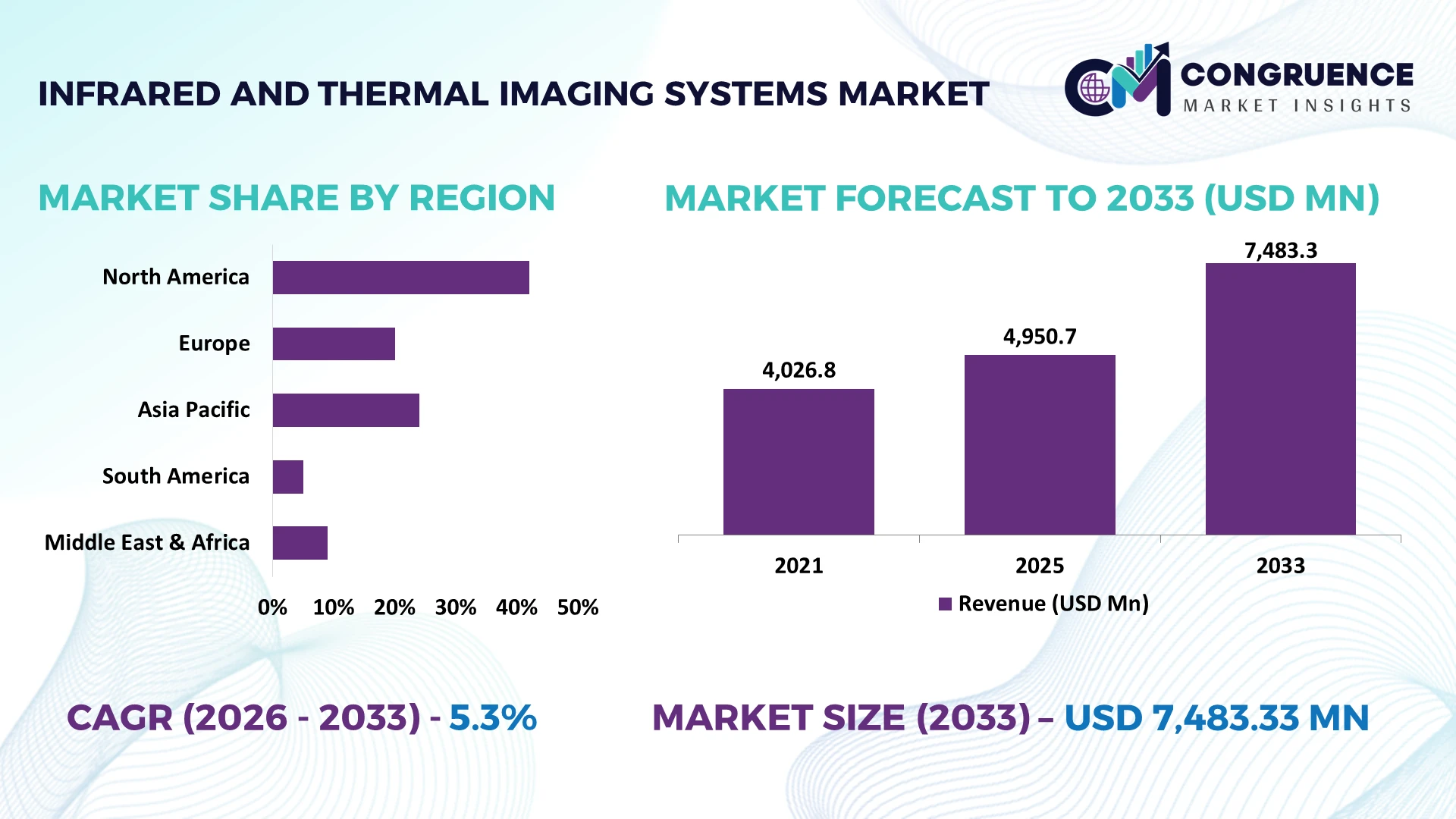
The Global Infrared and Thermal Imaging Systems Market was valued at USD 4950.72 Million in 2025 and is anticipated to reach a value of USD 7483.33 Million by 2033 expanding at a CAGR of 5.3% between 2026 and 2033. Growth is driven by defense ISR modernization, AI-enabled thermal analytics, automotive night-vision integration, industrial predictive maintenance, and counter-UAS deployments.
The United States remains the dominant country, supported by approximately 37.7% of global infrared imaging activity and extensive deployment across aerospace, defense, security, energy, automotive, and industrial inspection. U.S. adoption is strengthened by AI-assisted detection and established cooled and uncooled sensor manufacturing. China holds about 32.1% of Asia-Pacific thermal imaging activity, while India is expanding at 6.66%, supported by defense localization and industrial inspection. The Russia-Ukraine conflict has intensified demand for persistent thermal surveillance, drone detection, and battlefield ISR capabilities.
Strategically, suppliers should prioritize AI-integrated sensors, SWIR capabilities, compact uncooled platforms, and localized manufacturing across North America and Asia-Pacific.
Market Size & Growth: USD 4.95 billion in 2025 is projected to reach USD 7.48 billion by 2033 at a 5.3% CAGR, driven by defense modernization and AI-enabled imaging.
Top Growth Drivers: Defense modernization 35%, security and surveillance 38.2%, automotive and mobility 7.9%.
Short-Term Forecast: By 2030, AI-enabled inspection can reduce thermal-analysis labor by 20% and improve anomaly-identification efficiency by 15%.
Emerging Technologies: AI analytics, SWIR sensors, multispectral fusion, and edge processing are accelerating advanced thermal-system deployment.
Regional Leaders: North America reaches about USD 3.32 billion in 2026 with defense-led adoption; Europe reaches USD 2.41 billion through industrial and security deployment; Asia-Pacific reaches USD 2.17 billion with automotive and manufacturing adoption.
Consumer/End-User Trends: Uncooled LWIR systems represent 71.92% of thermal imaging adoption, reflecting stronger demand for compact, lower-cost inspection platforms.
Pilot/Case Example: A 2025 AI thermal-monitoring deployment in steelmaking delivered a 65% reduction in unplanned tuyere outages through earlier anomaly detection.
Competitive Landscape: Teledyne FLIR leads with approximately 17.5% share, alongside L3Harris, BAE Systems, Leonardo DRS, and RTX.
Regulatory & ESG Impact: NFPA-70B thermography requirements are strengthening recurring electrical-inspection programs, while thermal monitoring supports measurable reductions in equipment-related energy losses.
Investment & Funding: U.S. defense investment exceeding USD 900 billion is reinforcing demand for EO/IR modernization, AI-assisted surveillance, and next-generation sensor development.
Innovation & Future Outlook: Dual-band LWIR-MWIR systems, AI edge inference, autonomous thermal drones, and SWIR imaging are shifting competition toward integrated sensing and analytics platforms.
The Infrared and Thermal Imaging Systems Market is gaining demand across defense surveillance, industrial inspection, automotive night vision, energy infrastructure, fire detection, and unmanned systems. Uncooled LWIR represented 71.92% of thermal imaging systems adoption, reinforcing its commercial advantage through compact designs and lower operating complexity. AI-based analytics are converting thermal imagery into automated alerts for predictive maintenance and security applications, while SWIR technology is expanding visibility through smoke, haze, and low-light conditions. Geopolitical supply-chain restructuring is also accelerating regional sensor manufacturing and localized procurement, creating stronger opportunities for integrated imaging suppliers.
Infrared and thermal imaging systems are becoming strategically important because they convert heat signatures into actionable intelligence for defense, industrial uptime, transport safety, and asset protection. Thermal inspection identifies abnormal temperatures before equipment failures, shifting maintenance toward condition-based intervention. Supply-chain restructuring is also pushing manufacturers to localize detectors, optics, and electronics, particularly in the United States, China, and India.
Technology economics reinforce adoption: AI-assisted thermal inspection can reduce manual screening time by 20–30% versus operator-led inspection, while edge processing can reduce data-transfer requirements by up to 40%. The United States leads in defense-grade cooled sensors and advanced analytics, China emphasizes high-volume manufacturing, and India is expanding localized defense and industrial deployment. Over the next 2–3 years, automated thermal monitoring across large industrial sites is positioned to reach 35–45% adoption.
Companies are responding by combining thermal cameras with drones, machine vision, predictive-maintenance software, and edge AI. Continuous electrical-switchgear monitoring provides a practical deployment model, enabling earlier detection of abnormal heat and fewer manual inspections. Suppliers are increasing R&D partnerships, local assembly, and software integration rather than competing solely on detector specifications. Competitive positioning will increasingly depend on sensing accuracy, analytics, interoperability, and deployment economics.
AI-enabled thermal analytics are strengthening demand as industrial operators shift from periodic inspection toward continuous condition monitoring. Automated anomaly detection can reduce manual screening workloads by 20–30%, while predictive thermal monitoring can identify equipment abnormalities substantially earlier than visual inspection. In the United States, defense and industrial operators are integrating thermal sensors with drones, machine vision, and edge computing. This technology shift is increasing demand for integrated platforms rather than standalone cameras. Manufacturers are responding through AI partnerships, software acquisitions, and embedded analytics development. A non-obvious advantage is recurring software revenue from thermal-data analytics, allowing suppliers to increase customer lifetime value while helping asset-intensive companies reduce unplanned maintenance interventions.
High-performance detectors, precision optics, and specialized semiconductor components continue to constrain cost-sensitive deployments. Cooled infrared systems can carry equipment costs several times higher than uncooled alternatives, while advanced optical assemblies can represent 20–30% of system cost. Dependence on specialized materials and semiconductor supply chains also exposes manufacturers to procurement volatility. U.S. defense programs increasingly emphasize domestic sourcing, while Chinese manufacturers retain advantages in high-volume component production. Companies are mitigating exposure through dual sourcing, localized assembly, longer-term procurement contracts, and greater use of uncooled microbolometers. The key operational constraint is not camera availability alone, but maintaining consistent detector performance and calibration while reducing total system cost.
SWIR imaging, multispectral sensing, and edge AI are opening applications where conventional LWIR systems provide limited discrimination. Edge-based thermal analytics can reduce data-transfer requirements by up to 40% and accelerate anomaly classification by approximately 15–20%, creating measurable advantages for remote industrial assets. India is expanding indigenous electro-optical manufacturing, while Japan and South Korea are strengthening sensor integration across automotive and semiconductor applications. Companies are investing in compact SWIR modules, AI inference chips, and sensor-fusion platforms through R&D partnerships. A high-value opportunity lies in combining thermal sensing with visible and SWIR channels for automated inspection, enabling one platform to address fire detection, electrical faults, material defects, and low-light surveillance.
Integrating thermal imaging into enterprise systems remains difficult because approximately 25–35% of industrial deployments require customized interfaces, calibration workflows, or legacy-system adaptation. Cybersecurity exposure also increases when networked cameras transmit thermal data through cloud or edge infrastructure. In the United States, critical-infrastructure operators face stricter security expectations, increasing requirements for encrypted communications, access controls, and device authentication. Workforce capability presents another constraint, with advanced systems requiring expertise across thermography, AI analytics, networking, and industrial controls. Companies must therefore invest in secure edge architectures, standardized APIs, technician training, and lifecycle support. The strategic challenge is shifting from sensor accuracy alone toward reliable, cyber-secure system integration at scale.
AI Thermal Fusion Expands: Multispectral thermal-visible systems are moving into continuous perimeter monitoring, with AI classification reducing manual screening workloads by approximately 20–30%. Enterprises are integrating thermal feeds with video analytics to automate detection, tracking, and alert prioritization. This shift improves response speed while reducing dependence on large monitoring teams, encouraging suppliers to scale AI-enabled surveillance platforms and analytics partnerships.
Automotive Integration Accelerates: Thermal vision is shifting toward embedded vehicle safety, with advanced platforms targeting approximately 15–20% faster low-light object detection and 10–15% lower processing latency. Automotive manufacturers are integrating thermal sensors with ADAS, visible-light cameras, and edge processors. The transition is moving procurement from standalone cameras toward qualified OEM modules, increasing investment in compact sensors, software integration, and production-scale partnerships.
Localization Reshapes Procurement: Defense and industrial buyers are increasing domestic sourcing as geopolitical tensions expose dependencies in specialized optics, detectors, and semiconductor components. Localization programs target approximately 20–30% shorter procurement lead times, while manufacturers are expanding regional assembly and dual sourcing. Companies are also restructuring supplier contracts to secure critical components, creating a competitive advantage for vendors with diversified manufacturing and localized calibration capabilities.
Compact Platforms Gain Ground: Uncooled thermal systems account for roughly 75% of infrared-camera adoption, supported by lower power consumption, smaller form factors, and simpler deployment. Portable inspection platforms can reduce field inspection time by approximately 20%, encouraging maintenance teams to replace periodic manual checks with mobile radiometric workflows. Manufacturers are responding with compact sensors, embedded analytics, and modular platforms designed for industrial, construction, and energy applications.
Uncooled systems lead the type segmentation with approximately 75% share, supported by lower power consumption, compact microbolometer architectures, faster startup, and lower deployment complexity. Cooled systems retain importance in defense surveillance and long-range applications where higher sensitivity and detection range justify greater system complexity. Handheld systems remain established across industrial inspection and security, while fixed-mount systems support continuous monitoring of infrastructure and restricted areas. Portable systems are gaining adoption as maintenance teams shift from periodic visual checks toward mobile radiometric inspection. OEM modules represent the strongest structural transition because thermal sensing is increasingly embedded into vehicles, robotics, and industrial equipment.
Investment priorities are separating between mature and emerging formats. Handheld and fixed-mount products increasingly compete on durability, affordability, connectivity, and analytics, while OEM modules emphasize miniaturization, qualification, and production consistency. The fastest-growing shift is embedded thermal functionality, where OEM integration can expand thermal deployment beyond specialist users. Companies are therefore increasing R&D spending on compact microbolometers, automotive-qualified modules, and strategic OEM partnerships while maintaining specialized cooled-system portfolios.
Surveillance leads the application mix with approximately 38% share, reflecting persistent requirements for perimeter protection, border monitoring, critical infrastructure security, and low-light detection. Fire detection and building inspection remain established applications, while predictive maintenance and industrial inspection are becoming more automated through integration with asset-management platforms. Medical imaging remains specialized, whereas automotive vision represents the fastest-changing application as thermal sensing enters vehicle safety architectures. Companies are increasingly combining thermal cameras with visible imaging, AI classification, and automated alert systems to reduce manual monitoring and improve detection workflows.
Automotive vision is shifting procurement priorities because thermal cameras increasingly require vehicle-grade reliability, software compatibility, and sensor-fusion capabilities. Advanced thermal platforms can improve low-light object detection by approximately 15–20%, while automated classification can reduce manual screening requirements by 20–30%. Companies are responding through automotive OEM partnerships, embedded AI development, and multispectral product expansion. Surveillance providers are similarly moving toward persistent analytics and automated alerts, making integrated detection-to-response platforms increasingly important for operationally critical security environments.
Defense represents the leading end-user group at approximately 35% share, reflecting extensive deployment across surveillance, reconnaissance, targeting, border monitoring, and night operations. Law enforcement and energy utilities maintain recurring requirements for perimeter and asset monitoring, while oil and gas operators use thermal systems for equipment inspection and abnormal-temperature detection. Manufacturing and construction increasingly favor portable systems for maintenance workflows. Automotive represents the fastest-changing buyer group as thermal sensing moves into vehicle safety and autonomous perception, while healthcare remains a specialized application. Energy and utilities are increasing adoption of continuous monitoring for critical assets.
Purchasing behavior is separating into two models: defense prioritizes ruggedized, high-performance systems, while automotive and manufacturing emphasize scalability, qualification, software compatibility, and lifecycle economics. Automotive thermal adoption is increasing as OEMs integrate sensing directly into vehicle architectures, while industrial buyers favor modular systems that can connect with existing inspection platforms. Companies are responding through customized modules, OEM agreements, localized production, and sensor-plus-software ecosystems. India is becoming strategically important for localized defense-electronics manufacturing, while U.S. suppliers continue prioritizing advanced sensors and integrated surveillance platforms.
North America accounted for the largest market share at 37.7% in 2025 however, Asia Pacific is expected to register the fastest growth, expanding at a CAGR of 8.55% between 2026 and 2033.
Defense modernization and industrial automation strengthen deployment
North America holds approximately 37.7% of global infrared imaging activity, supported by concentrated defense procurement, industrial inspection, critical-infrastructure monitoring, and advanced automotive development. The United States represents the region’s principal demand center, with thermal imaging increasingly integrated into counter-UAS platforms, border surveillance, predictive maintenance, and vehicle safety systems. Uncooled technology accounts for more than 70% of infrared-camera deployments, supporting wider commercial adoption through lower power requirements and compact designs. U.S. manufacturers are expanding AI-enabled analytics and multispectral platforms, while procurement programs increasingly emphasize domestic supply resilience. Companies are responding through vertical integration, defense partnerships, localized component sourcing, and expansion of embedded thermal modules for automotive and industrial OEMs.
United States Market Outlook: The United States remains North America’s primary thermal-imaging technology and deployment center, supported by advanced defense procurement, aerospace manufacturing, automotive R&D, industrial automation, and critical-infrastructure monitoring. Thermal systems are increasingly integrated into counter-UAS platforms, border surveillance, predictive maintenance, and vehicle safety architectures. More than 70% of commercial infrared-camera deployments use uncooled technology, supporting broader adoption through compact designs and lower operating requirements. Companies are expanding domestic component sourcing, AI-enabled analytics, multispectral platforms, and embedded OEM modules to strengthen supply resilience and capture higher-value applications.
Defense modernization meets energy-efficiency inspection
Europe represented approximately 26.9% of global infrared imaging activity in 2025, with demand concentrated across Germany, the United Kingdom, France, Italy, and Nordic defense markets. Building-efficiency programs, industrial thermography, healthcare diagnostics, and defense modernization are broadening deployment beyond conventional surveillance. Germany and the United Kingdom maintain strong engineering capabilities, while European defense procurement is increasing demand for electro-optical systems, thermal sights, and border-monitoring equipment. Thermal inspection is also becoming more relevant to energy-efficiency programs, where automated diagnostics can identify heat losses and equipment abnormalities faster than manual inspection. Companies are responding through cross-border partnerships, localized manufacturing, and integration of thermal imaging with machine vision, building-management systems, and defense platforms.
Germany Market Outlook: Germany combines advanced automotive manufacturing, industrial automation, precision engineering, and defense-electronics capabilities, creating a diversified demand base for infrared and thermal imaging systems. Automotive suppliers are integrating thermal sensing into advanced driver-assistance and nighttime detection architectures, while manufacturers use infrared inspection for electrical equipment, machinery, production quality, and predictive maintenance. Industrial users increasingly connect thermal cameras with machine-vision and asset-management platforms to automate anomaly detection. Companies are prioritizing high-precision sensors, embedded modules, software integration, and strategic technology partnerships to strengthen their position across automotive and industrial applications.
Manufacturing scale accelerates thermal-sensing integration
Asia-Pacific represented approximately 24.1% of global infrared imaging activity in 2025 and is positioned as the fastest-expanding major market, supported by manufacturing modernization, infrastructure development, defense procurement, and automotive production. China remains a major production and consumption center, while Japan and South Korea contribute advanced semiconductor, automotive, and precision-sensor capabilities. India is increasing domestic electro-optical manufacturing and defense localization, creating additional demand for indigenous thermal systems. Chinese manufacturers are increasingly integrating detector fabrication, optics, electronics, and camera assembly, shortening supply chains and improving cost competitiveness. Companies are therefore prioritizing localized production, OEM partnerships, and compact uncooled platforms to capture high-volume industrial and automotive applications.
China Market Outlook: China combines large-scale electronics manufacturing with extensive industrial, infrastructure, security, and automotive deployment, giving domestic suppliers significant advantages in production scalability and component integration. Its established electronics ecosystem supports detector fabrication, optics, electronics assembly, and camera manufacturing within increasingly localized supply chains. Thermal imaging is expanding across factory automation, transportation infrastructure, security monitoring, energy assets, and automotive systems. Companies are focusing on cost-efficient uncooled platforms, AI-assisted image processing, compact modules, and vertically integrated production. The ability to combine competitive manufacturing economics with rapid product customization is strengthening China’s position across high-volume thermal-imaging applications.
Mining and energy projects anchor specialized demand
South America represents a smaller but strategically relevant thermal-imaging market, with approximately 5% share in broader infrared and thermal-system estimates. Brazil and Chile account for significant industrial opportunities through mining, utilities, oil and gas, agriculture, and wildfire monitoring. Thermal cameras are increasingly used for conveyor inspection, electrical maintenance, equipment diagnostics, and remote asset surveillance where physical inspection is difficult. Mining operators are combining fixed thermal sensors with drones and predictive-maintenance platforms to improve asset visibility across large sites. Import dependency remains a constraint, particularly for advanced detectors and specialized optics, encouraging distributors and system integrators to strengthen local inventories and technical support. Companies entering Brazil and Chile are prioritizing application-specific packages rather than premium standalone hardware.
Brazil Market Outlook: Brazil offers South America’s broadest industrial opportunity for thermal imaging, supported by mining, energy, utilities, manufacturing, agriculture, infrastructure, and oil and gas operations. Thermal cameras are increasingly deployed for electrical inspection, equipment monitoring, conveyor systems, remote asset surveillance, and wildfire detection. Mining operators are combining fixed thermal sensors with drones and predictive-maintenance software to monitor large and difficult-to-access facilities. Import dependence for advanced detectors and specialized optics remains a constraint, encouraging suppliers to strengthen local inventories, distributor relationships, calibration services, and technical support. Companies with application-specific solutions and local integration capabilities can address Brazil’s geographically distributed industrial assets more effectively.
Critical infrastructure drives premium thermal deployment
The Middle East and Africa account for approximately 3% of the broader infrared and thermal-imaging market, with demand concentrated around oil and gas facilities, airports, border infrastructure, utilities, and large-scale construction projects. Gulf countries are investing in automated perimeter surveillance, pipeline monitoring, and smart-infrastructure security, where thermal cameras provide continuous operation in darkness and challenging visibility conditions. Oil and gas operators are also combining infrared inspection with asset-management platforms to identify overheating equipment and maintenance anomalies. Africa remains more project-driven, with deployment concentrated around mining, utilities, security, and industrial facilities. Suppliers are responding through local distributor networks, system-integration partnerships, ruggedized products, and service agreements that address challenging operating environments.
Saudi Arabia Market Outlook: Saudi Arabia is becoming a significant Middle Eastern deployment center because of large infrastructure programs, energy assets, airport expansion, industrial projects, and security modernization. Thermal imaging is increasingly incorporated into perimeter protection, pipeline monitoring, industrial inspection, and critical-infrastructure surveillance where continuous operation is required under low-light and high-temperature conditions. Energy companies are adopting fixed and mobile thermal platforms to identify equipment abnormalities and support preventive maintenance across geographically distributed assets. Companies are strengthening local partnerships, technical support, and system-integration capabilities while developing ruggedized cameras suited to demanding environments. Large infrastructure projects are also creating demand for thermal inspection during construction, commissioning, and ongoing facility management.
Teledyne FLIR, L3Harris Technologies, BAE Systems, Leonardo DRS, Axis Communications, and regional Chinese manufacturers compete across defense, industrial inspection, surveillance, and automotive sensing. The top five global players collectively account for approximately 35–40% of the market, leaving substantial room for specialized regional suppliers and technology-focused entrants. Competition centers on detector performance, system cost, supply reliability, customization, and analytics integration. Uncooled systems command more than 70% adoption, intensifying price pressure in commercial applications, while advanced cooled and SWIR platforms compete through sensitivity and long-range performance. Leading companies are expanding through OEM partnerships, localized production, vertical integration, and AI-enabled software. Chinese suppliers increasingly compete through manufacturing scale and pricing, while U.S. and European players emphasize defense qualification, sensor performance, and supply-chain compliance. The competitive shift is moving from standalone camera specifications toward integrated sensing ecosystems. Winning requires differentiated detectors, reliable supply, embedded analytics, application-specific customization, and scalable manufacturing.
Teledyne FLIR
L3Harris Technologies
BAE Systems
Leonardo DRS
Axis Communications
RTX
Fluke Corporation
Lynred
Seek Thermal
Guide Infrared
Dali Technology
Xenics
Current systems center on uncooled LWIR microbolometers, radiometric processing, and multispectral fusion for industrial inspection, surveillance, and automotive sensing. Uncooled architectures account for roughly 75% of infrared-camera adoption, while embedded AI can reduce manual screening workload by 20–30%. This shifts value toward automated detection and faster maintenance decisions. Edge calibration enables faster temperature-based decisions and reduces centralized review.
Emerging platforms use SWIR, high-operating-temperature detectors, edge AI, and compact OEM modules. Advanced thermal platforms increasingly combine high-resolution sensing with functional-safety architectures, while edge processing can cut data-transfer requirements by roughly 40%. Compared with legacy inspection, AI-assisted workflows can improve anomaly-screening efficiency by approximately 15–20%, benefiting suppliers controlling sensors and analytics. Advanced optics improve sensitivity without proportionally increasing system size, strengthening embedded deployment economics.
From 2026–2028, competitive advantage will increasingly come from sensor fusion, embedded intelligence, and production-qualified modules rather than resolution alone. Automotive, defense, utilities, and manufacturing buyers are integrating thermal systems with radar, visible cameras, drones, and maintenance software. Companies acting now on AI datasets, localized components, and OEM partnerships can shorten deployment cycles, reduce integration costs, and secure recurring software demand. Strong beneficiaries include vertically integrated suppliers combining detector IP, software, ruggedization, and certification across high-value industrial programs globally.
January 2026 Teledyne FLIR launched Tura, an ASIL-B 640×512 LWIR camera for ADAS, after producing more than one million automotive thermal sensors. The launch strengthens vehicle-grade thermal integration, supporting safer nighttime perception and scalable OEM deployment across vehicle programs.
September 2025 LightPath Technologies received a $22.1 million follow-on purchase order for advanced infrared camera systems. The order expands defense production activity and reinforces vertically integrated optics and infrared manufacturing, supporting larger-scale supply commitments for demanding military imaging programs and requirements.
June 2025 ABB and Hydrosat expanded their infrared imaging partnership with a second camera planned for the VanZyl-2 satellite. ABB’s sensor can detect temperature variations below 0.1°C from orbit, strengthening thermal monitoring for crop water stress and irrigation decisions globally.
September 2025 U.S. Army training at Hohenfels used a drone equipped with thermal imaging that could spot vehicles up to four kilometers away. The deployment demonstrated persistent aerial thermal surveillance for real-time targeting, increasing operational awareness during multinational readiness exercises.
The report covers the global Infrared and Thermal Imaging Systems Market across Cooled, Uncooled, Handheld, Fixed-Mount, Portable, and OEM Modules, with application analysis spanning Surveillance, Fire Detection, Predictive Maintenance, Building Inspection, Automotive Vision, Border Security, Medical Imaging, and Industrial Inspection. End-user coverage includes Defense, Law Enforcement, Oil & Gas, Manufacturing, Automotive, Healthcare, Construction, and Energy & Utilities.
Regional assessment covers North America, Europe, Asia-Pacific, South America, and the Middle East & Africa, with country-level emphasis on major manufacturing and deployment centers. Technology analysis evaluates LWIR, MWIR, SWIR, microbolometers, cooled detectors, multispectral fusion, AI analytics, edge processing, and embedded sensing. The report supports investment planning, market-entry decisions, product prioritization, partnership strategy, supply-chain localization, and competitive positioning through 2026–2033, highlighting adoption shifts and emerging niche opportunities.
| Report Attribute/Metric | Report Details |
|---|---|
Market Revenue in 2025 | USD 4950.72 Million |
Market Revenue in 2033 | USD 7483.33 Million |
CAGR (2026 - 2033) | 5.3% |
Base Year | 2025 |
Forecast Period | 2026 - 2033 |
Historic Period | 2021 - 2025 |
Segments Covered | By Type
By Application
By End-User
|
Key Report Deliverable | Revenue Forecast, Growth Trends, Market Dynamics, Segmental Overview, Regional and Country-wise Analysis, Competition Landscape |
Region Covered | North America, Europe, Asia-Pacific, South America, Middle East, Africa |
Key Players Analyzed | Teledyne FLIR, L3Harris Technologies, BAE Systems, Leonardo DRS, Axis Communications, RTX, Fluke Corporation, Lynred, Seek Thermal, Guide Infrared, Dali Technology, Xenics |
Customization & Pricing | Available on Request (10% Customization is Free) |




