
Reports
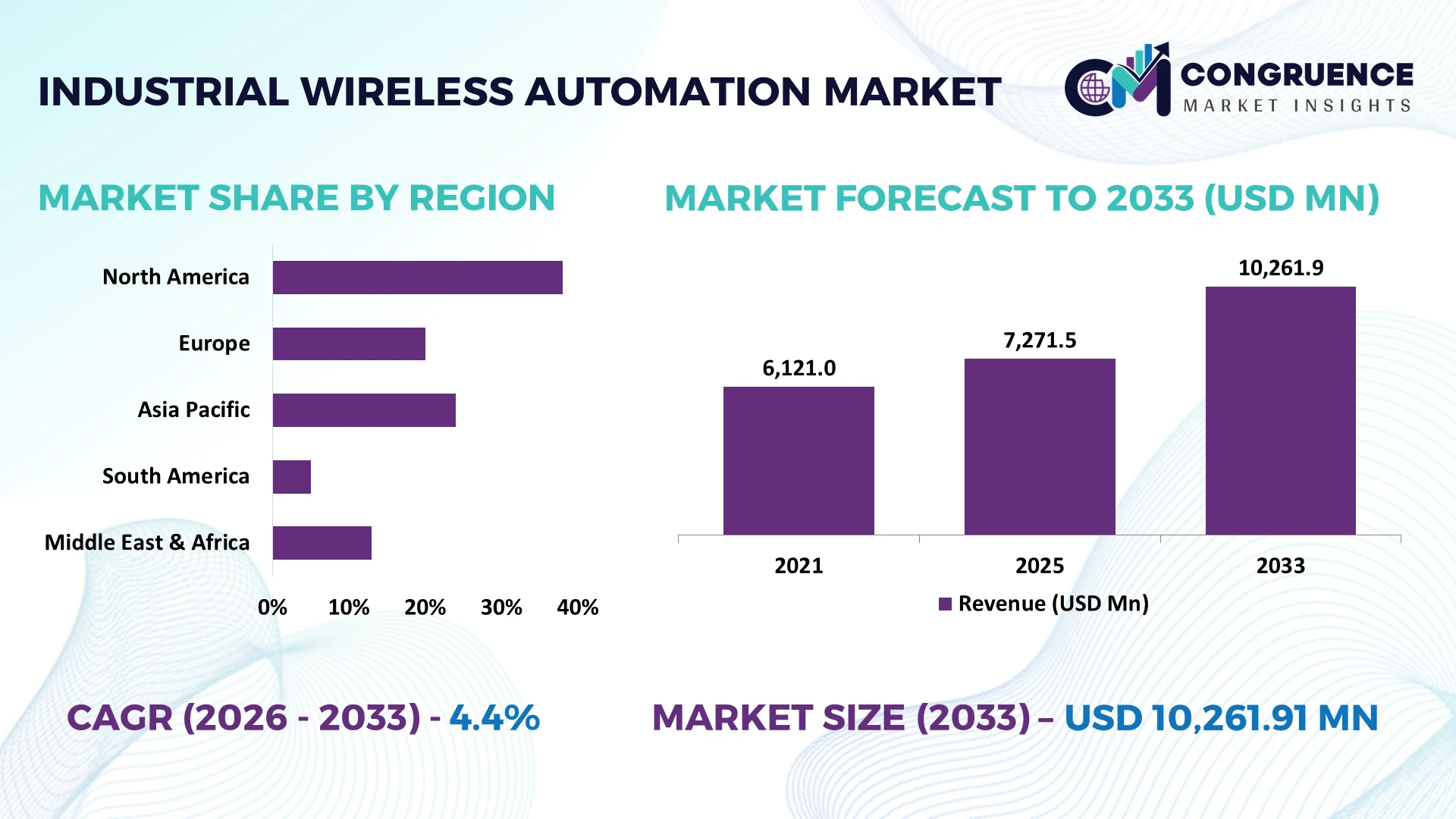
The Global Industrial Wireless Automation Market was valued at USD 7271.5 Million in 2025 and is anticipated to reach a value of USD 10261.91 Million by 2033 expanding at a CAGR of 4.4% between 2026 and 2033. Growth is driven by private industrial 5G networks, WirelessHART sensor deployment, predictive maintenance integration, and modernization of industrial control systems across manufacturing, energy, and process industries.
China holds a leading position in industrial wireless automation deployment, supported by extensive manufacturing infrastructure and industrial 5G expansion. By late 2024, China had established more than 4.25 million 5G base stations, strengthening connectivity infrastructure for industrial applications. Compared with Germany, where Industry 4.0 initiatives emphasize interoperable factory automation, China benefits from larger telecommunications infrastructure scale and concentrated electronics manufacturing. Automotive, petrochemical, mining, and machinery industries increasingly integrate wireless sensors, industrial gateways, and private cellular networks into production monitoring and equipment maintenance operations.
Strategically, manufacturers should prioritize wireless automation architectures targeting 99.9% network availability and measurable reductions in sensor installation complexity to improve industrial connectivity and operational resilience.
Market Size & Growth: USD 7,271.5 million in 2025, reaching USD 10,261.91 million by 2033 at 4.4% CAGR, supported by industrial 5G and wireless sensor deployment.
Top Growth Drivers: Illustrative demand attribution assigns 35% to equipment monitoring, 30% to industrial connectivity modernization, and 25% to predictive maintenance adoption.
Short Term Forecast: By 2028, optimized wireless sensor installation targets 20% lower deployment labor requirements in suitable industrial environments.
Emerging Technologies: Three priorities include private 5G, industrial edge AI, and time sensitive networking integration for deterministic machine communications.
Regional Leaders: Illustrative 2033 allocations place Asia Pacific at USD 4,105 million, North America at USD 2,873 million, and Europe at USD 2,463 million, reflecting factory connectivity, energy automation, and Industry 4.0 adoption.
Consumer/End User Trends: Industrial users increasingly prioritize 99.9% network availability targets for wireless equipment monitoring and production visibility.
Pilot/Case Example: In 2024, industrial private 5G deployments demonstrated wireless connectivity architectures supporting mobile equipment and automated manufacturing workflows.
Competitive Landscape: Siemens, ABB, Schneider Electric, Honeywell, and Emerson compete through industrial connectivity, automation platforms, and wireless instrumentation integration.
Regulatory & ESG Impact: The EU NIS2 framework covers 18 critical sectors, strengthening cybersecurity requirements for connected industrial infrastructure.
Investment & Funding: China's deployment of more than 4.25 million 5G base stations by late 2024 illustrates substantial telecommunications infrastructure investment supporting industrial connectivity.
Innovation & Future Outlook: Through 2033, 5G Advanced, edge intelligence, and software defined industrial networking will reshape wireless automation architecture.
The Industrial Wireless Automation Market is evolving as manufacturers integrate wireless instrumentation, machine connectivity, and real time operational analytics into existing production systems. Oil and gas operators deploy WirelessHART instrumentation for remote asset monitoring, while automotive manufacturers increasingly evaluate private 5G connectivity for mobile production equipment. Industrial Ethernet gateways and edge computing platforms support integration between wireless sensors and supervisory control systems. WirelessHART networks operating in the 2.4 GHz frequency band enable industrial sensor communication without extensive signal cabling. Growing emphasis on industrial cybersecurity and network reliability is shifting procurement priorities toward interoperable architectures, establishing the foundation for strategic investment and technology differentiation.
Industrial wireless automation is becoming strategically important as manufacturers replace isolated instrumentation with connected production networks that support continuous monitoring, predictive maintenance, and flexible equipment deployment. China's expansion beyond 4.25 million 5G base stations by late 2024 demonstrates the infrastructure scale supporting industrial connectivity. Meanwhile, Germany's Industry 4.0 initiatives emphasize interoperability between industrial equipment, automation software, and communication networks. Manufacturers are increasingly prioritizing wireless infrastructure that integrates operational technology with enterprise analytics while maintaining reliable process control and cybersecurity.
WirelessHART and industrial 5G offer distinct operational advantages over conventional cabling. In illustrative brownfield installations, wireless instrumentation can reduce installation labor requirements by 25% compared with equivalent wired sensor deployments, particularly across geographically dispersed assets. Private 5G networks also support mobile equipment connectivity, while traditional fixed industrial networks remain essential for deterministic control. During 2026 to 2028, manufacturers are expected to prioritize edge processing, automated network monitoring, and standardized connectivity interfaces to improve equipment visibility.
Emerson's WirelessHART instrumentation illustrates practical deployment through remote monitoring of pressure, temperature, and equipment conditions in process facilities. Siemens and ABB are strengthening industrial networking portfolios and automation integration capabilities. Competitive advantage increasingly depends on reliable connectivity, reduced installation complexity, and secure integration between wireless infrastructure and existing production systems.
Industrial equipment monitoring is accelerating wireless automation adoption as manufacturers require continuous visibility into machinery performance, operating conditions, and maintenance requirements. WirelessHART and industrial 5G enable sensor connectivity across production facilities without extensive signal cabling. In illustrative industrial installations, wireless instrumentation reduces installation labor by 25%, while continuous condition monitoring targets 15% lower unplanned equipment downtime. China's extensive 5G infrastructure supports expanding industrial connectivity applications across automotive, electronics, and machinery production. Emerson, Siemens, and ABB are strengthening wireless instrumentation, industrial gateways, and edge analytics integration. The operational advantage extends beyond connectivity: manufacturers gain access to previously unmonitored equipment, improving maintenance prioritization and enabling more effective utilization of existing production assets.
Industrial wireless automation adoption remains constrained by heterogeneous legacy control systems, industrial radio interference, and infrastructure integration expenses. Manufacturing facilities operating older programmable logic controllers frequently require additional gateways, protocol conversion, and network engineering before deploying wireless instrumentation. In a modeled retrofit project, integration activities can represent 20% of implementation expenditure, while 15% additional infrastructure allocation for redundant connectivity increases initial deployment requirements. Germany's established manufacturing base illustrates the complexity of integrating modern wireless networks with existing industrial Ethernet and fieldbus architectures. Siemens, Schneider Electric, and Honeywell are addressing compatibility through multiprotocol gateways, modular automation platforms, and hybrid connectivity architectures. Procurement decisions increasingly depend on integration lifecycle costs rather than wireless equipment pricing alone.
Private industrial 5G and edge intelligence create opportunities for wireless automation beyond conventional equipment monitoring. Dedicated cellular infrastructure supports autonomous mobile robots, flexible production layouts, and connected industrial vehicles. In illustrative deployment scenarios, edge analytics can reduce unnecessary upstream data transmission by 30%, while adaptive wireless sensor scheduling targets 20% lower communication energy consumption. India's expanding electronics manufacturing and industrial modernization initiatives provide opportunities for localized wireless automation deployment. The emergence of 5G Advanced and standardized industrial connectivity interfaces strengthens integration between mobile equipment and production management systems. Siemens, ABB, and Schneider Electric are investing in industrial networking partnerships, edge computing platforms, and application specific automation solutions. Competitive differentiation increasingly depends on combining connectivity infrastructure with actionable operational intelligence.
Maintaining predictable wireless performance across complex industrial environments presents long term challenges involving radio interference, network congestion, cybersecurity, and operational technology integration. Mission critical applications require consistent communication latency and reliable packet delivery despite moving machinery, metallic structures, and electromagnetic interference. A modeled industrial network experiencing 2% packet loss across 100,000 transmissions generates 2,000 unsuccessful deliveries, increasing retransmission requirements and operational uncertainty. Germany's automotive manufacturing facilities illustrate the difficulty of coordinating wireless mobility with established deterministic production controls. Industrial cybersecurity requirements under the EU NIS2 framework further strengthen network segmentation and access governance priorities. Siemens, Honeywell, and ABB are expanding secure networking capabilities and diagnostic tools. Sustained competitiveness requires validated communication performance, resilient network architectures, and specialized industrial cybersecurity expertise.
Wireless Network Convergence Reshapes Factory Architecture: Manufacturers are integrating industrial WiFi and cellular connectivity within unified network management environments. WiFi 6 supports orthogonal frequency division multiple access, while private 5G enables dedicated spectrum configurations. In facilities operating 2 wireless technologies, consolidated monitoring reduces fragmented network administration. Siemens and Cisco are strengthening industrial networking interoperability, enabling production teams to manage connected devices through coordinated infrastructure policies.
Wireless Cybersecurity Certification Gains Procurement Importance: The European Union's NIS2 framework covers 18 critical sectors, increasing scrutiny of connected industrial equipment. Industrial operators are strengthening device authentication, firmware validation, and network segmentation. IEC 62443 provides security requirements across industrial automation environments, while WPA3 strengthens supported WiFi authentication. Schneider Electric and Honeywell are expanding secure connectivity capabilities, helping manufacturers standardize procurement requirements and reduce exposure from unmanaged wireless endpoints.
Battery Lifecycle Optimization Changes Sensor Procurement: Wireless instrumentation buyers increasingly evaluate maintenance intervals alongside initial equipment specifications. A sensor requiring replacement every 2 years generates 5 maintenance cycles over a decade, compared with 2 cycles for a 5 year battery design. Emerson and ABB are strengthening low power instrumentation portfolios. Longer replacement intervals reduce technician visits and improve deployment economics in hazardous or inaccessible industrial locations.
Industrial Spectrum Planning Becomes Operational Priority: Private network deployment is increasing attention on licensed spectrum availability and radio coexistence. Germany's industrial spectrum framework includes the 3.7 to 3.8 GHz band, providing 100 MHz for local industrial applications. Manufacturing enterprises are coordinating spectrum licensing with equipment procurement and site planning. Nokia and Ericsson are expanding industrial connectivity partnerships, helping operators align network coverage, mobility requirements, and regulatory obligations.
WirelessHART represents the leading type in the Industrial Wireless Automation Market, with an indicative 29% share in 2025, supported by established process instrumentation deployments and compatibility with existing HART environments. Its self organizing mesh architecture supports communication between industrial sensors and gateways, reducing dependence on extensive signal cabling. Emerson and ABB offer WirelessHART instrumentation for monitoring pressure, temperature, and equipment conditions. ISA100.11a remains relevant for industrial applications requiring configurable wireless communication and interoperability across supported instrumentation. WiFi maintains substantial deployment across industrial facilities where high throughput connectivity and established networking infrastructure are priorities.
Industrial 5G represents the fastest growing type as manufacturers expand dedicated cellular connectivity for mobile machinery and flexible production environments. Its indicative 18% market share reflects increasing interest in private industrial networks. Bluetooth supports localized equipment communication and maintenance interfaces, while Wireless Sensor Networks provide distributed measurement capabilities across industrial assets. Siemens, Honeywell, and Schneider Electric are strengthening industrial gateways, wireless device integration, and network management capabilities. Investment priorities increasingly favor application specific connectivity rather than reliance on a single wireless standard.
Process Monitoring represents the leading application segment, accounting for an indicative 34% share of the Industrial Wireless Automation Market in 2025. Its dominance reflects extensive requirements for continuous measurement of pressure, temperature, flow, and equipment operating conditions across process industries. Wireless instrumentation enables operators to extend measurement coverage without extensive cabling, particularly in geographically dispersed facilities. Remote Equipment Monitoring accounts for an estimated 23% share, supporting centralized supervision of pumps, compressors, storage infrastructure, and industrial utilities. Emerson and Honeywell provide wireless measurement systems that integrate field instrumentation with industrial monitoring platforms.
Predictive Maintenance represents the fastest growing application as industrial operators increasingly combine wireless vibration sensors, equipment diagnostics, and maintenance analytics. Machine Control requires stringent communication reliability and predictable latency, favoring carefully engineered wireless infrastructure. Asset Tracking supports visibility into mobile equipment, materials, and industrial logistics operations. Siemens, ABB, and Schneider Electric are expanding connectivity platforms and operational analytics integration. Competitive advantage increasingly depends on converting wireless measurements into actionable maintenance and production decisions rather than increasing sensor counts alone.
Oil and Gas represents the largest end user segment of the Industrial Wireless Automation Market, with an indicative 31% share in 2025. Extensive pipelines, offshore facilities, refineries, and geographically dispersed production assets support demand for wireless instrumentation and remote operational visibility. WirelessHART networks enable measurement deployment in locations where conventional cabling requires substantial installation work. Manufacturing accounts for an estimated 27% share, supported by factory connectivity modernization and integration of wireless equipment monitoring. Emerson, Honeywell, and ABB target these industries through industrial sensors, wireless gateways, and process automation platforms.
Mining represents the fastest growing end user segment as operators expand connected equipment monitoring, mobile machinery communication, and remote asset supervision. Chemicals facilities prioritize reliable instrumentation and hazardous area compatibility, while Power Generation requires continuous monitoring of distributed operational assets. Water and Wastewater utilities increasingly deploy wireless monitoring across pumping stations, reservoirs, and treatment infrastructure. Suppliers are strengthening ruggedized equipment portfolios, industrial network partnerships, and specialized connectivity solutions. Future purchasing decisions increasingly emphasize equipment reliability, maintenance accessibility, and integration with established operational technology environments.
Asia Pacific accounted for the largest market share at an estimated 40% in 2025 however, Asia Pacific is expected to register the fastest growth, expanding at a CAGR of approximately 5.8% between 2026 and 2033.

Industrial Connectivity Modernization and Process Automation Integration
North America represents an estimated 28% of the global Industrial Wireless Automation Market, supported by established process industries, advanced manufacturing infrastructure, and extensive industrial automation investment. The United States leads deployment across oil and gas, chemicals, power generation, and automotive manufacturing. Emerson, Honeywell, and Rockwell Automation strengthen regional capabilities through wireless instrumentation, industrial networking, and control system integration. Canada's energy and mining industries contribute demand for remote equipment monitoring and ruggedized wireless connectivity. The United States' National Spectrum Strategy identified more than 2,700 MHz of spectrum for further study, reflecting broader efforts to strengthen wireless infrastructure availability. Industrial operators increasingly prioritize WirelessHART instrumentation, industrial WiFi, and private cellular connectivity for distributed assets. Competitive differentiation centers on reliable communication, existing control system compatibility, and secure integration between industrial networks and operational analytics platforms.
United States Market Outlook: The United States benefits from established automation suppliers, extensive industrial infrastructure, and advanced industrial networking capabilities. The Federal Communications Commission's Citizens Broadband Radio Service framework provides access to 150 MHz of spectrum within the 3.55 to 3.7 GHz band, supporting private wireless deployment options. Oil and gas operators in Texas and Louisiana increasingly evaluate wireless monitoring for pipelines, processing facilities, and distributed equipment. Domestic suppliers emphasize secure connectivity, industrial gateway integration, and scalable instrumentation architectures.
Industry 4.0 Integration and Secure Industrial Network Transformation
Europe accounts for an estimated 24% of the global Industrial Wireless Automation Market, supported by advanced manufacturing infrastructure, industrial automation expertise, and stringent cybersecurity requirements. Germany, France, Italy, and the United Kingdom contribute through automotive manufacturing, chemicals, industrial machinery, and energy operations. Siemens, ABB, and Schneider Electric strengthen regional technology capabilities through industrial communication systems, wireless instrumentation, and automation software integration. Germany's allocation of the 3.7 to 3.8 GHz frequency band provides 100 MHz for localized industrial wireless applications, supporting private network deployment. European manufacturers increasingly combine wireless connectivity with industrial Ethernet, programmable logic controllers, and manufacturing execution systems. The EU NIS2 framework strengthens cybersecurity expectations across critical industrial sectors. Competitive advantage increasingly depends on interoperability, deterministic communication requirements, and secure connectivity architectures compatible with established production infrastructure.
Germany Market Outlook: Germany represents a strategic industrial wireless automation market through its automotive, machinery, chemicals, and advanced manufacturing industries. The country's Industry 4.0 ecosystem supports integration of wireless networks with industrial control and production management systems. Germany's Federal Network Agency enables localized industrial spectrum assignments, allowing manufacturers to establish dedicated connectivity environments. Automotive production hubs in Bavaria and Baden Württemberg increasingly prioritize flexible equipment connectivity, network reliability, and secure communication between production assets.
Manufacturing Scale and Industrial 5G Infrastructure Expansion
Asia Pacific dominates the global Industrial Wireless Automation Market with an estimated 40% share in 2025, supported by extensive manufacturing capacity, industrial digitalization, and expanding telecommunications infrastructure. China leads regional deployment through electronics, automotive, machinery, and petrochemical production. Japan contributes advanced industrial robotics and automation technology, while South Korea strengthens connected manufacturing through established telecommunications infrastructure. India offers expanding opportunities through industrial modernization and electronics manufacturing investment. China's installation of more than 4.25 million 5G base stations by late 2024 demonstrates the scale of its wireless infrastructure development. Regional manufacturers increasingly integrate industrial 5G, wireless sensor networks, and industrial gateways with production monitoring systems. Technology suppliers are strengthening localized equipment development and industrial connectivity partnerships. Competitive positioning depends on manufacturing scale, network coverage, equipment interoperability, and integration with existing factory automation architectures.
China Market Outlook: China leads through extensive industrial production capacity, domestic telecommunications equipment manufacturing, and large scale digital infrastructure deployment. The country's industrial internet initiatives support wireless connectivity across automotive, electronics, steel, and industrial machinery facilities. Chinese telecommunications operators and equipment suppliers are expanding private industrial network solutions. Manufacturing centers including Guangdong, Jiangsu, and Zhejiang provide concentrated demand for connected production equipment, automated logistics, and industrial wireless monitoring systems.
Mining Connectivity and Energy Infrastructure Monitoring Expansion
South America accounts for an estimated 5% of the global Industrial Wireless Automation Market, supported by mining operations, energy infrastructure, and industrial process modernization. Brazil and Chile lead regional adoption through established mining, oil and gas, and manufacturing industries. Peru contributes demand for wireless monitoring across geographically dispersed mineral extraction facilities, while Argentina offers opportunities in energy production infrastructure. Industrial operators increasingly deploy wireless instrumentation to monitor equipment operating conditions and reduce dependence on extensive field cabling. Chile's copper mining industry provides a significant application base for ruggedized wireless sensor networks and remote asset monitoring. Regional deployment faces constraints involving challenging terrain, specialized technical workforce availability, and uneven telecommunications infrastructure. Automation suppliers are responding through local integration partnerships, industrial gateways, and equipment configurations designed for harsh operating environments.
Brazil Market Outlook: Brazil leads regional industrial wireless automation activity through its extensive oil and gas industry, mining operations, and manufacturing infrastructure. Petrobras operates offshore production assets requiring reliable monitoring and remote equipment supervision. Brazil's telecommunications regulator has allocated spectrum for industrial connectivity applications, supporting private wireless network development. Industrial centers in São Paulo and Minas Gerais offer opportunities for wireless instrumentation, production monitoring, and modernization of established automation systems.
Energy Automation Investment and Remote Industrial Asset Connectivity
The Middle East and Africa represent an estimated 3% of the global Industrial Wireless Automation Market, supported by energy infrastructure modernization, mining investment, and industrial diversification initiatives. Saudi Arabia and the United Arab Emirates lead regional deployment through petrochemical processing, oil and gas production, and industrial infrastructure expansion. South Africa contributes demand through mining operations, power generation, and manufacturing facilities. WirelessHART instrumentation and industrial sensor networks support monitoring across geographically dispersed industrial assets. Saudi Arabia's Vision 2030 industrial transformation agenda reinforces investment in advanced manufacturing and digital infrastructure. Industrial operators increasingly require wireless connectivity capable of operating in extreme temperatures, hazardous environments, and remote locations. Technology suppliers are expanding regional engineering partnerships and industrial communication portfolios. Competitive advantage depends on equipment durability, secure connectivity, and reliable integration with established process control systems.
Saudi Arabia Market Outlook: Saudi Arabia represents a strategically important market through its extensive petroleum processing infrastructure, petrochemical production, and industrial diversification programs. Saudi Aramco operates major energy facilities requiring continuous instrumentation and equipment monitoring. The country's National Industrial Strategy targets approximately 36,000 factories by 2035, supporting broader industrial infrastructure expansion. Industrial facilities in Jubail and Yanbu offer opportunities for wireless instrumentation, remote asset monitoring, and integration of industrial connectivity with established process automation systems.
Siemens, ABB, Schneider Electric, Honeywell, and Emerson compete through industrial connectivity platforms, wireless instrumentation, and integrated automation systems. Their combined share is provisionally estimated at 48%, reflecting an indicative competitive structure rather than verified standalone wireless automation revenues. Siemens emphasizes industrial networking and automation integration, while Emerson and Honeywell compete through WirelessHART instrumentation and process monitoring expertise. ABB and Schneider Electric strengthen portfolios through industrial gateways, energy management integration, and connected equipment solutions. Illustrative deployment models indicate wireless instrumentation can reduce installation labor by 25%, while optimized sensor scheduling targets 20% lower communication energy consumption. Suppliers are expanding industrial networking partnerships, cybersecurity capabilities, and interoperable communication platforms. Legacy protocol compatibility, hazardous area certification, and network reliability requirements create substantial entry barriers. Competitive leadership requires proven industrial performance, secure multiprotocol integration, specialized engineering support, and measurable improvements in equipment monitoring efficiency across demanding operating environments.
Siemens AG
ABB Ltd.
Schneider Electric SE
Honeywell International Inc.
Emerson Electric Co.
Rockwell Automation, Inc.
Yokogawa Electric Corporation
Cisco Systems, Inc.
Nokia Corporation
Ericsson
Phoenix Contact GmbH & Co. KG
HMS Networks AB
Advantech Co., Ltd.
Moxa Inc.
Current industrial wireless automation combines WirelessHART, ISA100.11a, industrial WiFi, and private cellular networks with programmable controllers and supervisory systems. WirelessHART mesh networking supports distributed instrumentation, while industrial gateways connect field measurements with existing control infrastructure. In modeled brownfield installations, wireless sensors reduce installation labor by 25% compared with equivalent wired configurations. Siemens expanded its private 5G infrastructure to support 24 radio units, demonstrating deployment readiness for larger manufacturing environments. Operators benefit from broader measurement coverage without extensive cable installation.
Emerging technologies include 5G Advanced, edge AI analytics, and integrated wireless network orchestration. Private 5G supports dedicated spectrum, device authentication, and controlled communication quality for industrial mobility. Illustrative edge processing scenarios reduce upstream data transmission by 30%, improving network efficiency. Compared with conventional centralized processing, local analytics also shortens response paths for equipment diagnostics. Siemens, Nokia, and Ericsson are strengthening industrial connectivity platforms, enabling manufacturers to combine wireless infrastructure with operational intelligence.
Between 2026 and 2028, disruptive developments will emphasize adaptive radio management, autonomous network diagnostics, and integrated industrial cybersecurity. Software controlled connectivity will support flexible production layouts and mobile equipment coordination. Suppliers delivering interoperable architectures, validated reliability, and automated network management will strengthen competitive positioning across manufacturing and energy operations.
January 2025: Siemens expanded its private industrial 5G infrastructure to support 24 radio units, each covering approximately 5,000 square meters. The upgrade extended factory connectivity capacity and introduced compact routing equipment, simplifying wireless automation deployment across industrial facilities. Source: siemens.com.
June 2026: Ericsson demonstrated private 5G connectivity at its Texas smart factory, where 2 radio units covered an area previously served by 28 WiFi access points. Reduced robot handovers improved mobility and supported more reliable automated production operations. Source: fierce-network.com.
June 2025: Nokia partnered with Verizon Business to deploy private 5G networks across multiple Thames Freeport industrial campuses. The initiative established connectivity infrastructure for autonomous vehicles, logistics automation, and industrial analytics, supporting coordinated modernization across the United Kingdom's maritime operations. Source: nokia.com.
February 2026: Ericsson and NTT DATA announced a strategic partnership covering 4 priority areas, including managed private 5G and edge AI integration. The collaboration strengthens industrial connectivity delivery, supporting automated inspection, equipment monitoring, and scalable enterprise wireless operations. Source: ericsson.com.
The Industrial Wireless Automation Market Report evaluates industry developments between 2026 and 2033, covering WirelessHART, ISA100.11a, WiFi, Industrial 5G, Bluetooth, and Wireless Sensor Networks. Application analysis examines Process Monitoring, Machine Control, Asset Tracking, Predictive Maintenance, and Remote Equipment Monitoring. End user coverage includes Oil and Gas, Manufacturing, Chemicals, Mining, Power Generation, and Water and Wastewater, assessing connectivity requirements, infrastructure modernization, and operational technology integration priorities.
Regional analysis covers North America, Europe, Asia Pacific, South America, and the Middle East and Africa. The report profiles 14 technology providers and evaluates private cellular infrastructure, industrial edge intelligence, secure wireless gateways, and network interoperability. Strategic findings support investment planning, equipment procurement, competitive benchmarking, industrial partnerships, geographic expansion, and deployment decisions across established and emerging automation environments.
| Report Attribute/Metric | Report Details |
|---|---|
Market Revenue in 2025 | USD 7271.5 Million |
Market Revenue in 2033 | USD 10261.91 Million |
CAGR (2026 - 2033) | 4.4% |
Base Year | 2025 |
Forecast Period | 2026 - 2033 |
Historic Period | 2021 - 2025 |
Segments Covered | By Type
By Application
By End-User
|
Key Report Deliverable | Revenue Forecast, Growth Trends, Market Dynamics, Segmental Overview, Regional and Country-wise Analysis, Competition Landscape |
Region Covered | North America, Europe, Asia-Pacific, South America, Middle East, Africa |
Key Players Analyzed | Siemens AG, ABB Ltd., Schneider Electric SE, Honeywell International Inc., Emerson Electric Co., Rockwell Automation, Inc., Yokogawa Electric Corporation, Cisco Systems, Inc., Nokia Corporation, Ericsson, Phoenix Contact GmbH & Co. KG, HMS Networks AB, Advantech Co., Ltd., Moxa Inc. |
Customization & Pricing | Available on Request (10% Customization is Free) |




