
Reports
The Global Industrial White Masterbatch Market was valued at USD 1,331.6 Million in 2025 and is anticipated to reach a value of USD 2,154.6 Million by 2033 expanding at a CAGR of 6.2% between 2026 and 2033. Growth is being driven by higher TiO₂ loading efficiency, lightweight plastic conversion, recycled-polymer processing, and tighter color-opacity requirements across packaging, construction, agriculture, and industrial film production.
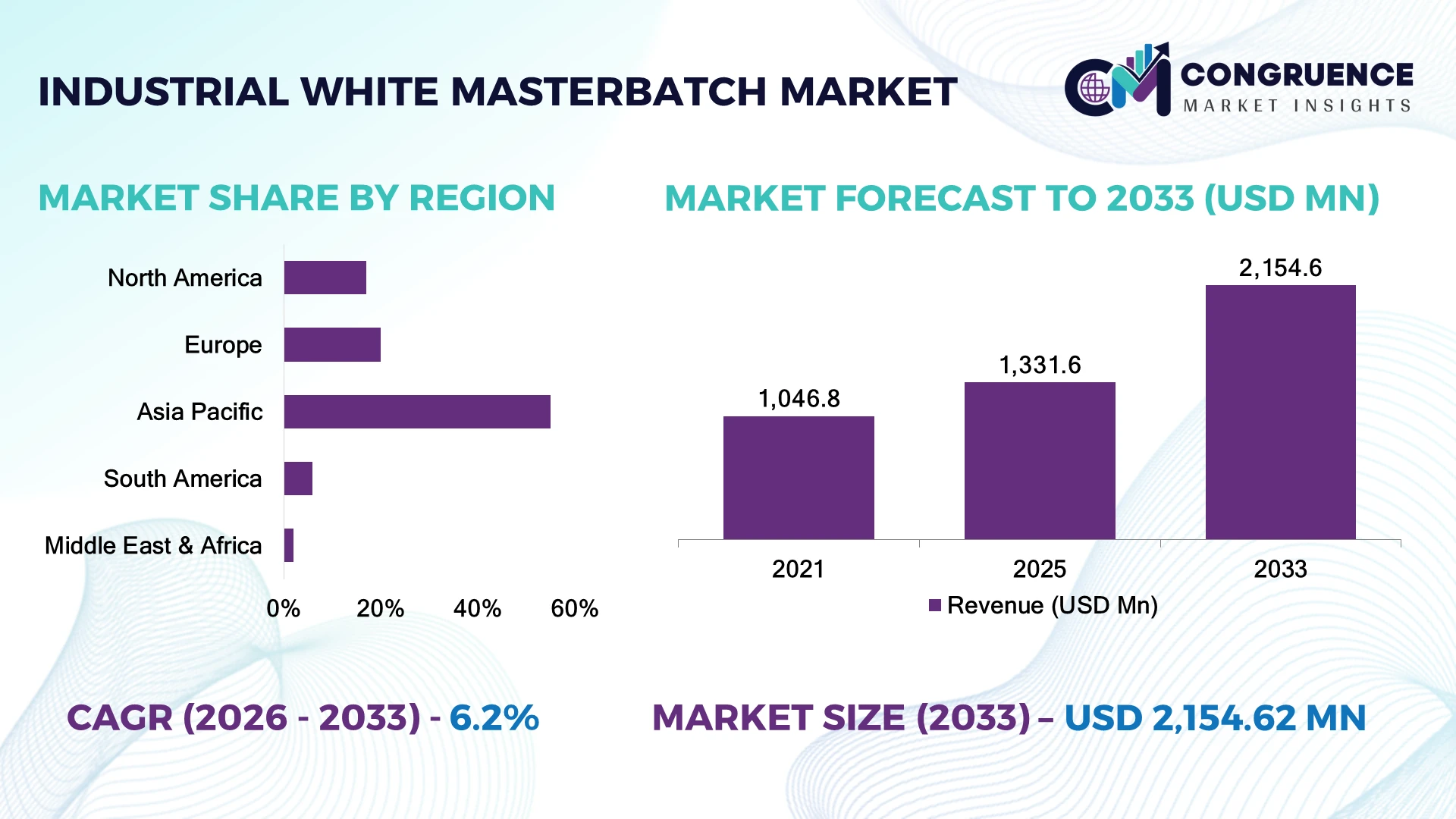
China is the dominant country market, contributing approximately 34% of global industrial white masterbatch consumption, supported by large polymer-processing capacity, packaging conversion, construction materials, and export-oriented manufacturing. India follows at roughly 8%, while China operates a substantially larger plastics-processing base. Approximately 55% of high-volume film and injection-molding producers increasingly use concentrated masterbatch formulations to improve dispersion and reduce handling losses. China’s continued manufacturing expansion amid global supply-chain diversification reinforces its production advantage.
Strategically, suppliers should prioritize high-opacity formulations, TiO₂ optimization, recycled-polymer compatibility, and localized production to defend margins and secure high-volume industrial accounts.
Market Size & Growth: USD 1,331.6 Million in 2025 to USD 2,154.6 Million by 2033 at 6.2% CAGR, driven by lightweight packaging and polymer conversion.
Top Growth Drivers: Flexible packaging 42%, injection molding 34%, construction plastics 29%.
Short-Term Forecast: By 2028, optimized formulations can reduce pigment consumption 8–12% while maintaining target opacity.
Emerging Technologies: High-loading TiO₂ systems, recycled-polymer-compatible carriers, AI-assisted formulation, and advanced dispersion technologies.
Regional Leaders: Asia-Pacific leads with approximately 55% share, followed by Europe at 20% and North America at 17%.
Consumer/End-User Trends: Packaging converters represent more than 40% of industrial white masterbatch consumption.
Pilot/Case Example: 2025 high-loading formulations achieved approximately 10% lower pigment usage while preserving opacity in selected film applications.
Competitive Landscape: Leading suppliers collectively control roughly 35% share, with Avient, Ampacet, LyondellBasell, Plastika Kritis and Tosaf competing globally.
Regulatory & ESG Impact: Recycled-polymer processing is increasing, with selected converters targeting 20–30% recycled content in applicable products.
Investment & Funding: More than USD 500 Million is being directed toward polymer-compounding, recycling, and specialty-masterbatch capacity expansion.
Innovation & Future Outlook: 2026–2028 investment is shifting toward low-TiO₂, high-opacity, recycled-content-compatible and digitally optimized formulations.
Industrial White Masterbatch demand is concentrated in flexible packaging, rigid containers, agricultural films, pipes, sheets, and injection-molded industrial components where consistent opacity and dispersion directly influence material efficiency. Approximately 40% of demand is linked to packaging-oriented conversion, while recycled-polymer adoption is pushing formulators toward carrier systems that tolerate variable feedstock quality. Supply-chain diversification following disruptions in Asian polymer and pigment logistics is also encouraging regional compounding capacity, creating a strategic transition toward localized formulation and shorter delivery cycles.
Industrial white masterbatch is becoming strategically important because pigment efficiency increasingly affects converter margins, product consistency, and recycled-content economics. TiO₂ remains the critical cost component, making dispersion quality and loading optimization commercially significant. Packaging, agricultural films, pipes, and injection-molded products are pushing converters toward concentrated formulations that deliver consistent whiteness without excessive polymer or pigment usage. China retains the largest manufacturing scale, while India is building additional polymer-processing capacity and localized compounding capabilities.
High-performance formulations can reduce TiO₂ consumption by approximately 8–12% compared with less efficient conventional systems while maintaining comparable opacity when optimized for the polymer grade and processing conditions. Advanced dispersion technologies also reduce filtration and surface-defect problems in film extrusion. The competitive difference is increasingly visible between commodity suppliers competing on price and specialty formulators competing on pigment efficiency, recycled-polymer compatibility, and application-specific performance.
During 2026–2028, recycled-content mandates, lightweighting programs, and improved recycling infrastructure will increase demand for masterbatch systems compatible with variable polymer feedstocks. A packaging converter using recycled polyethylene, for example, requires formulations capable of compensating for color variability without excessive TiO₂ loading. Producers are therefore expanding application laboratories, regional compounding plants, technical partnerships, and customized formulation programs. Long-term competitive positioning will depend on delivering measurable pigment savings, stable dispersion, recycled-material compatibility, and reliable regional supply rather than competing through price alone.
Rising demand for high-opacity films, rigid packaging, agricultural sheets, and injection-molded components is accelerating adoption of concentrated industrial white masterbatch. Approximately 42% of demand is linked to packaging conversion, while 55% of high-volume processors increasingly favor concentrated formulations to improve dispersion and handling efficiency. In China, large-scale polymer processing and export manufacturing are pushing converters toward formulations that maintain opacity at lower pigment loading. TiO₂ optimization is becoming commercially important as pigment procurement remains exposed to energy and logistics costs. Producers are responding with high-loading grades, improved carrier compatibility, and regional compounding capacity. The non-obvious advantage is reduced process variability: consistent dispersion can lower filtration, streaking, and reject rates while allowing converters to standardize formulations across multiple extrusion lines.
Titanium dioxide remains the largest cost-sensitive input in white masterbatch, creating exposure to pigment-price movements, energy costs, and international logistics. TiO₂ can represent approximately 50–70% of formulation cost in high-opacity grades, while pigment and polymer inputs together account for more than 75% of total material cost in many formulations. European and Asian producers also face differing energy and transportation structures, limiting uniform pricing. Supply disruptions affecting mineral feedstock, pigment production, or shipping can quickly increase conversion costs and weaken fixed-price contracts. Companies are reducing exposure through dual sourcing, regional inventory buffers, longer procurement agreements, and optimized low-TiO₂ formulations. The strategic pressure is strongest on suppliers that compete primarily through price without proprietary dispersion technology or localized raw-material access.
Growing use of recycled polyethylene and polypropylene is creating demand for white masterbatch formulations capable of correcting variable feedstock color without excessive pigment loading. Approximately 20–30% recycled content is increasingly targeted in selected packaging and industrial applications, while optimized formulations can reduce TiO₂ consumption by 8–12% under suitable processing conditions. India and Southeast Asian converters offer particularly attractive opportunities as recycling capacity and flexible-packaging production expand. AI-assisted formulation, digital color matching, and automated dosing represent the next technology layer, enabling tighter batch consistency with less manual adjustment. Producers are investing in application laboratories, localized technical centers, recycling partnerships, and customized carrier systems. The strongest opportunity lies in selling performance per kilogram of masterbatch rather than simply increasing pigment concentration.
Variable recycled-polymer quality creates persistent challenges for color consistency, dispersion, filtration, and extrusion stability. Feedstock variation can increase formulation adjustment requirements by approximately 15–25%, while recycled resin with inconsistent color or contamination can raise reject rates by 5–10% in sensitive applications. High-speed film extrusion further exposes weaknesses in dispersion and thermal stability, particularly when converters switch between virgin and recycled inputs. China and India are expanding recycling and compounding capacity, but quality consistency remains uneven across collection and processing networks. Masterbatch producers must invest in automated dosing, digital color measurement, formulation databases, and application testing to maintain repeatability. The long-term competitive issue is not pigment availability alone; it is the ability to deliver stable optical and processing performance across increasingly heterogeneous polymer feedstocks.
High-Opacity Grades Gain Traction: Converters are shifting toward concentrated formulations as packaging and agricultural-film producers seek stronger opacity with lower pigment consumption. High-loading grades can reduce TiO₂ usage by approximately 8–12% while maintaining target whiteness when polymer and processing conditions are optimized. Producers are expanding application-specific formulations and technical support, making dispersion performance increasingly important in purchasing decisions.
Recycled Resin Drives Reformulation: Recycled polyethylene and polypropylene are changing formulation requirements, with selected converters targeting 20–30% recycled content in industrial and packaging applications. Variable feedstock color is increasing demand for masterbatch with stronger tinting efficiency and carrier compatibility. Producers are developing dedicated recycled-polymer grades, laboratory color-matching services, and customized formulations to reduce adjustment cycles and production rejects.
Regional Compounding Expands: Supply-chain diversification is encouraging masterbatch producers to establish or expand localized compounding capacity closer to major polymer-processing hubs. China and India are strengthening domestic manufacturing, while European converters increasingly emphasize shorter supply routes. Regional production can reduce delivery lead times by approximately 15–25% and lower inventory exposure, prompting suppliers to expand local technical centers alongside manufacturing capacity.
Digital Formulation Gains Ground: Automated dosing, spectrophotometric color measurement, and formulation databases are entering larger industrial conversion operations. Digitized color-control workflows can reduce manual formulation adjustments by approximately 20% and improve batch-to-batch consistency. The non-obvious shift is that masterbatch suppliers are increasingly competing through process intelligence rather than pigment concentration alone, leading companies to combine formulation software, laboratory analytics, and technical-service partnerships.
Titanium-dioxide-based industrial white masterbatch represents the leading type, accounting for approximately 78% of global demand because it delivers high opacity, brightness, UV resistance, and consistent dispersion across polyethylene, polypropylene, and other high-volume polymer systems. Standard high-loading grades dominate packaging and injection molding, while low-TiO₂ formulations are gaining traction as converters seek pigment-efficiency improvements and tighter material economics. Approximately 55% of large processors increasingly prioritize concentrated formulations that reduce dosing complexity and improve color consistency.
Recycled-polymer-compatible white masterbatch is the fastest-growing type, supported by rising recycled-content requirements and greater use of post-consumer polyethylene and polypropylene. These grades are gaining approximately 15–20% faster adoption than conventional formulations in sustainability-focused applications. Suppliers are expanding carrier-system R&D, dispersion technologies, and application-specific grades. The strategic shift is toward formulations that preserve opacity despite variable recycled-resin color, allowing converters to reduce virgin-material dependence without sacrificing appearance or processing stability.
PlasticsEurope reported in 2025 that circular plastics represented 15.4% of European plastics production in 2024, while global plastics production increased 4.1%, highlighting the widening requirement for formulations compatible with recycled feedstocks.
Flexible packaging represents the leading application, accounting for approximately 41% of industrial white masterbatch consumption because films require consistent opacity, whiteness, printability, and dispersion at high extrusion speeds. Rigid packaging follows at around 24%, while agricultural films represent approximately 15%. Flexible-film converters increasingly favor concentrated grades because masterbatch efficiency directly affects pigment consumption and extrusion stability. Approximately 35% of packaging converters are increasingly evaluating formulations based on recycled-polymer compatibility alongside optical performance.
Agricultural films and recycled-content packaging represent the fastest-growing application areas as manufacturers adapt formulations to variable polymer feedstocks and sustainability requirements. PPWR implementation in Europe from August 2026 is strengthening demand for packaging solutions compatible with recyclability and reduced virgin-material use. Companies are responding with high-loading formulations, recyclable carrier systems, automated dosing, and application-specific technical support. The business implication is clear: suppliers with strong film-extrusion expertise can capture higher-value accounts by solving both color-performance and circular-material challenges rather than competing solely on masterbatch price.
The European Commission states that the Packaging and Packaging Waste Regulation entered into force in February 2025 and generally applies from August 2026, with requirements designed to make packaging recyclable and increase recycled-plastic use.
Packaging converters represent the leading end-user group, accounting for approximately 46% of industrial white masterbatch demand because of their high-volume consumption across films, containers, closures, and multilayer packaging. Plastic processors serving construction applications contribute around 18%, while agricultural-film producers account for approximately 12%. Large packaging converters increasingly prioritize consistent dispersion, automated dosing, and recycled-polymer compatibility, whereas smaller processors remain more price-sensitive and often purchase standardized grades.
Agricultural-film manufacturers and recycled-packaging processors are the fastest-growing buyer groups as sustainability requirements reshape formulation specifications. Approximately 30% of larger converters increasingly evaluate masterbatch suppliers on recycled-resin compatibility, technical support, and formulation consistency rather than pigment concentration alone. Suppliers are responding through dedicated application laboratories, regional inventory, long-term supply contracts, and customized formulations. The competitive opportunity is strongest where masterbatch performance can reduce production rejects or compensate for feedstock variability. Companies with local technical teams and flexible formulation capabilities are therefore better positioned than commodity suppliers to secure long-term converter relationships.
The European Commission reported in 2026 that the EU’s recycled-content reporting framework for PET beverage bottles now includes formal calculation, verification, and reporting requirements, reinforcing the shift toward measurable recycled-content compliance across packaging supply chains.
Asia-Pacific accounted for the largest market share at 55% in 2025 however, Asia-Pacific is expected to register the fastest growth, expanding at a CAGR of 7.1% between 2026 and 2033.
Localized Compounding Strengthens Supply Reliability
North America represents approximately 17% of global industrial white masterbatch demand, supported by advanced flexible-packaging conversion, rigid plastics, agricultural films, construction products, and established polymer-compounding infrastructure. The United States contributes nearly 85% of regional consumption, with Texas, Ohio, Michigan, and the Midwest plastics corridor serving as important processing hubs. Around 45% of large converters increasingly specify high-loading formulations to improve TiO₂ efficiency and reduce dosing variability. Recycled-polymer adoption is also reshaping product specifications, particularly for packaging and industrial films. Producers are expanding regional compounding capacity, application laboratories, and technical-service networks to shorten delivery cycles and reduce exposure to overseas pigment and polymer logistics. The strategic shift favors suppliers capable of combining high-opacity performance with recycled-resin compatibility and consistent regional availability.
United States Market Outlook: The United States dominates North American demand through its extensive packaging, construction, agricultural-film, and injection-molding industries. Approximately 45% of major converters increasingly prioritize concentrated white masterbatch formulations that provide stable opacity with lower dosing complexity. Strong domestic polymer-processing infrastructure also supports customized formulations for polyethylene and polypropylene applications. Suppliers are strengthening local inventory, application testing, and technical support to reduce lead-time exposure and improve responsiveness to large converter contracts.
Circular Packaging Requirements Reshape Formulation Priorities
Europe accounts for approximately 20% of global industrial white masterbatch demand, with Germany, Italy, France, Spain, and the United Kingdom representing the strongest processing markets. Germany contributes around 27% of European demand through packaging, automotive plastics, construction products, and specialty film manufacturing. Approximately 35% of major converters increasingly evaluate white masterbatch on recycled-polymer compatibility and recyclability alongside opacity. Packaging regulation is accelerating formulation changes as converters prepare for stricter recycled-content and circularity requirements. Producers are developing low-TiO₂ formulations, recyclable carrier systems, and application-specific grades while expanding regional technical support. The market increasingly rewards suppliers that demonstrate stable optical performance in recycled feedstocks rather than relying exclusively on conventional virgin-polymer formulations.
Germany Market Outlook: Germany remains Europe's most strategically significant market because of its sophisticated polymer-processing base, packaging manufacturing, automotive plastics, and industrial film production. Approximately 35% of larger converters increasingly assess masterbatch performance against recycled-content and circularity requirements. German processors also prioritize consistent dispersion and tight color tolerances, encouraging suppliers to expand application laboratories and customized formulation services. Local technical support and short supply routes provide an important advantage as procurement teams seek greater resilience.
Manufacturing Scale Drives High-Volume Formulation Demand
Asia-Pacific accounts for approximately 55% of global industrial white masterbatch consumption, supported by extensive polymer conversion, packaging production, agricultural films, consumer goods, construction plastics, and export manufacturing. China represents more than 60% of regional demand, while India, Japan, South Korea, and Southeast Asia provide expanding processing capacity. Approximately 55% of high-volume converters increasingly use concentrated formulations to improve pigment dispersion and production consistency. China is strengthening domestic masterbatch and polymer-compounding capacity, while India is expanding flexible packaging and plastics-processing infrastructure. Suppliers are responding with localized production, high-loading TiO₂ grades, recycled-polymer-compatible formulations, and technical centers near major industrial clusters. The principal competitive advantage is manufacturing scale combined with fast formulation customization and reliable regional supply.
China Market Outlook: China is the dominant national market because of its extensive plastics-processing capacity, packaging conversion base, agricultural-film production, and export-oriented manufacturing. More than 60% of Asia-Pacific demand is concentrated in China, creating significant volume opportunities for high-loading white masterbatch. Guangdong, Zhejiang, Jiangsu, and Shandong remain important processing centers. Domestic suppliers are strengthening formulation capabilities and localized raw-material sourcing, increasing pricing pressure on international producers while improving delivery responsiveness.
Packaging Expansion Supports Localized Masterbatch Demand
South America contributes approximately 6% of global industrial white masterbatch demand, with Brazil accounting for more than 65% of regional consumption. São Paulo, Paraná, Santa Catarina, and Minas Gerais contain major packaging, agricultural-film, construction-plastics, and injection-molding operations. Approximately 25% of larger converters increasingly use concentrated masterbatch grades to improve pigment dispersion and reduce production variability. Brazil's agricultural sector creates sustained requirements for white agricultural films, while food and consumer packaging supports flexible and rigid plastic conversion. Suppliers are expanding distributor partnerships, local inventory, and application support to manage logistics costs and currency volatility. The market remains more price-sensitive than North America and Europe, making multi-purpose formulations and localized supply commercially important.
Brazil Market Outlook: Brazil is the region's principal market because of its large plastics-processing industry, agricultural-film consumption, food-packaging production, and established converter network. More than 65% of South American demand is concentrated in the country. São Paulo remains the primary industrial hub, while Paraná and Santa Catarina support agricultural and packaging applications. Suppliers are increasingly using local distributors, regional inventory, and application-specific grades to manage logistics and improve customer responsiveness.
Industrial Diversification Builds New Polymer Demand
Middle East & Africa represents approximately 2% of global industrial white masterbatch demand, with Saudi Arabia, the UAE, South Africa, Egypt, and Turkey-linked supply networks forming key commercial centers. Saudi Arabia and the UAE together account for roughly 40% of regional demand, supported by packaging, construction plastics, agricultural applications, and petrochemical-linked polymer conversion. Approximately 20% of larger processors increasingly specify concentrated masterbatch formulations to improve dispersion and reduce handling requirements. Gulf petrochemical capacity provides an important feedstock advantage, while downstream plastics diversification is increasing demand for specialized formulations. Suppliers are establishing distributor partnerships, regional warehouses, and technical-support capabilities. The strategic opportunity is to connect locally available polymer feedstock with application-specific masterbatch production rather than relying on imported finished formulations.
Saudi Arabia Market Outlook: Saudi Arabia is the region's most strategically significant market because of its integrated petrochemical industry, polymer availability, packaging manufacturing, and downstream plastics investment. Approximately 40% of combined Saudi and UAE demand is concentrated across the two Gulf markets. Jubail and Riyadh are important industrial centers, supporting packaging and injection-molding applications. Suppliers can leverage local polymer availability while developing high-loading and recycled-polymer-compatible grades for expanding downstream conversion capacity.
Ampacet, Avient, Plastika Kritis, Tosaf and LyondellBasell compete as global masterbatch specialists and polymer suppliers, while regional producers such as Debao and Indian formulators challenge them through lower pricing and faster customization. The top five groups hold an estimated 35% combined share. Competition centers on TiO₂ efficiency, dispersion, application engineering, supply reliability and formulation speed; optimized grades can reduce pigment use 8–12%, while localized supply can shorten delivery cycles 15–25%. Leaders are expanding application laboratories, digital color-management tools and recycled-polymer formulations, whereas regional suppliers emphasize flexible minimum orders, localized production and aggressive pricing. The competitive shift is moving from commodity whiteness toward high-loading, recycled-resin-compatible and application-specific systems. Entry barriers include TiO₂ sourcing, dispersion expertise, food-contact compliance, process validation and converter relationships. Margin pressure remains acute where pigment costs fluctuate. Winning requires pigment efficiency, stable optical performance, fast customization, dependable regional supply and technical support across film, molding and extrusion applications.
Ampacet Corporation
Avient Corporation
Plastika Kritis S.A.
Tosaf Group
LyondellBasell Industries
Americhem
Hubron International
Plastiblends India
GCR Group
Astra Polymers
Gabriel-Chemie Group
Techmer PM
Debao Masterbatch
Alok Masterbatches
Industrial white masterbatch technology is shifting toward high-loading TiO₂ systems, engineered carrier resins, advanced dispersion and automated color control. Concentrated formulations can reduce pigment consumption by 8–12% when opacity targets are maintained, while optimized dispersion reduces streaking and filtration interruptions. Approximately 55% of high-volume processors increasingly specify concentrated grades, making formulation consistency a purchasing criterion.
Digital color-management, inline spectrophotometry, automated dosing and AI-assisted formulation are emerging across larger converters. Compared with manual formulation adjustment, digital color-control workflows can reduce correction cycles by roughly 20% and improve batch consistency. Ampacet, Avient and other global suppliers benefit through stronger technical integration, while regional formulators compete by offering rapid customization and application-specific grades.
Between 2026 and 2028, recycled-polymer-compatible masterbatch, NIR-sortable formulations, low-TiO₂ systems and digitally optimized dosing will gain strategic importance. Recycled feedstock variability is pushing suppliers toward predictive color correction and formulation databases. Companies that combine pigment efficiency with circular-material compatibility will gain an advantage in packaging and industrial films. Investment should prioritize application laboratories, automated dosing, digital color libraries and localized compounding capacity rather than standalone pigment-loading improvements alone. This approach improves converter yield, shortens formulation approval cycles, and protects margins when TiO₂ or recycled-resin specifications change across regional operations today.
April 2025 Ampacet published a 60% TiO₂ white PE grade for BOPE films, targeting high opacity and dispersion at 10–20% addition. The launch strengthens sustainable flexible-packaging capabilities and supports thinner, recyclable polyethylene structures for converters globally at scale. Source: ampacet.com (Ampacet)
June 2025 Plastika Kritis expanded digital masterbatch selection with Color Selector and ColorIt tools, enabling real-time color development. The initiative strengthens formulation speed and customer customization while supporting faster product development across polymer-processing applications and export markets efficiently. Source: plastikakritis.com (Plastika Kritis)
January 2025 Tosaf secured ISO 22000 certification covering its white masterbatch production facility, adding documented food-safety controls and traceability. The certification strengthens qualification for food-packaging customers and reinforces compliance-driven differentiation in regulated masterbatch applications across global markets today. Source: tosaf.com (Tosaf)
January 2025 Avient launched ColorMatrix Lactra ESL, a low-TiO₂ light-blocking masterbatch for dairy packaging supporting shelf lives up to three months. The solution enables existing PET lines, strengthens lightweighting options, and reduces inorganic content without sacrificing protection performance effectively commercially. Source: avient.com (Avient)
The Industrial White Masterbatch Market Report covers TiO₂-based high-loading, standard, low-pigment, recycled-polymer-compatible, and application-specific formulations across flexible packaging, rigid packaging, agricultural films, construction plastics, injection molding, extrusion, pipes, sheets, and industrial components. End-user analysis evaluates packaging converters, polymer processors, agricultural-film producers, construction-material manufacturers, and specialty plastics manufacturers, with emphasis on formulation requirements, dosage, dispersion, opacity, and processing performance.
Regional coverage spans North America, Europe, Asia-Pacific, South America, and Middle East & Africa, with country-level assessment of China, the United States, Germany, India, Brazil, Saudi Arabia, and other industrial hubs. Technology analysis covers high-loading TiO₂ dispersion, digital color management, automated dosing, recycled-resin compatibility, NIR-sortable systems, and low-TiO₂ alternatives. Approximately 55% of high-volume processors increasingly prioritize concentrated formulations, supporting decisions on capacity expansion, localization, R&D, supplier selection, pricing, and competitive positioning through 2026–2033.
| Report Attribute/Metric | Report Details |
|---|---|
|
Market Revenue in 2025 |
USD 1,331.6 Million |
|
Market Revenue in 2033 |
USD 2,154.6 Million |
|
CAGR (2026 - 2033) |
6.2% |
|
Base Year |
2025 |
|
Forecast Period |
2026 - 2033 |
|
Historic Period |
2021 - 2025 |
|
Segments Covered |
By Type
By Application
By End-User
|
|
Key Report Deliverable |
Revenue Forecast, Growth Trends, Market Dynamics, Segmental Overview, Regional and Country-wise Analysis, Competition Landscape |
|
Region Covered |
North America, Europe, Asia-Pacific, South America, Middle East, Africa |
|
Key Players Analyzed |
Ampacet Corporation, Avient Corporation, Plastika Kritis S.A., Tosaf Group, LyondellBasell Industries, Americhem, Hubron International, Plastiblends India, GCR Group, Astra Polymers, Gabriel-Chemie Group, Techmer PM, Debao Masterbatch, Alok Masterbatches |
|
Customization & Pricing |
Available on Request (10% Customization is Free) |




