
Reports
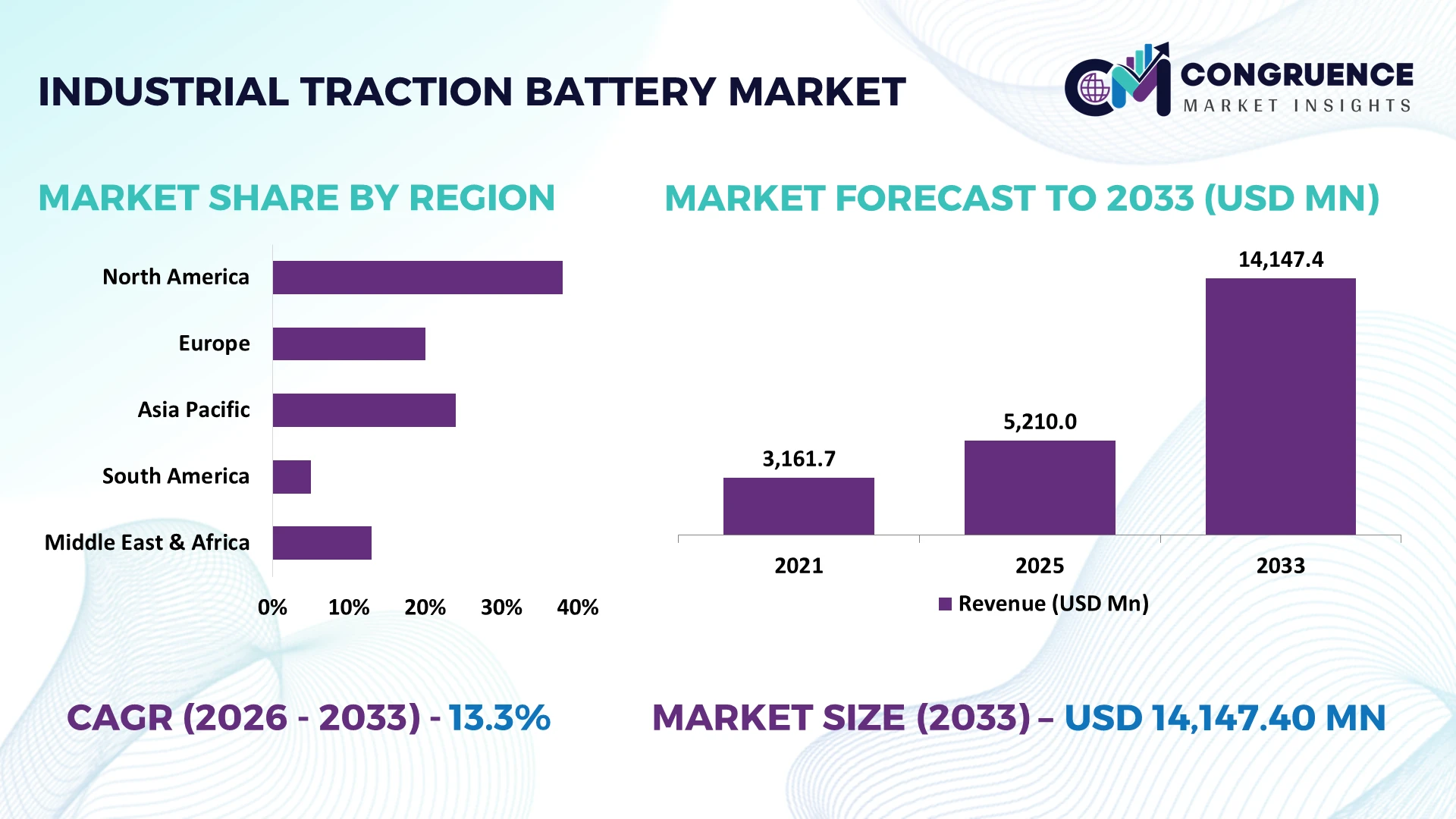
The Global Industrial Traction Battery Market was valued at USD 5210 Million in 2025 and is anticipated to reach a value of USD 14147.4 Million by 2033 expanding at a CAGR of 13.3% between 2026 and 2033. Growth is driven by lithium-ion forklift electrification, automated warehouse fleet expansion, replacement of lead-acid batteries, and adoption of opportunity charging in multishift industrial operations.
China holds a leading position in industrial traction battery manufacturing, supported by its dominant lithium-ion battery supply chain and extensive electric material-handling equipment production. Chinese manufacturers account for more than 70% of global lithium-ion battery cell production, supporting cost-efficient lithium iron phosphate battery integration. Domestic forklift manufacturers BYD, Hangcha, and HELI are expanding lithium-powered equipment offerings for logistics and manufacturing facilities. Compared with Germany, where industrial battery adoption emphasizes high-performance warehouse automation, China benefits from vertically integrated cathode manufacturing, cell production, and industrial equipment assembly.
Strategically, battery suppliers should prioritize lithium iron phosphate technology, forklift OEM partnerships, and localized service networks to capture industrial fleet electrification opportunities.
Market Size & Growth: Valued at USD 5210 Million in 2025, projected to USD 14147.4 Million by 2033 at 13.3% CAGR, driven by warehouse automation and multi-shift logistics operations.
Top Growth Drivers: Forklift electrification reaching 68.6% of material handling equipment, lithium-ion adoption at 60.4% revenue share, and 24/7 multi-shift operations requiring opportunity charging.
Short-Term Forecast: By 2027, opportunity charging adoption reduces battery fleet size requirements by 20–30% as fast-charging lithium-ion platforms displace lead-acid battery swapping workflows.
Emerging Technologies: LFP chemistry dominance for thermal safety, IoT-enabled battery management systems for predictive maintenance, and solid-state pilot lines targeting 2027 industrial deployment.
Regional Leaders: China at 36% global manufacturing share with BYD and CATL, United States at USD 436.6 million and 70% of North American revenue, and Germany leading European forklift battery supply.
Consumer/End-User Trends: Forklifts command 68.6% of application share; lithium-ion holds 60.4% of battery chemistry revenue as lead-acid phase-out accelerates in indoor operations.
Pilot/Case Example: EnerSys expanded its fast-charging battery portfolio for electric forklifts in September 2024, targeting warehouse operations with reduced downtime and improved BMS integration.
Competitive Landscape: EnerSys leads with USD 3.6 billion fiscal 2025 revenue; Sunlight Group reported USD 1.3 billion 2024 revenue with 28% lithium-ion share; BYD, Exide, and Hoppecke compete across chemistry platforms.
Regulatory & ESG Impact: Indoor air quality regulations drive lead-acid phase-out; EU Battery Directive mandates recycling and carbon footprint disclosure across industrial traction batteries.
Investment & Funding: India's Ola Electric, Reliance, Tata, and Amara Raja committed 86 GWh combined cell manufacturing capacity by 2030; LG Energy Solution partnered with Siemens Mobility for rail electrification in January 2025.
Innovation & Future Outlook: Battery-as-a-Service and leasing models expand accessibility; IoT integration with fleet telematics enables preventive maintenance and uptime optimization.
The Industrial Traction Battery Market is undergoing a structural transition as warehouse operators, manufacturing facilities, and logistics companies replace conventional lead-acid batteries with lithium-ion energy storage systems. Lithium iron phosphate technology is gaining preference because of its thermal stability, extended cycle life, and compatibility with rapid opportunity charging. Advanced battery management systems increasingly integrate state-of-health monitoring, automated charging controls, and fleet performance analytics. Modern lithium-ion traction batteries can exceed 95% round-trip energy efficiency under suitable operating conditions. European battery traceability requirements are also influencing supplier qualification and product documentation, establishing new competitive priorities around lifecycle performance and industrial equipment integration.
Industrial traction batteries are becoming strategically important as warehouse automation, electric material handling, and manufacturing electrification reshape equipment procurement and operating economics. Logistics operators increasingly evaluate batteries through total ownership costs, charging availability, and equipment utilization rather than initial purchase prices. Lithium iron phosphate technology is accelerating this transition through longer cycle life and reduced maintenance requirements. China's established battery manufacturing ecosystem provides substantial production advantages, while European suppliers increasingly emphasize lifecycle traceability, industrial safety, and battery management integration under evolving regulatory requirements.
Modern lithium-ion traction batteries typically achieve 90–95% round-trip energy efficiency, compared with approximately 70–85% for conventional flooded lead-acid systems under comparable operating conditions. This performance difference reduces charging electricity requirements and supports multishift warehouse operations. Germany emphasizes automated intralogistics and integrated charging infrastructure, whereas India presents opportunities through expanding organized warehousing and industrial electrification. Battery manufacturers are consequently developing application-specific packs with improved thermal management, modular voltage configurations, and predictive diagnostics.
Between 2026 and 2028, investment priorities will increasingly favor opportunity charging, connected fleet monitoring, and standardized battery interfaces. Electric forklift deployments using scheduled charging breaks demonstrate how operators can eliminate routine battery exchanges. Suppliers are strengthening OEM partnerships, expanding service networks, and integrating battery analytics into equipment maintenance platforms. Competitive advantage will depend on verified lifecycle performance, operational uptime, and reliable integration with industrial fleet management systems.
Warehouse electrification is accelerating industrial traction battery adoption as logistics operators replace combustion-powered equipment and conventional lead-acid battery fleets. Lithium-ion systems typically deliver charging efficiencies above 90%, while opportunity charging reduces dependence on dedicated battery exchange infrastructure. In Germany, automated distribution facilities increasingly prioritize electric forklifts, pallet trucks, and automated guided vehicles to support continuous material movement. Lithium iron phosphate batteries offer approximately 2,000–5,000 cycles depending on operating conditions, compared with roughly 1,000–1,500 cycles for conventional lead-acid alternatives. Manufacturers including EnerSys and BYD are expanding application-specific battery portfolios and strengthening forklift OEM integration. Reduced charging downtime allows fleet operators to improve equipment availability without proportionally increasing vehicle inventories.
Industrial lithium-ion traction batteries face procurement constraints from higher upfront equipment costs, specialized charging infrastructure, and concentrated upstream material processing. Lithium-based battery systems frequently require greater initial investment than comparable flooded lead-acid configurations, creating financial barriers for smaller warehouse operators. China accounts for more than 70% of global lithium-ion cell production, exposing international buyers to concentrated manufacturing capacity and trade-policy changes. Battery packs also require compatible charging equipment, communication interfaces, and certified maintenance procedures. In India, fragmented industrial charging infrastructure complicates fleet conversion across smaller manufacturing facilities. Suppliers are addressing these constraints through localized pack assembly, diversified cell procurement, equipment leasing, and battery-as-a-service arrangements that distribute acquisition expenditure across operating periods.
Connected traction battery systems create opportunities to integrate energy storage, charging infrastructure, and industrial fleet analytics into unified operating platforms. Battery management systems continuously monitor state of charge, cell temperature, and discharge behavior, supporting predictive maintenance and optimized charging schedules. Modern lithium-ion systems can achieve approximately 95% charging efficiency, strengthening energy management economics in electricity-intensive distribution facilities. In the United States, automated warehouses increasingly require batteries compatible with autonomous mobile robots and industrial material-handling fleets. Suppliers are developing cloud-connected monitoring platforms, modular battery architectures, and intelligent charging controls. Partnerships with warehouse automation providers create opportunities for recurring software services and performance-based maintenance contracts, extending competitive differentiation beyond battery hardware.
Scaling industrial traction battery deployment requires reliable thermal protection, standardized communication protocols, and consistent performance across demanding duty cycles. Lithium-ion battery packs commonly operate across 24 V, 48 V, and 80 V industrial equipment configurations, requiring application-specific electrical integration. High-current charging increases thermal management requirements, particularly in facilities operating continuous shifts. Battery management systems must coordinate cell balancing, charger communication, and equipment control functions to prevent operational interruptions. Germany's industrial safety framework places significant emphasis on equipment certification and workplace electrical protection. Manufacturers are investing in thermal monitoring, fault isolation, and standardized communication interfaces while collaborating with forklift OEMs and charging equipment suppliers. Long-term competitiveness depends on maintaining predictable battery performance, safe charging operations, and reliable interoperability across mixed industrial fleets.
• Rapid Charging Reshapes Warehouse Operations: Industrial operators are transitioning toward high-current charging configurations that restore approximately 80% battery capacity within 60–90 minutes under suitable conditions. German logistics facilities increasingly integrate 48 V and 80 V lithium battery chargers into scheduled operating breaks. Manufacturers are expanding charger compatibility, automated power allocation, and thermal protection systems, reducing battery handling requirements and improving equipment availability across intensive material-handling operations.
• Modular Battery Architecture Gains Industrial Preference: Equipment manufacturers are standardizing interchangeable battery modules across 24 V, 48 V, and 80 V industrial platforms. Modular configurations simplify servicing, component replacement, and equipment integration while reducing customized inventory requirements. Chinese forklift manufacturers are expanding standardized lithium battery portfolios and coordinating pack specifications with cell suppliers, improving manufacturing flexibility and accelerating product configuration for different warehouse operating environments.
• Battery Traceability Transforms Supplier Qualification: European industrial battery procurement increasingly emphasizes material documentation, carbon footprint reporting, and lifecycle traceability under Regulation 2023/1542. Digital battery passport requirements beginning in 2027 apply to qualifying industrial batteries above 2 kWh. Manufacturers are integrating product identification, material tracking, and digital compliance records into battery production systems, strengthening regulatory readiness and improving access to regulated industrial equipment supply chains.
• Sodium Ion Chemistry Enters Evaluation: Battery developers are assessing sodium-ion alternatives for cost-sensitive industrial traction applications where energy density is less critical than material availability. Commercial sodium-ion cells typically offer lower energy density than established lithium-ion technologies, creating packaging tradeoffs for compact equipment. Chinese manufacturers are advancing pilot production and battery qualification programs, targeting improved supply diversification and reduced dependence on lithium-based cathode materials.
Lead-Acid Batteries retain a substantial position in the Industrial Traction Battery Market because of established forklift compatibility, mature recycling infrastructure, and comparatively low initial acquisition costs. Their widespread use across conventional warehouse fleets supports recurring replacement demand, particularly among price-sensitive industrial operators. However, Lithium-Ion Batteries represent the fastest-growing technology category as operators prioritize charging flexibility, energy efficiency, and extended operational life. Lithium-ion systems commonly deliver 2,000–5,000 charge cycles, compared with approximately 1,000–1,500 cycles for conventional industrial lead-acid batteries. This performance advantage shifts procurement decisions toward lifecycle operating costs rather than upfront battery pricing.
Nickel-Cadmium Batteries maintain specialized relevance where temperature tolerance and durability outweigh energy density considerations, while Nickel-Metal Hydride Batteries serve selected industrial applications requiring established rechargeable chemistry. Sodium-Ion Batteries represent an emerging alternative for applications prioritizing material availability and supply diversification. Chinese manufacturers are expanding lithium iron phosphate battery production, while established industrial battery suppliers are strengthening modular pack engineering and aftermarket service capabilities. Investment priorities increasingly favor chemistry-specific charging systems, standardized battery interfaces, and application-focused product portfolios.
Forklifts represent the leading application for industrial traction batteries because of their extensive deployment across manufacturing plants, distribution facilities, and industrial storage operations. Electric forklift fleets require dependable rechargeable power systems capable of supporting repetitive lifting, transportation, and loading activities. The global industrial truck industry recorded approximately 2.1 million new truck orders during 2024, demonstrating the scale of material-handling equipment procurement. Electric Industrial Trucks contribute substantial battery requirements across specialized transport applications, while Warehouse Equipment supports smaller battery configurations for pallet movement and order fulfillment activities.
Automated Guided Vehicles represent a rapidly expanding application as industrial facilities integrate autonomous material movement into production and distribution workflows. These systems increasingly require compact lithium-ion batteries, automated charging compatibility, and precise energy management. Mining Vehicles demand high-capacity battery configurations with robust thermal protection, whereas Rail Traction applications prioritize durability, vibration resistance, and operational reliability. Manufacturers are expanding application-specific battery engineering, collaborating with automation equipment suppliers, and developing integrated charging solutions. Competitive differentiation increasingly depends on equipment compatibility, charging reliability, and predictable battery performance under intensive duty cycles.
Warehousing represents a leading end-user category for industrial traction batteries because distribution facilities operate extensive electric forklift, pallet handling, and automated material movement fleets. Battery purchasing decisions increasingly emphasize equipment availability, charging infrastructure utilization, and operating cost predictability. Manufacturing facilities represent another important customer group, particularly automotive, electronics, and machinery producers requiring continuous internal material transportation. Logistics operators prioritize battery systems capable of supporting intensive loading schedules and variable shift patterns. Modern lithium-ion traction batteries can achieve charging efficiencies above 90%, improving energy utilization across high-frequency industrial operations.
Logistics is emerging as a particularly dynamic end-user segment as distribution networks adopt automated handling systems and expand electric equipment deployment. Mining operations require high-capacity batteries with ruggedized enclosures, while Railways prioritize dependable traction performance under demanding operating conditions. Ports increasingly integrate electrified cargo-handling equipment, and Construction applications emphasize durable battery configurations suited to mobile industrial machinery. Battery suppliers are strengthening OEM partnerships, expanding fleet service agreements, and introducing customized charging solutions. Commercial positioning increasingly reflects operational intensity, equipment compatibility, and lifecycle maintenance requirements rather than standardized battery specifications.
Asia-Pacific accounted for the largest market share at an estimated 45% in 2025 however, Asia-Pacific is expected to register the fastest growth, expanding at a CAGR of an estimated 14.8% between 2026 and 2033.
Lithium-Ion Fleet Conversion and Warehouse Productivity Optimization
North America represents an established industrial traction battery market, supported by extensive material-handling equipment fleets, advanced distribution infrastructure, and industrial electrification initiatives. The United States dominates regional demand through large warehouse networks, automotive manufacturing, and third-party logistics operations. Electric forklifts increasingly utilize lithium iron phosphate batteries to reduce maintenance requirements and support continuous warehouse operations. Industrial battery manufacturers including EnerSys and East Penn Manufacturing maintain established production and distribution networks serving original equipment manufacturers and replacement battery customers. Lithium-ion traction systems commonly support charging efficiencies exceeding 90%, improving energy utilization across multishift facilities. Canada contributes through electric material-handling equipment deployment in automotive production, food distribution, and industrial logistics. Suppliers are strengthening equipment integration partnerships and expanding technical support capabilities to improve battery reliability and fleet operating performance.
United States Market Outlook: The United States leads regional industrial traction battery procurement through extensive distribution networks and established electric forklift fleets. Industrial equipment manufacturers including Hyster-Yale and Crown Equipment support battery integration across warehouse and manufacturing applications. The country's growing automated logistics infrastructure strengthens demand for lithium-ion battery packs operating across 24 V, 48 V, and 80 V equipment platforms. Domestic battery suppliers benefit from established aftermarket distribution, industrial service capabilities, and close relationships with equipment manufacturers.
Regulatory Compliance and Automated Intralogistics Electrification
Europe's industrial traction battery market is shaped by automated warehouse infrastructure, industrial equipment electrification, and increasingly stringent battery sustainability requirements. Germany, France, Italy, and the United Kingdom represent important demand centers supported by automotive production, manufacturing logistics, and advanced material-handling operations. European industrial equipment manufacturers increasingly integrate lithium-ion batteries into forklifts, automated guided vehicles, and warehouse handling systems. Regulation (EU) 2023/1542 introduces lifecycle documentation and battery traceability requirements, influencing supplier qualification and product development. Industrial batteries above 2 kWh fall within specified digital battery passport requirements beginning in 2027. Manufacturers are investing in battery management software, standardized charging interfaces, and documentation systems to maintain regulatory compliance. The region's established equipment engineering capabilities support specialized battery configurations designed for automated industrial operations and demanding safety requirements.
Germany Market Outlook: Germany maintains a leading position through its advanced intralogistics industry and concentration of automotive, machinery, and industrial automation companies. Jungheinrich, KION Group, and other equipment manufacturers are expanding lithium-ion integration across electric industrial trucks and warehouse automation platforms. German industrial facilities increasingly prioritize battery diagnostics, automated charging, and energy-efficient equipment operation. The country's established engineering and certification infrastructure supports premium battery systems emphasizing operational reliability, equipment compatibility, and lifecycle performance.
Integrated Battery Manufacturing and Industrial Equipment Electrification
Asia-Pacific dominates industrial traction battery manufacturing through extensive lithium-ion cell production, established industrial equipment supply chains, and expanding electric material-handling fleets. China leads regional production with integrated battery materials processing, cell manufacturing, and forklift assembly operations. Japan contributes advanced industrial battery engineering and established equipment manufacturing capabilities, while South Korea specializes in lithium-ion cell technology and battery management integration. India represents an expanding industrial battery market supported by organized warehousing, automotive manufacturing, and industrial logistics modernization. The region benefits from strong production capabilities across lithium iron phosphate cells, battery modules, electronic control systems, and industrial charging equipment. Manufacturers including BYD, Hangcha, HELI, and GS Yuasa are strengthening product development and equipment integration capabilities. Competitive advantages increasingly depend on manufacturing efficiency, localized component sourcing, and standardized battery architectures.
China Market Outlook: China maintains a leading industrial traction battery manufacturing position through extensive lithium iron phosphate production and vertically integrated battery supply chains. Chinese companies account for more than 70% of global lithium-ion battery cell manufacturing, supporting industrial equipment electrification. BYD, Hangcha, and HELI manufacture electric forklifts and industrial handling equipment incorporating lithium-based battery systems. Domestic suppliers benefit from established cathode processing, automated cell assembly, and integrated battery management technology, strengthening production scalability and international equipment competitiveness.
Warehouse Modernization and Industrial Fleet Electrification
South America's industrial traction battery market is influenced by expanding distribution infrastructure, manufacturing modernization, and increasing deployment of electric material-handling equipment. Brazil dominates regional industrial activity through automotive production, food processing, agricultural logistics, and extensive warehousing operations. Chile contributes demand from mining support activities and industrial logistics, while Argentina maintains traction battery requirements across manufacturing and distribution facilities. Conventional lead-acid batteries retain an important position because of established servicing infrastructure and comparatively low initial acquisition costs. Lithium-ion systems are gaining attention among operators seeking reduced maintenance and improved charging flexibility. Industrial equipment suppliers are strengthening distributor partnerships, expanding battery service capabilities, and introducing application-specific lithium battery configurations. Import dependency, financing conditions, and uneven charging infrastructure remain important considerations influencing fleet electrification decisions.
Brazil Market Outlook: Brazil represents the principal industrial traction battery market in South America, supported by its extensive manufacturing base and established logistics infrastructure. São Paulo and surrounding industrial corridors concentrate automotive production, distribution centers, and material-handling equipment demand. Battery suppliers serve electric forklifts, warehouse equipment, and industrial transport applications through domestic distribution and aftermarket networks. Brazil's established lead-acid battery manufacturing ecosystem provides a foundation for replacement demand, while lithium-ion adoption creates opportunities for specialized charging equipment and technical service providers.
Logistics Infrastructure Expansion and Industrial Equipment Modernization
The Middle East & Africa industrial traction battery market is supported by logistics infrastructure development, manufacturing diversification, mining operations, and industrial equipment modernization. Saudi Arabia and the United Arab Emirates are expanding warehouse facilities, distribution hubs, and industrial logistics infrastructure associated with national economic diversification programs. South Africa maintains traction battery demand across mining, manufacturing, and established material-handling operations. Industrial equipment fleets increasingly require reliable rechargeable batteries capable of operating under high ambient temperatures and intensive duty cycles. Lithium iron phosphate technology offers thermal stability advantages when combined with appropriate battery management and cooling systems. Equipment suppliers are strengthening regional distribution agreements, maintenance networks, and industrial charging partnerships. Infrastructure availability, technical servicing capacity, and equipment acquisition costs influence battery procurement across emerging industrial centers.
Saudi Arabia Market Outlook: Saudi Arabia represents a strategically important industrial traction battery market through expanding logistics infrastructure and industrial development under Vision 2030. The National Transport and Logistics Strategy targets substantial improvements in logistics capabilities and industrial connectivity. New distribution facilities, manufacturing zones, and port-related logistics operations support electric forklift and warehouse equipment deployment. Battery suppliers are prioritizing heat-resistant pack configurations, industrial charging compatibility, and localized maintenance partnerships to address demanding operating environments and strengthen long-term equipment reliability.
The global Industrial Traction Battery Market features competition between established lead-acid manufacturers and lithium-ion technology specialists. EnerSys, Exide Technologies, East Penn Manufacturing, GS Yuasa, and BYD compete through industrial distribution, battery chemistry, equipment integration, and manufacturing scale. Lithium-ion systems offer approximately 15–25% higher charging efficiency than conventional lead-acid configurations, while advanced battery management improves operational reliability. Chinese manufacturers emphasize vertically integrated lithium iron phosphate production, whereas European suppliers prioritize customized industrial battery systems and regulatory compliance. Companies are expanding modular battery portfolios, strengthening forklift OEM partnerships, and investing in automated pack assembly. Competition increasingly centers on lifecycle economics, charging compatibility, and supply-chain localization rather than initial acquisition costs. Battery certification, established equipment relationships, and technical servicing capabilities create substantial entry barriers. Competitive success requires reliable battery performance, scalable manufacturing, competitive lifecycle costs, and integrated industrial charging solutions supported by responsive aftermarket service networks.
EnerSys
Sunlight Group
BYD Company
Hoppecke Batterien
Exide Industries
GS Yuasa Corporation
East Penn Manufacturing
Amara Raja Batteries
Exide Technologies
Systems Sunlight
Johnson Controls
TAB Batteries
Storage Battery Systems
Microtex Energy
Lithium iron phosphate batteries are transforming industrial traction systems through higher charging efficiency, extended cycle life, and improved thermal stability. Modern lithium-ion packs achieve approximately 90–95% charging efficiency, compared with 70–85% for conventional flooded lead-acid batteries. Battery management systems monitor cell voltage, temperature, and charge balance, reducing premature degradation. Adoption is concentrated in electric forklifts, automated warehouse equipment, and multishift manufacturing facilities where charging downtime directly affects equipment productivity.
Emerging technologies include silicon-enhanced anodes, modular battery architectures, and intelligent opportunity charging. Silicon-based anode materials improve energy density by approximately 10–20% in suitable cell designs, supporting compact industrial equipment configurations. Automated charging platforms integrate battery diagnostics with fleet scheduling software, enabling charging during operational breaks. Sodium-ion batteries represent a disruptive alternative for cost-sensitive equipment, although lower energy density currently limits compact traction applications. Manufacturers integrating chemistry development with equipment controls gain advantages in customization and servicing.
Between 2026 and 2028, connected battery systems will increasingly incorporate predictive degradation models, wireless diagnostics, and automated charging coordination. Suppliers combining battery hardware, software, and maintenance services will strengthen customer retention. Industrial operators benefit from improved asset utilization, standardized fleet integration, and lower lifecycle maintenance requirements across demanding operating environments.
February 2025: BYD expanded its lithium-ion battery offerings for electric forklifts and material handling equipment, focusing on cost-effective, high-energy-density LFP solutions for warehouses and logistics companies. This positions BYD to capture market share in Europe and North America where forklift fleets undergo rapid electrification. Source: gminsights.com
September 2026: Exide Industries signed a long-term strategic cooperation with Germany’s ExCom Energy Solutions to expand industrial battery sales across the European Economic Area, covering traction and motive-power solutions for material handling and logistics. The partnership provides Exide direct EEA market access through ExCom’s distribution and application engineering capabilities. Source: thebatterymagazine.com
October 2025: EnerSys launched the ODYSSEY Evolution ODV31 battery featuring AGM2 technology with over 650 charge/recharge cycles at 80% depth of discharge, delivering up to 60% increased cycle life versus its prior model. The product targets commercial vehicles, marine systems, and auxiliary power applications requiring extended service life. Source: odysseybattery.com
January 2025: Sunlight Group acquired 51% stake in Lehmann Marine, a Germany-based LFP battery systems specialist, to strengthen positions in the maritime battery market. The partnership enables production scaling and next-generation maritime energy storage deployment for shipping decarbonization. Source: world-energy.org
The Industrial Traction Battery Market Report evaluates battery technologies, equipment applications, end-user demand, and competitive developments across the 2026–2033 forecast period. Technology segmentation includes lead-acid, lithium-ion, nickel-cadmium, nickel-metal hydride, and sodium-ion batteries. Application analysis covers forklifts, automated guided vehicles, electric industrial trucks, mining vehicles, rail traction, and warehouse equipment. End-user assessment examines warehousing, manufacturing, logistics, mining, railways, ports, and construction, identifying operational requirements, replacement cycles, and equipment electrification priorities.
Geographical coverage encompasses North America, Europe, Asia-Pacific, South America, and the Middle East & Africa. The report assesses lithium iron phosphate chemistry, intelligent battery management, modular pack architectures, and automated charging technologies. Competitive analysis examines manufacturing localization, OEM partnerships, supply-chain integration, and aftermarket services, supporting investment planning, product development, market entry decisions, and long-term industrial battery positioning.
| Report Attribute/Metric | Report Details |
|---|---|
Market Revenue in 2025 | USD 5210 Million |
Market Revenue in 2033 | USD 14147.4 Million |
CAGR (2026 - 2033) | 13.3% |
Base Year | 2025 |
Forecast Period | 2026 - 2033 |
Historic Period | 2021 - 2025 |
Segments Covered | By Type
By Application
By End-User
|
Key Report Deliverable | Revenue Forecast, Growth Trends, Market Dynamics, Segmental Overview, Regional and Country-wise Analysis, Competition Landscape |
Region Covered | North America, Europe, Asia-Pacific, South America, Middle East, Africa |
Key Players Analyzed | EnerSys, Sunlight Group, BYD Company, Hoppecke Batterien, Exide Industries, GS Yuasa Corporation, East Penn Manufacturing, Amara Raja Batteries, Exide Technologies, Systems Sunlight, Johnson Controls, TAB Batteries, Storage Battery Systems, Microtex Energy |
Customization & Pricing | Available on Request (10% Customization is Free) |




