
Reports
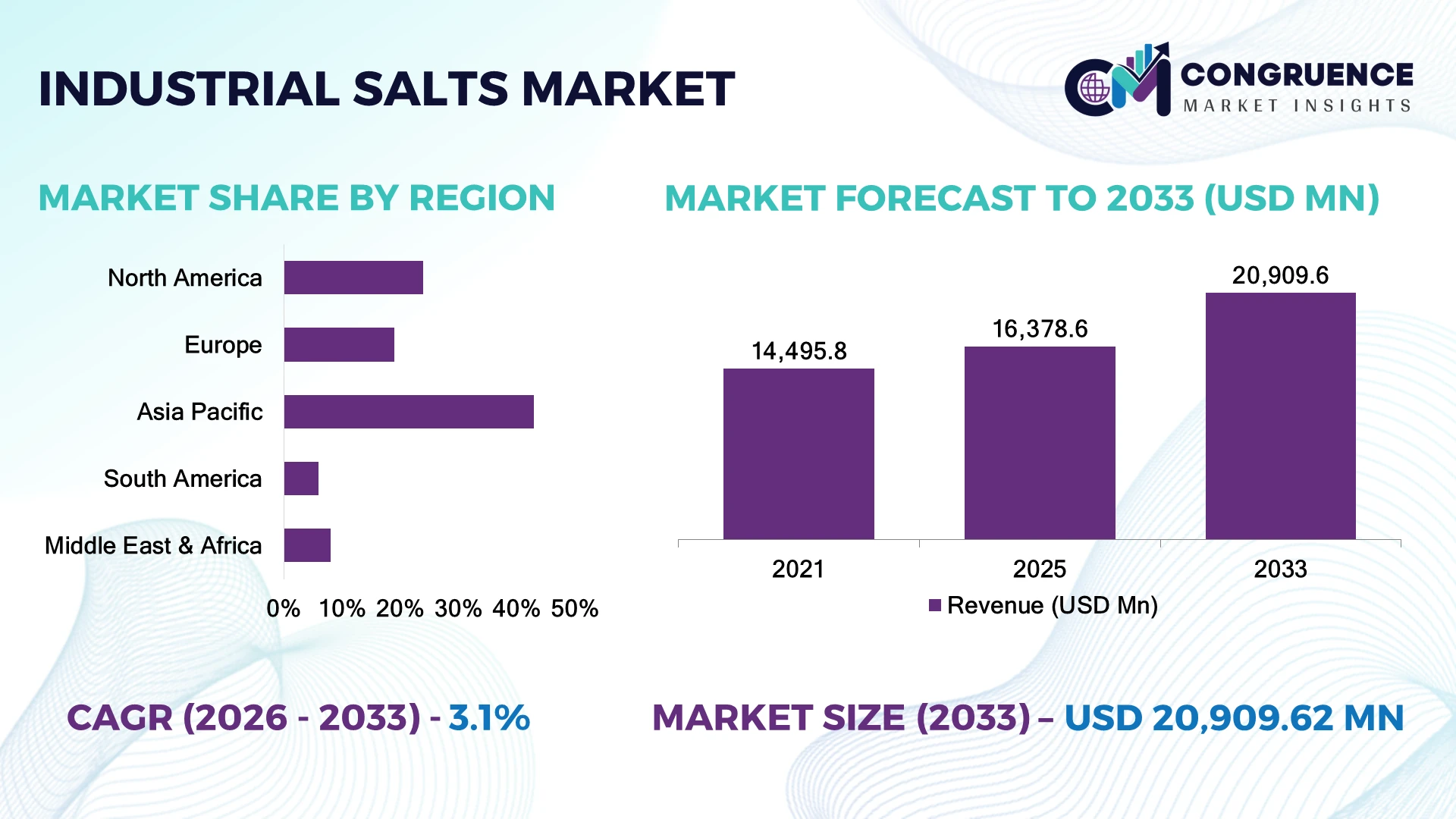
The Global Industrial Salts Market was valued at USD 16,378.6 Million in 2025 and is anticipated to reach a value of USD 20,909.6 Million by 2033 expanding at a CAGR of 3.1% between 2026 and 2033. Growth is being driven by expanding chlor-alkali processing, water-treatment capacity, chemical manufacturing, and demand for high-purity salt grades used in pharmaceutical and specialty applications.
China represents the dominant industrial-salt production base, supported by large chlor-alkali, chemical, and industrial-processing clusters, while the United States combines extensive salt production with major chemical and water-treatment consumption. China’s chemical manufacturing capacity exceeds that of the U.S., while India is accelerating industrial and water-treatment investment, creating a stronger demand pipeline for processed and specialty grades. Geopolitical supply-chain restructuring is also encouraging regional sourcing.
Strategic priority is shifting toward secure mineral supply, higher-purity grades, and integrated production assets rather than commodity-volume expansion alone.
Market Size & Growth: USD 16,378.6 million in 2025 to USD 20,909.6 million by 2033 at 3.1% CAGR, supported by chemical-processing and water-treatment consumption.
Top Growth Drivers: Chemical processing 34%, water treatment 27%, chlor-alkali production 22%, defining the strongest industrial demand pools.
Short-Term Forecast: By 2028, automated evaporation and crystallization systems are positioned to improve processing efficiency by 8–12% while reducing material losses.
Emerging Technologies: Membrane-based chlor-alkali integration, automated crystallization, and digital brine monitoring are improving process control by 10–15%.
Regional Leaders: Asia-Pacific represents about 47%, North America 24%, and Europe 19% of demand, with Asian chemical complexes driving the strongest volume expansion.
Consumer/End-User Trends: Chemical manufacturing accounts for roughly 35% of industrial consumption, while water-treatment applications are expanding their share as municipal infrastructure modernizes.
Pilot/Case Example: Advanced crystallization projects implemented during 2024–2025 have targeted 10%–15% reductions in energy consumption through improved heat recovery and process automation.
Competitive Landscape: Leading producers collectively control an estimated 25%–30% of global industrial-salt capacity, with competition centered on logistics, purity, mine access, and downstream integration.
Regulatory & ESG Impact: Closed-loop brine management and lower-energy processing can reduce freshwater intensity by approximately 10%–20% at integrated facilities.
Investment & Funding: More than USD 1 billion in cumulative capacity and modernization programs across major producing markets is shifting investment toward purification, automation, and integrated chemical facilities.
Innovation & Future Outlook: High-purity grades, specialty salts, automated processing, and vertically integrated supply chains will increasingly outperform undifferentiated bulk-volume strategies through 2026–2028.
Industrial salts are increasingly differentiated by purity, particle size, moisture control, and application-specific specifications rather than basic sodium-chloride volume. Chemical manufacturing and water treatment remain the largest demand pools, while pharmaceutical-grade and specialty formulations are gaining strategic importance. Around 27% of demand is linked to water-treatment and related infrastructure applications, reinforcing the importance of localized supply and reliable logistics as industrial buyers manage geopolitical and freight disruptions.
Industrial salts have become a strategic input for chemical production, water treatment, food processing, pharmaceuticals, and deicing operations, making supply reliability directly relevant to manufacturing continuity. The market is shifting from low-cost bulk procurement toward multi-source contracting, higher-purity specifications, and geographically diversified inventories. This transition is particularly important as chemical producers in China, India, and the United States expand integrated processing capacity.
Technology is also changing plant economics. Automated crystallization and digital moisture monitoring can improve process efficiency by roughly 8–15% compared with conventional manual controls, while membrane-integrated chlor-alkali systems reduce energy intensity relative to older mercury- or diaphragm-based configurations. North American operators emphasize mine-to-customer logistics and water-treatment applications, whereas Asian producers prioritize high-volume chemical integration and capacity utilization.
Over the next 2–3 years, industrial buyers are expected to increase dual-sourcing and digital quality monitoring, with automated process controls reaching substantially wider deployment across modern facilities. Companies are responding through mine expansions, purification investments, long-term supply agreements, and downstream integration. Competitive advantage will increasingly depend on secure mineral access combined with consistent purity, efficient processing, and resilient delivery networks.
Expansion of chlor-alkali and downstream chemical manufacturing is increasing industrial salt consumption, with chemical processing representing approximately 34% of demand and chlor-alkali applications accounting for about 22%. In India, new chemical and water-treatment capacity is increasing requirements for consistent industrial-grade and purified salt inputs. Energy-intensive processing is also accelerating adoption of automated evaporation and crystallization, improving process efficiency by 8–12%. Companies are responding through integrated salt-to-chemical production, purification investments, and long-term feedstock contracts. The non-obvious advantage is supply synchronization: producers located near chlor-alkali clusters can reduce transportation exposure while improving feedstock consistency, strengthening margins and plant utilization.
Industrial salt economics remain exposed to evaporation energy, transportation, and geographic supply concentration, with energy and logistics together influencing roughly 15–20% of delivered costs in processing-intensive supply chains. Producers in the United States and India face different cost structures because inland transportation can represent more than 10% of delivered bulk-salt pricing in distant industrial markets. Weather-related disruptions at production and transport corridors further tighten availability. Companies are reducing exposure through regional stockpiles, multi-origin procurement, contracted freight capacity, and closer-to-customer purification facilities. The strategic constraint is increasingly delivered-cost volatility rather than mineral availability itself, forcing buyers to evaluate suppliers on logistics resilience and contract reliability alongside price.
High-purity industrial salts offer a stronger value pool as pharmaceutical, specialty chemical, electronics, and advanced water-treatment applications tighten impurity specifications. Specialty and purified grades can command materially higher pricing than conventional bulk material, while automated purification systems can reduce process losses by approximately 5–10%. India is particularly positioned to expand this opportunity through pharmaceutical and chemical manufacturing clusters. Companies are investing in membrane purification, controlled crystallization, particle-size engineering, and application-specific formulations. A less visible opportunity lies in converting existing bulk-salt assets into purification hubs, allowing producers to capture downstream margins without building entirely new extraction infrastructure. Partnerships with chemical processors can accelerate qualification and shorten commercialization cycles.
Scaling advanced industrial-salt processing requires tighter control of moisture, particle size, impurities, and crystallization conditions, creating operational complexity that conventional bulk facilities are not designed to manage. Automated plants can reduce process variability by approximately 10–15%, but integration with legacy evaporation, drying, and packaging systems remains difficult. Workforce shortages in specialized process engineering further increase commissioning and maintenance requirements. In China and the United States, producers are upgrading instrumentation and predictive maintenance systems to improve equipment availability by roughly 5–8%. Companies must prioritize modular plant modernization, operator training, digital process controls, and equipment partnerships. The critical challenge is achieving specialty-grade consistency at industrial volumes without eroding the cost advantage of established bulk operations.
Purity Specifications Are Tightening: Pharmaceutical, specialty chemical, and advanced water-treatment buyers are increasingly requiring controlled impurity profiles, with purified grades capturing approximately 15–20% higher-value applications than conventional bulk salt. Producers are expanding crystallization, washing, and quality-control systems to meet tighter specifications while reducing rejected batches.
Automation Is Reshaping Processing: Automated evaporation, crystallization, and moisture monitoring are moving deeper into modern salt facilities, delivering roughly 8–12% efficiency improvements and reducing manual process intervention by 15–20%. Operators in India and the United States are prioritizing sensor integration and predictive maintenance to stabilize output amid skilled-labor constraints.
Supply Chains Are Regionalizing: Geopolitical trade disruptions and freight volatility are pushing industrial buyers toward dual sourcing, regional inventories, and shorter supply contracts. Approximately 20–25% of large industrial procurement programs are increasingly structured around multi-origin supply strategies, encouraging producers to establish purification or storage assets closer to chemical and water-treatment clusters.
Water Treatment Gains Strategic Weight: Municipal and industrial water-treatment modernization is increasing demand for consistent-grade salt inputs, with treatment-related consumption estimated near 27% of industrial applications. Stricter water-quality requirements are encouraging automated dosing and brine-management systems, while producers are developing application-specific grades and partnerships with treatment-equipment operators to secure recurring contracts.
Rock salt is the leading industrial salts type, estimated at approximately 44% of global volume, supported by abundant reserves, low processing requirements, and suitability for high-volume chemical processing, deicing, and industrial applications. Solar salt follows at roughly 34%, benefiting from low-cost evaporation and strong availability in coastal production centers. Vacuum pan salt represents a smaller share near 9% but is the fastest-growing premium category as pharmaceutical, specialty chemical, and high-purity water-treatment users demand tighter impurity specifications.
Salt in brine remains strategically important for integrated chlor-alkali operations because it minimizes solid handling and supports continuous feedstock delivery. Companies are increasingly prioritizing integrated extraction, purification, and downstream chemical assets rather than standalone commodity production. The investment shift is particularly visible in India, where modernization can materially increase salt-work productivity while improving quality consistency.
The U.S. Geological Survey reported that salt sold or used in the United States in 2025 comprised approximately 44% salt in brine, 38% rock salt, 9% solar salt, and 9% vacuum-pan salt, highlighting the continued importance of brine and bulk grades in industrial supply chains.
Chemical processing leads industrial salt applications, accounting for approximately 32–35% of global consumption, because sodium chloride remains an essential feedstock for chlorine and caustic-soda production. Water treatment is the fastest-strengthening application, with demand supported by desalination, industrial water reuse, and municipal treatment modernization. Deicing remains a large mature use case, while oil and gas, agriculture, and specialty processing maintain more cyclical or geographically concentrated demand.
The application mix is increasingly separating into two business models: bulk-volume consumption in chemical processing and deicing versus specification-driven demand in water treatment and specialty manufacturing. Water-treatment applications are gaining strategic relevance as purification and brine-management systems become more automated. Producers are responding by developing application-specific grades, strengthening regional storage, and partnering with chemical and treatment operators. This favors suppliers that can guarantee consistent purity, delivery reliability, and technical specifications rather than competing solely on delivered price.
The U.S. Geological Survey reported that chemical manufacturing represented approximately 42% of U.S. salt sales in 2025, with salt in brine supplying about 90% of salt used as chemical feedstock, confirming the structural importance of chlor-alkali operations.
Chemical manufacturers represent the dominant industrial salt end-user group, estimated at approximately 35–40% of demand, because chlor-alkali facilities require continuous, high-volume sodium chloride feedstock. Water-treatment operators form the fastest-growing strategic buyer group, driven by desalination, industrial wastewater treatment, and municipal infrastructure upgrades. Deicing authorities and contractors remain significant seasonal purchasers, while oil and gas operators, pharmaceutical manufacturers, and specialty chemical producers increasingly prioritize specification and reliability over bulk pricing.
Buyer behavior is therefore becoming more segmented: large chemical producers emphasize secure volumes, integrated brine supply, and long-term contracts, whereas pharmaceutical and specialty users prioritize purity, traceability, and controlled particle characteristics. Water-treatment buyers increasingly seek consistent-grade material and dependable replenishment rather than spot-market procurement. Companies are responding with differentiated product portfolios, localized warehouses, multi-year contracts, and direct partnerships with high-consumption industrial clusters. The competitive advantage is shifting toward suppliers capable of matching grade, logistics, and technical requirements to individual end-user processes.
The Alkali Manufacturers Association of India reported 64.04 lakh tonnes per annum of installed caustic-soda capacity and 78.4% capacity utilization in 2024–25, reinforcing the scale of chemical-industry demand underpinning industrial salt consumption in India.
Asia-Pacific accounted for the largest market share at 43% in 2025 however, Middle East & Africa is expected to register the fastest growth, expanding at a CAGR of 4.2% between 2026 and 2033.

Integrated Chemical Production Reshapes Salt Supply Economics
North America accounted for approximately 24% of the global industrial salts market in 2025, supported by extensive rock-salt extraction, brine production, chlor-alkali manufacturing, water treatment, and winter road maintenance. The United States represents the regional production and consumption hub, with industrial applications absorbing a substantial portion of output. Integrated producers are increasingly linking salt extraction with chemical processing and regional storage to reduce transportation exposure. Automation in evaporation, crystallization, and material handling is improving processing efficiency by roughly 8–12% at modern facilities. Infrastructure spending and continued chemical manufacturing investment are strengthening demand for consistent industrial-grade inputs. Companies are prioritizing mine modernization, automated quality control, and strategically located distribution terminals, shifting investment toward resilient supply networks rather than additional undifferentiated bulk capacity.
United States Market Outlook: The United States remains the strategic anchor because of its diversified salt production base, large chlor-alkali industry, extensive highway-deicing requirements, and established water-treatment infrastructure. Salt in brine represents a particularly important industrial feedstock, while rock salt supports large-volume applications. Producers are increasingly investing in automated handling, purification, storage, and mine productivity improvements, with digital monitoring capable of reducing process variability by approximately 10%.
Purity, Energy Efficiency, and Circular Processing Gain Priority
Europe represented approximately 19% of global industrial salts demand in 2025, with Germany, France, the United Kingdom, and Italy anchoring chemical manufacturing, water treatment, food processing, and specialty applications. Energy-intensive processing remains a central cost consideration, encouraging producers to improve crystallization, drying, and heat-recovery systems. Regulatory pressure on industrial emissions is accelerating investments in lower-energy processing and resource-efficient brine management. European buyers increasingly prioritize consistent purity and traceability over lowest-cost bulk supply, particularly in specialty chemicals and pharmaceutical manufacturing. Producers are responding through plant modernization, automated quality systems, and long-term supply agreements. The strategic shift favors facilities capable of delivering specification-controlled grades while maintaining competitive energy intensity.
Germany Market Outlook: Germany holds a strategically important position because of its dense chemical manufacturing base and established industrial infrastructure. Demand is concentrated around integrated chemical clusters requiring dependable salt feedstock and controlled-quality grades. Automated process monitoring and energy-efficiency upgrades are becoming increasingly important as manufacturers manage industrial energy costs. Facilities improving heat recovery and crystallization efficiency by 8–10% gain stronger cost positioning while meeting tighter operational requirements.
Chemical Manufacturing Scale Drives Regional Dominance
Asia-Pacific accounted for approximately 43% of the global industrial salts market in 2025, making it the largest demand and production center. China and India anchor the regional market through extensive chlor-alkali, chemical, pharmaceutical, water-treatment, and industrial-processing capacity. China benefits from large integrated chemical clusters, while India is expanding chemical manufacturing and water infrastructure. Industrial salt consumption is increasingly linked to integrated production rather than standalone commodity applications. Modern facilities are adopting automated evaporation, crystallization, and impurity-control systems that can improve processing efficiency by approximately 8–12%. Producers are expanding purification capacity, regional storage, and downstream partnerships to capture higher-value demand. The principal strategic advantage remains proximity between salt production and high-volume chemical manufacturing.
China Market Outlook: China remains the most strategically significant country because of its extensive chemical-processing infrastructure and large integrated chlor-alkali base. Industrial salt demand benefits from dense manufacturing clusters where feedstock can move directly into downstream chemical production. Producers are emphasizing high-volume extraction, brine integration, purification, and automated process control. Facilities incorporating digital monitoring and automated material handling can achieve approximately 10% better process consistency, supporting higher utilization and reducing quality-related losses.
Mining Expansion Supports Industrial Supply Diversification
South America represented approximately 6% of global industrial salts demand in 2025, with Brazil serving as the principal industrial hub through chemical manufacturing, water treatment, food processing, and infrastructure activity. Coastal salt production provides logistical advantages, while inland buyers face higher transportation sensitivity. Brazil's expanding industrial and municipal water-treatment requirements are strengthening demand for reliable salt supplies, while chemical producers continue to favor consistent feedstock specifications. Producers are responding through storage expansion, regional distribution partnerships, and improved purification capabilities. Logistics remains the key differentiator, with delivered transportation costs potentially accounting for more than 10% of bulk salt costs for distant industrial customers. Companies that combine coastal production with inland inventory networks gain a measurable service advantage.
Brazil Market Outlook: Brazil offers the strongest country-level opportunity because of its industrial scale, extensive coastline, chemical manufacturing base, and expanding water-treatment infrastructure. Coastal salt production provides a natural logistics advantage for domestic and export supply, while inland industrial consumers require strategically positioned storage. Producers are increasingly developing regional distribution networks and application-specific grades, helping reduce supply interruptions and improve delivery reliability for large chemical and treatment customers.
Desalination Investment Elevates Strategic Salt Demand
Middle East & Africa accounted for approximately 8% of global industrial salts demand in 2025, with demand increasingly connected to desalination, water treatment, chemical processing, and industrial infrastructure development. Saudi Arabia and the United Arab Emirates are particularly important because of large-scale water infrastructure and industrial diversification programs. Desalination and wastewater-treatment capacity expansion is increasing requirements for dependable salt and brine-management inputs, while chemical manufacturing investments are broadening industrial consumption. Modern treatment facilities increasingly use automated dosing and monitoring systems, improving material-use efficiency by approximately 5–10%. Producers are responding through localized storage, supply partnerships, purification facilities, and integrated logistics. The region's strategic opportunity lies in connecting salt supply with rapidly expanding water infrastructure rather than relying solely on commodity exports.
Saudi Arabia Market Outlook: Saudi Arabia is the region's most strategically significant market because industrial diversification, desalination, and water-security investment are creating multiple demand channels for industrial salts. Large water infrastructure projects require reliable chemical inputs and controlled supply logistics. Producers and distributors are strengthening local storage and contract-based procurement, while automated dosing and monitoring can reduce salt consumption per treatment cycle by approximately 5–10%, improving operating economics for large facilities.
Cargill, Compass Minerals, K+S, Tata Chemicals, and China National Salt Industry compete as integrated scale leaders, while INEOS, Nouryon, GHCL, and regional solar-salt producers challenge them on specialty grades, proximity, and cost. The top five hold roughly 30% combined share, leaving substantial room for regional competition. Price influences about 35% of purchasing decisions, while purity and specification consistency account for roughly 25%; logistics reliability contributes about 20%. K+S is strengthening Central European coverage through acquisition, Tata Chemicals is expanding vacuum-salt capacity, and producers increasingly integrate salt with chlor-alkali, soda ash, and water-treatment value chains. The competitive shift is moving from commodity volume toward supply security, high-purity specifications, and vertically integrated production. Entry barriers remain high because of mineral rights, evaporation infrastructure, energy requirements, environmental permits, and freight economics. Winning requires low delivered cost, dependable multi-site supply, consistent purity, integrated downstream demand, and targeted investment in specialty salt capacity.
Cargill Incorporated
Compass Minerals International, Inc.
K+S Aktiengesellschaft
Tata Chemicals Limited
China National Salt Industry Group Co., Ltd.
INEOS
Nouryon
Rio Tinto plc
GHCL Limited
Dominion Salt Limited
Salins Group
Zoutman NV
Kissner Group Holdings
American Rock Salt Company LLC
Industrial salt production is shifting toward vacuum evaporation, membrane-based purification, automated crystallization, and advanced brine management. Vacuum evaporation delivers tighter impurity control than conventional solar evaporation, with premium-grade operations targeting NaCl purity above 99.5%. Automated process monitoring can reduce production variability by 5–8%, while digital moisture and particle-size controls improve batch consistency. Adoption is strongest among integrated chemical producers serving chlor-alkali, pharmaceutical, and specialty applications.
Energy-efficient mechanical vapor recompression (MVR) is emerging as a disruptive technology, reducing thermal energy requirements by approximately 20–30% versus conventional evaporation configurations. Advanced crystallization controls can improve usable yield by 3–6%, benefiting producers with high energy or brine-treatment costs. Tata Chemicals is integrating new vacuum-salt capacity with broader chemical operations, while European producers are prioritizing electrification and process optimization. These technologies favor vertically integrated players with strong engineering capabilities and reliable energy access.
Between 2026 and 2028, industrial salt producers will increasingly combine AI-assisted process control, digital twins, automated quality inspection, renewable electricity, and waste-heat recovery. Plants adopting integrated monitoring can target 5–10% lower operating losses and faster quality-release cycles. The competitive advantage will shift toward producers that combine high purity, lower energy intensity, and flexible production across multiple grades.
June 2026 K+S agreed to acquire Qemetica’s salt business in Germany and Poland for €350 million plus up to €30 million, adding two evaporated-salt sites and about 400 employees. The transaction strengthens Central European supply and expands specialty salt coverage. Source: kpluss.com (K+S Aktiengesellschaft)
May 2026 Tata Chemicals announced 82.5 KTPA additional IVSD salt capacity at Mithapur, supported by ₹100 crore investment, alongside a 210 KTPA greenfield facility in Tamil Nadu. The expansion strengthens high-purity salt supply for industrial and specialty applications. Source: tatachemicals.com (Tata Chemicals)
December 2024 GHCL received environmental clearance for its greenfield soda-ash project in Kutch, Gujarat, supporting integrated salt and chemical production. The company is also developing vacuum-salt and bromine facilities, strengthening captive feedstock utilization and downstream portfolio integration. Source: ghcl.co.in (GHCL)
2024 QatarEnergy formed a strategic partnership to establish Qatar Salt Products Company, using reverse-osmosis desalination brine to produce table and industrial salts plus bromine and potassium chlorides. The model improves resource utilization and supports domestic petrochemical feedstock security. Source: qatarenergy.qa (QatarEnergy)
The Industrial Salts Market Report covers production and consumption across vacuum salt, solar salt, rock salt, and specialty industrial grades, with analysis spanning chlor-alkali, chemical processing, water treatment, de-icing, food processing, pharmaceuticals, textiles, and other industrial applications. Coverage evaluates manufacturers, chemical producers, water-treatment operators, industrial processors, distributors, and integrated downstream users across North America, Europe, Asia-Pacific, South America, and the Middle East & Africa.
The study assesses production technology, purity specifications, evaporation systems, crystallization, brine management, logistics, energy intensity, and supply-chain integration. It tracks adoption patterns, capacity expansion, vertical integration, and specialty-grade penetration to identify investment priorities and competitive pressure points. The analysis supports 2026–2033 decisions on capacity planning, geographic expansion, supplier diversification, technology upgrades, partnership strategy, and positioning in higher-purity and lower-energy industrial salt segments.
| Report Attribute/Metric | Report Details |
|---|---|
|
Market Revenue in 2025 |
USD 16,378.6 Million |
|
Market Revenue in 2033 |
USD 20,909.6 Million |
|
CAGR (2026 - 2033) |
3.1% |
|
Base Year |
2025 |
|
Forecast Period |
2026 - 2033 |
|
Historic Period |
2021 - 2025 |
|
Segments Covered |
By Type
By Application
By End-User
|
|
Key Report Deliverable |
Revenue Forecast, Growth Trends, Market Dynamics, Segmental Overview, Regional and Country-wise Analysis, Competition Landscape |
|
Region Covered |
North America, Europe, Asia-Pacific, South America, Middle East, Africa |
|
Key Players Analyzed |
Cargill Incorporated, Compass Minerals International, Inc., K+S Aktiengesellschaft, Tata Chemicals Limited, China National Salt Industry Group Co., Ltd., INEOS, Nouryon, Rio Tinto plc, GHCL Limited, Dominion Salt Limited, Salins Group, Zoutman NV, Kissner Group Holdings |
|
Customization & Pricing |
Available on Request (10% Customization is Free) |




