
Reports
The Global Industrial Roller Chain Drives Market was valued at USD 2,280.1 Million in 2025 and is anticipated to reach a value of USD 3,335.5 Million by 2033 expanding at a CAGR of 4.87% between 2026 and 2033. Growth is driven by automation-led manufacturing, high-speed conveyor deployment, precision power transmission, and the shift toward low-maintenance chains using advanced materials, coatings, and lubrication technologies.
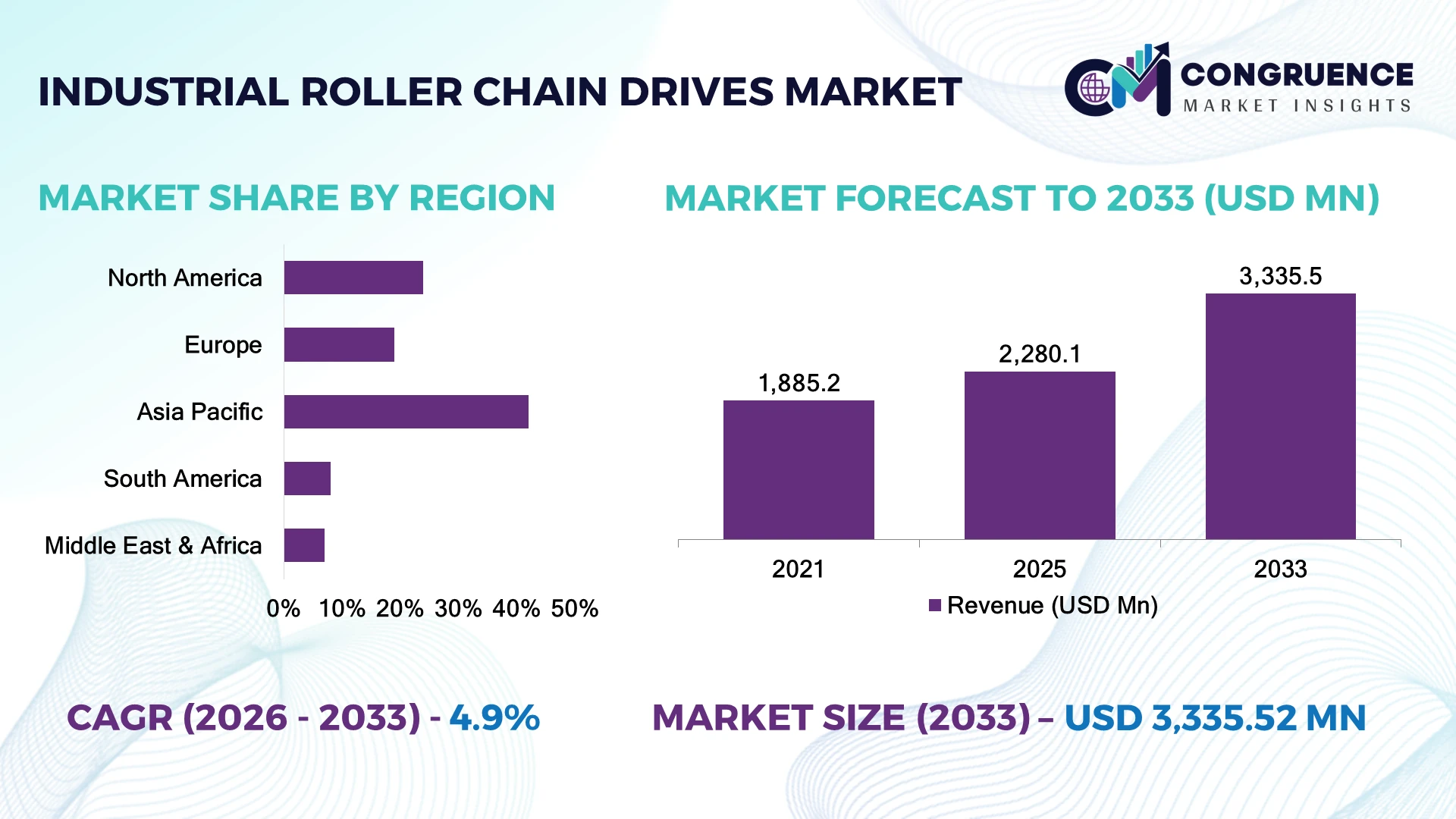
China dominates industrial roller chain drive consumption, supported by large-scale manufacturing, logistics, agricultural machinery, and factory automation, while the U.S. remains a major high-value market with strong adoption across material handling and OEM equipment. APAC represented about 44% of market activity, while China is advancing smart-factory deployment above 70% in targeted applications by 2030. The Ukraine war and resulting supply-chain restructuring are accelerating localized sourcing and multi-site production strategies.
Strategically, manufacturers that combine localized capacity, precision engineering, and low-maintenance technologies are positioned to capture the strongest industrial replacement and automation opportunities.
Market Size & Growth: Market value reaches USD 2,280.1 Million in 2025 and USD 3,335.5 Million by 2033 at a 4.87% CAGR, supported by automated material handling and machinery modernization.
Top Growth Drivers: Automation contributes approximately 30%, manufacturing modernization 25%, and logistics expansion 20% to identified growth momentum.
Short-Term Forecast: By 2028, predictive maintenance and precision-chain adoption are positioned to reduce unplanned chain-related downtime by 10–15% in automated facilities.
Emerging Technologies: AI-enabled condition monitoring, automated lubrication, advanced steel alloys, precision manufacturing, and low-maintenance chain designs are reshaping high-load applications.
Regional Leaders: APAC leads with roughly 44% share, North America benefits from automated logistics adoption, while Europe advances low-maintenance and energy-efficient transmission technologies.
Consumer/End-User Trends: More than 60% of industrial buyers increasingly prioritize lifecycle reliability and maintenance reduction when specifying power-transmission components.
Pilot/Case Example: A high-temperature manufacturing conveyor deployment reduced chain maintenance time by nearly 75% after switching to an application-specific chain solution.
Competitive Landscape: The market remains moderately concentrated, with leading suppliers including Tsubakimoto Chain, Renold, SKF, Timken, and iwis collectively strengthening precision-chain and specialized transmission portfolios.
Regulatory & ESG Impact: Low-lubrication and lubricant-free chains can reduce maintenance-related material consumption and contamination exposure by approximately 20% in suitable applications.
Investment & Funding: Renold increased capital investment to £16.4 million in FY2025, supporting automation, manufacturing efficiency, capacity expansion, and supply-chain resilience.
Innovation & Future Outlook: Next-generation chains are shifting toward sensor-enabled monitoring, advanced coatings, recyclable materials, digital configuration, and localized manufacturing to strengthen total-cost performance.
Industrial roller chain drives are gaining traction across food processing, automated warehousing, automotive manufacturing, agriculture, and heavy machinery, where precision transmission and reduced maintenance directly affect throughput. Advanced low-lubrication products can extend operating intervals substantially, while supply-chain restructuring following geopolitical disruption is pushing manufacturers toward regional production and diversified sourcing. This transition creates a stronger strategic case for engineered, application-specific chain systems.
Industrial roller chain drives are becoming strategically important because they sit directly within the machinery infrastructure that determines uptime, throughput, and maintenance economics. Manufacturers are moving beyond basic chain replacement toward engineered systems that combine precision components, specialized materials, automated lubrication, and condition monitoring. This shift is particularly important as factories increase conveyor speeds and automation density.
Technology differentiation is measurable. Premium roller-chain designs can achieve substantially longer wear intervals than lower-specification alternatives, while optimized lubrication has demonstrated energy reductions of up to 26% in drive-chain applications. Japan emphasizes precision manufacturing and efficiency standards, whereas China combines larger manufacturing scale with faster smart-factory deployment. The resulting competitive divide increasingly depends on lifecycle performance rather than initial component price.
Over the next 2–3 years, industrial buyers are expected to increase adoption of low-maintenance and digitally monitored chains, particularly in automated warehouses, food processing, automotive plants, and logistics facilities. Companies are responding through localized manufacturing, regional distribution centers, acquisitions, and automation investments. The strongest strategic position will belong to suppliers that combine reliable engineering with faster delivery, application customization, and measurable maintenance savings.
Factory automation and high-speed material handling are strengthening demand for precision roller chains capable of continuous operation under variable loads. Automated warehousing and manufacturing applications can represent more than 60% of targeted high-throughput deployments, while optimized lubrication has demonstrated energy reductions of up to 26% in suitable drive-chain systems. The expansion of smart factories in China is accelerating demand for reliable mechanical transmission alongside digital controls. Geopolitical disruption and rising logistics costs are also encouraging manufacturers to automate repetitive material movement. Suppliers are responding through precision manufacturing, automated assembly, low-maintenance chain development, and regional capacity expansion. The strategic advantage is shifting toward chains engineered around complete operating cycles rather than components selected solely on purchase price.
Steel, specialty coatings, energy, and transportation costs remain significant constraints because roller chains require tightly controlled metallurgy and dimensional precision. Material and input-cost volatility can raise manufacturing expenses by 5–10% during periods of supply disruption, while imported components expose buyers to longer lead times and currency movements. European manufacturers have faced additional pressure from elevated energy costs and geopolitical uncertainty linked to the Ukraine war. China-based supply concentration also creates exposure to trade restrictions and tariff changes. Companies are mitigating these pressures through dual sourcing, regional inventories, long-term procurement contracts, and localized component production. The key operational issue is maintaining consistent chain quality while reducing dependence on a single low-cost manufacturing corridor.
Low-maintenance and lubricant-free chains create a high-value opportunity in food processing, packaging, textiles, automotive assembly, and clean manufacturing. Premium chain designs have demonstrated wear-life improvements of several multiples over lower-grade alternatives, while lubricant-free configurations eliminate recurring manual lubrication requirements. Adoption of automated lubrication and digital chain-condition monitoring is positioned to exceed 20% in advanced industrial applications as manufacturers prioritize predictive maintenance. India offers an especially attractive expansion pathway as automotive, logistics, food processing, and agricultural machinery investments increase. Manufacturers are positioning through R&D partnerships, regional distribution centers, application-specific engineering, and digital configuration tools. The non-obvious opportunity lies in selling maintenance reduction as a measurable productivity service rather than treating the chain as a commodity replacement component.
The increasing automation of production systems raises the consequences of chain misalignment, incorrect lubrication, vibration, and inconsistent installation. In high-speed conveyor environments, even small alignment deviations can accelerate wear and interrupt synchronized production, while maintenance teams increasingly face skilled-labor shortages. Advanced chains can deliver substantially longer operating life, but performance depends on correct sprocket geometry, lubrication, tensioning, and installation practices. Digital monitoring also introduces integration requirements across sensors, control systems, and maintenance platforms. Companies must therefore invest in technician training, standardized installation procedures, condition-monitoring infrastructure, and application engineering. The strategic challenge is no longer simply producing durable chains; it is ensuring consistent performance across increasingly automated, interconnected production environments.
Smart Condition Monitoring: Industrial buyers are integrating sensors, IIoT platforms, and predictive maintenance into chain-driven equipment. Around 46% of manufacturers report active smart-manufacturing initiatives, while 29% use AI or machine learning at facility or network level. Suppliers are responding with sensor-ready chain systems and digital maintenance tools that improve uptime and reduce unnecessary replacement.
Self-Lubricating Chain Adoption: Self-lubricating chain variants are gaining traction in food processing, packaging, and continuous-conveyor environments. In 2025, these products represented about 22% of new chain-drive production, while reported maintenance intervals improved approximately 11%. Companies are expanding coated, corrosion-resistant, and lubricant-free portfolios as labor shortages and stricter hygiene requirements increase pressure to simplify maintenance workflows.
Heavy-Duty Configuration Shift: Multi-strand chains are gaining preference in mining, heavy processing, and high-load machinery, where demand is shifting toward higher torque capacity and longer service intervals. Multi-strand configurations capture approximately 54.8% of mining and heavy-processing applications, compared with 45.2% for single-strand configurations. Manufacturers are increasing investment in high-strength materials and engineered chain assemblies.
Regional Supply Restructuring: Supply-chain disruption and geopolitical uncertainty are encouraging manufacturers to localize inventories and diversify component sourcing. China produced more than 3.5 million chain-drive units in 2025, representing over 40% of global volume, while U.S. logistics operators installed approximately 0.9 million new units during 2023–2024. Suppliers are expanding regional warehouses and dual-sourcing networks to shorten lead times and protect industrial customers.
Single-Strand Roller Chain remains the leading type, accounting for approximately 46.7% of the market in 2025. Its dominance comes from lower acquisition cost, compact installation, straightforward maintenance, and compatibility with moderate-load machinery. Single-strand chains are widely deployed in manufacturing equipment, conveyors, packaging systems, and general industrial machinery. Multi-Strand Roller Chain follows with strong demand from high-load equipment, while Double-Pitch Roller Chain supports extended-pitch conveying applications. Other specialized configurations retain niche importance where equipment geometry or operating conditions require customized designs.
Multi-Strand Roller Chain is the faster-growing type as mining, heavy processing, and high-load material-handling systems increase load requirements. Multi-strand configurations account for approximately 54.8% of mining and heavy-processing applications, compared with 45.2% for single-strand designs. The cost premium of multi-strand configurations can reach 35%–40%, but longer service intervals improve lifecycle economics. Manufacturers are therefore expanding high-strength product lines while maintaining high-volume single-strand production.
Power Transmission Application represents the leading application, accounting for approximately 65% of demand. Its concentration reflects widespread use across industrial machinery, automotive equipment, agricultural systems, and heavy-duty mechanical drives. Roller chains provide positive mechanical transmission without belt slippage, making them suitable for variable-load and continuous-duty environments. Conveyor Application represents the second major segment and is becoming increasingly important as automated warehouses, packaging facilities, and material-handling operations expand.
Conveyor Application is the faster-growing segment, expanding at approximately 4.6%, compared with around 3.6% for power transmission applications. Automated conveying is increasing demand for precision chains, low-maintenance configurations, corrosion-resistant materials, and double-pitch designs. Companies are adapting through conveyor-specific engineering, automation partnerships, and expanded aftermarket services. The strategic implication is that suppliers with integrated conveyor expertise can secure specification-driven demand rather than competing only on replacement price.
Manufacturing End-Use remains the dominant end-user segment, representing approximately 42% of market demand. High equipment density across assembly lines, machine tools, packaging systems, automated conveyors, and production machinery creates continuous OEM and replacement requirements. Automotive manufacturing and general industrial production remain particularly important buyers. Agriculture retains a mature installed base, while Construction & Mining applications favor high-load and wear-resistant chain configurations for demanding operating conditions.
Construction & Mining End-Use is emerging as the fastest-growing demand group, with mining-related applications recording growth of approximately 6.5% as heavy-duty conveyor and material-handling systems are modernized. Food & Beverage End-Use is also shifting toward corrosion-resistant and low-lubrication chains, while Automotive End-Use increasingly emphasizes precision and uptime. Companies are responding with customized assemblies, application engineering, distributor partnerships, and localized inventories. The competitive focus is shifting toward lifecycle reliability and maintenance reduction.
Asia-Pacific accounted for the largest market share at 42.0% in 2025 however, Middle East & Africa is expected to register the fastest growth, expanding at a CAGR of 5.60% between 2026 and 2033.
North America accounted for approximately 24% of the global market in 2025, supported by advanced manufacturing, automotive production, logistics, food processing, and material-handling infrastructure. The United States represents the largest demand center, with automated warehouses and production facilities increasingly replacing conventional mechanical systems with monitored, high-efficiency equipment. More than 40% of manufacturers prioritize factory automation hardware, strengthening demand for precision roller chains and engineered drive assemblies. Canada contributes through mining, agriculture, and food-processing applications, while U.S. manufacturers increasingly favor domestic and nearshore sourcing to reduce lead-time exposure. Suppliers are expanding distributor networks, aftermarket services, and application-specific chain portfolios to capture recurring replacement demand.
United States Market Outlook: The United States remains the region’s strategic production and consumption hub, supported by large automotive, logistics, aerospace, packaging, and industrial machinery bases. More than 80% of major supply-chain organizations are prioritizing automation and robotics investment, increasing demand for dependable mechanical transmission systems. Domestic manufacturers are also emphasizing predictive maintenance and localized component availability to protect production continuity.
Europe represented approximately 19% of global demand in 2025, supported by Germany, Italy, France, and the United Kingdom. Industrial modernization, stringent equipment-performance requirements, and sustainability-focused manufacturing are increasing demand for corrosion-resistant, low-maintenance, and precision-engineered roller chains. Germany remains a major machinery and automotive manufacturing center, while Italy maintains strong demand from packaging, food-processing, and industrial equipment producers. Around 48% of European manufacturing companies are upgrading toward corrosion-resistant chain materials in demanding applications. Manufacturers are responding with advanced coatings, improved metallurgy, longer-life components, and automated lubrication solutions. The market is increasingly shaped by lifecycle economics rather than initial purchase cost.
Germany Market Outlook: Germany remains Europe's most strategically significant market because of its concentration of automotive plants, machinery manufacturers, robotics integrators, and automated production facilities. More than 20,000 industrial machinery companies operate across the country, creating a broad installed base for roller chain drives. Industry 4.0 investment is also increasing demand for precision components compatible with predictive maintenance and digitally monitored production systems.
Asia-Pacific dominated the market with approximately 42% share in 2025 and more than 60% of global roller-chain production capacity concentrated across major manufacturing economies. China leads regional demand through automotive, electronics, machinery, textile, packaging, and heavy-equipment production, while India is strengthening demand through automotive, infrastructure, agriculture, and logistics expansion. Japan and South Korea maintain strong positions in precision machinery and robotics. Approximately 46% of regional applications are concentrated in manufacturing, while automated chain-system adoption is approaching one-third of industrial plants. Suppliers are expanding local production, distribution networks, and application engineering capabilities to support shorter lead times and growing OEM demand.
China Market Outlook: China is the region’s largest individual market, accounting for approximately 57.7% of Asia-Pacific demand. Its extensive machinery, automotive, electronics, textile, and logistics manufacturing base creates sustained requirements for standard and engineered roller chains. Factory automation and domestic equipment production are strengthening local procurement, while manufacturers are increasingly investing in high-strength materials, automated production lines, and localized component ecosystems.
South America accounted for approximately 8% of global demand in 2025, with Brazil representing the principal market because of its large agricultural machinery, mining, food-processing, and industrial manufacturing base. Agricultural processing and mining equipment generate sustained requirements for high-load and corrosion-resistant chain systems, while logistics modernization is supporting conveyor applications. Brazil's agricultural machinery ecosystem increasingly favors durable components capable of operating under high dust, humidity, and load conditions. Around 35% of regional industrial demand is linked to agriculture, mining, and resource-processing applications. Companies are strengthening distributor partnerships, regional inventories, and application-specific engineering to address long-distance logistics and uneven maintenance infrastructure.
Brazil Market Outlook: Brazil provides the strongest commercial opportunity in South America because of its scale in agriculture, mining, food processing, and industrial machinery. The country is one of the world's largest agricultural producers, creating extensive demand for chain-driven harvesting, conveying, processing, and material-handling equipment. Suppliers are emphasizing corrosion resistance, high-load configurations, and locally available replacement components to reduce equipment downtime.
Middle East & Africa represented approximately 7% of global demand in 2025, with infrastructure development, mining, food processing, logistics, and industrial diversification supporting equipment deployment. Gulf economies are investing heavily in manufacturing, warehousing, ports, and processing infrastructure, while African mining operations require high-load chain systems for conveyors and material movement. Industrial diversification programs are reducing dependence on traditional resource sectors and increasing demand for machinery components. Mining and infrastructure applications account for a significant portion of regional heavy-duty chain requirements, with project-based procurement often exceeding conventional replacement cycles. Suppliers are responding through regional warehouses, distributor partnerships, technical support, and customized heavy-duty assemblies.
Saudi Arabia Market Outlook: Saudi Arabia represents the region's strongest investment-led opportunity, supported by industrial diversification, logistics infrastructure, mining development, and manufacturing expansion. Large-scale industrial and infrastructure programs are increasing demand for conveyors, material-handling equipment, and automated machinery. Suppliers are establishing stronger local distribution and service capabilities to meet project procurement requirements and shorten replacement lead times.
The market is led by Tsubakimoto Chain, Renold, iwis, Timken, and SKF, competing with regional manufacturers on price, availability, and customization. The top five players hold an estimated 42% combined share. Premium suppliers compete through advanced metallurgy and lifecycle performance, while regional producers emphasize 10–15% lower pricing and faster delivery. Tsubaki and Renold are expanding manufacturing footprints and acquisitions, while iwis emphasizes precision engineering and digital chain solutions. The competitive shift is toward supply-chain localization, specialized chains, and application-specific engineering rather than commodity pricing alone. Entry barriers remain high because precision manufacturing, heat treatment, metallurgical control, certification, and established distributor networks require substantial investment. Buyers increasingly evaluate total lifecycle cost, where premium chains offering longer wear life can offset 15–25% higher acquisition costs. Winning requires reliable global supply, measurable durability, rapid customization, and strong aftermarket service. The strongest competitors will combine manufacturing scale with specialized engineering and localized fulfillment.
Tsubakimoto Chain Co.
Renold plc
iwis SE & Co. KG
The Timken Company
SKF
Regal Rexnord Corporation
Donghua Chain Group
HKK Chain Corporation
KANA Chain
Diamond Chain Company
PEER Chain
U.S. Tsubaki Power Transmission, LLC
Advanced roller-chain technology is shifting toward high-strength metallurgy, precision heat treatment, specialized coatings, and digitally monitored chain systems. Modern chains with optimized pin-bush geometry and improved surface treatment can deliver up to 2x longer wear life than conventional designs in demanding applications. Approximately 30% of advanced industrial installations increasingly incorporate maintenance-monitoring or condition-based service practices.
Smart chain monitoring is emerging through sensors, vibration detection, lubrication monitoring, and connected maintenance platforms. These systems can reduce unnecessary inspection activity by 10–15% and improve maintenance scheduling by identifying wear before functional failure. Automated lubrication systems are also gaining adoption in continuous-duty conveyors, packaging machinery, and automated material-handling equipment, where manual servicing creates labor and downtime pressure.
From 2026 to 2028, digitally integrated chains, low-maintenance coatings, advanced stainless-steel configurations, and application-specific engineered assemblies will gain competitive importance. Tsubaki benefits from precision-chain innovation, while iwis gains from integrated monitoring and engineering capabilities. Regional manufacturers retain an advantage in price-sensitive standard chains. The technology shift therefore favors suppliers capable of combining mechanical reliability with digital diagnostics, lifecycle optimization, and faster customization. Companies investing now can differentiate through measurable uptime, reduced maintenance, and application-specific performance rather than competing primarily on acquisition price.
September 2024 Tsubakimoto Chain introduced the Epsilon Chain Stainless Steel Series, featuring a 1.905 mm pitch, roughly half the pitch of its previous smallest chain. The launch enables power transmission in extremely confined spaces and expands applications involving compact machinery and wet environments. Source: tsubakimoto.com
December 2024 Tsubakimoto Chain agreed to acquire Germany-based EUROCATENA GmbH, establishing a European industrial-steel-chain manufacturing base. The transaction strengthens localized production and faster delivery of large conveyor chains, reducing reliance on exports from Japan for customized European applications. Source: tsubakimoto.com
June 2025 Renold acquired Ognibene in Italy for €10 million, expanding transmission-chain access across Southern Europe. The transaction adds manufacturing and distribution capabilities while creating purchasing, production, and supply-chain synergies within Renold’s existing industrial-chain network. Source: renold.com
April 2026 iwis announced targeted investment in its Munich production site, adding modern assembly machines, automated processes, and engineering capabilities. The facility produces more than 30 million individual components daily, strengthening precision, repeatability, customization, and European supply resilience. Source: iwis.com
The report covers the Industrial Roller Chain Drives Market across major types, applications, and end-user groups, including single-strand, multi-strand, double-pitch, and specialized chain configurations. Application coverage includes power transmission and conveyor systems, while end-user analysis encompasses manufacturing, automotive, agriculture, construction, mining, food and beverage, and other industrial environments. The assessment spans North America, Europe, Asia-Pacific, South America, and Middle East & Africa.
The report evaluates approximately 42% of market demand concentrated in Asia-Pacific, with particular emphasis on China, Japan, India, and South Korea. Technology coverage includes advanced metallurgy, corrosion-resistant coatings, low-maintenance designs, automated lubrication, condition monitoring, and precision manufacturing. Competitive analysis covers major global and regional suppliers, supporting investment planning, localization decisions, expansion strategies, supplier selection, product positioning, and competitive benchmarking from 2026 through 2033.
| Report Attribute / Metric | Details |
|---|---|
| Market Revenue (2025) | USD 2,280.1 Million |
| Market Revenue (2033) | USD 3,335.5 Million |
| CAGR (2026–2033) | 4.87% |
| Base Year | 2025 |
| Forecast Period | 2026–2033 |
| Historic Period | 2021–2025 |
| Segments Covered |
By Type
By Application
By End-User
|
| Key Deliverables | Revenue Forecast; Market Trends; Growth Drivers & Restraints; Technology Insights; Segmentation Analysis; Regional Insights; Competitive Landscape; Regulatory & ESG Overview; Recent Developments |
| Regions Covered | North America; Europe; Asia-Pacific; South America; Middle East & Africa |
| Companies Profiled | Tsubakimoto Chain Co.; Renold plc; iwis SE & Co. KG; The Timken Company; SKF; Regal Rexnord Corporation; Donghua Chain Group; HKK Chain Corporation; KANA Chain; Diamond Chain Company; PEER Chain; U.S. Tsubaki Power Transmission, LLC |
| Customization & Pricing | Available on Request (10% Customization Free) |




