
Reports
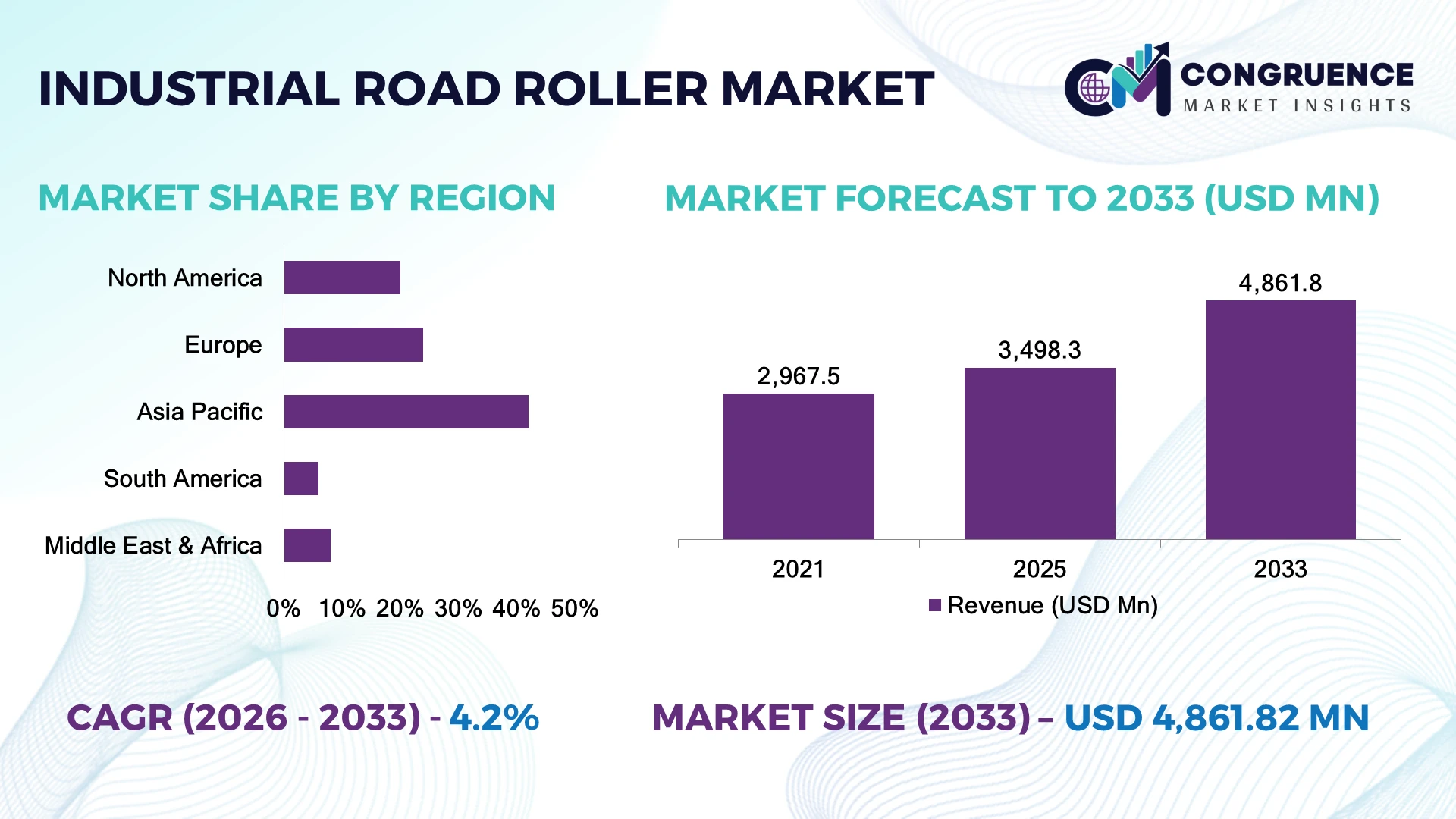
The Global Industrial Road Roller Market was valued at USD 3,498.3 Million in 2025 and is anticipated to reach a value of USD 4,861.8 Million by 2033 expanding at a CAGR of 4.2% between 2026 and 2033. Growth is driven by highway construction, pavement rehabilitation, airport runway upgrades, and contractors’ need for precise soil and asphalt compaction with fewer corrective passes.
China maintains a strong position in road-construction machinery manufacturing, while India is strengthening equipment demand through highway expansion and localized production. India's National Highway network reached 146,560 km by the end of 2025, approximately 61% larger than in 2014. Its road-building programme creates demand for soil compactors, tandem rollers, and pneumatic-tyred models, while North American buyers place greater emphasis on fleet productivity, emissions compliance, and equipment lifecycle costs. SANY India's 2025 launch of an 11.2-tonne soil compactor with optional real-time compaction measurement illustrates the growing relevance of precision controls. Manufacturers should prioritize localized production, service coverage, and compaction technology matched to project conditions.
Suppliers that combine reliable machine availability, measurable compaction performance, and strong after-sales support can compete more effectively as contractors balance project deadlines with operating costs.
Market Size & Growth: The market is valued at USD 3,498.3 million in 2025 and is projected to reach USD 4,861.8 million by 2033, supported by highway construction and pavement rehabilitation.
Top Growth Drivers: Highway development, resurfacing requirements, and productivity-focused compaction technologies drive demand; project pipelines and fleet replacement cycles determine local purchasing intensity.
Short-Term Forecast: By 2028, contractors targeting 3–5% lower fuel consumption per compacted area can evaluate optimized engine modes, reduced idle time, and better pass planning; results require site-level measurement.
Emerging Technologies: Compaction meters, telematics, machine guidance, and digital jobsite records improve process visibility and help crews identify under-compacted or overworked sections.
Regional Leaders: Asia-Pacific benefits from highway construction and manufacturing scale; North America emphasizes fleet utilization and emissions compliance; Europe prioritizes machine efficiency, operator safety, and emissions performance.
End-User Trends: Road contractors and infrastructure agencies increasingly evaluate rollers through uptime, service access, fuel use, and compaction consistency rather than purchase price alone.
Operational Example: SANY India's 2025 SSR110C-10 PRO soil compactor has an operating weight of 11,200 kg, a 132 HP engine, and an optional compaction meter for real-time soil-density feedback.
Competitive Landscape: BOMAG, Caterpillar, Hamm, Dynapac, and SANY compete through machine performance, product range, service networks, and application-specific compaction features; verified global market shares are not consistently disclosed.
Regulatory & ESG Impact: U.S. Tier 4 standards and other non-road engine requirements raise the importance of emissions-control systems, fuel compatibility, and maintenance discipline.
Investment & Expansion: SANY India's Pune facility has annual production capacity exceeding 14,000 units across its broader equipment operations, reflecting the importance of localized manufacturing and regional supply networks.
Innovation & Future Outlook: Competitive differentiation is shifting toward compaction data, connected fleet monitoring, operator ergonomics, and service responsiveness alongside engine power and drum design.
Industrial road rollers remain essential to highway construction, industrial yards, airport pavements, and maintenance programmes where compaction quality affects pavement durability and rework costs. Machine-level measurement, telematics, and improved vibration control are helping contractors manage compaction more consistently. India's continued expansion of national highways and China's large construction-equipment manufacturing base reinforce the importance of regional production and service capacity. The next strategic discussion focuses on how contractors and equipment manufacturers translate these operational requirements into investment priorities.
Industrial road rollers are becoming strategically important because compaction quality influences pavement life, construction schedules, material performance, and the cost of corrective work. Contractors operating under fixed-price infrastructure contracts need equipment that delivers repeatable density without unnecessary passes or excessive fuel consumption. The market is therefore shifting from machine acquisition based primarily on operating weight and engine power toward a broader assessment of compaction precision, uptime, operator capability, and lifecycle cost.
Connected compaction systems strengthen this shift by providing real-time feedback on machine passes and soil-density indicators. Conventional visual inspection relies heavily on operator judgment, whereas measurement-assisted workflows provide more consistent evidence for quality control. Savings depend on soil conditions, asphalt mix, operator training, and project specifications; manufacturers and contractors should validate any claimed efficiency improvement through controlled site trials. India’s highway expansion creates demand for robust, serviceable machines, while North American and European fleets place stronger emphasis on emissions compliance and fleet data.
Between 2026 and 2028, investment should focus on compaction measurement, telematics, maintenance diagnostics, and service coverage. A contractor completing a highway section can use machine data to identify missed coverage and reduce unnecessary passes, provided the system is calibrated and aligned with project quality requirements. Manufacturers are expanding localized production, dealer support, and operator-focused controls to improve customer retention. Competitive advantage will depend on combining verified compaction performance with low downtime, predictable maintenance, and dependable parts availability.
National highway construction, expressway development, and resurfacing programmes create sustained requirements for soil compactors, tandem rollers, and pneumatic-tyred rollers. India's National Highway network reached 146,560 km by the end of 2025, providing a measurable indication of the scale of infrastructure requiring construction and maintenance. Compaction equipment demand also follows the mix of earthworks, granular base preparation, and asphalt finishing across individual contracts. A 3–5% reduction in unnecessary roller passes is a practical site-level target where measurement-assisted compaction improves process control, not a guaranteed industry-wide result. Manufacturers are responding with application-specific drum configurations, optional compaction meters, and broader service networks. The strongest sales opportunity lies in matching machine configuration to contractor workloads rather than simply increasing fleet size.
Industrial road rollers require significant upfront investment, and their utilization depends on project schedules, seasonal weather, and contractor workload. When a machine operates below its planned annual hours, ownership costs are spread over fewer productive shifts, weakening the economics of replacement purchases. A 10–15% reduction in machine utilization can serve as a sensitivity scenario for evaluating rental-versus-purchase decisions, although actual impacts depend on financing, resale value, and service costs. Engine-emissions requirements also add equipment and maintenance complexity in regulated markets. Contractors are reducing exposure through rental fleets, used-equipment purchases, shared deployment across projects, and longer-term service agreements. Manufacturers need financing options and predictable maintenance costs to protect demand when project awards or public expenditure are delayed.
Compaction measurement and telematics offer opportunities to differentiate rollers beyond mechanical specifications. Real-time feedback can help operators identify missed coverage, manage pass counts, and document work completed across large sites. Contractors can test targets such as 3–5% lower fuel use per compacted area or fewer corrective passes, but must validate results against a comparable baseline. SANY India's SSR110C-10 PRO, launched in 2025, offers an optional compaction meter and standard telematics, demonstrating the integration of machine performance and connected monitoring in a production model. Suppliers can expand recurring service relationships through diagnostics, maintenance planning, and fleet reporting. The opportunity is strongest where project owners value documented quality and contractors manage multiple machines across dispersed worksites.
Connected rollers create operational value only when machine data is interpreted correctly and integrated into site quality procedures. Differences in sensor calibration, soil conditions, asphalt temperature, operator technique, and project specifications can limit comparability across jobs. Contractors should validate system readings against approved testing methods before using them as acceptance evidence. A 90–95% rate of complete machine-data capture can serve as an internal implementation target for connected fleets, but it is not a published industry adoption rate. Cybersecurity, inconsistent fleet software, and gaps in operator training also complicate deployment. Manufacturers need interoperable reporting, practical training, reliable sensors, and accessible technical support. Without these foundations, digital features risk becoming underused equipment options rather than measurable productivity tools.
Compaction Measurement Enters Standardized Workflows. Manufacturers are integrating optional compaction meters and real-time feedback to help operators monitor soil-density indicators and reduce unnecessary passes. SANY India's 11.2-tonne SSR110C-10 PRO, introduced in 2025, combines dual-frequency vibration with optional compaction measurement and standard telematics. Contractors are evaluating these features through density-test results, pass counts, and rework records. A 3–5% reduction in unnecessary passes is a trial target, not a universal performance result.
Telematics Extends Beyond Location Tracking. Fleet systems increasingly support equipment-status monitoring, service planning, and machine utilization analysis. These functions help fleet managers identify excessive idling, schedule maintenance, and compare deployment across projects. Contractors can set a 3–5% improvement target for productive operating time through better scheduling, but actual gains depend on fleet age, site conditions, and operator discipline. Manufacturers are strengthening dealer support and digital service capabilities to make data useful for daily decisions rather than treating connectivity as a standalone feature.
Localized Manufacturing Strengthens Supply Resilience. In January 2025, SANY India inaugurated an expanded Pune manufacturing facility with annual production capacity exceeding 14,000 units across its broader equipment operations. Local production can shorten supply chains and improve access to machine configurations and parts, although the capacity figure is not specific to road rollers. Manufacturers are combining regional production with dealer and service expansion to reduce customer downtime. A 5–10% reduction in parts-related waiting time is a potential operational target that requires company-level measurement.
Emissions Compliance Influences Fleet Decisions. Non-road diesel engine standards shape machine design, fuel-system requirements, and maintenance practices in regulated markets. Buyers increasingly assess emissions compliance alongside fuel consumption, service intervals, and equipment availability. Fuel-saving targets of 3–5% can be tested through idle-time management, suitable operating modes, and pass planning; results vary by duty cycle and material conditions. Manufacturers are investing in engine controls, operator displays, and maintenance support, while contractors must train operators to preserve both performance and emissions-system reliability.
Vibratory rollers are estimated to account for approximately 55% of industrial road roller demand by type, supported by their effectiveness in compacting granular subgrades, aggregate bases, and asphalt layers. Vibration improves particle rearrangement, helping contractors achieve required density with fewer passes under suitable operating conditions. Static rollers remain relevant for finishing and applications requiring controlled surface pressure, while pneumatic-tyred rollers provide kneading action and help improve uniformity in asphalt compaction. Tandem rollers are important for surface finishing, whereas single-drum rollers serve earthworks and base preparation. These shares are directional estimates because manufacturers do not consistently disclose global sales by roller configuration.
Intelligent vibratory rollers with compaction measurement are a potential high-growth category as contractors pursue documented quality and more consistent operating procedures. A 3–5% reduction in unnecessary passes is a practical trial target, not an established industry-wide result. Manufacturers are responding with optional compaction meters, telematics, and application-specific vibration settings. Static and conventional rollers remain attractive where acquisition cost and straightforward maintenance dominate purchasing decisions. Investment priorities should favor measurement-enabled equipment for large infrastructure projects while maintaining cost-effective, durable models for smaller contractors and maintenance fleets.
Road construction is estimated to represent approximately 62% of industrial road roller demand by application, reflecting the need to compact soil, granular bases, and asphalt across highways, urban roads, and access corridors. Road maintenance and rehabilitation provide recurring demand as pavements require resurfacing, patching, and structural upgrades. Airport runways and industrial sites represent specialized applications where surface uniformity, load-bearing performance, and strict project specifications influence equipment selection. Highway projects typically require multiple roller configurations across successive construction stages, while maintenance contractors often favor versatile machines that can be redeployed across smaller jobs. These application shares are directional estimates rather than audited global sales data.
Road maintenance and rehabilitation are strategically important because existing infrastructure requires ongoing surface renewal even when new-project awards fluctuate. Contractors can test 3–5% reductions in fuel consumed per compacted area through improved pass planning, reduced idling, and better matching of roller settings to material conditions; actual results require site validation. Airport and industrial applications generally demand tighter documentation and specification compliance, creating opportunities for specialized equipment and service packages. Manufacturers are expanding compaction-monitoring options and maintenance support to improve fleet productivity. Commercial priorities should balance large highway contracts with recurring maintenance work that can stabilize equipment utilization between major projects.
Road construction contractors are estimated to account for approximately 50% of industrial road roller demand by end-user group, reflecting their direct responsibility for earthworks, pavement preparation, compaction quality, and delivery schedules. Government road agencies and public works departments influence procurement through infrastructure programmes, equipment specifications, and contractor requirements. Equipment rental companies serve smaller contractors and project operators that need machinery for limited periods without committing to full ownership costs. Industrial facility operators and airport contractors form specialized buyer groups with distinct requirements for surface performance, service availability, and operating documentation. These estimated shares are directional and depend on whether demand is measured by equipment purchases, fleet deployment, or rental utilization.
Rental companies are a potential faster-expanding buyer group where contractors seek to manage capital commitments and match equipment availability to project schedules. A 10–15% improvement in fleet utilization is a reasonable internal target for rental operators using better scheduling, maintenance planning, and cross-project redeployment, but it is not a verified industry average. Large contractors typically prioritize machine uptime, productivity, and lifecycle cost, while public agencies emphasize procurement compliance and performance specifications. Manufacturers are responding through dealer-supported rentals, financing arrangements, service contracts, and telematics-based maintenance. Future positioning will depend on supplying reliable machines with predictable running costs and support models suited to both high-utilization fleets and intermittent project demand.
Asia-Pacific accounted for the largest market share at 42% in 2025 moreover, Asia-Pacific is also expected to register the fastest growth, expanding at a CAGR of 5.1% between 2026 and 2033.

North America is estimated to account for approximately 20% of the global industrial road roller market in 2025. Demand is supported by highway rehabilitation, bridge-access improvements, urban road resurfacing, and construction activity around logistics and industrial facilities. The United States represents the region’s principal demand center, while Canada contributes through highway maintenance, resource-sector access roads, and transportation infrastructure upgrades. Contractors increasingly evaluate equipment through lifecycle cost, operator comfort, fuel efficiency, uptime, and availability of dealer support. Telematics and compaction-monitoring systems can help fleet managers improve maintenance planning and document jobsite performance. However, high equipment acquisition costs and sensitivity to public-sector project schedules influence purchasing decisions. Manufacturers and distributors can strengthen competitiveness through financing, rental availability, parts support, and machines configured for both large infrastructure contracts and smaller maintenance projects.
United States Market Outlook: The United States benefits from a large highway network, established heavy-equipment distribution channels, and sustained investment in the maintenance of aging transport infrastructure. Federal and state-funded projects create demand for rollers across asphalt resurfacing, road reconstruction, and bridge-access works. Contractors increasingly prioritize equipment reliability and measurable productivity as project schedules and labor availability remain important operating considerations. Manufacturers with strong dealer coverage, rapid parts delivery, and telematics-enabled maintenance capabilities are well positioned to serve national contractors and regional paving businesses. Equipment replacement demand also creates opportunities for more fuel-efficient and technologically advanced models.
Europe is estimated to represent approximately 24% of the industrial road roller market in 2025. Demand is influenced by motorway maintenance, urban road renewal, bridge rehabilitation, and construction requirements associated with established transport networks. Germany, France, the United Kingdom, and Italy are important national markets, with purchasing decisions shaped by contractor productivity, machine durability, emissions requirements, and service coverage. European buyers also show interest in compaction measurement, lower-emission powertrains, and equipment that supports consistent paving quality. Germany announced a planned €166 billion in transport investment for the 2025–2029 legislative period, including substantial allocations for railways and federal roads. This creates a significant infrastructure-renewal backdrop, although the allocation is not exclusively for road construction or compaction machinery.
Germany Market Outlook: Germany combines a substantial motorway and federal-road network with established construction-equipment engineering, manufacturing, and service capabilities. Road maintenance and rehabilitation create demand for tandem rollers, vibratory rollers, and specialized compaction equipment. The country’s planned transport investment program includes €51.9 billion for roads over 2025–2029, supporting a pipeline of maintenance, modernization, and selected expansion projects. Contractors are likely to assess machines based on fuel consumption, operating precision, maintenance intervals, and compliance with applicable environmental requirements. Suppliers that combine dependable equipment with digital monitoring and strong aftermarket support can address both large contractors and regional road-building companies.
Asia-Pacific is estimated to account for approximately 42% of global industrial road roller demand in 2025, making it the largest regional market. China and India are major demand centers, supported by highway construction, urban road development, industrial corridors, and ongoing rehabilitation of existing networks. China also benefits from a large domestic construction-machinery manufacturing base, creating opportunities for both domestic suppliers and export-oriented producers. India’s demand is supported by national highway development, rural connectivity, and expanding urban infrastructure. Regional buyers span large infrastructure contractors, government-linked project operators, and equipment rental businesses. Competition remains price-sensitive, particularly in conventional roller categories, while telematics, compaction monitoring, fuel efficiency, and machine uptime provide differentiation opportunities for manufacturers targeting larger contractors.
China Market Outlook: China benefits from extensive road infrastructure, established construction-equipment manufacturing capabilities, and a broad supplier ecosystem supporting domestic sales and international exports. The country recorded approximately 8,699 km of newly constructed or rebuilt highways in 2025, illustrating continued infrastructure activity. Domestic manufacturers can compete through production scale, model variety, pricing, and distribution reach, while advanced suppliers have opportunities in automated compaction monitoring and fleet-management systems. Demand conditions vary by province and project type, making dealer coverage and alignment with public infrastructure spending important to equipment sales. Export competitiveness further supports China’s strategic position in the global road roller supply chain.
South America is estimated to represent approximately 6% of the industrial road roller market in 2025. Brazil is the principal demand center, supported by highway concessions, road rehabilitation, agricultural logistics, and infrastructure connecting production areas with ports. Argentina, Chile, Colombia, and Peru provide additional demand through road maintenance, mining access routes, and selected public works. Brazil’s highway-concession model creates opportunities for contractors undertaking construction, resurfacing, and long-term maintenance. However, financing constraints, currency fluctuations, uneven public investment, and high import costs can delay equipment purchases in smaller markets. Suppliers can improve market access through local dealers, financing support, rental partnerships, and durable machines suited to demanding operating conditions. Aftermarket service availability remains important for contractors operating far from major urban centers.
Brazil Market Outlook: Brazil offers the region’s broadest opportunity through its extensive road network, agricultural freight requirements, and highway concession pipeline. The federal government presented a pipeline of 36 highway concession projects representing approximately US$68.6 billion in potential investment over four years in 2025. Although these investments are planned across infrastructure projects rather than dedicated road roller purchases, they indicate a potential source of demand for earthworks, pavement construction, and maintenance equipment. Contractors require machines that can withstand intensive operation while maintaining reasonable fuel and service costs. Suppliers with local technical support, parts availability, and financing options are better positioned to serve concessionaires and regional construction firms.
The Middle East & Africa region is estimated to account for approximately 8% of the industrial road roller market in 2025. Demand is concentrated in Gulf infrastructure programs, urban road expansion, logistics corridors, and selected African transport and mining projects. Saudi Arabia and the United Arab Emirates are important markets for large-scale infrastructure deployment, while South Africa and other African economies contribute through road rehabilitation, freight corridors, and industrial access routes. High temperatures, dust exposure, remote job sites, and demanding duty cycles influence equipment specifications and maintenance requirements. Project concentration and dependence on public budgets can create uneven purchasing cycles. Manufacturers can strengthen their position through heat-tolerant equipment configurations, reliable service networks, local distributor partnerships, and flexible fleet procurement options.
Saudi Arabia Market Outlook: Saudi Arabia benefits from large-scale urban development, logistics infrastructure, and road-network modernization under its national development agenda. Riyadh’s Main and Ring Road Axes Development Program covers more than 500 km of road-network development and improvement, creating potential requirements for earthworks, base compaction, and asphalt finishing equipment. Contractors working on these projects need dependable rollers, accessible replacement parts, and service support capable of operating across demanding environmental conditions. Suppliers offering fleet monitoring, operator-focused controls, and maintenance agreements can differentiate themselves from price-led competitors. The scale and phasing of major projects also favor distributors able to manage equipment availability and support requirements across multiple construction packages.
The market pits global OEMs Caterpillar and Volvo Construction Equipment against compaction specialists BOMAG, Dynapac, and Wirtgen Group, while XCMG, SANY, and LiuGong compete on price, scale, and emerging-market distribution. The top five players are estimated to hold 45–55% of global sales, a directional estimate because audited shares are not consistently disclosed. Premium suppliers differentiate through compaction control, telematics, operator ergonomics, dealer coverage, and lifecycle support; cost-focused manufacturers use localized production, simpler configurations, and shorter delivery cycles. Digital monitoring can target 1–3% fewer unnecessary passes, while fleet scheduling can target 2–4% higher utilization, depending on site conditions. OEMs launch locally built models, expand parts networks, and integrate machine data with paving workflows. Competition is shifting from drum performance toward verified compaction quality and ownership cost. Service investment and contractor qualification remain barriers. Winners combine dependable machines, measurable productivity, responsive support, and competitive ownership economics across mature and emerging infrastructure markets.
Conventional vibratory and static rollers remain workhorses, but intelligent compaction shifts buying criteria toward verified pavement and soil outcomes. Accelerometers, GNSS, pass mapping, and temperature monitoring provide coverage data and help limit under-compaction or repeated passes. Adoption remains selective, led by large contractors and highway projects; reliable global penetration data are unavailable. On suitable jobs, pass planning can target 1–3% fewer unnecessary passes, reducing fuel use and machine hours.
Digital grade-control platforms increasingly connect compaction with paving workflows. Compared with manual observation and paper records, integrated systems can target 1–2% better operational productivity, depending on crew capability and calibration. Telematics supports preventive maintenance, remote diagnostics, fuel monitoring, and utilization analysis. These capabilities favor OEMs and dealers with software support and interoperable systems, while contractors gain traceability and more disciplined fleet scheduling.
Battery-electric rollers remain emerging options for urban and emission-sensitive worksites. Adoption depends on purchase price, charging access, runtime, and duty cycle. They eliminate tailpipe emissions at point of use, but a universal cost advantage is unproven. During 2026–2028, expect selective deployments, richer digital packages, and stronger competition around data integration. Contractors should pilot technologies against measured fuel, rework, uptime, and maintenance before scaling purchases before wider fleet-wide deployment begins.
The Industrial Road Roller Market Report evaluates demand across vibratory, static, pneumatic-tyred, tandem, and single-drum equipment, with coverage of road construction, maintenance, airport and industrial-site applications. End-user analysis distinguishes contractors, government agencies, rental fleets, and industrial infrastructure operators. It assesses the competitive positions of global OEMs and regional manufacturers, including product breadth, manufacturing localization, service networks, and technology differentiation.
Regional chapters examine North America, Europe, Asia-Pacific, South America, and the Middle East & Africa, with country-level outlooks for leading markets. Technology coverage includes intelligent compaction, telematics, grade-control integration, low-emission powertrains, and emerging electric rollers. The report supports investment planning, market-entry prioritization, distributor selection, product positioning, and competitor benchmarking by connecting deployment patterns with procurement needs and infrastructure activity. Forward-looking analysis identifies where service coverage, digital capability, localized production, or cost-efficient models may influence decisions through 2033.
| Report Attribute/Metric | Report Details |
|---|---|
|
Market Revenue in 2025 |
USD 3,498.3 Million |
|
Market Revenue in 2033 |
USD 4,861.8 Million |
|
CAGR (2026 - 2033) |
4.2% |
|
Base Year |
2025 |
|
Forecast Period |
2026 - 2033 |
|
Historic Period |
2021 - 2025 |
|
Segments Covered |
By Type
By Application
By End-User
|
|
Key Report Deliverable |
Revenue Forecast, Growth Trends, Market Dynamics, Segmental Overview, Regional and Country-wise Analysis, Competition Landscape |
|
Region Covered |
North America, Europe, Asia-Pacific, South America, Middle East, Africa |
|
Key Players Analyzed |
Caterpillar Inc., Volvo Construction Equipment, BOMAG GmbH, Dynapac, Wirtgen Group, Sakai Heavy Industries, Ltd., Ammann Group, JCB, XCMG, LiuGong Machinery, SANY Group, Shantui Construction Machinery, CASE Construction Equipment, John Deere |
|
Customization & Pricing |
Available on Request (10% Customization is Free) |




