
Reports
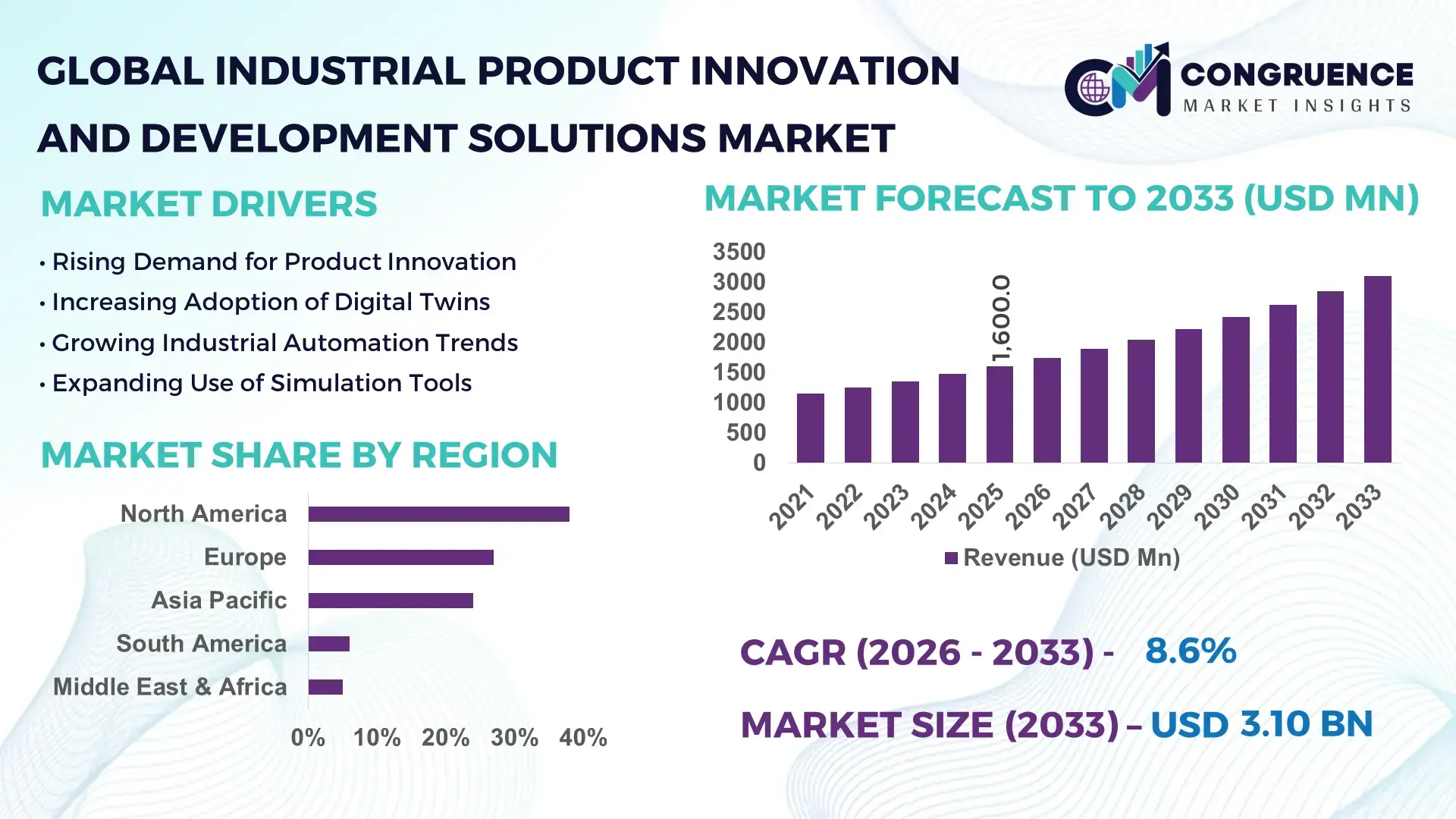
The Global Industrial Product Innovation and Development Solutions Market was valued at USD 1,600.0 Million in 2025 and is anticipated to reach a value of USD 3,095.7 Million by 2033 expanding at a CAGR of 8.6% between 2026 and 2033, according to an analysis by Congruence Market Insights. This growth is primarily driven by the increasing adoption of digital engineering, automation, and AI-driven product lifecycle management solutions across industrial sectors.
The United States dominates the Industrial Product Innovation and Development Solutions Market, supported by advanced manufacturing capabilities and strong R&D investments exceeding USD 700 billion annually across industries. Over 62% of industrial enterprises in the country have integrated digital product development platforms, particularly in aerospace, automotive, and heavy machinery sectors. The U.S. accounts for nearly 35% of global industrial IoT deployments, significantly enhancing product prototyping efficiency and lifecycle management. Additionally, more than 48% of manufacturers utilize AI-assisted simulation tools, reducing development cycle times by up to 30%. High adoption of cloud-based engineering platforms, with over 55% enterprise penetration, further strengthens innovation pipelines and accelerates commercialization timelines across multiple industrial verticals.
Market Size & Growth: USD 1,600.0 Million in 2025, projected to reach USD 3,095.7 Million by 2033, growing at 8.6% CAGR, driven by rapid digital transformation in industrial engineering workflows.
Top Growth Drivers: 65% adoption of digital twin technologies, 52% increase in AI-based design automation, 47% efficiency gains in product lifecycle management systems.
Short-Term Forecast: By 2028, product development cycle times are expected to reduce by 28% through automation and simulation integration.
Emerging Technologies: AI-driven generative design, digital twins, cloud-native PLM platforms gaining rapid traction.
Regional Leaders: North America (USD 1,050 Million by 2033) leads in advanced adoption, Asia-Pacific (USD 920 Million) shows manufacturing-led growth, Europe (USD 780 Million) driven by sustainability-focused innovation.
Consumer/End-User Trends: Automotive and aerospace sectors account for over 58% adoption, with increased reliance on simulation-driven product development.
Pilot or Case Example: In 2025, a German automotive OEM reduced prototyping costs by 32% using AI-based simulation tools.
Competitive Landscape: Market leader holds ~18% share, followed by Siemens, Dassault Systèmes, PTC, Autodesk, and IBM.
Regulatory & ESG Impact: Over 40% of firms aligning product design with carbon-neutral standards and lifecycle emission tracking mandates.
Investment & Funding Patterns: Over USD 12 Billion invested globally in industrial innovation platforms, with strong venture activity in AI engineering tools.
Innovation & Future Outlook: Integration of IoT-enabled design ecosystems and real-time data analytics expected to redefine industrial product development workflows.
Industrial Product Innovation and Development Solutions Market is increasingly shaped by automotive (32%), aerospace (21%), and industrial manufacturing (27%) sectors. Emerging technologies such as AI-driven simulation and digital twins are improving product accuracy by over 35%. Regulatory emphasis on sustainable manufacturing and lifecycle emissions is influencing design strategies, while Asia-Pacific shows over 45% growth in industrial innovation adoption, driven by rapid industrialization and smart factory initiatives.
The Industrial Product Innovation and Development Solutions Market holds critical strategic relevance as industries shift toward digital-first engineering ecosystems. Organizations are increasingly prioritizing integrated product lifecycle management systems, enabling up to 35% faster product launches and 25% cost optimization across manufacturing workflows. The transition from traditional CAD systems to AI-enabled generative design platforms is reshaping innovation pipelines, where generative design delivers 40% efficiency improvement compared to conventional modeling approaches.
Regionally, North America dominates in volume, while Asia-Pacific leads in adoption with over 58% of manufacturing enterprises integrating smart product development solutions. This regional contrast reflects strong industrial bases in the U.S. alongside rapid digitization in China, Japan, and India. By 2028, AI-driven predictive engineering is expected to reduce product failure rates by 30%, significantly improving reliability and compliance across industries.
Sustainability is emerging as a key strategic pillar, with firms committing to reducing product lifecycle emissions by 25% by 2030 through eco-design and circular manufacturing principles. In 2025, a leading German automotive manufacturer achieved a 28% reduction in prototyping waste through digital twin deployment, highlighting measurable ESG gains.
Additionally, cloud-based collaboration platforms are enabling cross-border engineering teams to improve design efficiency by over 33%, accelerating global innovation cycles. Governments are also supporting innovation through tax incentives and R&D funding, particularly in advanced manufacturing hubs.
Looking ahead, the Industrial Product Innovation and Development Solutions Market will continue to act as a foundational pillar for industrial resilience, regulatory compliance, and sustainable growth, driven by continuous technological advancements and global industrial transformation.
The Industrial Product Innovation and Development Solutions Market is characterized by rapid technological evolution, increasing industrial automation, and growing demand for faster product commercialization. Industries are shifting toward digital engineering ecosystems, where over 60% of manufacturers are adopting integrated platforms combining design, simulation, and lifecycle management. The rise of Industry 4.0 has accelerated the use of smart manufacturing tools, with nearly 50% of enterprises implementing IoT-enabled product development systems. Additionally, increasing regulatory pressures related to sustainability and product compliance are influencing innovation strategies. Companies are investing heavily in AI, cloud computing, and advanced analytics to improve product accuracy, reduce time-to-market, and enhance operational efficiency across global industrial sectors.
The growing adoption of digital engineering platforms is significantly driving the Industrial Product Innovation and Development Solutions Market. More than 62% of industrial firms have transitioned from traditional design methods to integrated digital platforms that combine simulation, testing, and lifecycle management. These solutions enable up to 30% reduction in product development timelines and improve design accuracy by over 35%. Industries such as automotive and aerospace are leading adopters, accounting for over 55% of total platform usage. Additionally, AI-powered design tools are being used by nearly 48% of manufacturers to automate complex engineering tasks, enhancing productivity and reducing human error. This shift toward digitalization is enabling faster innovation cycles and improved product quality across global markets.
High implementation costs remain a significant restraint in the Industrial Product Innovation and Development Solutions Market. Advanced product development platforms require substantial upfront investment, with enterprise-level deployments often exceeding USD 2–5 million. Additionally, integration with existing legacy systems can increase costs by up to 25%, creating financial barriers for small and medium enterprises. Around 40% of SMEs report budget constraints as a primary reason for delayed adoption of advanced innovation tools. Training costs also add complexity, as over 35% of organizations require extensive workforce upskilling to effectively utilize AI-driven platforms. These financial and operational challenges limit widespread adoption, particularly in developing regions where industrial digitalization is still evolving.
AI and digital twin technologies are creating substantial opportunities in the Industrial Product Innovation and Development Solutions Market. Over 65% of large enterprises are investing in digital twin solutions to simulate real-world product performance, enabling predictive analysis and reducing physical prototyping needs by up to 40%. AI-driven generative design tools are enhancing innovation capabilities, allowing engineers to explore thousands of design variations within minutes. The adoption of these technologies is particularly strong in sectors such as aerospace and heavy machinery, where precision and efficiency are critical. Additionally, cloud-based platforms are enabling real-time collaboration, improving global engineering productivity by over 30%. These advancements are opening new avenues for innovation, efficiency, and scalability.
Data integration complexity poses a major challenge in the Industrial Product Innovation and Development Solutions Market. Industrial enterprises often operate with multiple legacy systems, making integration with modern digital platforms difficult. Approximately 45% of organizations report challenges in consolidating data from different sources, leading to inefficiencies and delays in product development processes. Additionally, managing large volumes of real-time data generated by IoT devices requires advanced infrastructure, which is not widely available across all regions. Security concerns also arise, with over 38% of companies citing data privacy risks as a barrier to adopting cloud-based solutions. These challenges hinder seamless digital transformation and limit the full potential of advanced innovation platforms.
Increasing Adoption of AI-Driven Generative Design: Over 52% of industrial manufacturers are integrating AI-based generative design tools to accelerate product innovation. These tools enable engineers to generate up to 1,000 design iterations within minutes, reducing design time by nearly 35% and improving material efficiency by 20%, particularly in aerospace and automotive applications.
Expansion of Digital Twin Technology Across Manufacturing: Approximately 65% of large-scale industrial enterprises have implemented digital twin systems to simulate product performance. These systems have reduced physical prototyping requirements by 40% and improved predictive maintenance accuracy by 28%, enhancing operational efficiency and reducing downtime.
Growth in Cloud-Based Product Lifecycle Management (PLM): Cloud-based PLM adoption has surpassed 55% among global enterprises, enabling real-time collaboration across distributed teams. Organizations using cloud PLM report a 33% improvement in project coordination and a 25% reduction in product development cycle times.
Rising Focus on Sustainable Product Innovation: Nearly 45% of industrial firms are integrating sustainability metrics into product design, targeting a 30% reduction in lifecycle emissions. Use of recyclable materials has increased by 22%, while energy-efficient manufacturing processes have improved overall operational efficiency by 18%.
The Industrial Product Innovation and Development Solutions Market is segmented based on type, application, and end-user, reflecting the diverse requirements of industrial ecosystems. Digital engineering platforms, simulation tools, and lifecycle management solutions form the core segmentation by type, with increasing emphasis on integrated solutions that combine multiple functionalities. Applications span across automotive, aerospace, industrial manufacturing, and energy sectors, each requiring tailored innovation approaches. End-user segmentation highlights large enterprises as dominant adopters, while SMEs are gradually increasing participation due to cloud-based solutions. Approximately 60% of demand originates from industries prioritizing high-precision engineering and rapid product development cycles, demonstrating the critical role of innovation platforms in modern industrial operations.
The Industrial Product Innovation and Development Solutions Market by type includes Product Lifecycle Management (PLM) solutions, Computer-Aided Design (CAD) tools, simulation & testing software, and digital twin platforms. PLM solutions lead the segment, accounting for approximately 38% share due to their ability to integrate design, manufacturing, and lifecycle data into a unified system. CAD tools follow with around 27% adoption, widely used in engineering design processes across industries. Simulation & testing solutions contribute nearly 22%, enabling virtual validation and reducing physical prototyping requirements. Digital twin platforms, though currently representing about 13%, are the fastest-growing segment with an estimated growth rate of 12.5%, driven by increasing demand for predictive analytics and real-time performance monitoring.
• In 2025, a major aerospace manufacturer implemented digital twin technology to simulate aircraft component performance, reducing testing cycles by 30% and improving safety validation processes for over 500 components annually.
Applications of Industrial Product Innovation and Development Solutions span automotive, aerospace, industrial manufacturing, energy, and electronics sectors. Automotive leads with approximately 32% share due to high demand for rapid prototyping and innovation in electric vehicles. Aerospace follows with 24%, driven by precision engineering requirements. Industrial manufacturing contributes around 26%, while energy and electronics collectively account for 18%. Simulation-based product development is the fastest-growing application, expanding at a rate of approximately 11.8% due to its ability to reduce testing costs and improve efficiency. In 2025, over 42% of global manufacturers reported adopting simulation tools for product testing, while 38% of enterprises implemented AI-driven design platforms to enhance innovation efficiency.
• In 2025, a global automotive manufacturer deployed AI-based simulation tools across its design centers, improving product validation efficiency by 27% and reducing development errors in over 200 vehicle models.
End-users in the Industrial Product Innovation and Development Solutions Market include large enterprises, SMEs, and research institutions. Large enterprises dominate with approximately 58% share due to their high investment capacity and advanced infrastructure. SMEs account for around 28%, increasingly adopting cloud-based solutions to reduce costs. Research institutions contribute about 14%, focusing on advanced innovation and experimental product development. SMEs represent the fastest-growing segment with an estimated growth rate of 13.2%, driven by increasing accessibility to scalable cloud platforms. In 2025, over 45% of SMEs globally reported adopting digital product development tools, while 60% of large enterprises integrated AI-driven engineering platforms to enhance productivity.
• In 2025, a government-backed innovation program enabled over 1,000 SMEs to adopt cloud-based product development solutions, improving their operational efficiency by 22% and accelerating product launch timelines.
North America accounted for the largest market share at 38% in 2025 however, Asia-Pacific is expected to register the fastest growth, expanding at a CAGR of 10.2% between 2026 and 2033.

North America leads due to advanced industrial infrastructure, with over 65% of enterprises adopting digital product innovation platforms. Europe holds approximately 27% share, driven by strong regulatory frameworks and sustainability initiatives, with over 50% of manufacturers integrating eco-design practices. Asia-Pacific accounts for around 24% share, supported by rapid industrialization in China, India, and Japan, where more than 55% of manufacturing firms are adopting smart factory solutions. South America contributes about 6%, while the Middle East & Africa hold nearly 5%, with growing adoption in energy and infrastructure sectors.
North America holds approximately 38% of the global Industrial Product Innovation and Development Solutions Market, driven by strong adoption across automotive, aerospace, and defense sectors. Over 68% of enterprises utilize AI-driven design platforms, enabling faster product development cycles. Government initiatives supporting Industry 4.0 adoption and tax incentives for R&D further strengthen market growth. Digital twin adoption exceeds 60%, particularly in manufacturing hubs. A leading player, Autodesk, has expanded cloud-based engineering solutions, improving collaboration efficiency by over 30%. Consumer behavior indicates high enterprise reliance on integrated platforms, especially in healthcare and finance sectors.
Europe accounts for approximately 27% of the market, with Germany, the UK, and France leading adoption. Regulatory frameworks emphasizing carbon neutrality have driven over 52% of manufacturers to integrate sustainable product design practices. Adoption of AI and digital twin technologies exceeds 48%, particularly in automotive and energy sectors. Siemens has invested heavily in digital manufacturing solutions, enhancing operational efficiency by over 25%. Consumer behavior reflects strong demand for transparent and compliant product development processes due to strict regulatory pressure.
Asia-Pacific represents around 24% of the global market and ranks as the fastest-growing region. China, India, and Japan are key contributors, with over 57% of manufacturing firms adopting smart factory technologies. Infrastructure expansion and industrial automation are key growth drivers. Local players such as Tata Technologies are enhancing digital engineering capabilities, improving product development efficiency by over 28%. Consumer trends show strong demand driven by e-commerce growth and mobile-based industrial solutions.
South America holds approximately 6% market share, with Brazil and Argentina leading adoption. Infrastructure development and energy sector investments are driving demand, with over 40% of industrial firms adopting digital product development tools. Government incentives for industrial modernization have increased adoption rates by 18%. Regional players are focusing on automation technologies to improve efficiency. Consumer behavior highlights demand tied to localization and cost-effective solutions.
The Middle East & Africa region accounts for around 5% of the market, driven by oil & gas, construction, and infrastructure sectors. UAE and South Africa are key growth countries, with over 35% of enterprises adopting digital innovation platforms. Technological modernization initiatives and trade partnerships are accelerating adoption. Regional demand is supported by increasing investments in smart infrastructure projects. Consumer behavior indicates growing interest in advanced engineering solutions for large-scale industrial projects.
United States – 35% Market share: Driven by high R&D investments and advanced manufacturing capabilities.
China– 22% Market share: Supported by large-scale industrial production and rapid adoption of smart manufacturing technologies.
The Industrial Product Innovation and Development Solutions Market is moderately fragmented, with over 120 active global and regional competitors. The top five companies collectively account for approximately 48% of the market share, indicating a competitive yet innovation-driven landscape. Leading players focus on strategic partnerships, mergers, and acquisitions to expand their technological capabilities and geographic presence. Over 35% of companies have launched AI-integrated product development platforms between 2023 and 2025, reflecting rapid innovation trends.
Key market participants are investing heavily in cloud-based engineering solutions, with more than 50% of new product launches centered on SaaS-based platforms. Collaboration between software providers and industrial manufacturers has increased by 28%, enabling integrated ecosystems for product lifecycle management. Additionally, companies are prioritizing sustainability-focused innovation, with over 40% of new solutions incorporating carbon tracking and eco-design features.
Competition is also driven by technological differentiation, with firms leveraging digital twin technology, AI-driven simulation, and IoT integration to gain competitive advantage. The market continues to evolve as new entrants introduce specialized solutions targeting niche industrial applications, intensifying competition across global regions.
Dassault Systèmes
Autodesk
PTC
IBM
SAP
Oracle
Hexagon AB
ANSYS
Altair Engineering
Bentley Systems
AVEVA Group
Rockwell Automation
Tata Technologies
Technological advancements are playing a transformative role in the Industrial Product Innovation and Development Solutions Market, enabling faster, more efficient, and highly accurate product development processes. Artificial intelligence and machine learning are now integrated into over 50% of advanced engineering platforms, allowing automated design optimization and predictive analytics. Generative design tools can produce up to 1,000 design alternatives in minutes, improving material efficiency by 20% and reducing design time by 35%.
Digital twin technology is another critical innovation, adopted by approximately 65% of large industrial enterprises. These systems enable real-time simulation of product performance, reducing physical prototyping requirements by up to 40% and enhancing predictive maintenance capabilities. Cloud-based product lifecycle management platforms have achieved over 55% adoption, enabling seamless collaboration across geographically distributed teams and improving project efficiency by 33%.
IoT integration is further enhancing product innovation, with over 60% of manufacturers using connected devices to collect real-time data for design improvements. Advanced simulation tools are also gaining traction, with more than 45% of companies leveraging them to reduce testing costs and improve accuracy. Additionally, augmented reality and virtual reality technologies are being used by approximately 30% of enterprises for immersive product design and training applications. These technologies collectively support faster innovation cycles and improved product quality across industries.
• In January 2025, Siemens introduced new Industrial AI capabilities within its Xcelerator platform at CES 2025, including the Industrial Copilot for real-time shopfloor decision-making. The platform enables AI-driven automation and faster engineering cycles across manufacturing environments. Source: www.siemens.com
• In January 2025, Siemens launched Teamcenter Digital Reality Viewer, integrating NVIDIA Omniverse to deliver photorealistic digital twins. This enables real-time visualization of complex engineering data, reduces reliance on physical prototypes, and improves collaboration across product lifecycle stages.
• In January 2025, Siemens announced collaboration with aviation startup JetZero to develop a blended wing aircraft using its Xcelerator platform. The project aims to improve fuel efficiency by 50% and leverages full digital twin simulation for design and manufacturing validation.
• In 2024, Siemens was selected by Fédération Internationale de l'Automobile (FIA) as the Official Digital Twin Sponsor, enabling virtual aerodynamic modeling for next-generation race cars. The solution reduces physical wind tunnel testing and lowers environmental impact in vehicle development.
The Industrial Product Innovation and Development Solutions Market Report provides a comprehensive analysis of the global market landscape, covering multiple dimensions including technology, application, industry verticals, and regional insights. The report evaluates key solution types such as product lifecycle management systems, simulation tools, digital twin platforms, and cloud-based engineering solutions, highlighting their adoption across industries. It covers applications in automotive, aerospace, industrial manufacturing, energy, and electronics sectors, which collectively account for over 80% of market demand.
Geographically, the report spans North America, Europe, Asia-Pacific, South America, and the Middle East & Africa, analyzing regional adoption trends, industrial infrastructure, and technological advancements. It also examines the role of emerging technologies such as AI, IoT, and augmented reality, which are transforming product innovation processes and improving efficiency across industrial ecosystems.
The report further explores end-user segments including large enterprises, SMEs, and research institutions, providing insights into adoption patterns and technological capabilities. Additionally, it highlights key industry trends such as sustainability-focused innovation, digital transformation, and collaborative engineering platforms. With a focus on actionable insights, the report serves as a strategic tool for decision-makers seeking to understand market dynamics, identify growth opportunities, and optimize investment strategies in the Industrial Product Innovation and Development Solutions Market.
| Report Attribute / Metric | Details |
|---|---|
| Market Revenue (2025) | USD 1,600.0 Million |
| Market Revenue (2033) | USD 3,095.7 Million |
| CAGR (2026–2033) | 8.6% |
| Base Year | 2025 |
| Forecast Period | 2026–2033 |
| Historic Period | 2021–2025 |
| Segments Covered |
By Type
By Application
By End-User Insights
|
| Key Report Deliverables | Revenue Forecast; Market Trends; Growth Drivers & Restraints; Technology Insights; Segmentation Analysis; Regional Insights; Competitive Landscape; Regulatory & ESG Overview; Recent Developments |
| Regions Covered | North America; Europe; Asia-Pacific; South America; Middle East & Africa |
| Key Players Analyzed | Siemens AG; Dassault Systèmes; Autodesk Inc.; PTC Inc.; IBM Corporation; SAP SE; Oracle Corporation; Hexagon AB; ANSYS Inc.; Altair Engineering Inc.; Bentley Systems Inc.; AVEVA Group plc; Rockwell Automation Inc.; Tata Technologies Ltd. |
| Customization & Pricing | Available on Request (10% Customization Free) |




