
Reports
The Global Industrial Product Design Market was valued at USD 1980 Million in 2025 and is anticipated to reach a value of USD 3338.93 Million by 2033 expanding at a CAGR of 6.75% between 2026 and 2033. Growth is driven by digital prototyping, AI-assisted engineering, additive manufacturing, connected-product development, and manufacturer pressure to shorten physical prototype cycles.
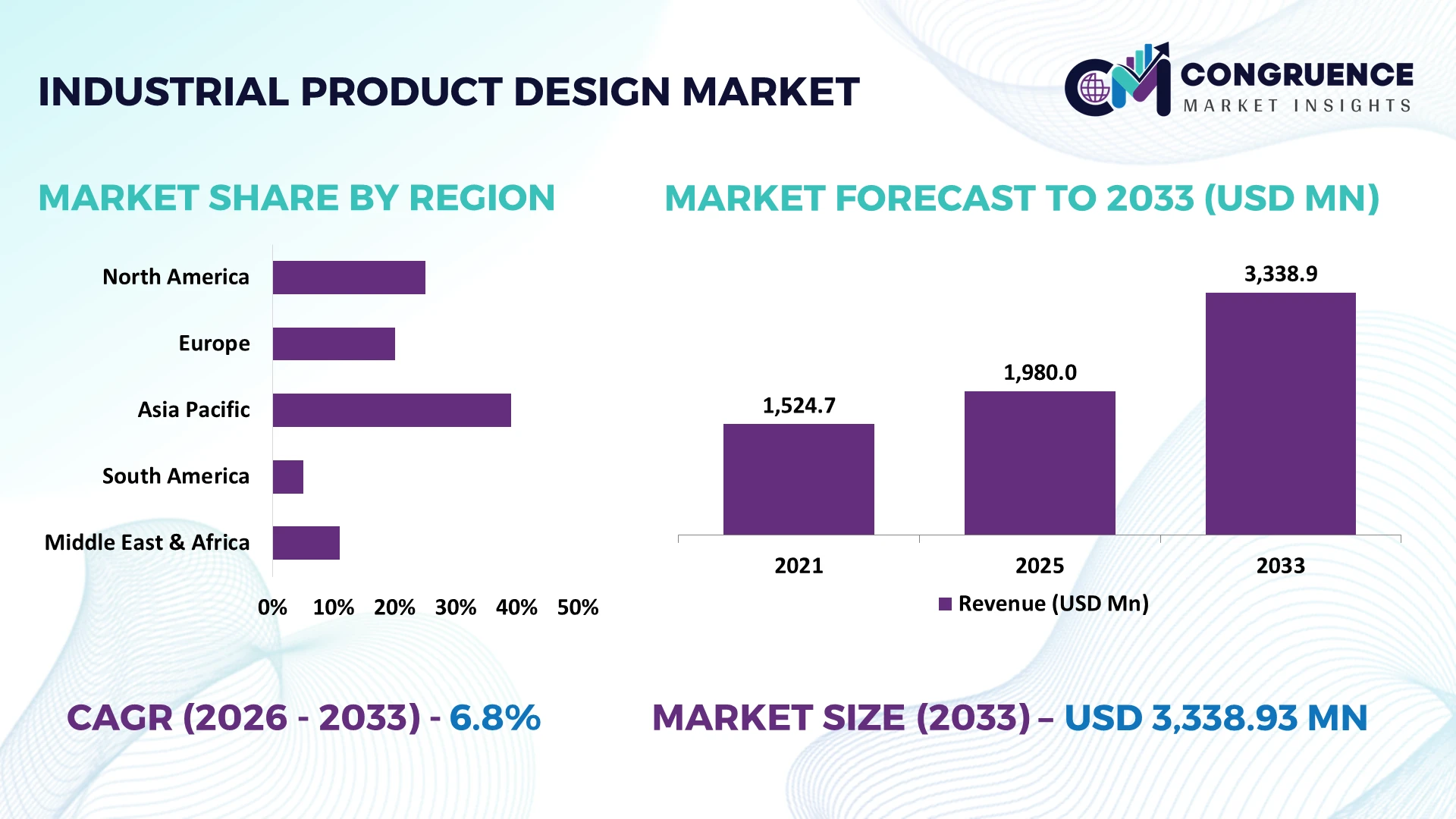
The United States represents an estimated 25% of global industrial product design activity, supported by aerospace, automotive, medical devices, electronics, machinery, and advanced manufacturing. U.S. private manufacturing construction exceeded USD 200 billion annually during the recent factory-investment cycle, expanding demand for design engineering and production-ready product development. More than 55% of manufacturers are using or evaluating generative AI applications. Germany provides a manufacturing-intensive comparison, with manufacturing contributing roughly 18% of national value added. U.S.–China technology controls and supply-chain localization are simultaneously pushing companies toward component redesign and alternative sourcing.
Strategically, design providers combining engineering simulation, AI workflows, manufacturability expertise, and localized supplier intelligence are positioned to capture higher-value product-development programs.
Market Size & Growth: USD 1.98 billion in 2025 reaches USD 3.34 billion by 2033 at 6.75%, driven by digital product engineering and faster design-to-manufacturing cycles.
Top Growth Drivers: AI-enabled engineering adoption exceeds 55%; additive manufacturing can reduce prototype lead times by 50–90%; digital simulation can cut physical testing requirements by 20–30%.
Short-Term Forecast: By 2028, integrated AI and simulation workflows are positioned to reduce concept-to-validation cycles by approximately 20–30% for digitally mature manufacturers.
Emerging Technologies: Generative AI, digital twins, topology optimization, and additive manufacturing are enabling 20–50% lighter optimized components in suitable aerospace, mobility, and industrial applications.
Regional Leaders: Applying estimated 2025 shares to the 2033 forecast places North America near USD 1.07 billion, Europe USD 0.90 billion, and Asia-Pacific USD 1.17 billion, led respectively by AI engineering, sustainability, and manufacturing-scale digitalization.
Consumer/End-User Trends: More than 55% of manufacturers use or evaluate generative AI, shifting design procurement toward digitally integrated engineering partners.
Pilot/Case Example: In 2024, Airbus continued additive-manufacturing deployment where topology-optimized aircraft components have demonstrated weight reductions exceeding 30%, strengthening lightweight-design economics.
Competitive Landscape: IDEO remains an influential design specialist; Accenture Song, frog, Designworks, and Pininfarina compete through digital integration, engineering depth, and sector specialization across global assignments.
Regulatory & ESG Impact: EU Ecodesign rules target improved product circularity across nearly all physical goods, increasing design requirements around durability, repairability, recycled content, and lifecycle documentation.
Investment & Funding: U.S. manufacturing construction investment exceeded USD 200 billion annually during the factory expansion cycle, creating downstream requirements for equipment, automation, tooling, and industrial product development.
Innovation & Future Outlook: AI-assisted engineering can compress iterative design work by 20–30%, shifting competitive advantage toward firms integrating simulation, digital twins, material optimization, and production data.
Industrial Product Design Market demand is strengthening across automotive systems, aerospace components, medical devices, consumer electronics, industrial machinery, robotics, and connected equipment as manufacturers compress development schedules and design products around automated production. Generative AI, digital twins, topology optimization, additive manufacturing, and immersive visualization are replacing sequential concept-to-prototype workflows with integrated digital engineering. Additive manufacturing can reduce prototype lead times by 50–90% in suitable applications. Meanwhile, U.S.–China technology restrictions and broader supply-chain localization are increasing component redesign and supplier qualification requirements, making manufacturability and sourcing intelligence central to the market’s strategic direction.
Industrial product design is becoming strategically critical as manufacturers compete on development speed, manufacturability, product differentiation, and supply-chain resilience rather than styling alone. U.S.–China technology controls and localization programs are forcing component redesign and alternative supplier qualification, while more than 55% of manufacturers are using or evaluating generative AI. This shift makes design engineering an upstream investment decision influencing tooling, sourcing, certification, and production economics.
AI-assisted generative design combined with simulation can shorten iterative engineering cycles by roughly 20–30% compared with sequential CAD and physical-prototype workflows. North America leads AI-intensive product engineering, Germany maintains strength in precision industrial design, while China provides unmatched manufacturing-scale design-to-production integration. Through 2028, digital twins, topology optimization, additive prototyping, and AI copilots will increasingly connect concept development directly with manufacturing data.
A practical example is topology-optimized aerospace component development, where additive manufacturing has delivered weight reductions exceeding 30% while consolidating multi-part assemblies. Manufacturers and design consultancies are consequently investing in simulation specialists, AI platforms, additive capabilities, and engineering partnerships. Competitive advantage will belong to firms that connect creative design with production feasibility, supply resilience, and measurable lifecycle performance.
Manufacturers are replacing sequential concept, CAD, prototype, and testing processes with connected digital engineering workflows. More than 55% of manufacturers are using or evaluating generative AI, while additive manufacturing can reduce prototype lead times by 50–90% in suitable applications and simulation-led development can lower physical testing requirements by roughly 20–30%. U.S. aerospace, automotive, medical-device, and machinery companies are accelerating this transition as reshoring expands domestic production capacity and increases demand for production-ready designs. The operational impact is faster design validation, fewer tooling iterations, and earlier manufacturability assessment. Design firms are investing in AI-assisted engineering, simulation, digital twins, and additive prototyping partnerships. A critical advantage is earlier failure detection: correcting geometry digitally prevents substantially more expensive tooling-stage modifications and protects launch schedules.
Advanced industrial product design remains constrained by expensive engineering software, specialized hardware, material qualification, and fragmented digital ecosystems. Engineering software subscriptions and cloud-compute requirements can raise digital-development overhead by 10–20% for smaller design organizations, while interoperability failures can consume approximately 15–25% of engineering time through file conversion, geometry repair, and data reconciliation. U.S.–China semiconductor restrictions also complicate access to advanced computing hardware and electronics components used in connected-product development. These pressures reduce scalability for smaller consultancies and increase quotation risk on complex programs. Companies are responding by consolidating CAD/PLM platforms, adopting cloud-based licensing, localizing critical component sourcing, and negotiating multi-year supplier agreements. The non-obvious constraint is data migration: legacy engineering libraries can lock manufacturers into outdated platforms because converting validated product records introduces certification and configuration-control costs.
Generative engineering, digital twins, topology optimization, and additive manufacturing are creating opportunities beyond conventional outsourced design services. AI-assisted workflows can reduce concept iteration time by approximately 20–30%, while topology optimization can deliver 20–50% component weight reductions in suitable aerospace, mobility, and machinery applications. India offers a particularly attractive deployment base as manufacturing's contribution is targeted toward 25% of national output, supported by electronics, automotive, defense, and industrial localization programs. Through 2028, connected digital threads will increasingly link customer requirements, simulation, materials, manufacturing constraints, and field-performance data. Design firms are building AI engineering teams, additive laboratories, and partnerships with manufacturers and software providers. A higher-value opportunity lies in post-launch design services: operating data from connected products enables continuous redesign, converting one-time assignments into lifecycle engineering relationships.
Scaling advanced product design requires multidisciplinary expertise spanning industrial design, mechanical engineering, electronics, embedded software, simulation, cybersecurity, and manufacturing engineering. Approximately 70% of industrial organizations report difficulty securing digitally skilled talent, while connected products can contain thousands of software-dependent functions and increasingly complex supplier interfaces. Germany's engineering-intensive manufacturers face particular pressure from an aging technical workforce while simultaneously adopting AI, digital twins, and software-defined product architectures. Poor integration between CAD, PLM, ERP, simulation, and factory systems creates version-control errors, delayed validation, and inconsistent design transfer. Companies must expand engineering reskilling, establish common product-data architectures, strengthen cybersecurity-by-design, and partner with software and specialist engineering providers. The decisive long-term issue is validation scalability: faster AI-generated concepts provide limited advantage unless organizations can verify safety, manufacturability, compliance, and configuration integrity at comparable speed.
AI Moves Into Engineering Workflows: Generative AI is shifting from experimentation into concept evaluation, specification drafting, and geometry exploration, with more than 55% of manufacturers using or assessing applications. AI-supported workflows can compress selected engineering tasks by 20–30%. Companies are integrating copilots into CAD environments and establishing controlled validation processes to accelerate iterations without weakening engineering governance.
Physical Prototyping Becomes More Selective: High-fidelity simulation and immersive visualization are reducing dependence on repeated physical builds. Virtual validation can lower physical testing requirements by 20–30%, while additive methods shorten prototype turnaround by 50–90% for suitable components. Automotive and machinery companies are restructuring validation gates around simulation-first workflows, reserving physical prototypes increasingly for certification, ergonomics, and final performance verification.
Design Responds to Supply Localization: Semiconductor controls, logistics disruption, and sourcing concentration are pushing manufacturers to design around component availability rather than idealized global procurement. Dual-sourcing programs can reduce single-supplier exposure by 20–40%, while component standardization can eliminate 10–20% of unique parts in selected product families. Companies are embedding sourcing teams earlier in design reviews and qualifying interchangeable electronics, materials, and manufacturing processes.
Circularity Enters Product Specifications: EU product-policy changes are moving repairability, durability, recycled content, and disassembly upstream into engineering briefs. Design optimization can reduce material consumption by 15–30%, while topology-optimized parts achieve 20–50% weight reductions in suitable applications. Companies are developing material databases, modular architectures, lifecycle assessment workflows, and design-for-disassembly capabilities, turning regulatory compliance into lower material intensity and stronger aftermarket serviceability.
Product Engineering leads with an estimated 32% share, reflecting its central role in translating concepts into manufacturable products through mechanical engineering, simulation, material selection, tolerance analysis, and production validation. Its scalability across automotive, machinery, electronics, and industrial equipment supports larger project scopes than standalone creative services. Industrial Design represents approximately 24%, retaining importance where ergonomics, usability, aesthetics, and brand differentiation influence purchasing decisions. Concept Design remains the upstream foundation for defining requirements and alternative architectures.
Design Optimization is the fastest-growing type as simulation, topology optimization, generative engineering, and AI shift investment toward measurable performance improvements. Optimized geometries can reduce component weight by 20–50% in suitable applications while limiting material consumption. Prototype Design remains strategically important for physical validation, although digital simulation is reducing repetitive builds. Providers are expanding engineering teams, simulation capabilities, additive prototyping partnerships, and integrated CAD/PLM workflows. Investment priorities are therefore shifting from isolated design stages toward connected services spanning concept definition through production validation.
Automotive Design leads applications with an estimated 30% share, supported by intensive model-development cycles, electrification, software-defined vehicles, lightweighting, safety requirements, and high-volume manufacturing constraints. Automotive programs require coordinated exterior, interior, structural, thermal, electronic, and manufacturability engineering, creating deeper design-service requirements than less complex products. Machinery Design represents approximately 24%, supported by factory automation, robotics, and equipment modernization across Germany, the United States, China, and Japan.
Electronics Design is the fastest-growing application as connected devices increasingly combine compact mechanical architectures with sensors, embedded software, thermal management, and advanced user interfaces. Consumer Product Design is becoming more digitally integrated as brands accelerate iteration and personalization, while Equipment Design emphasizes reliability, serviceability, operator ergonomics, and lifecycle cost. Design providers are expanding electronics-mechanical integration, simulation automation, digital prototyping, and specialized mobility capabilities. Demand is shifting toward suppliers capable of managing multidisciplinary product architectures rather than delivering isolated styling or mechanical packages.
Automotive Manufacturers represent the leading end-user group with an estimated 31% share because vehicle programs require extensive industrial design, engineering validation, tooling coordination, supplier integration, and regulatory compliance before mass production. Electrification further increases demand for battery enclosures, thermal management, lightweight structures, redesigned interiors, and electronic interfaces. Machinery Manufacturers account for approximately 23%, with purchasing concentrated around automation, productivity improvement, modular platforms, and equipment modernization.
Electronics Companies are the fastest-growing buyer group as connected-product architectures increase mechanical-electrical integration and compress product refresh cycles. Industrial Equipment Firms increasingly procure optimization, digital-twin, and design-for-serviceability expertise, while Consumer Goods Companies prioritize rapid prototyping, material efficiency, ergonomics, and differentiated form factors. Design providers are targeting automotive manufacturers through long-term engineering frameworks while forming semiconductor, software, additive-manufacturing, and simulation partnerships for electronics customers. Competitive positioning increasingly depends on providing multidisciplinary engineering capacity that moves reliably from digital concept to validated production.
Asia-Pacific accounted for the largest market share at 35% in 2025 however, Asia-Pacific is expected to register the fastest growth, expanding at a CAGR of 8.1% between 2026 and 2033.

Reshoring Accelerates Digital Product Engineering
North America accounted for approximately 29% of industrial product design activity in 2025, anchored by U.S. aerospace, automotive, semiconductor, medical-device, machinery, and industrial-automation programs. Manufacturing construction spending reached a record USD 238 billion in June 2024, strengthening downstream requirements for equipment engineering, tooling, automation systems, and production-ready product development. Semiconductor and battery localization is simultaneously moving supplier qualification and manufacturability analysis earlier into design workflows. U.S. manufacturers are expanding AI-assisted engineering, simulation, digital twins, additive prototyping, and PLM integration as product complexity rises. Supply-chain restructuring is particularly important because semiconductor controls and critical-material dependencies require alternative component architectures. Canadian engineering capabilities complement U.S. scale in aerospace, transportation equipment, and advanced manufacturing. Design providers with engineering-validation and domestic supplier intelligence gain an operational advantage as manufacturers prioritize shorter industrialization cycles.
United States Market Outlook: The United States combines advanced engineering capability with substantial factory modernization. More than USD 31 billion of clean-technology manufacturing investment covering 192 facilities was announced through October 2024, with nearly 27,000 associated jobs. Semiconductor, battery, aerospace, robotics, and medical-device programs are increasing demand for multidisciplinary product design linking mechanical engineering, electronics, software, simulation, and manufacturability.
Engineering Depth Meets Product Regulation
Europe represented approximately 27% of 2025 market activity, supported by Germany, Italy, France, the United Kingdom, and Nordic manufacturing clusters. Product design is increasingly shaped by electrification, automation, circularity requirements, repairability, and digital-product documentation. Germany provides the region's engineering anchor, combining automotive scale with machinery, robotics, electronics, and precision manufacturing. It operated almost half of Western Europe's industrial robots in 2024, reinforcing demand for automation-compatible equipment and product engineering. EU sustainability regulation is simultaneously pushing durability, resource efficiency, disassembly, and lifecycle considerations upstream into design specifications. Automotive electrification is changing component architectures, while aerospace and machinery companies are deploying simulation and digital twins to control validation costs. European design providers are strengthening engineering-software partnerships and lifecycle capabilities because regulatory compliance increasingly needs to be embedded during concept development rather than addressed after product engineering.
Germany Market Outlook: Germany produced approximately 4.15 million passenger vehicles in 2025 and maintains an industrial robot density of 449 units per 10,000 manufacturing employees. Its automotive sector employs more than 158,000 R&D personnel, creating a dense customer base for industrial design, product engineering, battery-system development, automation equipment, lightweighting, and production-oriented digital simulation.
Manufacturing Scale Drives Design Integration
Asia-Pacific captured approximately 35% of the market in 2025, reflecting China's manufacturing scale alongside Japan's precision engineering, South Korea's electronics ecosystem, and India's expanding automotive, semiconductor, aerospace, and industrial-equipment base. China remained the strongest manufacturing performer during late 2025, while higher-technology industries such as electronics and transport equipment outpaced lower-technology production. This scale allows product designers to work close to tooling, component suppliers, prototyping facilities, and contract manufacturers, shortening design-to-production feedback loops. Japan and South Korea emphasize robotics, mobility, semiconductors, and electronics miniaturization, while India is attracting semiconductor engineering and supply-chain investment. Global manufacturers are expanding engineering centers and supplier-development programs across the region. The strategic advantage is increasingly integrated development: industrial design, engineering validation, sourcing, tooling, and manufacturing can be coordinated within geographically concentrated production ecosystems.
China Market Outlook: China combines extensive supplier networks with electronics, machinery, electric-vehicle, battery, robotics, and consumer-product manufacturing. Medium-high and high-technology production maintained quarterly expansion above 1% across several periods during 2025, while higher-technology manufactured exports rose 2.6% quarter-on-quarter in Q4. This production density supports rapid prototyping, design-for-manufacturing iteration, component substitution, and accelerated product industrialization.
Mobility Investment Revitalizes Engineering Demand
South America accounted for approximately 5% of 2025 industrial product design activity, with Brazil concentrating automotive, machinery, agricultural equipment, aerospace, appliances, and industrial manufacturing demand. Product-development requirements are shifting toward electrified mobility, locally engineered equipment, automation, and designs adapted to regional cost and operating conditions. Brazil's established vehicle and supplier ecosystem provides a foundation for engineering-intensive programs, while Argentina and Chile contribute specialized industrial and resource-sector equipment requirements. A recent €319 million Renault-Geely investment in Brazil demonstrates renewed localization of automotive engineering and manufacturing as Chinese electrified-vehicle competition intensifies. Execution remains constrained by imported electronics, capital-equipment dependency, currency volatility, and uneven advanced-manufacturing infrastructure. Design providers are responding through local engineering teams, modular product architectures, supplier partnerships, and component substitution strategies that reduce exposure to imported assemblies while maintaining global platform compatibility.
Brazil Market Outlook: Brazil offers South America's strongest combination of automotive engineering, aerospace expertise, machinery production, and supplier depth. Renault and Geely's €319 million industrial expansion highlights the intensifying requirement for localized vehicle development as electrification changes powertrain, electronics, thermal-management, and interior architectures. Product design firms positioned near manufacturing clusters gain faster access to supplier validation and physical testing.
Industrial Localization Expands Engineering Requirements
Middle East & Africa represented approximately 4% of 2025 industrial product design activity, with Saudi Arabia, the UAE, South Africa, and Morocco providing the strongest industrial platforms. Saudi localization programs are creating design requirements across machinery, automotive components, medical supplies, defense products, and energy equipment. More than 3,000 Saudi factories had joined the Factories of the Future initiative by 2025, accelerating advanced manufacturing, automation, and digital production adoption. Morocco's automotive and aerospace manufacturing clusters strengthen engineering requirements around supplier localization, while South Africa maintains established automotive and industrial-equipment capabilities. The regional shift from importing finished products toward local production increases demand for design adaptation, tooling engineering, material substitution, and design-for-manufacturing services. Product-development firms are building partnerships with manufacturers, technology providers, and industrial zones to connect engineering expertise with newly localized production capacity.
Saudi Arabia Market Outlook: Saudi Arabia had 12,946 industrial facilities in 2025 and targets substantially deeper advanced-manufacturing localization. The national industrial strategy identifies 118 priority product groups, while Future Factories initiatives are modernizing production systems. This creates design opportunities in machinery, mobility, medical equipment, energy products, and automation where locally manufacturable specifications increasingly determine procurement eligibility and industrial competitiveness.
IDEO, Accenture Song, frog, Pininfarina, and Designworks compete for innovation-led product programs, while engineering specialists challenge them on manufacturability, simulation, and industrialization. The top five account for an estimated 24% of market activity, leaving substantial scope for sector-focused design firms. Competition increasingly centers on development speed, engineering depth, digital integration, and customization: AI-assisted workflows can shorten selected design iterations by 20–30%, additive prototyping can reduce lead times by 50–90%, and topology optimization can lower component weight by 20–50%. Leaders are integrating industrial design with engineering, simulation, prototyping, software, and manufacturing support while forming partnerships with CAD, additive-manufacturing, materials, and electronics providers. The competitive shift favors digitally connected design-to-production services over standalone styling. Entry barriers include specialist engineering talent, validation infrastructure, software investment, intellectual-property protection, and manufacturing knowledge. Winning requires multidisciplinary expertise, rapid iteration, production feasibility, secure product data, supplier integration, and measurable performance improvements across development cycles.
IDEO
Accenture
frog
Pininfarina
Designworks
PA Consulting
Cambridge Consultants
Arup
Tata Elxsi
Designit
RKS Design
Seymourpowell
Whipsaw
Karten Design
Current industrial product design is anchored by CAD/CAE, PLM, simulation, additive prototyping, and collaboration. Integrated simulation can reduce physical prototype requirements by 20–30%, while additive manufacturing cuts prototype lead times by 50–90% for suitable geometries. Digital adoption is strongest in automotive, aerospace, electronics, and machinery programs, where teams connect geometry, materials, tolerances, electronics, and manufacturing constraints before tooling. This improves validation speed and reduces downstream engineering changes.
Emerging workflows combine generative AI, topology optimization, XR design reviews, and digital twins. AI-assisted engineering can shorten selected concept iterations by 20–30%, while topology optimization delivers 20–50% component weight reduction in suitable applications. Compared with legacy sequential CAD and physical review cycles, integrated virtual development provides roughly 25% faster iteration by allowing concurrent engineering and remote validation. Large manufacturers and digitally equipped design consultancies benefit most because reusable engineering data scales across product families.
Between 2026 and 2028, agentic engineering, physics-informed AI, automated design-for-manufacturing checks, and closed-loop digital twins will become influential. Connecting field data with product models can improve engineering responsiveness by 10–15% and enable continuous optimization after launch. Firms integrating AI with simulation, PLM governance, XR collaboration, and manufacturing intelligence now gain faster industrialization, stronger design traceability, and defensible lifecycle relationships.
April 2024 PA Consulting won three iF Design Awards for Hydrow Wave, Cala Health kIQ, and another client innovation, validating its integrated product-development approach. Recognition across three projects strengthened PA’s positioning in engineered consumer and healthcare product design. Source: PA.
June 2025 Tata Elxsi partnered with Infineon to develop deployment-ready EV systems for two-wheelers, three-wheelers, passenger and commercial vehicles. India’s EV sales had risen 25–30% during 2024, making cost-optimized, safety-compliant subsystem design strategically important for manufacturers. Source: Tata Elxsi.
September 2025 Whipsaw launched The Workshop, a 10-week hardware accelerator starting with five early-stage startups spanning health, home, and human connection. Direct access to industrial designers, engineers, strategists, and brand specialists compresses the path toward investor-ready hardware development. Source: PRNewswire.
August 2026 Whipsaw secured two International Design Excellence Awards: Gridstack received Silver in Consumer Technology and Reef Track earned Bronze in Sports, Leisure and Recreation. The recognition demonstrates commercial relevance across distinct product categories and collaborative industrial-design programs. Source: Whipsaw.
The Industrial Product Design Market Report evaluates Concept Design, Product Engineering, Industrial Design, Prototype Design, and Design Optimization across Machinery Design, Automotive Design, Consumer Product Design, Electronics Design, and Equipment Design. End-user analysis covers Automotive Manufacturers, Machinery Manufacturers, Electronics Companies, Industrial Equipment Firms, and Consumer Goods Companies. Product Engineering represents approximately 32% of type-level activity, while Automotive Design accounts for nearly 30% of application demand.
Regional coverage spans North America, Europe, Asia-Pacific, South America, and Middle East & Africa, with country-level assessment of manufacturing ecosystems and engineering deployment. Technology analysis examines generative AI, CAD/CAE, digital twins, XR, topology optimization, additive manufacturing, simulation, and PLM integration. The 2026–2033 outlook connects digital engineering adoption, localization, product circularity, and manufacturing automation with investment planning, market entry, partnership development, competitive positioning, and design-service expansion.
| Report Attribute/Metric | Report Details |
|---|---|
Market Revenue in 2025 | USD 1980 Million |
Market Revenue in 2033 | USD 3338.93 Million |
CAGR (2026 - 2033) | 6.75% |
Base Year | 2025 |
Forecast Period | 2026 - 2033 |
Historic Period | 2021 - 2025 |
Segments Covered | By Type
By Application
By End-User
|
Key Report Deliverable | Revenue Forecast, Growth Trends, Market Dynamics, Segmental Overview, Regional and Country-wise Analysis, Competition Landscape |
Region Covered | North America, Europe, Asia-Pacific, South America, Middle East, Africa |
Key Players Analyzed | IDEO, Accenture, frog, Pininfarina, Designworks, PA Consulting, Cambridge Consultants, Arup, Tata Elxsi, Designit, RKS Design, Seymourpowell, Whipsaw, Karten Design |
Customization & Pricing | Available on Request (10% Customization is Free) |




