
Reports
The Global Industrial Processed Seafood Market was valued at USD 26,226.0 Million in 2025 and is anticipated to reach a value of USD 1,05,464.9 Million by 2033 expanding at a CAGR of 19% between 2026 and 2033. Growth is being driven by large-scale seafood processing automation, rising value-added seafood exports, and expanding cold-chain infrastructure across major fishing economies.
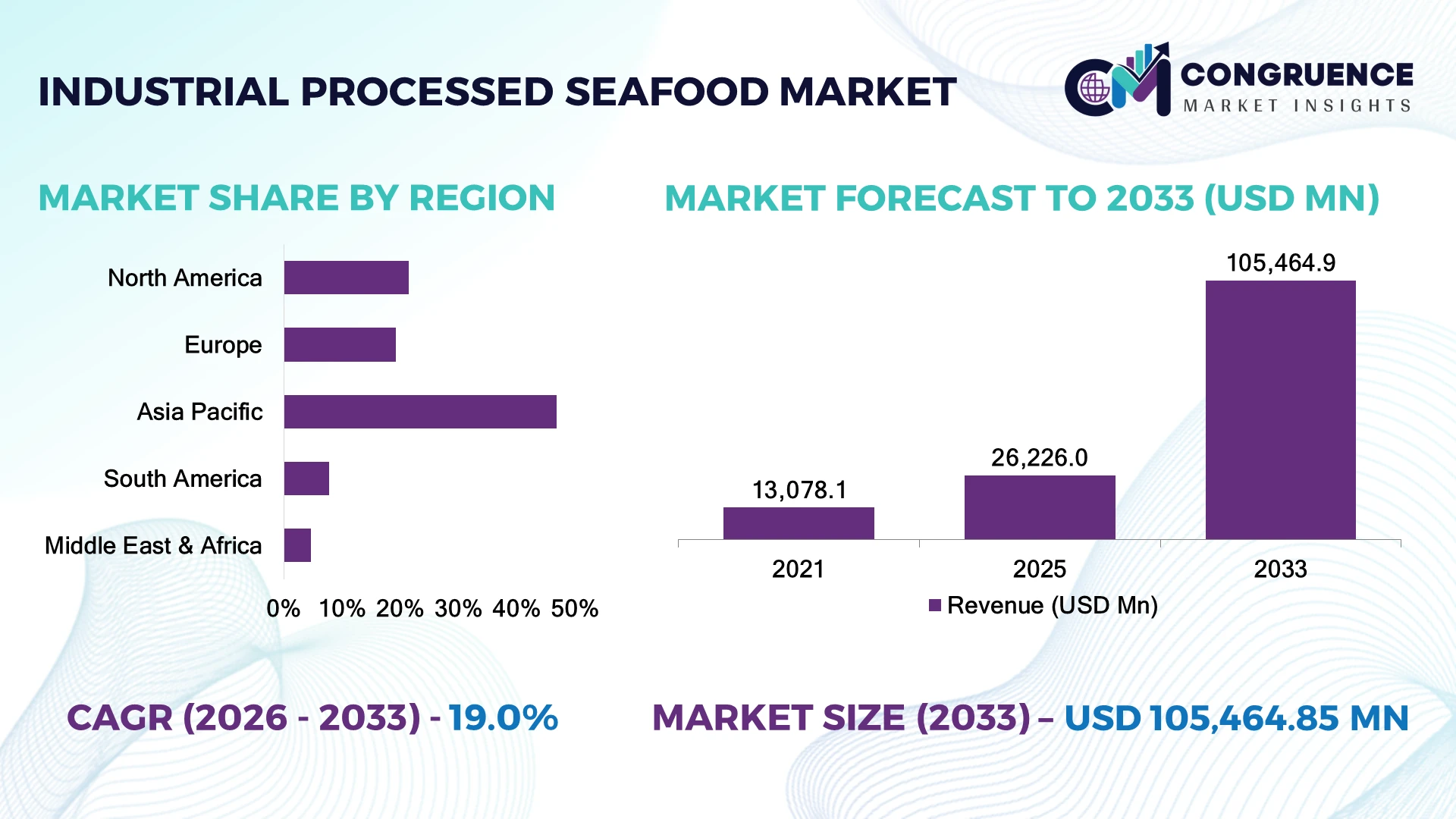
China remains the dominant country, accounting for approximately 28% of global industrial seafood processing capacity, supported by over 14,000 seafood processing facilities and strong investments in automated freezing and packaging systems. The country processes significantly higher seafood volumes than Vietnam, which holds roughly 9% of global export-oriented processing capacity. Adoption of AI-enabled sorting technologies has improved throughput efficiency by more than 20% in leading Chinese plants, while export-focused industries continue benefiting from trade diversification following supply-chain adjustments linked to Indo-Pacific maritime logistics shifts.
Strategically, market leadership increasingly depends on processing efficiency, export resilience, and technology-enabled value addition rather than raw catch volumes alone.
Market Size & Growth: USD 26,226.0 Million in 2025, reaching USD 1,05,464.9 Million by 2033 at 19% CAGR, driven by automated seafood processing and advanced cold-chain expansion.
Top Growth Drivers: Processing automation (+22%), value-added seafood exports (+18%), cold-storage capacity expansion (+16%).
Short-Term Forecast: By 2028, processing waste is expected to decline by 15% while plant efficiency improves by nearly 20%.
Emerging Technologies: AI grading systems, robotic filleting, and smart traceability platforms are reducing processing errors by over 25%.
Regional Leaders: Asia Pacific (~USD 48 Billion), Europe (~USD 23 Billion), North America (~USD 18 Billion); adoption centers on automation, traceability, and premium seafood products.
Consumer/End-User Trends: More than 40% of retail seafood purchases in developed markets now favor ready-to-cook or processed products.
Pilot/Case Example: In 2024, automated seafood processing deployments in Norway improved yield recovery by approximately 12%.
Competitive Landscape: Top players collectively control nearly 35% share; Thai Union, Maruha Nichiro, Mowi, Nippon Suisan, and Austevoll Seafood remain key competitors.
Regulatory & ESG Impact: Digital traceability initiatives improved compliance visibility by nearly 30% across export-focused operations.
Investment & Funding: Over USD 4 Billion has been directed toward processing upgrades, cold-chain assets, and strategic partnerships.
Innovation & Future Outlook: Smart factories, by-product utilization, and advanced freezing technologies are reshaping global seafood value chains amid ongoing supply-chain diversification.
Industrial processed seafood demand is accelerating across retail foodservice, frozen meal manufacturing, and export-oriented protein supply chains. Companies are deploying AI-assisted grading systems, robotic filleting equipment, and advanced preservation technologies to improve yield and consistency. More than 35% of new processing investments now target traceability and automation upgrades. Increasing regulatory scrutiny of seafood sourcing and evolving maritime logistics networks are also encouraging modernization, setting the stage for deeper strategic transformation across the value chain.
Industrial processed seafood has become strategically important as food security priorities, export competitiveness, and protein diversification reshape global supply chains. Processors are moving beyond volume-based operations toward value-added production, automated quality control, and digitally managed distribution networks. Supply-chain restructuring following international trade disruptions has accelerated investment in localized processing capacity and resilient cold-chain infrastructure.
Technology adoption is creating measurable operational advantages. AI-enabled sorting and robotic filleting systems improve processing throughput by approximately 20% while reducing labor dependency by nearly 15% compared with conventional manual operations. Norway and Japan lead in automation intensity and traceability deployment, whereas Vietnam and India continue expanding capacity through cost-efficient processing hubs and export-focused infrastructure. This contrast highlights the growing importance of balancing scale with technological sophistication.
Over the next two to three years, digital traceability adoption is expected to exceed 50% among large exporters. Several processors are deploying integrated freezing, packaging, and monitoring systems to improve product consistency and compliance. Companies are also strengthening partnerships with fishing fleets, logistics providers, and retail chains to secure supply continuity. Organizations that successfully combine processing efficiency, traceability, and value-added product innovation will achieve stronger competitive positioning and long-term relevance.
Industrial seafood processors are accelerating automation investments to improve yield, consistency, and labor productivity. Automated grading and robotic filleting systems increase throughput by approximately 20% while reducing product losses by nearly 12%. In China and Norway, digital quality-control platforms have achieved inspection accuracy improvements exceeding 25%, supporting higher export compliance rates. Growing labor shortages across seafood processing hubs are reinforcing this transition. As a result, leading companies are expanding smart processing facilities, upgrading freezing infrastructure, and partnering with technology providers. A key operational insight is that processors adopting integrated automation are achieving stronger margin protection through higher recovery rates and lower waste generation, creating a competitive advantage in increasingly quality-sensitive export markets.
The market continues to face structural pressure from fluctuating seafood landings, energy expenses, and transportation costs. Fuel-related operating expenditures account for up to 30% of certain seafood processing operations, while supply variability can alter raw material availability by more than 15% annually. Export-dependent processors in countries such as Vietnam have also faced logistical disruptions linked to port congestion and changing maritime routes. These conditions directly affect production planning, inventory management, and profitability. Companies are responding through long-term procurement contracts, diversified sourcing strategies, and localized cold-storage investments. A significant strategic insight is that supply stability is increasingly becoming as important as processing capability in maintaining operational competitiveness.
Advanced traceability systems, digital certification tools, and premium seafood product development present substantial opportunities. More than 40% of seafood buyers in developed markets increasingly prioritize transparency and sustainability verification. AI-enabled monitoring systems can improve supply-chain visibility by approximately 30%, while advanced processing technologies enhance product shelf life by nearly 20%. Japan and Singapore are supporting digital seafood ecosystem initiatives that encourage data-driven compliance and quality management. Companies are expanding R&D programs, forming technology partnerships, and investing in premium ready-to-cook seafood categories. A notable strategic opportunity lies in monetizing verified sustainability and traceability data, transforming compliance requirements into differentiated market positioning and stronger customer loyalty.
Successfully integrating automation, digital monitoring platforms, and traceability systems remains a major execution challenge. Large seafood processors often operate multiple legacy production lines, making technology integration projects 20–25% more complex than greenfield installations. Workforce reskilling requirements have increased as digital operations expand, while implementation timelines can extend by more than 15% when operational disruptions occur. In several major processing countries, shortages of specialized automation technicians are creating deployment bottlenecks. Companies must invest in workforce development, digital infrastructure, and ecosystem partnerships to maintain implementation consistency. The strongest long-term performers will be those capable of synchronizing technology adoption, operational training, and process standardization across geographically distributed processing networks.
Smart Processing Line Expansion Industrial seafood facilities are rapidly deploying AI-assisted grading, machine-vision inspection, and robotic filleting systems. Automated processing lines have improved throughput by 18–22% while reducing product loss by nearly 12%. Labor shortages in China and Norway are accelerating automation programs, prompting processors to scale digital production environments. The result is faster batch handling, improved consistency, and lower operational dependency on manual labor.
Traceability Platform Integration Digital traceability adoption has increased by approximately 30% among export-focused processors as compliance requirements tighten across major seafood trade routes. Blockchain-enabled tracking and cloud-based monitoring platforms now reduce product verification time by nearly 25%. Companies are restructuring supplier networks and expanding technology partnerships to strengthen transparency, improve audit readiness, and protect premium seafood product positioning.
Value-Added Product Acceleration Ready-to-cook and portion-controlled seafood categories now account for more than 40% of new product launches across several developed markets. Processing facilities report packaging efficiency gains of 15% through automated portioning systems. Companies are expanding secondary processing capabilities and investing in customized product formats to capture higher-margin demand from retail and foodservice channels.
Cold-Chain Network Modernization Advanced freezing systems and intelligent storage monitoring technologies have reduced spoilage rates by up to 20% while improving inventory visibility by approximately 28%. Supply-chain disruptions and export reliability concerns have encouraged processors to modernize distribution infrastructure. A notable shift is the growing integration of predictive inventory management, enabling companies to optimize shipment timing and strengthen supply continuity.
Frozen Seafood holds the leading position with an estimated 48% market share, supported by superior shelf life, large-scale export suitability, and compatibility with automated cold-chain logistics. Processors increasingly favor frozen formats because they reduce spoilage risk and improve inventory flexibility. Canned Seafood represents a mature segment accounting for roughly 24% of demand, benefiting from long storage duration and stable retail distribution channels. Smoked and Cured Seafood products maintain strategic relevance in premium and specialty categories where value addition and product differentiation are critical.
Frozen Seafood also represents the fastest-growing segment as processors expand blast-freezing capacity and adopt advanced preservation technologies. Adoption of high-efficiency freezing systems has improved product quality retention by nearly 18%, while processing yields have increased by approximately 10% in modern facilities. Companies are expanding freezing infrastructure, strengthening logistics partnerships, and prioritizing export-ready product portfolios. Investment priorities increasingly favor technologies that enhance quality consistency and support international distribution requirements.
Food Processing Industry remains the largest application segment with approximately 44% market share due to extensive use of processed seafood in packaged meals, frozen foods, and value-added protein products. Consistent raw material requirements and large-scale manufacturing operations sustain demand concentration within this segment. Retail Food Products account for roughly 31% of utilization as supermarkets expand seafood offerings, while Foodservice Applications continue benefiting from menu diversification and convenience-focused consumption patterns.
Foodservice Applications represent the fastest-growing segment as restaurants, quick-service chains, and institutional kitchens increasingly adopt pre-processed seafood products to improve preparation efficiency. Operational productivity improvements of nearly 20% have been reported through standardized seafood inputs. Companies are expanding processing capacity, deploying automated packaging systems, and developing customized product formats. Demand is becoming increasingly concentrated around convenience, consistency, and supply reliability, making application-specific processing capabilities strategically important.
Foodservice Operators constitute the dominant end-user segment with an estimated 42% market share, supported by large procurement volumes, menu standardization requirements, and dependence on reliable processed seafood supply. Restaurants, hospitality chains, and institutional catering providers increasingly utilize portion-controlled seafood products to reduce preparation complexity. Retail Consumers account for approximately 34% of demand through growing purchases of frozen, canned, and ready-to-cook seafood products, while Industrial Food Manufacturers remain essential buyers for packaged food production.
Industrial Food Manufacturers represent the fastest-growing end-user group as demand rises for seafood-based snacks, prepared meals, and protein-enriched food products. Procurement volumes among large manufacturers have increased by approximately 15%, while automated ingredient handling systems have improved operational efficiency by nearly 18%. Companies are responding through customized product development, long-term supply agreements, and strategic processing partnerships. Future demand is increasingly shifting toward buyers requiring scalable supply, traceability, and consistent product specifications.
Asia-Pacific accounted for the largest market share at 46.8% in 2025 however, South America is expected to register the fastest growth, expanding at a CAGR of 20.4% between 2026 and 2033.
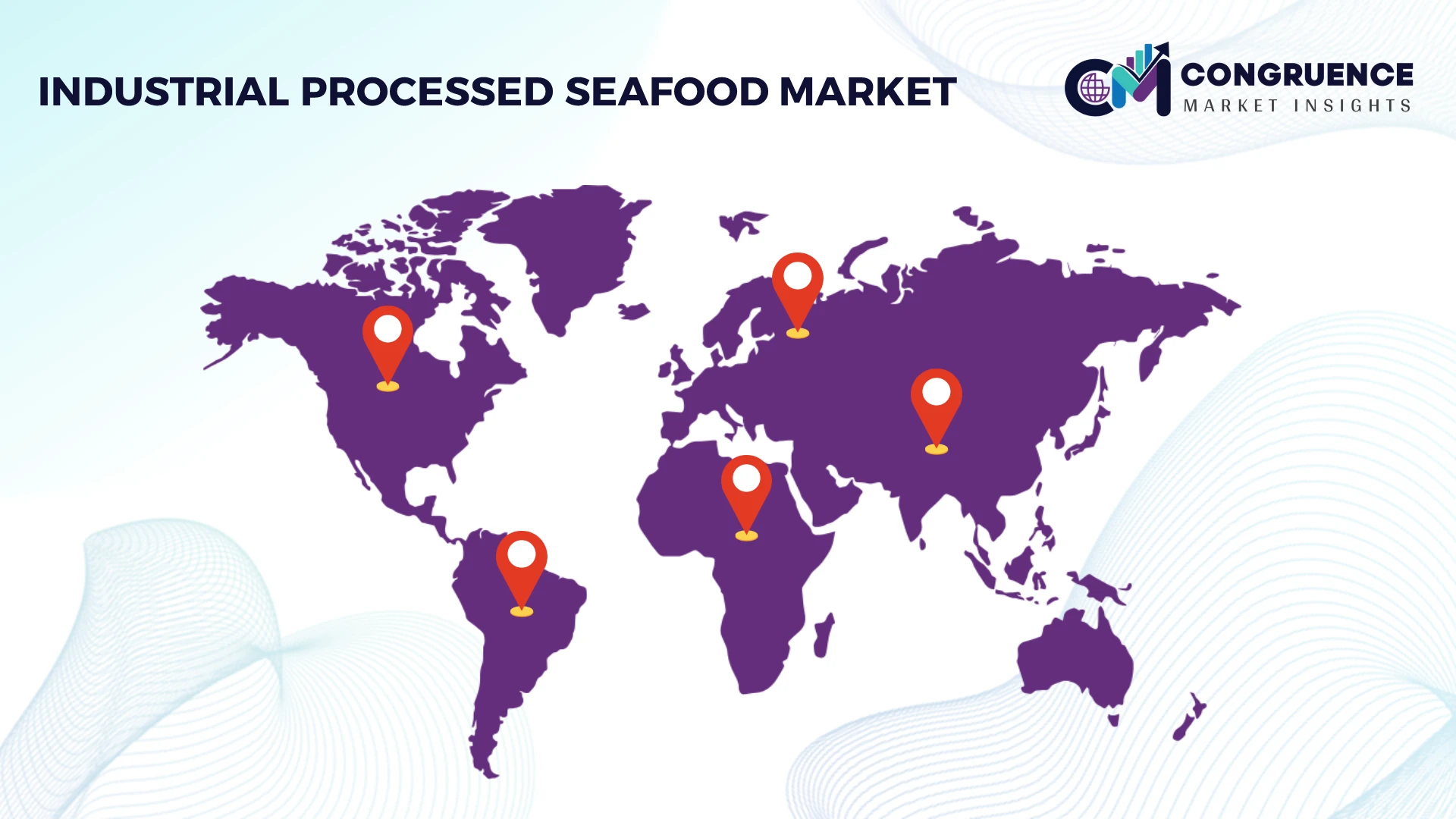
North America accounted for approximately 21.5% of the global Industrial Processed Seafood Market in 2025, supported by advanced cold-chain infrastructure, high seafood consumption, and strong deployment of automated processing technologies. The United States and Canada continue investing in smart seafood handling systems, robotic filleting equipment, and digital quality-monitoring platforms to improve productivity and traceability. More than 45% of large seafood processing facilities in the region have integrated automated sorting or packaging technologies, improving operational consistency and reducing labor dependency. Enterprise partnerships between seafood processors, retailers, and logistics providers are strengthening supply continuity and product standardization. The region also benefits from established food safety frameworks and extensive frozen-food distribution networks, supporting scalable industrial seafood processing operations.
United States Market Outlook: The United States remains the strategic center of North American seafood processing due to its extensive processing infrastructure, advanced logistics network, and strong retail demand. Alaska and the Pacific Northwest continue serving as major seafood processing hubs, while Gulf Coast facilities are expanding value-added seafood production. More than 60% of industrial seafood output is processed through highly mechanized facilities, supporting higher throughput and product consistency. Investments in automated inspection systems and traceability technologies are helping processors strengthen operational efficiency and compliance capabilities.
Europe represented approximately 19.2% of the global market in 2025, characterized by advanced seafood processing standards, strong traceability requirements, and high-value seafood product demand. Processors across the region are prioritizing sustainable sourcing, digital supply-chain monitoring, and premium product development. Adoption of automated portioning and packaging technologies has increased by nearly 25% across major seafood processing facilities. Modernization programs focused on energy-efficient freezing and storage systems are improving operational performance while supporting sustainability objectives. Regulatory alignment and strong retail distribution channels continue encouraging investment in value-added seafood processing capabilities. The region maintains a leading position in premium seafood exports and advanced processing innovation.
Norway Market Outlook: Norway serves as Europe's most influential industrial seafood processing market due to its globally competitive aquaculture industry and technologically advanced processing ecosystem. Salmon processing remains a core strength, supported by integrated production, harvesting, and export infrastructure. More than 70% of large seafood facilities utilize advanced monitoring and automation technologies. Companies continue expanding processing capacity and investing in digital traceability systems, strengthening Norway's position as a benchmark for operational efficiency and premium seafood product manufacturing.
Asia-Pacific held the largest market share at approximately 46.8% in 2025, driven by extensive seafood production capacity, large export-oriented processing networks, and expanding domestic seafood consumption. China, Vietnam, Thailand, and India collectively represent a significant concentration of global seafood processing activity. The region benefits from integrated fishing, aquaculture, processing, and export ecosystems. More than 55% of newly commissioned seafood processing facilities in recent years have been established within Asia-Pacific. Companies are investing heavily in freezing infrastructure, automated grading technologies, and export-compliant traceability systems. Strong manufacturing scale and competitive production costs continue reinforcing the region's leadership in global seafood supply chains.
China Market Outlook: China remains the dominant country market due to its extensive seafood processing capacity, advanced manufacturing ecosystem, and export-oriented production model. Thousands of processing facilities support large-scale frozen, canned, and value-added seafood output. Automation adoption across major seafood plants has improved processing efficiency by over 20% in several industrial clusters. Continued investments in smart processing equipment, cold-chain logistics, and digital quality-control systems are strengthening China's competitive advantage while supporting higher-value seafood product exports.
South America accounted for approximately 7.8% of the global market in 2025 and is emerging as an increasingly important seafood processing region. Strong fisheries resources, expanding aquaculture activity, and export-focused investment programs are supporting industrial development. Several processors are upgrading freezing facilities and expanding cold-storage capacity to improve export readiness. Processing efficiency improvements of nearly 15% have been reported following modernization initiatives in key seafood production zones. Despite infrastructure limitations in certain coastal areas, the region continues attracting investment aimed at strengthening logistics and export competitiveness. Growing demand for processed seafood products in international markets remains a major operational driver.
Chile Market Outlook: Chile represents the region's most strategically significant market, supported by a globally recognized salmon industry and sophisticated export infrastructure. Integrated aquaculture operations provide a reliable supply base for industrial processors. Large processing facilities are increasingly adopting automated handling and packaging technologies to improve operational efficiency. Export-oriented seafood enterprises continue investing in processing modernization, while advanced cold-chain networks support product quality preservation and international market access across major trade corridors.
Middle East & Africa accounted for approximately 4.7% of the global market in 2025, supported by expanding seafood trade activities, modernization initiatives, and growing investment in food-processing infrastructure. Governments and private enterprises are increasingly focusing on cold-storage expansion, seafood handling facilities, and export-oriented processing operations. New logistics and port development projects are improving seafood distribution efficiency and reducing product losses. Adoption of modern freezing and storage technologies has improved product preservation performance by nearly 18% across several industrial facilities. While processing capacity remains lower than more established regions, infrastructure modernization is steadily strengthening market competitiveness and operational capabilities.
Saudi Arabia Market Outlook: Saudi Arabia is emerging as the region's leading industrial seafood processing market due to strong food-security initiatives, infrastructure investment, and industrial diversification strategies. Expansion of seafood processing zones and cold-chain networks is supporting greater domestic processing capacity. Modern food manufacturing facilities are integrating advanced preservation and packaging technologies to improve operational efficiency. Continued investment in logistics infrastructure and industrial processing capabilities is positioning the country as a growing seafood distribution and value-added processing hub within the broader regional market.
The Industrial Processed Seafood Market is led by global seafood processors including Mowi, Thai Union Group, Maruha Nichiro, Nippon Suisan (Nissui), and Austevoll Seafood, which compete directly against regional export-focused processors in China, Vietnam, Chile, and India. The top five players collectively control approximately 32% of global market activity, creating a moderately consolidated competitive structure. Competition centers on processing efficiency, product quality, traceability, and supply-chain control rather than raw harvesting scale alone. Automated facilities deliver throughput improvements exceeding 20%, while integrated cold-chain systems reduce product losses by nearly 15%. Leading companies are expanding processing infrastructure, strengthening aquaculture integration, and forming logistics partnerships to secure supply continuity. Technology-driven operators increasingly compete against cost-focused processors through automation, digital traceability, and premium product differentiation. Vertical integration from aquaculture to processing is becoming a decisive competitive shift. The primary entry barrier remains capital-intensive processing and cold-storage infrastructure. Winning requires scalable operations, traceability leadership, supply security, and advanced processing efficiency.
Thai Union Group PCL
Maruha Nichiro Corporation
Nippon Suisan Kaisha Ltd. (Nissui)
Austevoll Seafood ASA
Leroy Seafood Group ASA
SalMar ASA
Bakkafrost P/F
High Liner Foods Inc.
Dongwon Industries Co., Ltd.
Cooke Inc.
Pacific Seafood Group
Trident Seafoods Corporation
Clearwater Seafoods Incorporated
Industrial processed seafood operations are increasingly centered on AI-enabled grading systems, robotic filleting platforms, and machine-vision quality inspection technologies. Automated sorting solutions improve processing accuracy by approximately 25% while reducing manual inspection requirements by nearly 18%. More than 40% of large-scale processors have deployed some form of digital quality-control technology. Companies benefit through higher product consistency, lower waste generation, and improved throughput across export-oriented facilities. Early adopters are strengthening competitive positions through operational standardization and labor-efficiency gains.
Emerging technologies include blockchain-enabled traceability platforms, intelligent cold-chain monitoring systems, and predictive inventory management tools. Digital traceability deployments improve supply-chain visibility by nearly 30%, while smart storage monitoring reduces spoilage rates by approximately 20%. Compared with traditional paper-based tracking methods, integrated digital systems accelerate compliance verification by more than 35%. Large exporters and premium seafood brands are realizing the greatest advantages through stronger transparency and customer confidence.
Between 2026 and 2028, advanced automation, digital twins, and AI-driven production optimization will increasingly influence investment decisions. Processors deploying integrated technology ecosystems are expected to achieve faster production cycles, improved yield recovery, and stronger export competitiveness. Companies delaying modernization risk higher operating costs, reduced traceability performance, and weaker positioning in increasingly technology-driven seafood value chains.
May 2025 – Mowi officially opened its new Haukå post-smolt facility in Norway following an investment of approximately NOK 600 million. The project significantly expands production capacity and strengthens vertically integrated seafood supply operations while improving production efficiency and sustainability performance. Source: mowi.com
August 2025 – Thai Union launched an expanded shrimp decarbonization collaboration through blue-finance partnerships, targeting lower-emission aquaculture practices. The initiative supports seafood supply-chain sustainability and strengthens industry-wide adoption of climate-focused production strategies across shrimp farming ecosystems. Source: thaiunion.com
March 2026 – Nissui rebranded its domestic salmon aquaculture business as Nissui Salmon and reaffirmed plans to build a domestic production system targeting 10,000 tons by 2030. The move strengthens brand alignment, aquaculture scale, and long-term seafood supply resilience. Source: nissui.co.jp
June 2026 – Thai Union reported that 99.9% of its tuna sourcing now meets responsible sourcing standards, supported by 95% on-water monitoring coverage and 100% vessel traceability. The milestone enhances supply-chain transparency, compliance performance, and premium market access. Source: thaiunion.com Sustainability Report Update
This report provides comprehensive analysis of the Industrial Processed Seafood Market across major product types, applications, end-users, and geographic regions. Coverage includes frozen seafood, canned seafood, smoked seafood, and cured seafood segments, alongside demand assessment across food processing, retail food products, and foodservice applications. The study evaluates operational trends, processing technologies, traceability adoption, cold-chain infrastructure development, and evolving procurement patterns. More than 40% of recent processing investments are concentrated in automation, digital monitoring, and quality-control technologies, highlighting the sector’s ongoing modernization.
The report further examines competitive positioning, regional production dynamics, enterprise strategies, and technology deployment trends across North America, Europe, Asia-Pacific, South America, and Middle East & Africa. Strategic insights cover supply-chain optimization, processing efficiency improvements, sustainability initiatives, and value-added product innovation. The analysis supports investment prioritization, capacity expansion planning, partnership evaluation, and long-term competitive decision-making while identifying emerging opportunities in digital traceability, advanced processing systems, and export-oriented seafood manufacturing between 2026 and 2033.
| Report Attribute / Metric | Details |
|---|---|
| Market Revenue (2025) | USD 26,226.0 Million |
| Market Revenue (2033) | USD 1,05,464.9 Million |
| CAGR (2026–2033) | 19.0% |
| Base Year | 2025 |
| Forecast Period | 2026–2033 |
| Historic Period | 2021–2025 |
| Segments Covered |
By Type
By Application
By End-User
|
| Key Deliverables | Revenue Forecast; Market Trends; Growth Drivers & Restraints; Technology Insights; Segmentation Analysis; Regional Insights; Competitive Landscape; Regulatory & ESG Overview; Recent Developments |
| Regions Covered | North America; Europe; Asia-Pacific; South America; Middle East & Africa |
| Companies Profiled | Mowi ASA; Thai Union Group PCL; Maruha Nichiro Corporation; Nippon Suisan Kaisha Ltd. (Nissui); Austevoll Seafood ASA; Leroy Seafood Group ASA; SalMar ASA; Bakkafrost P/F; High Liner Foods Inc.; Dongwon Industries Co., Ltd.; Cooke Inc.; Pacific Seafood Group; Trident Seafoods Corporation; Clearwater Seafoods Incorporated |
| Customization & Pricing | Available on Request (10% Customization Free) |




