
Reports
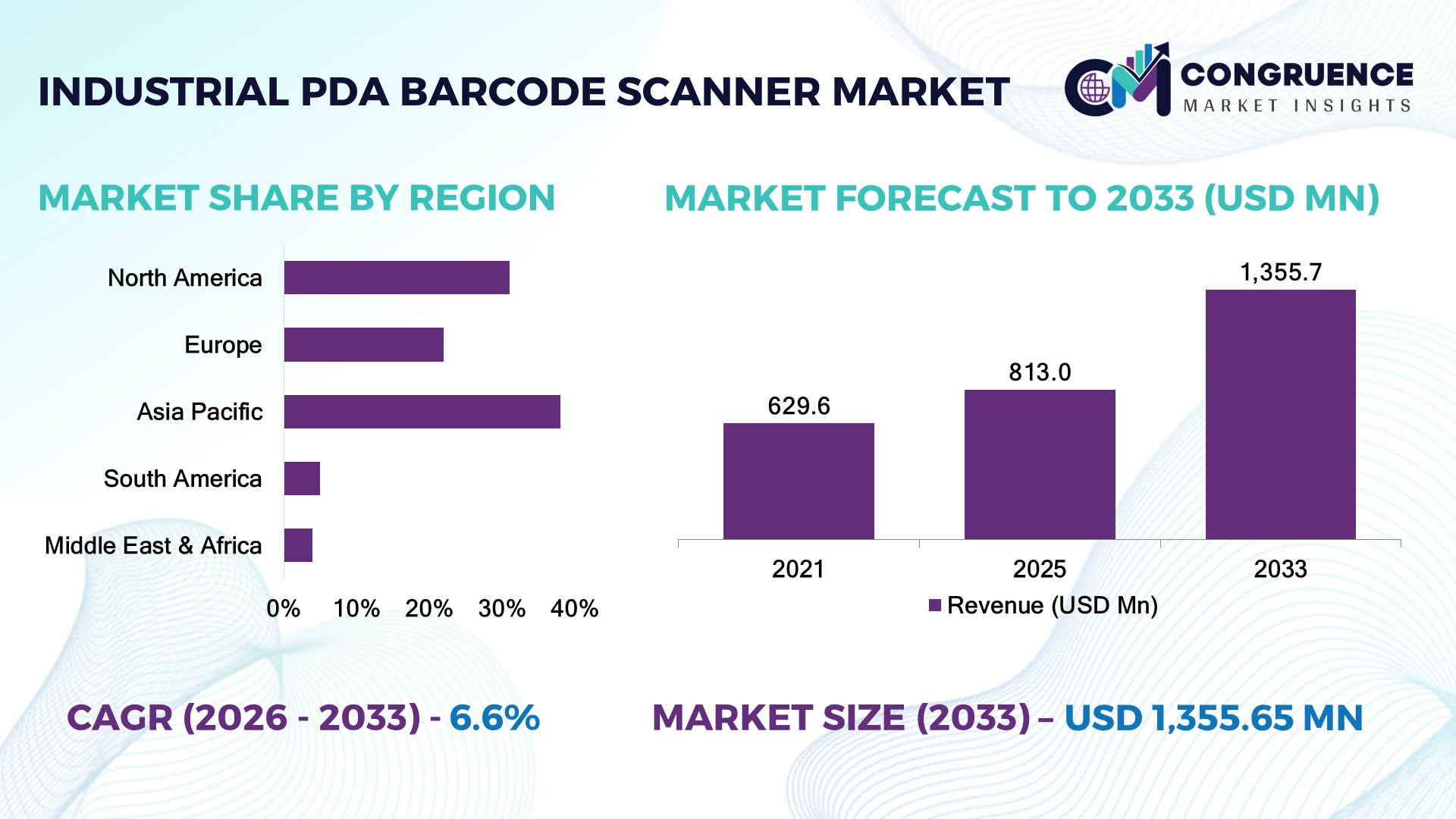
The Global Industrial PDA Barcode Scanner Market was valued at USD 813.0 Million in 2025 and is anticipated to reach a value of USD 1,355.7 Million by 2033 expanding at a CAGR of 6.6% between 2026 and 2033. Growth is driven by warehouse automation, real-time inventory visibility, rugged mobile computing adoption, and Industry 4.0 integration across logistics, manufacturing, and retail operations.
China dominates the global landscape with nearly 32% market adoption, supported by large-scale smart manufacturing investments, automated warehouses, and electronics production hubs under industrial modernization initiatives. The United States accounts for around 24% share, driven by advanced logistics networks and automation upgrades, while Germany maintains strong deployment across automotive facilities with over 70% of large manufacturers using digital tracking systems. Compared with India’s emerging adoption base of approximately 12%, China’s industrial scanner deployment remains significantly more mature due to deeper automation infrastructure.
Strategic implication Companies prioritizing AI-enabled scanning, connected workflows, and localized supply-chain solutions will gain stronger competitive positioning.
Market Size & Growth: USD 813.0 Million (2025) to USD 1,355.7 Million (2033) at 6.6% CAGR, driven by warehouse digitization and smart logistics adoption.
Top Growth Drivers: Automation adoption (35%), inventory accuracy improvement (40%), and mobile workforce digitization (30%) are accelerating industrial scanner deployments.
Short-Term Forecast: By 2028, enterprises are targeting 20%–30% faster warehouse processing through connected PDA scanning systems.
Emerging Technologies: AI-based recognition, 5G-enabled scanners, edge computing, and cloud-connected inventory platforms are reshaping operations.
Regional Leaders: Asia-Pacific projected near USD 520 Million by 2033 through manufacturing automation; North America near USD 360 Million through logistics upgrades; Europe near USD 300 Million through Industry 4.0 adoption.
Consumer/End-User Trends: Over 60% of large warehouses are adopting handheld scanning solutions to improve tracking accuracy and reduce manual entry.
Pilot/Case Example: A 2024 smart warehouse deployment reduced picking errors by 35% using AI-integrated PDA scanners and real-time analytics.
Competitive Landscape: Zebra Technologies leads with approximately 25% share, alongside Honeywell, Datalogic, Panasonic, and Urovo competing through rugged enterprise devices.
Regulatory & ESG Impact: Digital traceability initiatives improve operational transparency by more than 20% while supporting waste reduction programs.
Investment & Funding: Over USD 1 billion invested globally in warehouse automation technologies, increasing partnerships between scanner manufacturers and software providers.
Innovation & Future Outlook: Next-generation PDA scanners are shifting toward autonomous workflows, predictive analytics, and integrated industrial ecosystems.
Industrial PDA Barcode Scanners are becoming essential tools for high-volume logistics, manufacturing, healthcare, and retail environments requiring accurate data capture. Innovations such as AI-powered scanning, rugged Android-based devices, and cloud connectivity are improving operational efficiency, with enterprises reporting up to 40% faster inventory processing. The expansion of smart factories and supply-chain restructuring initiatives following global disruptions is accelerating demand for connected mobile data solutions, creating new opportunities for advanced scanner ecosystems.
Industrial PDA Barcode Scanners are becoming strategically important as enterprises transition from manual data collection toward connected, automated operations. Supply-chain restructuring, warehouse modernization, and the adoption of digital traceability frameworks are increasing the need for rugged mobile computing devices that provide instant inventory intelligence. Manufacturers are investing in integrated hardware-software platforms to strengthen operational resilience and reduce dependency on fragmented tracking systems.
Compared with traditional handheld barcode readers, advanced PDA scanners equipped with AI processing and wireless connectivity improve workflow speed by nearly 30% and reduce scanning errors by more than 25%. China and the United States remain large-scale deployment markets, while India and Southeast Asian economies are accelerating adoption through manufacturing expansion and logistics infrastructure development. Over the next 2–3 years, enterprise deployments are expected to focus on cloud integration, predictive inventory management, and automated fulfillment operations.
Companies are expanding through partnerships between scanner manufacturers, warehouse software providers, and automation specialists. Practical deployments in automotive plants, distribution centers, and e-commerce warehouses demonstrate measurable productivity gains. Strategic positioning will depend on delivering secure, intelligent, and scalable scanning solutions that improve operational accuracy and long-term competitiveness.
The rapid adoption of automated warehouses and connected manufacturing systems is strengthening demand for Industrial PDA Barcode Scanners. More than 45% of logistics operators are increasing investment in digital inventory tools, while automated facilities report up to 35% improvement in order-processing efficiency. The expansion of smart factories in China, Germany, and the United States is creating strong demand for rugged mobile scanning devices capable of operating in harsh environments. Companies such as Zebra Technologies and Honeywell are responding through AI-enabled devices, software integration, and strategic partnerships with warehouse automation providers. The key shift is moving from simple barcode capture toward real-time operational intelligence.
High initial investment and integration complexity remain major constraints for smaller industrial users. Advanced PDA scanners with rugged designs, wireless connectivity, and enterprise software compatibility can increase deployment costs by 20%–40% compared with conventional scanning systems. Supply-chain disruptions affecting semiconductor availability have also increased component procurement challenges, particularly across Asian manufacturing networks. Companies are reducing exposure through diversified sourcing, regional manufacturing strategies, and longer-term supplier agreements. The major operational challenge is balancing advanced functionality with affordability while maintaining compatibility with existing enterprise resource planning and warehouse management platforms.
AI-driven scanning, edge computing, and predictive analytics create significant opportunities for next-generation Industrial PDA Barcode Scanner solutions. AI-based recognition technologies can improve data accuracy by more than 30%, while cloud-connected platforms enable centralized monitoring across multiple facilities. India, Vietnam, and Mexico are emerging opportunities as manufacturers expand production bases and modernize logistics networks. Companies are increasing R&D investment in intelligent scanners, Android enterprise platforms, and automation partnerships. A major untapped opportunity lies in combining scanning hardware with operational analytics, enabling companies to optimize workforce productivity and reduce inventory inefficiencies.
Increasing connectivity creates cybersecurity and interoperability challenges for industrial scanning environments. More than 50% of enterprises now prioritize secure device management as connected warehouse ecosystems expand. Integration with legacy ERP systems, warehouse management software, and industrial networks remains a significant operational hurdle, particularly in older manufacturing facilities across developed markets. Companies must strengthen encryption, device monitoring, and software compatibility through investment in secure platforms and ecosystem partnerships. The long-term competitive advantage will depend on delivering reliable scanners that combine physical durability with advanced cybersecurity and seamless industrial integration.
AI-Powered Data Intelligence: Industrial PDA scanners are shifting from basic barcode capture toward AI-supported analytics, with more than 35% of large enterprises adopting intelligent data workflows and nearly 30% improvement reported in inventory decision speed. Automotive and logistics companies are integrating machine-learning capabilities, while manufacturers are partnering with software providers to enable predictive inventory control and automated exception handling. The transition is driven by labor shortages and the need for faster operational visibility.
Rugged Mobile Workforce Expansion: Demand is increasing for durable Android-based PDA scanners as warehouse and field operations become more mobile. Around 60% of logistics operators are upgrading handheld devices to improve worker productivity, while enterprises report 25%–35% faster scanning cycles after replacing legacy systems. Companies in the United States and Germany are expanding device fleets through subscription models and managed mobility partnerships to reduce technology replacement costs.
Cloud-Connected Supply Chains: Cloud integration is transforming scanner deployment by enabling centralized device management, real-time tracking, and remote troubleshooting. Nearly 50% of enterprises implementing connected warehouse platforms are prioritizing cloud-compatible scanning solutions. Supply-chain disruptions after global logistics volatility have pushed companies to restructure inventory visibility systems, encouraging manufacturers to develop secure cloud-enabled PDA ecosystems.
Automation-Driven Deployment Models: Industrial PDA scanners are becoming critical components of automated fulfillment networks, with smart warehouses achieving up to 40% improvement in picking accuracy and 20% reduction in manual processing time. Companies are combining scanners with robotics, RFID systems, and warehouse management platforms. A non-obvious shift is the growing adoption among mid-sized manufacturers seeking automation benefits without full warehouse replacement investments.
Rugged PDA Barcode Scanners represent the leading type segment, accounting for approximately 48% of the market due to their durability, extended battery performance, and ability to operate in harsh industrial environments. Their dominance is supported by manufacturing, logistics, and automotive facilities requiring reliable scanning under dust, temperature variation, and continuous-use conditions. Advanced rugged models with Android operating systems and wireless connectivity have improved workforce efficiency by nearly 30%, encouraging enterprises to replace traditional handheld devices. Standard PDA scanners remain widely deployed due to lower acquisition costs, while wearable and compact industrial scanning solutions are gaining traction as companies optimize worker mobility. Wearable-connected scanners are the fastest-growing type segment, expanding at adoption rates exceeding 20% among high-volume fulfillment operations. Companies are increasing investment in lightweight designs, integrated software platforms, and customized solutions to support flexible warehouse environments.
Warehouse and logistics operations account for the largest application segment with approximately 52% market share, driven by high-volume inventory tracking, order fulfillment, and distribution requirements. E-commerce expansion and supply-chain restructuring have increased the need for real-time scanning accuracy, with automated warehouses achieving up to 35% improvement in inventory processing speed through connected PDA systems. Companies are scaling deployments across distribution centers to improve throughput and reduce manual errors. Manufacturing applications represent another major segment, while healthcare, retail, and field service applications are expanding steadily. Manufacturing is the fastest-growing application area as smart factories adopt digital traceability and connected production workflows. More than 40% of industrial manufacturers are upgrading operational data systems, encouraging scanner providers to develop solutions compatible with enterprise resource planning and industrial automation platforms.
Logistics and distribution companies represent the dominant end-user segment with approximately 45% market share due to extensive warehouse networks, high transaction volumes, and continuous demand for inventory accuracy. Large logistics operators rely on PDA scanners to manage shipment tracking, sorting, and fulfillment activities, with connected systems improving workforce productivity by around 25%. Companies are prioritizing scalable device ecosystems and integrated warehouse management solutions. Manufacturing companies form the fastest-growing end-user group as smart factory initiatives expand across China, India, and Mexico. More than 35% of manufacturers are accelerating digital shop-floor transformation, increasing demand for rugged scanners linked with industrial software platforms. Retailers, healthcare organizations, and government users continue adopting specialized solutions, but investment is shifting toward industries requiring real-time operational intelligence. Scanner providers are responding through customized enterprise packages, software partnerships, and flexible deployment models.
Asia-Pacific accounted for the largest market share at 38% in 2025 however, North America is expected to register the fastest growth, expanding at a CAGR of 7.1% between 2026 and 2033.
North America represents one of the most technology-intensive Industrial PDA Barcode Scanner markets, supported by large-scale logistics networks, e-commerce fulfillment centers, and smart manufacturing investments. The region accounted for approximately 31% of global market share in 2025, with strong deployment across the United States automotive, retail, healthcare, and third-party logistics sectors. More than 65% of large warehouses in the United States use mobile scanning solutions to improve inventory visibility and workforce efficiency. Companies are expanding partnerships between scanner manufacturers, warehouse software providers, and automation firms to support AI-enabled workflows, cloud device management, and real-time tracking. Rising labor optimization initiatives and warehouse modernization programs are accelerating enterprise adoption.
United States Market Outlook: The United States remains the leading North American market due to its advanced logistics infrastructure and high automation penetration. Over 70% of major distribution operators have adopted digital inventory management technologies, driving demand for rugged PDA scanners integrated with warehouse management systems. Strong investment in e-commerce fulfillment and industrial automation continues to position the country as a strategic innovation hub.
Europe holds a significant position in the Industrial PDA Barcode Scanner market, supported by automotive manufacturing, industrial automation, and strict supply-chain traceability requirements. The region contributes nearly 22% of global market adoption, with Germany, France, and the United Kingdom representing major deployment centers. More than 55% of European manufacturers are increasing investments in connected production systems to improve operational visibility and compliance. Regulatory emphasis on digital documentation, sustainability reporting, and efficient resource management is encouraging companies to integrate advanced scanning technologies. Manufacturers are focusing on energy-efficient devices, secure enterprise mobility platforms, and partnerships with automation providers to modernize industrial operations.
Germany Market Outlook: Germany leads Europe through its advanced automotive and manufacturing ecosystem, where industrial digitalization is deeply integrated into production processes. Nearly 60% of large German factories utilize connected manufacturing technologies, supporting demand for rugged PDA scanners in production tracking, quality control, and warehouse management applications. The country’s Industry 4.0 initiatives continue to strengthen technology adoption.
Asia-Pacific represents the largest Industrial PDA Barcode Scanner market, accounting for approximately 38% global share in 2025, driven by manufacturing concentration, export activity, and rapid warehouse automation. China, Japan, South Korea, and India are major deployment markets, with China alone contributing more than 25% of global industrial scanner consumption due to its extensive electronics, automotive, and logistics sectors. Large manufacturers are integrating PDA scanners with robotics, cloud platforms, and automated inventory systems to improve production efficiency. Over 50% of smart factory projects in China incorporate digital data-capture technologies. Companies are expanding regional production capacity, forming technology partnerships, and developing cost-efficient solutions for high-volume industrial users.
China Market Outlook: China remains the dominant Asia-Pacific market due to its manufacturing ecosystem, smart factory expansion, and logistics modernization programs. More than 80% of large industrial enterprises have adopted some form of digital production management technology, creating strong demand for connected scanning solutions. Government-backed manufacturing upgrades continue supporting enterprise investment in automation infrastructure.
South America is an emerging Industrial PDA Barcode Scanner market, supported by modernization of logistics networks, retail distribution, and manufacturing operations. The region accounts for approximately 5% of global adoption, with Brazil and Argentina representing key markets. Warehouse operators are increasingly investing in digital tracking systems, with around 35% of large logistics companies upgrading inventory management processes. However, infrastructure limitations and uneven technology adoption across smaller enterprises continue influencing deployment speed. Companies are addressing these challenges through affordable scanner models, cloud-based solutions, and partnerships with local distributors. Growth is particularly visible in food processing, mining supply chains, and retail logistics.
Brazil Market Outlook: Brazil represents the largest South American market due to its extensive retail, agriculture, and industrial supply chains. Over 40% of major logistics operators are implementing digital inventory solutions to improve shipment visibility and warehouse accuracy. Expanding e-commerce activity and distribution infrastructure investments are strengthening demand for mobile scanning technologies.
The Middle East & Africa market is developing through logistics infrastructure expansion, smart city programs, and industrial diversification strategies. The region represents approximately 4% of global market share, with adoption concentrated in the United Arab Emirates, Saudi Arabia, and South Africa. Large logistics hubs and free-trade zones are deploying advanced warehouse technologies, with more than 30% of major distribution facilities adopting digital tracking systems. Investments linked to manufacturing diversification and supply-chain resilience are encouraging enterprises to implement connected PDA scanners. Companies are responding through regional partnerships, customized solutions, and expansion of service networks to support growing industrial requirements.
United Arab Emirates Market Outlook: The UAE is the leading regional market due to its advanced logistics infrastructure, automated ports, and smart commerce initiatives. Over 50% of major logistics facilities in Dubai use digital warehouse management technologies, increasing demand for rugged scanning solutions. Continued investment in transportation infrastructure and trade connectivity supports long-term adoption.
The Industrial PDA Barcode Scanner market features intense competition between global automation technology leaders and regional device manufacturers. Zebra Technologies, Honeywell, and Datalogic compete through premium enterprise solutions, while Urovo and Chainway Technology target cost-sensitive industrial users. The top five players collectively control approximately 55% of the market, creating a moderately concentrated structure. Competition is based on rugged hardware performance, software integration, device reliability, and supply-chain responsiveness. Advanced models deliver around 30% faster data processing and nearly 25% higher operational accuracy compared with conventional scanners. Companies are expanding through warehouse automation partnerships, Android enterprise platforms, and localized manufacturing strategies. The competitive landscape is shifting toward AI-enabled scanning, cloud connectivity, and cybersecurity capabilities, increasing pressure on traditional hardware-only suppliers. High R&D investment and ecosystem compatibility remain major entry barriers. Winning players must combine intelligent technology, customization, global support networks, and cost efficiency.
Honeywell International
Datalogic
Panasonic Connect
CipherLab
Urovo Technology
Chainway Information Technology
Unitech Electronics
Bluebird Inc.
Point Mobile
Newland AIDC
Keyence Corporation
Industrial PDA Barcode Scanner technology is advancing from traditional laser-based data capture toward AI-powered imaging, edge computing, and connected enterprise platforms. Advanced 2D imaging scanners now improve recognition accuracy by nearly 30% compared with older laser systems, while AI-based error detection reduces manual verification needs by around 20%. Adoption is increasing among logistics operators, smart factories, and retail distribution networks.
Cloud-connected PDA scanners and Android enterprise devices are becoming critical technologies, enabling centralized management, remote updates, and real-time analytics. Nearly 50% of large warehouse operators are prioritizing connected mobile devices to improve workforce visibility. Companies benefiting most are those integrating scanners with warehouse management systems, robotics, and automation platforms.
Between 2026 and 2028, disruptive technologies such as AI vision, 5G connectivity, and predictive analytics will reshape industrial scanning workflows. Autonomous inventory systems and intelligent mobile terminals will provide faster decision-making and lower operational costs. Manufacturers investing in secure software ecosystems, device interoperability, and vertical-specific solutions will gain stronger competitive advantages as scanning evolves from a capture tool into an industrial intelligence platform.
March 2025 – Zebra Technologies announced a collaboration with Merck KGaA to develop M-Trust™ traceability solutions using Zebra’s TC58 mobile computer with integrated 1D/2D barcode scanning, Wi-Fi 6E, and 5G connectivity. The solution improves product verification, supply-chain visibility, and counterfeit prevention for manufacturers. Source: www.zebra.com
March 2025 – Zebra Technologies unveiled new intelligent automation solutions at ProMat 2025, including AI-powered scanning, machine vision, and mobile computing technologies for warehouses and manufacturing facilities. Zebra reported that 63% of warehouse decision-makers plan to accelerate modernization investments, strengthening demand for connected scanning ecosystems. Source: www.zebra.com
May 2025 – Datalogic launched the PowerScan™ 9600 RFID Series, combining industrial barcode scanning and embedded UHF RFID reading within a single rugged handheld device. The innovation enables logistics, manufacturing, and healthcare users to improve multi-technology data capture flexibility and prepare operations for evolving tracking requirements. Source: www.datalogic.com
May 2025 – Panasonic Connect and Honeywell announced a strategic partnership to expand rugged mobile computing availability for mission-critical industries. The collaboration combines Panasonic TOUGHBOOK solutions with Honeywell rugged Android devices, improving deployment flexibility across healthcare, utilities, government, and industrial operations.
The Industrial PDA Barcode Scanner Market Report covers comprehensive analysis across product types, applications, end-users, regional markets, competitive positioning, and technology trends. The segmentation includes rugged PDA scanners, standard PDA scanners, and emerging mobile scanning solutions across logistics, manufacturing, retail, healthcare, and field service applications. Regional coverage evaluates North America, Europe, Asia-Pacific, South America, and Middle East & Africa with emphasis on industrial adoption patterns.
The report provides strategic insights into automation integration, AI-enabled scanning, cloud connectivity, enterprise mobility, and evolving deployment models. It evaluates competitive participation from leading manufacturers, technology innovators, and regional suppliers, supporting investment planning, market expansion decisions, and positioning strategies. Analysis of adoption trends, workflow modernization, and emerging industrial applications helps stakeholders understand market direction from 2026 to 2033.
| Report Attribute / Metric | Details |
|---|---|
| Market Revenue (2025) | USD 813.0 Million |
| Market Revenue (2033) | USD 1,355.7 Million |
| CAGR (2026–2033) | 6.6% |
| Base Year | 2025 |
| Forecast Period | 2026–2033 |
| Historic Period | 2021–2025 |
| Segments Covered |
By Type
By Application
By End-User
|
| Key Deliverables | Revenue Forecast; Market Trends; Growth Drivers & Restraints; Technology Insights; Segmentation Analysis; Regional Insights; Competitive Landscape; Regulatory & ESG Overview; Recent Developments |
| Regions Covered | North America; Europe; Asia-Pacific; South America; Middle East & Africa |
| Companies Profiled | Zebra Technologies; Honeywell International; Datalogic; Panasonic Connect; CipherLab; Urovo Technology; Chainway Information Technology; Unitech Electronics; Bluebird Inc.; Point Mobile; Newland AIDC; Keyence Corporation |
| Customization & Pricing | Available on Request (10% Customization Free) |




