
Reports
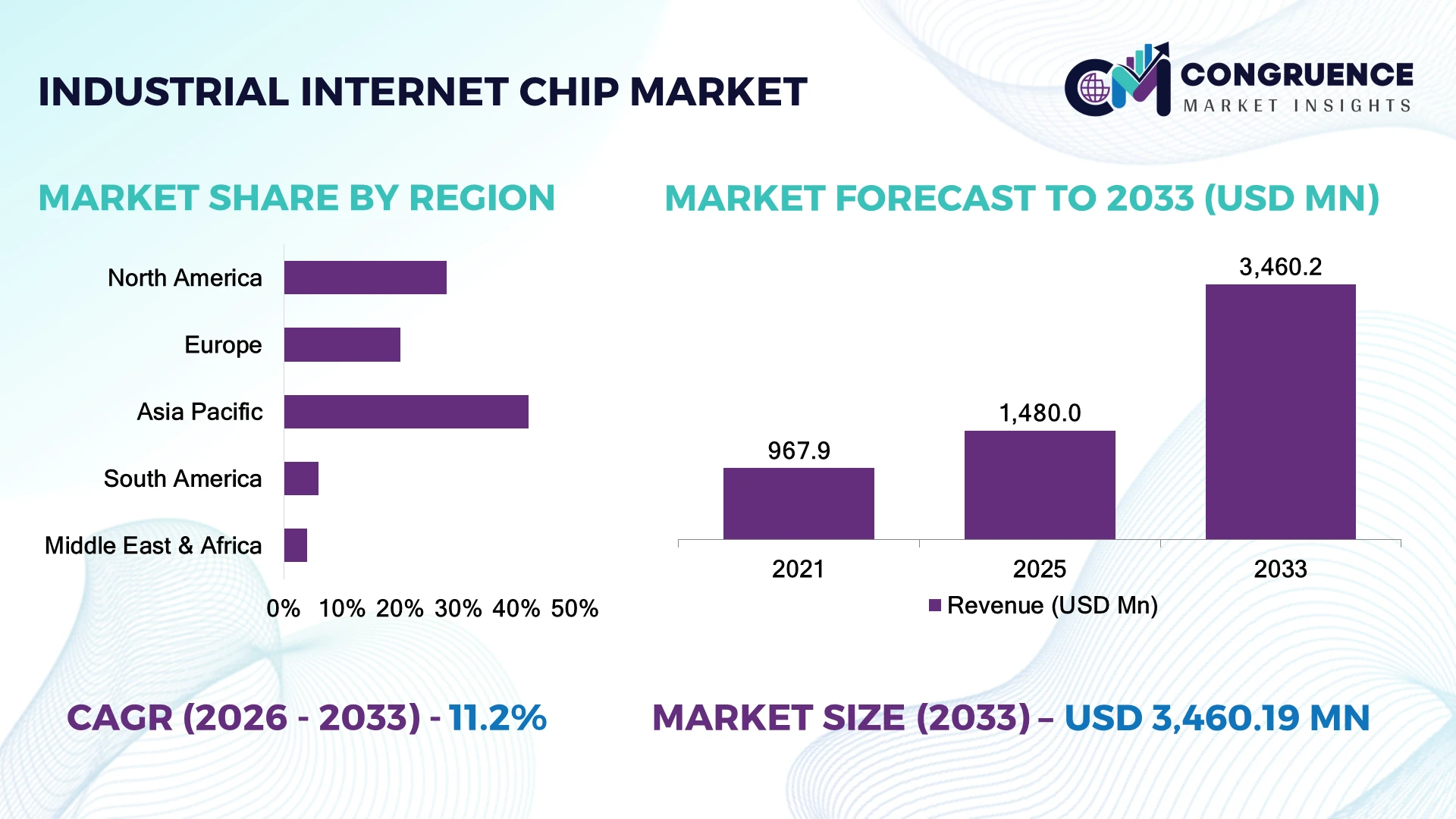
The Global Industrial Internet Chip Market was valued at USD 1,480.0 Million in 2025 and is anticipated to reach a value of USD 3,460.2 Million by 2033 expanding at a CAGR of 11.2% between 2026 and 2033. Growth is driven by AI-enabled industrial processors, edge computing deployment, semiconductor localization initiatives, and rising automation across smart factories.
China dominates the market with around 38% share, supported by large-scale semiconductor investments exceeding USD 100 billion under national chip programs and adoption across manufacturing, robotics, and industrial IoT networks. The United States follows with nearly 25% share, driven by advanced semiconductor ecosystems and defense-linked industrial applications. China’s smart manufacturing adoption exceeds 50% in major industrial sectors, while U.S. industrial facilities prioritize high-security edge computing architectures.
Strategic implication companies strengthening localized chip supply chains and industrial partnerships gain competitive advantage in next-generation automation markets.
Market Size & Growth: USD 1.48 Billion (2025) to USD 3.46 Billion (2033) at 11.2% CAGR, driven by industrial AI, edge computing, and factory automation expansion.
Top Growth Drivers: AI adoption (35%), industrial automation (30%), and connected equipment deployment (25%) are accelerating chip integration.
Short-Term Forecast: By 2028, industrial edge systems reduce processing latency by 40% and improve operational efficiency by 25%.
Emerging Technologies: AI accelerators, advanced semiconductor architectures, and real-time edge processing are reshaping industrial chip designs.
Regional Leaders: Asia-Pacific reaches USD 1.7 Billion with smart factory expansion; North America reaches USD 900 Million with secure edge adoption; Europe reaches USD 600 Million through Industry 4.0 programs.
Consumer/End-User Trends: More than 45% of industrial enterprises are adopting connected chip-based systems for predictive maintenance and automation.
Pilot/Case Example: In 2024, smart factory deployments using industrial chips achieved nearly 30% reduction in equipment downtime through predictive analytics.
Competitive Landscape: Intel leads with approximately 15% share, alongside NVIDIA, Qualcomm, NXP Semiconductors, Texas Instruments, and Renesas Electronics.
Regulatory & ESG Impact: Semiconductor efficiency improvements reduce industrial energy consumption by up to 20%, supporting global sustainability initiatives.
Investment & Funding: Over USD 80 Billion invested globally in semiconductor capacity expansion, driven by supply-chain diversification and regional manufacturing programs.
Innovation & Future Outlook: Next-generation industrial chips integrate AI, cybersecurity, and low-power architectures, shifting competition toward intelligent autonomous factories.
Industrial Internet Chips are becoming essential components for smart manufacturing ecosystems, with demand expanding across robotics, autonomous systems, and connected industrial infrastructure. Innovations in edge AI processors and secure communication modules are improving real-time decision-making, while approximately 40% of new industrial equipment incorporates advanced connectivity features. Supply-chain restructuring initiatives in Asia and Europe are accelerating localized semiconductor production and technology adoption, creating a stronger foundation for industrial digital transformation.
Industrial Internet Chips are becoming strategically important as manufacturers transition toward intelligent production systems requiring faster processing, secure connectivity, and autonomous decision-making. The shift toward localized semiconductor supply chains following global chip shortages has encouraged governments and enterprises to expand domestic production capabilities and strengthen industrial technology ecosystems.
Advanced industrial chips deliver measurable advantages compared with traditional processing systems, reducing data transmission delays by nearly 50% through edge computing while lowering operational costs through real-time analytics. China maintains leadership in manufacturing-scale deployment, while the United States emphasizes high-performance computing, cybersecurity, and specialized industrial applications. Europe focuses on energy-efficient industrial systems aligned with digital modernization initiatives.
Over the next 2–3 years, industrial enterprises are increasing investments in AI-enabled controllers, robotics integration, and connected equipment upgrades. Companies are forming partnerships with semiconductor designers and automation providers to improve supply reliability and accelerate deployment. Industrial chip platforms supporting predictive maintenance, autonomous operations, and energy optimization will define competitive positioning as manufacturers pursue higher productivity and operational resilience.
AI-powered automation and edge computing adoption are the primary drivers reshaping industrial chip demand. Smart factories using connected semiconductor solutions improve equipment monitoring accuracy by over 30% and reduce operational interruptions by nearly 25%. China’s manufacturing sector is rapidly integrating AI controllers, while Germany and Japan expand Industry 4.0 deployments. Semiconductor companies are responding through R&D investments, AI processor development, and partnerships with industrial automation providers. The growing need for real-time processing is shifting chip design priorities from basic connectivity toward intelligent, energy-efficient industrial computing platforms.
Supply-chain concentration and semiconductor manufacturing constraints remain major limitations for industrial chip scalability. Advanced chip production requires specialized fabrication facilities, with leading-edge semiconductor capacity concentrated among a limited number of countries. Material shortages have increased component procurement challenges by more than 20% in certain industrial segments. Companies are reducing exposure through supplier diversification, regional manufacturing agreements, and long-term capacity contracts. The United States, Europe, and Asian economies are increasing domestic semiconductor investments to strengthen supply resilience and reduce dependence on concentrated production networks.
The expansion of smart factories, autonomous equipment, and industrial AI platforms creates significant opportunities for advanced chip providers. Industrial automation adoption is increasing by more than 30% across manufacturing hubs, while edge AI deployments improve processing efficiency by approximately 35%. Emerging markets are investing in digital infrastructure modernization and connected production systems. Companies are developing customized chip architectures, forming ecosystem partnerships, and expanding product portfolios for robotics, energy management, and intelligent transportation applications. The integration of low-power AI processors represents a strategic opportunity for manufacturers seeking sustainable and efficient industrial operations.
Industrial Internet Chip deployment faces challenges related to cybersecurity, interoperability, and workforce capability gaps. Connected industrial systems experience increasing cyber risks, with industrial attacks rising by more than 25% in recent years. Integration between legacy equipment and advanced chip-based platforms creates deployment complexity across factories. Companies must invest in secure chip architectures, standardized communication protocols, and skilled engineering resources. Industrial leaders are prioritizing cybersecurity partnerships and modular technology platforms to maintain operational reliability while expanding connected manufacturing networks across global production environments.
Edge AI Processing Expansion: Industrial enterprises are shifting from centralized computing toward edge AI chip architectures, with adoption increasing by nearly 35% across smart manufacturing environments. Companies are deploying real-time processing units to reduce latency by 40% and improve machine response speed. Supply-chain disruptions in advanced semiconductor availability have accelerated localized chip development strategies, encouraging manufacturers to expand domestic production partnerships and optimize industrial data workflows.
Secure Industrial Connectivity Growth: Rising cybersecurity requirements are driving adoption of secure industrial chips with integrated encryption and authentication features, increasing deployment by approximately 30% in critical infrastructure systems. Regulatory pressure on operational technology security in countries such as the United States and Germany is pushing enterprises toward trusted semiconductor platforms. Chip manufacturers are responding through embedded security innovations, firmware protection, and collaborations with automation solution providers.
Energy-Efficient Chip Architectures: Industrial operators are prioritizing low-power semiconductor designs as energy optimization becomes a key operational target. Advanced industrial chips improve processing efficiency by nearly 25% while reducing system power consumption by around 20%. Companies are redesigning product portfolios with energy-efficient processors and compact architectures, particularly for robotics, industrial sensors, and autonomous equipment where continuous operation is essential.
Localized Semiconductor Ecosystems: Global manufacturers are restructuring procurement strategies as semiconductor supply concentration remains a major operational concern. Government-led initiatives in China, India, and the United States are supporting domestic chip manufacturing expansion, with localization programs improving supply resilience by more than 30%. Companies are forming regional partnerships, increasing fabrication investments, and diversifying suppliers to secure long-term industrial chip availability.
Integrated chips dominate the Industrial Internet Chip Market, accounting for approximately 42% share due to their scalability, compact design, and ability to combine processing, communication, and control functions within industrial systems. Their widespread use in smart factories, robotics, and connected equipment reduces hardware complexity and improves deployment efficiency. Standard processors and communication chips maintain strong demand, contributing nearly 35% combined adoption, particularly in established industrial automation environments. AI-enabled industrial chips represent the fastest-growing type, expanding as enterprises prioritize real-time analytics and autonomous decision-making. Adoption of AI accelerators within industrial platforms has increased by more than 30%, driven by predictive maintenance and machine vision applications. Companies are investing in advanced chip architectures, strategic semiconductor partnerships, and customized solutions to improve processing performance. Emerging AI-integrated designs are reshaping investment priorities as manufacturers move toward intelligent and self-optimizing industrial operations.
Smart manufacturing represents the leading application segment with approximately 45% market share, supported by widespread adoption of industrial automation, robotics, and connected production systems. Manufacturers rely on industrial chips for machine control, real-time monitoring, and predictive maintenance, improving operational visibility and reducing downtime. Industrial automation applications account for nearly 30% adoption as factories modernize legacy equipment with connected semiconductor solutions. Industrial robotics and energy management applications are emerging as high-growth areas, driven by workforce shortages and increasing demand for autonomous operations. Robotics-based chip deployment has increased by more than 35% as companies integrate intelligent controllers and AI-powered systems into production lines. Remaining applications, including logistics automation and infrastructure monitoring, continue expanding through digital transformation programs. Companies are responding by developing application-specific chips, strengthening ecosystem partnerships, and scaling integrated hardware-software platforms.
Manufacturing companies represent the largest end-user segment, accounting for approximately 50% market share due to extensive reliance on automation infrastructure, robotics, and industrial IoT systems. Large-scale factories require high-performance chips for equipment control, monitoring, and data processing, creating strong demand concentration. Automotive, electronics, and heavy machinery manufacturers are among the largest adopters, with smart factory investments increasing by nearly 35% in major industrial hubs. Energy and utilities represent the fastest-growing end-user group as operators deploy industrial chips for grid monitoring, renewable integration, and infrastructure optimization. Adoption within energy systems has increased by more than 30% as companies modernize operational networks and improve asset management. Logistics, transportation, and government infrastructure users are also expanding adoption through connected systems and automation initiatives. Chip providers are targeting these segments through customized solutions, strategic partnerships, and industry-specific platforms that address reliability, security, and scalability requirements.
Asia-Pacific accounted for the largest market share at 42% in 2025 however, North America is expected to register the fastest growth, expanding at a CAGR of 12.5% between 2026 and 2033.

North America held approximately 28% share of the Industrial Internet Chip Market in 2025, supported by strong semiconductor capabilities, industrial automation adoption, and high investment in smart manufacturing infrastructure. The United States represents the largest contributor, driven by aerospace, automotive, defense, and advanced manufacturing applications. More than 40% of large industrial enterprises in the region are integrating edge-based computing solutions to improve real-time operations. Government-backed semiconductor initiatives and private-sector investments exceeding USD 50 billion are strengthening domestic chip production and supply resilience. Companies are expanding fabrication partnerships, developing secure industrial processors, and increasing AI-enabled chip deployments to support next-generation industrial networks.
United States Market Outlook: The United States maintains a dominant position through advanced semiconductor design capabilities, industrial automation leadership, and strong enterprise adoption. The country accounts for nearly 24% of global industrial chip demand, with manufacturers increasingly deploying AI-powered controllers and secure edge processors across automotive, energy, and defense facilities. Domestic semiconductor expansion programs are accelerating local supply-chain development and reducing dependency on overseas production.
Europe accounted for approximately 20% market share in 2025, supported by industrial modernization programs, automotive manufacturing strength, and demand for energy-efficient automation systems. Germany, France, and Italy are leading adoption through smart factory investments and advanced industrial equipment upgrades. Nearly 35% of European manufacturers have integrated connected automation technologies to improve production visibility and efficiency. Regulatory emphasis on semiconductor resilience and sustainable manufacturing is encouraging local technology development. Companies are responding by investing in low-power chip designs, industrial cybersecurity solutions, and partnerships with automation providers to strengthen digital production ecosystems.
Germany Market Outlook: Germany represents the leading European market with around 8% global industrial internet chip demand, supported by its automotive, machinery, and industrial equipment sectors. More than 50% of large manufacturers are implementing Industry 4.0 solutions, increasing demand for high-performance industrial processors, embedded systems, and intelligent control technologies.
Asia-Pacific dominated the Industrial Internet Chip Market with approximately 42% share in 2025, driven by large-scale manufacturing operations, semiconductor production capacity, and rapid smart factory deployment. China, Japan, South Korea, and India are key contributors due to strong electronics, automotive, and industrial automation ecosystems. China alone contributes nearly 30% of global industrial chip consumption, supported by extensive factory digitization initiatives. More than 50% of major manufacturing facilities in leading Asian economies are adopting connected industrial technologies. Companies are expanding regional production networks, investing in semiconductor fabrication capabilities, and forming partnerships to secure industrial chip supply chains.
China Market Outlook: China leads the Asia-Pacific market through its manufacturing ecosystem, semiconductor investments, and industrial automation initiatives. The country accounts for approximately 30% market share globally and has accelerated smart manufacturing adoption across electronics, automotive, and machinery industries. Government-supported semiconductor programs and domestic production expansion are strengthening industrial chip availability.
South America represented nearly 6% market share in 2025, with adoption concentrated in Brazil, Argentina, and Chile across mining, energy, manufacturing, and logistics sectors. Industrial chip deployment is increasing as companies modernize operational infrastructure and introduce automation into resource-intensive industries. Brazil contributes around 3% of global demand, supported by manufacturing and energy applications. More than 25% of large industrial operators in key sectors are adopting connected monitoring systems to improve asset performance. Companies are addressing infrastructure limitations through technology partnerships, localized service networks, and scalable industrial IoT platforms.
Brazil Market Outlook: Brazil is the largest South American market, supported by mining, agriculture technology, energy, and manufacturing industries. The country contributes approximately half of the region’s industrial internet chip demand, with growing adoption of automation systems and connected equipment. Investments in industrial modernization are creating opportunities for semiconductor suppliers and technology integrators.
Middle East & Africa accounted for around 4% market share in 2025, supported by industrial diversification programs, infrastructure modernization, and automation investments. Gulf countries are leading adoption through smart city projects, energy optimization initiatives, and industrial digital transformation programs. The United Arab Emirates and Saudi Arabia are expanding technology infrastructure, with industrial automation deployment increasing by more than 20% across selected sectors. Companies are investing in secure industrial connectivity solutions, advanced monitoring systems, and localized technology partnerships to support operational efficiency. Supply-chain diversification strategies are also encouraging regional technology ecosystem development.
Saudi Arabia Market Outlook: Saudi Arabia represents the most strategically significant market in the region due to large-scale industrial transformation initiatives and infrastructure investments. The country contributes nearly 2% of global industrial internet chip demand, with adoption increasing across energy, manufacturing, and smart infrastructure projects. Industrial digitalization programs are driving demand for connected semiconductor technologies and intelligent control systems.
The Industrial Internet Chip Market features competition between global semiconductor leaders such as Intel, NVIDIA, Texas Instruments, and NXP Semiconductors against specialized industrial chip providers and regional innovators. The top five players collectively account for approximately 45% market share, reflecting a moderately consolidated structure. Competition is driven by processor performance, industrial-grade reliability, supply-chain control, customization, and cybersecurity integration, with advanced chip solutions improving processing efficiency by 25–35%. Global leaders are expanding AI-enabled semiconductor portfolios, while regional players compete through cost optimization and application-specific designs. Companies are strengthening positions through fabrication partnerships, ecosystem alliances, and vertical integration across hardware and software platforms. The competitive landscape is shifting toward AI acceleration, edge computing capabilities, and localized semiconductor production. High fabrication costs, intellectual property requirements, and technology expertise create significant entry barriers. Winning requires superior chip innovation, secure supply networks, and deep industrial ecosystem partnerships.
NVIDIA Corporation
Texas Instruments Incorporated
NXP Semiconductors N.V.
Qualcomm Incorporated
Renesas Electronics Corporation
STMicroelectronics N.V.
Infineon Technologies AG
Analog Devices, Inc.
Microchip Technology Incorporated
Broadcom Inc.
MediaTek Inc.
Industrial Internet Chip technologies are advancing through AI accelerators, edge computing processors, and secure semiconductor architectures. AI-enabled chips improve industrial decision-making speed by nearly 40% compared with traditional processors, enabling predictive maintenance and autonomous operations. Adoption of edge processing platforms is increasing across smart factories, with more than 45% of advanced manufacturing facilities integrating localized computing capabilities to reduce latency and improve operational control.
A major technology transition involves replacing conventional industrial controllers with AI-integrated edge chips that deliver approximately 30% higher processing efficiency and reduce data transmission requirements. Companies benefiting most include semiconductor innovators and automation providers developing customized solutions for robotics, industrial vision, and connected infrastructure. Secure embedded processors are also gaining importance as cyber protection becomes a core industrial requirement.
Between 2026 and 2028, industrial chip platforms will increasingly combine AI, cybersecurity, and energy-efficient architectures. Companies investing in scalable chip ecosystems, advanced packaging, and software integration will gain competitive advantages as manufacturers prioritize intelligent automation, operational resilience, and real-time industrial analytics.
April 2024 Intel Corporation and Altera introduced new edge-optimized processors and FPGA solutions for AI-enabled industrial applications at Embedded World. The solutions expanded AI deployment across industrial, automotive, healthcare, and defense sectors, improving edge processing flexibility through programmable architectures. Source: www.newsroom.intel.com
February 2025 NXP Semiconductors announced the acquisition agreement for Kinara, an edge AI semiconductor company, strengthening its neural processing capabilities. The acquisition integrates Kinara’s energy-efficient NPUs with NXP’s processing and connectivity portfolio to accelerate AI-powered industrial edge systems and intelligent IoT deployments. Source: www.nxp.com
June 2025 NVIDIA Corporation announced the development of an industrial AI cloud in Germany powered by 10,000 GPUs to support European manufacturing applications. The platform targets digital twins, robotics, and factory optimization, enabling industrial companies including BMW Group and Siemens ecosystem partners to accelerate AI-driven production workflows. Source: www.nvidianews.nvidia.com
June 2025 Texas Instruments Incorporated announced a more than USD 60 billion investment in seven U.S. semiconductor fabs across Texas and Utah to expand foundational chip manufacturing capacity. The initiative supports more than 60,000 jobs and strengthens domestic supply resilience for industrial and embedded semiconductor demand.
The Industrial Internet Chip Market Report covers comprehensive analysis across chip types, including integrated chips, processors, communication chips, AI-enabled chips, and other industrial semiconductor solutions. The report evaluates applications such as smart manufacturing, industrial automation, robotics, energy management, and connected infrastructure. It includes end-user analysis covering manufacturing, energy and utilities, transportation, government infrastructure, and other industrial sectors.
The report provides regional insights across North America, Europe, Asia-Pacific, South America, and Middle East & Africa, highlighting adoption patterns, production capabilities, technology integration, and investment trends. Coverage includes emerging areas such as edge AI processing, secure industrial connectivity, and intelligent automation platforms. The analysis supports strategic decisions related to expansion planning, technology partnerships, competitive positioning, supply-chain development, and market opportunities through 2026–2033.
| Report Attribute / Metric | Details |
|---|---|
| Market Revenue (2025) | USD 1,480.0 Million |
| Market Revenue (2033) | USD 3,460.2 Million |
| CAGR (2026–2033) | 11.2% |
| Base Year | 2025 |
| Forecast Period | 2026–2033 |
| Historic Period | 2021–2025 |
| Segments Covered |
By Type
By Application
By End-User
|
| Key Deliverables | Revenue Forecast; Market Trends; Growth Drivers & Restraints; Technology Insights; Segmentation Analysis; Regional Insights; Competitive Landscape; Regulatory & ESG Overview; Recent Developments |
| Regions Covered | North America; Europe; Asia-Pacific; South America; Middle East & Africa |
| Companies Profiled | Intel Corporation; NVIDIA Corporation; Texas Instruments Incorporated; NXP Semiconductors N.V.; Qualcomm Incorporated; Renesas Electronics Corporation; STMicroelectronics N.V.; Infineon Technologies AG; Analog Devices, Inc.; Microchip Technology Incorporated; Broadcom Inc.; MediaTek Inc. |
| Customization & Pricing | Available on Request (10% Customization Free) |




