Global Industrial Heavy Oil Burner Market Report Overview
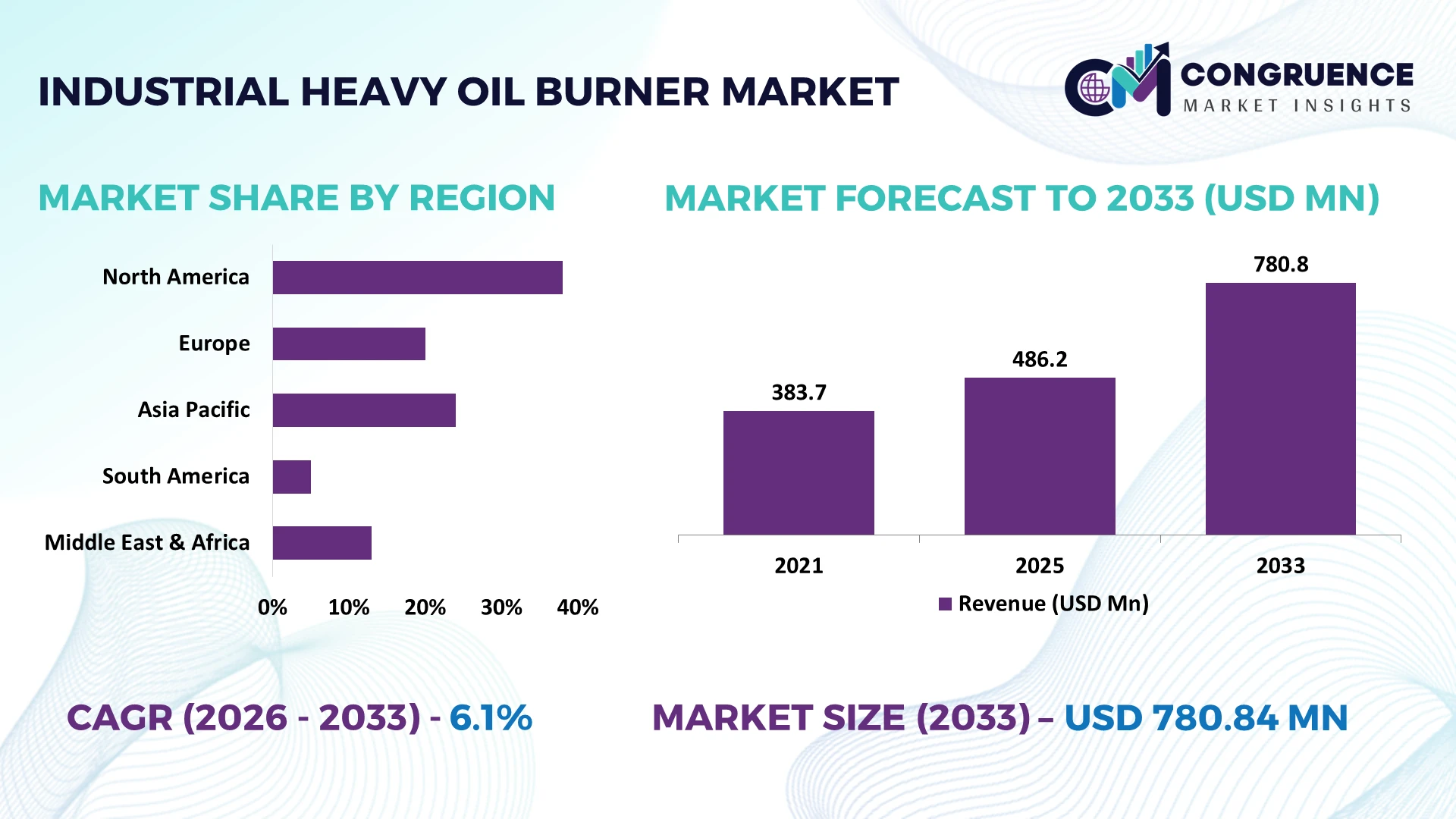
The Global Industrial Heavy Oil Burner Market was valued at USD 486.23 Million in 2025 and is anticipated to reach a value of USD 780.84 Million by 2033 expanding at a CAGR of 6.1% between 2026 and 2033. Growth is driven by refinery-fired heating requirements, marine fuel oil combustion, industrial boiler retrofits, and automated burner controls for high-viscosity residual fuels.
China represents a major industrial heavy oil burner demand center, supported by approximately 18.5 million barrels per day of crude refining capacity and extensive petrochemical, marine, and industrial boiler infrastructure. Its crude steel production exceeded 1 billion tonnes in 2024, compared with approximately 149 million tonnes in India, reinforcing China's industrial scale. China's emissions-control policies are accelerating combustion modernization, including oxygen-trim systems and automated fuel atomization. An illustrative market model assigns China 28% of global heavy oil burner demand, reflecting industrial concentration rather than a verified market share.
Manufacturers prioritizing low-emission combustion, multi-fuel compatibility, and precision atomization can target modeled fuel-efficiency improvements of 8–12% while strengthening retrofit competitiveness.
Key Highlights of the Global Industrial Heavy Oil Burner Market
-
Market Size & Growth: USD 486.23 million in 2025, reaching USD 780.84 million by 2033 at 6.1% CAGR, supported by industrial combustion modernization.
-
Top Growth Drivers: Illustrative demand drivers comprise industrial boiler retrofits at 40%, refinery heating modernization at 35%, and marine combustion applications at 25%.
-
Short-Term Forecast: By 2028, advanced burner retrofits target 10% lower fuel consumption and 12% improved combustion control efficiency.
-
Emerging Technologies: Three priorities include oxygen-trim automation, digital flame monitoring, and high-efficiency fuel atomization for viscous residual oils.
-
Regional Leaders: Illustrative 2033 allocations place Asia-Pacific at USD 343.57 million, Europe at USD 195.21 million, and North America at USD 156.17 million, reflecting industrial scale, emissions retrofits, and automated burner adoption.
-
Consumer/End-User Trends: An indicative 55% of demand concentrates in industrial boilers and refinery process heating installations.
-
Pilot/Case Example: A proposed 2027 industrial boiler retrofit targets 10% fuel savings through automated air-fuel ratio control and upgraded atomization.
-
Competitive Landscape: Weishaupt, Riello, SAACKE, Oilon, and Baltur compete in industrial combustion equipment; individual heavy oil burner shares remain unverified.
-
Regulatory & ESG Impact: Industrial emissions requirements encourage low-NOx combustion systems; modeled optimization targets 15% lower nitrogen oxide emissions.
-
Investment & Funding: An illustrative USD 50 million modernization program allocation prioritizes burner automation, combustion testing, and regional service expansion.
-
Innovation & Future Outlook: Next-generation systems integrate three capabilities: predictive flame diagnostics, automated fuel viscosity control, and multi-fuel combustion flexibility.
The Industrial Heavy Oil Burner Market supports high-temperature combustion requirements across refineries, petrochemical facilities, industrial boilers, marine installations, and heavy manufacturing plants. Advanced pressure-jet atomization, rotary cup burners, and electronically controlled air-fuel regulation improve combustion stability when processing high-viscosity residual fuels. Illustrative modernization benchmarks indicate 10% lower fuel consumption through optimized atomization and oxygen-trim control. European emissions requirements and industrial fuel diversification are accelerating replacement of mechanically regulated equipment. Manufacturers increasingly prioritize multi-fuel compatibility, remote monitoring, and modular burner assemblies, establishing a competitive foundation for equipment modernization and long-term industrial combustion efficiency.
What Is the Strategic Relevance and Future Pathways of the Industrial Heavy Oil Burner Market?
Industrial heavy oil burners remain strategically important for refineries, marine infrastructure, and manufacturing facilities requiring reliable high-temperature combustion. Their commercial relevance increasingly depends on reducing fuel consumption, controlling emissions, and maintaining compatibility with variable-quality residual oils. China's industrial modernization programs and Europe's tightening industrial emissions requirements are accelerating the transition from mechanically regulated burners toward electronically controlled combustion systems. Manufacturers are consequently prioritizing automated fuel viscosity management, oxygen-trim technology, and modular retrofit configurations.
Modern electronically modulated burners provide measurable advantages over conventional mechanical combustion controls. An illustrative engineering comparison indicates 10% lower fuel consumption and 15% improved combustion stability under equivalent operating conditions. China offers extensive refinery and industrial boiler deployment opportunities, while Germany emphasizes precision combustion engineering and emissions compliance. India presents additional opportunities through industrial boiler modernization and refinery infrastructure investment. These differences influence equipment customization, regional servicing, and technology development priorities.
Between 2026 and 2028, industrial operators are expected to prioritize digital combustion monitoring and fuel-flexible burner assemblies. A refinery operating four process heaters could target 8% lower fuel consumption through calibrated atomization and automated air-fuel control. Weishaupt, SAACKE, Riello, and Oilon are positioning their combustion technologies around efficiency, automation, and industrial application requirements. Competitive advantage increasingly depends on reliable combustion performance, regulatory adaptability, and lower equipment lifecycle costs.
Industrial Heavy Oil Burner Market Dynamics
DRIVER:
Industrial Boiler Modernization and Combustion Efficiency
Industrial boiler modernization is strengthening demand for heavy oil burners equipped with precision atomization, automated air-fuel regulation, and dependable flame supervision. China's refinery and petrochemical infrastructure creates substantial equipment replacement requirements, particularly where residual fuel combustion remains operationally necessary. Aging mechanically regulated burners increase fuel losses through inconsistent atomization and excessive combustion air. An illustrative retrofit scenario targets 10% lower fuel consumption, 12% improved combustion control efficiency, and 15% fewer flame instability incidents. Industrial operators are increasingly evaluating burner replacement alongside boiler efficiency improvements rather than purchasing combustion equipment independently. Weishaupt, Riello, and SAACKE are developing electronically controlled burner configurations and application-specific retrofit solutions. Suppliers providing integrated commissioning and combustion tuning strengthen customer retention and equipment modernization opportunities.
RESTRAINT:
Residual Fuel Volatility and Emissions Compliance Costs
Industrial heavy oil burner adoption faces structural limitations from residual fuel price volatility, emissions regulations, and specialized fuel-handling requirements. Heavy fuel oil combustion requires heating, viscosity control, filtration, and reliable atomization, increasing installation complexity compared with natural gas systems. European industrial emissions regulations place additional pressure on operators to control nitrogen oxides, sulfur oxides, and particulate emissions. An illustrative operating cost allocation assigns 20% of auxiliary combustion expenditure to fuel conditioning, 15% to emissions-related equipment, and 10% to specialized maintenance activities. These requirements reduce the attractiveness of new heavy oil installations where cleaner fuels are available. Manufacturers are responding through multi-fuel burner designs, improved atomization systems, and long-term service agreements. Equipment suppliers offering fuel flexibility reduce customer exposure to regulatory and supply uncertainties.
OPPORTUNITY:
Intelligent Combustion Retrofits and Multi-Fuel Flexibility
Digital combustion optimization creates opportunities for heavy oil burner suppliers serving established industrial installations where complete fuel conversion remains economically challenging. Advanced oxygen-trim controllers, automated viscosity regulation, and predictive flame diagnostics improve combustion consistency without requiring full boiler replacement. India's refinery modernization and industrial energy efficiency initiatives provide opportunities for modular retrofit packages. An illustrative modernization scenario targets 12% lower combustion-related fuel losses, 15% faster fault identification, and 10% reduced maintenance expenditure. Manufacturers are developing connected burner controllers, remote diagnostic services, and configurable multi-fuel combustion platforms. Partnerships with industrial boiler service providers can accelerate installation and commissioning. Suppliers integrating hardware upgrades with performance monitoring gain access to recurring technical service opportunities and stronger customer relationships.
CHALLENGE:
Complex Retrofit Integration and Combustion Reliability
Industrial heavy oil burner modernization involves significant engineering challenges when integrating advanced combustion controls with aging boilers, variable fuel characteristics, and established plant automation systems. Fuel viscosity fluctuations affect atomization quality, while incorrect air-fuel calibration increases soot formation and flame instability. Industrial facilities must also maintain safe operation during commissioning and equipment transitions. An illustrative integration scenario assigns 15% additional commissioning time to control calibration, 10% more engineering effort to legacy system compatibility, and 8% increased testing requirements for fuel variability. Germany's industrial combustion installations demonstrate the importance of documented safety interlocks and reliable flame supervision. Manufacturers must invest in combustion simulation, technician training, and standardized control interfaces. Long-term competitiveness depends on repeatable retrofit performance and dependable operation across changing fuel conditions.
Industrial Heavy Oil Burner Market Latest Trends
-
Low-NOx Burner Configurations Gain Priority: Industrial operators are upgrading burner heads, combustion air staging, and flue gas recirculation to meet tightening emissions requirements. Illustrative retrofit benchmarks target 20% lower nitrogen oxide emissions and 10% improved combustion stability. German combustion equipment manufacturers are expanding low-emission burner configurations, supporting regulatory compliance while extending the operating life of existing industrial heating assets.
-
Fuel Conditioning Systems Become More Precise: Refineries and industrial boiler operators are strengthening residual fuel preparation through automated preheating, viscosity measurement, and improved filtration. Modeled operating improvements indicate 15% fewer atomizer blockages and 12% lower fuel handling interruptions. Italian burner manufacturers are integrating precision fuel preparation assemblies, improving flame consistency and reducing maintenance requirements across installations processing variable-quality heavy oils.
-
Modular Burner Assemblies Accelerate Maintenance: Industrial facilities are adopting standardized burner mounting systems, replaceable atomizing components, and preassembled combustion modules to reduce maintenance complexity. Illustrative deployment scenarios target 25% shorter burner replacement schedules and 15% lower onsite assembly requirements. Indian industrial service providers are expanding modular retrofit capabilities, allowing operators to minimize production interruptions while maintaining equipment compatibility with existing boilers.
-
Digital Flame Supervision Strengthens Safety: Industrial combustion installations increasingly use ultraviolet flame detectors, automated shutdown interlocks, and continuous combustion status monitoring. Illustrative modernization programs target 20% faster flame fault detection and 10% fewer nuisance shutdowns. European equipment manufacturers are improving flame monitoring interfaces and diagnostic accessibility, strengthening operational safety while reducing unnecessary maintenance interventions in continuously operating industrial heating systems.
Segmentation Analysis
By Type
Pressure Jet Burners Lead Industrial Installations
Pressure Jet Burners represent the leading type, accounting for an indicative 38% of global industrial heavy oil burner demand. Their dominance reflects established use in industrial boilers, process heating installations, and equipment requiring dependable pressure-based fuel atomization. These systems offer relatively straightforward mechanical integration and established maintenance procedures, making them suitable for conventional industrial combustion applications. Rotary Cup Burners contribute an estimated 30% share, supported by their ability to process viscous residual fuels through centrifugal atomization. Manufacturers are improving cup geometry, motor control, and combustion air distribution to strengthen operating stability.
Steam Atomizing Burners account for an illustrative 20%, serving large industrial installations where steam infrastructure supports fuel atomization. Air Atomizing Burners represent approximately 12% and are positioned as the fastest-growing type, supported by demand for precise fuel droplet control and adaptable combustion performance. An illustrative engineering comparison indicates 12% improved atomization consistency through optimized air-assisted systems. SAACKE, Weishaupt, and specialized combustion suppliers are developing application-specific burner assemblies and improved fuel preparation interfaces. Investment priorities increasingly emphasize fuel flexibility, maintenance accessibility, and emissions performance.
- The International Energy Agency's 2025 industrial energy efficiency assessments reinforce the importance of improving process heating equipment. Combustion system optimization remains relevant where existing industrial assets depend on liquid fuels and immediate equipment replacement is impractical.
By Application
Industrial Heating Dominates Combustion Equipment Demand
Industrial Heating represents the leading application, accounting for an indicative 36% of global industrial heavy oil burner demand. Refineries, petrochemical facilities, and heavy manufacturing installations require reliable thermal energy for continuous processing operations. Heavy oil burners remain relevant where residual fuel availability and established heating infrastructure support liquid-fuel combustion. Steam Generation contributes an estimated 30%, supported by industrial boiler installations requiring dependable thermal output and stable flame control. Equipment manufacturers are improving burner modulation, fuel conditioning, and combustion monitoring to strengthen operational reliability.
Furnace and Kiln Heating represents approximately 22% and is positioned as the fastest-growing application within an illustrative segmentation model, reflecting specialized industrial modernization requirements. Thermal Oil Heating contributes the remaining 12%, serving processes requiring controlled indirect heating. An illustrative combustion optimization scenario targets 10% lower fuel consumption and 15% improved temperature control stability. Suppliers are expanding customized burner configurations, modular fuel preparation assemblies, and technical commissioning services. Procurement increasingly emphasizes thermal performance, fuel compatibility, and dependable operation under varying industrial process loads.
- The International Energy Agency's 2025 energy efficiency analysis identifies industrial process heating as an important area for energy performance improvements. This reinforces demand for efficient burner modulation, reliable thermal control, and modernization of established heating installations.
By End-User
Chemical and Petrochemical Plants Lead Procurement
Chemical and Petrochemical Plants represent the dominant end-user segment, accounting for an indicative 32% of global industrial heavy oil burner demand. Refineries and petrochemical processing facilities operate extensive heating infrastructure requiring stable combustion, dependable fuel atomization, and continuous thermal output. Residual fuel availability at selected refinery installations supports specialized heavy oil burner requirements. Steel and Metal Industries contribute an estimated 24%, reflecting industrial furnace and thermal processing applications. Manufacturers are developing high-capacity combustion systems with improved flame control and configurable fuel preparation equipment.
Power Generation Plants account for an illustrative 20%, supported by existing liquid-fuel generation assets and specialized backup combustion requirements. Cement Plants represent approximately 14%, emphasizing kiln heating and fuel flexibility. Marine Industries contribute 10% and are positioned as the fastest-growing segment within an illustrative equipment modernization scenario, driven by specialized vessel combustion and auxiliary heating requirements. Modeled equipment upgrades target 12% lower maintenance expenditure through improved atomization reliability. Suppliers are strengthening marine service partnerships, corrosion-resistant equipment designs, and application-specific combustion engineering capabilities.
- The International Maritime Organization's 2025 emissions policy discussions reinforce operational pressure on marine fuel combustion systems. Equipment suppliers serving vessels and port infrastructure increasingly prioritize fuel compatibility, emissions control, and dependable combustion performance under changing operating requirements.
Region-Wise Market Insights
Asia-Pacific accounted for the largest market share at an estimated 44% in 2025 however, Asia-Pacific is expected to register the fastest growth, expanding at a CAGR of 7.2% between 2026 and 2033.
North America Industrial Heavy Oil Burner Market
Refinery Modernization and Advanced Combustion Control
North America accounted for an estimated 20% of global industrial heavy oil burner demand in 2025, supported by refinery infrastructure, industrial process heating, and specialized liquid-fuel combustion applications. The United States dominates regional procurement through established petroleum refining facilities, petrochemical manufacturing, and industrial boiler installations. Canada contributes demand from oil sands processing and heavy industrial operations, where fuel conditioning and reliable thermal output remain important. The United States maintained approximately 18 million barrels per day of operable refinery capacity in 2025, demonstrating substantial industrial heating infrastructure. However, natural gas availability limits new heavy oil burner installations, shifting procurement toward specialized retrofits. An illustrative modernization scenario targets 10% lower fuel consumption through improved atomization and oxygen-trim regulation. Equipment suppliers increasingly emphasize multi-fuel compatibility, burner maintenance services, and customized combustion engineering.
United States Market Outlook: The United States benefits from concentrated refinery infrastructure along the Gulf Coast, particularly in Texas and Louisiana. Industrial operators prioritize dependable combustion systems for process heaters, auxiliary boilers, and specialized residual fuel applications. The Environmental Protection Agency's industrial emissions requirements encourage precise air-fuel control and reliable combustion monitoring. An illustrative 15% reduction in flame instability incidents strengthens the business case for modernized burner controls, particularly where existing heating equipment remains operationally viable.
Europe Industrial Heavy Oil Burner Market
Emissions Compliance and Precision Combustion Engineering
Europe represented an estimated 25% of global industrial heavy oil burner demand in 2025, supported by established combustion equipment manufacturing, industrial boiler modernization, and specialized refinery heating requirements. Germany leads precision burner engineering, while Italy contributes substantial expertise in industrial combustion equipment and fuel atomization technology. European industrial emissions regulations are encouraging operators to evaluate low-emission burner configurations and improved combustion monitoring. Heavy oil installations face particular pressure from sulfur oxide, nitrogen oxide, and particulate emissions requirements. An illustrative retrofit program targets 20% lower nitrogen oxide emissions and 12% improved atomization consistency through upgraded burner assemblies. Manufacturers are strengthening electronically controlled combustion platforms, modular retrofit equipment, and technical commissioning capabilities. Regional procurement increasingly prioritizes regulatory compatibility, fuel flexibility, and dependable lifecycle servicing rather than conventional equipment replacement alone.
Germany Market Outlook: Germany maintains advanced combustion engineering capabilities through established industrial equipment manufacturers and specialized burner technology suppliers. Industrial facilities in North Rhine-Westphalia and Bavaria support demand for high-performance process heating and boiler equipment. Germany's industrial emissions framework reinforces requirements for reliable flame supervision, combustion efficiency, and equipment documentation. Weishaupt's industrial burner portfolio demonstrates domestic engineering capabilities, while specialized service providers support modernization of existing liquid-fuel installations and associated control systems.
Asia-Pacific Industrial Heavy Oil Burner Market
Industrial Heating Scale and Equipment Manufacturing Localization
Asia-Pacific dominated the industrial heavy oil burner market with an estimated 44% share in 2025, reflecting extensive refining infrastructure, industrial manufacturing capacity, and specialized liquid-fuel heating applications. China represents the largest regional demand center through petrochemical processing, industrial boilers, and heavy manufacturing operations. India contributes opportunities through refinery modernization and industrial heating infrastructure, while Japan supports precision combustion engineering and advanced burner controls. China's refining capacity exceeds 18 million barrels per day, demonstrating the scale of its petroleum processing infrastructure. An illustrative combustion modernization scenario targets 10% lower fuel consumption and 15% improved operating stability through automated fuel conditioning. Regional manufacturers are expanding modular burner assemblies, precision atomization components, and localized servicing capabilities. Procurement increasingly emphasizes equipment compatibility, operational reliability, and cost-effective modernization of existing thermal infrastructure.
China Market Outlook: China maintains extensive industrial heating infrastructure across Shandong, Guangdong, and Jiangsu, supported by petroleum refining, petrochemical manufacturing, and heavy industrial processing. The country produced more than 1 billion tonnes of crude steel in 2024, illustrating its manufacturing scale, although steel output does not directly measure heavy oil burner demand. Industrial emissions policies encourage combustion modernization and improved monitoring. Domestic suppliers are strengthening electronically controlled burner assemblies and fuel preparation systems to support equipment localization.
South America Industrial Heavy Oil Burner Market
Refinery Infrastructure and Industrial Boiler Modernization
South America represented an estimated 6% of global industrial heavy oil burner demand in 2025, supported by petroleum refining, industrial boilers, and specialized process heating installations. Brazil anchors regional demand through refinery operations, petrochemical manufacturing, and industrial processing facilities. Argentina contributes requirements from energy processing and industrial heating, while Chile supports specialized thermal applications in mining and manufacturing. Existing liquid-fuel infrastructure sustains demand for burner maintenance, fuel conditioning, and equipment modernization. An illustrative retrofit scenario targets 12% lower maintenance expenditure and 10% improved combustion efficiency through upgraded atomization components. Imported precision burner assemblies and limited specialized servicing infrastructure increase procurement complexity in remote industrial locations. Suppliers are strengthening regional distributor partnerships, spare-part inventories, and modular retrofit capabilities to reduce equipment downtime and improve maintenance responsiveness.
Brazil Market Outlook: Brazil's industrial heavy oil burner demand is concentrated around refinery infrastructure, petrochemical processing, and manufacturing operations in São Paulo and Rio de Janeiro. The country operates more than 2 million barrels per day of refining capacity, supporting extensive process heating requirements. Petrobras facilities and associated industrial supply chains create opportunities for specialized burner servicing and combustion system upgrades. Equipment suppliers offering localized technical support and compatible replacement components can improve procurement efficiency.
Middle East & Africa Industrial Heavy Oil Burner Market
Refinery Expansion and Industrial Fuel Flexibility
The Middle East & Africa accounted for an estimated 5% of global industrial heavy oil burner demand in 2025, supported by petroleum refining, petrochemical manufacturing, industrial boilers, and specialized marine heating installations. Saudi Arabia and the United Arab Emirates anchor regional industrial combustion requirements through established energy infrastructure and downstream processing investments. South Africa contributes demand from manufacturing and industrial thermal operations. High ambient temperatures and variable residual fuel characteristics increase requirements for reliable atomization, fuel conditioning, and burner cooling. An illustrative modernization scenario targets 15% fewer combustion interruptions and 10% lower fuel handling losses. Equipment manufacturers are strengthening regional servicing partnerships, corrosion-resistant component offerings, and configurable multi-fuel burner systems. Procurement decisions increasingly prioritize dependable operation, equipment maintainability, and compatibility with evolving industrial fuel strategies.
Saudi Arabia Market Outlook: Saudi Arabia benefits from extensive refinery and petrochemical infrastructure concentrated around Jubail, Yanbu, and major industrial processing centers. Saudi Aramco's downstream operations support demand for specialized industrial heating and combustion equipment. The Jazan refinery has a processing capacity of approximately 400,000 barrels per day, illustrating the scale of modern downstream infrastructure. Industrial operators increasingly prioritize fuel-flexible burners, automated flame supervision, and dependable maintenance capabilities for demanding thermal processing applications.
Market Competition Landscape
The Industrial Heavy Oil Burner Market features competition between Weishaupt, Riello, SAACKE, Oilon, and Baltur, alongside specialized regional combustion equipment suppliers. An illustrative concentration model assigns these five manufacturers a combined 52% market share, pending independent verification. Weishaupt and Riello compete through industrial burner portfolios and automation capabilities, while SAACKE emphasizes engineered combustion systems for demanding applications. Oilon targets specialized industrial heating requirements, whereas Baltur competes through configurable burner technology and distribution reach. Advanced combustion controls offer modeled 10% fuel savings, improved atomization targets 12% greater combustion stability, and low-emission configurations target 20% nitrogen oxide reductions. Manufacturers strengthen competitiveness through regional service partnerships, modular equipment development, and customized fuel preparation systems. Emissions regulations and fuel diversification are shifting procurement toward adaptable combustion platforms. Engineering qualification, safety compliance, and servicing infrastructure create significant entry barriers. Winning requires reliable combustion performance, fuel flexibility, competitive lifecycle costs, and responsive technical support.
Companies Profiled in the Industrial Heavy Oil Burner Market Report
-
Max Weishaupt GmbH
-
Riello S.p.A.
-
SAACKE GmbH
-
Oilon Group Oy
-
Baltur S.p.A.
-
Fives Group
-
John Zink Hamworthy Combustion
-
Zeeco, Inc.
-
Elco Burners
-
Limpsfield Combustion Engineering Ltd.
-
Ecostar Burners
-
CIB Unigas S.p.A.
-
Bentone
-
Webster Combustion Technology
Technology Insights for the Industrial Heavy Oil Burner Market
Current industrial heavy oil burners employ pressure jet atomization, rotary cup assemblies, fuel preheating, and electronically regulated combustion air. Oxygen trim controllers continuously adjust air supply against flue gas measurements, limiting excess oxygen and associated heat losses. Compared with conventional mechanical linkage controls, electronically modulated systems target an illustrative 10% reduction in fuel consumption under comparable loads. Deployment concentrates in refinery process heaters, industrial steam boilers, and specialized thermal installations requiring residual fuel compatibility.
Emerging technologies combine automated viscosity measurement, variable frequency combustion fans, and digital flame supervision. Integrated fuel conditioning maintains atomization quality despite changing residual oil characteristics. Illustrative engineering scenarios indicate 12% fewer atomizer blockages and 15% faster fault detection. German combustion manufacturers emphasize precision controls, while Indian equipment integrators prioritize retrofit compatibility. Facilities with established fuel handling infrastructure benefit from improved maintenance predictability and reduced commissioning complexity.
Disruptive development focuses on predictive combustion analytics, adaptive burner tuning, and digitally connected maintenance platforms. Model based flame diagnostics target 20% fewer unplanned combustion interruptions through earlier detection of unstable operating conditions. Between 2026 and 2028, manufacturers integrating secure industrial communications, automated calibration, and modular fuel flexibility will strengthen competitive positioning. Industrial operators gain dependable thermal performance, improved regulatory readiness, and measurable equipment lifecycle advantages without replacing entire heating installations.
Recent Developments in the Global Industrial Heavy Oil Burner Market
-
February 2024: SAACKE advanced its SKVJG-M and ROTONOX rotary atomizing burners for methanol-compatible marine boilers, supporting up to 10 tonnes of steam hourly. The development strengthens fuel flexibility for vessels retaining conventional oil combustion capability. Source: saacke.com
-
August 2024: Baltur detailed its TB burner range redesign, covering approximately 150 models and introducing improved electronic controls. The restructuring supports standardized manufacturing, easier commissioning, and liquid-fuel flexibility, strengthening competitiveness in industrial combustion equipment replacement projects. Source: baltur.com
-
March 2025: Weishaupt introduced Ultra-Low-NOx burners with firing capacities reaching 11,000 kW and backup compatibility with heating oil and bio-oils. Gas-mode emissions reach 7 ppm NOx, strengthening industrial fuel flexibility and compliance capabilities. Source: weishaupt.de
-
September 2025: Ferroli launched its TECNO BLU light-oil burner range, extending output to 450 kW with single-stage and two-stage configurations. Although distinct from heavy-oil burners, the launch demonstrates adjacent liquid-fuel combustion innovation and product portfolio modernization. Source: ferroli.com
Scope of the Industrial Heavy Oil Burner Market Report
The Industrial Heavy Oil Burner Market Report examines developments between 2026 and 2033 across Rotary Cup Burners, Pressure Jet Burners, Steam Atomizing Burners, and Air Atomizing Burners. Application coverage includes Industrial Heating, Steam Generation, Furnace and Kiln Heating, and Thermal Oil Heating. End-user analysis evaluates Power Generation Plants, Cement Plants, Steel and Metal Industries, Chemical and Petrochemical Plants, and Marine Industries. Geographic assessment covers North America, Europe, Asia-Pacific, South America, and the Middle East & Africa, with indicative Asia-Pacific participation of 44%.
Technology evaluation addresses fuel atomization, electronic combustion modulation, viscosity conditioning, flame supervision, and multi-fuel configurations. Competitive assessment examines 14 equipment suppliers, industrial service capabilities, and retrofit specialization. The report supports capital investment planning, geographic expansion, emissions compliance strategies, and identification of modernization opportunities across established liquid-fuel combustion infrastructure.
Industrial Heavy Oil Burner Market Report Summary
| Report Attribute/Metric | Report Details |
|---|
Market Revenue in 2025 | USD 486.23 Million |
Market Revenue in 2033 | USD 780.84 Million |
CAGR (2026 - 2033) | 6.1% |
Base Year | 2025 |
Forecast Period | 2026 - 2033 |
Historic Period | 2021 - 2025 |
Segments Covered | By TypeBy ApplicationBy End-UserSteel and Metal Industries Chemical and Petrochemical Plants
|
Key Report Deliverable | Revenue Forecast, Growth Trends, Market Dynamics, Segmental Overview, Regional and Country-wise Analysis, Competition Landscape |
Region Covered | North America, Europe, Asia-Pacific, South America, Middle East, Africa |
Key Players Analyzed | Max Weishaupt GmbH, Riello S.p.A., SAACKE GmbH, Oilon Group Oy, Baltur S.p.A., Fives Group, John Zink Hamworthy Combustion, Zeeco, Inc., Elco Burners, Limpsfield Combustion Engineering Ltd., Ecostar Burners, CIB Unigas S.p.A., Bentone, Webster Combustion Technology |
Customization & Pricing | Available on Request (10% Customization is Free) |





