
Reports
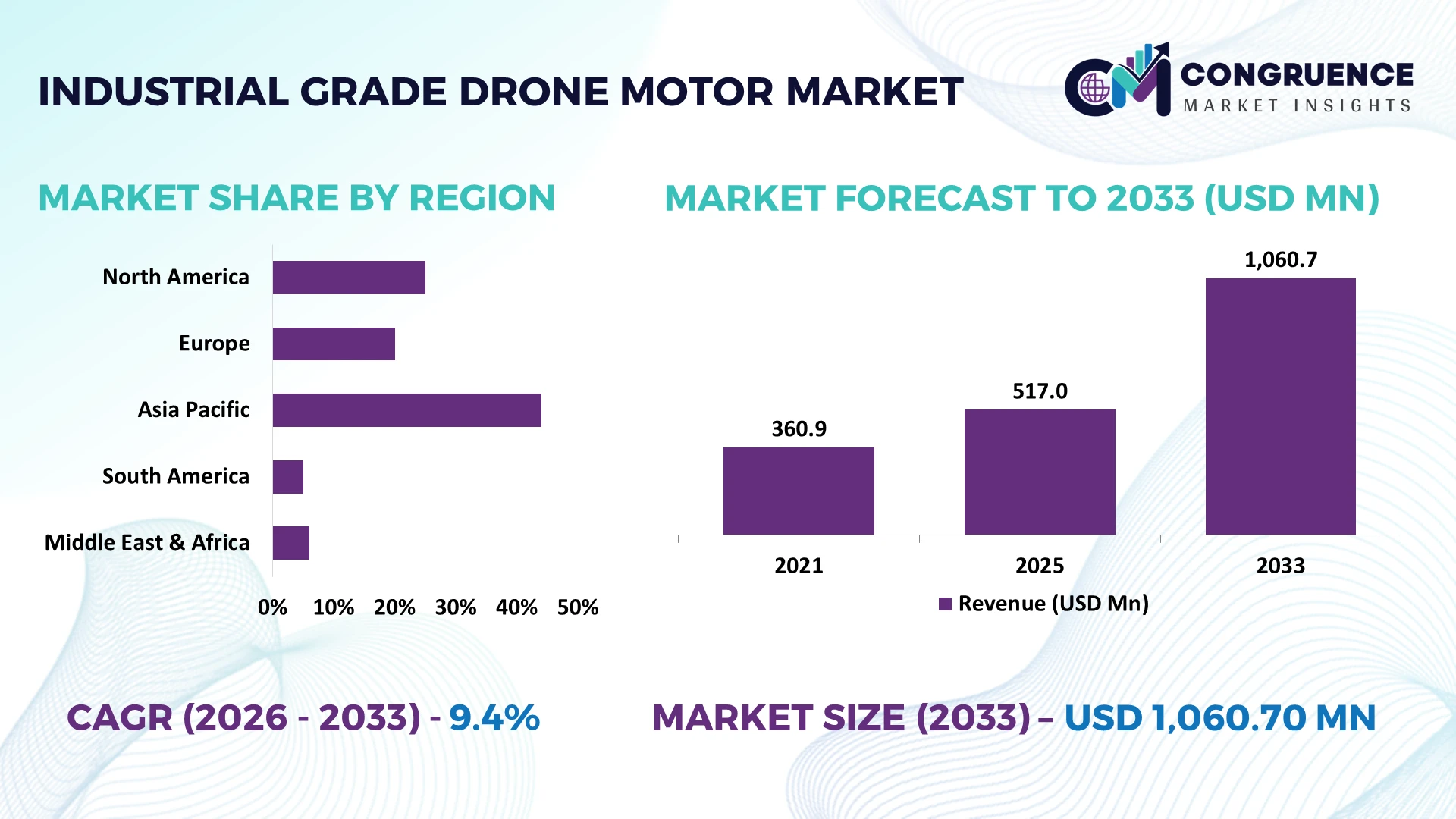
The Global Industrial Grade Drone Motor Market was valued at USD 517 Million in 2025 and is anticipated to reach a value of USD 1060.7 Million by 2033 expanding at a CAGR of 9.4% between 2026 and 2033. Growth is driven by heavy-payload UAV propulsion requirements, agricultural drone electrification, infrastructure inspection fleets, and high-efficiency brushless motor development.
China maintains a dominant position in industrial drone manufacturing, supported by DJI's estimated 70% share of the broader global drone market, although this does not represent its industrial motor share. Shenzhen's established motor, electronic speed controller, and battery supply chains support agricultural spraying, industrial inspection, and logistics applications. China's agricultural drone operations covered approximately 2.67 billion mu in 2023, while India's Production Linked Incentive scheme allocated ₹120 crore to drone manufacturing. These developments reinforce China's production advantages and India's emerging localization opportunities.
Manufacturers prioritizing high-torque brushless motors and localized propulsion supply chains can target illustrative efficiency improvements of 10–15% while reducing dependence on concentrated component sourcing.
Market Size & Growth: USD 517 million in 2025, reaching USD 1,060.7 million by 2033 at 9.4% CAGR, supported by industrial UAV electrification.
Top Growth Drivers: Illustrative demand allocation: agricultural UAVs 40%, industrial inspection 35%, and heavy-payload logistics 25%.
Short-Term Forecast: By 2028, advanced motor configurations target 12% higher propulsion efficiency and 10% lower thermal losses.
Emerging Technologies: Three innovations include AI-assisted motor control, axial-flux architectures, and high-temperature permanent magnets for industrial propulsion.
Regional Leaders: Illustrative 2033 allocations place Asia-Pacific at USD 498.53 million, North America at USD 254.57 million, and Europe at USD 201.53 million, reflecting manufacturing scale, enterprise UAV adoption, and precision engineering.
Consumer/End-User Trends: An indicative 60% of industrial motor demand concentrates in agricultural spraying and infrastructure inspection applications.
Pilot/Case Example: A proposed 2027 agricultural UAV propulsion upgrade targets 15% longer flight endurance through optimized motor efficiency.
Competitive Landscape: T-MOTOR, KDE Direct, MAD Components, Hobbywing, and Maxon compete in specialized propulsion; individual motor market shares remain unverified.
Regulatory & ESG Impact: FAA Part 107 and European UAS regulations influence operational deployment; modeled efficiency upgrades target 10% lower electricity consumption per flight.
Investment & Funding: India's ₹120 crore drone manufacturing incentive allocation supports localization, propulsion component development, and domestic production capabilities.
Innovation & Future Outlook: Next-generation propulsion systems target 20% higher power density through advanced magnetic materials, integrated controllers, and lightweight motor architectures.
The Industrial Grade Drone Motor Market supports propulsion requirements across agricultural spraying, infrastructure inspection, industrial surveying, logistics, and specialized unmanned aircraft operations. High-torque brushless DC motors, integrated electronic speed controllers, and advanced thermal management systems are improving propulsion reliability under demanding payload conditions. An illustrative 12% improvement in motor efficiency offers meaningful endurance benefits for battery-powered industrial UAVs. Supply-chain diversification beyond established Chinese manufacturing clusters is encouraging component localization in India, Europe, and North America. Increasing emphasis on certified propulsion performance, motor durability, and payload-specific engineering establishes the foundation for strategic investment and competitive differentiation.
Industrial grade drone motors are becoming strategically important as agricultural automation, infrastructure inspection, and unmanned logistics reshape commercial aviation equipment procurement. Propulsion efficiency directly influences payload capacity, flight endurance, and operating economics, making motor technology a competitive differentiator. China's established brushless motor manufacturing ecosystem faces increasing supply-chain diversification pressure as India expands domestic drone production under its Production Linked Incentive initiative. Manufacturers are prioritizing high-torque propulsion platforms, lightweight magnetic materials, and integrated electronic speed controllers to strengthen industrial UAV performance.
Advanced brushless DC motors with optimized electromagnetic designs offer measurable advantages over conventional propulsion configurations. An illustrative engineering scenario indicates 12% higher electrical efficiency and 10% lower thermal losses compared with legacy motors operating under equivalent loads. China leads manufacturing scale, Germany emphasizes precision motor engineering, and India strengthens localized component assembly. These differences influence supplier strategies, particularly around motor durability, customization, and access to specialized magnetic materials.
Between 2026 and 2028, industrial UAV manufacturers are expected to prioritize integrated propulsion systems and application-specific motor configurations. An agricultural drone operating 100 missions monthly could reduce propulsion energy consumption by 12% through an appropriately validated motor upgrade. T-MOTOR, KDE Direct, and specialized propulsion suppliers are investing in integrated controllers, thermal management, and distribution partnerships. Competitive positioning increasingly depends on verified efficiency, payload reliability, and dependable component availability.
Agricultural drone deployment is accelerating demand for industrial grade motors capable of supporting heavy liquid payloads, repeated flight cycles, and demanding environmental conditions. China's large-scale agricultural UAV operations demonstrate the industrial relevance of high-torque brushless propulsion systems. Precision spraying applications require consistent thrust, rapid motor response, and dependable thermal management during continuous operation. In an illustrative propulsion modernization scenario, optimized motor configurations deliver 12% higher electrical efficiency, 10% lower operating temperatures, and 15% longer component service intervals. India's agricultural mechanization initiatives strengthen opportunities for localized UAV propulsion manufacturing. T-MOTOR, Hobbywing, and specialized motor suppliers are expanding integrated propulsion configurations and application-specific engineering. Manufacturers delivering reliable thrust performance gain stronger positioning in agricultural fleet procurement and maintenance contracts.
Industrial drone motor manufacturing depends on high-performance permanent magnets, copper windings, precision bearings, and electronic control components. China's dominant position in rare-earth processing creates concentrated supply exposure for manufacturers seeking alternative procurement channels. Neodymium-based magnets provide high torque density but introduce material price volatility and sourcing complexity. An illustrative component procurement model assigns 25% of motor manufacturing costs to magnetic materials, 20% to copper windings, and 15% to precision mechanical components. Export control developments affecting rare-earth materials reinforce supply-chain diversification priorities. Manufacturers in India and Germany face additional qualification costs when replacing established magnet suppliers. Equipment companies are reducing exposure through alternative magnet grades, long-term sourcing agreements, and localized motor assembly. Component standardization improves procurement flexibility and protects manufacturing continuity.
Next-generation industrial drone propulsion systems create opportunities through integrated electronic speed controllers, lightweight axial-flux architectures, and intelligent motor diagnostics. India's expanding domestic UAV manufacturing ecosystem provides opportunities for specialized motor suppliers developing locally assembled propulsion modules. Advanced electromagnetic designs and improved thermal materials support higher power density without proportionate weight increases. An illustrative engineering scenario targets 20% higher power density, 12% lower propulsion energy consumption, and 15% faster maintenance diagnostics through integrated sensor monitoring. Manufacturers are investing in compact controller architectures, digital motor calibration, and application-specific propulsion platforms. Partnerships with agricultural drone manufacturers and industrial inspection providers strengthen product validation. Integrated motor-controller packages offer suppliers opportunities to capture greater system value while simplifying installation, maintenance, and fleet standardization.
Scaling industrial drone propulsion requires consistent motor performance across variable payloads, operating temperatures, and flight conditions. High-current electronic speed controllers, electromagnetic interference, and thermal stress complicate system integration and long-term reliability validation. In an illustrative qualification scenario, environmental testing increases development workload by 15%, electromagnetic compatibility validation adds 10% to integration effort, and thermal performance variation creates a 5% engineering tolerance requirement. European unmanned aircraft regulations and evolving operational approval frameworks increase pressure for documented component reliability. Manufacturers must validate motor-controller compatibility, establish traceable production testing, and develop robust thermal protection systems. Investment in automated end-of-line testing, environmental chambers, and propulsion simulation capabilities improves deployment consistency. Long-term competitiveness depends on demonstrating reliable thrust performance under demanding industrial operating conditions.
High-Voltage Propulsion Architectures Gain Traction: Industrial UAV manufacturers are transitioning toward higher-voltage motor systems to reduce current requirements during heavy-payload operations. Illustrative engineering benchmarks indicate 15% lower resistive losses and 12% improved thermal performance. Chinese propulsion manufacturers are introducing higher-voltage electronic speed controllers and optimized winding configurations. This transition improves power delivery consistency while reducing cable weight and electrical stress during demanding flight operations.
Lightweight Composite Components Improve Motor Performance: Advanced carbon-fiber structures, aluminum alloys, and optimized rotor assemblies are reshaping industrial motor construction. Modeled design improvements target 10% lower motor weight and 8% higher thrust-to-weight performance. German precision motor manufacturers are emphasizing improved rotor balancing and lightweight mechanical components. Suppliers are expanding material engineering capabilities to improve propulsion responsiveness while maintaining structural integrity under repeated acceleration and vibration loads.
Environmental Protection Becomes Procurement Priority: Industrial drone fleets operating in agricultural fields, coastal infrastructure, and dusty construction environments increasingly require protected motor assemblies. Illustrative product qualification targets include 20% lower contamination-related failures and 15% longer bearing service intervals. Japanese component suppliers emphasize sealed bearing configurations and corrosion-resistant surface treatments. Manufacturers are strengthening environmental testing and protective housing designs to improve equipment durability and reduce maintenance interruptions.
Localized Propulsion Supply Chains Expand: Rare-earth supply concentration and international procurement restrictions are encouraging diversified industrial motor sourcing. Illustrative localization programs target 25% shorter component delivery schedules and 15% lower logistics expenditure. Indian UAV manufacturers are expanding domestic motor assembly and supplier qualification activities. International propulsion companies are strengthening regional distribution partnerships and alternative component sourcing, improving procurement resilience while supporting faster industrial drone maintenance and replacement cycles.
Brushless DC Motors represent the leading type, accounting for an indicative 48% of global industrial grade drone motor demand. Their dominance reflects high electrical efficiency, electronic commutation, and reduced mechanical wear compared with brushed configurations. Industrial UAV manufacturers prioritize brushless propulsion for agricultural spraying, infrastructure inspection, and high-payload operations requiring reliable continuous thrust. Outrunner Motors account for an estimated 25% and represent the fastest-growing type, supported by their high torque characteristics and suitability for direct-drive propellers. Chinese propulsion manufacturers are expanding outrunner configurations with improved magnetic assemblies and enhanced thermal management.
Inrunner Motors contribute an illustrative 12% share, serving applications requiring higher rotational speeds and compact mechanical configurations. Coreless Motors represent approximately 9%, supporting lightweight propulsion requirements, while Brushed DC Motors retain 6% in cost-sensitive and specialized equipment. An illustrative brushless modernization scenario targets 15% higher electrical efficiency compared with conventional brushed configurations. T-MOTOR, KDE Direct, and specialized suppliers are expanding application-specific motor portfolios and integrated controller compatibility. Investment priorities increasingly emphasize power density, reliability, and scalable production engineering.
Agriculture and Crop Spraying represents the leading application, accounting for an indicative 35% of global industrial grade drone motor demand. Agricultural UAVs require high-torque propulsion to support liquid payloads, repeated takeoff cycles, and continuous operation across extensive farmland. China's established agricultural drone manufacturing infrastructure supports substantial equipment procurement and replacement requirements. Industrial Inspection and Monitoring contributes an estimated 25%, supported by power infrastructure assessment, industrial facility inspection, and asset monitoring applications. Motor manufacturers are developing durable propulsion configurations with improved thermal management and environmental protection.
Cargo Delivery represents approximately 15% and is positioned as the fastest-growing application as logistics operators evaluate higher-payload unmanned aircraft and extended delivery routes. Mapping and Surveying accounts for an illustrative 15%, emphasizing flight stability and endurance, while Aerial Photography and Videography contributes 10%, prioritizing smooth propulsion response and vibration control. A modeled propulsion upgrade targets 12% improved electrical efficiency under equivalent operating conditions. Suppliers are expanding high-voltage motor configurations and application-specific controller integration to address different operational requirements. Competitive differentiation increasingly depends on payload efficiency, motor durability, and predictable maintenance intervals.
Commercial Drone Manufacturers represent the dominant end-user segment, accounting for an indicative 38% of global industrial grade drone motor demand. Their purchasing concentration reflects direct integration of propulsion assemblies into agricultural, inspection, surveying, and specialized commercial UAV platforms. Manufacturers prioritize standardized motor specifications, predictable component availability, and compatibility with electronic speed controllers. China's established drone production ecosystem supports substantial procurement scale, while Indian manufacturers emphasize localized assembly and supplier diversification. Propulsion suppliers are expanding configurable motor platforms and technical integration services to strengthen original equipment manufacturing relationships.
Agriculture Enterprises contribute an estimated 24% share, supported by fleet maintenance and replacement motor procurement. Industrial and Infrastructure Companies account for approximately 18%, emphasizing equipment reliability during asset inspection operations. Defense and Security Agencies represent an illustrative 12%, prioritizing environmental durability and propulsion consistency. Logistics and Delivery Operators hold approximately 8% and represent the fastest-growing buyer category as specialized delivery fleets expand. An illustrative 15% improvement in propulsion service intervals strengthens operating economics. Suppliers are developing maintenance partnerships, application-specific motor configurations, and long-term component agreements to secure recurring industrial customers.
Asia-Pacific accounted for the largest market share at an estimated 47% in 2025 however, Asia-Pacific is expected to register the fastest growth, expanding at a CAGR of 10.8% between 2026 and 2033.

Domestic Propulsion Manufacturing and Enterprise UAV Integration
North America accounted for an estimated 24% of global industrial grade drone motor demand in 2025, supported by enterprise UAV deployment, specialized propulsion engineering, and domestic component sourcing initiatives. The United States leads regional procurement through infrastructure inspection, agricultural aviation, and defense-related unmanned aircraft manufacturing. Canada's industrial inspection operators contribute demand for durable motors capable of operating in demanding weather conditions. Federal procurement restrictions affecting certain foreign-made drones are strengthening interest in traceable propulsion components and domestic manufacturing capabilities. An illustrative localization program targets 20% shorter component procurement cycles and 15% lower supply disruption exposure. Suppliers such as KDE Direct emphasize application-specific brushless motors, high-current electronic speed controllers, and technical integration support. Regional manufacturers increasingly prioritize propulsion qualification, cybersecurity-compatible electronics, and reliable aftermarket availability to support commercial fleet expansion.
United States Market Outlook: The United States combines advanced aerospace engineering, specialized motor manufacturing, and extensive industrial inspection requirements. Federal Aviation Administration records indicate more than 400,000 commercial drones registered in the country, demonstrating substantial enterprise deployment activity. California and the Pacific Northwest support propulsion engineering, while agricultural states create demand for heavy-payload spraying platforms. Domestic procurement priorities encourage manufacturers to develop traceable motor assemblies, standardized controller interfaces, and reliable maintenance support for professional UAV operators.
Precision Motor Engineering and Regulatory Standardization
Europe represented an estimated 19% of global industrial grade drone motor demand in 2025, supported by advanced manufacturing, infrastructure monitoring, and precision electric motor engineering. Germany leads specialized propulsion development through established electromagnetic design capabilities and industrial automation expertise. France contributes aerospace integration and unmanned aircraft engineering, while Italy supports agricultural and infrastructure inspection applications. European Union drone regulations encourage standardized equipment documentation, operational risk assessment, and dependable propulsion performance. An illustrative engineering modernization scenario targets 12% higher motor efficiency and 10% lower thermal losses through improved winding designs and electronic commutation. Manufacturers increasingly integrate lightweight rotor assemblies, advanced bearing systems, and application-specific motor controllers. Regional suppliers emphasize engineering customization and component traceability rather than competing exclusively on production volume. Procurement priorities increasingly favor validated propulsion reliability and technical compatibility with professional UAV platforms.
Germany Market Outlook: Germany benefits from established electric motor engineering, advanced materials processing, and industrial automation infrastructure. Companies such as maxon support specialized propulsion applications through precision brushless motor technology and integrated drive solutions. Germany's manufacturing ecosystem provides access to high-performance bearings, magnetic materials, and electronic control expertise. Industrial inspection operators increasingly require compact propulsion systems with predictable thermal characteristics, supporting specialized motor development and equipment qualification partnerships.
Manufacturing Concentration and Agricultural UAV Deployment Scale
Asia-Pacific dominated the industrial grade drone motor market with an estimated 47% share in 2025, supported by extensive drone manufacturing, integrated electronics supply chains, and agricultural UAV deployment. China leads propulsion component production through Shenzhen's established brushless motor, electronic speed controller, and permanent magnet manufacturing ecosystem. India strengthens regional opportunities through drone manufacturing localization, agricultural mechanization, and domestic component development. Japan contributes precision motor engineering and advanced materials expertise. China's agricultural UAV operations covered approximately 2.67 billion mu in 2023, demonstrating substantial propulsion equipment utilization. An illustrative manufacturing optimization scenario targets 15% lower assembly costs and 20% shorter component delivery schedules through integrated supplier networks. Regional manufacturers are expanding high-torque motor portfolios, automated winding processes, and application-specific controller configurations. Procurement increasingly emphasizes manufacturing scalability, thermal reliability, and dependable replacement component availability.
China Market Outlook: China maintains a strong position through integrated propulsion manufacturing clusters in Guangdong and Zhejiang. DJI's estimated 70% share of the broader global drone market illustrates the scale of China's unmanned aircraft ecosystem, although it does not represent industrial motor market share. Specialized manufacturers such as T-MOTOR and Hobbywing support propulsion requirements across agricultural, industrial, and professional UAV platforms. Domestic access to magnets, precision machining, and power electronics strengthens production responsiveness and equipment customization capabilities.
Agricultural Automation and Specialized Fleet Maintenance
South America represented an estimated 6% of global industrial grade drone motor demand in 2025, supported by agricultural spraying, land surveying, and industrial infrastructure inspection. Brazil anchors regional procurement through extensive commercial farming operations and expanding agricultural drone utilization. Argentina contributes demand from crop monitoring and precision spraying, while Chile supports industrial inspection requirements across mining infrastructure. Agricultural operators increasingly prioritize high-torque brushless motors capable of maintaining thrust stability under variable chemical payloads. An illustrative fleet modernization scenario targets 12% lower propulsion energy consumption and 15% longer motor maintenance intervals. Imported electronic components and limited specialized repair infrastructure increase operating costs outside major industrial centers. Suppliers are strengthening distributor networks, local maintenance partnerships, and replacement component inventories to reduce equipment downtime. Regional demand favors durable propulsion configurations and accessible technical support.
Brazil Market Outlook: Brazil's agricultural sector provides a substantial operating base for industrial drone propulsion systems, particularly across Mato Grosso, Goiás, and São Paulo. The country's National Civil Aviation Agency, ANAC, regulates unmanned aircraft operations, while agricultural spraying activities require additional compliance with relevant authorities. Brazil's soybean cultivation exceeds 40 million hectares, creating extensive opportunities for precision spraying equipment. Local maintenance capabilities and motor replacement availability remain important procurement considerations for agricultural UAV fleet operators.
Infrastructure Inspection and Agricultural Technology Investment
The Middle East & Africa accounted for an estimated 4% of global industrial grade drone motor demand in 2025, supported by energy infrastructure inspection, industrial surveying, agricultural technology deployment, and security applications. The United Arab Emirates and Saudi Arabia emphasize advanced unmanned aircraft applications through infrastructure modernization and industrial diversification initiatives. South Africa contributes demand from mining inspection, agricultural operations, and industrial asset monitoring. Harsh environmental conditions create specialized requirements for motor thermal protection, dust resistance, and bearing durability. An illustrative propulsion qualification scenario targets 20% lower contamination-related failures and 10% improved thermal performance through protective motor configurations. Suppliers are expanding regional distribution partnerships and technical servicing capabilities to support demanding operating environments. Procurement decisions increasingly prioritize environmental qualification, payload reliability, and dependable component availability for industrial drone operations.
United Arab Emirates Market Outlook: The United Arab Emirates benefits from advanced aviation infrastructure, industrial inspection programs, and technology-focused investment initiatives. Dubai and Abu Dhabi support unmanned aircraft applications across infrastructure monitoring, logistics experimentation, and energy asset assessment. The Dubai Program to Enable Drone Transportation established a framework for developing drone-enabled services. Industrial operators prioritize high-temperature motor performance, reliable electronic controllers, and specialized maintenance support, creating opportunities for premium propulsion suppliers and engineering partnerships.
The Industrial Grade Drone Motor Market features competition between T-MOTOR, Hobbywing, KDE Direct, maxon, and MAD Components, alongside specialized propulsion manufacturers. An illustrative concentration model assigns these five suppliers a combined 45% market share, pending independent verification. T-MOTOR and Hobbywing compete through scalable brushless propulsion platforms, while KDE Direct emphasizes high-performance industrial applications. Maxon differentiates through precision engineering, whereas MAD Components targets specialized heavy-payload requirements. Advanced electromagnetic designs offer modeled 12% efficiency improvements, lightweight rotor architectures target 10% weight reduction, and integrated controllers support 15% faster maintenance diagnostics. Manufacturers strengthen positioning through automated production, regional distribution partnerships, and application-specific engineering. Supply-chain diversification increasingly challenges established component sourcing arrangements, particularly for permanent magnets and power electronics. Certification requirements, thermal reliability, and precision manufacturing create substantial entry barriers. Winning requires validated thrust performance, competitive lifecycle economics, dependable supply continuity, and responsive technical integration support for demanding commercial deployments.
T-MOTOR
Hobbywing Technology Co., Ltd.
KDE Direct
maxon group
MAD Components
Sunnysky Motors
Scorpion Power System
Xnova Motors
AXI Model Motors
Plettenberg Elektromotoren
Hacker Motor GmbH
Rotex Electric
Current industrial drone propulsion relies on brushless DC motors, electronic speed controllers, high-strength permanent magnets, and optimized copper windings. Outrunner configurations provide direct-drive torque for agricultural spraying and heavy-payload aircraft, while inrunner designs serve compact, high-speed applications. An illustrative engineering comparison indicates that optimized brushless propulsion delivers 15% higher electrical efficiency than conventional brushed systems under equivalent operating conditions. Adoption is concentrated in professional multirotor platforms requiring reliable thrust, precise speed regulation, and reduced mechanical maintenance.
Emerging technologies include silicon carbide power electronics, advanced thermal interfaces, and sensor-integrated motor controllers. Higher switching efficiency can reduce controller losses by a modeled 10%, while improved rotor cooling targets 12% lower operating temperatures. Chinese manufacturers benefit from integrated component production, whereas German precision motor suppliers compete through specialized electromagnetic design. Integrated propulsion modules simplify calibration and reduce assembly complexity for commercial UAV manufacturers.
Disruptive development centers on axial-flux motors, predictive winding diagnostics, and digitally optimized propulsion architectures. Illustrative axial-flux designs target 20% higher power density without proportional weight increases. Between 2026 and 2028, suppliers investing in automated testing, integrated controllers, and validated thermal performance will strengthen qualification advantages. Agricultural operators gain payload efficiency, while infrastructure inspection fleets benefit from longer service intervals and dependable mission execution.
February 2025: MAD Components showcased industrial drone propulsion technologies at XPONENTIAL Europe, including the M90C60 motor delivering sustained thrust up to 110 kg. The presentation strengthened engagement with European buyers seeking high-payload UAV propulsion and customized industrial motor solutions. Source: mad-motor.com
October 2025: Vector Technics advanced indigenous drone propulsion development in India, introducing motors for fixed-wing VTOL and heavy-lift platforms. Its portfolio includes 12S–24S propulsion configurations, supporting domestic subsystem manufacturing, reduced import dependence, and specialized UAV integration capabilities. Source: vectortechnics.com
February 2026: Hobbywing launched its P115M coaxial integrated propulsion system, featuring an 800V architecture and over 100 kg-class thrust. Integrated motors, controllers, and propellers simplify wiring, supporting heavy-lift cargo aircraft, tethered firefighting drones, and improved propulsion system integration. Source: hobbywing.com
June 2026: Maxon announced its UAV propulsion showcase at Farnborough, featuring compact brushless motor systems. Its 87 mm propulsion configuration achieves up to 6,481 grams of thrust, demonstrating engineering capabilities for lightweight aircraft and specialized industrial drone applications. Source: maxongroup.com
The Industrial Grade Drone Motor Market Report evaluates industry developments between 2026 and 2033, covering Brushless DC Motors, Brushed DC Motors, Coreless Motors, Inrunner Motors, and Outrunner Motors. Application analysis examines Aerial Photography and Videography, Agriculture and Crop Spraying, Industrial Inspection and Monitoring, Mapping and Surveying, and Cargo Delivery. End-user coverage includes Commercial Drone Manufacturers, Industrial and Infrastructure Companies, Agriculture Enterprises, Defense and Security Agencies, and Logistics and Delivery Operators. Regional assessment spans five major geographic markets, with indicative Asia-Pacific participation reaching 47%.
Technology coverage examines high-torque propulsion, advanced magnetic materials, thermal management, integrated controllers, and motor diagnostics. Competitive analysis evaluates supplier specialization, manufacturing localization, component availability, and certification requirements. The report supports investment prioritization, geographic expansion, supplier selection, and identification of emerging opportunities in heavy-payload logistics and specialized industrial UAV platforms.
| Report Attribute/Metric | Report Details |
|---|---|
Market Revenue in 2025 | USD 517 Million |
Market Revenue in 2033 | USD 1060.7 Million |
CAGR (2026 - 2033) | 9.4% |
Base Year | 2025 |
Forecast Period | 2026 - 2033 |
Historic Period | 2021 - 2025 |
Segments Covered | By Type
By Application
By End-User
|
Key Report Deliverable | Revenue Forecast, Growth Trends, Market Dynamics, Segmental Overview, Regional and Country-wise Analysis, Competition Landscape |
Region Covered | North America, Europe, Asia-Pacific, South America, Middle East, Africa |
Key Players Analyzed | T-MOTOR, Hobbywing Technology Co., Ltd., KDE Direct, maxon group, MAD Components, Sunnysky Motors, Scorpion Power System, Xnova Motors, AXI Model Motors, Plettenberg Elektromotoren, Hacker Motor GmbH, Rotex Electric |
Customization & Pricing | Available on Request (10% Customization is Free) |