
Reports
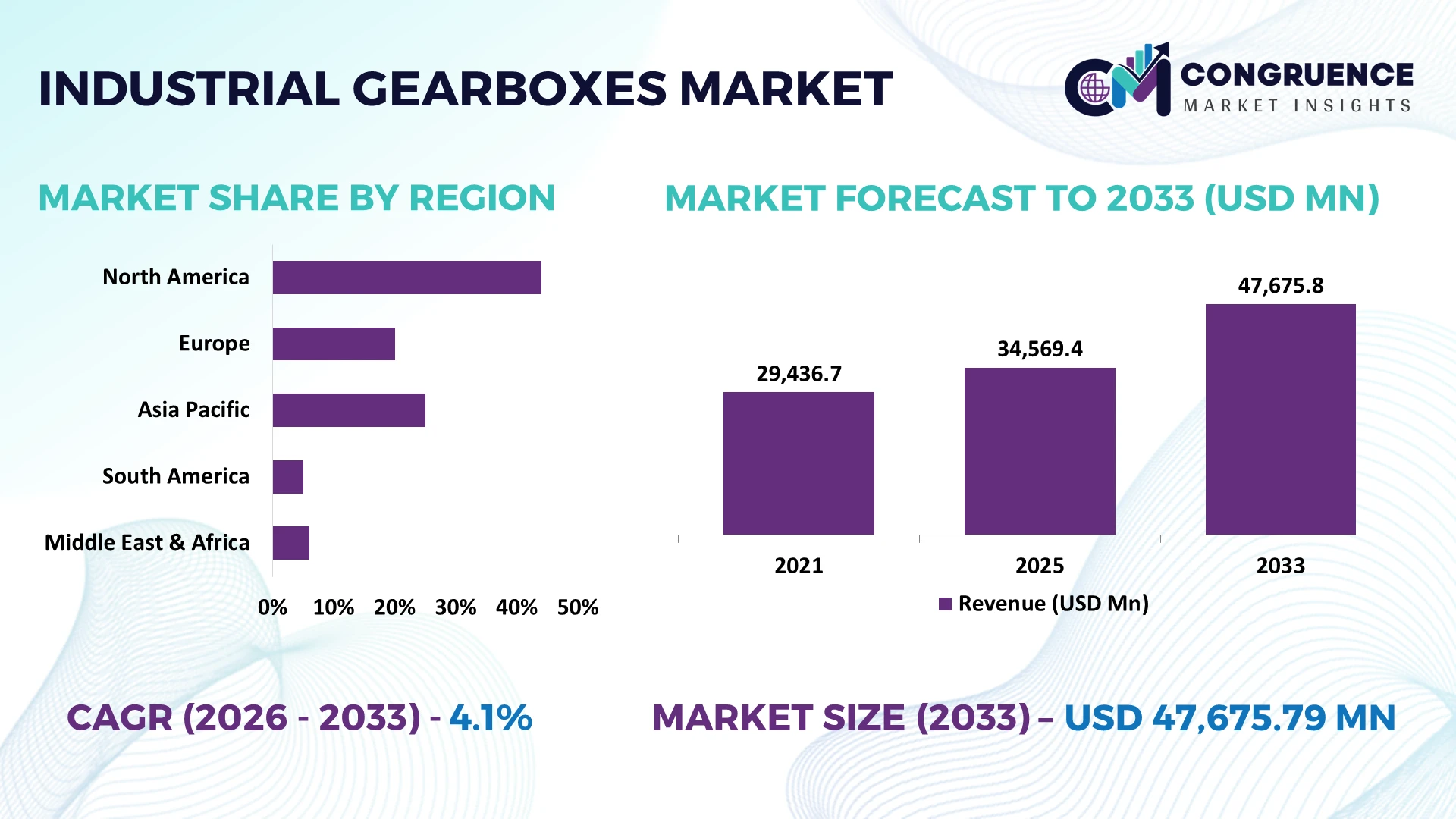
The Global Industrial Gearboxes Market was valued at USD 34569.42 Million in 2025 and is anticipated to reach a value of USD 47675.79 Million by 2033 expanding at a CAGR of 4.1% between 2026 and 2033. Growth is driven by wind turbine drivetrain installations, automated material handling, mining conveyor upgrades, high torque manufacturing equipment, and replacement of inefficient legacy transmissions with condition monitored gear systems.
China anchors global industrial gearbox demand through machinery, wind power, mining, metals, and factory automation. The country added 79.9 GW of wind capacity in 2024, representing 68.2% of worldwide additions, creating substantial requirements for geared drivetrains and supporting equipment. China also produced more than 55 million industrial robots between 2015 and 2024. Germany provides a technology intensive comparison, with manufacturing contributing around 18% of national gross value added. Against continuing US China supply chain realignment, localized gears, bearings, castings, and service capacity are becoming procurement priorities.
Strategically, gearbox manufacturers combining high torque density, condition monitoring, localized components, and application specific engineering will capture replacement and modernization spending more effectively than standardized transmission suppliers.
Market Size & Growth: USD 34,569.42 million in 2025 reaches USD 47,675.79 million by 2033 at 4.1%, driven by drivetrain modernization and industrial automation.
Top Growth Drivers: Wind installations expanded 11%, industrial robot installations exceeded 540,000 units, and global manufacturing value added increased 2.9%, strengthening transmission demand.
Short Term Forecast: By 2028, condition based gearbox maintenance can reduce unplanned equipment downtime by 30% through vibration, temperature, and lubricant monitoring.
Emerging Technologies: AI diagnostics, digital twins, and integrated sensors are moving gearbox servicing toward predictive intervention, with smart maintenance capable of reducing maintenance costs by 25%.
Regional Leaders: Applying indicative market distribution to 2025 sizing places Asia Pacific near USD 15.0 billion, Europe around USD 8.3 billion, and North America near USD 7.6 billion, alongside increasing intelligent drive adoption.
End User Trends: Manufacturing represents more than 20% of global economic output, sustaining gearbox replacement across conveyors, mixers, extruders, cranes, machine tools, and automated production equipment.
Pilot Case Example: In 2024, Flender's AIQ Detect monitoring architecture enabled continuous drivetrain condition assessment, targeting detection of developing gearbox faults before production interruption.
Competitive Landscape: SEW EURODRIVE holds an estimated 10% global position, competing with Flender, Bonfiglioli, Sumitomo Drive Technologies, and NORD through efficiency, customization, digital services, and distribution depth.
Regulatory & ESG Impact: EU electric motor ecodesign requirements cover motors up to 1,000 kW, increasing pressure to optimize complete motor gearbox drivetrain efficiency rather than individual components.
Investment & Funding: Germany approved approximately USD 5.4 billion for industrial decarbonization contracts, strengthening investment conditions for efficient production equipment, electrified processes, and modern drivetrain systems.
Innovation & Future Outlook: Next generation gearboxes combining integrated sensing, high efficiency gearing, and digital lifecycle monitoring can extend maintenance intervals by 20%, shifting competition toward availability based drivetrain value.
Industrial gearboxes remain essential across wind power, mining, cement, metals, material handling, food processing, robotics, and automated manufacturing where controlled torque transmission determines equipment availability. Product development is concentrating on compact planetary architectures, integrated sensors, improved tooth geometry, advanced lubrication, and digitally connected condition monitoring. Global industrial robot installations exceeded 540,000 units annually, intensifying demand for precise motion and reliable geared systems. Meanwhile, supply chain localization for castings, bearings, gears, and electronic controls is reshaping sourcing strategies, positioning drivetrain efficiency and lifecycle intelligence as central considerations for the market's strategic direction.
Industrial gearboxes are becoming strategic productivity assets as manufacturers connect mechanical drivetrains with plant automation, predictive maintenance, and energy management. Rising electricity costs and supply chain restructuring are pushing buyers toward efficient, locally serviceable systems. Modern helical gear units can exceed 96% efficiency per gear stage, versus roughly 85% to 90% for aging worm configurations, lowering energy losses in continuously operated conveyors, mixers, and processing lines.
China provides deployment scale through an automation ecosystem representing 54% of global industrial robot installations in 2024, while Germany differentiates through precision engineering and digitally integrated drive systems. Through 2028, sensor equipped gearboxes will penetrate more critical duty applications as vibration, oil condition, torque, and temperature data become integrated with plant maintenance platforms, moving service decisions from fixed intervals toward equipment condition.
A practical cement conveyor deployment can pair monitored gear units with variable speed motors, allowing operators to detect bearing or lubrication deterioration before shutdown. Manufacturers are consequently expanding connected drive portfolios, remanufacturing capabilities, engineering partnerships, and local service centers. Competitive positioning will increasingly depend on delivering complete drivetrain availability rather than selling standalone mechanical hardware.
Wind power expansion is creating sustained demand for high torque planetary and helical gearboxes capable of handling variable loads within increasingly powerful turbines. Global wind installations reached 117 GW in 2024, 11% above 2023, while offshore additions increased 6%. India installed 4.15 GW during FY2025, reflecting accelerated domestic project execution and component localization. Larger turbines impose greater torque density, bearing load, and reliability requirements, shifting procurement toward optimized tooth profiles and integrated drivetrain engineering. Domestic content policies and renewable manufacturing incentives are simultaneously strengthening localized supply chains. Gearbox producers are expanding wind specific engineering, heat treatment capacity, service networks, and partnerships with turbine manufacturers. The strategic advantage lies in supplying both original drivetrains and lifecycle replacement components, converting expanding installed capacity into recurring aftermarket demand.
Industrial gearbox production remains exposed to alloy steel, bearings, specialty lubricants, forgings, and precision machined components whose cost movements directly affect unit economics. Nickel prices moved by more than 20% during 2024, while European steel production declined 2.6%, tightening procurement planning for manufacturers requiring consistent metallurgical specifications. Germany's industrial electricity prices also remain materially above several competing manufacturing locations, increasing machining, heat treatment, and finishing costs. Because large engineered gear units have long production cycles, rapid input changes cannot always be transferred immediately into customer pricing. Manufacturers are reducing exposure through multisource bearing procurement, indexed material contracts, regional casting suppliers, and redesigned housings that lower material intensity. The non obvious constraint is specification rigidity: qualified alloys and bearings cannot be substituted quickly without validation, limiting procurement flexibility precisely when volatility rises.
The strongest untapped opportunity lies in converting the enormous installed gearbox population into digitally managed service assets. Predictive maintenance programs can reduce equipment downtime by 30% and lower maintenance expenditure by 25%, while condition monitoring can extend intervention intervals by roughly 20% when deterioration is detected before functional failure. India's manufacturing digitalization creates a particularly attractive deployment environment as factories increasingly connect rotating equipment to centralized maintenance platforms. Edge sensors capable of tracking vibration, temperature, lubricant condition, and torque transform conventional gear units into recurring service touchpoints. Manufacturers are developing retrofit sensor kits, cloud diagnostics, remote engineering support, and performance based maintenance agreements rather than limiting digital functionality to new equipment. This creates a valuable business model shift: legacy gearbox fleets become addressable software and service opportunities without requiring customers to replace mechanically sound transmissions.
Digitally connected gearboxes create execution complexity because mechanical reliability, sensor accuracy, controls integration, analytics, and cybersecurity must operate as one system. Manufacturing companies globally face a potential shortfall exceeding 8 million skilled workers by 2030, while industrial cybersecurity incidents increasingly target connected operational technology. Germany faces additional workforce pressure as roughly 23% of its population is already aged 65 or older, tightening availability of experienced mechanical and maintenance specialists. Poor sensor placement or incorrect vibration interpretation can generate false alarms, undermining predictive maintenance economics and customer confidence. Gearbox suppliers therefore need multidisciplinary teams spanning tribology, gearing, electronics, software, and industrial communications. Companies are investing in remote diagnostic centers, technician academies, standardized sensor interfaces, and automation partnerships. Long term leadership requires making advanced drivetrain intelligence deployable without depending on scarce specialist expertise at every customer facility.
Localized Assembly Compresses Lead Times: Gearbox manufacturers are moving final assembly closer to customers as procurement teams prioritize availability alongside engineering performance. SEW EURODRIVE began assembling P2.e planetary units in South Carolina during 2025, cutting standard configuration lead times to about 6 weeks and customized deliveries to roughly 12 weeks. Competitors are expanding regional assembly, component inventories, and configuration capability to reduce exposure to international logistics disruption.
Compact Torque Density Gains Priority: Machinery builders increasingly require higher torque within restricted installation envelopes. Planetary gearboxes represented about 28% of North American demand in 2025, while bevel units accounted for 15% and worm designs 12%. Suppliers are redesigning housings, bearings, and lubrication paths to increase power density, allowing OEMs to reduce drivetrain footprint without sacrificing load handling in automated machinery.
Worm Technology Loses Ground: Procurement is shifting away from conventional worm architectures where energy consumption outweighs their compact reduction advantage. Helical gearboxes captured 36.9% of global demand in 2025, reflecting smoother transmission and stronger continuous duty efficiency. Manufacturers are restructuring portfolios toward helical, bevel helical, and planetary platforms while retaining worm products for self locking, high reduction, and application specific installations.
Standardized Platforms Accelerate Configuration: Industrial buyers increasingly prefer modular gear families that share housings, interfaces, motors, and accessories across multiple equipment classes. Parallel axis designs represented 55.4% of gearbox demand in 2025, demonstrating the value of established mechanical architectures. Suppliers are expanding configurable product platforms and automated engineering workflows, reducing specification complexity while enabling distributors to serve more torque and mounting requirements from standardized inventories.
Helical gearboxes lead the type landscape with approximately 36.9% share in 2025, supported by smooth tooth engagement, high load capacity, quiet operation, and suitability for continuous duty machinery. Their scalability across multiple ratios and power ratings makes them economical for standardized equipment platforms. Planetary units represent roughly 21% to 28% of demand depending on industrial mix and are the fastest advancing type as compact machinery requires higher torque density and low backlash. Bevel gearboxes retain strategic importance where shaft direction must change, while Spur units serve straightforward, cost sensitive power transmission requirements.
Worm gearboxes remain relevant for high reduction and self locking configurations but face substitution where operating efficiency dominates purchasing decisions. Hypoid systems provide compact offset shaft arrangements with smoother engagement, while Cycloidal units address shock loading and precision reduction requirements. Manufacturers are therefore directing engineering resources toward modular helical platforms and precision planetary systems, while improving sealing, lubrication, tooth geometry, and mounting flexibility across specialized designs.
Material Handling leads application demand with approximately 29.6% share in 2025 as warehouses, factories, ports, distribution centers, and processing facilities require continuous torque transmission across automated movement systems. Conveyor Systems form a substantial mature application because long operating hours place high importance on reliability, mounting flexibility, and controlled speed. Lifting Equipment requires high starting torque and dependable braking interfaces, while Mixers prioritize continuous operation under variable material resistance. Pumps and Compressors maintain specialized gearbox requirements where process speed and load matching influence energy consumption.
Machine Tools are emerging as the fastest developing application within the supplied categories as automated production equipment demands tighter positioning, lower backlash, and compact transmission packages. Manufacturers are adapting through precision planetary units, optimized bevel architectures, servo compatible interfaces, and configurable mounting arrangements. Gearbox selection is consequently moving from basic speed reduction toward application engineered drivetrain performance, particularly where automated equipment uptime directly determines plant throughput.
Manufacturing leads end user demand with 24.2% share in 2025, reflecting gearbox deployment across production machinery, packaging equipment, assembly systems, processing lines, and factory material movement. Automotive remains an automation intensive buyer requiring repeatable motion across body, component, and powertrain production. Mining prioritizes rugged transmissions capable of handling abrasive environments and severe loading, while Oil & Gas requires engineered units for processing and handling equipment. Chemicals and Food & Beverage emphasize sealing integrity, reliability, and application appropriate materials, while Construction supports demand through mechanically driven heavy equipment.
Power Generation is the fastest developing buyer group among the specified industries as generating assets increasingly require specialized high capacity transmission systems and modernization of auxiliary equipment. Gearbox manufacturers are segmenting portfolios around duty cycles rather than offering universal platforms, combining customized ratios, cooling arrangements, coatings, lubrication systems, and service packages. This approach directs engineering investment toward applications where downtime carries the highest operational penalty.
Asia Pacific accounted for the largest market share at 40.8% in 2025 however, Asia Pacific is expected to register the fastest growth, expanding at a CAGR of 5.5% between 2026 and 2033. Pasted markdown

Localized Production Strengthens Drivetrain Availability
North America maintains a substantial industrial gearbox position through advanced manufacturing, mining, logistics automation, food processing, energy equipment, and material handling infrastructure. US machinery production represents about 12% of worldwide machinery output, providing a large installed base requiring geared power transmission and aftermarket servicing. Localization is becoming commercially decisive as equipment builders seek shorter procurement cycles for engineered drives. In 2025, SEW EURODRIVE introduced local assembly of P2.e planetary gear units at Wellford, South Carolina, bringing standard configuration lead times to around 6 weeks and customized units to approximately 12 weeks. This manufacturing shift reduces dependence on transatlantic supply, improves configuration responsiveness, and supports heavy duty customers requiring rapid replacement. Gearbox suppliers are consequently increasing domestic assembly, engineering capability, inventory availability, and service coverage near major industrial corridors.
United States Market Outlook: US capital goods output increased 16.9% year over year in August 2026, indicating strong investment activity across equipment intensive industries. Electrical equipment production expanded 30.9%, while transport equipment advanced 25.3%. These production gains strengthen demand for geared drives serving automated machinery, material movement, assembly systems, and specialized production assets, rewarding manufacturers with scalable domestic technical support.
Engineering Depth Sustains Premium Gear Demand
Europe combines established mechanical engineering expertise with demanding efficiency, safety, and equipment modernization requirements. The region accounts for approximately 25% of global industrial gearbox demand, supported by machinery, automotive production, process industries, food manufacturing, material handling, and specialized equipment. EU machinery production represented around 27% of worldwide machinery output in 2025, demonstrating the scale of the installed drivetrain ecosystem even as machinery production declined nearly 1% during the year. Procurement is therefore shifting toward replacement efficiency, equipment longevity, compact drivetrain architectures, and engineered lifecycle support rather than capacity expansion alone. Suppliers are responding through standardized modular platforms, remanufacturing, application specific gear configurations, and closer integration with motor and inverter systems. Poland's stronger machinery production performance during 2025 also illustrates how manufacturing activity is gradually diversifying beyond traditional western industrial centers.
Germany Market Outlook: Germany remains Europe's core gearbox engineering center despite machinery and equipment production declining 2.6% in 2025. Other transport equipment production increased 10.5% in December, contrasting with weaker conventional machinery output. This divergence directs gearbox suppliers toward technically demanding transport, automation, process equipment, and replacement applications where precision engineering and lifecycle reliability support stronger differentiation.
Manufacturing Scale Drives Transmission Localization
Asia Pacific holds 40.8% of global industrial gearbox demand, supported by the world's largest concentration of machinery production, factory investment, infrastructure development, electronics manufacturing, and industrial equipment deployment. China alone generated almost 34% of worldwide machinery output in 2025, substantially exceeding the United States and individual European manufacturing economies. India is adding another demand layer through capital equipment localization: domestic capital goods production increased from INR 1.86 trillion in FY2024 to INR 2.05 trillion in FY2025, while exports reached INR 333.56 billion. Imports nevertheless increased 6.3%, demonstrating continuing dependence on selected advanced machinery and components. Gearbox manufacturers are responding by expanding localized machining, assembly, engineering, and distribution capabilities, creating a two tier competitive environment where international technology platforms increasingly compete with improving domestic manufacturing ecosystems.
China Market Outlook: China remains the region's industrial scale anchor, producing approximately one third of global machinery in 2025. Its manufacturing ecosystem combines metals processing, construction machinery, automation equipment, chemicals, logistics systems, and electrical machinery, creating unusually broad gearbox requirements. Domestic component availability and high production volumes favor suppliers capable of balancing competitive manufacturing costs with precision gearing and application specific engineering.
Mining Assets Concentrate Heavy Duty Demand
South America represents about 9% of global industrial gearbox demand, with mining, mineral processing, agriculture related manufacturing, chemicals, infrastructure, and bulk material handling forming the primary equipment base. Brazil provides the strongest heavy industry concentration, while Chile and Peru create additional demand through copper processing and mine infrastructure. Brazilian mining generated nearly BRL 299 billion during 2025, increasing 10.3% from 2024, reinforcing expenditure around crushers, mills, conveyors, feeders, and processing installations that depend on high torque transmissions. Infrastructure quality and imported equipment exposure remain operational constraints, particularly where remote mines require specialized replacement units and technical expertise. Gearbox suppliers are addressing these conditions through authorized service partnerships, repair capability, localized inventories, and ruggedized products designed for dust, shock loading, temperature variation, and extended operating cycles.
Brazil Market Outlook: Minas Gerais generated 39.9% of Brazilian mining sector activity in 2025, while Pará represented another 34.5%, creating geographically concentrated demand for heavy duty transmission servicing. Planned mining investment of USD 76.9 billion through 2030 strengthens the case for gearbox suppliers to position service centers, replacement inventories, and application engineering closer to major mineral corridors.
Industrial Diversification Expands Drive Applications
Middle East and Africa accounts for around 7.5% of industrial gearbox demand, supported by petroleum processing, mining, chemicals, water infrastructure, metals, cement, and expanding manufacturing capacity. Saudi Arabia is reshaping the regional opportunity through industrial diversification: 1,660 new industrial licenses were issued during 2025, while 1,201 factories entered production. Mining expansion adds another transmission intensive demand stream, with 2,925 active Saudi mining licenses recorded by year end. Across Gulf industrial zones, gearbox procurement is increasingly tied to localization, lifecycle support, and equipment availability because process interruptions carry substantial production penalties. African mining markets provide a different operating environment where ruggedness, repairability, and distributor reach remain critical. Manufacturers are consequently strengthening service partnerships, local stocking, maintenance capability, and application engineering rather than relying solely on imported finished units.
Saudi Arabia Market Outlook: Saudi manufacturing expanded 6% during 2025, while machinery and electrical equipment exports reached SAR 80.9 billion. The country operated 12,946 industrial facilities by year end and added SAR 775 billion in completed nongovernmental investment across strategic program sectors. This expanding industrial footprint strengthens requirements for locally supported gear drives across manufacturing, mining, logistics, utilities, and processing installations.
Bonfiglioli, Flender, Sumitomo Heavy Industries, ZF Friedrichshafen, and Schaeffler compete globally across heavy duty, planetary, helical, and application engineered gearbox platforms, while SEW EURODRIVE and NORD pressure incumbents through modular drive systems and service reach. The top five suppliers held approximately 26% of the market in 2025, confirming fragmented competition outside specialized niches. Bonfiglioli held over 4%, making scale less decisive than application engineering, distribution, and aftermarket responsiveness. Suppliers increasingly compete on torque density, efficiency, delivery speed, digital monitoring, and customization, with localized assembly cutting selected standard delivery cycles to roughly 6 weeks. Product development is shifting toward integrated mechatronics, sensor ready housings, modular architectures, and condition visibility. Expansion centers on regional assembly, engineering hubs, acquisitions, and distributor ecosystems. Precision manufacturing, metallurgy expertise, qualification cycles, and installed service infrastructure create substantial entry pressure. Winning requires application specific engineering, dependable component availability, rapid configuration, and lifecycle support that protects customer uptime across demanding industrial operations.
SEW EURODRIVE
Flender
Bonfiglioli
Sumitomo Heavy Industries
NORD Drivesystems
ZF Friedrichshafen
Regal Rexnord
Bosch Rexroth
Schaeffler
Nabtesco Corporation
Elecon Engineering
Rossi
Renold
Dana Incorporated
Industrial gearbox technology is advancing through integrated motor, inverter, sensor, and gearing architectures that optimize complete drivetrains rather than isolated components. IE5+ motor gearbox combinations can reach 92% system efficiency, while sensor equipped units increasingly monitor vibration, temperature, oil condition, and load. Digital commissioning also reduces manual parameterization, giving automated plants faster startup and more consistent operating performance.
Emerging designs combine zero backlash cycloidal gearing, compact planetary stages, digital twins, and edge analytics. New precision gearheads deliver 60% higher allowable peak torque and 41% higher allowable moment than preceding models, while lost motion reaches 1 arc minute. Compared with conventional multi component assemblies, integrated single stage designs remove coupling complexity and lubrication preparation, benefiting machine tool, semiconductor, robotics, and high precision automation builders.
Disruptive development through 2026 to 2028 will center on digitally configurable gear platforms, embedded intelligence, and software guided lifecycle optimization. New universal architectures already cover 100% of major industrial gearbox applications while preserving common retrofit footprints. Adoption will accelerate where operators need rapid configuration without custom engineering delays. OEMs gaining most are those combining mechanical IP with controls, sensing, and application software. Acting now secures specification influence as gearbox procurement shifts toward connected drivetrain platforms at scale.
July 2024 Flender expanded FLENDER ONE beyond pumps and paper into more than 100 applications, including conveyors, elevators, and hoists. The broader standardized platform increases configuration coverage while preserving engineered performance, reducing customization complexity for industrial equipment builders. Source: flender.com
October 2024 Bonfiglioli committed INR 320 crore to Indian expansion, including a 25 acre Cheyyar Industry and Automation plant and Chennai innovation hub. The project adds 150 to 200 jobs while expanding localized heavy duty gearbox manufacturing capacity. Source: bonfiglioli.in
January 2025 Sumitomo Heavy Industries launched the zero backlash Fine CYCLO DA Series servo gearhead with one arc minute lost motion. Peak allowable torque increased 60% and allowable moment 41%, strengthening precision positioning performance for machine tools. Source: shi.co.jp
June 2025 SEW EURODRIVE began assembling P2.e planetary gear units in South Carolina, enabling cataloged configurations to ship within 6 weeks and non stocked options within 12 weeks. Local assembly shortens turnaround for US heavy industry drivetrain projects. Source: seweurodrive.com
The Industrial Gearboxes Market report evaluates seven gearbox types including Helical, Bevel, Worm, Planetary, Spur, Hypoid, and Cycloidal architectures across seven applications spanning Material Handling, Conveyor Systems, Pumps, Compressors, Mixers, Machine Tools, and Lifting Equipment. Eight end user industries are assessed, covering Manufacturing, Mining, Oil & Gas, Power Generation, Automotive, Construction, Food & Beverage, and Chemicals. Technology coverage examines integrated drives, precision gearing, digital configuration, sensing, lubrication, and advanced drivetrain controls.
Regional assessment covers North America, Europe, Asia Pacific, South America, and Middle East & Africa, with attention to manufacturing localization, replacement cycles, industrial modernization, and service infrastructure. The report also evaluates high torque, zero backlash, compact planetary, and digitally configurable niches. Analysis through 2033 supports capacity investment, product allocation, localization decisions, partnership strategy, competitive benchmarking, and identification of applications where engineering differentiation creates stronger commercial positioning.
| Report Attribute/Metric | Report Details |
|---|---|
Market Revenue in 2025 | USD 34569.42 Million |
Market Revenue in 2033 | USD 47675.79 Million |
CAGR (2026 - 2033) | 4.1% |
Base Year | 2025 |
Forecast Period | 2026 - 2033 |
Historic Period | 2021 - 2025 |
Segments Covered | By Type
By Application
By End-User
|
Key Report Deliverable | Revenue Forecast, Growth Trends, Market Dynamics, Segmental Overview, Regional and Country-wise Analysis, Competition Landscape |
Region Covered | North America, Europe, Asia-Pacific, South America, Middle East, Africa |
Key Players Analyzed | SEW EURODRIVE, Flender, Bonfiglioli, Sumitomo Heavy Industries, NORD Drivesystems, ZF Friedrichshafen, Regal Rexnord, Bosch Rexroth, Schaeffler, Nabtesco Corporation, Elecon Engineering, Rossi, Renold, Dana Incorporated |
Customization & Pricing | Available on Request (10% Customization is Free) |




