
Reports
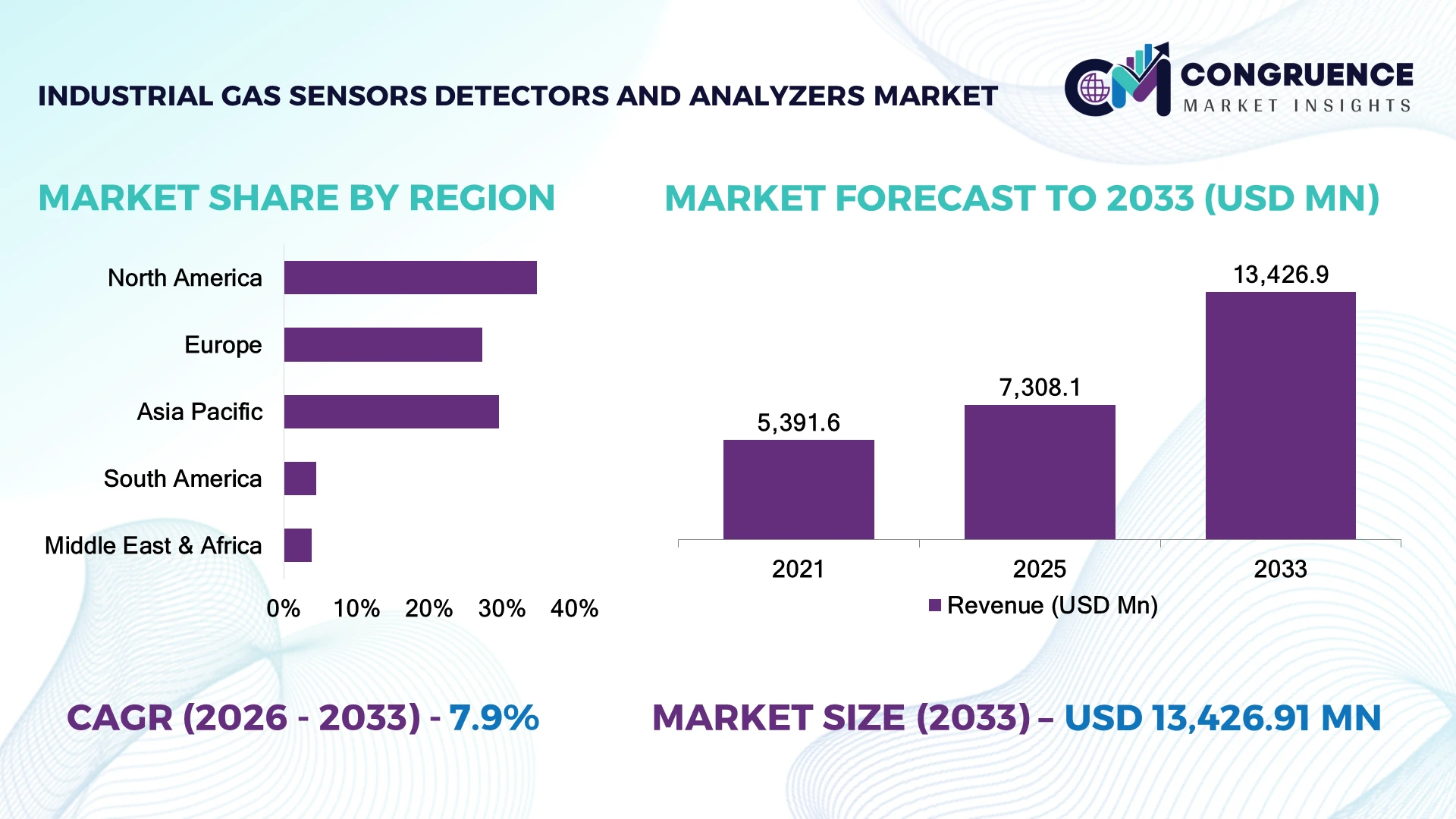
The Global Industrial Gas Sensors Detectors and Analyzers Market was valued at USD 7,308.1 Million in 2025 and is anticipated to reach a value of USD 13,426.9 Million by 2033 expanding at a CAGR of 7.9% between 2026 and 2033. Growth is being driven by stricter industrial emission compliance, expanding hydrogen infrastructure, and accelerated deployment of smart process monitoring across oil & gas, chemicals, power generation, and manufacturing facilities.
The United States accounts for approximately 29% of global industrial gas monitoring deployments, supported by sustained investments in industrial automation, LNG infrastructure, and advanced manufacturing. More than 64% of large processing facilities operate continuous gas monitoring systems, while Germany records over 48% adoption across Industry 4.0-enabled manufacturing plants. Continued energy security initiatives following global supply-chain realignment and geopolitical disruptions have accelerated investment in intelligent industrial safety systems and real-time emissions monitoring.
Manufacturers investing in AI-enabled sensing platforms, multi-gas analytics, and predictive industrial monitoring are strengthening long-term competitive positioning across regulated industrial sectors.
Market Size & Growth: USD 7,308.1 Million in 2025, reaching USD 13,426.9 Million by 2033 at a CAGR of 7.9%, driven by industrial digitalisation and tighter emissions compliance.
Top Growth Drivers: Industrial automation 34%, emission monitoring 28%, hydrogen infrastructure expansion 19%.
Short-Term Forecast: By 2028, predictive maintenance reduces unplanned downtime by 21% and calibration costs decline 16%.
Emerging Technologies: AI diagnostics, MEMS sensors, laser-based spectroscopy, and edge analytics improve monitoring precision.
Regional Leaders: North America exceeds USD 4.2 Billion, Asia-Pacific approaches USD 4.8 Billion, Europe surpasses USD 2.9 Billion with expanding industrial safety deployments.
Consumer/End-User Trends: Approximately 62% of process industries prioritise continuous multi-gas monitoring over periodic inspections.
Pilot/Case Example: A 2026 refinery digital monitoring programme reduced gas leak response time by 31%.
Competitive Landscape: Leading suppliers control approximately 43% market share, led by Honeywell, Emerson, ABB, Siemens, and Dräger.
Regulatory & ESG Impact: Continuous emissions monitoring improves regulatory compliance by approximately 26% across industrial operations.
Investment & Funding: More than USD 2.4 Billion supports industrial sensing, hydrogen safety, and smart factory expansion amid supply-chain diversification.
Innovation & Future Outlook: Optical sensing, wireless detection, and AI-enabled diagnostics are redefining industrial gas monitoring platforms.
Industrial Gas Sensors, Detectors and Analyzers are becoming indispensable across hydrogen production, carbon capture, semiconductor fabrication, and chemical processing, where continuous process visibility directly influences operational safety and compliance. AI-assisted gas diagnostics improve fault identification accuracy by approximately 27%, while wireless industrial sensing simplifies deployment across distributed facilities. Expanding industrial decarbonisation programmes and resilient equipment supply strategies are accelerating intelligent monitoring investments, creating a natural transition into the market's strategic evolution.
Industrial Gas Sensors, Detectors and Analyzers have become strategic infrastructure for industries seeking higher operational resilience, environmental compliance, and workforce safety. Increasing industrial automation, hydrogen economy development, and stricter environmental regulations are transforming gas monitoring from a compliance requirement into a core operational intelligence platform. Manufacturers are restructuring supply chains to secure semiconductor components and specialised sensing materials while integrating connected monitoring into digital manufacturing environments.
Modern laser-based and MEMS sensing technologies deliver approximately 32% faster gas identification and reduce maintenance interventions by nearly 24% compared with conventional electrochemical monitoring systems. North America leads large-scale deployment across oil & gas and chemical processing, while China is expanding manufacturing capacity for industrial sensing equipment and process automation. Continuous monitoring platforms equipped with AI analytics now support predictive maintenance strategies that minimise production interruptions and improve asset reliability.
Industrial operators are deploying networked gas detection systems across refineries, hydrogen production plants, and pharmaceutical facilities to strengthen process control and emergency response. Suppliers are expanding strategic partnerships with automation companies, industrial software providers, and engineering contractors to deliver integrated safety ecosystems. Over the next two to three years, competitive leadership will depend on sensor precision, interoperability, cybersecurity, and scalable analytics platforms capable of supporting increasingly automated industrial operations while enabling measurable environmental and operational performance improvements.
Tighter industrial safety and emissions regulations are driving continuous investment in Industrial Gas Sensors, Detectors and Analyzers across oil & gas, chemicals, power generation, mining, and pharmaceutical manufacturing. Approximately 67% of newly commissioned industrial plants now integrate continuous gas monitoring systems during initial design, while AI-enabled monitoring reduces hazardous gas response time by nearly 26%. The United States continues expanding methane monitoring requirements across energy infrastructure, accelerating deployment of fixed and portable gas detection technologies. This regulatory shift is strengthening demand for intelligent monitoring platforms that improve operational reliability and compliance. Manufacturers are responding through AI-enabled analytics, expanded calibration services, strategic automation partnerships, and investment in multi-gas sensing technologies capable of supporting increasingly digital industrial environments.
Industrial gas monitoring equipment remains dependent on precision optical components, MEMS devices, infrared emitters, and specialised semiconductor materials that continue experiencing procurement volatility. Approximately 44% of manufacturing costs are associated with sensing modules and electronic components, while calibration and certification activities increase lifecycle expenses by nearly 18%. Dependence on specialised component suppliers across East Asia exposes manufacturers to delivery disruptions and inventory uncertainty during geopolitical trade adjustments. These structural constraints extend production lead times, reduce pricing flexibility, and slow deployment across cost-sensitive industries. Companies are mitigating risk through regional manufacturing expansion, supplier diversification, long-term procurement agreements, and greater localisation of electronic assembly operations to improve operational resilience.
Rapid expansion of hydrogen production, carbon capture facilities, and advanced semiconductor manufacturing is creating specialised demand for next-generation gas sensing technologies. AI-supported predictive diagnostics improve leak detection efficiency by approximately 29%, while laser-based gas analysis reduces false alarms by nearly 22% in complex industrial environments. Japan's hydrogen infrastructure investments and South Korea's clean energy manufacturing programmes are accelerating adoption of high-precision detection systems. Companies are strengthening research into tunable diode laser spectroscopy, wireless industrial sensing, and cloud-connected monitoring platforms while forming partnerships with automation providers. A growing opportunity lies in subscription-based remote monitoring services that combine hardware, predictive analytics, and lifecycle maintenance within integrated industrial safety ecosystems.
Integrating gas detection platforms with industrial control systems, cloud analytics, and cybersecurity frameworks remains a significant execution challenge. Approximately 41% of brownfield industrial facilities require customised integration before modern monitoring platforms can operate efficiently, while software validation increases deployment timelines by nearly 19%. Growing industrial cybersecurity requirements are placing additional pressure on connected sensing infrastructure as operational technology networks become increasingly interconnected. These complexities reduce deployment consistency across multi-site operations and delay digital transformation initiatives. Companies must strengthen open communication protocols, cybersecurity investment, software standardisation, and engineering partnerships to deliver scalable monitoring platforms capable of supporting autonomous industrial operations and future smart manufacturing environments.
AI Diagnostics Transform Monitoring: AI-assisted gas analysis platforms now improve fault identification accuracy by approximately 28% while reducing unnecessary maintenance interventions by nearly 19%. Industrial operators are embedding predictive analytics into continuous monitoring workflows, prompting manufacturers to expand software capabilities and integrate cloud-based diagnostics with process automation systems.
Wireless Detection Deployment Expands: Wireless industrial gas detectors now account for approximately 37% of new hazardous-area installations, reducing installation time by nearly 24% compared with conventional wired systems. Labour shortages and plant modernisation initiatives are encouraging companies to accelerate deployment across distributed industrial assets and remote processing facilities.
Hydrogen Safety Monitoring Rises: Hydrogen production projects have increased demand for dedicated leak detection technologies, with deployment of hydrogen-compatible sensors expanding by approximately 31%. Equipment manufacturers are developing specialised sensing platforms, strengthening engineering partnerships, and enhancing calibration accuracy to support evolving clean energy infrastructure and industrial decarbonisation programmes.
Optical Sensing Gains Momentum: Laser-based and optical gas analyzers improve measurement precision by approximately 27% while reducing calibration frequency by nearly 18% compared with conventional technologies. Process industries are replacing legacy equipment in high-value production environments, encouraging suppliers to expand modular product portfolios and strengthen integration with digital industrial control platforms.
Fixed Gas Detection Systems account for approximately 49% of the Industrial Gas Sensors Detectors and Analyzers market, driven by their continuous monitoring capability, seamless integration with distributed control systems, and mandatory deployment across refineries, chemical plants, power stations, and manufacturing facilities. Their ability to monitor multiple hazardous gases in real time while supporting automated shutdown procedures makes them the preferred solution for high-risk industrial environments. Portable gas detectors remain essential for confined-space entry and maintenance operations, while gas analyzers continue expanding across emissions monitoring and process optimisation where measurement precision directly influences production efficiency.
Wireless gas detection systems represent the fastest-growing segment as industrial facilities modernise hazardous-area monitoring without extensive cabling infrastructure. Adoption has increased by approximately 27%, while wireless deployments reduce installation time by nearly 24%. Around 58% of newly commissioned industrial facilities now specify hybrid fixed and wireless gas monitoring architectures. Manufacturers are investing in cloud-enabled diagnostics, intrinsically safe wireless communication, and modular sensing platforms while strengthening partnerships with industrial automation providers to support scalable safety ecosystems.
A 2026 industrial safety assessment released by an international process safety organisation reported that integrated fixed and wireless gas detection architectures are becoming the preferred deployment model for newly commissioned hazardous industrial facilities.
Oil & Gas accounts for approximately 36% of Industrial Gas Sensors Detectors and Analyzers deployment because upstream, midstream, and downstream facilities require continuous monitoring of combustible, toxic, and oxygen-deficient environments. Regulatory compliance, process safety, and asset protection continue concentrating investment within refineries, LNG terminals, and pipeline infrastructure. Chemical & Petrochemical remains another major application, while mining, pharmaceuticals, food processing, and power generation continue expanding advanced gas monitoring to strengthen operational reliability and worker safety.
Hydrogen and clean energy applications represent the fastest-growing segment as hydrogen production, storage, and transport infrastructure require specialised leak detection and process monitoring technologies. Deployment across hydrogen facilities has increased by approximately 32%, while laser-based gas analyzers improve leak detection accuracy by nearly 23%. Around 54% of newly installed hydrogen production assets incorporate dedicated hydrogen sensing platforms from commissioning. Suppliers are expanding AI-enabled analytics, integrating monitoring with industrial automation platforms, and developing specialised sensing technologies for emerging energy applications.
According to a 2025 enterprise survey conducted by a recognised industrial automation authority, continuous gas monitoring has become a standard operational requirement for new hydrogen production and advanced process manufacturing facilities.
Process industries account for approximately 52% of Industrial Gas Sensors Detectors and Analyzers demand owing to continuous operations, hazardous process environments, and stringent environmental compliance obligations. Refineries, chemical manufacturers, power plants, and pharmaceutical producers depend on permanent gas monitoring infrastructure to maintain production continuity and workforce safety. Manufacturing industries continue expanding deployment through digital factory initiatives, while utilities, mining companies, and environmental monitoring organisations increasingly invest in connected sensing technologies for operational resilience.
Hydrogen production operators and renewable energy infrastructure developers represent the fastest-growing end-user group as industrial decarbonisation programmes accelerate globally. Adoption within this segment has increased by approximately 30%, while integrated AI diagnostics improve predictive maintenance efficiency by nearly 21%. Nearly 49% of new hydrogen facilities are implementing continuous multi-gas monitoring during initial construction. Equipment suppliers are responding through customised sensing platforms, lifecycle service agreements, digital monitoring subscriptions, and engineering partnerships that strengthen long-term customer relationships and improve operational reliability.
A 2026 institutional study published by an international industrial safety authority found that process industries continue prioritising continuous gas monitoring as a core operational investment to improve plant safety, regulatory compliance, and predictive maintenance outcomes.
North America accounted for the largest market share at 34.8% in 2025 however, Asia-Pacific is expected to register the fastest growth, expanding at a CAGR of 8.6% between 2026 and 2033.
Industrial Automation and Compliance Modernization Drive Deployment
North America maintains the leading position in the Industrial Gas Sensors Detectors and Analyzers market, supported by mature oil & gas infrastructure, advanced process industries, and widespread adoption of industrial automation. Continuous emissions monitoring, predictive maintenance, and connected safety systems are becoming standard across refineries, LNG terminals, chemical processing facilities, and pharmaceutical manufacturing plants. Approximately 68% of newly commissioned industrial facilities deploy networked gas detection systems integrated with plant control platforms. Industrial operators are also increasing investment in AI-enabled monitoring and wireless sensing technologies to strengthen worker safety, reduce unplanned downtime, and improve environmental compliance across high-risk operations.
United States Market Outlook: The United States leads regional demand through its extensive refining capacity, chemical manufacturing base, semiconductor expansion, and accelerating hydrogen infrastructure development. Federal methane reduction initiatives and industrial digitalisation continue driving replacement of legacy gas monitoring equipment with intelligent multi-gas platforms. Approximately 63% of large industrial facilities have implemented continuous gas monitoring integrated with supervisory control systems, reinforcing the country's leadership in industrial safety technology and process automation.
Industrial Decarbonisation Reshapes Monitoring Infrastructure
Europe represents approximately 27.3% of the Industrial Gas Sensors Detectors and Analyzers market, driven by stringent industrial emissions regulations, hydrogen economy investments, and rapid Industry 4.0 implementation. Process manufacturers are replacing conventional monitoring equipment with intelligent gas detection systems that support continuous compliance and predictive maintenance. Nearly 52% of new industrial modernisation projects now incorporate advanced gas analytics and connected sensing platforms. Equipment suppliers continue expanding partnerships with automation providers to strengthen integration between gas monitoring, industrial software, and plant safety systems.
Germany Market Outlook: Germany remains the region's technology leader through its advanced chemical industry, engineering expertise, and automated manufacturing infrastructure. Industrial facilities increasingly deploy optical gas analyzers and AI-enabled monitoring across pharmaceutical, automotive, and specialty chemical production. Approximately 58% of newly modernised manufacturing facilities incorporate digitally connected gas monitoring solutions, supporting operational efficiency, environmental compliance, and long-term industrial competitiveness.
Manufacturing Expansion Accelerates Intelligent Safety Adoption
Asia-Pacific is the fastest-growing Industrial Gas Sensors Detectors and Analyzers market, supported by expanding industrial manufacturing, semiconductor fabrication, petrochemical investments, and clean energy infrastructure. China, Japan, South Korea, and India continue strengthening industrial automation while increasing deployment of continuous gas monitoring systems across hazardous production environments. Approximately 61% of new heavy industrial projects within the region specify integrated gas detection during plant construction. Manufacturers are expanding regional production capacity, strengthening calibration services, and investing in local engineering support to meet growing industrial demand.
China Market Outlook: China serves as the region's largest industrial market through its extensive petrochemical production, electronics manufacturing, steel industry, and expanding hydrogen projects. Industrial safety regulations and digital factory programmes continue accelerating deployment of intelligent gas detection platforms. Nearly 57% of newly commissioned large-scale manufacturing facilities incorporate networked gas monitoring systems, positioning China as both a leading manufacturing base and one of the largest deployment markets for industrial sensing technologies.
Resource Industries Strengthen Safety Investments
South America is experiencing steady demand for Industrial Gas Sensors Detectors and Analyzers as mining, oil & gas, metals processing, and chemical industries modernise operational safety infrastructure. Continuous monitoring is becoming increasingly important for hazardous production environments where regulatory oversight and workforce protection are receiving greater investment. Approximately 38% of industrial safety upgrades now include multi-gas detection technologies. While imported equipment and calibration infrastructure remain operational constraints, manufacturers are expanding local distribution partnerships, engineering support, and maintenance services to improve deployment efficiency and customer responsiveness.
Brazil Market Outlook: Brazil leads regional adoption through its offshore oil production, mining industry, biofuel processing, and expanding industrial manufacturing sector. Large industrial operators continue investing in digital safety infrastructure to improve operational reliability and environmental compliance. Approximately 53% of regional industrial gas monitoring deployments are concentrated in Brazil, supported by increasing automation investment and sustained expansion of energy and resource processing industries.
Energy Infrastructure Modernisation Expands Monitoring Systems
The Middle East & Africa market is advancing through sustained investment in oil & gas infrastructure, petrochemical production, hydrogen projects, and industrial diversification initiatives. Process industries are strengthening continuous gas monitoring to improve operational safety, emissions control, and plant reliability across large industrial complexes. Approximately 35% of newly commissioned energy infrastructure projects integrate advanced gas detection technologies during construction. Equipment suppliers are expanding engineering partnerships, calibration facilities, and technical service networks to support increasingly sophisticated industrial operations across the region.
Saudi Arabia Market Outlook: Saudi Arabia represents the region's most significant market due to ongoing petrochemical expansion, refining capacity growth, hydrogen development initiatives, and industrial diversification programmes. Major industrial operators continue implementing intelligent gas monitoring platforms across large processing facilities to strengthen safety and operational performance. Approximately 47% of regional investment in advanced industrial gas monitoring systems is associated with projects located in Saudi Arabia, reinforcing its strategic role in industrial process safety and energy infrastructure modernisation.
Global automation leaders Honeywell, Emerson, ABB, Siemens, and Dräger compete directly with specialised safety providers such as MSA Safety and Teledyne, while integrated automation vendors challenge standalone gas detection manufacturers through platform-based monitoring solutions. The top five participants collectively command approximately 46% of the market. Competition centres on detection accuracy, AI-enabled diagnostics, lifecycle cost, and industrial interoperability, with optical sensing improving response precision by nearly 27%, predictive diagnostics reducing maintenance requirements by approximately 21%, and wireless deployment lowering installation costs by around 18%. Companies are expanding manufacturing capacity, integrating software with industrial control systems, strengthening hydrogen monitoring portfolios, and pursuing strategic acquisitions to broaden technology capabilities. Competitive momentum is shifting toward cloud-connected emissions monitoring, optical spectroscopy, and vertically integrated industrial safety ecosystems. The principal entry barrier remains certification, hazardous-area compliance, and proprietary sensing expertise. Success requires combining high-precision sensing, automation integration, regulatory compliance, and lifecycle service capabilities within scalable industrial platforms.
Honeywell International Inc.
Emerson Electric Co.
ABB Ltd.
Siemens AG
Drägerwerk AG & Co. KGaA
MSA Safety Incorporated
Teledyne Technologies Incorporated
Yokogawa Electric Corporation
Endress+Hauser Group
AMETEK, Inc.
Fuji Electric Co., Ltd.
RIKEN KEIKI Co., Ltd.
New Cosmos Electric Co., Ltd.
Industrial Gas Sensors, Detectors and Analyzers are increasingly built around laser spectroscopy, MEMS sensing, electrochemical detection, infrared technology, and edge-enabled industrial connectivity. Optical and laser-based analyzers improve gas identification precision by approximately 29% while reducing calibration frequency by nearly 18% compared with conventional technologies. Around 63% of newly installed continuous monitoring systems now integrate digital communication protocols for seamless connectivity with distributed control systems, enabling predictive maintenance and continuous regulatory reporting. These technologies strengthen process reliability, minimise hazardous incidents, and improve operational visibility across high-risk industrial environments.
Emerging technologies include tunable diode laser absorption spectroscopy, AI-assisted diagnostics, wireless industrial sensing, and cloud-based emissions analytics. Compared with traditional catalytic bead detection, hybrid optical sensing delivers approximately 31% faster response while reducing false alarms by nearly 22%. Large refinery operators, hydrogen producers, and chemical manufacturers gain the greatest competitive advantage because integrated monitoring platforms improve plant availability, simplify compliance, and optimise maintenance scheduling through continuous operational intelligence.
Between 2026 and 2028, autonomous calibration, digital twins, and multimodal sensor fusion will redefine industrial gas monitoring. Deployment of AI-assisted analytics is expected to exceed 58% across newly commissioned industrial facilities. Companies investing early in interoperable sensing platforms, cybersecurity, and advanced optical technologies will secure stronger competitive differentiation, improve environmental performance, and support expanding hydrogen, carbon capture, semiconductor, and smart manufacturing applications.
February 2024 Honeywell joined Saudi Arabia's "Made in Saudi" programme, localising assembly and calibration of gas detection products with planned output of 10,000 units during 2024, strengthening regional supply resilience and industrial safety capabilities. Source: Honeywell (Honeywell Automation)
December 2024 Emerson introduced the Rosemount 470XA Gas Chromatograph for natural gas, renewable gas, hydrogen, and carbon capture applications, delivering C6+ measurement capability within a compact platform that expands analytical flexibility for process industries. Source: Emerson (Emerson.com)
March 2025 Emerson launched the Rosemount 625IR Fixed Gas Detector featuring factory calibration for life and ultra-fast optical hydrocarbon detection, reducing routine maintenance by 100% for calibration while improving operational reliability in hazardous facilities. Source: Emerson News (Emerson.com)
March 2026 Honeywell unveiled its 4-Series NDIR Hydrocarbon Gas Sensor with infrared detection technology offering lower power consumption than catalytic bead alternatives while improving poisoning resistance, enabling longer portable detector operating life and higher industrial safety performance. Source: Honeywell Press Release
The Industrial Gas Sensors Detectors and Analyzers Market Report delivers comprehensive analysis across fixed gas detection systems, portable gas detectors, wireless gas detection systems, and industrial gas analyzers serving oil & gas, chemical processing, hydrogen production, power generation, mining, pharmaceuticals, semiconductor manufacturing, and environmental monitoring. The assessment evaluates demand across process industries, manufacturing enterprises, utilities, mining operators, and emerging clean energy infrastructure while covering North America, Europe, Asia-Pacific, South America, and the Middle East & Africa. More than 60% of new industrial monitoring deployments now integrate intelligent digital sensing with automation platforms.
The report further examines optical spectroscopy, electrochemical sensing, MEMS technology, AI-assisted diagnostics, wireless monitoring, industrial IoT integration, and predictive maintenance capabilities shaping market evolution between 2026 and 2033. It provides strategic insights into competitive positioning, regional deployment patterns, technology adoption, industrial investment priorities, and partnership strategies, supporting informed decisions on capacity expansion, product innovation, market entry, and long-term operational competitiveness.
| Report Attribute/Metric | Report Details |
|---|---|
|
Market Revenue in 2025 |
USD 7,308.1 Million |
|
Market Revenue in 2033 |
USD 13,426.9 Million |
|
CAGR (2026 - 2033) |
7.9% |
|
Base Year |
2025 |
|
Forecast Period |
2026 - 2033 |
|
Historic Period |
2021 - 2025 |
|
Segments Covered |
By Type
By Application
By End-User
|
|
Key Report Deliverable |
Revenue Forecast, Growth Trends, Market Dynamics, Segmental Overview, Regional and Country-wise Analysis, Competition Landscape |
|
Region Covered |
North America, Europe, Asia-Pacific, South America, Middle East, Africa |
|
Key Players Analyzed |
Honeywell International Inc., Emerson Electric Co., ABB Ltd., Siemens AG, Drägerwerk AG & Co. KGaA, MSA Safety Incorporated, Teledyne Technologies Incorporated, Yokogawa Electric Corporation, Endress+Hauser Group, AMETEK, Inc., Fuji Electric Co., Ltd., RIKEN KEIKI Co., Ltd., New Cosmos Electric Co., Ltd. |
|
Customization & Pricing |
Available on Request (10% Customization is Free) |




