
Reports
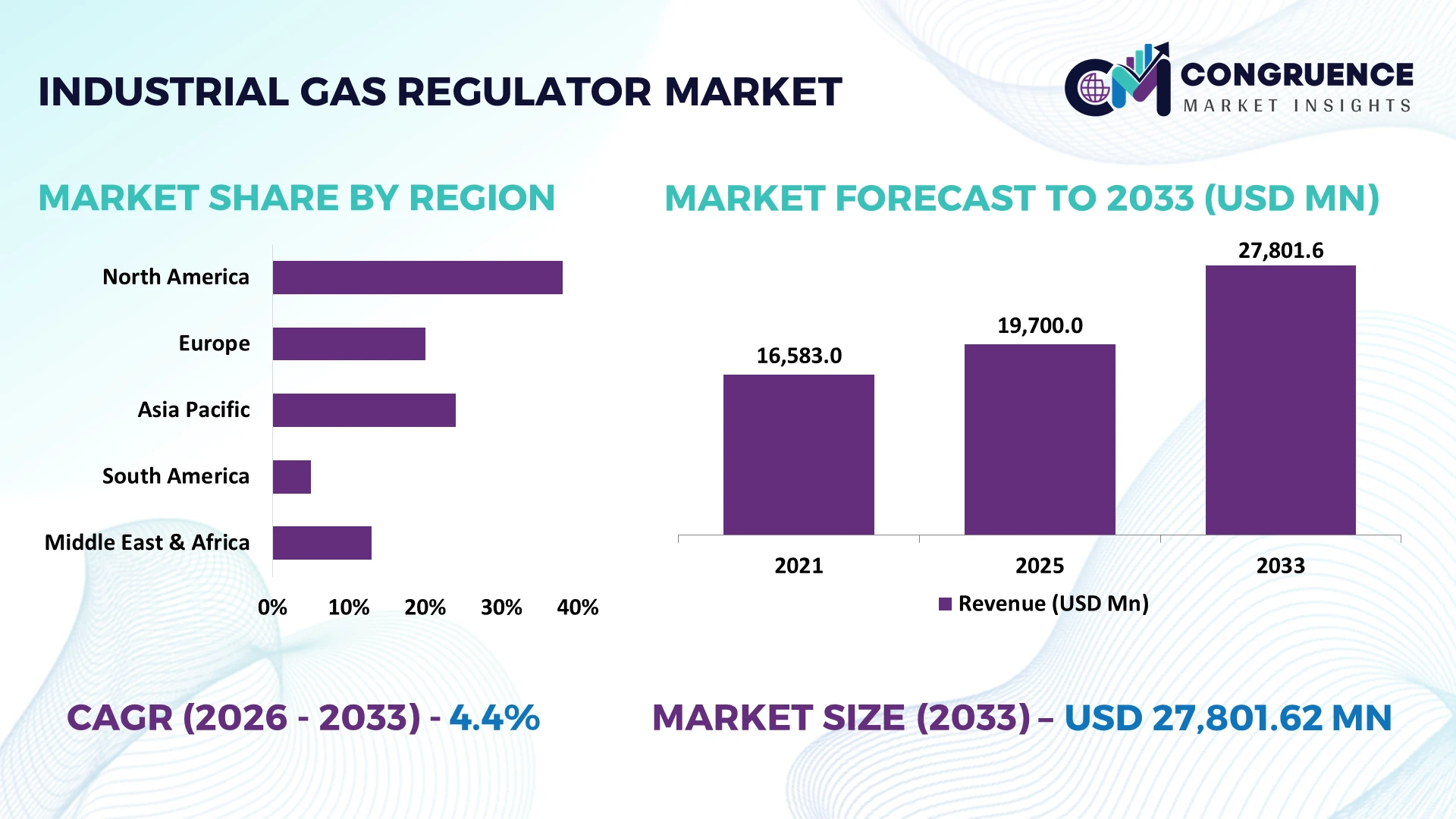
The Global Industrial Gas Regulator Market was valued at USD 19700 Million in 2025 and is anticipated to reach a value of USD 27801.62 Million by 2033 expanding at a CAGR of 4.4% between 2026 and 2033. Growth is driven by semiconductor fab expansion, hydrogen infrastructure, automated welding, medical gas systems, and tighter pressure control requirements across high purity industrial processes.
China represents the strongest country level demand base, supported by manufacturing that contributes roughly 25% of national GDP and its position as the source of more than 30% of global manufacturing output. Semiconductor fabrication, chemicals, metals, electronics, hydrogen projects, and industrial gas distribution underpin regulator consumption, while digitally monitored pressure systems are gaining relevance in automated facilities. Compared with the United States, China benefits from substantially larger manufacturing scale, while US demand is more concentrated in advanced semiconductor, aerospace, healthcare, and high purity gas applications. Continuing US China technology and semiconductor supply chain realignment is reinforcing localized equipment sourcing.
Industrial gas regulator suppliers should prioritize high purity, hydrogen compatible, digitally monitored, and application engineered platforms in countries expanding advanced manufacturing capacity.
Market Size & Growth: USD 19.70 billion in 2025 advances to USD 27.80 billion by 2033 at 4.4% CAGR, supported by semiconductor, hydrogen, welding, healthcare, and process automation investment.
Top Growth Drivers: Semiconductor fabrication, hydrogen infrastructure, and industrial automation form the three strongest demand engines, with manufacturing representing roughly 25% of Chinese GDP and reinforcing regulator consumption.
Short Term Forecast: By 2028, digital pressure monitoring and automated control integration will increasingly target 10% to 20% reductions in unplanned gas system intervention through predictive maintenance and remote diagnostics.
Emerging Technologies: Smart regulators combining electronic pressure sensing, IoT connectivity, and automated control are shifting industrial gas management from mechanical adjustment toward continuous digital monitoring with sub 1% class measurement capabilities.
Regional Leaders: Asia Pacific represents the largest demand center, while North America and Europe remain advanced technology markets; their combined opportunity is anchored by multibillion dollar semiconductor, hydrogen, healthcare, and industrial decarbonization programs.
End User Trends: Semiconductor processing increasingly requires ultra high purity gas delivery, with critical process gases commonly specified at 99.999% purity or higher, strengthening demand for contamination resistant regulator architectures.
Pilot and Case Example: Hydrogen mobility projects increasingly operate storage systems near 700 bar for light duty vehicles, requiring specialized pressure reduction stages capable of safely converting extremely high storage pressure into controlled downstream flow.
Competitive Landscape: Emerson, Honeywell, Linde, Air Liquide, and Parker Hannifin compete through precision engineering, gas compatibility, distribution reach, and integrated control technology rather than a single player holding a defensible 20% plus global position.
Regulatory & ESG Impact: Hydrogen systems spanning 350 bar and 700 bar operating classes are raising requirements for leak integrity, material compatibility, pressure cycling durability, and certified safety performance across advanced regulator portfolios.
Investment & Funding: Global semiconductor manufacturing incentives exceed USD 100 billion across major US, European, Japanese, Indian, and Asian programs, expanding high purity process gas infrastructure and associated pressure control equipment requirements.
Innovation & Future Outlook: Next generation regulators are moving toward electronic actuation, integrated sensors, hydrogen compatible materials, and predictive diagnostics, positioning digitally connected pressure control as a strategic differentiator through 2033.
Industrial Gas Regulator Market demand is increasingly concentrated in semiconductor fabrication, specialty chemicals, hydrogen systems, metal processing, healthcare, and automated manufacturing where stable downstream pressure directly affects process quality and safety. Smart pressure regulators integrating sensors, electronic control, and remote diagnostics are replacing purely mechanical monitoring in advanced installations. Semiconductor operations requiring process gases at 99.999% purity or higher are strengthening demand for contamination resistant components. Hydrogen deployment adds another operational requirement through 350 bar and 700 bar storage architectures, creating a clear transition toward application specific, digitally monitored pressure control strategies.
Industrial gas regulators are becoming strategically important as semiconductor fabrication, hydrogen infrastructure, specialty chemicals, healthcare, and automated manufacturing demand tighter pressure stability and higher gas purity. Semiconductor processes routinely require gases at 99.999% purity or higher, making contamination control and precise delivery competitive requirements. Supply chain localization in the United States, China, India, and Japan is simultaneously shifting procurement toward qualified domestic and regional pressure control ecosystems.
Digitally monitored regulators combine electronic sensing, automated adjustment, and remote diagnostics, enabling pressure accuracy around ±1% in advanced configurations while reducing manual inspection requirements compared with conventional mechanical systems. China offers greater manufacturing scale, whereas the United States concentrates investment in semiconductor, aerospace, hydrogen, and high purity applications. Through 2028, connected pressure monitoring will increasingly become standard across critical gas distribution installations.
A practical hydrogen station can reduce gas stored near 700 bar through multiple regulated stages before dispensing or downstream utilization. Suppliers are consequently investing in hydrogen compatible materials, sensor integration, localized manufacturing, and OEM partnerships. Competitive advantage will increasingly depend on combining pressure precision, digital visibility, application certification, and dependable lifecycle support.
Semiconductor fabrication, hydrogen processing, specialty chemicals, and automated welding are intensifying demand for precision pressure regulation. Semiconductor production commonly requires process gases at 99.999% purity or higher, while hydrogen mobility systems operate around 350 bar or 700 bar storage classes. Manufacturing contributes roughly 25% of China's GDP, creating a substantial installed base for industrial gas handling equipment. US semiconductor localization under the CHIPS manufacturing push is simultaneously expanding high purity gas infrastructure. These shifts increase demand for corrosion resistant diaphragms, dual stage regulation, low internal volume designs, and electronic pressure monitoring. Manufacturers are responding with hydrogen compatible alloys, integrated sensors, and application specific regulator platforms. The strategic advantage lies in controlling pressure stability and contamination simultaneously, reducing process variability rather than merely managing gas flow.
Specialty regulators face higher qualification and material costs because hydrogen, corrosive gases, and ultra high purity applications require tighter specifications than conventional industrial installations. Hydrogen molecules can permeate sealing systems, while semiconductor gases commonly require purity levels of 99.999% or higher and leak tight components. Nickel prices have experienced swings exceeding 20% within annual trading cycles, directly affecting corrosion resistant alloy component economics. Qualification requirements for 350 bar and 700 bar hydrogen systems further increase testing complexity and product validation expenditure. US and European buyers are also reducing dependence on concentrated component supply chains, increasing localization costs during supplier transitions. Manufacturers are mitigating exposure through dual sourcing, longer material contracts, localized machining, and standardized component families. Maintaining specification compliance without excessive customization remains the critical profitability constraint.
Electronic regulation creates an opportunity to transform pressure control from a passive mechanical function into an intelligent process management layer. Advanced digital pressure sensors can deliver accuracy near ±0.25% of full scale, compared with roughly ±1% performance common across less sophisticated industrial measurement configurations. Connected regulators can also reduce manual inspection requirements by transmitting pressure, flow, alarm, and equipment health information directly into plant control systems. India's manufacturing expansion and semiconductor investment pipeline create additional demand for digitally integrated high purity gas distribution. Through 2028, sensor equipped regulators will increasingly support predictive maintenance, automated gas changeover, and remote configuration. Suppliers are investing in embedded diagnostics, communication protocols, compact electronic actuation, and OEM integration partnerships. The non obvious opportunity is recurring lifecycle value through calibration, diagnostics, software integration, and condition based service rather than hardware sales alone.
Integrating electronics into critical gas regulation introduces execution complexity because pressure control, functional safety, cybersecurity, calibration, and plant communication must operate reliably as one system. Hydrogen installations can involve pressures up to 700 bar, while semiconductor applications require gases exceeding 99.999% purity, leaving minimal tolerance for leakage, contamination, or sensor drift. Industrial cybersecurity adds another layer as connected regulators become addressable components within plant networks; manufacturing accounted for more than 20% of observed cyber incidents across several recent industrial threat assessments. Germany, Japan, and the United States are simultaneously tightening digital infrastructure resilience expectations. Suppliers must therefore invest in secure firmware, redundant sensing, automated calibration diagnostics, technician training, and interoperable communication architectures. Long term competitiveness depends on scaling connected regulation without allowing digital complexity to weaken mechanical reliability or certified safety performance.
Compact Regulators Reshape Equipment Design: OEMs are shifting toward compact, lightweight regulators for analytical instruments, portable fabrication equipment, and mobile gas systems where enclosure space directly affects product design. Component consolidation is cutting regulator footprints by 15% to 30%, while optimized flow paths can reduce internal volume by more than 20%. Manufacturers are redesigning valve seats, diaphragms, and integrated manifolds to reduce connection counts. The non obvious benefit is lower purge gas consumption during cylinder changes, which improves operating economics for expensive specialty gases.
Automatic Changeover Gains Plant Adoption: Continuous production sites are replacing manual cylinder bank switching with automatic changeover assemblies that maintain uninterrupted downstream supply. Modern installations can transition between two gas banks without operator intervention and maintain supply continuity approaching 100% during routine cylinder replacement. Plants running three shifts gain the strongest operational benefit because fewer manual interventions reduce production interruptions. Regulator manufacturers are integrating changeover valves, alarm contacts, and centralized control panels while partnering with gas system integrators for packaged installations.
Additive Manufacturing Changes Gas Workflows: Metal additive manufacturing is creating specialized regulator demand because laser powder bed fusion requires tightly controlled inert atmospheres, particularly argon and nitrogen. Oxygen concentration inside build chambers can be maintained below 0.1% for sensitive alloys, while industrial metal printing installations increasingly operate multiple machines from centralized gas networks. Aerospace and medical component producers are therefore moving away from individual cylinder arrangements toward engineered distribution architectures. Suppliers are responding with higher flow regulators, purge assemblies, and dedicated manifold packages optimized for additive manufacturing cells.
Cylinder Logistics Become More Automated: Industrial gas distributors are modernizing cylinder handling as labor availability and traceability requirements reshape filling operations. RFID and barcode systems can provide individual identification across thousands of cylinders, while automated filling lines increasingly combine pressure verification, valve handling, and batch recording. Companies are restructuring regulator and manifold specifications around standardized connections and faster replacement workflows. This shifts purchasing decisions toward products that simplify fleet maintenance, reduce cylinder turnaround time, and integrate cleanly with distributor asset management processes.
Single Stage regulators represent the leading type with an estimated 35% market share, supported by simple architecture, lower component requirements, compact installation, and suitability for applications where inlet pressure variation has limited downstream impact. Their established position spans general manufacturing, fabrication, utilities, and routine cylinder service. Low Pressure regulators remain important for controlled downstream delivery, while Line Regulators support intermediate pressure management within centralized piping networks. Suppliers are broadening these mature portfolios through modular body designs, wider connection options, and application specific seat materials.
Two Stage regulators are the fastest advancing type as users prioritize outlet pressure stability across declining cylinder pressure. Their sequential pressure reduction architecture provides tighter control than Single Stage designs for sensitive equipment. High Pressure regulators serve demanding compressed gas installations, while Point of Use configurations are gaining relevance where pressure adjustment is required immediately before equipment consumption. Manufacturers are consequently directing engineering investment toward compact multistage architectures and configurable outlet ranges, shifting competitive emphasis from unit price toward pressure stability and application fit.
Pressure Control represents the leading application with an estimated 31% share because virtually every compressed gas installation requires pressure reduction between storage, pipeline, and operating equipment. Gas Distribution remains a mature application across centralized plants, while Welding & Cutting maintains substantial regulator usage through fabrication, construction, shipbuilding, and maintenance operations. Laboratory Gas Supply requires finer adjustment and material compatibility, particularly for analytical instrumentation where stable delivery influences measurement consistency. Manufacturers are expanding application specific configurations rather than relying on universal regulator designs.
Process Gas Supply is the fastest developing application as advanced production systems require increasingly controlled delivery of reactive, inert, carrier, and specialty gases. Gas Mixing is also becoming more sophisticated as food processing, controlled atmosphere production, calibration, and engineered mixtures demand repeatable composition. Process installations increasingly specify outlet stability within low single digit percentage tolerances, creating stronger demand for engineered regulator assemblies. Suppliers are responding with higher flow capacity, corrosion resistant wetted components, integrated filtration, and application matched control ranges, concentrating investment on installations where pressure variability directly affects production quality.
Manufacturing represents the leading end user with an estimated 27% share, reflecting regulator deployment across fabrication, automotive production, machinery, heat treatment, assembly, and maintenance operations. Metals & Mining remains an intensive user for cutting, heating, smelting, and processing, while Oil & Gas relies on regulated gases for instrumentation and maintenance. Chemical plants emphasize compatibility with aggressive media, whereas Food & Beverage facilities require controlled gas delivery for carbonation, packaging, and processing. Suppliers are segmenting portfolios by duty cycle, gas compatibility, flow requirement, and maintenance economics.
Electronics is the fastest advancing end user as chip manufacturing expands deposition, etching, cleaning, and controlled atmosphere operations. Pharmaceuticals and Healthcare form separate specification intensive customer groups, prioritizing repeatability, cleanliness, and regulated gas handling rather than maximum throughput. Electronics suppliers increasingly require specialized pressure control architectures as production moves toward advanced logic, memory, and packaging. Regulator manufacturers are targeting this shift through high purity product families, dedicated technical support, qualification programs, and partnerships with gas delivery equipment integrators, making engineering capability increasingly important in customer acquisition.
Asia Pacific accounted for the largest market share at 38.5% in 2025 however, India is expected to register the fastest growth, expanding at a CAGR of 8.17% between 2026 and 2033.
Advanced Industrial Infrastructure Sustains Specification Led Demand
North America represents a mature industrial gas regulator market shaped by established energy infrastructure, aerospace manufacturing, life sciences production, metal fabrication, and extensive packaged gas distribution. The United States anchors deployment through dense industrial corridors in Texas, California, Ohio, Pennsylvania, and the Gulf Coast, where pressure control equipment operates across refineries, chemical facilities, fabrication plants, laboratories, and bulk gas installations. Purchasing increasingly favors certified assemblies offering repeatable performance, simplified maintenance, and compatibility with existing plant piping. Canada adds demand from energy processing, mining, metal production, and industrial gas distribution. Mexico contributes through expanding automotive and export manufacturing clusters. North American cylinder regulator markets represented around 29.4% of global demand in 2025, demonstrating the region's substantial installed equipment base and replacement requirement.
United States Market Outlook: The United States benefits from one of the world's deepest industrial gas distribution and engineering service networks. Manufacturing contributed about 10% of US GDP in 2025, while large refining, aerospace, pharmaceutical, and fabricated metal industries sustain diversified regulator requirements. Domestic suppliers gain an advantage through shorter technical support cycles, certification expertise, and proximity to specification intensive industrial customers.
Compliance Modernization Reshapes Equipment Procurement
Europe's market is defined by specification intensive procurement, aging equipment replacement, industrial decarbonization projects, and harmonized equipment safety requirements. Germany, France, Italy, the United Kingdom, and Benelux concentrate demand across machinery, chemicals, industrial gases, pharmaceuticals, food processing, and engineered manufacturing. European cylinder regulator demand represented roughly 26% of the worldwide market in 2025, indicating a substantial replacement driven installed base. Industrial buyers increasingly evaluate lifecycle maintainability, documented component conformity, leakage performance, and compatibility with plant safety procedures alongside acquisition cost. The Pressure Equipment Directive and ATEX framework strengthen requirements for equipment operating in pressurized and potentially explosive environments. Suppliers are responding by rationalizing certified product platforms, strengthening European distribution inventories, and designing regulator families capable of serving multiple national markets without extensive engineering modifications.
Germany Market Outlook: Germany combines Europe's largest manufacturing economy with dense chemicals, machinery, automotive, metals, and process engineering clusters. Manufacturing generates roughly one fifth of national gross value added, supporting sustained regulator replacement and plant modernization. German customers particularly reward documentation quality, serviceability, standardized interfaces, and equipment capable of operating reliably within highly automated production environments.
Manufacturing Scale Drives Market Leadership
Asia Pacific held approximately 38.5% of the industrial gas regulator market in 2025, supported by extensive manufacturing, industrial gas production, electronics assembly, steelmaking, shipbuilding, chemicals, and expanding factory infrastructure. China provides the largest deployment base, while India, Japan, South Korea, and Southeast Asian manufacturing centers broaden equipment demand across both standardized and engineered regulator configurations. India alone represented about 11.1% of global industrial gas regulator demand in 2025, highlighting how rapidly industrial equipment purchasing is dispersing beyond established East Asian manufacturing centers. Japanese and South Korean customers maintain strong demand for precision engineered equipment, whereas Indian and Southeast Asian plants increasingly combine imported specialist products with locally sourced standard regulators. Suppliers are expanding distributor coverage, application engineering capabilities, localized inventories, and assembly capacity to shorten lead times across geographically dispersed industrial clusters.
China Market Outlook: China remains the region's most strategically important country because of its unmatched concentration of chemicals, steel, machinery, electronics, batteries, and industrial gas consumption. Manufacturing contributes roughly 25% of national GDP, providing regulator suppliers with unusually broad application exposure. Local producers compete aggressively in standardized equipment while international brands retain leverage in specification sensitive installations requiring extensive qualification and engineering support.
Resource Industries Anchor Equipment Demand
South American demand remains concentrated around Brazil, Argentina, Chile, Colombia, and Peru, where mining, steel, petroleum processing, pulp and paper, food production, and fabrication create application specific regulator requirements. The region represents a smaller global share than the three major industrial markets, making distributor coverage and equipment availability particularly important purchasing factors. Brazil's industrial base provides the broadest recurring demand, while Chile and Peru create specialized requirements around mining operations and associated maintenance networks. Brazil produced more than 3 million barrels of crude oil per day during recent operating periods, reinforcing extensive offshore and downstream equipment ecosystems. Imported precision components remain important in technically demanding installations, creating exposure to currency movement and logistics delays. Suppliers are strengthening local inventories, distributor training, repair capabilities, and standardized product ranges to reduce customer downtime.
Brazil Market Outlook: Brazil combines petroleum production, chemicals, steel, mining, food processing, and diversified manufacturing at a scale unmatched elsewhere in South America. Industry contributes more than 20% of national GDP, supporting broad pressure control equipment consumption. São Paulo's manufacturing concentration and Rio de Janeiro's offshore energy ecosystem create distinct customer bases, rewarding suppliers capable of maintaining inventory and technical service close to operating sites.
Industrial Megaprojects Reshape Procurement Priorities
Middle East and Africa demand is increasingly linked to large energy, petrochemical, fertilizer, metals, mining, and industrial diversification projects rather than broad replacement cycles. Saudi Arabia and the United Arab Emirates lead Gulf procurement, while South Africa maintains the continent's most diversified industrial equipment base. Qatar and Oman add specialized requirements through LNG, refining, petrochemicals, and downstream processing. Saudi industrial transformation is particularly significant as localization programs move equipment procurement closer to domestic manufacturing and maintenance ecosystems. Across Africa, mining and mineral processing remain important regulator applications, but fragmented distribution networks can lengthen equipment replacement cycles outside major industrial centers. Vendors are therefore combining project sales with authorized distribution, local service partnerships, inventory hubs, and technical training to improve equipment availability across remote operating environments.
Saudi Arabia Market Outlook: Saudi Arabia offers the strongest strategic positioning through refinery, petrochemical, mining, metals, and industrial diversification investment. Vision 2030 programs are expanding domestic manufacturing capability, while localization requirements increasingly influence supplier selection. Industrial cities such as Jubail and Yanbu provide concentrated demand, encouraging international equipment manufacturers to strengthen Saudi distribution, service, qualification, and local partnership capabilities.
Emerson through TESCOM, Parker Hannifin, Swagelok, Cavagna Group, and GCE Group compete across precision pressure control, while Rotarex and WITT Gas Controls challenge through specialized gas handling portfolios. The top five manufacturers collectively hold an estimated 32% share, leaving substantial demand accessible to specialist and regional suppliers. Emerson's reported position approaches 18%, supported by precision engineering and automation integration, while vertically connected gas suppliers compete through direct customer access. Premium engineered regulators can command price differences exceeding 20% where purity, certification, pressure stability, or material compatibility outweigh acquisition cost. Suppliers are shortening configured product lead times by 10% to 20% through modular architectures and localized inventories. Competition is shifting from standalone mechanical hardware toward integrated pressure management, application engineering, and lifecycle support. Certification costs, qualification cycles, and established distributor relationships remain powerful entry barriers. Winning requires specification depth, responsive supply, proven reliability, and customization without sacrificing manufacturing economics.
Emerson Electric Co.
Parker Hannifin Corporation
Swagelok Company
Cavagna Group S.p.A.
GCE Group
Rotarex S.A.
WITT Gas Controls
Air Liquide S.A.
Air Products and Chemicals, Inc.
Iwatani Corporation
Messer SE & Co. KGaA
Matheson Tri-Gas, Inc.
The Harris Products Group
Pressure Tech Ltd.
Balanced valve architectures are improving regulator performance by isolating seat loading from inlet pressure variation. Compared with conventional unbalanced designs, optimized balanced valves can reduce supply pressure effect by 30% to 50% in duty, improving repeatability as cylinders deplete. Adoption is strongest in specialty gas panels, analytical systems, and automated process skids, where stable delivery reduces recalibration and protects downstream instrumentation. Modular cartridges simplify servicing, lowering intervention time by roughly 20%.
Emerging manufacturing technologies are shifting regulator performance at the material interface. Electropolished 316L stainless steel, metal face seals, and threadless wetted paths reduce particle retention and enable helium leak integrity near 10⁻⁹ mbar litres per second. Advanced surface finishing can cut internal roughness by more than 50% versus conventional machined passages, improving purge performance. Semiconductor equipment builders and specialty gas integrators benefit most because contamination control directly determines process yield and qualification acceptance.
Through 2026 to 2028, simulation led sizing and digitally configured flow curves will disrupt traditional catalogue selection. Engineering teams can compare multiple regulator configurations before hardware installation, potentially reducing specification iteration by 15% to 25%. Suppliers integrating computational flow modelling, configurable components, and virtual application engineering will shorten design cycles and capture specification driven projects earlier.
April 2024 Emerson launched the TESCOM HV 7000 two stage hydrogen regulator for heavy duty fuel cell and combustion vehicles. Its 700 bar compatible architecture stabilizes delivery as tanks deplete, reducing fuel loss and downstream equipment downtime globally. Source: Emerson.com
April 2025 ControlAir introduced CG330 and CG340 low emission gas regulators for natural gas and inert gas service. Atmospheric leakage remains below 0.1 scfh, helping operators meet fugitive emissions requirements while maintaining stable pressure under changing process flows. Source: ControlAir.com
July 2025 WITT Gas Controls introduced COLDSTOP SMART for cryogenic installations, combining dome loaded regulation with automatic temperature protection. Adjustable shutdown thresholds span minus 30°C to plus 50°C, preventing brittle fracture while enabling real time remote telemetry monitoring. Source: NewEquipment.com New
June 2026 Rotarex updated its RX4100 ultra high purity regulator platform for semiconductor gas systems. The springless design achieves certified helium inboard leakage at or below 1×10⁻⁹ mbar·l/s, strengthening contamination control and qualification reliability in advanced fabrication environments. Source: Rotarex.com
The Industrial Gas Regulator Market report evaluates competitive and deployment patterns across Single Stage, Two Stage, High Pressure, Low Pressure, Point of Use, and Line Regulators. Application coverage spans Gas Distribution, Pressure Control, Gas Mixing, Welding & Cutting, Laboratory Gas Supply, and Process Gas Supply, while end user analysis addresses Chemical, Oil & Gas, Healthcare, Food & Beverage, Metals & Mining, Electronics, Pharmaceuticals, and Manufacturing. Regional assessment covers North America, Europe, Asia Pacific, South America, and Middle East & Africa.
Technology coverage examines balanced valve mechanisms, ultra high purity construction, electropolished wetted surfaces, advanced sealing, simulation based sizing, and configurable regulator architectures. The report connects segment positioning with supplier strategies, qualification requirements, industrial deployment patterns, and emerging specialty gas niches. This framework supports 2026 to 2033 investment prioritization, geographic expansion, product portfolio decisions, partnership planning, and competitive positioning.
| Report Attribute/Metric | Report Details |
|---|---|
Market Revenue in 2025 | USD 19700 Million |
Market Revenue in 2033 | USD 27801.62 Million |
CAGR (2026 - 2033) | 4.4% |
Base Year | 2025 |
Forecast Period | 2026 - 2033 |
Historic Period | 2021 - 2025 |
Segments Covered | By Type
By Application
By End-User
|
Key Report Deliverable | Revenue Forecast, Growth Trends, Market Dynamics, Segmental Overview, Regional and Country-wise Analysis, Competition Landscape |
Region Covered | North America, Europe, Asia-Pacific, South America, Middle East, Africa |
Key Players Analyzed | Emerson Electric Co., Parker Hannifin Corporation, Swagelok Company, Cavagna Group S.p.A., GCE Group, Rotarex S.A., WITT Gas Controls, Air Liquide S.A., Air Products and Chemicals, Inc., Iwatani Corporation, Messer SE & Co. KGaA, Matheson Tri-Gas, Inc., The Harris Products Group, Pressure Tech Ltd. |
Customization & Pricing | Available on Request (10% Customization is Free) |




