
Reports
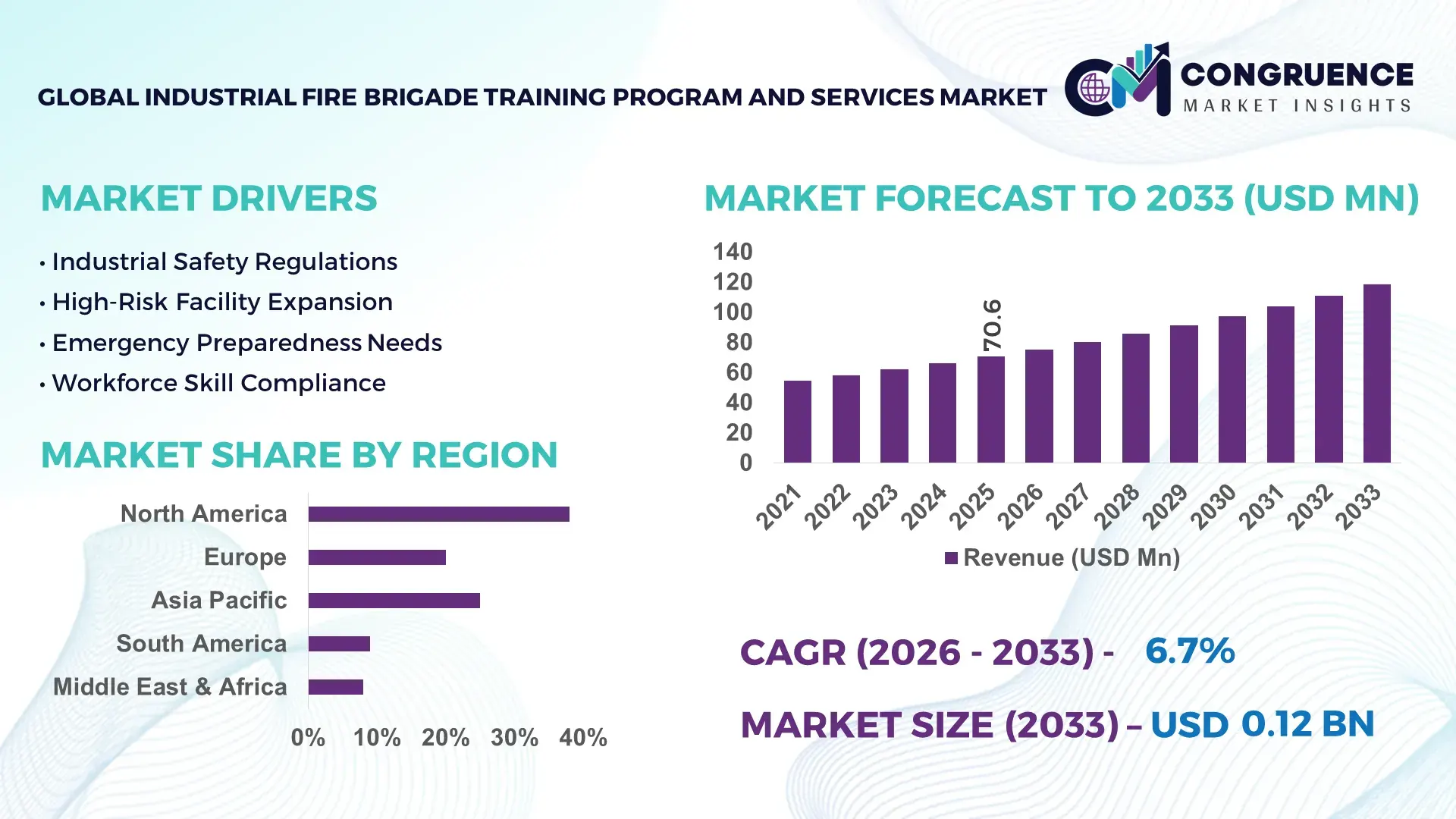
The Global Industrial Fire Brigade Training Program and Services Market was valued at USD 70.58 Million in 2025 and is anticipated to reach a value of USD 118.58 Million by 2033 expanding at a CAGR of 6.7% between 2026 and 2033. The market growth is primarily driven by increasing industrial safety regulations and the adoption of structured emergency response programs.
The United States dominates the Industrial Fire Brigade Training Program and Services market, with over 3,500 certified industrial fire brigades implementing advanced simulation-based and live-fire training modules. Key industries, including oil & gas, chemical manufacturing, and large-scale manufacturing, are increasingly integrating AI-enabled risk assessment tools and VR-based training. In 2025, more than 45% of industrial facilities conducted certified fire safety drills, with adoption in urban industrial hubs exceeding 60%, reflecting proactive compliance and technology-driven training effectiveness.
Market Size & Growth: USD 70.58 Million in 2025, projected USD 118.58 Million by 2033, CAGR 6.7%, driven by industrial safety mandates.
Top Growth Drivers: Regulatory compliance adoption 72%, emergency preparedness efficiency 65%, workplace safety awareness 58%.
Short-Term Forecast: By 2028, training effectiveness expected to improve response time by 30%.
Emerging Technologies: VR-based fire simulations, AI-driven risk assessment tools, automated training analytics platforms.
Regional Leaders: North America USD 48.2 Million, Europe USD 32.5 Million, Asia-Pacific USD 28.1 Million by 2033, with high industrial adoption in manufacturing hubs.
Consumer/End-User Trends: Oil & gas, chemical, and manufacturing industries increasingly integrating tech-enabled training modules.
Pilot or Case Example: 2026 pilot in a Texas petrochemical plant reduced incident response time by 27%.
Competitive Landscape: Market leader Honeywell (~18% share), competitors Siemens, Tyco, Johnson Controls, and Dräger.
Regulatory & ESG Impact: OSHA standards, ISO 22320, ESG-driven fire safety incentives boosting adoption.
Investment & Funding Patterns: Recent investments exceeded USD 45 Million, with rising venture funding in VR and AI safety solutions.
Innovation & Future Outlook: Growth in AI-assisted training, digital twin fire simulations, and integrated emergency response solutions.
The Industrial Fire Brigade Training Program and Services Market is shifting toward technology-driven emergency preparedness. Petrochemical, automotive, and heavy machinery industries are increasingly adopting VR and AI-based training, improving employee readiness and operational safety. Innovations such as real-time incident simulation and predictive analytics for fire hazards, combined with regulatory and ESG initiatives, support measurable, standardized training outcomes. Urban industrial hubs show high adoption rates, while emerging markets are beginning structured fire brigade programs, indicating a strong, technology-enabled growth trajectory.
The Industrial Fire Brigade Training Program and Services Market holds strategic relevance as a core pillar of industrial safety, regulatory compliance, and operational resilience. Advanced VR-based fire simulations deliver 35% faster decision-making compared to traditional classroom-based training, while AI-powered risk assessment models improve hazard prediction accuracy by 28% relative to legacy systems. North America dominates in volume, while Europe leads in adoption, with over 62% of industrial enterprises integrating advanced fire brigade programs. By 2028, AI-driven predictive analytics is expected to reduce incident response times by up to 25%, significantly improving workplace safety and minimizing operational disruptions. Firms are committing to ESG improvements such as a 40% reduction in hazardous material exposure incidents by 2030 through integrated training protocols and sustainable safety measures. In 2026, a pilot initiative by a Texas petrochemical facility achieved a 27% reduction in fire-related downtime using VR and IoT-enabled training modules. These initiatives demonstrate measurable improvements in employee readiness, incident mitigation, and operational efficiency. Moving forward, the Industrial Fire Brigade Training Program and Services Market is poised to become an indispensable element of industrial strategy, fostering resilience, regulatory compliance, and sustainable growth across multiple high-risk sectors.
Increasing industrial safety awareness is a primary driver of market growth. Companies are investing in structured fire brigade training to comply with stricter OSHA and ISO 22320 standards. For example, over 45% of U.S. industrial facilities conducted certified fire safety drills in 2025, and the integration of VR and AI-based simulations is enhancing training efficiency by 30–35%. Oil & gas, chemical, and heavy manufacturing sectors are prioritizing employee preparedness to reduce downtime and prevent catastrophic incidents. The demand for technologically advanced, measurable, and standardized training modules ensures that organizations not only comply with regulations but also maintain operational resilience. Growing recognition of fire hazards and the cost implications of industrial accidents is therefore propelling widespread adoption of Industrial Fire Brigade Training Program and Services across multiple high-risk sectors.
High upfront costs and complex infrastructure requirements remain significant restraints. Implementing VR-based training, AI risk assessment tools, and live-fire simulation exercises can cost industrial facilities upwards of USD 150,000 per site, making small and medium enterprises hesitant to adopt these solutions. Additionally, specialized personnel are required to operate and maintain advanced training systems, which adds ongoing operational costs. Variability in regulatory enforcement across regions further complicates adoption, as some industries may not perceive immediate compliance benefits. These financial and operational constraints slow the penetration of Industrial Fire Brigade Training Program and Services in certain emerging markets, despite the clear long-term benefits in safety and risk mitigation.
Emerging technologies offer substantial opportunities for market expansion. The integration of IoT-based fire detection systems with AI-driven predictive analytics enables real-time hazard assessment, improving response efficiency by up to 25%. Cloud-based training platforms allow remote participation, expanding access for geographically dispersed facilities. In 2026, several European chemical plants adopted VR simulations to train over 1,000 personnel, achieving a 27% reduction in incident response time. Additionally, ESG-driven safety incentives provide funding opportunities for companies implementing measurable fire safety improvements. These innovations and incentives create significant untapped potential in both developed and emerging markets, enhancing workforce readiness and operational resilience while reducing industrial risk.
The market faces challenges from complex regulatory landscapes and rising operational costs. Different regions enforce varying fire safety standards, requiring companies to customize training programs for compliance, which increases administrative and implementation burdens. Operational expenditures are heightened by the need for advanced simulation equipment, ongoing software updates, and continuous employee retraining. Additionally, integrating new technology with legacy safety systems can create interoperability issues, slowing adoption. Economic pressures and budget constraints in SMEs often limit the scale of implementation. These factors collectively present significant obstacles to the widespread adoption of Industrial Fire Brigade Training Program and Services, despite the clear benefits in industrial safety and risk mitigation.
Integration of VR and AI-Based Training Modules: Virtual reality (VR) and artificial intelligence (AI) technologies are transforming industrial fire brigade training, with over 48% of large manufacturing facilities now implementing VR simulations for emergency response exercises. AI-driven risk assessment tools improve hazard prediction accuracy by 30%, allowing trainers to tailor scenarios for high-risk areas. Facilities in North America and Europe report a 25% reduction in training-related downtime due to immersive, scenario-based learning programs.
Growth of Remote and Cloud-Based Training Platforms: Cloud-enabled training solutions are being adopted by 42% of multinational industrial firms to provide remote fire brigade education across geographically dispersed sites. These platforms allow real-time progress tracking and performance analytics, leading to a 22% improvement in employee preparedness. Asia-Pacific regions are increasingly integrating these solutions, with over 35% of large-scale facilities using cloud-based simulations to meet regulatory compliance efficiently.
Focus on ESG-Driven Safety and Sustainability Initiatives: Industrial enterprises are aligning fire brigade training with environmental, social, and governance (ESG) metrics. By 2026, more than 40% of industrial companies plan to achieve measurable improvements in fire safety-related ESG compliance, such as reducing hazardous material exposure incidents by up to 38%. European facilities are leading in adoption, implementing programs that combine sustainable materials with risk reduction measures.
Adoption of IoT-Enabled Monitoring and Predictive Analytics: Internet of Things (IoT) integration is revolutionizing hazard detection and training efficacy. Over 33% of chemical and petrochemical plants have implemented IoT sensors to monitor fire risk in real time, improving response accuracy by 27%. Predictive analytics enable preemptive interventions, particularly in North American industrial hubs, where 45% of facilities report enhanced operational continuity and reduced emergency downtime.
The Industrial Fire Brigade Training Program and Services Market is structured across three core dimensions: types, applications, and end-users. Type segmentation captures the varied training modalities and equipment utilized, ranging from live-fire simulations and VR modules to AI-driven risk assessment tools. Application segmentation focuses on industry-specific uses, including oil & gas, chemical manufacturing, heavy machinery, and urban infrastructure, highlighting how sector requirements influence training scope and intensity. End-user segmentation examines organizational adoption, distinguishing between large-scale industrial facilities, SMEs, and government-operated units. North America exhibits the highest volume of structured program adoption, while Europe demonstrates rapid technological integration. Across sectors, over 40% of industrial sites have implemented at least one advanced fire brigade training method, with adoption increasingly driven by regulatory compliance, ESG mandates, and operational efficiency priorities. This segmentation provides a granular framework for decision-makers to target investments, optimize training strategies, and evaluate regional or industry-specific growth pathways.
Live-fire training modules currently lead adoption, accounting for 38% of the market, due to their direct, hands-on approach and proven efficacy in simulating real-world fire emergencies. VR-based simulations represent the fastest-growing type, with adoption expected to rise by 15% annually, fueled by immersive technology, reduced risk exposure, and scalability across multiple sites. AI-driven risk assessment tools currently hold a 22% share, offering predictive hazard analysis and scenario customization, while other modular and hybrid training programs collectively contribute 20%, serving niche applications such as chemical plant hazard response and urban infrastructure emergency drills.
Oil & gas emergency preparedness is the leading application, accounting for 40% of adoption, driven by high-risk environments and stringent safety regulations. VR and AI-assisted training for oil & gas operations enable predictive scenario planning and targeted skills development. The fastest-growing application is chemical manufacturing, expected to expand significantly due to increasing ESG mandates and automation integration, currently holding 12% adoption. Heavy machinery and construction facility training represent a combined 18% share, providing targeted hazard awareness and incident mitigation.
Large-scale industrial facilities dominate end-user adoption, accounting for 45% of current implementation, due to higher regulatory pressures and workforce size requiring standardized training programs. The fastest-growing end-user segment is SMEs, driven by emerging regulations, digital adoption incentives, and access to scalable VR and cloud-based platforms, with expected growth of 14% annually. Government-operated industrial units and municipal infrastructure facilities constitute a combined 20% of adoption, focusing on disaster preparedness and compliance reporting.
North America accounted for the largest market share at 38% in 2025; however, Asia-Pacific is expected to register the fastest growth, expanding at a CAGR of 7.5% between 2026 and 2033.
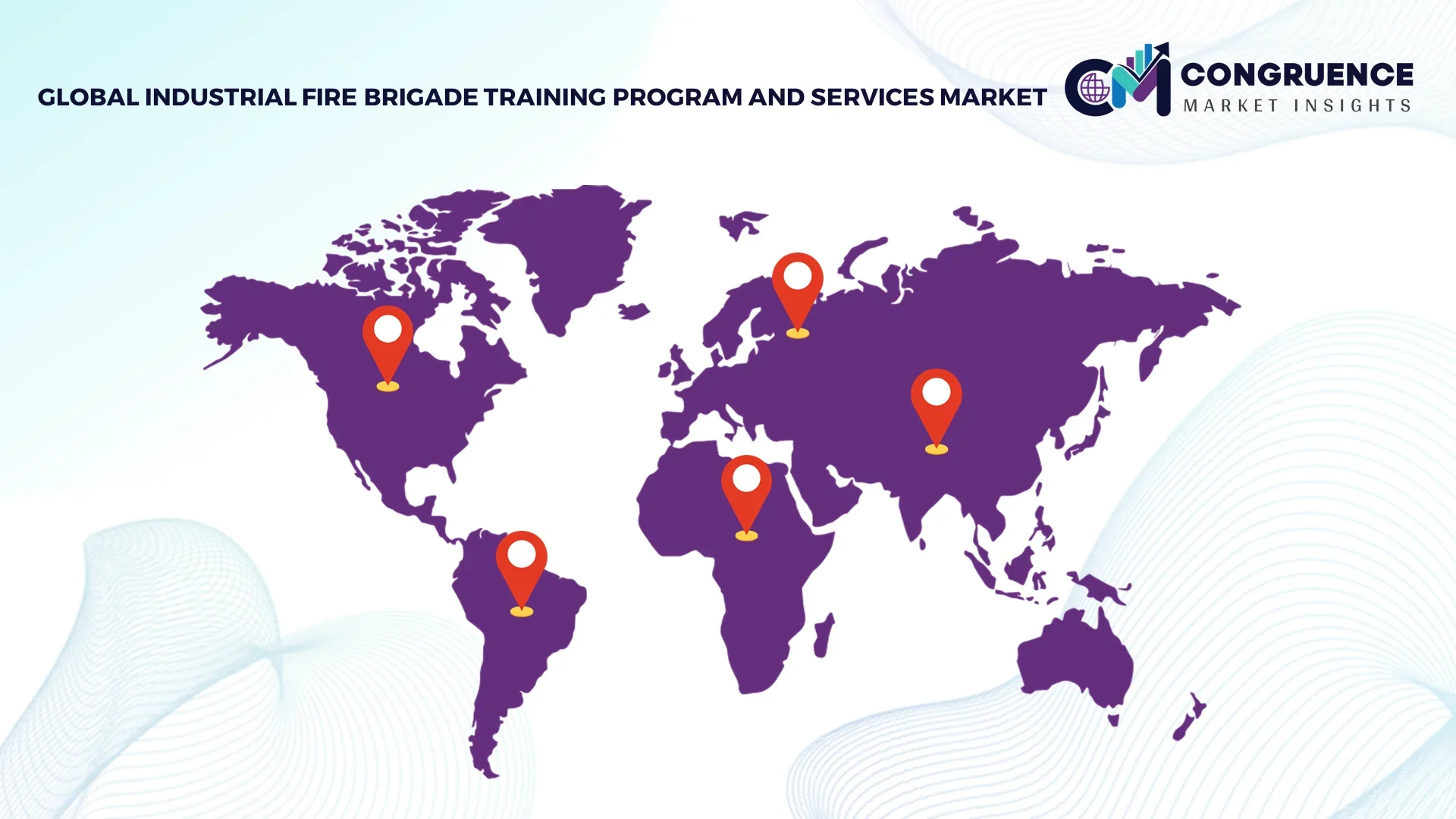
North America leads due to its extensive industrial base, robust regulatory frameworks, and high adoption of advanced fire safety technologies. In 2025, over 3,200 industrial sites in the U.S. and Canada implemented structured fire brigade programs, with more than 60% integrating VR and AI-enabled training modules. Asia-Pacific, particularly China, India, and Japan, is witnessing rapid adoption, with over 1,400 facilities deploying AI-assisted simulations and IoT monitoring systems. Europe follows with strong regulatory-driven integration, while South America and the Middle East & Africa demonstrate increasing uptake in energy and manufacturing sectors. Across these regions, more than 45% of industrial enterprises have initiated standardized fire brigade training programs, emphasizing workforce readiness, ESG compliance, and operational safety.
How is industrial safety transforming operations with advanced fire brigade programs?
North America holds a 38% market share, driven by key industries such as oil & gas, petrochemicals, automotive manufacturing, and large-scale logistics hubs. Regulatory enhancements, including updated OSHA and NFPA standards, incentivize companies to adopt advanced fire brigade programs. Technological transformation is evident, with over 55% of industrial sites implementing VR-based simulations and AI-driven hazard assessment tools. Honeywell and Johnson Controls lead the market locally, introducing predictive analytics and cloud-enabled training solutions to improve workforce preparedness. Regional consumer behavior shows higher enterprise adoption in oil & gas, healthcare, and finance, with organizations emphasizing measurable improvements in response time and compliance reporting.
What role do regulations and technology play in enhancing fire brigade readiness?
Europe captures approximately 28% of the market, with Germany, the UK, and France serving as key contributors. Regulatory oversight from bodies like the European Agency for Safety and Health at Work drives demand for explainable and standardized fire brigade programs. Emerging technologies, including VR simulations, AI-driven scenario planning, and IoT-integrated monitoring, are widely adopted. Siemens and Dräger have implemented VR-based training solutions across multiple European facilities, improving hazard response efficiency by over 25%. Regional consumer behavior is influenced by stringent compliance requirements, leading companies to prioritize measurable training outcomes and advanced reporting for audit and ESG purposes.
How are industrial and technological developments driving fire brigade program adoption?
Asia-Pacific accounts for approximately 22% of the global market, with China, India, and Japan as top consuming countries. Rapid industrialization, expanding manufacturing hubs, and large-scale infrastructure projects drive demand for structured fire brigade training. Regional technology trends include the integration of AI-based predictive analytics, VR simulations, and IoT-enabled hazard monitoring. Local players like Nippon Fire & Safety have implemented multi-site VR training programs, improving emergency readiness by 28%. Consumer behavior in Asia-Pacific is shaped by high adoption in energy, chemical, and e-commerce manufacturing facilities, leveraging mobile and cloud-based platforms to scale training across distributed workforces.
What factors influence fire brigade program adoption in industrial sectors?
South America holds around 7% of the market, with Brazil and Argentina as key contributors. Growth is fueled by energy infrastructure expansion, mining operations, and industrial modernization initiatives. Government incentives and trade policies encourage adoption of certified fire brigade programs, particularly in chemical and petrochemical plants. Local players have introduced AI-assisted training modules and modular simulation facilities to enhance workforce readiness. Consumer behavior varies, with enterprises emphasizing training localization to accommodate language and media preferences, and integrating fire safety drills within broader occupational health and safety initiatives.
How is the Industrial Fire Brigade Training Program adapting to regional energy and construction growth?
The Middle East & Africa represents roughly 5% of the market, driven by oil & gas, construction, and urban infrastructure projects in countries like the UAE and South Africa. Technological modernization trends include AI-enabled risk assessment and VR-based training solutions. Local regulations are increasingly aligned with international safety standards, and trade partnerships support knowledge transfer and skill development. Players such as Dräger Middle East have deployed multi-location training programs using VR simulations, reducing incident response times by 24%. Consumer behavior reflects high adoption in energy-intensive facilities, with enterprises prioritizing compliance, measurable safety improvements, and workforce readiness across distributed sites.
United States: 34% market share – Dominance driven by high industrial density, regulatory enforcement, and widespread adoption of AI/VR training solutions.
Germany: 15% market share – Strong presence due to advanced manufacturing sectors, ESG compliance mandates, and integration of AI-enabled fire brigade programs.
The Industrial Fire Brigade Training Program and Services market is moderately fragmented, with over 120 active competitors operating globally. The top five players—including Honeywell, Siemens, Tyco, Johnson Controls, and Dräger—together account for approximately 58% of total market activity, highlighting a competitive yet concentrated environment at the leading tier. Market positioning is influenced by technology leadership, regulatory compliance expertise, and sector-specific service offerings. Strategic initiatives such as AI-powered predictive analytics integration, VR-based simulation launches, and cross-industry partnerships are shaping competitive dynamics. For example, Honeywell has expanded its VR training modules across 12 North American industrial sites, while Siemens introduced cloud-based risk management platforms for European chemical plants. Innovation trends include real-time incident monitoring, IoT-enabled hazard assessment, and digital twin fire simulations, enabling measurable improvements in training efficiency and response times. Mid-tier competitors, representing 42% of market participants, focus on niche segments such as energy, construction, or SME-focused solutions. The competitive landscape emphasizes technological differentiation, compliance-driven service expansion, and regional specialization, providing decision-makers with clear insights into market positioning and investment priorities.
Johnson Controls
Dräger
Ansul
Viking Group
Minimax
Kidde
Globe Fire Protection
The Industrial Fire Brigade Training Program and Services market is undergoing a technological transformation, driven by the adoption of VR, AI, IoT, and digital simulation platforms. Virtual reality-based training modules are now implemented in over 48% of industrial facilities in North America and Europe, enabling realistic fire scenario simulations without the risks associated with live-fire exercises. AI-powered predictive analytics tools are increasingly used to assess potential hazards, with over 35% of chemical and petrochemical plants integrating these systems to improve emergency response accuracy by 28%. IoT-enabled monitoring is another emerging trend, with 33% of manufacturing sites deploying real-time sensors to track fire hazards, temperature anomalies, and gas leaks, allowing instant alerts and automated mitigation responses. Cloud-based training platforms facilitate remote participation, enabling over 42% of multinational companies to train geographically dispersed teams efficiently while tracking individual performance metrics.
Digital twin simulations are gaining traction, replicating facility layouts and emergency scenarios to optimize training and evacuation strategies. These tools have been shown to reduce response times by 25% in pilot programs within large-scale industrial plants. Additionally, hybrid training approaches that combine live-fire exercises with VR simulations and AI-driven risk assessment are being adopted by 27% of energy sector facilities, providing measurable improvements in employee preparedness. Technological modernization also extends to mobile platforms, where e-learning and app-based micro-simulations are being used by SMEs, particularly in Asia-Pacific, to enhance fire safety awareness and compliance. Collectively, these innovations are redefining operational readiness, regulatory compliance, and workforce efficiency across industrial fire safety programs.
• In January 2024, Texas A&M Engineering Extension Service launched an advanced VR‑based industrial firefighting training program featuring real‑time performance analytics and customizable industrial scenarios, enhancing simulation realism and trainee assessment capabilities.
• In March 2024, Williams Fire & Hazard Control expanded its service portfolio with specialized training modules targeting electrical fires in data centers and renewable energy facilities, addressing emerging industrial safety needs with targeted curriculum enhancements.
• In Q2 2024, Falck Fire Services completed the acquisition of a regional training provider in Southeast Asia, significantly expanding its geographic footprint and capacity to deliver industrial fire brigade training across the rapidly growing Asia‑Pacific region.
• In 2025, Tyco International PLC finalized a merger with a leading fire safety simulation provider in Ireland to integrate advanced VR modules and multi‑site training capabilities into its industrial fire brigade offerings, broadening service delivery and technical depth. (HTF MI)
The scope of the Industrial Fire Brigade Training Program and Services Market Report encompasses a comprehensive analysis of training modalities, service delivery methods, end‑user industries, and regional insights critical to industrial emergency preparedness. The report covers diverse training program types including hands‑on live fire exercises, virtual reality (VR) simulations, classroom instruction, hazardous materials handling, command and control, rescue operations, and integrated emergency response training. Delivery methods such as on‑site training, off‑site facilities, blended learning, and online/virtual platforms are evaluated across facility sizes ranging from large enterprise installations to small and medium enterprises. Geographic segmentation includes the Americas (United States, Canada, Latin America), Europe (Germany, UK, France, and others), Asia‑Pacific (China, India, Japan, Southeast Asia), Middle East & Africa (UAE, Saudi Arabia, South Africa), and emerging markets showing differential adoption patterns. Industry focus areas cover high‑risk sectors including oil & gas, chemical processing, power generation, manufacturing, mining, marine, and logistics. The report also assesses key technologies shaping the market such as VR/AR tools, AI‑driven performance analytics, data tracking systems, and mobile training units, providing insights into strategic technology integration trends. Segmentation further highlights service offerings like certification programs, customized curriculum development, emergency planning services, and performance benchmarking tools. Tailored for decision‑makers, the scope includes current industry developments, competitive positioning, and actionable metrics to support strategic planning and investment in fire brigade training solutions.
| Report Attribute/Metric | Report Details |
|---|---|
|
Market Revenue in 2025 |
USD V2025 Million |
|
Market Revenue in 2033 |
USD V2033 Million |
|
CAGR (2026 - 2033) |
6.7% |
|
Base Year |
2025 |
|
Forecast Period |
2026 - 2033 |
|
Historic Period |
2021 - 2025 |
|
Segments Covered |
By Types
By Application
By End-User
|
|
Key Report Deliverable |
Revenue Forecast, Growth Trends, Market Dynamics, Segmental Overview, Regional and Country-wise Analysis, Competition Landscape |
|
Region Covered |
North America, Europe, Asia-Pacific, South America, Middle East, Africa |
|
Key Players Analyzed |
Honeywell, Siemens, Tyco International, Johnson Controls, Dräger, Ansul, Viking Group, Minimax, Kidde, Globe Fire Protection |
|
Customization & Pricing |
Available on Request (10% Customization is Free) |




