
Reports
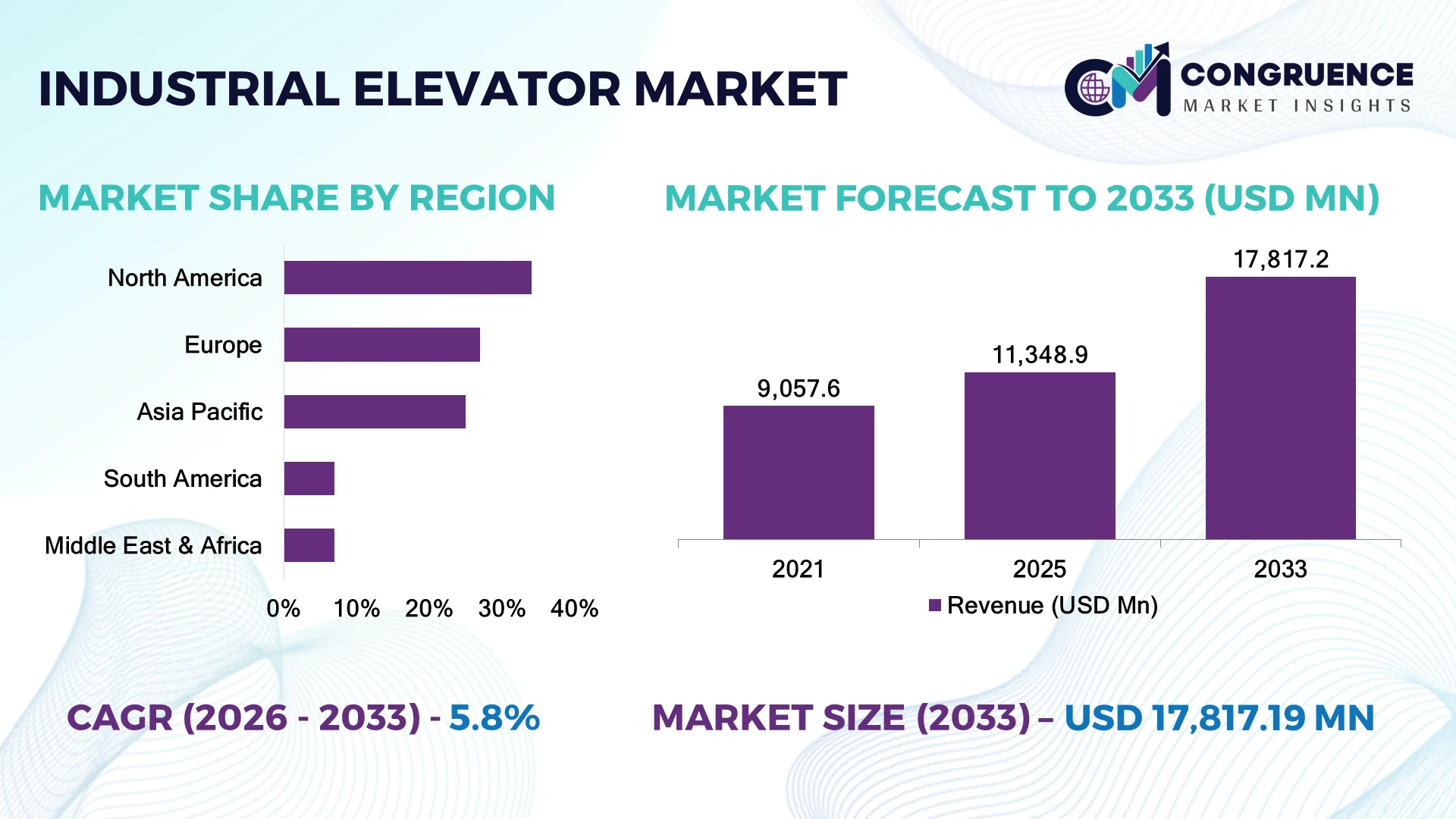
The Global Industrial Elevator Market was valued at USD 11,348.9 Million in 2025 and is anticipated to reach a value of USD 17,817.2 Million by 2033 expanding at a CAGR of 5.8% between 2026 and 2033. Growth is being driven by warehouse automation, vertical material-flow optimization, manufacturing facility expansion, and modernization of aging industrial lifting infrastructure.
China represents the dominant country market, supported by large-scale manufacturing, logistics, automotive, semiconductor, and industrial construction activity, with an estimated 30% share of global industrial elevator deployments. Germany follows with approximately 9%, while Japan remains technologically advanced in automated vertical transport. In 2026, automated industrial facilities increasingly integrate elevator controls with warehouse-management systems, improving material-transfer efficiency by approximately 15%.
The strategic priority is shifting toward connected, high-throughput industrial elevators that combine lifting capacity, automation, safety, and predictive maintenance.
Market Size & Growth: USD 11.35 billion in 2025 to USD 17.82 billion by 2033 at 5.8% CAGR, supported by warehouse automation and industrial modernization.
Top Growth Drivers: Warehouse automation 31%, manufacturing expansion 26%, and logistics infrastructure 22%.
Short-Term Forecast: By 2028, connected elevator controls can improve material-transfer efficiency by 12–18% through automated dispatch and condition monitoring.
Emerging Technologies: AI-based dispatch, IoT sensors, regenerative drives, and digital-twin monitoring are reshaping industrial elevator operations.
Regional Leaders: Asia-Pacific leads with approximately 45% deployment share, Europe emphasizes modernization, while North America prioritizes automated logistics facilities.
Consumer/End-User Trends: Warehousing and logistics operators account for roughly 28% of demand, with automated facilities increasingly favoring integrated vertical transport.
Pilot/Case Example: 2025 automated warehouse deployments demonstrated approximately 15% faster vertical material movement after integrating elevator controls with warehouse-management workflows.
Competitive Landscape: Leading suppliers compete through approximately 10–15% efficiency gains, safety engineering, customization, and digital-service integration.
Regulatory & ESG Impact: Energy-efficient drives and regenerative systems can reduce elevator electricity consumption by approximately 20–30% in suitable high-cycle applications.
Investment & Funding: Industrial automation programs increasingly allocate 15–20% of material-handling modernization budgets toward connected lifting and vertical-transport infrastructure.
Innovation & Future Outlook: AI dispatch, predictive maintenance, digital twins, and autonomous material handling will shift competition toward integrated industrial mobility platforms.
The Industrial Elevator Market is increasingly concentrated in manufacturing plants, automated warehouses, distribution centers, automotive facilities, and heavy-industry sites where vertical material movement directly affects production continuity. Demand is shifting toward elevators capable of integration with warehouse-management and manufacturing-execution systems, with connected monitoring improving operational visibility by approximately 15%. In 2026, supply-chain localization and accelerated warehouse automation are reinforcing investment in intelligent vertical transport, creating a stronger commercial case for elevators designed as integrated material-flow infrastructure.
Industrial elevators are becoming strategically important because vertical material movement increasingly determines throughput in automated factories, high-density warehouses, and multi-level logistics facilities. Unlike conventional passenger elevators, industrial systems directly influence production-cycle timing, inventory movement, loading efficiency, and worker safety. In 2026, manufacturers are increasingly integrating elevator controls with warehouse-management systems, programmable logic controllers, and automated storage-and-retrieval infrastructure.
Modern variable-frequency drives and regenerative systems can improve energy performance by approximately 20–30% compared with older fixed-speed configurations, while predictive monitoring can reduce unplanned maintenance interruptions by roughly 10–15%. China emphasizes large-scale manufacturing and logistics deployment, whereas Germany and Japan place greater emphasis on precision engineering, energy efficiency, and automation integration. North American demand is increasingly linked to high-throughput distribution facilities and reshoring-related industrial investment.
Over the next 2–3 years, connected industrial elevators are expected to move from standalone equipment toward digitally managed material-flow assets. A multi-level automated warehouse, for example, can coordinate elevator dispatch with conveyors and storage systems to reduce transfer delays and unnecessary machine cycles. Manufacturers are therefore prioritizing sensor integration, remote diagnostics, modular controls, and partnerships with automation providers. Competitive advantage will increasingly depend on uptime, energy efficiency, integration capability, safety performance, and lifecycle service rather than lifting capacity alone.
Warehouse automation and high-density manufacturing are increasing reliance on industrial elevators, with automated facilities achieving approximately 15% faster vertical material transfer and 20–30% lower energy consumption through regenerative drives. China’s expansion of smart factories and automated logistics centers is accelerating deployment of PLC-connected elevators, while Japan is prioritizing precision controls and predictive diagnostics. The integration of elevators with conveyors and warehouse-management systems is shifting procurement from standalone lifting equipment toward coordinated material-flow platforms. Manufacturers are responding by investing in sensor-enabled controls, modular drive systems, and automation partnerships. The non-obvious advantage is throughput synchronization: elevator dispatch aligned with conveyor cycles can reduce idle movement by approximately 10–12%, making control integration increasingly important for high-cycle facilities.
Industrial elevator deployment faces cost pressure from specialized engineering, structural modifications, and integration with existing automation infrastructure. Retrofit projects can require 15–25% higher installation expenditure than standardized new-build configurations, while customized control interfaces can increase commissioning requirements by approximately 10–15%. In Germany and Japan, stringent safety and machine-interface requirements further extend validation cycles for complex installations. Supply-chain exposure for drives, controllers, sensors, and safety components creates additional procurement pressure when projects depend on imported electronics. Companies are reducing exposure through localized component sourcing, standardized control architectures, and longer-term supplier agreements. The critical constraint is not elevator hardware alone but compatibility with legacy production systems, making modular retrofit platforms commercially stronger than highly customized designs for cost-sensitive operators.
Connected industrial elevators create a high-value opportunity as factories and warehouses shift toward autonomous material handling. Predictive-maintenance systems can reduce unplanned downtime by approximately 10–15%, while condition-based servicing can lower maintenance expenditure by 8–12% through earlier detection of motor, brake, and drive abnormalities. India’s expanding logistics and manufacturing infrastructure is creating additional demand for compact, digitally integrated vertical transport in multi-level facilities. From 2026 onward, edge analytics, digital twins, and AI-based dispatch optimization are becoming more commercially relevant because they connect elevator performance with broader material-flow data. Manufacturers are positioning through sensor integration, software partnerships, and remote-service platforms. A distinctive opportunity lies in upgrading installed elevator fleets with connected control modules rather than replacing complete systems, opening recurring service revenue and extending equipment life.
Industrial elevators increasingly operate as components of interconnected automation environments, creating execution challenges around cybersecurity, controls interoperability, commissioning, and specialist maintenance. Facilities integrating elevator controls with manufacturing-execution or warehouse-management systems can face 10–15% longer commissioning cycles when legacy protocols require custom interfaces. Workforce shortages in industrial automation can increase maintenance response times by approximately 12%, particularly in remote manufacturing clusters. Cybersecurity exposure also rises as remote diagnostics and connected controllers become standard operational features. Companies must address these pressures through standardized communication protocols, encrypted control architectures, technician training, and partnerships with automation integrators. The long-term competitive issue is system reliability across the entire material-flow chain: an elevator operating efficiently but poorly synchronized with conveyors can still constrain facility throughput.
Connected Control Architectures: Industrial elevators are increasingly integrated with PLCs, warehouse-management systems, and conveyor controls, improving dispatch efficiency by approximately 10–15% and reducing idle cycles by 8–12%. Manufacturers are expanding modular control platforms as operators prioritize synchronized material movement over standalone elevator performance.
Regenerative Drive Adoption: Energy-efficient drives are gaining traction in high-cycle facilities, delivering approximately 20–30% lower electricity consumption than older configurations while improving braking control by nearly 10%. European industrial operators are accelerating modernization as energy-efficiency requirements influence equipment procurement and lifecycle-cost calculations.
Predictive Maintenance Deployment: Sensor-based monitoring is shifting maintenance from scheduled servicing toward condition-based intervention, with connected systems targeting 10–15% reductions in unplanned downtime and 8–12% lower maintenance expenditure. Manufacturers are embedding vibration, temperature, and motor-current monitoring to strengthen remote diagnostics and service responsiveness.
Automation-Ready Retrofit Systems: Existing factories are increasingly upgrading elevators through modular automation interfaces rather than full replacement, reducing modernization expenditure by approximately 15–20% and shortening installation schedules by 10%. This approach is particularly relevant where supply-chain constraints and production interruptions make complete equipment replacement commercially unattractive.
Heavy-Duty Systems Lead High-Cycle Operations
Heavy-duty industrial elevators are estimated to hold approximately 43% market share, supported by high load capacity, continuous duty cycles, and deployment across manufacturing plants, warehouses, automotive facilities, and process industries. Medium-duty systems account for about 35%, offering a balance between lifting capacity, footprint, and acquisition cost, while light-duty systems represent roughly 22% and remain relevant for lower-load industrial facilities. Heavy-duty configurations increasingly incorporate variable-frequency drives, regenerative braking, and electronic safety controls, improving energy performance by approximately 12–18% compared with conventional drive architectures.
The fastest-growing shift is toward automation-ready elevator systems featuring PLC connectivity, sensor-based diagnostics, and modular controls. Adoption is strengthening as manufacturers integrate vertical transport with conveyors, automated storage, and production-control platforms. Companies are responding through configurable platforms, digital monitoring, and automation partnerships, redirecting investment toward higher-performance systems rather than basic lifting capacity. This favors suppliers combining mechanical durability with digital interoperability, particularly where elevator throughput directly influences overall factory productivity.
Deloitte’s 2025 Smart Manufacturing Survey found that 41% of manufacturers prioritized factory-automation hardware investment over the following two years, while 46% ranked process automation among their leading investment priorities, reinforcing the industrial shift toward connected automation infrastructure.
Warehousing and Logistics Drive Deployment
Warehousing and logistics are estimated to represent approximately 40% of industrial elevator demand, supported by multi-level storage, pallet movement, automated retrieval, and high-density distribution facilities. Manufacturing applications follow at around 32%, where elevators support inter-floor movement of components, work-in-process materials, and finished goods. Process industries and specialized industrial facilities account for the remaining 28%. Logistics installations increasingly prioritize compact footprints, automated loading, and dispatch synchronization, while manufacturing applications emphasize load stability, duty-cycle reliability, and production-line integration.
Automated warehousing represents the fastest-growing application shift as operators connect elevators with warehouse-management systems, conveyors, and automated storage infrastructure. Integrated controls can reduce manual intervention by approximately 15% and improve material-transfer coordination by 10–12%. Companies are responding through automation-ready designs, system-integrator partnerships, and remote monitoring capabilities. The strategic implication is a transition from standalone lifting equipment toward coordinated vertical material-flow infrastructure, strengthening suppliers capable of integrating elevator controls with broader facility automation.
Deloitte’s 2025 Smart Manufacturing Survey reported that 24% of manufacturers ranked factory synchronization among their first- or second-priority investment areas, highlighting the increasing importance of coordinated material, asset, and production flows within automated facilities.
Manufacturing Plants Anchor Industrial Demand
Manufacturing plants are estimated to account for approximately 44% of industrial elevator demand, reflecting continuous material movement, multi-level production layouts, and high equipment utilization. Warehouses and distribution centers represent roughly 35%, driven by automated fulfillment and high-density storage, while process industries and other industrial facilities contribute approximately 21%. Manufacturing buyers prioritize load capacity, uptime, safety, and production integration, whereas warehouse operators place greater emphasis on dispatch intelligence, throughput synchronization, and automation compatibility.
Warehouses and distribution centers represent the fastest-growing end-user group as investment shifts from conventional storage infrastructure toward connected material-flow systems. Approximately 46% of surveyed manufacturers prioritize process automation, while 37% prioritize physical automation, strengthening demand for elevators capable of interfacing with conveyors, automated storage systems, and facility-control platforms. Suppliers are responding through application-specific configurations, remote diagnostics, service agreements, and integration partnerships. Purchasing priorities are therefore shifting toward lifecycle performance, energy efficiency, downtime reduction, and interoperability, favoring suppliers with connected equipment and service capabilities.
Deloitte’s 2025 Smart Manufacturing Survey found that 88% of manufacturers expected smart-manufacturing investment to continue or increase in the following fiscal year, while reported smart-manufacturing initiatives delivered average production-output improvements of 10–20%, supporting continued automation investment across industrial facilities.
North America accounted for the largest market share at 34% in 2025 however, Asia-Pacific is expected to register the fastest growth, expanding at a CAGR of 6.8% between 2026 and 2033.
Automation-Intensive Facilities Reshape Vertical Material Flow
North America maintains the leading position with approximately 34% market share, supported by advanced manufacturing, high-density warehousing, automotive production, and large-scale distribution infrastructure. The United States represents the principal demand center as manufacturers modernize multi-level facilities and integrate elevators with conveyors, automated storage, and warehouse-management systems. Connected controls and regenerative drives are gaining traction in high-cycle installations, with digitally monitored systems targeting approximately 10–15% lower unplanned downtime. Data-center, semiconductor, and advanced manufacturing investments are also creating demand for precision vertical transport with tighter uptime requirements. Supply-chain localization is strengthening investment in domestic industrial capacity, while tariffs and geopolitical trade realignment are encouraging manufacturers to prioritize serviceable, standardized elevator platforms. Suppliers with automation integration, predictive diagnostics, and rapid aftermarket support are gaining stronger positioning than conventional equipment-focused vendors.
United States Market Outlook: The United States combines a large installed industrial base with sustained investment in advanced manufacturing, logistics, semiconductors, and data-center infrastructure. Automation intensity is particularly important because industrial facilities increasingly require elevators to communicate with conveyors and facility-control systems. Approximately 41% of manufacturers identify factory-automation hardware as a leading investment priority, reinforcing demand for digitally integrated vertical transport. Manufacturers are therefore emphasizing retrofit-ready controls, remote diagnostics, and energy-efficient drives to improve lifecycle economics across high-utilization facilities.
Industrial Modernization Prioritizes Efficiency and Digital Integration
Europe represents approximately 27% of the global industrial elevator market, supported by Germany, Italy, France, and the United Kingdom's established manufacturing and logistics infrastructure. Industrial buyers are increasingly replacing conventional drive systems with variable-frequency and regenerative technologies as energy efficiency becomes a stronger procurement criterion. Germany's industrial ecosystem is particularly relevant, with 62% of companies reported to have implemented digital solutions and 9 in 10 using or planning Industrie 4.0 applications. This strengthens demand for elevator systems compatible with plant-control architectures, predictive maintenance, and automated material handling. European suppliers are emphasizing modular modernization packages that reduce disruption to operating plants. The strategic shift favors lifecycle optimization over basic equipment replacement, particularly where energy consumption and maintenance costs represent a substantial share of total ownership expenditure.
Germany Market Outlook: Germany remains the region's most strategically significant market because of its dense machinery, automotive, chemicals, and logistics base and its strong Industry 4.0 ecosystem. Industrial facilities increasingly deploy connected equipment alongside robotics and digital production systems. Germany records approximately 415 industrial robots per 10,000 employees, demonstrating the automation intensity surrounding industrial elevator applications. This environment supports demand for high-precision elevators with PLC connectivity, predictive diagnostics, and synchronized material-flow controls, particularly in automotive and machinery manufacturing clusters.
Manufacturing Scale Accelerates Automated Vertical Handling
Asia-Pacific is estimated to represent approximately 25% of the industrial elevator market and is positioned as the fastest-growing regional market, driven by manufacturing expansion, logistics infrastructure, electronics production, automotive assembly, and automated warehousing. China remains the dominant demand and manufacturing center, while Japan, South Korea, and India are expanding automation-intensive facilities. China's transition toward higher-value industrial production is increasing demand for precision machinery and digitally integrated factory equipment. Industrial elevators are increasingly specified alongside conveyors, automated storage systems, and robotic handling platforms rather than procured as standalone equipment. Companies are expanding regional manufacturing capacity, localizing components, and developing modular controls to address cost-sensitive industrial buyers. India is also strengthening demand through logistics and manufacturing infrastructure, creating opportunities for compact, automation-compatible systems in multi-level facilities.
China Market Outlook: China holds the strongest industrial elevator position in Asia-Pacific because of its extensive manufacturing ecosystem, machinery production, electronics clusters, automotive capacity, and rapidly expanding automated logistics infrastructure. The country's industrial transformation is increasing demand for higher-performance material-handling equipment rather than basic lifting systems. Domestic industrial automation suppliers are also strengthening component availability, helping reduce dependence on imported drives and controllers. For elevator manufacturers, localized production, competitive pricing, rapid customization, and compatibility with Chinese automation platforms are becoming critical to securing large industrial projects.
Industrial Logistics Expansion Supports Selective Vertical Transport Demand
South America accounts for approximately 7% of global industrial elevator demand, with Brazil representing the primary market because of its manufacturing, food processing, mining, automotive, and logistics infrastructure. Demand is concentrated around São Paulo, Minas Gerais, Paraná, and other industrial corridors where multi-level warehouses and production facilities require reliable material movement. Brazil's industrial base is increasingly incorporating automation, while warehouse modernization is raising the need for elevators compatible with conveyors and automated storage systems. The market remains more price-sensitive than North America and Europe, making lifecycle cost and local service availability important purchasing factors. Manufacturers are responding through regional distribution partnerships, modular equipment, and locally supported maintenance programs. The strategic opportunity lies in combining affordable configurations with automation compatibility rather than replicating premium specifications designed for mature industrial markets.
Brazil Market Outlook: Brazil provides the strongest South American opportunity because of its diversified manufacturing base, large agricultural-processing industry, mining operations, automotive clusters, and expanding logistics infrastructure. Approximately 41% of Brazilian companies surveyed in industrial research reported using machine learning to some extent, indicating growing digital capability across industrial operations. This supports gradual integration of connected equipment and predictive maintenance. Industrial elevator suppliers that establish local service coverage, offer adaptable control architectures, and maintain competitive installation costs are better positioned to capture modernization projects.
Industrial Diversification Drives New Logistics Infrastructure
Middle East & Africa represents approximately 7% of the industrial elevator market, with demand concentrated in Saudi Arabia, the United Arab Emirates, South Africa, and other industrializing economies. Saudi Arabia is emerging as the principal regional growth center as Vision 2030 accelerates manufacturing, logistics, industrial-city development, and supply-chain infrastructure. In 2025, Saudi industrial cities recorded approximately SAR 30 billion in total investment, including SAR 22 billion in industrial investment, strengthening the infrastructure base for material-handling equipment. Warehousing and logistics development is also supporting elevator deployment in multi-level facilities. Manufacturers are responding with ruggedized systems, remote monitoring, localized service partnerships, and equipment designed for high-temperature operating conditions. The key competitive shift is toward suppliers capable of combining rapid deployment with local maintenance and automation integration rather than relying solely on imported standardized systems.
Saudi Arabia Market Outlook: Saudi Arabia is the most strategically significant market because industrial-city expansion, logistics modernization, and manufacturing diversification are creating concentrated demand for vertical material-handling systems. Industrial-city facilities reached approximately 9,557 in 2025, an 11% increase from the previous year, while electricity capacity expanded 12% to 8,959 MVA. These infrastructure improvements strengthen the operating environment for automated factories, distribution centers, and process facilities. Suppliers are increasingly positioning through local partnerships, service networks, and automation-ready equipment aligned with large industrial and logistics projects.
The industrial elevator market pits global OEMs such as KONE, Otis, Schindler, Mitsubishi Electric, and Hitachi against regional manufacturers competing through cost, customization, installation speed, and local service. The top five players are estimated to control about 48% collectively, leaving regional specialists project opportunities. Competition centers on lifecycle economics: digitally connected systems can reduce unplanned downtime by 10–15%, while regenerative drives can lower elevator energy consumption by up to 30–40%. Global leaders are expanding modernization portfolios, remote diagnostics, and automation partnerships; regional suppliers counter with faster customization and localized sourcing. The competitive shift is moving from equipment-only sales toward service-integrated, data-enabled contracts and retrofit programs. Entry barriers remain high because safety certification, engineering expertise, installed-service networks, and component compatibility require substantial capital and technical depth. Winning requires reliable hardware, rapid commissioning, strong aftermarket coverage, interoperable controls, and measurable energy or uptime gains—not merely lower equipment pricing or broader catalog coverage.
KONE Corporation
Otis Worldwide Corporation
Schindler Group
Mitsubishi Electric Corporation
Hitachi, Ltd.
TK Elevator GmbH
Fujitec Co., Ltd.
Hyundai Elevator Co., Ltd.
Toshiba Elevator and Building Systems Corporation
Canny Elevator Co., Ltd.
SJEC Corporation
Sicher Elevator Co., Ltd.
Industrial elevator technology is shifting from electromechanical control toward connected variable-frequency drives, regenerative braking, IoT sensors, and cloud diagnostics. Regenerative systems can recover up to 75% of braking energy, while connected monitoring can identify up to 80% of failures before disruption. Adoption is strongest in modernization programs and high-cycle industrial facilities where uptime directly affects throughput.
Emerging platforms combine AI-based predictive maintenance, destination-control logic, digital twins, and edge analytics. Compared with conventional scheduled maintenance, condition-based monitoring can reduce unplanned downtime by approximately 10–15% and maintenance intervention by 8–12%. Digital-twin simulation improves commissioning and configuration accuracy, while machine-room-less and compact traction systems reduce spatial requirements. Global OEMs benefit most because installed service fleets provide the data scale needed to train analytics and monetize connected maintenance.
From 2026–2028, interoperability will become decisive as elevators connect with warehouse-management systems, conveyors, robotics, access control, and building-management platforms. KONE already applies AI-enabled monitoring across more than 800,000 connected units, signaling industrial-scale deployment. Suppliers combining regenerative drives, secure connectivity, modular controls, and predictive service will gain advantage. This approach shortens service response cycles and improves asset visibility. Investment should prioritize retrofit-compatible digital architectures because upgrading aging equipment can capture efficiency gains without replacing complete installations.
June 2025 Hitachi announced a new elevator development facility at Mito Works, targeting next-generation models covering approximately 80% of Japan’s new installations. The investment strengthens R&D, modernization, and digital-service capabilities, accelerating localized engineering for aging elevator fleets. Source: hitachi.com
November 2025 Mitsubishi Electric completed its acquisition of AG MELCO Elevator in Dubai, making the company wholly owned. The transaction expands Middle East operations and strengthens maintenance and renewal capabilities, positioning Mitsubishi for deeper regional lifecycle-service penetration. Source: mitsubishielectric.com
October 2025 Otis reported a 27% increase in modernization orders, supporting an 8.7% year-over-year rise in service sales. The result demonstrates stronger upgrade demand from aging installed bases, shifting competitive emphasis toward modernization, maintenance contracts, and lifecycle services.
April 2025 Schindler launched its Schindler 5000 machine-room-less elevator in North America with capacities up to 5,000 pounds and speeds reaching 350 feet per minute. Its regenerative drive reduces energy consumption by up to 30%, strengthening efficient positioning. (Elevator Solutions) Source: schindler.com
The Industrial Elevator Market Report provides a structured assessment of demand across heavy-duty, medium-duty, and light-duty configurations, with application coverage spanning warehousing and logistics, manufacturing, process industries, and specialized industrial facilities. End-user analysis distinguishes manufacturing plants, warehouses and distribution centers, process industries, and other industrial operators, enabling comparison of purchasing priorities, deployment intensity, and automation requirements.
The report evaluates North America, Europe, Asia-Pacific, South America, and Middle East & Africa, with country-level analysis emphasizing industrial capacity, logistics infrastructure, modernization activity, and automation adoption. Technology coverage includes regenerative drives, variable-frequency controls, IoT monitoring, AI-enabled predictive maintenance, digital twins, and automation interfaces. Competitive analysis covers leading OEMs, regional suppliers, modernization strategies, and service models, supporting investment planning, market-entry decisions, expansion priorities, technology positioning, and strategic planning through 2026–2033.
| Report Attribute/Metric | Report Details |
|---|---|
|
Market Revenue in 2025 |
USD 11,348.9 Million |
|
Market Revenue in 2033 |
USD 17,817.2 Million |
|
CAGR (2026 - 2033) |
5.8% |
|
Base Year |
2025 |
|
Forecast Period |
2026 - 2033 |
|
Historic Period |
2021 - 2025 |
|
Segments Covered |
By Type
By Application
By End-User
|
|
Key Report Deliverable |
Revenue Forecast, Growth Trends, Market Dynamics, Segmental Overview, Regional and Country-wise Analysis, Competition Landscape |
|
Region Covered |
North America, Europe, Asia-Pacific, South America, Middle East, Africa |
|
Key Players Analyzed |
KONE Corporation, Otis Worldwide Corporation, Schindler Group, Mitsubishi Electric Corporation, Hitachi, Ltd., TK Elevator GmbH, Fujitec Co., Ltd., Hyundai Elevator Co., Ltd., Toshiba Elevator and Building Systems Corporation, Canny Elevator Co., Ltd., SJEC Corporation, Sicher Elevator Co., Ltd. |
|
Customization & Pricing |
Available on Request (10% Customization is Free) |




