
Reports
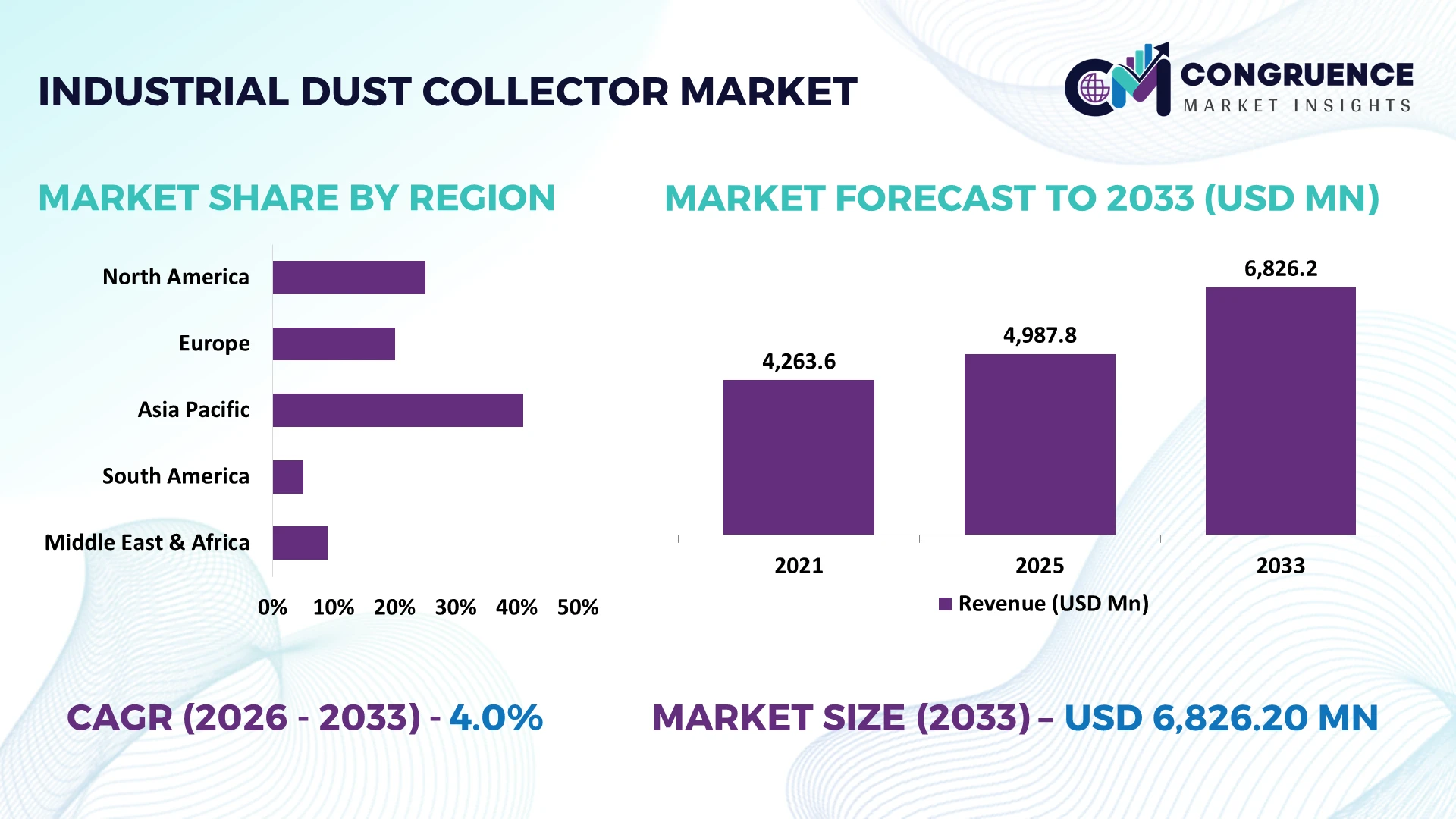
The Global Industrial Dust Collector Market was valued at USD 4987.84 Million in 2025 and is anticipated to reach a value of USD 6826.2 Million by 2033 expanding at a CAGR of 4% between 2026 and 2033. Growth is driven by tighter particulate-emission limits, replacement of aging filtration systems, and rising dust-control requirements across cement, steel, mining, and advanced manufacturing.
China holds approximately 17% of global industrial dust collector demand, supported by steel, cement, chemicals, and manufacturing capacity, while India represents a smaller but rapidly expanding base across cement, metals, pharmaceuticals, and infrastructure. China’s industrial dust-control investment remains concentrated across high-capacity steel and cement facilities, while India is increasing deployment of automated baghouse and cartridge systems. Emission limits of 10–30 mg/m³ are accelerating filtration upgrades and higher-efficiency collection technologies, strengthening demand for digitally monitored systems.
Strategic implication: China remains the dominant country market, while India provides a strong expansion opportunity for advanced, energy-efficient dust collection systems.
Market Size & Growth: USD 4,987.84 Million in 2025 and USD 6,826.2 Million by 2033 at a 4% CAGR, supported by automated filtration upgrades and stricter particulate-emission controls.
Top Growth Drivers: Stricter emission compliance 35%; industrial automation 28%; replacement of aging filtration equipment 22%.
Short-Term Forecast: By 2028, smart monitoring systems are positioned to reduce maintenance costs by 10–15% and improve filtration operating efficiency by 5–8%.
Emerging Technologies: AI-based monitoring, IoT-connected filtration, and advanced membrane filter media are improving dust capture performance by approximately 5–10%.
Regional Leaders: Asia-Pacific is projected near USD 3.4 billion, North America around USD 1.4 billion, and Europe approximately USD 1.2 billion, with smart filtration adoption accelerating.
Consumer/End-User Trends: Approximately 40% of large industrial facilities are increasing adoption of automated filter monitoring to reduce pressure losses, maintenance intervention, and unplanned downtime.
Pilot/Case Example: A 2025 automated filtration deployment delivered approximately 12% lower maintenance intervention and 7% higher operating efficiency through continuous filter-performance monitoring.
Regional Expansion: China, India, and Southeast Asia remain priority markets as the China+1 supply-chain shift expands manufacturing capacity and increases dust-control requirements.
Competitive Landscape: Leading suppliers collectively control a significant portion of the fragmented market, with Donaldson holding approximately 12% share alongside Camfil, Nederman, Parker Hannifin, and CFW Environmental.
Regulatory & ESG Impact: Tighter particulate standards targeting emissions of approximately 10–30 mg/m³ are accelerating high-efficiency filtration retrofits and reducing particulate exposure across industrial facilities.
Investment & Funding: Industrial filtration investment is increasingly directed toward automation, energy-efficient equipment, and regional manufacturing expansion, with major suppliers allocating multimillion-dollar budgets to capacity and technology upgrades.
Innovation & Future Outlook: Next-generation systems will combine AI diagnostics, predictive filter replacement, low-pressure-drop media, and automated controls, shifting purchasing decisions from basic collection capacity toward measurable operating-cost reduction.
The Industrial Dust Collector Market is seeing strongest demand from cement, steel, mining, chemicals, pharmaceuticals, and semiconductor manufacturing, where particulate control directly affects production continuity and compliance. Advanced baghouse, cartridge, cyclone, and wet-collection systems are increasingly integrated with sensors and automated controls, with smart monitoring improving operating efficiency by approximately 5–8%. The China+1 manufacturing shift is also expanding dust-control requirements across India and Southeast Asia. Meanwhile, tighter particulate-emission requirements are accelerating replacement of older, inefficient collectors, creating stronger demand for energy-efficient filtration and predictive maintenance solutions and setting the foundation for strategic market expansion.
Industrial dust collection is becoming a competitive operating priority because particulate control now affects production uptime, worker protection, energy consumption, and regulatory compliance rather than serving only as an environmental-control function. China’s steel and cement industries are accelerating high-capacity filtration upgrades, while India is expanding dust-control infrastructure alongside manufacturing localization and the China+1 supply-chain shift. Over the next 2–3 years, automated monitoring adoption is positioned to rise across large facilities as operators prioritize measurable equipment performance.
Modern pulse-jet and smart cartridge systems can reduce pressure-related energy consumption by roughly 8–15% versus aging filtration configurations while extending maintenance intervals by about 10%. The technology gap is particularly visible between mature U.S. and German installations, where predictive monitoring is more established, and rapidly industrializing Indian facilities, where replacement of legacy collectors remains a larger opportunity. This creates differentiated investment pathways based on installed-equipment maturity.
A practical deployment model combines differential-pressure sensors, automated cleaning controls, and predictive maintenance alerts to reduce unnecessary filter replacement and unplanned stoppages. Suppliers are responding by expanding localized manufacturing, integrating controls with plant-management systems, and forming technology partnerships. Competitive advantage will increasingly depend on lifecycle efficiency, retrofit capability, and reliable particulate performance rather than collector capacity alone.
Stricter particulate controls and aging filtration fleets are accelerating replacement demand across China, India, and the United States. Facilities adopting automated pressure monitoring and pulse-jet controls can achieve approximately 5–10% higher collection efficiency while reducing unnecessary cleaning cycles by 10–15%. China’s large steel and cement complexes are prioritizing automated baghouse modernization, while Indian manufacturers are increasingly specifying digitally monitored cartridge and fabric collectors for new plants. The structural shift from fixed-cycle maintenance to condition-based servicing improves uptime and reduces filter-related operating costs. Manufacturers are responding through localized production, sensor integration, and retrofit partnerships, making monitoring-enabled filtration a stronger purchasing criterion than basic collection capacity.
High-grade filter media, fan systems, motors, and electronic controls expose buyers to component-cost volatility and procurement delays. Imported specialty filtration components can increase system acquisition costs by approximately 10–20% compared with standardized locally sourced configurations, while replacement-media expenses can represent 15–25% of annual collector operating costs in intensive applications. India remains particularly sensitive to imported high-performance media and control components, whereas China has deeper domestic manufacturing capacity. Companies are mitigating this pressure through supplier diversification, localized fabrication, multi-year component contracts, and standardized filter designs. The non-obvious constraint is lifecycle economics: a lower-priced collector can generate materially higher energy and replacement costs when pressure-drop performance is poorly optimized.
The largest near-term opportunity lies in upgrading installed collectors with sensors, variable-speed drives, automated cleaning controls, and predictive diagnostics rather than replacing complete systems. Smart retrofits can reduce fan and cleaning energy consumption by approximately 8–15% and extend filter service intervals by 10–20%. India’s expanding cement and metals capacity provides an attractive retrofit base, while Southeast Asian manufacturing hubs are adding new dust-intensive production lines. AI-assisted differential-pressure analysis is emerging as a differentiating technology because it converts routine filtration data into maintenance decisions. Suppliers that combine retrofit engineering, digital controls, and performance-based service contracts can capture recurring revenue while helping industrial customers reduce energy intensity and unplanned downtime.
Integrating advanced dust collectors into older production environments remains a significant execution challenge because control architectures, sensors, communication protocols, and maintenance practices differ across facilities. Approximately 20–30% of modernization projects can require additional engineering work when legacy controls lack compatible interfaces, while workforce gaps can increase commissioning and troubleshooting time by 10–15%. Older plants in India and parts of Southeast Asia face greater interoperability constraints than recently automated facilities in Germany and the United States. Companies must address these barriers through modular control architectures, standardized communication protocols, cybersecurity safeguards, technician training, and regional service teams. Long-term competitiveness will depend on delivering reliable retrofit performance without disrupting continuous industrial production.
Smart Filtration Monitoring Accelerates: Industrial facilities are integrating differential-pressure sensors, remote diagnostics, and automated cleaning controls, with smart monitoring reducing unnecessary cleaning cycles by 10–15% and maintenance interventions by 8–12%. U.S. and German operators are scaling connected systems as labor shortages and uptime requirements push suppliers toward predictive-service partnerships.
Energy Optimization Gains Priority: Variable-frequency drives, low-pressure-drop filter media, and optimized pulse-jet sequencing are reducing collector energy consumption by approximately 8–14%. Cement and steel producers in India are increasingly specifying energy-efficient fans and filtration packages as electricity costs and decarbonization targets reshape equipment procurement and plant-modernization decisions.
Localized Filtration Supply Expands: Supply-chain disruption and longer specialty-media lead times are driving manufacturers toward regional fabrication and dual sourcing. Chinese suppliers are increasing domestic component integration, while Indian producers are localizing filter bags and housings, reducing procurement lead times by 15–25% and strengthening responsiveness for retrofit projects.
Compact Collectors Gain Adoption: Cartridge-based systems are expanding in space-constrained pharmaceutical, automotive, and precision-manufacturing facilities, with compact configurations reducing installation footprints by roughly 20–30%. Companies are increasingly combining modular collectors with centralized controls, enabling faster installation and standardized maintenance across multiple production lines.
Baghouse Collectors remain the leading type, accounting for approximately 38% of market demand because their high dust-loading capacity, scalable configurations, and suitability for cement, metals, mining, and power applications support continuous industrial operation. Electrostatic Precipitators remain important for very large particulate-control installations, while Cyclone Collectors retain a strong role as pre-separation equipment because of their relatively low maintenance requirements. Wet Scrubbers serve applications requiring simultaneous particulate and gas treatment, while Mist Collectors remain concentrated in machining and oil-mist environments.
Cartridge Collectors represent the fastest-growing type, with adoption increasing roughly 9–12% across compact manufacturing and automated production environments. Their smaller footprint and simplified filter replacement are shifting investment toward modular systems, particularly in India and Southeast Asian manufacturing hubs. Suppliers are expanding cartridge portfolios and combining them with intelligent controls, while established baghouse manufacturers are developing hybrid configurations to protect installed-base relationships. The strategic shift is toward application-specific filtration rather than one standardized collector architecture.
Dust Extraction is the leading application, representing approximately 31% of demand because cement, mining, woodworking, grinding, and material-handling operations generate continuous particulate loads requiring centralized or point-source collection. Air Pollution Control and Process Filtration remain mature applications in large industrial facilities, while Material Handling increasingly incorporates localized extraction around transfer points. Welding Fume Control and Grinding Dust Control are gaining attention as manufacturers strengthen worker-exposure controls and automate production cells.
Welding Fume Control is among the fastest-expanding applications, with deployment increasing approximately 8–11% as automated welding raises fume-generation intensity and workplace-control requirements. Companies are integrating source-capture arms, compact cartridge collectors, and automated extraction with robotic cells. Pharmaceuticals and food-processing facilities are also increasing Process Filtration deployment where contamination control directly affects production quality. The non-obvious opportunity is multi-point extraction: standardized modular systems allow manufacturers to expand production without redesigning entire plant ventilation networks.
Cement represents the leading end-user group at approximately 23% of demand, reflecting high-volume kiln, clinker, crushing, conveying, and material-handling operations. Metals & Mining follows closely at around 20%, where abrasive dust and continuous processing require heavy-duty filtration. Power Generation remains a major established user, while Chemicals and Pharmaceuticals increasingly prioritize contamination control and automated filtration. Food & Beverage, Woodworking, and Automotive use more application-specific systems, particularly around grinding, cutting, mixing, and material-transfer operations.
Automotive is among the fastest-growing end-user groups, with advanced manufacturing facilities increasing dust and fume-control deployment by approximately 8–10% as robotic welding, machining, and surface-processing expand. Pharmaceuticals are also shifting toward higher-specification collectors with tighter contamination controls. Suppliers are responding through customized airflow configurations, compact cartridge platforms, service contracts, and direct partnerships with plant engineering teams. Competitive positioning is moving toward sector-specific engineering, where collector performance, footprint, maintenance frequency, and integration capability influence purchasing decisions as strongly as equipment price.
Asia-Pacific accounted for the largest market share at 52% in 2025 however, Middle East & Africa is expected to register the fastest growth, expanding at a CAGR of 6.2% between 2026 and 2033.

Smart filtration and retrofit modernization strengthen industrial positioning
North America represents approximately 23% of global industrial dust collector demand, supported by mature cement, metals, automotive, chemical, and pharmaceutical manufacturing. The United States concentrates most regional deployment, particularly in facilities upgrading legacy baghouse systems with variable-speed drives, digital pressure monitoring, and automated cleaning controls. Industrial operators increasingly prioritize lifecycle efficiency, with advanced monitoring reducing unnecessary maintenance activity by approximately 10–15%. Infrastructure modernization and stricter workplace exposure controls are accelerating replacement of aging equipment rather than simple capacity additions. Suppliers are expanding retrofit engineering, remote diagnostics, and service contracts to capture installed-base demand. The region’s competitive advantage rests on technology integration and aftermarket capabilities, making predictive maintenance and energy optimization more important purchasing criteria than initial equipment cost.
United States Market Outlook: The United States remains the region’s largest demand center because of its extensive manufacturing base and established industrial ventilation infrastructure. Approximately 35% of major dust-intensive facilities are prioritizing filtration modernization, particularly across metals, automotive, chemicals, and pharmaceutical production. Suppliers with strong retrofit engineering and service networks hold a distinct advantage.
Energy efficiency and emissions modernization reshape equipment procurement
Europe accounts for approximately 19% of global demand, with Germany, Italy, France, and the United Kingdom forming major industrial deployment centers. Industrial operators are replacing energy-intensive filtration equipment as electricity costs and environmental-performance requirements influence capital planning. Advanced filtration systems with optimized airflow can reduce fan-related energy consumption by approximately 8–12%, strengthening demand for low-pressure-drop media and variable-speed controls. Germany maintains strong adoption of engineered baghouse and cartridge systems across metals, chemicals, automotive, and machinery manufacturing. Suppliers are increasingly combining filtration equipment with digital monitoring and energy-performance services. The region’s distinctive shift is toward lifecycle optimization, where maintenance, energy intensity, and emissions performance increasingly influence purchasing decisions alongside equipment specifications.
Germany Market Outlook: Germany leads European deployment through its dense concentration of machinery, automotive, metalworking, and chemical manufacturing. Approximately 30% of large industrial facilities are prioritizing energy-efficiency upgrades within air-handling and filtration systems. Strong engineering capabilities and automation adoption support demand for digitally integrated collectors and specialized retrofit solutions.
Manufacturing scale and supply-chain relocation accelerate deployment
Asia-Pacific holds approximately 52% of global industrial dust collector demand, with China, India, Japan, South Korea, and Southeast Asian manufacturing hubs driving deployment. China remains the largest country market because of its steel, cement, mining, chemicals, and heavy manufacturing capacity, while India is gaining importance through industrial localization and infrastructure investment. Approximately 45% of new dust-intensive manufacturing capacity in major Asian markets is incorporating automated filtration or monitoring features. The China+1 supply-chain shift is transferring production toward India, Vietnam, Indonesia, and Thailand, creating new requirements for particulate extraction and process filtration. Suppliers are responding through localized manufacturing, regional service centers, and modular collector platforms that shorten installation timelines and reduce component dependency.
China Market Outlook: China remains the dominant country market because of its enormous steel, cement, mining, and manufacturing base. Its industrial facilities increasingly favor high-capacity baghouse systems integrated with automated cleaning and pressure monitoring. Approximately 40% of new large-scale filtration installations incorporate enhanced monitoring capabilities, strengthening demand for intelligent equipment and retrofit services.
Mining and processing modernization drives selective equipment demand
South America represents approximately 6% of global industrial dust collector demand, with Brazil accounting for the largest share through mining, steel, cement, food processing, and pulp and paper production. Mining operations create sustained requirements for high-capacity dust extraction around crushing, conveying, and material-transfer points. Approximately 25% of new industrial filtration projects increasingly incorporate automated monitoring or variable-speed equipment, although infrastructure quality and imported-component dependency remain constraints. Brazil’s industrial modernization is encouraging suppliers to establish local service capabilities and strengthen distributor partnerships. Chile and Peru provide additional demand from copper and mineral processing, where harsh operating conditions favor durable baghouse and cyclone configurations. The strategic opportunity lies in customized systems capable of handling abrasive dust while minimizing maintenance interruptions and imported replacement-component exposure.
Brazil Market Outlook: Brazil is the region’s most significant market because of its diversified industrial base and large mining operations. Approximately 30% of major mining and processing facilities are increasing investment in dust-control modernization. Local engineering partnerships and stronger service coverage are becoming important competitive differentiators as operators seek shorter maintenance cycles.
Industrial diversification and large-scale infrastructure accelerate modernization
Middle East & Africa accounts for approximately 7% of global demand, with Saudi Arabia, the United Arab Emirates, South Africa, and Egypt providing major deployment opportunities. Cement, metals, mining, petrochemicals, and large infrastructure projects are driving requirements for high-capacity particulate-control systems. Saudi Arabia’s industrial diversification programs are expanding manufacturing and processing capacity, while South Africa’s mining sector continues to require heavy-duty extraction equipment. Approximately 20–25% of new large industrial projects are incorporating automated filtration monitoring, increasing demand for digitally controlled systems. Suppliers are responding through local partnerships, regional inventories, and project-specific engineering. The principal market constraint remains uneven service infrastructure, making local maintenance capability and spare-parts availability critical factors in winning large industrial contracts.
Saudi Arabia Market Outlook: Saudi Arabia offers the strongest strategic opportunity through rapid industrial diversification, cement capacity expansion, metals processing, and large infrastructure development. Approximately 25% of major industrial projects increasingly specify automated environmental-control systems. Suppliers with local engineering partnerships and rapid after-sales support are positioned to capture project-driven demand.
Donaldson, Camfil, Nederman, Parker Hannifin, and CECO Environmental compete directly with regional filtration manufacturers and specialized engineering suppliers. The top five players collectively account for approximately 30–35% of global market activity, leaving substantial room for regional specialists. Competition centers on technology, customization, service speed, energy efficiency, and supply reliability. Advanced suppliers can achieve 8–15% lower operating energy consumption through optimized airflow, while digital monitoring can reduce maintenance interventions by 10–15%. Global leaders are expanding retrofit services, partnering with automation providers, and localizing production to shorten delivery cycles. Regional players compete through 10–20% lower equipment pricing, faster customization, and stronger local service coverage. The competitive shift is moving from standalone equipment sales toward integrated filtration, monitoring, and lifecycle-service packages. High engineering requirements, certification, installed-base relationships, and after-sales infrastructure remain major entry barriers. Winning requires combining reliable filtration performance with localized supply, digital controls, rapid service, and measurable lifecycle-cost advantages.
Donaldson Company, Inc.
Camfil
Nederman Holding AB
Parker Hannifin Corporation
CECO Environmental Corp.
Babcock & Wilcox Enterprises, Inc.
Coperion GmbH
SUEZ
KANSAI FILTER INDUSTRY CO., LTD.
Schenck Process
Air Filters, Inc.
Imperial Systems, Inc.
Filtration Group Corporation
Henghe Clean Technology Co., Ltd.
Industrial dust collection is shifting from conventional pulse-jet and fixed-cycle filtration toward sensor-enabled, automated systems. Differential-pressure monitoring, variable-frequency drives, and intelligent pulse controls can improve filtration efficiency by 5–10% while reducing compressed-air consumption by 8–12%. Adoption is strongest in large cement, metals, mining, and chemical facilities, where connected monitoring is moving from pilot deployment toward multi-site implementation. Compared with legacy collectors relying on manual inspection and fixed cleaning cycles, automated systems deliver approximately 10% faster fault detection, giving operators better uptime and maintenance control.
Emerging technologies include IoT-connected collectors, edge analytics, advanced membrane media, and predictive maintenance platforms. Emerson’s 2025 monitoring solution integrates sensors, PLCs, HMI/SCADA, and analytics, while Donaldson’s connected controls enable real-time performance tracking. Smart filtration can extend filter life by up to 15% and reduce avoidable maintenance activity by approximately 10%. Camfil’s newer cartridge designs also improve airflow and cleaning consistency. Technology leaders and large multi-site manufacturers benefit most because centralized monitoring converts filtration data into standardized operating decisions.
From 2026–2028, AI-assisted diagnostics, low-pressure-drop media, automated airflow optimization, and cloud-based fleet management will become stronger purchasing differentiators. Deployment should increasingly favor retrofit-compatible systems, particularly across India and Southeast Asia, where legacy equipment remains widespread. Companies acting now can secure lower operating costs, stronger compliance visibility, and differentiated service capabilities before intelligent filtration becomes a standard specification.
March 2025 Emerson launched a Dust Collector Monitoring and Control Solution integrating sensors, PLCs, HMI/SCADA and analytics, supporting up to 500 pulse valves. The system targets predictive maintenance, optimized cleaning and reduced compressed-air consumption across dust-intensive industries. Source: Emerson
November 2025 Parker Hannifin agreed to acquire Filtration Group for USD 9.25 billion, adding complementary filtration technologies and an expected USD 2 billion in 2025 sales. The transaction strengthened Parker’s industrial filtration portfolio and aftermarket positioning globally. Source: Parker Hannifin
May 2026 Camfil introduced Stat-Safe filter cartridges using antistatic urethane to dissipate static charges within dust collectors. The cartridges are compatible with major collector brands and target combustible-dust applications across pharmaceutical, plastics, textile, and food processing. Source: Camfil APC
August 2026 Parker Hannifin completed its USD 9.25 billion acquisition of Filtration Group, creating one of the largest global industrial filtration businesses. The integration expanded complementary technologies and aftermarket capabilities, strengthening Parker’s competitive position across industrial filtration applications. Source: Parker Hannifin
The Industrial Dust Collector Market Report covers six major technology types: Baghouse Collectors, Cartridge Collectors, Cyclone Collectors, Wet Scrubbers, Electrostatic Precipitators, and Mist Collectors. Application analysis spans Dust Extraction, Fume Collection, Process Filtration, Air Pollution Control, Material Handling, Welding Fume Control, and Grinding Dust Control. End-user coverage includes cement, metals and mining, chemicals, pharmaceuticals, food and beverage, woodworking, power generation, and automotive industries.
The report evaluates North America, Europe, Asia-Pacific, South America, and Middle East & Africa, with country-level assessment of industrial deployment, modernization, technology adoption, and manufacturing intensity. It examines smart monitoring, automated cleaning, advanced filter media, predictive maintenance, and energy-efficient filtration, with connected systems increasingly targeting 5–15% operational improvements. The analysis supports investment planning, market-entry decisions, expansion priorities, competitive positioning, technology selection, and strategic planning through 2026–2033.
| Report Attribute/Metric | Report Details |
|---|---|
Market Revenue in 2025 | USD 4987.84 Million |
Market Revenue in 2033 | USD 6826.2 Million |
CAGR (2026 - 2033) | 4% |
Base Year | 2025 |
Forecast Period | 2026 - 2033 |
Historic Period | 2021 - 2025 |
Segments Covered | By Type
By Application
By End-User
|
Key Report Deliverable | Revenue Forecast, Growth Trends, Market Dynamics, Segmental Overview, Regional and Country-wise Analysis, Competition Landscape |
Region Covered | North America, Europe, Asia-Pacific, South America, Middle East, Africa |
Key Players Analyzed | Donaldson Company, Inc., Camfil, Nederman Holding AB, Parker Hannifin Corporation, CECO Environmental Corp., Babcock & Wilcox Enterprises, Inc., Coperion GmbH, SUEZ, KANSAI FILTER INDUSTRY CO., LTD., Schenck Process, Air Filters, Inc., Imperial Systems, Inc., Filtration Group Corporation, Henghe Clean Technology Co., Ltd. |
Customization & Pricing | Available on Request (10% Customization is Free) |




