
Reports
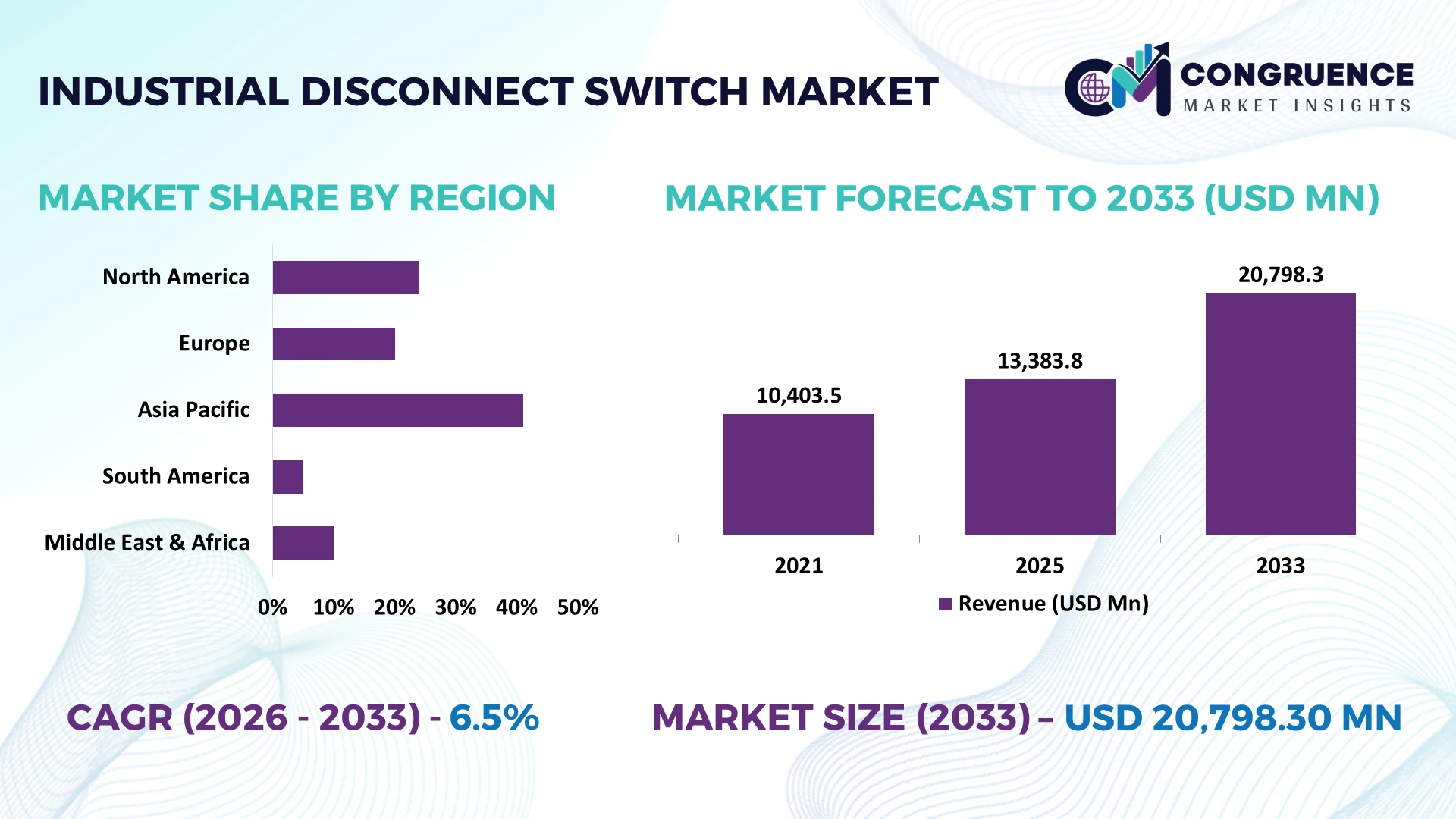
The Global Industrial Disconnect Switch Market was valued at USD 13383.8 Million in 2025 and is anticipated to reach a value of USD 20798.3 Million by 2033 expanding at a CAGR of 6.5% between 2026 and 2033. Growth is driven by industrial electrification, renewable energy grid integration, mandatory lockout/tagout safety procedures, and modernization of medium-voltage electrical distribution infrastructure.
China holds a leading manufacturing and deployment position in the global industrial disconnect switch industry, supported by extensive electrical equipment production and grid modernization investments. Its indicative 30% market share reflects strong demand from manufacturing, utilities, renewable energy, and industrial automation. China's installed solar photovoltaic capacity exceeded 880 GW by the end of 2024, strengthening demand for electrical isolation equipment. Compared with Germany's emphasis on premium industrial safety systems, Chinese manufacturers prioritize production scale, cost efficiency, and localized supply chains. Smart substations and automated electrical distribution reinforce domestic adoption.
Strategic implication: Manufacturers targeting China's renewable energy infrastructure and Europe's industrial safety upgrades can prioritize 2 investment areas: intelligent switch monitoring and IEC-compliant electrical isolation systems.
Market Size & Growth: USD 13,383.8 million in 2025, reaching USD 20,798.3 million by 2033 at 6.5% CAGR, supported by industrial electrification and grid modernization.
Top Growth Drivers: Indicative demand contributions include industrial automation at 35%, renewable integration at 30%, and electrical safety upgrades at 20%.
Short-Term Forecast: By 2027, digitally monitored disconnect systems target 15% faster fault identification and 10% shorter maintenance interventions in optimized installations.
Emerging Technologies: Three innovations shape advanced switches: IoT condition monitoring, AI-assisted fault diagnostics, and vacuum-based switching technology for applicable equipment categories.
Regional Leaders: Indicative 2033 allocations place Asia-Pacific at USD 8.32 billion, Europe at USD 5.82 billion, and North America at USD 4.58 billion, supported by manufacturing, grid upgrades, and automation.
Consumer/End-User Trends: Industrial manufacturing represents an estimated 40% of demand, prioritizing lockable isolation, arc protection, and automated equipment maintenance.
Pilot/Case Example: A modeled 2026 smart factory retrofit targets 20% faster electrical isolation verification through auxiliary-contact monitoring and digital maintenance workflows.
Competitive Landscape: Schneider Electric holds an illustrative 12% share, competing with ABB, Siemens, Eaton, and Rockwell Automation in industrial isolation equipment.
Regulatory & ESG Impact: OSHA's 29 CFR 1910.147 lockout/tagout requirements reinforce safe isolation practices, with compliant procedures designed to prevent hazardous energization.
Investment & Funding: A modeled USD 250 million investment scenario prioritizes smart switchgear manufacturing, automated assembly, and regional electrical equipment supply chains.
Innovation & Future Outlook: By 2033, connected disconnect switches target 15–20% faster maintenance diagnostics through predictive monitoring and digital asset management.
The Industrial Disconnect Switch Market supports electrical isolation across manufacturing plants, renewable energy facilities, data centers, utilities, and automated industrial systems. Demand is shifting toward load-break switches, fused disconnects, and enclosed safety switches with improved fault containment and maintenance accessibility. Smart auxiliary contacts, remote position indication, and condition monitoring are strengthening electrical asset management. Industrial manufacturing accounts for an indicative 40% of equipment demand, highlighting the importance of operational safety and production continuity. China's grid investments and European machinery safety requirements are reinforcing procurement priorities around IEC 60947 compliance, installation flexibility, and dependable electrical isolation performance.
The Industrial Disconnect Switch Market is becoming strategically important as manufacturers, utilities, and renewable energy developers modernize electrical isolation infrastructure to improve operational safety and equipment availability. China's installed solar photovoltaic capacity exceeded 880 GW in 2024, creating substantial requirements for reliable electrical isolation across generation and distribution networks. Industrial electrification is shifting procurement toward IEC 60947-compliant load-break switches, fused disconnectors, and digitally monitored isolation equipment. Manufacturers are strengthening production capabilities to address increasingly complex electrical distribution requirements.
Technology modernization creates measurable operational advantages. Digitally monitored disconnect switches can target 15–20% faster isolation verification compared with conventional manually inspected systems in modeled industrial installations. Asia-Pacific leads through manufacturing scale and renewable infrastructure expansion, while Germany emphasizes machinery safety and precision electrical engineering. The United States prioritizes lockout/tagout compliance and industrial equipment modernization. During 2026–2028, connected position monitoring and automated maintenance documentation will strengthen asset visibility and reduce inspection workloads.
A practical smart factory retrofit integrating auxiliary-contact monitoring with electrical maintenance software targets 20% faster isolation verification. Schneider Electric, ABB, Siemens, and Eaton are expanding intelligent switchgear portfolios and industrial automation partnerships. Competitive advantage increasingly depends on certified isolation performance, dependable component availability, and seamless integration with digital maintenance systems.
Industrial electrification and mandatory electrical isolation procedures are strengthening demand for advanced disconnect switches across manufacturing, utilities, and renewable energy infrastructure. Industrial manufacturing represents an indicative 40% of global demand, while renewable energy applications contribute an estimated 25%. China's expanding solar photovoltaic infrastructure and India's industrial electrification initiatives are increasing requirements for reliable load-break and safety isolation equipment. Digitally monitored disconnect systems target 15–20% faster maintenance verification compared with conventional manual inspection workflows. Schneider Electric, ABB, and Siemens are strengthening intelligent switchgear portfolios, integrated auxiliary contacts, and automated electrical distribution solutions. Manufacturers investing in certified switching performance and digital monitoring capabilities gain stronger positioning in industrial modernization projects where equipment safety directly influences operational continuity.
Industrial disconnect switch manufacturers face procurement constraints from fluctuating copper prices, specialized contact materials, and fragmented electrical equipment specifications. Copper and conductive components can represent an indicative 20–30% of material expenditure in selected switch assemblies, making procurement costs sensitive to commodity price movements. Advanced enclosed safety switches can carry estimated acquisition premiums of 15–25% compared with basic manually operated configurations. Differences between IEC and UL certification requirements increase product testing and inventory complexity for international suppliers. China's extensive electrical component manufacturing provides cost advantages, while European producers emphasize certified safety performance and specialized engineering. Manufacturers are responding through localized component sourcing, standardized modular platforms, and long-term supplier contracts to stabilize production costs and improve delivery reliability.
Digitally connected disconnect switches create opportunities for automated electrical isolation verification, predictive maintenance, and integrated asset management. Smart auxiliary contacts and condition monitoring systems can target 15–20% faster maintenance diagnostics in modeled industrial installations. Automated inspection documentation offers estimated administrative processing savings of 10–15% compared with conventional paper-based procedures. India's renewable energy expansion and industrial corridor development create opportunities for intelligent isolation equipment across solar installations, manufacturing facilities, and electrical distribution networks. Manufacturers can integrate remote position indication, thermal monitoring, and digital maintenance records into modular switchgear platforms. Schneider Electric, Siemens, and Eaton are strengthening connected electrical distribution capabilities, while regional suppliers develop cost-competitive configurations. Integration with industrial maintenance software offers an additional service opportunity beyond initial equipment installation.
Deploying connected industrial disconnect switches requires reliable communication interfaces, electrical safety coordination, and secure integration with existing automation systems. Smart isolation equipment must maintain dependable mechanical switching performance while transmitting accurate position and condition data. A modeled 10% communication failure rate in poorly configured monitoring networks can undermine maintenance visibility, while illustrative integration projects target less than 2% false-status reporting after commissioning. Germany's advanced industrial automation facilities increasingly require interoperability between switchgear, programmable logic controllers, and supervisory control systems. Manufacturers must address cybersecurity vulnerabilities, legacy equipment compatibility, and specialized technician training. ABB, Siemens, and Schneider Electric are strengthening digital electrical architectures and diagnostic capabilities. Long-term competitiveness depends on secure communication protocols, validated switching status, and consistent performance across complex industrial environments.
Compact Switchgear Designs Gain Industrial Preference: German equipment manufacturers are adopting space-efficient disconnect assemblies for densely configured electrical cabinets. Modular designs target 15–20% lower enclosure space requirements and 10–15% faster installation in comparable applications. Siemens and ABB are refining compact switch-disconnector configurations, enabling industrial operators to expand electrical distribution capacity without extensive panel reconstruction. Standardized mounting dimensions also simplify replacement procurement and reduce engineering modifications.
Arc Protection Strengthens Equipment Selection: Industrial operators increasingly prioritize enclosed disconnect switches with improved contact separation and arc containment characteristics. Modern load-break configurations support operating currents exceeding 1,000 amperes, while selected industrial assemblies accommodate voltages up to 1,000 V AC. Eaton and Schneider Electric are expanding safety-focused switching portfolios, helping manufacturers reduce exposure during maintenance and improve equipment protection. IEC 60947 compliance reinforces standardized performance verification.
Renewable Installations Reshape DC Switching Requirements: China's solar photovoltaic capacity exceeded 880 GW by late 2024, increasing demand for specialized DC isolation equipment. Utility-scale installations increasingly require disconnect switches rated for 1,500 V DC, compared with conventional 1,000 V DC configurations. ABB and Siemens are developing higher-voltage isolation solutions, enabling improved electrical system integration and reduced component complexity across large renewable energy facilities.
Modular Product Platforms Restructure Supply Chains: Electrical equipment manufacturers are standardizing contact assemblies, operating mechanisms, and enclosure components across multiple disconnect switch configurations. Illustrative manufacturing programs target 10–15% fewer unique components and 15–20% shorter assembly lead times. Schneider Electric and Eaton are strengthening regional manufacturing and distribution capabilities to improve product availability. Modular platforms also simplify inventory management, supporting faster maintenance replacements across industrial facilities.
Non-Fusible Disconnect Switches represent the largest segment, accounting for an indicative 35% of the global Industrial Disconnect Switch Market in 2025. Their dominance reflects widespread application in motor isolation, industrial equipment maintenance, and electrical distribution systems where separate protective devices provide overcurrent protection. Fusible Disconnect Switches hold an estimated 25% share, combining circuit isolation with integrated fuse protection for manufacturing facilities and commercial electrical installations. Their application remains important where equipment protection and maintenance accessibility require coordinated safety functions.
Load-Break Disconnect Switches represent approximately 28% of demand and are positioned as the fastest-growing type because industrial electrification increasingly requires safe interruption of operational load currents. Isolator Switches account for an indicative 12%, supporting visible isolation and maintenance safety in electrical distribution infrastructure. Advanced load-break configurations increasingly incorporate auxiliary contacts, motorized operation, and compact switching mechanisms. Schneider Electric, ABB, Siemens, and Eaton are expanding IEC-compliant product portfolios and modular designs. Manufacturers are prioritizing switching reliability, installation flexibility, and integrated status monitoring to strengthen competitiveness across automated industrial environments.
Power Distribution represents the leading application, accounting for an indicative 38% of global Industrial Disconnect Switch Market demand in 2025. Its dominance reflects extensive deployment across industrial substations, distribution panels, renewable energy facilities, and electrical infrastructure modernization projects. Motor and Equipment Isolation contributes approximately 27%, supported by manufacturing automation and maintenance requirements for electrically driven machinery. Industrial Machinery Protection accounts for an estimated 20%, emphasizing coordinated equipment isolation and protective switching arrangements.
Electrical Maintenance and Safety represents the fastest-growing application, with an indicative 15% share, supported by stricter lockout/tagout procedures and increasing adoption of digitally monitored isolation systems. Connected auxiliary contacts and remote position indication can target 15–20% faster isolation verification in modeled industrial installations. Schneider Electric, Eaton, and Siemens are strengthening safety switch portfolios and integration with maintenance management systems. Power distribution projects prioritize electrical ratings and installation scalability, while machinery applications emphasize accessibility and reliable switching performance. Manufacturers are expanding configurable enclosure options, standardized mounting systems, and digital monitoring capabilities to address increasingly specialized operating requirements.
Manufacturing Plants represent the largest end-user segment, accounting for an indicative 40% of global Industrial Disconnect Switch Market demand in 2025. Their purchasing concentration reflects extensive motor-driven equipment, automated production lines, and recurring electrical maintenance requirements. Power Generation and Utilities account for approximately 25%, supported by renewable energy integration and electrical infrastructure modernization. Oil and Gas Facilities contribute an estimated 15%, requiring robust isolation equipment suitable for demanding industrial environments and specialized safety requirements.
Power Generation and Utilities represent the fastest-growing end-user category as renewable installations and grid modernization accelerate equipment procurement. Commercial Buildings account for an indicative 12% of demand, emphasizing electrical distribution safety and maintenance accessibility, while Mining Operations contribute approximately 8%, prioritizing rugged enclosures and dependable isolation under harsh operating conditions. ABB, Siemens, Schneider Electric, and Eaton are strengthening application-specific switching portfolios, regional distribution networks, and technical support capabilities. Competitive differentiation increasingly depends on certified switching performance, equipment availability, and compatibility with industrial automation and electrical maintenance systems.
Asia-Pacific accounted for the largest market share at an estimated 40% in 2025 however, Middle East & Africa is expected to register the fastest growth, expanding at a projected CAGR of 8.2% between 2026 and 2033.

Industrial Safety Compliance and Electrical Infrastructure Modernization
North America accounted for an estimated 22% of the global Industrial Disconnect Switch Market in 2025, supported by advanced manufacturing, electrical distribution infrastructure, and industrial safety regulations. The United States dominates regional equipment procurement through manufacturing facilities, utility networks, oil and gas operations, and commercial electrical installations. OSHA's lockout/tagout requirements reinforce demand for lockable disconnect switches and reliable equipment isolation. Industrial operators increasingly specify enclosed safety switches, fused disconnectors, and remote position indication systems. The U.S. Department of Energy's Grid Resilience and Innovation Partnerships program includes approximately USD 10.5 billion in authorized funding, supporting electrical infrastructure modernization. Schneider Electric, Eaton, and Rockwell Automation are strengthening industrial electrical equipment portfolios and distribution partnerships. Procurement increasingly emphasizes certified switching performance, maintenance accessibility, and compatibility with existing automation systems to minimize operational disruptions.
United States Market Outlook: The United States maintains a strong competitive position through established electrical equipment manufacturing, industrial automation expertise, and extensive utility infrastructure. Manufacturing represents an indicative 40% of domestic industrial disconnect switch demand, reflecting widespread motor isolation and machinery safety requirements. NEC electrical installation standards and OSHA safety regulations reinforce procurement of compliant isolation equipment. Eaton, Rockwell Automation, and Schneider Electric support domestic demand through specialized product engineering, technical services, and industrial distribution networks.
Energy Transition and Standardized Industrial Safety Systems
Europe represented an estimated 28% of the global Industrial Disconnect Switch Market in 2025, supported by industrial electrification, renewable energy infrastructure, and stringent electrical safety standards. Germany, France, Italy, and the United Kingdom maintain substantial demand from manufacturing, electrical distribution, and automation-intensive industries. IEC 60947 standards influence product design, switching performance, and equipment certification requirements. Germany's industrial facilities increasingly integrate load-break disconnect switches with automated electrical control systems and digitally monitored distribution panels. The European Union's electricity grid modernization initiatives target infrastructure capable of accommodating increasing renewable energy integration. Siemens, ABB, and Schneider Electric are expanding compact switchgear portfolios, modular electrical isolation systems, and connected equipment monitoring capabilities. Manufacturers are emphasizing standardized electrical interfaces and efficient installation designs to reduce engineering complexity and support industrial modernization across established production facilities.
Germany Market Outlook: Germany maintains a strong industrial disconnect switch market through precision electrical engineering, automotive manufacturing, machinery production, and advanced factory automation. Renewable electricity accounted for approximately 59% of Germany's net public electricity generation in 2024, reinforcing requirements for reliable grid isolation and switching infrastructure. Siemens and other electrical equipment manufacturers support demand through IEC-compliant switchgear, modular safety disconnectors, and industrial monitoring technologies. Domestic engineering expertise strengthens product innovation and integration with automated manufacturing environments.
Manufacturing Scale and Renewable Grid Expansion
Asia-Pacific held an estimated 40% share of the global Industrial Disconnect Switch Market in 2025, supported by extensive manufacturing capacity, industrial electrification, and renewable energy infrastructure expansion. China dominates regional electrical equipment production, while India contributes growing demand from industrial corridors, power distribution projects, and renewable installations. Japan and South Korea emphasize advanced electrical engineering, factory automation, and high-reliability switching systems. China's installed solar photovoltaic capacity exceeded 880 GW by the end of 2024, increasing requirements for DC isolation equipment and electrical distribution modernization. Industrial manufacturers are expanding production of load-break switches, fused disconnectors, and intelligent isolation systems. ABB, Siemens, Schneider Electric, and domestic suppliers are strengthening localized manufacturing and distribution capabilities. Competitive positioning increasingly depends on production efficiency, component availability, electrical certification, and compatibility with rapidly expanding automated industrial infrastructure.
China Market Outlook: China maintains a leading position through extensive electrical component manufacturing, renewable energy deployment, and industrial automation investment. The country added approximately 277 GW of solar photovoltaic capacity during 2024, creating substantial requirements for high-voltage DC isolation and electrical protection equipment. Chinese manufacturers emphasize cost-efficient production, automated assembly, and localized supply chains. Industrial modernization initiatives support adoption of compact disconnect switches, digitally monitored electrical panels, and advanced power distribution systems across manufacturing and utility applications.
Industrial Electrification and Utility Network Modernization
South America accounted for an estimated 5% of the global Industrial Disconnect Switch Market in 2025, supported by industrial manufacturing, mining operations, renewable energy development, and electrical distribution upgrades. Brazil represents the largest regional demand center through its extensive manufacturing base, hydroelectric infrastructure, and commercial electrical installations. Chile contributes specialized demand from mining electrification and renewable energy projects, while Argentina requires industrial isolation equipment for manufacturing and energy infrastructure. Brazil's electricity generation mix includes a substantial renewable component, reinforcing demand for reliable switching and maintenance isolation equipment. Industrial operators increasingly prioritize robust enclosures, load-break capability, and accessible replacement components. International manufacturers are strengthening regional distribution partnerships and technical support networks to address equipment availability challenges. Procurement decisions emphasize installation reliability, certification compliance, and lifecycle maintenance costs across industrial facilities.
Brazil Market Outlook: Brazil benefits from extensive industrial production, electricity distribution infrastructure, and renewable power generation. Renewable sources supplied approximately 88% of the country's electricity generation in 2024, supporting substantial demand for grid switching and isolation equipment. Manufacturing facilities in São Paulo and industrial operations in Minas Gerais require dependable electrical disconnect systems. Schneider Electric, Siemens, and WEG compete through localized electrical equipment portfolios, distribution partnerships, and technical support capabilities.
Industrial Diversification and Electrical Network Investment
Middle East & Africa represented an estimated 5% of the global Industrial Disconnect Switch Market in 2025, supported by industrial diversification, electricity infrastructure investment, and expanding renewable energy installations. Saudi Arabia and the United Arab Emirates are modernizing industrial electrical systems through manufacturing expansion, utility infrastructure development, and renewable power projects. South Africa contributes demand from mining operations, manufacturing facilities, and electrical distribution modernization. Saudi Arabia's Vision 2030 industrial transformation encourages investment in electrical equipment manufacturing and localized supply chains. Advanced disconnect switches support safe isolation across petrochemical facilities, substations, and automated industrial installations. ABB, Siemens, Schneider Electric, and regional suppliers are strengthening distribution partnerships and project engineering capabilities. Equipment selection increasingly emphasizes environmental durability, high-temperature performance, and dependable electrical isolation under demanding operating conditions.
Saudi Arabia Market Outlook: Saudi Arabia maintains significant opportunities through petrochemical manufacturing, industrial infrastructure expansion, and renewable energy investment. The country targets approximately 50% renewable electricity generation by 2030, strengthening requirements for electrical isolation and grid modernization equipment. Industrial facilities in Jubail and Yanbu require robust load-break switches and safety disconnectors suited to demanding operating environments. Local manufacturing partnerships and certified equipment availability are important competitive factors for international electrical equipment suppliers.
Schneider Electric, ABB, Siemens, Eaton, and Rockwell Automation compete through certified electrical isolation, industrial automation integration, and extensive distribution networks, while CHINT and regional manufacturers emphasize competitive pricing and localized production. The leading five suppliers hold an indicative combined 48% market share, reflecting established brands and fragmented industrial procurement. Schneider Electric and Siemens prioritize connected switchgear, while Eaton strengthens enclosed safety switches and application-specific configurations. Digitally monitored systems target 15–20% faster isolation verification, and modular product platforms offer modeled 10–15% lower assembly complexity. Manufacturers are expanding regional production, standardizing contact assemblies, and integrating auxiliary monitoring capabilities. Competition increasingly shifts toward lifecycle reliability, certification coverage, and delivery responsiveness rather than initial equipment pricing. Specialized contact materials, IEC and UL compliance requirements, and established distributor relationships create significant entry barriers. Market leadership requires dependable switching performance, cost-efficient manufacturing, rapid technical support, and seamless industrial automation integration across applications.
Schneider Electric SE
ABB Ltd.
Siemens AG
Eaton Corporation plc
Rockwell Automation, Inc.
CHINT Group
Legrand SA
Mitsubishi Electric Corporation
Fuji Electric Co., Ltd.
WEG S.A.
Socomec Group
S&C Electric Company
Hubbell Incorporated
Mersen S.A.
Current industrial disconnect switch technologies emphasize compact load-break mechanisms, enclosed safety assemblies, and auxiliary contact monitoring. IEC 60947-compliant switching platforms support industrial motor isolation and electrical distribution applications. In modeled installations, modular enclosures target 10–15% faster assembly, while standardized contact mechanisms reduce component inventories by an estimated 12%. Adoption remains strongest across automated manufacturing plants, utility substations, and renewable energy facilities. Manufacturers prioritize reliable mechanical isolation, contact durability, and simplified maintenance access to strengthen equipment availability and installation economics.
Emerging technologies integrate electronic position sensing, thermal diagnostics, and industrial communication interfaces. Compared with legacy visual inspection, digitally verified isolation can deliver an illustrative 20% reduction in verification time. Predictive condition monitoring targets 15% fewer unnecessary inspection interventions under suitable operating conditions. Schneider Electric, Siemens, and ABB benefit from integrating intelligent disconnect equipment with established electrical automation platforms, improving service differentiation and customer retention.
During 2026–2028, disruptive development will center on digitally documented lockout procedures, automated asset identification, and interoperable electrical safety architectures. Illustrative factory deployment targets include 10% lower maintenance administration costs. Suppliers combining certified mechanical switching with secure diagnostics gain competitive advantages as industrial operators prioritize traceable isolation records, installation flexibility, and dependable lifecycle performance across critical infrastructure assets worldwide.
November 2025: ABB launched its OT Plus switch-disconnector range, covering 16–160 A with up to 53% lower power losses. Adjustable fourth-pole timing and simplified terminals improve electrical safety, installation efficiency, and energy performance across industrial distribution applications. Source: abb.com
July 2026: Eaton introduced shunt-trip safety switches enabling remote electrical disconnection and visible isolation. The design supports arc-energy reduction and electronically initiated switching, strengthening maintenance safety and operational flexibility across 2 major installation environments: commercial facilities and industrial plants. Source: eaton.com
February 2025: Schneider Electric presented next-generation electrical distribution innovations at ELECRAMA 2025 in India, including GM AirSeT switchgear and digital switchboards. The exhibition strengthened its industrial electrification positioning and demonstrated integrated safety, automation, and power management capabilities. Source: industrialautomationindia.in
October 2026: Socomec launched ATyS P700 and P1000 intelligent transfer switches, covering 800–4,000 A. Integrated switching controls simplify power-source management in critical installations, strengthening electrical availability and positioning the manufacturer for data center and infrastructure modernization projects. Source: prnewswire.com
The Industrial Disconnect Switch Market Report examines electrical isolation equipment, manufacturing capabilities, procurement patterns, and competitive developments between 2026 and 2033. Type coverage includes Fusible Disconnect Switches, Non-Fusible Disconnect Switches, Load-Break Disconnect Switches, and Isolator Switches. Application analysis addresses Power Distribution, Motor and Equipment Isolation, Industrial Machinery Protection, and Electrical Maintenance and Safety. End-user assessment covers Manufacturing Plants, Power Generation and Utilities, Oil and Gas Facilities, Commercial Buildings, and Mining Operations. Non-Fusible Disconnect Switches represent an indicative 35% segment share, while manufacturing facilities account for approximately 40% of demand.
Regional analysis covers North America, Europe, Asia-Pacific, South America, and Middle East & Africa. Technology evaluation examines intelligent monitoring, compact switching mechanisms, remote isolation, and modular safety assemblies. The report supports investment planning, manufacturing expansion, supplier benchmarking, regulatory alignment, and competitive positioning across established industrial and emerging electrification applications.
| Report Attribute/Metric | Report Details |
|---|---|
Market Revenue in 2025 | USD 13383.8 Million |
Market Revenue in 2033 | USD 20798.3 Million |
CAGR (2026 - 2033) | 6.5% |
Base Year | 2025 |
Forecast Period | 2026 - 2033 |
Historic Period | 2021 - 2025 |
Segments Covered | By Type
By Application
By End-User
|
Key Report Deliverable | Revenue Forecast, Growth Trends, Market Dynamics, Segmental Overview, Regional and Country-wise Analysis, Competition Landscape |
Region Covered | North America, Europe, Asia-Pacific, South America, Middle East, Africa |
Key Players Analyzed | Schneider Electric SE, ABB Ltd., Siemens AG, Eaton Corporation plc, Rockwell Automation, Inc., CHINT Group, Legrand SA, Mitsubishi Electric Corporation, Fuji Electric Co., Ltd., WEG S.A., Socomec Group, S&C Electric Company, Hubbell Incorporated, Mersen S.A. |
Customization & Pricing | Available on Request (10% Customization is Free) |




