
Reports
The Global Industrial Decommissioning Market was valued at USD 16080 Million in 2025 and is anticipated to reach a value of USD 27217.99 Million by 2033 expanding at a CAGR of 6.8% between 2026 and 2033. Growth is driven by aging oil-and-gas assets, stricter well-abandonment obligations, nuclear shutdown programs, and rising costs of maintaining legacy industrial infrastructure.
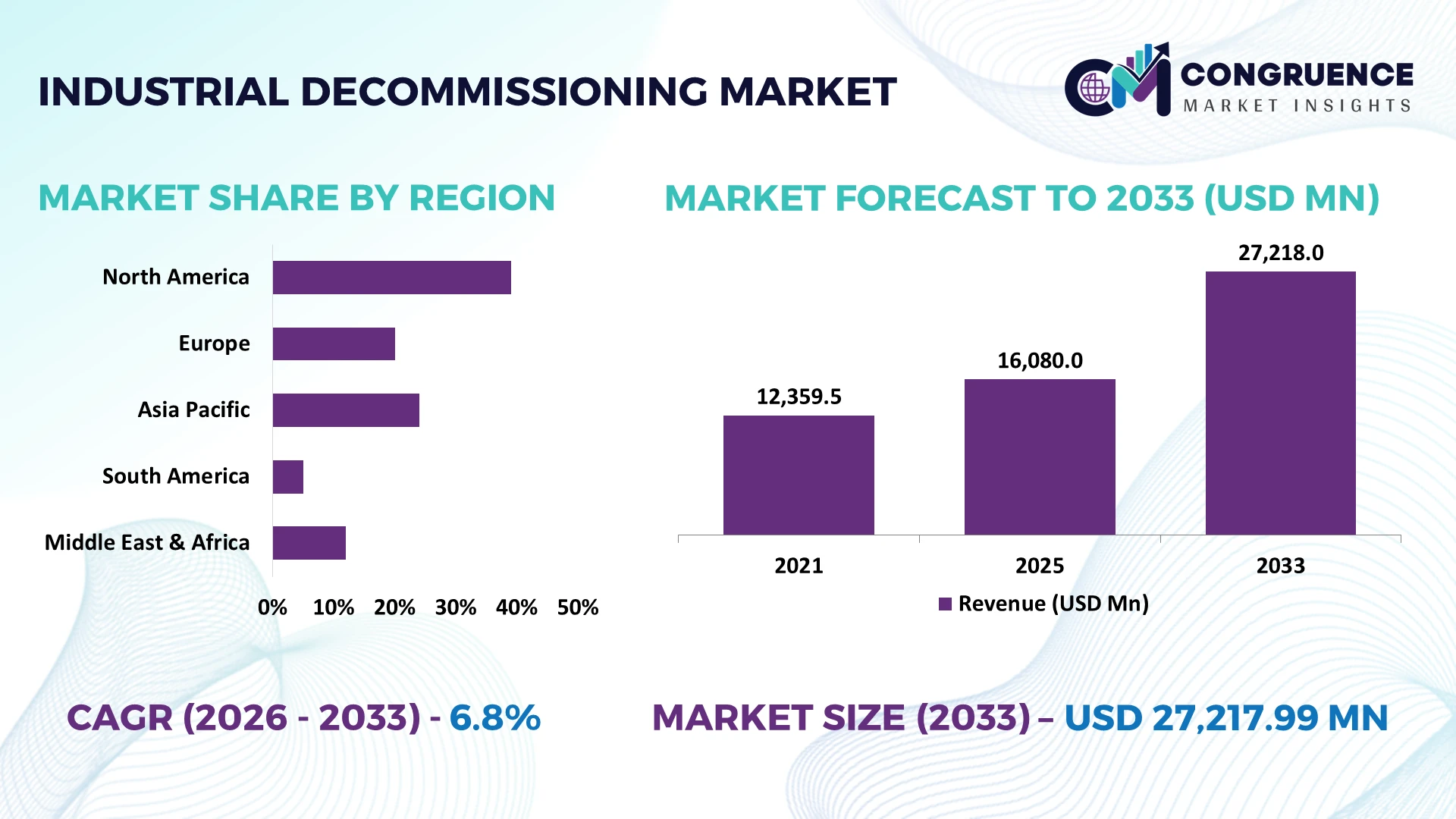
The United States remains a dominant industrial decommissioning hub, with Gulf of Mexico offshore production representing about 14% of total U.S. oil output and mature assets sustaining extensive retirement activity; North America held about 41.45% of the offshore decommissioning segment in 2025, ahead of Europe. The 2025 U.S. offshore leasing shift reinforces long-term asset-cycle planning.
Strategically, operators prioritizing robotics, remote inspection, asset repurposing, and integrated dismantling programs will secure stronger cost control and execution capacity.
Market Size & Growth: USD 16.08 billion in 2025 rising to USD 27.22 billion by 2033 at 6.8% CAGR, driven by aging industrial assets and regulatory retirement obligations.
Top Growth Drivers: Aging infrastructure 32%, regulatory compliance 27%, and energy-transition asset replacement 21% are the leading growth forces.
Short-Term Forecast: By 2028, automated planning and remote inspection are positioned to reduce project costs 8% and improve execution efficiency 12%.
Emerging Technologies: AI inspection, autonomous robotics, digital twins, and advanced cutting systems are reshaping high-risk dismantling and hazardous-site operations.
Regional Leaders: North America is projected near USD 11.3 billion, Europe USD 8.2 billion, and Asia-Pacific USD 4.9 billion, supported by offshore retirement and industrial modernization.
Consumer/End-User Trends: More than 60% of major operators increasingly prioritize digital monitoring and asset-lifecycle planning when selecting decommissioning contractors.
Pilot/Case Example: In 2024, Petrobras allocated USD 9.9 billion for 2025–2029 decommissioning, while optimizing platform retirement from 23 planned units to 10, strengthening capital efficiency.
Competitive Landscape: Leading providers include Amentum, Halliburton, SLB, Petrofac, and Wood, with large integrated contractors capturing roughly 35% of specialized project activity.
Regulatory & ESG Impact: UK decommissioning spending reached £2.4 billion in 2024, while regulators target a 10% industry cost reduction by 2028, intensifying efficiency requirements.
Investment & Funding: UK operators are expected to spend £27 billion during 2023–2032, accelerating partnerships, specialized vessels, engineering capacity, and decommissioning supply-chain expansion.
Innovation & Future Outlook: Next-generation projects will combine AI, robotics, digital twins, material recovery, and asset repurposing, shifting competition from dismantling capacity toward lifecycle optimization.
The Industrial Decommissioning Market is increasingly concentrated around offshore oil and gas, nuclear facilities, refineries, chemical plants, power stations, and aging manufacturing infrastructure. Demand is shifting toward remote-operated equipment, predictive asset assessment, hazardous-environment robotics, and material recovery, with digital technologies improving planning and inspection efficiency by approximately 10–15%. Regulatory pressure is also accelerating structured retirement schedules, creating stronger opportunities for specialized contractors and integrated lifecycle-service providers.
Industrial decommissioning is becoming a strategic discipline because asset retirement now directly affects capital allocation, liability management, environmental compliance, and contractor competitiveness. In the UK, estimated offshore decommissioning costs reached £44 billion in 2025, 11% above the 2022 baseline, forcing operators to redesign schedules, procurement and asset-transfer strategies. The market is shifting toward integrated lifecycle planning rather than end-of-life dismantling.
Technology is separating high-performing contractors from conventional providers. Digital twins, remote inspection and robotics reduce offshore personnel exposure and improve planning accuracy; automated inspection can cut field inspection time by roughly 20% versus manual workflows. The United States has about 1,430 offshore platforms, with approximately 75% older than 25 years, creating a substantial technology-led retirement pipeline. By contrast, the UK emphasizes regulatory coordination and standardized cost reduction.
Over the next 2–3 years, operators will prioritize bundled engineering, plug-and-abandonment, heavy-lift and recycling contracts, with digital monitoring adoption moving toward 50–60% across complex projects. Petrobras' multi-year decommissioning program demonstrates this capital discipline, while BP's 2026 North Sea asset-sale strategy highlights how companies are reassessing mature-asset liabilities. Competitive advantage will increasingly depend on executing safer, faster and more predictable decommissioning programs.
Aging infrastructure is the strongest structural driver, particularly in the United States, where 75% of 1,430 offshore platforms are more than 25 years old. The UK recorded £2.6 billion of decommissioning spending in 2025, while approximately 500 North Sea wells are already overdue for closure. Regulatory enforcement is therefore converting deferred liabilities into scheduled workloads. Operators are responding through multi-year contractor frameworks, integrated well-abandonment programs and specialized vessel partnerships. The non-obvious advantage is capacity visibility: early contracting protects access to rigs, vessels and engineering teams before supply becomes constrained, improving schedule certainty and reducing idle-time exposure.
Cost volatility and limited specialist capacity remain immediate constraints. The UK's latest decommissioning estimate increased 11% from its 2022 baseline to £44 billion, while global competition for rigs, vessels and technical resources is tightening procurement conditions. In the North Sea, roughly 1,000 additional wells are expected to cease production within five years, intensifying demand for plug-and-abandonment capacity. Companies are mitigating exposure through longer-term service contracts, shared logistics, regional supply-chain diversification and standardized engineering packages. The critical operational issue is sequencing: bringing projects forward without sufficient planning can destroy economies of scale and raise day rates, making procurement discipline as important as technical capability.
Digitalization creates a high-value opportunity by moving decommissioning from labor-intensive inspection toward data-led execution. Remote inspection, autonomous robotics and digital twins can reduce offshore inspection time by about 20% while lowering personnel exposure to hazardous environments. In the United States, the large population of mature platforms supports scalable deployment of these systems, while the UK provides a strong testbed for cost-reduction technologies under its 10% industry cost-reduction target through 2028. Companies are investing in robotic inspection, automated cutting, digital asset records and metal-recovery ecosystems. The strongest opportunity lies in combining these technologies with integrated contracts, turning recovered materials and verified asset data into additional project value.
Execution complexity remains a long-term challenge because decommissioning combines subsea engineering, hazardous-material handling, heavy lifting, environmental monitoring and waste recovery within tightly controlled schedules. Around 80% of UK decommissioning responsibilities are concentrated among 10 companies, increasing the consequence of project delays and contractor bottlenecks. Meanwhile, approximately 75% of U.S. offshore platforms exceeding 25 years of age creates a sustained requirement for specialized expertise. Companies must invest in digital competency, robotics training, standardized data platforms and multi-disciplinary partnerships. The strategic challenge is interoperability: disconnected engineering, inspection and regulatory datasets can erase productivity gains, making integrated digital workflows essential for consistent execution and sustainable competitiveness.
Digital Inspection Becomes Standard: Remote inspection, drones, digital twins and AI-assisted integrity assessment are moving into mainstream workflows, with inspection productivity improving 15–20% and offshore personnel exposure falling around 10%. U.S. contractors are scaling data-led surveys as mature assets require faster retirement decisions.
Offshore Retirement Intensifies: Gulf of Mexico activity is reshaping contractor pipelines as offshore operations account for 14% of U.S. oil production, while deeper-water assets demand specialized lifting and subsea capabilities. Companies are securing vessels and engineering capacity earlier, creating stronger multi-year supply-chain commitments.
Methane Control Gains Priority: Abandoned wells and facilities are becoming measurable ESG liabilities, with abandoned fossil-fuel sites contributing about 8 Mt of methane emissions globally in 2024. Operators are integrating leak detection, well sealing and monitoring into closure programs, shifting spending toward environmental verification rather than physical removal alone.
Nuclear Workflows Become Specialized: Nuclear decommissioning is moving toward highly controlled dismantling, waste characterization and remote handling. The IAEA tracks 417 operating reactors alongside permanently shut units worldwide, increasing demand for specialist engineering. Companies are strengthening radiation-management partnerships and modular remote tooling to shorten hazardous-site exposure.
Offshore decommissioning is estimated to represent about 31% of market activity, supported by large asset footprints, complex subsea infrastructure and expensive abandonment obligations. Plant decommissioning follows at approximately 27%, while Facility activity accounts for around 19%, reflecting refinery, processing and industrial-site closures. Offshore projects command greater contractor spending because heavy lifting, subsea intervention and marine logistics require specialized assets. Companies are therefore prioritizing vessel alliances, integrated engineering packages and regional staging bases. Infrastructure represents roughly 14%, while Nuclear contributes about 9%, with nuclear projects requiring longer regulatory cycles and specialized waste protocols.
Offshore is also the fastest-shifting type, with deployment intensity increasing around 8% as operators accelerate retirement planning for mature platforms. The United States and United Kingdom are prioritizing bundled abandonment scopes, whereas nuclear operators emphasize containment and waste characterization. This divergence is redirecting investment toward marine logistics in mature hydrocarbon hubs and remote-handling technologies in nuclear markets.
Asset Dismantling leads with an estimated 34% share because offshore platforms, processing units and aging industrial equipment require direct structural removal before sites can transition to remediation or redevelopment. Equipment Removal follows at approximately 22%, while Site Remediation captures about 18%. Dismantling projects increasingly integrate cutting automation, heavy-lift planning and material segregation, improving workflow productivity by roughly 12–15%. Companies are responding with integrated engineering-to-recycling contracts rather than isolated removal services, increasing schedule control and recovered-material value.
Environmental Restoration is the fastest-growing application, advancing deployment intensity by around 9% as regulators and operators place greater emphasis on post-closure site conditions. Waste Management represents nearly 15%, supported by stricter hazardous-material handling. In the United States, methane concerns are strengthening well-sealing and monitoring requirements, while European operators increasingly combine remediation with circular-material recovery. The resulting shift moves spending beyond physical dismantling toward measurable site restoration outcomes.
Oil & Gas accounts for an estimated 43% of market demand, reflecting the large installed base of offshore platforms, wells, pipelines and processing assets requiring retirement. Power Generation follows at about 24%, supported by aging thermal and nuclear facilities. Manufacturing contributes nearly 14%, while Chemicals and Mining represent approximately 11% and 8%, respectively. Oil and gas companies increasingly favor multi-asset frameworks covering engineering, well abandonment, dismantling and environmental monitoring, giving large contractors greater contract visibility.
Power Generation is the fastest-growing end-user segment, with project deployment increasing around 8% as utilities address aging plants and nuclear shutdown programs. Nuclear facilities require specialized radiation protection and waste handling, creating higher-value service opportunities than conventional equipment removal. Mining demand is shifting toward methane control and land restoration, while chemical manufacturers prioritize hazardous-material containment. Companies are differentiating through sector-specific engineering, specialist partnerships and bundled compliance services rather than competing solely on dismantling price.
North America accounted for the largest market share at 41.45% in 2025 however, Asia-Pacific is expected to register the fastest growth, expanding at a CAGR of 7.6% between 2026 and 2033.

Offshore retirement and mature-asset optimization dominate regional activity
North America remains the leading industrial decommissioning market, supported by extensive offshore infrastructure, aging refineries, power assets, and industrial facilities. The United States drives deployment, particularly around the Gulf of Mexico, where mature offshore platforms create sustained demand for well abandonment, subsea removal, heavy lifting, and environmental restoration. Operators are increasingly bundling engineering, dismantling, recycling, and monitoring into integrated contracts to reduce mobilization costs and execution delays. Remote inspection, drones, digital twins, and robotic tooling are gaining traction as contractors address hazardous offshore work and specialist labor shortages. Canada adds demand through oil-sands infrastructure retirement and industrial-site remediation. The regional supply chain is also becoming more localized, with contractors expanding staging capacity and long-term vessel arrangements to secure project availability.
United States Market Outlook: The United States holds the region's strongest asset base and technology ecosystem. Gulf offshore production represents roughly 14% of U.S. oil output, supporting a large retirement pipeline. Operators are prioritizing integrated abandonment contracts, automated inspection, material recovery, and environmental compliance, strengthening demand for specialized engineering and marine-service providers.
Regulatory discipline is reshaping North Sea retirement economics
Europe remains a mature decommissioning hub, led by the United Kingdom and Norway, where aging offshore infrastructure, stringent environmental rules, and structured asset retirement programs sustain specialized service demand. The United Kingdom's North Sea operators are increasingly coordinating well abandonment, platform removal, waste processing, and site restoration to improve cost visibility. Norway is emphasizing offshore engineering capability, subsea technology, and material recovery, creating a stronger technology-oriented service ecosystem. European projects increasingly incorporate circular-economy practices, with recovered steel and equipment entering secondary industrial supply chains. Regulatory scrutiny is also pushing operators toward earlier liability planning rather than delayed dismantling. Contractors are responding through long-term frameworks, modular equipment, engineering partnerships, and digital project controls, while standardized work packages are improving procurement efficiency and reducing operational fragmentation across complex offshore campaigns.
United Kingdom Market Outlook: The UK remains strategically important because of its dense North Sea asset base and established decommissioning ecosystem. Industry estimates place UK decommissioning expenditure at roughly £44 billion across the coming decade. Operators are increasingly using integrated contracting, digital planning, and specialist vessel partnerships to control project sequencing and improve supply-chain utilization.
Industrial modernization is creating a new retirement cycle
Asia-Pacific is emerging as the fastest-changing decommissioning market as mature offshore assets intersect with rapid industrial modernization. Australia, China, Japan, South Korea, and Southeast Asian producers are generating demand across offshore platforms, power infrastructure, shipyards, refineries, and heavy industrial facilities. Australia is particularly important because aging offshore assets require specialized well abandonment and subsea removal capabilities, while Japan emphasizes nuclear and industrial-site decommissioning expertise. China and South Korea provide strong fabrication, marine engineering, and heavy-lift capabilities that can support regional project execution. Contractors are increasing partnerships with local engineering firms and shipyards to reduce mobilization requirements and improve equipment availability. The region's large manufacturing base also creates an unusual advantage: dismantled industrial equipment and recovered metals can move efficiently into established recycling and fabrication networks.
Australia Market Outlook: Australia combines substantial offshore infrastructure with advanced engineering and environmental regulation. Its mature offshore basins are generating increasing demand for plug-and-abandonment, subsea removal, and environmental monitoring. Companies are expanding local specialist capacity and forming alliances with marine contractors, creating stronger domestic execution capabilities for complex retirement programs.
Brazil's offshore cycle is redefining regional service demand
South America is increasingly centered on Brazil, where deepwater and mature offshore assets are creating a specialized decommissioning pipeline. Petrobras is restructuring retirement programs around platform removal, well abandonment, subsea infrastructure and environmental management, making Brazil the region's primary demand center. The country's offshore production concentration creates requirements for heavy-lift vessels, remotely operated vehicles, subsea engineering and specialized waste handling. Argentina adds longer-term potential through mature hydrocarbon infrastructure, while Colombia contributes smaller but strategically relevant onshore and offshore retirement projects. Brazil's local-content ecosystem is also encouraging domestic engineering, fabrication and marine-service participation. Contractors are therefore combining international technology with local partnerships to improve project execution and regulatory alignment. The strongest commercial opportunity lies in integrated offshore packages rather than standalone dismantling, particularly where operators seek predictable scheduling and reduced vessel mobilization.
Brazil Market Outlook: Brazil dominates regional decommissioning activity because of its extensive offshore petroleum infrastructure and deepwater operating expertise. Petrobras has allocated billions of dollars across its multi-year decommissioning portfolio, supporting demand for specialized vessels, subsea robotics, engineering services, recycling, and environmental restoration capabilities.
Energy diversification is creating a selective retirement pipeline
Middle East & Africa activity is increasingly linked to aging oil and gas infrastructure, refinery modernization, energy diversification, and environmental compliance. Saudi Arabia, the United Arab Emirates, Qatar, and Nigeria represent important project centers, although demand remains concentrated around specific mature assets rather than broad-based retirement programs. Gulf operators are investing heavily in industrial modernization, creating opportunities for contractors that combine dismantling with brownfield redevelopment and waste recovery. Nigeria's mature offshore infrastructure creates additional demand for well abandonment and asset removal, while South Africa adds industrial and power-asset decommissioning requirements. Companies are forming local partnerships to navigate permitting, logistics, workforce requirements, and regional procurement conditions. The strategic shift is toward repurposing usable infrastructure where technically feasible, allowing operators to reduce abandonment costs while aligning industrial retirement with broader energy-transition and sustainability programs.
Saudi Arabia Market Outlook: Saudi Arabia offers strong long-term potential because of its extensive hydrocarbon infrastructure and large-scale industrial diversification programs. The country's major energy and industrial operators increasingly integrate asset modernization with environmental management, creating demand for controlled dismantling, waste recovery, specialist engineering, and brownfield redevelopment services.
Global leaders such as Amentum, Wood, Petrofac, SLB, and Halliburton compete with regional engineering contractors and specialist marine-service providers. The top five players collectively capture roughly 25–30% of organized project activity, leaving substantial room for regional specialists. Competition centers on technology, execution speed, vessel access, safety performance, and integrated contracting. Digital inspection and robotics can improve field productivity by 10–20%, while integrated procurement can reduce mobilization costs by 5–10%. Large contractors are expanding through multi-year frameworks, specialist partnerships, and vertical integration spanning engineering, well abandonment, dismantling, waste handling, and remediation. Regional firms compete through local permitting expertise and lower logistics costs. The competitive shift is moving from manpower-intensive dismantling toward technology-enabled lifecycle management. High entry barriers include specialized equipment, regulatory approvals, hazardous-site expertise, marine logistics, and proven safety records. Winning requires integrated capabilities, reliable supply-chain control, digital execution, and the ability to deliver predictable outcomes across complex retirement programs.
Amentum
Wood
Petrofac
SLB
Halliburton
TechnipFMC
Saipem
Worley
Heerema Marine Contractors
Allseas
Boskalis
DEME
Mammoet
DNV
Digital twins, AI-assisted inspection, drones, ROVs, and robotic systems are becoming core tools for industrial decommissioning. Remote inspection can improve field productivity by 15–20%, while AI-supported data interpretation reduces manual review workloads by roughly 10–15%. Adoption is strongest in offshore and nuclear projects, where hazardous environments justify automation. Integrated digital workflows connect asset records, inspection data, engineering models, and disposal planning, giving contractors faster decisions and stronger safety performance.
Single-lift removal represents a major technology shift versus conventional modular dismantling. Allseas’ Pioneering Spirit can remove topsides up to 60,000 tonnes in one lift, reducing offshore work and shifting dismantling to controlled onshore facilities. Compared with conventional piece-by-piece removal, this approach can improve removal productivity by approximately 20% and reduce offshore exposure. Large integrated contractors benefit most because specialized vessels, engineering capability, and recycling infrastructure create significant competitive barriers.
From 2026–2028, autonomous inspection, machine-learning risk assessment, robotic cutting, digital twins, and low-emission marine equipment will move toward broader deployment. New offshore construction vessels with hybrid battery systems are entering service, supporting more efficient intervention and inspection workflows. Companies combining robotics with predictive analytics and integrated recycling will gain scheduling, safety, and utilization advantages, making technology investment increasingly important now.
October 2025 Amentum secured positions on Sellafield’s 15-year Decommissioning and Nuclear Waste Partnership, with potential work of £1.4 billion. The award expands remediation, robotics, digital visualization and AI deployment, strengthening Amentum’s nuclear decommissioning platform and long-term UK project pipeline significantly. Source: amentum.com
September 2025 Allseas won TAQA’s Brae Alpha decommissioning contract covering a 33,000-tonne topside and 13,000-tonne jacket. Pioneering Spirit will execute removal from 2028, with at least 95% of materials reused or recycled, reinforcing single-lift capability and circular recovery. Source: allseas.com
December 2024 Petrobras reduced planned decommissioning investment to $9.9 billion for 2025–2029 and cut targeted floating-platform retirements from 23 to 10. The optimization redirects capital toward fewer campaigns and evaluates revitalization of four platforms, reshaping Brazil’s retirement strategy materially. Source: reuters.com
November 2024 The NSTA launched its Tree and Wellhead Information for Subsea Tooling database and decommissioning data dashboard. Initiative improves access to information and supports campaign sequencing, addressing supply-chain constraints while enabling operators to coordinate multi-asset well abandonment more effectively. Source: gov.uk
The Industrial Decommissioning Market Report covers Plant, Facility, Offshore, Nuclear, and Infrastructure types, alongside Asset Dismantling, Site Remediation, Waste Management, Equipment Removal, and Environmental Restoration applications. End-user analysis spans Oil & Gas, Power Generation, Mining, Manufacturing, and Chemicals, providing a structured view of demand concentration and changing project priorities.
Regional coverage includes North America, Europe, Asia-Pacific, South America, and Middle East & Africa, with country-level assessment of industrial asset maturity, regulatory requirements, deployment activity, and specialist-service capacity. The report evaluates digital twins, robotics, AI-assisted inspection, remote-operated systems, heavy-lift technologies, and material-recovery workflows. With offshore activity representing a major portion of specialized projects and digital technologies improving inspection productivity by approximately 15–20%, the analysis supports investment planning, contractor expansion, technology adoption, partnership decisions, competitive positioning, and strategic planning through 2026–2033.
| Report Attribute/Metric | Report Details |
|---|---|
Market Revenue in 2025 | USD 16080 Million |
Market Revenue in 2033 | USD 27217.99 Million |
CAGR (2026 - 2033) | 6.8% |
Base Year | 2025 |
Forecast Period | 2026 - 2033 |
Historic Period | 2021 - 2025 |
Segments Covered | By Type
By Application
By End-User
|
Key Report Deliverable | Revenue Forecast, Growth Trends, Market Dynamics, Segmental Overview, Regional and Country-wise Analysis, Competition Landscape |
Region Covered | North America, Europe, Asia-Pacific, South America, Middle East, Africa |
Key Players Analyzed | Amentum, Wood, Petrofac, SLB, Halliburton, TechnipFMC, Saipem, Worley, Heerema Marine Contractors, Allseas, Boskalis, DEME, Mammoet, DNV |
Customization & Pricing | Available on Request (10% Customization is Free) |




