
Reports
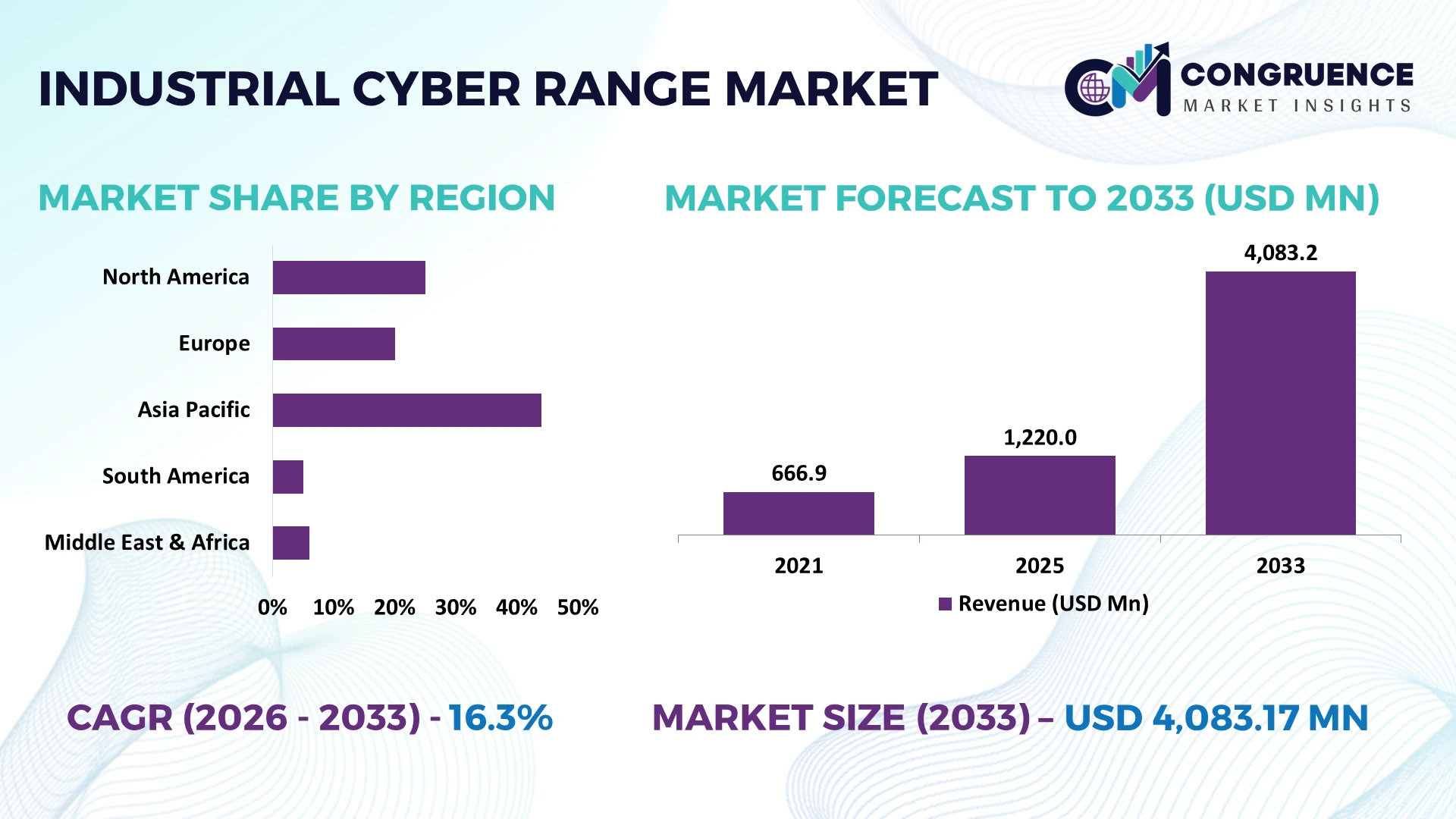
The Global Industrial Cyber Range Market was valued at USD 1220 Million in 2025 and is anticipated to reach a value of USD 4083.17 Million by 2033 expanding at a CAGR of 16.3% between 2026 and 2033. Growth is driven by IEC 62443 security validation, operational technology attack simulation, industrial control system resilience testing, and mandatory incident response preparedness across critical infrastructure.
The United States leads industrial cyber range adoption, supported by its extensive critical infrastructure network, advanced cybersecurity training capabilities, and federal investment in operational technology protection. The country operates 16 designated critical infrastructure sectors, including energy, manufacturing, transportation, and water systems. The Department of Defense's Cyber Mission Force comprises 147 teams, strengthening the national cyber training ecosystem. Compared with Germany, where industrial cybersecurity emphasizes manufacturing automation and Industry 4.0 integration, the United States benefits from broader defense and infrastructure simulation requirements.
Strategically, vendors integrating IEC 62443 assessment capabilities with realistic industrial attack simulations gain stronger positioning across 16 critical infrastructure sectors and expanding OT security procurement programs.
Market Size & Growth: USD 1,220 million in 2025, reaching USD 4,083.17 million by 2033 at 16.3% CAGR, driven by industrial control system security validation.
Top Growth Drivers: OT attack exposure (+2.0%), industrial cybersecurity skills shortages (+1.8%), and AI adversary emulation (+1.5%) represent estimated growth contributions.
Short Term Forecast: By 2027, automated simulation platforms will prioritize faster incident detection, response efficiency, and measurable recovery readiness across industrial networks.
Emerging Technologies: AI adversary emulation, digital twin simulation, and automated red team exercises strengthen testing across Modbus, DNP3, and IEC 61850 environments.
Regional Leaders: North America, Europe, and Asia Pacific lead adoption through utility protection, industrial compliance, and smart manufacturing expansion; independently verified regional USD forecasts remain unavailable.
Consumer / End User Trends: Industrial operators increasingly prioritize practical exercises; 94% of participants in CISA's 2025 security exercises reported improved preparedness.
Pilot / Case Example: Cyber Fortress 2025 deployed an AWS cloud cyber range supporting 528 participants from 47 organizations, demonstrating scalable electric grid defense training.
Competitive Landscape: SimSpace, Cyberbit, Cloud Range, CybExer, and Immersive Labs compete in a fragmented market without a verified dominant vendor share.
Regulatory & ESG Impact: NIS2 establishes cybersecurity obligations across 18 critical sectors, strengthening demand for operational resilience testing and documented incident preparedness.
Investment & Funding: SimSpace secured USD 39 million in October 2025, supporting international expansion and AI integration into advanced cyber simulation capabilities.
Innovation & Future Outlook: The EUR 60.4 million CITADEL Range initiative integrates AI capabilities across 39 organizations, accelerating sovereign cyber training infrastructure development.
Industrial cyber range platforms are becoming essential for validating security controls across power generation, oil and gas, manufacturing, transportation, and water infrastructure. Innovations in programmable logic controller emulation, digital twins, and AI powered attack simulation enable realistic exercises without interrupting production systems. Dragos identified a 49% annual increase in ransomware groups targeting industrial organizations during 2025, reinforcing the importance of operational readiness. India's 2025 national cybersecurity exercise also incorporated industrial control system security, reflecting expanding regional training priorities. These developments establish simulation fidelity, deployment flexibility, and measurable response performance as strategic purchasing criteria.
Industrial cyber ranges are becoming strategic infrastructure for protecting automated production, energy distribution, and interconnected supply chains. Their importance extends beyond cybersecurity training into investment protection, operational continuity, and regulatory compliance. The European Union's NIS2 Directive covers 18 critical sectors, increasing pressure on industrial operators to demonstrate effective incident management. Manufacturers are consequently shifting security expenditure from theoretical awareness programs toward realistic operational technology simulations that validate defensive capabilities without exposing production assets.
Digital twin environments offer measurable advantages over conventional physical training laboratories. For planning purposes, virtualized industrial control system scenarios can target 30% faster exercise preparation and 20% lower infrastructure maintenance requirements, although results depend on simulation complexity. The United States emphasizes defense integration and critical infrastructure resilience, while Germany prioritizes Industry 4.0 production security. India's expanding industrial automation ecosystem creates opportunities for localized simulation platforms supporting utilities, manufacturing clusters, and industrial training institutions.
Between 2026 and 2028, procurement priorities will increasingly emphasize simulation accuracy, repeatable exercises, and measurable incident response performance. An electricity distributor can reproduce substation communication failures within an isolated cyber range, allowing engineers to validate recovery procedures before operational deployment. Vendors are strengthening partnerships with automation manufacturers, cloud providers, and cybersecurity training institutions. Competitive differentiation will depend on translating simulated attack scenarios into demonstrable improvements in industrial resilience.
Industrial cybersecurity regulations are accelerating investment in realistic attack simulation and operational resilience assessment. The European Union's NIS2 framework encompasses 18 critical sectors, while IEC 62443 establishes security requirements for industrial automation and control systems. In the United States, the Cybersecurity and Infrastructure Security Agency identifies 16 critical infrastructure sectors requiring coordinated protection. A 2025 Dragos assessment reported a 49% increase in ransomware groups targeting industrial organizations, intensifying demand for controlled threat simulation. Industrial operators are integrating programmable logic controller testing, adversary emulation, and incident response exercises into cybersecurity programs. Technology providers are responding through partnerships with utilities, industrial automation vendors, and specialist training organizations to deliver sector-specific simulation environments.
Industrial cyber range deployment faces substantial infrastructure and integration expenses, particularly across facilities operating proprietary control systems. IBM reported an 18% increase in industrial sector breach costs during 2024, intensifying scrutiny of cybersecurity expenditure. Separately, 33% of organizations surveyed by ISC2 in 2025 lacked sufficient cybersecurity staffing budgets, while 29% struggled to finance specialized recruitment. In Germany, established manufacturing facilities frequently combine legacy programmable controllers with modern industrial Ethernet networks, complicating simulation fidelity. Reproducing proprietary firmware, process logic, and communication protocols increases engineering requirements. Vendors are addressing these constraints through modular virtualization, reusable protocol libraries, and partnerships with automation equipment manufacturers, reducing dependence on dedicated physical laboratories.
Artificial intelligence and industrial digital twins create opportunities for scalable cybersecurity training without disrupting production infrastructure. IBM's 2025 Indian cybersecurity findings revealed that 73% of surveyed organizations reported limited or no security AI automation, highlighting substantial untapped adoption potential. Meanwhile, 42% maintained policies addressing AI governance or unauthorized AI usage. Automated adversary emulation, synthetic telemetry generation, and adaptive attack scenarios offer differentiated capabilities for industrial cyber range providers. India's expanding electronics manufacturing and smart grid modernization programs provide practical deployment opportunities. Vendors are investing in AI assisted scenario generation, cloud hosted training environments, and partnerships with engineering institutions. Integrating cybersecurity simulation into existing industrial digital twins creates additional value through shared infrastructure and reusable operational models.
Maintaining realistic industrial attack simulations requires specialized expertise across process engineering, network security, and control system operations. ISC2's 2025 workforce research identified significant or critical cybersecurity skills shortages among 59% of respondents, compared with 44% in 2024. Additionally, 88% reported at least one significant operational consequence associated with skills deficiencies. In the United States, increasingly sophisticated attacks against industrial infrastructure demand simulation environments that accurately reproduce controller behavior, safety interlocks, and operational dependencies. Inaccurate digital representations risk producing misleading readiness assessments and ineffective recovery procedures. Providers must strengthen industrial engineering partnerships, invest in continuous scenario validation, and develop specialized training certifications. Long term competitiveness depends on maintaining simulation credibility as industrial architectures and adversarial techniques evolve.
Cloud Native Exercise Delivery Expansion: Industrial cyber range providers are shifting from dedicated laboratories toward remotely accessible simulation environments. Cloud platforms support 24/7 exercise availability, while virtual infrastructure enables multiple isolated training sessions simultaneously. Vendors are standardizing deployment templates, reducing physical equipment dependencies and improving utilization across distributed industrial facilities.
Realistic Industrial Protocol Emulation: Cyber range developers are expanding simulation coverage across Modbus TCP, DNP3, and IEC 61850 communication protocols. These 3 protocol families support distinct industrial operating environments, including manufacturing automation, electric utilities, and substations. Companies are developing reusable protocol libraries and equipment models to improve scenario accuracy and reduce configuration workloads.
Collaborative Cyber Defense Exercise Models: Industrial enterprises increasingly conduct coordinated exercises involving security operations teams, plant engineers, and external response specialists. NATO's Locked Shields 2025 exercise involved approximately 4,000 participants from 41 nations. Training providers are expanding collaborative simulation capabilities, enabling organizations to evaluate cross functional coordination and decision making during complex infrastructure incidents.
Performance Based Training Procurement: Industrial buyers are replacing attendance focused training assessments with operational performance measurements. Cyber range platforms increasingly track 3 critical indicators: threat detection time, containment effectiveness, and recovery completion. Vendors are integrating automated exercise scoring and replay capabilities, allowing enterprises to compare repeated scenarios, identify procedural weaknesses, and prioritize corrective investments.
OT Cyber Ranges represent the leading segment, with an indicative 40% market share, reflecting concentrated requirements for industrial control system security testing. These environments reproduce programmable logic controllers, supervisory control systems, industrial communication networks, and process control dependencies. Their operational relevance is strongest in electricity distribution, chemical processing, and automated manufacturing. IT Cyber Ranges retain an estimated 25% share, supporting enterprise network defense, endpoint security training, and conventional attack simulation. However, their limited representation of physical process behavior reduces suitability for industrial incident validation. Vendors are expanding controller emulation capabilities and integrating realistic production scenarios to strengthen OT simulation accuracy.
Hybrid Cyber Ranges are gaining importance as industrial networks converge with enterprise IT infrastructure. With an indicative 22% share, hybrid platforms connect business networks, industrial control environments, and security operations workflows within coordinated exercises. Cloud Based Cyber Ranges account for an estimated 13% and represent the fastest expanding deployment category, supported by remote accessibility and elastic infrastructure provisioning. Providers are investing in reusable virtual environments and cloud partnerships, shifting procurement toward scalable simulation services.
Cybersecurity Training leads the Industrial Cyber Range Market with an indicative 35% share, supported by recurring requirements for technical workforce development, industrial network defense, and control system security exercises. Manufacturing enterprises and utility operators prioritize structured training to strengthen analyst proficiency in identifying malicious activity across supervisory control systems and industrial communication networks. Incident Response Testing represents approximately 25% of application demand, reflecting growing emphasis on validating containment procedures and production recovery capabilities. Organizations are increasingly integrating simulation exercises into established security operations workflows. Providers are expanding scenario libraries, automated performance evaluation, and instructor guided training environments to improve operational consistency and reduce exercise preparation workloads.
Threat Simulation represents an indicative 20% share and is positioned as the fastest expanding application, supported by increasingly complex industrial attack scenarios and demand for realistic adversary behavior modeling. Security Assessment accounts for approximately 12%, focusing on identifying configuration weaknesses and validating defensive controls. Red Team Exercises contribute the remaining 8%, emphasizing coordinated adversarial testing. Vendors are strengthening simulation fidelity and automated exercise orchestration, allowing industrial customers to prioritize measurable security improvements.
Government and Defense represents the leading end user segment, with an indicative 32% market share, reflecting sustained investment in national cybersecurity readiness, defense exercises, and critical infrastructure protection. Military cybersecurity units and public sector agencies require controlled environments for testing coordinated attacks against industrial networks and operational technology assets. Energy and Utilities account for approximately 28%, supported by electricity grid modernization, substation automation, and increasingly interconnected energy infrastructure. Procurement emphasizes realistic power system simulations and recovery procedure validation. Cyber range providers are developing specialized defense training environments and utility focused simulation modules, strengthening their positions through government contracts and partnerships with infrastructure operators.
Manufacturing represents an indicative 22% share and the fastest expanding end user category, driven by industrial automation, connected production equipment, and increasing exposure across factory networks. IT and Telecommunications contribute approximately 12%, focusing on network resilience and infrastructure incident coordination. BFSI represents the remaining 6%, primarily supporting enterprise cybersecurity exercises and operational continuity testing. Vendors are prioritizing modular deployment models, manufacturing specific attack scenarios, and partnerships with industrial automation specialists to capture emerging demand.
North America accounted for the largest estimated market share at 38% in 2025 however, Asia Pacific is expected to register the fastest growth, expanding at an estimated CAGR of 19.2% between 2026 and 2033.
Critical Infrastructure Defense and Advanced Simulation Leadership
North America holds an estimated 38% share of the global Industrial Cyber Range Market, supported by established cybersecurity infrastructure, defense simulation programs, and operational technology security investment. The United States and Canada are strengthening cyber resilience across electricity transmission, manufacturing, transportation, and water treatment facilities. Industrial operators increasingly integrate cyber range platforms with security operations centers to reproduce programmable controller attacks and evaluate incident response procedures. The United States Department of Defense operates 147 Cyber Mission Force teams, demonstrating the institutional scale supporting advanced cybersecurity exercises. Cloud hosted simulation platforms are also improving training accessibility for geographically distributed industrial facilities. Vendors are expanding partnerships with defense contractors, automation manufacturers, and managed security providers, prioritizing realistic industrial protocol emulation and repeatable operational readiness assessments over conventional classroom training.
United States Market Outlook: The United States maintains a strong position through federal cybersecurity initiatives, industrial automation expertise, and specialized defense training infrastructure. The National Institute of Standards and Technology Cybersecurity Framework 2.0 strengthens enterprise risk management practices. Domestic vendors benefit from established procurement relationships, advanced simulation development capabilities, and demand from industrial operators seeking validated recovery procedures across complex production environments.
Regulatory Compliance Accelerates Industrial Security Modernization
Europe represents an estimated 27% of global industrial cyber range demand, driven by industrial digitalization, regulatory enforcement, and increasing integration between operational technology and enterprise networks. Germany, France, the United Kingdom, and the Netherlands maintain established industrial cybersecurity ecosystems supporting advanced simulation deployment. The European Union's NIS2 Directive establishes cybersecurity obligations across 18 critical sectors, increasing emphasis on incident preparedness and documented security testing. Industrial enterprises are incorporating digital twin environments into security assessment workflows, allowing engineering teams to evaluate cyber incidents without interrupting production. European cybersecurity initiatives also emphasize technological sovereignty and secure infrastructure development. Simulation providers are strengthening partnerships with industrial automation manufacturers, research institutions, and national cybersecurity agencies to deliver localized training environments aligned with sector specific operational requirements and regulatory expectations.
Germany Market Outlook: Germany benefits from extensive automotive manufacturing, industrial machinery production, and Industry 4.0 adoption. Its manufacturing ecosystem creates substantial requirements for programmable logic controller security validation and production network resilience. The IEC 62443 framework supports industrial cybersecurity assessment practices, while German engineering companies increasingly emphasize integrated safety and security testing across connected manufacturing environments.
Smart Manufacturing Expansion and Industrial Network Protection
Asia Pacific accounts for an estimated 24% of the global Industrial Cyber Range Market, supported by large manufacturing ecosystems, smart factory investment, and critical infrastructure modernization. China, Japan, South Korea, and India are strengthening cybersecurity capabilities across industrial automation, semiconductor manufacturing, electricity distribution, and transportation networks. China's industrial modernization programs encourage integration of connected production systems, increasing the operational importance of secure industrial communications. Japan's Society 5.0 strategy supports advanced digital infrastructure, while South Korea emphasizes semiconductor and electronics manufacturing security. Industrial cybersecurity providers are developing localized simulation environments compatible with diverse control system architectures. Partnerships between technology companies, engineering universities, and industrial operators are expanding practical training capabilities. Cloud accessible platforms are particularly relevant for manufacturers operating multiple geographically distributed production facilities.
China Market Outlook: China maintains a significant industrial automation base and extensive manufacturing infrastructure, creating demand for security simulation across production networks and connected equipment. The country accounted for approximately 32% of global manufacturing value added in 2023. Domestic cybersecurity providers are positioned to develop localized industrial protocol libraries, supporting operational resilience testing across advanced manufacturing and electricity infrastructure.
Energy Infrastructure Security and Industrial Training Adoption
South America represents an estimated 6% of global industrial cyber range demand, with Brazil, Chile, Colombia, and Argentina providing the principal industrial adoption opportunities. Electricity generation, mining, petroleum processing, and manufacturing operations require stronger protection against disruptions affecting industrial control systems. Brazil's expanding electricity infrastructure and Chile's highly automated mining facilities create practical applications for simulated network intrusion and operational recovery exercises. Industrial operators face constraints involving specialized cybersecurity expertise, legacy equipment integration, and limited access to advanced simulation infrastructure. Cloud delivered cyber ranges provide an alternative to dedicated training laboratories, reducing physical infrastructure requirements. Technology vendors are developing partnerships with local engineering institutions, utilities, and cybersecurity service providers to expand training accessibility and improve industrial incident response capabilities across strategically important infrastructure assets.
Brazil Market Outlook: Brazil leads regional industrial cybersecurity opportunities through its diversified manufacturing base, energy infrastructure, and expanding digital economy. The country's electricity system includes extensive hydroelectric generation and interconnected transmission assets. Industrial enterprises are strengthening operational technology security practices, while cybersecurity providers are targeting utility operators, petroleum facilities, and manufacturing companies through localized simulation services and technical training partnerships.
Energy Sector Digitalization and Cyber Resilience Investment
The Middle East & Africa accounts for an estimated 5% of global industrial cyber range demand, supported by energy infrastructure modernization, industrial diversification, and national cybersecurity investment. Saudi Arabia, the United Arab Emirates, Qatar, and South Africa represent important adoption centers. Petroleum production, refining, electricity generation, and desalination infrastructure require specialized operational technology protection and realistic incident response exercises. Saudi Arabia's Vision 2030 industrial transformation agenda supports digital infrastructure investment, while the United Arab Emirates emphasizes advanced cybersecurity capabilities across critical services. Industrial operators are incorporating remote monitoring and connected control systems, increasing requirements for simulation environments that reproduce operational disruptions. Vendors are strengthening partnerships with energy companies, government institutions, and industrial technology providers to deliver localized training capabilities and improve cybersecurity workforce readiness.
Saudi Arabia Market Outlook: Saudi Arabia benefits from substantial oil and gas infrastructure, petrochemical production, and government supported industrial modernization. The National Cybersecurity Authority's Operational Technology Cybersecurity Controls establish requirements for protecting industrial environments. Energy operators are prioritizing realistic control system exercises, specialized workforce development, and integrated cybersecurity testing to strengthen resilience across production facilities and strategically important energy infrastructure.
The Industrial Cyber Range Market features competition between established simulation specialists such as SimSpace, Cyberbit, and Cloud Range, alongside industrial cybersecurity innovators including SANS Institute and CybExer Technologies. The top five providers collectively hold an indicative 35% market share, reflecting fragmented procurement and specialized deployment requirements. Competition centers on simulation fidelity, industrial protocol coverage, deployment flexibility, and exercise automation. Advanced platforms target estimated 25% reductions in scenario preparation time, while reusable virtual environments offer potential infrastructure savings of 20%. Automated exercise evaluation targets 30% faster performance reporting compared with manual assessment. Vendors are expanding cloud infrastructure partnerships, developing industrial digital twins, and integrating AI assisted adversary simulation. Competition increasingly favors providers offering integrated IT and OT environments rather than isolated training laboratories. Proprietary controller compatibility and specialized engineering expertise remain significant entry barriers. Winning requires validated industrial realism, scalable deployment, measurable training outcomes, and strong automation partnerships.
SimSpace
Cyberbit
Cloud Range
CybExer Technologies
SANS Institute
Immersive Labs
RangeForce
Hack The Box
Keysight Technologies
Airbus
Leonardo S.p.A.
Thales Group
Dragos
Fortinet
Current industrial cyber range technologies combine virtualized industrial control systems, programmable logic controller emulation, and network traffic simulation to reproduce operational attacks safely. Digital environments support repeatable exercises across Modbus, DNP3, and IEC 61850 protocols. Compared with conventional physical laboratories, virtualized ranges target an estimated 25% improvement in scenario preparation efficiency and 20% lower infrastructure maintenance costs. These planning benchmarks favor utilities and manufacturers operating distributed facilities.
Emerging technologies include AI powered adversary emulation, industrial digital twins, and automated exercise orchestration. Adaptive simulation platforms can target 30% faster scenario configuration and 15% improvements in training resource utilization, subject to deployment validation. Cloud accessible ranges support simultaneous exercises across multiple locations, while integration with security information and event management platforms enables realistic detection testing. Defense organizations and industrial cybersecurity specialists benefit from reusable simulation environments.
Disruptive capabilities center on autonomous attack generation, hardware integrated digital twins, and continuous security validation. During 2026 to 2028, vendors will prioritize controller fidelity, automated scoring, and production representative scenarios. Enterprise adoption will increasingly depend on measurable recovery performance rather than exercise participation. Providers combining industrial engineering expertise with scalable simulation software gain competitive advantages through deployment flexibility and stronger customer retention.
March 2024: IBM opened its X Force Cyber Range in Washington, DC, introducing specialized federal cybersecurity exercises and 2 complimentary critical infrastructure training sessions. The expansion strengthened practical incident response preparation for energy, chemical, and water operators. Source: IBM.
March 2025: Japan's Information Technology Promotion Agency showcased a portable industrial cyber range incorporating physical controllers and 12 realistic attack scenarios. The demonstration expanded access to practical power plant cybersecurity training beyond centralized facilities, supporting geographically distributed industrial operators. Source: IPA.
August 2025: India's National Security Council Secretariat concluded Bharat National Cybersecurity Exercise 2025, organized with Rashtriya Raksha University. The program engaged over 600 participants and incorporated industrial control system security, strengthening national preparedness against operational technology threats. Source: PIB.
October 2025: SimSpace secured USD 39 million in debt and equity financing from new and existing investors. The investment supports advanced cyber range development, AI agent readiness testing, and expansion of realistic enterprise cybersecurity simulation capabilities across international markets. Source: SimSpace.
The Industrial Cyber Range Market Report evaluates technology adoption, competitive dynamics, deployment models, and industrial cybersecurity investment priorities between 2026 and 2033. Segmentation covers IT Cyber Ranges, OT Cyber Ranges, Hybrid Cyber Ranges, and Cloud Based Cyber Ranges. Application analysis examines Cybersecurity Training, Incident Response Testing, Threat Simulation, Security Assessment, and Red Team Exercises. End user coverage includes Government and Defense, Energy and Utilities, Manufacturing, IT and Telecommunications, and BFSI, highlighting sector specific procurement requirements.
Regional assessment spans North America, Europe, Asia Pacific, South America, and the Middle East & Africa. The report examines industrial digital twins, AI adversary emulation, controller virtualization, and automated exercise evaluation. Competitive analysis addresses platform differentiation, industrial partnerships, deployment scalability, and emerging cloud simulation opportunities, supporting investment planning, geographic expansion, and strategic positioning.
| Report Attribute/Metric | Report Details |
|---|---|
Market Revenue in 2025 | USD 1220 Million |
Market Revenue in 2033 | USD 4083.17 Million |
CAGR (2026 - 2033) | 16.3% |
Base Year | 2025 |
Forecast Period | 2026 - 2033 |
Historic Period | 2021 - 2025 |
Segments Covered | By Type
By Application
By End-User
|
Key Report Deliverable | Revenue Forecast, Growth Trends, Market Dynamics, Segmental Overview, Regional and Country-wise Analysis, Competition Landscape |
Region Covered | North America, Europe, Asia-Pacific, South America, Middle East, Africa |
Key Players Analyzed | SimSpace, Cyberbit, Cloud Range, CybExer Technologies, SANS Institute, Immersive Labs, RangeForce, Hack The Box, Keysight Technologies, Airbus, Leonardo S.p.A., Thales Group, Dragos, Fortinet |
Customization & Pricing | Available on Request (10% Customization is Free) |




