
Reports
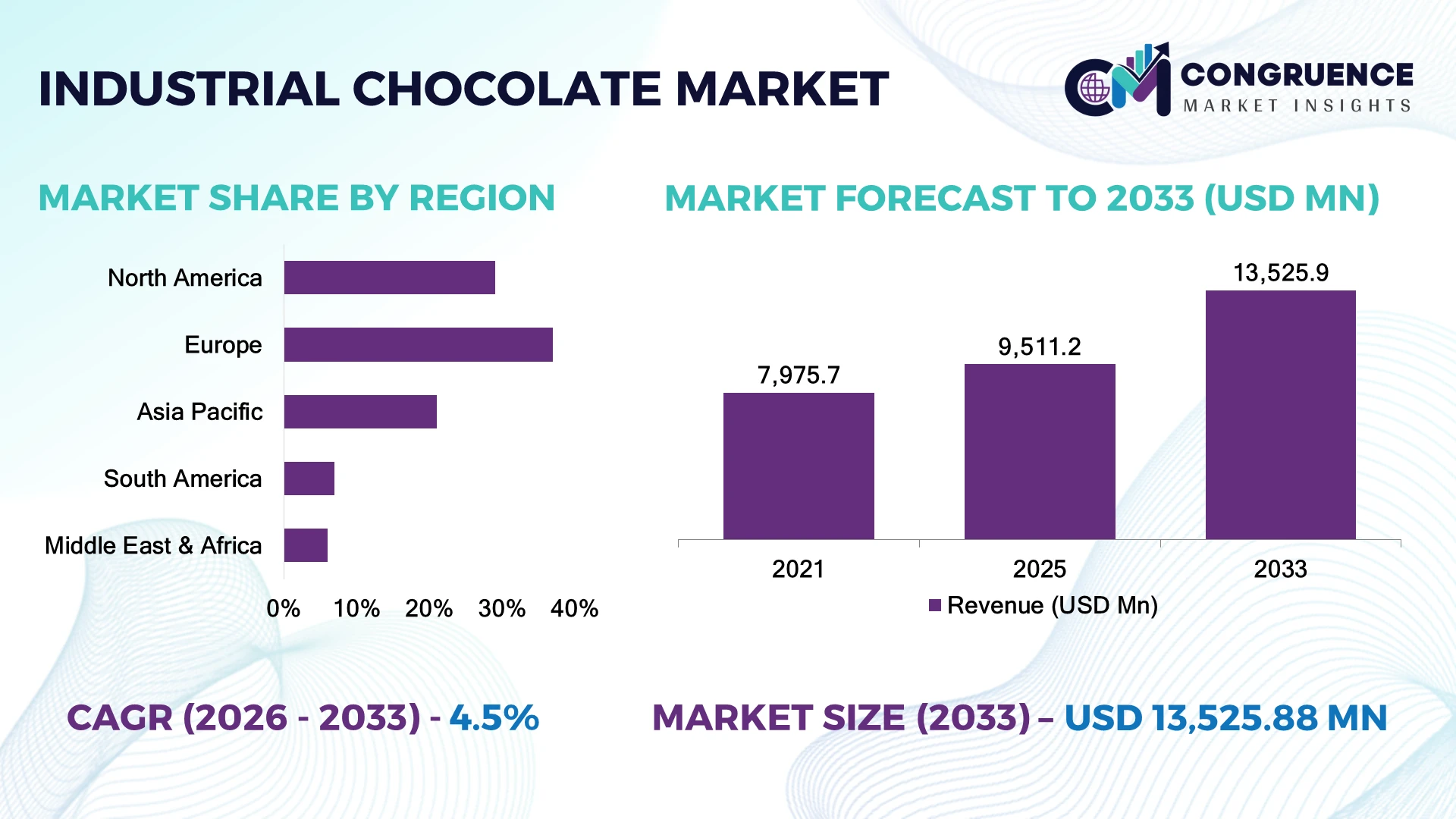
The Global Industrial Chocolate Market was valued at USD 9,511.2 Million in 2025 and is anticipated to reach a value of USD 13,525.9 Million by 2033 expanding at a CAGR of 4.5% between 2026 and 2033. Growth is driven by demand for compound coatings, bakery and confectionery inclusions, ready-to-use chocolate ingredients, and reformulated products that help manufacturers manage cocoa-cost volatility.
Côte d’Ivoire remains central to industrial chocolate supply because it produces roughly 40% of the world’s cocoa beans in typical recent seasons, giving West African crop conditions an outsized influence on ingredient availability and pricing. Ghana provides another important sourcing base, while Europe and North America remain major chocolate-processing and food-manufacturing centers. In 2025–2026, sharp cocoa-price movements pushed manufacturers to reassess recipe costs, inventory exposure, and alternative coatings, making sourcing flexibility a competitive priority.
Industrial chocolate suppliers should secure diversified cocoa sourcing, flexible processing capacity, and technically validated compound and specialty formulations to protect customers against raw-material volatility.
Market Size & Growth: The market is valued at USD 9.51 billion in 2025 and is projected to reach USD 13.53 billion by 2033, supported by demand for processed chocolate ingredients and compound coatings.
Top Growth Drivers: Bakery and confectionery applications, ready-to-use industrial formulations, and reformulation for ingredient-cost control are shaping procurement and product development.
Short-Term Forecast: By 2028, manufacturers will prioritize recipe flexibility, multi-origin sourcing, and shorter production-planning cycles to respond to cocoa-price changes and shifting customer order patterns.
Emerging Technologies: Precision tempering, automated dosing, digital process control, and cultured-cocoa ingredients are expanding the available toolkit for consistency and supply resilience.
Regional Leaders: Europe remains a major processing and industrial-chocolate center, North America emphasizes local production and customer responsiveness, and Asia-Pacific benefits from expanding bakery, dairy, and confectionery manufacturing.
Consumer/End-User Trends: Food manufacturers are balancing premium chocolate experiences with affordability, increasing interest in compound coatings, fillings, inclusions, and portion-conscious product formats.
Pilot/Case Example: In 2026, Cargill and Voyage Foods announced North American commercialization of NextCoa, a cocoa-free alternative reported to have a 67% lower carbon footprint than conventional chocolate.
Competitive Landscape: Barry Callebaut, Cargill, ofi, Puratos, and Fuji Oil compete through processing scale, application expertise, formulation flexibility, and customer-specific ingredient solutions; comparable industrial-chocolate-only market shares are not consistently disclosed.
Regulatory & ESG Impact: Traceability and deforestation-related compliance requirements are increasing the importance of verified cocoa origin, supplier documentation, and responsible sourcing programs.
Investment & Funding: Manufacturers are investing in regional production, logistics capacity, digital planning, and alternative ingredients to reduce exposure to supply interruptions and volatile input costs.
Innovation & Future Outlook: Competition is shifting toward differentiated coatings, specialty powders, cocoa-free alternatives, and application support that helps customers maintain product quality while managing ingredient costs.
The industrial chocolate market supplies chocolate and cocoa-based ingredients to confectionery, bakery, dairy, ice cream, snacks, and food-service manufacturers. Purchasing decisions increasingly reflect cocoa availability, recipe cost, processing consistency, and the ability to reformulate without compromising taste or texture. In 2025–2026, steep cocoa-price movements and emerging cocoa-free technologies strengthened interest in compound coatings and alternative ingredients. Suppliers that combine technical application support with resilient sourcing are better placed to help customers balance product quality, affordability, and continuity of supply.
Industrial chocolate has become strategically important because cocoa-price volatility directly affects manufacturers’ margins, product formulations, inventory decisions, and retail pricing. The sharp increase in cocoa costs during 2024–2025 prompted food companies to reassess purchasing contracts, pack sizes, recipes, and sourcing exposure. By 2026, falling cocoa prices had begun to change procurement conditions again, demonstrating that both rapid increases and declines can create inventory and pricing challenges for processors and their customers.
Traditional chocolate offers established flavor, texture, and consumer familiarity, while compound coatings replace some or all cocoa butter with alternative fats and can simplify certain processing requirements. These products support cost and formulation flexibility, but they do not provide a universal substitute for chocolate where labeling, sensory quality, or product specifications require cocoa-derived ingredients. European processors remain important for industrial formulations and premium applications, while North American manufacturers increasingly value regional supply responsiveness. Asian food manufacturers are expanding ingredient requirements across bakery, dairy, and confectionery applications.
During 2026–2028, manufacturers will prioritize sourcing diversification, recipe optimization, process automation, and selective investment in alternative ingredients. A bakery producer, for example, can qualify multiple coating formulations for different price points while preserving performance in enrobing, molding, and storage. Ingredient suppliers are strengthening technical partnerships and regional production capabilities to help customers adjust formulations faster. Competitive advantage will depend on reliable supply, consistent sensory performance, and the ability to deliver commercially viable recipes as cocoa markets fluctuate.
Food manufacturers require consistent chocolate ingredients that run reliably through high-volume molding, enrobing, depositing, and baking operations. Industrial formulations reduce the need for individual customers to manage every stage of chocolate processing and enable repeatable taste, viscosity, and setting behavior across production batches. Bakery, confectionery, ice cream, and snack manufacturers use coatings, fillings, chips, and inclusions to differentiate products without rebuilding their production systems. The expansion of application-specific ingredients is strengthening demand for tailored fat systems, controlled particle size, and stable processing performance. Suppliers are responding through customer laboratories, formulation support, and regional production. The non-obvious advantage is faster product commercialization: qualified industrial ingredients help food brands launch new formats while limiting process changes on established production lines.
Cocoa supply concentration makes industrial chocolate vulnerable to weather shocks, crop disease, inventory tightening, and abrupt changes in commodity prices. During the 2024–2025 disruption, high bean costs raised working-capital requirements and forced manufacturers to reconsider purchase timing, pricing clauses, and recipe economics. The subsequent price decline in 2026 introduced a different risk: expensive inventories and contracts could become less competitive as replacement costs fell. Smaller processors face particular pressure because they have less bargaining power and fewer options for hedging or multi-origin sourcing. Companies are responding with staggered procurement, contract flexibility, demand forecasting, and qualified alternative formulations. The operational priority is to match inventory cover to customer commitments rather than assume that either rising or falling cocoa prices will persist.
Compound coatings, specialized fillings, low-fat cocoa powders, and cocoa-free alternatives create opportunities for manufacturers serving customers with distinct price, processing, and sustainability requirements. In 2026, Cargill and Voyage Foods announced the North American launch of NextCoa, reporting a 67% lower carbon footprint than conventional chocolate. Cultured-cocoa development is also progressing toward professional food-manufacturing applications. These innovations do not replace traditional chocolate in every recipe, but they widen the formulation options available to brands managing supply exposure or pursuing new product claims. Suppliers are investing in sensory testing, food-safety validation, scale-up, and customer co-development. A strategic opportunity lies in offering several technically validated formulations for the same application, allowing customers to adjust ingredient choices without redesigning their entire manufacturing process.
Industrial chocolate manufacturers must maintain consistent flavor, viscosity, crystallization, gloss, snap, and storage stability across batches and production sites. Changes in cocoa origin, fat composition, particle size, or recipe structure can affect pumping, enrobing, molding, and final-product performance. Alternative ingredients introduce additional validation requirements because a formulation that matches cost targets may still differ in melting behavior, mouthfeel, allergen profile, or labeling treatment. Manufacturers also need to manage traceability and evolving due-diligence expectations across complex cocoa supply chains. Companies are responding with standardized quality specifications, pilot trials, supplier audits, automated process monitoring, and application testing with customers. Long-term competitiveness depends on proving that reformulated products perform reliably at commercial scale, not merely matching flavor in laboratory samples.
Ingredient Costs Drive Recipe Flexibility — The cocoa-price shock of 2024–2025 and the subsequent decline in 2026 have increased pressure on manufacturers to review formulations and inventory positions. Barry Callebaut reported a 61% fall in cocoa bean prices during the first half of its 2025/26 financial year. Customers are reassessing contract timing, compound coatings, and price-tiered recipes, while suppliers strengthen forecasting and technical support to protect product performance during reformulation.
Cocoa-Free Alternatives Reach Commercial Markets — Alternative ingredients are moving beyond laboratory development toward commercial food-manufacturing use. In May 2026, Cargill and Voyage Foods announced the North American introduction of NextCoa, reporting a 67% lower carbon footprint than conventional chocolate. These products offer potential sourcing flexibility but require application-specific validation for flavor, texture, processing, and labeling. Ingredient suppliers are combining proprietary formulation technologies with established distribution networks to make alternatives accessible to industrial customers.
Regional Production Strengthens Supply Resilience — Industrial chocolate suppliers are investing in regional manufacturing and logistics to improve service reliability and reduce dependence on cross-border finished-product movements. Barry Callebaut opened its third Canadian chocolate factory in Brantford in November 2025, strengthening its North American production footprint. Regional capacity helps shorten replenishment routes and support customer-specific formulations, although cocoa-bean sourcing remains internationally exposed. Companies are aligning production planning, warehousing, and customer forecasts to improve responsiveness when demand or trade conditions shift.
Traceability Becomes a Procurement Requirement — Food manufacturers increasingly require documented cocoa origin, supplier due diligence, and more transparent sourcing records. European deforestation-related requirements have intensified attention to geolocation and traceability across cocoa supply chains, making data quality an operational concern as well as a sustainability issue. Suppliers are strengthening farm-level records, chain-of-custody controls, and digital documentation. The business impact extends to supplier qualification: processors that cannot provide reliable traceability data risk longer onboarding cycles and reduced access to customers with stringent sourcing policies.
Milk chocolate is estimated to account for approximately 36% of the global industrial chocolate market in 2025, supported by its broad application across confectionery, bakery fillings, coatings, and dairy-based products. Its balanced sweetness, familiar flavor profile, and compatibility with high-volume manufacturing make it a preferred formulation for mass-market food brands. Dark chocolate represents an estimated 29%, serving premium confectionery, bakery, and products emphasizing higher cocoa content. White chocolate contributes approximately 17%, particularly in decorative coatings, fillings, and specialty desserts. Compound chocolate represents a distinct formulation category that overlaps with these flavor profiles because it uses alternative vegetable fats instead of relying exclusively on cocoa butter. Its appeal lies in processing flexibility and reduced exposure to cocoa-butter costs.
Compound chocolate is positioned for faster adoption as manufacturers seek more flexible ingredient economics following recent cocoa-price volatility. Dark chocolate also benefits from premium product development, while milk chocolate remains the established volume anchor. Manufacturers are investing in fat-system optimization, controlled viscosity, flavor consistency, and application-specific formulations. For industrial buyers, the critical choice is between sensory requirements, processing performance, and cost stability rather than chocolate type alone. Suppliers offering both conventional and compound formulations can retain customers across price tiers and respond faster to recipe changes. The resulting investment priority is flexible production capability and application testing rather than expanding capacity for a single formulation category.
Confectionery is estimated to represent approximately 38% of global industrial chocolate demand in 2025, supported by chocolate bars, pralines, molded products, seasonal confectionery, and enrobed snacks. Its scale favors standardized chocolate masses, controlled tempering characteristics, and reliable supply contracts. Bakery products account for an estimated 27%, driven by chocolate chips, coatings, fillings, biscuits, cakes, and pastries. Dairy products and frozen desserts contribute approximately 16%, using chocolate inclusions, coatings, sauces, and stracciatella-style ingredients. Beverages and other applications represent the remaining demand, including drink powders, dessert preparations, and specialized food formulations. Each application imposes different requirements for viscosity, heat resistance, setting behavior, particle size, and storage stability, shaping product specifications and supplier selection.
Bakery and frozen-dessert applications offer attractive expansion opportunities because manufacturers can introduce new formats, layered textures, and differentiated coatings without changing their core product category. Industrial suppliers are developing application-specific recipes and optimizing processing performance to reduce line interruptions and product waste. Confectionery customers, by contrast, place greater emphasis on flavor consistency, appearance, snap, and dependable large-volume deliveries. Beverage applications prioritize dispersion and controlled cocoa flavor, while dairy manufacturers need formulations that perform under refrigeration or freezing. Cocoa-price fluctuations are encouraging customers to qualify alternative coatings and multiple recipe options. Suppliers that combine pilot-scale testing, technical support, and reliable production schedules can strengthen customer retention and capture demand across diverse food-manufacturing operations.
Confectionery manufacturers are estimated to account for approximately 42% of industrial chocolate purchases in 2025, reflecting their intensive use of chocolate masses, coatings, fillings, and molded ingredients across high-volume production lines. Bakery and biscuit manufacturers represent an estimated 25%, purchasing chips, compound coatings, fillings, and chocolate inclusions for standardized and seasonal products. Dairy and frozen-dessert manufacturers account for approximately 15%, using chocolate in ice cream coatings, inclusions, and dessert formulations. Other food processors, beverage manufacturers, and food-service suppliers comprise the remaining demand. Large confectionery buyers typically prioritize consistent flavor, traceability, bulk supply, and contractual reliability, whereas smaller bakery producers place greater weight on manageable pack sizes, ease of processing, technical guidance, and predictable ingredient costs.
Bakery manufacturers and specialized food processors are positioned for faster adoption of flexible formulations as they introduce premium fillings, contrasting textures, and cost-adjusted product lines. Dairy producers also require ingredients that remain stable under freezing and temperature changes, encouraging suppliers to tailor fat composition and particle characteristics. Following cocoa-price volatility, buyers increasingly benefit from dual-formulation strategies that qualify conventional chocolate alongside suitable compound alternatives. Industrial suppliers are responding with customer-specific recipes, regional technical centers, flexible order sizes, and closer collaboration during product development. Large multinational customers reward dependable capacity and global quality consistency, while smaller accounts offer opportunities for differentiated service and specialty formulations. Competitive success depends on matching technical support and supply arrangements to each customer's production scale and operating requirements.
Europe accounted for the largest market share at an estimated 37% in 2025 however, Asia-Pacific is expected to register the fastest growth, expanding at an estimated CAGR of 5.8% between 2026 and 2033.

Regional Production and Flexible Formulations Strengthen Supply Resilience
North America represents an estimated 29% of the global industrial chocolate market, supported by confectionery manufacturing, bakery production, ice cream, and food-service applications. Manufacturers are prioritizing local production capacity and flexible formulations to manage cocoa-price volatility, changing customer orders, and cross-border supply exposure. Compound coatings and application-specific chocolate ingredients offer alternatives for selected products where processing requirements and cost targets permit reformulation. In November 2025, Barry Callebaut opened its third Canadian chocolate factory in Brantford, Ontario, following an investment of USD 104 million. The facility includes industrial molding and liquid-chocolate production lines, strengthening customer proximity and manufacturing flexibility. Suppliers that combine regional capacity with formulation support are better positioned to serve multinational food manufacturers and smaller customers requiring shorter replenishment cycles.
United States Market Outlook: The United States is the region's principal industrial chocolate market, supported by large confectionery brands, bakery manufacturers, and extensive food-processing infrastructure. Manufacturers require consistent bulk chocolate, coatings, fillings, and inclusions that perform reliably across automated production lines. In April 2025, Barry Callebaut announced plans to expand its US production capabilities toward approximately 100,000 tonnes, responding to changing trade conditions and customer requirements. This focus on domestic production highlights the commercial value of supply continuity, localized manufacturing, and flexible customer contracts. Suppliers with scalable facilities and strong application-development teams are positioned to capture reformulation and capacity-expansion projects.
Processing Modernization and Traceability Reshape Industrial Supply
Europe accounts for an estimated 37% of global industrial chocolate demand, supported by established confectionery, bakery, biscuit, and dairy-processing industries. Belgium, Germany, Switzerland, France, and the Netherlands form important production and ingredient-processing centers. Manufacturers are investing in food safety, production reliability, traceability, and operational efficiency while adapting to cocoa-cost fluctuations and evolving sourcing requirements. In February 2026, Barry Callebaut announced a EUR 250 million modernization program for its Wieze facility in Belgium and a further EUR 125 million investment in Halle. These projects emphasize production-line upgrades, quality, and site safety. The commercial priority is to protect high-volume manufacturing performance while maintaining flexibility across customer formulations and stricter supply-chain documentation expectations.
Belgium Market Outlook: Belgium is a strategically important industrial chocolate hub because of its concentrated chocolate-processing expertise, export infrastructure, and access to European food manufacturers. The Wieze facility, described by Barry Callebaut as its largest chocolate factory, is receiving EUR 250 million in planned modernization investment. Upgrades target food safety, quality, operational capability, and site logistics. Belgian processors benefit from established ingredient suppliers and technical expertise in chocolate production, molding, and specialty formulations. Continued investment in manufacturing reliability and traceability strengthens the country's role in supplying multinational confectionery and bakery customers across Europe.
Food-Manufacturing Expansion and Flexible Ingredients Drive Regional Momentum
Asia-Pacific represents an estimated 21% of the global industrial chocolate market, with demand supported by confectionery, bakery, biscuits, dairy, ice cream, and packaged snacks. China, India, Japan, Australia, and Southeast Asian markets have distinct demand profiles, ranging from large-scale food manufacturing to premium and specialty products. Suppliers are adapting formulations to local flavor preferences, price points, and processing requirements. Barry Callebaut reported that its Asia-Pacific, Middle East and Africa business recorded 10.3% volume growth in the third quarter of fiscal 2025/26, supported by regional momentum. This performance illustrates the importance of local customer relationships and product-market fit. Investment priorities include application laboratories, regional distribution, flexible product portfolios, and dependable ingredient availability.
China Market Outlook: China offers significant industrial chocolate opportunities through its large bakery, biscuit, dairy, snack, and confectionery manufacturing sectors. Domestic food producers increasingly require consistent chocolate coatings, inclusions, fillings, and cocoa-based ingredients suited to local tastes and manufacturing economics. Suppliers must balance premium formulations with price-sensitive mass-market requirements, while maintaining stable texture and processing performance. Regional technical support and customer-specific recipes help manufacturers qualify new ingredients without extensive production-line changes. Companies with strong local distribution and the ability to adapt recipes quickly are better positioned to serve established food brands and emerging bakery and snack producers.
Domestic Cocoa Resources Support Processing and Product Differentiation
South America represents an estimated 7% of the global industrial chocolate market, with Brazil serving as the principal demand center through confectionery, bakery, biscuits, dairy, and packaged-food manufacturing. Regional cocoa production provides a sourcing advantage, although crop conditions, quality variation, logistics, and international commodity prices continue to influence procurement decisions. Manufacturers are developing products across mainstream chocolate, compound coatings, fillings, and premium cocoa formulations to serve different consumer price points. Brazil's large domestic food-processing sector supports demand for industrial ingredients, while Argentina, Chile, Colombia, and other markets offer additional opportunities in confectionery and bakery production. Suppliers are prioritizing regional distribution, customer-specific formulations, and procurement flexibility to limit exposure to imported ingredient costs and currency movements.
Brazil Market Outlook: Brazil is the region's most strategically significant market because it combines a substantial domestic confectionery industry with cocoa cultivation and established food-processing infrastructure. Domestic sourcing can improve supplier access to cocoa inputs, but processors must still manage crop quality, seasonal availability, and price volatility. Manufacturers serving Brazil can differentiate through locally adapted chocolate profiles, compound coatings, bakery inclusions, and flexible pack formats for industrial customers of different sizes. Investment in cocoa processing, quality control, and closer grower relationships can strengthen traceability and reduce procurement uncertainty. Suppliers that combine local knowledge with consistent product specifications are better positioned to support both domestic brands and export-oriented manufacturers.
Food-Manufacturing Investment Connects Cocoa Origins With Regional Demand
The Middle East & Africa region represents an estimated 6% of the global industrial chocolate market, with demand concentrated in Gulf food manufacturing, bakery and confectionery production, hospitality, and growing packaged-food markets. The UAE and Saudi Arabia offer opportunities for industrial coatings, fillings, and chocolate ingredients used in locally manufactured products, while Côte d'Ivoire and Ghana remain strategically important cocoa-producing countries. This creates a market with distinct roles: Gulf states act as manufacturing and distribution centers, while West African countries anchor raw-material supply and increasingly seek greater local value addition. Suppliers are investing in distribution partnerships, temperature-controlled logistics, and customer-specific formulations suited to hot climates. Traceability and reliable storage are central to managing product quality and supply continuity.
United Arab Emirates Market Outlook: The UAE is a strategically important market because of its food-manufacturing ecosystem, logistics infrastructure, hospitality sector, and access to Gulf and wider regional customers. Industrial chocolate ingredients serve local confectionery, bakery, biscuit, and dessert manufacturers, including businesses supplying hotels, restaurants, and retail brands. High ambient temperatures make storage, transport, and formulation stability particularly important, increasing the value of suitable fat systems and validated handling practices. Suppliers can strengthen their position through regional warehousing, technical support, and flexible ingredient portfolios. Partnerships with local food producers and distributors help improve customer responsiveness and expand access to neighboring markets without relying exclusively on direct imports for every order.
The industrial chocolate market is led by Barry Callebaut and Cargill, which compete with ofi, Fuji Oil, and Puratos for multinational confectionery, bakery, and dairy manufacturers. Processors and specialists such as Blommer, IRCA, and Guan Chong compete on local service, formulation flexibility, and cost. One 2026 industry estimate places the top five suppliers’ combined share near 41%, although boundaries differ across reports. Buyers compare price, flavor consistency, viscosity, processing performance, traceability, and delivery reliability; even 2–3% recipe-cost reductions can matter at production volumes. Barry Callebaut is investing €250 million in Wieze and €125 million in Halle, while Cargill is commercializing cocoa-free NextCoa with Voyage Foods. Puratos is developing cultured-cocoa chocolate with California Cultured, challenging conventional supply models. Cocoa-price volatility, traceability requirements, and food-safety validation raise entry barriers. Smaller firms face qualification costs and limited sourcing leverage. Winning requires dependable raw-material access, scalable processing, proven sensory quality, and rapid customized formulation.
Automated tempering, inline viscosity measurement, and digital process control stabilize crystallization, coating thickness, and product consistency. Compared with manual sampling, continuous monitoring can reduce process variation by an estimated 10–20% in suitably instrumented lines, depending on baseline controls and recipe complexity. Adoption is strongest in high-throughput confectionery and bakery plants, where rejected batches and interruptions are costly. Suppliers integrating sensors with production recipes improve repeatability and shorten changeovers.
High-pressure refining, energy-efficient grinding, and advanced conching target particle-size uniformity, texture, and throughput. Modern controls can reduce energy use by approximately 5–10% in optimized operations, although plant layout and cocoa formulation determine actual savings. Compound coatings and tailored fat systems offer alternatives when cocoa-butter costs or processing conditions constrain conventional recipes. Large processors benefit from scale and process engineering; specialists compete through small-batch customization, rapid trials, and application laboratories.
During 2026–2028, digital traceability and AI-assisted planning will influence investment. Batch data improves origin documentation and helps teams adjust procurement. Puratos’ planned cultured-cocoa product with California Cultured illustrates ingredient diversification, but commercial scale and cost competitiveness remain unproven. Manufacturers should prioritize validated savings, sensory equivalence, food safety, and line compatibility before scaling. Suppliers combining process data, formulation expertise, and resilient sourcing gain advantage.
The Industrial Chocolate Market Report examines milk, dark, white, and compound chocolate formulations across confectionery, bakery, dairy and frozen desserts, beverages, and other food applications. End-user coverage includes confectionery producers, bakery and biscuit manufacturers, dairy processors, and other food manufacturers. Regional analysis compares North America, Europe, Asia-Pacific, South America, and the Middle East & Africa, with country-level attention to cocoa sourcing, processing capacity, manufacturing investment, and customer demand.
The report assesses industrial tempering, refining, conching, process automation, digital traceability, tailored fat systems, and emerging cocoa alternatives. Competitive analysis covers global processors and regional specialists, with attention to sourcing concentration, traceability, formulation customization, and production resilience. Quantitative segment estimates and verified company developments help decision-makers evaluate capacity investments, supplier diversification, market entry, product positioning, and operational priorities through 2026–2033.
| Report Attribute/Metric | Report Details |
|---|---|
|
Market Revenue in 2025 |
USD 9,511.2 Million |
|
Market Revenue in 2033 |
USD 13,525.9 Million |
|
CAGR (2026 - 2033) |
4.5% |
|
Base Year |
2025 |
|
Forecast Period |
2026 - 2033 |
|
Historic Period |
2021 - 2025 |
|
Segments Covered |
By Type
By Application
By End-User
|
|
Key Report Deliverable |
Revenue Forecast, Growth Trends, Market Dynamics, Segmental Overview, Regional and Country-wise Analysis, Competition Landscape |
|
Region Covered |
North America, Europe, Asia-Pacific, South America, Middle East, Africa |
|
Key Players Analyzed |
Barry Callebaut AG, Cargill, Incorporated, ofi (Olam Food Ingredients), Fuji Oil Holdings Inc., Puratos Group, IRCA Group, Guan Chong Berhad, Cémoi Group, Guittard Chocolate Company, Alpezzi Chocolate, Kerry Group plc, The Hershey Company, Mars, Incorporated, Ferrero Group |
|
Customization & Pricing |
Available on Request (10% Customization is Free) |




